

Category Archives for Saving Money & Frugal Living

5 Ways To Get The Best Vacation Hotel Deal
 The following post is by MPFJ staff writer Travis, who blogs at Enemy of Debt where he candidly shares his family’s financial struggles, failures and successes. As a father and husband, he provides a unique perspective on balancing debt, finances, and family.
The point of a vacation is to get away from the stresses of everyday life and relax. Unfortunately, planning the vacation is not a stress free activity. Taking time away from work, arranging travel, accommodations, and transportation can all take their toll on a person’s state of mind. One might think that booking a hotel room would be a relatively easy task. Unfortunately, even once you decide on a hotel getting the best value for your money has a difficulty factor ranking right up their with negotiating the price of a car.
This is especially true when the hotel IS the vacation destination. For example, my family and I are planning a vacation to a water park destination a few hours away from home. The hotel we like to stay at includes both an indoor and outdoor water park, as well as an indoor amusement park. We spent hours navigating their website in an attempt to book our room, and learned a few things that could make a significant difference in our vacation budget.
1. Investigate Room Types
Hotels have several types of rooms. The first thing to do is to familiarize yourself with all the types of rooms available, and identify which ones will work for the number of people you have in your group as well as how you plan to use your room. Sometimes we’ve required a kitchen to do our own cooking, and sometimes we don’t. Some rooms have a pull out sofa that we normally assign to our son. It allows him to stay up later and play video games on the biggest television in the room while the rest of us retire to bedrooms with a door and sleep undisturbed. As we read the descriptions of the room types, I wrote down which ones would work for our family.
2. Collect Information on Packages
Hotels and vacation destinations may have packages available that can help you get the most out of your vacation dollars. We found that the hotel we had chosen were offering special family packages, as well as various types of two night package specials. I again wrote down the packages that best fit our vacation plans.
3. Search For Online Specials
Many web sites, not only for hotels but also many retailers, have a tab labeled, “Coupons,” or “Online Specials.” Our vacation destination had a “Specials” tab that stated all guests between May and August received free tickets to a water skiing show. I printed off the page and included it with all our vacation information. We had been to the show previously, and would love to see it again.
4. Explore All Options
We wanted to get an idea as to the cost, including taxes and fees, of different room/package combinations. We filled in our information as if we were actually going to make a reservation, selecting each combination of room and package that we were interested in. Things got a little confusing here, because the website allowed me to pick between “Package Prices” and “Best Rates.” However, the best rates were the standard room only prices, while the package prices were discounted prices. The term “Best Rates” was misleading, as they certainly were not the least expensive option.
The lesson here is to ignore what the words say, and simply get a price for every room and package pair. As before, I wrote down the price of each room/package combination that we were interested in.
5. Call the Hotel Directly
Once I’d compiled a list of room/package combinations that work for us that also fit within our budget, I called the hotel directly. I had to be careful to ensure I was actually talking to the specific location. When dealing with a hotel chain many times I ended up talking to their central reservation office. One can verify they are talking to the actual location, and if not ask for a direct number. Usually the direct number can also be found on a hotel or resort’s web page. Once I was connected with local hotel, I inquired about any specials they have have that aren’t listed on the website. I also asked a series of questions to find out if they give any discounts for corporate rates, AAA or Costco Members.
The more questions you ask, the better chance you have at finding additional discounts, or having the hotel reservation agent tell you about a deal that you may not have found otherwise.
In my experience with this specific vacation destination there were dozens of combinations of rooms, packages, and specials. I don’t think that the hotel is purposely trying to make it difficult or confusing for potential guests to find the best deal. I think that the hotel adds ideas as they come up with them, as well as matching discounts offered by other hotels in the area.
I also don’t think that my experience with this vacation destination is unique. I believe that there are other hotels and resorts that have the exact same problem with their reservation system. The good news is that by following these steps, you can navigate the even the most confusing reservation system and find that gem of a package that helps you stretch your vacation dollars to the max, and finally get that relaxation you deserve!
How about you all? Have you tried and succeeded in lowering your hotel vacation costs by using any of these tricks? What other tips can you give other readers to lower their hotel vacation costs?
Share your experiences by commenting below!
***Photo courtesy https://www.flickr.com/photos/uniquehotelsgroup/5691503052

Want to Retire Well? Be Healthy

 The following is a post by MPFJ staff writer, Derek Sall. Derek is the owner of the blog, LifeAndMyFinances.com, where he teaches people how to get out of debt, save money, and become wealthy.
Do you know what the most common job was in the 1950’s? If you were alive back then, you probably wouldn’t be surprised to hear that most men worked in agriculture or industrial jobs. In other words, men were working hard. They got up early, used their strength the entire day, and then likely worked on their homes or vehicles at night. Their bodies were getting a work out every single day just through their occupation alone.
Guess what the common job title is today? A retail salesperson. Half of these salespeople likely sit behind their desk all day and greet people while perched on a stool. The other half are, at best, walking a total of five miles each day, and using absolutely no strength during their working hours. Put quite simply, we aren’t the physical specimens that we used to be and it’s killing us.

The Rise in Obesity
Over the past few decades, Americans have really noticed their waistlines growing. In fact, even since the quite recent year of 2008, the percentage of Americans that are considered obese has seen an obvious increase. With our more sedentary jobs today, it is becoming increasingly difficult to keep the pounds off, which in turn, is also making it harder to stay out of the doctor’s office.
Medical Issues Due to Overeating and Lack of Exercise
Nearly 10% of all medical spending stems from obesity. Diabetes, coronary disease, strokes, high blood pressure, and even cancer – these are all diseases that could be prevented if we just ate right and exercised more frequently. The remedy is really quite simple, and you’d think that more people would better their habits to save all that money from escaping their bank account. Perhaps you will be one of the smart ones.
The Rising Cost of Health Care
The cost of healthcare is increasing at an alarming rate. On average, an American individual spends just over $8,500 per year on health care. Isn’t that just insane?!
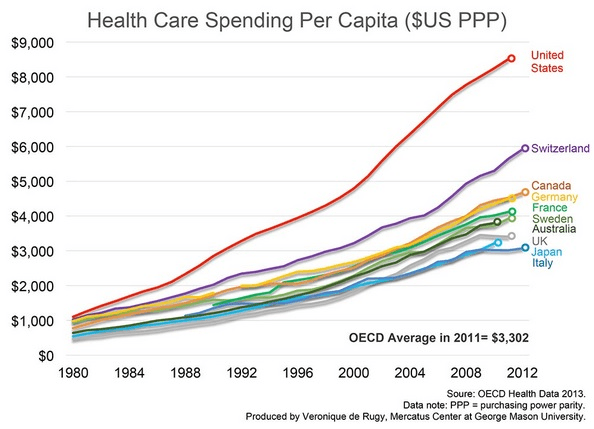
Source: http://mercatus.org/publication/us-health-care-spending-more-twice-average-developed-countries
Many people shrug their shoulders and act like there isn’t anything they can do about it, but that is completely untrue. If you are educated about your options, then there is certainly action that can be taken to reduce your health insurance costs both now and in the future.
1) Save Up a Large Emergency Fund
One of the best ways to save on your medical insurance premiums is to increase the deductible. But, before you raise your deductible to $7,000, you need to make sure that you have that much in the bank account (because accidents DO happen – that’s kind of why we buy insurance in the first place ;)). If you’re able to save up 3-6 months’ worth of expenses as a protection against job loss AND an additional $7,000 to cover your high deductible, then you are ready to raise that deductible and start saving some serious money every month. Sure, it might take a while to save up this much cash, but the savings could be as high as $300 a month, or $3,600 a year. Isn’t your retirement just looking better already?
2) Become Fit and Exercise Regularly
Truthfully, the only reason that you’d want to raise your deductible is if you are healthy. It’s a very important variable in this equation of living a long time with money in your bank account. Quality health takes time and effort (especially since many of us are sitting during work all day).
According to Mayo Clinic, our bodies need 150 minutes of aerobic exercise each week, which equates to a little more than 20 minutes per day. It might seem daunting, but a mere 20 minutes a day (helpful hint: turn off the TV a few times each week) could mean the difference between being healthy without a worry in the world and that triple bypass surgery that’s going to cost you $20,000 out-of-pocket (not to mention the risks this surgery has on your life).
If you want to live a healthy, wealthy life, then you’d better start moving and learning more about the potential health care costs in your future.
How about you all? Are you trying to live a more healthy lifestyle? How have these changes affected your health care costs?
Share your experiences by commenting below!
***Photo courtesy https://www.flickr.com/photos/11553519@N03/6220234414/

Even More Ways to Save Money Each Month

 The following is a post by MPFJ staff writer, Jeff. Jeff writes about reducing waste, saving money and building freedom at his website, Sustainable Life Blog.
When I first started to try to get my finances in order, I did the usual things. I looked for cost savings in my major monthly bills (cell phone, car, rent, etc) and while that saved me a lot of money, it wasn’t going to get me out of debt as quickly as I wanted to be.
After I let the changes I made to my major cost centers sink in for a month, I dug back in to my finances and went looking for more ways to save. What I found was fairly shocking though very helpful in my quest to spend less money and free up more money to pay down debt.
Looking at my results from the end of the month, it was clear that something needed to change – not with my large expenses, but my constant small ones. I was spending a bit of money here and there on small things like snacks, lunches and dinners out, the occasional beer or wine as well as many unplanned trips to the grocery store. In increments typically under $15 and usually under $10, I was burning a ton of cash every month.
I wasn’t even thinking about this spending, it was money that was simply spent because it’s what I’d always done. It was time to readjust my habits and free up more money to pay off debt. Here are a few things that I did.
Establish no-spend days
The first thing I did was to start having what I called no spend days, which are just days where you don’t spend any money. Just about every single purchase I was making most days was something that I didn’t need at all, or if I absolutely needed it I could wait until later to purchase it on a day that I decided to spend money.
I changed my spending day to Sunday only (when I went grocery shopping) and freed up about $50 per week. This added quite a bit of muscle to my debt pay off.
Cook at Home
This gets said a lot, but it’s one thing you can do that will make a huge dent. Stop spending so much money on eating out, and start cooking for yourself instead. One way that I did this was to start batch cooking on Sunday.
My routine went something like this: wake up, pick up a bit around the house, create a menu for the week, then go to the grocery store. Once I got back from the grocery store, it was time to prep my meals for the week. I would cook big batches of things, then individually portion them out into containers so I could just grab one from the fridge every morning and eat it for lunch. I did this with dinners as well. I was eating the same things quite often, but that didn’t matter to me. I was saving a ton.
If you’re interested in getting started, there’s a great part of Reddit dedicated to meal planning, which you can find here.
Add a time buffer
During my (sort of) research on this, I read a book called The Power of Habit and was astounded by how much people do without really thinking about it at all – and I was one of those people. I made a rule where if I found something I thought I wanted (But didnt really need) I’d wait 15 minutes before I made a buy decision and I’d go do something else. For instance if I was shopping on amazon and about ready to check out, I’d get up from the computer and go for a walk.
Usually by the time I was finished walking, I didnt want whatever I had put in my cart anymore.
These are just a few good habits that helped me pay off debt and get me on my way to healthy finances.
How about you all? What are your healthy or unhealthy financial habits? What ways have you used to help save money every month?
Share your experiences by commenting below!
***Photo by Flickr user https://www.flickr.com/photos/68751915@N05/6355251231/

3 Huge Reasons Why Budgeting Became My Friend

 The following is a post by MPFJ staff writer, Derek Sall. Derek is the owner of the blog, LifeAndMyFinances.com, where he teaches people how to get out of debt, save money, and become wealthy.
Budgeting was never taught to me when I was growing up. My parents basically functioned like this: my dad came home with his paycheck, he handed it to my mom, she gave him $20 for the week, and then she was the one stretching that paycheck to pay bills for the entire family. Never once did I see a written budget that they adhered to. They simply lived on as little as possible to get through each month with some money.
While this method seemed to work for them month after month, was it really the most effective way to handle the family finances? At this point in my life, I would say, “certainly not”. Many people try this form of handling their money – you know, the “put your head down, work so you can pay the bills, and survive into the next month – but it often leaves them fighting and with very little invested once they reach retirement age.
Why Budgeting Became My Friend
In my younger years, I married a carefree spender (which drove me nuts), and I used the budget as a way to control her spending. It wasn’t fun, it taught us nothing (other than that I was passionate about saving and she didn’t care one bit about it), and the experience actually left me a little bitter. Is this what it means to be responsible with my money? All these money fights and still not much forward progress financially? Budgets seemed like such a waste.
Today, however, I see budgets in a whole new light.
3 Ways Budgeting Became Fun
Budgeting has allowed me to pay off $21,000 of debt in just six months, and then $54,500 in less than 12 months, all while earning less than $75,000 a year. “How is this possible?” you might ask – “Budgeting,” I’d reply.
1) Budgeting showed me my average income and spending
I keep my budgeting pretty simple and use Mint.com to track both my income and my spending. With this simple tool, I can accurately find how much I typically earn each month, and I can also easily discover the main categories where I’ve been spending my money. This simple tool opened my eyes to how much I had (or didn’t have) at the end of each month. Often times, I only saw a couple hundred bucks after each 30 day segment, which meant I either had an income problem, a spending problem, or both.
2) It helped me reduce my bills drastically
In this Internet age, it is so hard to get a feel for where your money is actually going. Many times, money is automatically withdrawn from your account for various bills and you never really feel the hit. Through budgeting, I was finally able to see exactly where my money was going, and it was so much easier to take action on it.
My phone bill, car insurance, food, gas, my home insurance, my PMI, and my escrow – I was overpaying in all of these areas and could finally see it! By taking action immediately, I was able to reduce my expenses by nearly $200 a month in these areas. This never would have happened without seeing all of those monthly expenses in a budget.
3) Living on practically nothing made me happy
My friends all spend like the typical Americans. They go out to eat, they drive nice cars, and they often one-up each other with their purchases. Envy runs rampant among many of us, and in order to satisfy this intense wanting, we buy stuff – nice stuff, and often go into debt for it.
I started getting caught up in this a little bit just before I wrote my first budget. My friend was looking for a new ride, so naturally I had to find a nice car as well. In a short amount of time, I found my dream car – a black Nissan Altima. Man, that thing was gorgeous, and in the first week or two, I absolutely loved walking up to it and taking it for a cruise.
Then, a strange thing happened – it became a normal car.
The excitement of the purchase was gone and this car became my means of transportation and nothing more. A few months later, I sold it and bought a severely used Honda Civic and a bicycle (to save even more money on gas).
After riding my bike almost everywhere I had to go, I realized that my happiness level was soaring. I was spending practically no money, I was able to get places with my own God-given strength, and I was healthier than I had ever been!
I still feel the same way today. By coming to the realization that stuff doesn’t make me happy long-term, I really have no urge to buy much. As my friends purchase bigger and bigger toys (like expensive RVs for instance), I absolutely love my Honda Civic and my tent. It’s simple, cheap, and empowering, and I wouldn’t have it any other way.
How about you all? What about you? Has budgeting changed your life yet? In what ways has budgeting helped you?
Share your experiences by commenting below.
***Photo courtesy https://www.flickr.com/photos/jakerust/17135106706/

3 Keys to Live a Minimalist Lifestyle

 The following is a post by MPFJ staff writer, Derek Sall. Derek is the owner of the blog, LifeAndMyFinances.com, where he teaches people how to get out of debt, save money, and become wealthy.
We hear the term thrown around all the time, but what is minimalism anyway? According to the gentlemen over at theminimalist.com,
“Minimalism is a tool used to rid yourself of life’s excess in favor of focusing on what’s important so you can find happiness, fulfillment, and freedom.”
There are no defined rules of minimalism. There’s no one that says you can’t own a house or a car and still be a minimalist. Minimalism is different for each person. Some people choose to own less than 100 items, and others own a house in the suburbs and drive a car, and there are (of course) many people mixed everywhere in between.
To be a minimalist, you just need to unbind yourself from the stuff in this world. For those minimalists that own homes, their house does not define who they are and they certainly aren’t struggling from month to month to make the payments. They live far below their means each month so that they can be free from life’s daily struggles. They choose to live on far less than they earn so that they have options to do whatever it is that they please. By getting rid of the excess, they find out what is truly important to them.
The Keys to Live a Minimalist Lifestyle
Minimalism isn’t for everyone. If you like the way your neighbors look at you when you drive past in your new luxury car, then you’re probably not ready to live a minimalist lifestyle. If, however, you question yourself monthly (you know, when all those bills come due) and wonder why you keep torturing yourself with all of those payments, then it’s probably time to start considering a pseudo-minimalist lifestyle.
So if minimalism intrigues you, where should you start? That’s easy – start with the stuff that pains you the most – those big ticket items.
1) Downsize Your House
There are so many people out there that are house poor. They have this huge mansion of a house, which looks awesome, but it comes with such a large monthly payment that it cripples them financially, and they can’t ever have any fun because they are stuck making that stupid payment each month.
This is certainly not the way to live. If you are discontent with the mortgage payment on your home, then why not consider downsizing? Or maybe you could even rent a small apartment above someone’s garage. Think about it. What kind of freedom would you have if you cut your house payment in half? What if you got rid of it entirely? By downsizing your home, you could probably save yourself a thousand dollars a month. Wouldn’t that be such a freeing feeling?
2) Downgrade Your Car
The second largest expense for most people is their car. It often comes with a monthly payment, high insurance costs, maintenance costs, and fuel costs. It’s not uncommon for a person to spend nearly $10,000 per year on their vehicle alone.
What if you went from owning a $20,000 car with payments to a $5,000 that you paid for with cash? Your monthly payments would be gone, your insurance would go down, and your maintenance costs and fuel costs will likely remain the same. By downgrading your ride, you could save yourself around $5,000 per year.
3) Buy Quality Food for Less
People waste so much money on food. Instead of frying up an egg themselves for $0.10, they go to a restaurant and pay $3.00. Or, for the so-called “wise” consumer, they’ll go the grocery store for their eggs instead. But, instead of going to the discount grocery store where eggs are $1.29 a dozen, they’ll go to the nearby grocer where they’re selling for $1.79. Why? Because they feel too sophisticated to shop at a discount grocery store. In my option, that’s just downright stupid.
If you want to save big money on food, avoid restaurants and shop at discount grocery stores like Aldi or Save-A-Lot. The food is good, the prices are cheap, and you’ll save a bunch of time as well (I’m often in and out in less than 10 minutes). Instead of spending $1,000 on food each month, you could just follow this simple advice and cut that bill in half, saving you $6,000 per year. That’s huge!
Final Key Points to Live a Minimalist Lifestyle
To save even more money, do your best to combine all three of these points. If you decide to downsize or move into an apartment, pay careful attention to where it’s located. To save the maximum amount of money, you should find a place that’s within three miles from work and three miles from the nearest discount grocery store. This will allow you to do without your car much of the time, and maybe even allow you to get rid of it entirely! This simple move will save you money in gas, insurance, and also means that your car doesn’t even have to be very expensive since you could bike or walk everywhere anyway!
How about you all? Are you ready to live a minimalist lifestyle? What will you reduce in your life?
Share your experiences by commenting below!
***Photo courtesy https://www.flickr.com/photos/mes_regards/12167414035/
Review: Cinch Financial Free Financial Product/Account Locator and Savings Tool

Recently, I had the opportunity to be exposed to a new (well, new for me anyhow!) free financial website/tool called Cinch Financial. As such, today, I wanted to share a little about some of the features it offers, as well as my opinion on its real-world utility.
What is Cinch Financial?
From what I can tell, Cinch has three primary functions/features with which users can engage on the site:
- First, it allows individuals to upload copies of their personal bills and/or account statements.
- The documents are then reviewed by someone at Cinch, and they issue personal recommendations back to the user on if/how they can save money based on their current state.
- Second, the team at Cinch has taken the time to review the myriad thousands of banking, credit cards, auto insurance, home insurance, and mortgage account providers out there, and whittled the confusion down to providing less than 5-10 top picks (called Cinch Picks) for users.
- This is quite powerful, as in my opinion, there is a high degree of information overload that often prevents individuals making decisions to reach their financial goals.
- Third, users can get personalized recommendations for the financial products mentioned in #2 above by answering 5-10 very simple and quick questions about their specific financial situation.
- With both #2 and #3, the interface allows you to input a current product you are using, and it will provide an estimate of how much you can save or how much more you can earn with another product.
- Although I have not yet tried the 1st feature (uploading a statement/bills), I was able to try out the 2nd and 3rd. Below is screenshot of what this section of the website looks like.
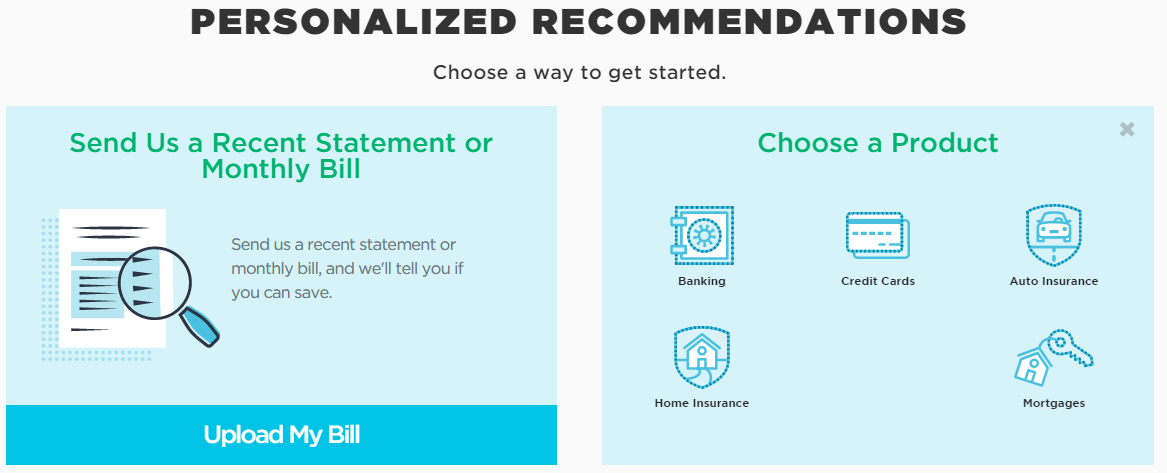
Personalized Recommendations for Financial Products
In my opinion, my favorite feature of the site was the interface that provides personalized recommendations for financial products that can most benefit me.
Banking
After clicking on the button indicating that you want to get a personal recommendation for banking financial accounts, you will then be taken to easy-to-interface with screens (only 1 question per screen!) where you answer the following questions:
- What is your zip code?
- The biggest drawback for the personalized recommendations is that Cinch currently only covers the following states for local financial products and providers: MA, NY, TX, IL, and CA.
- How much do you direct deposit monthly?
- How much do you spend on your debit card monthly?
- Will you use the bank account as a primary checking account or an extra account?
- Do you want access to a local bank branch?
- What ATM features do you want?
- Do you want overdraft protection?
- Rank several account features in order of importance
After answering these questions, you will be taken to your personalized bank account recommendations. Below is an example of what one of the recommendation screens looks like:
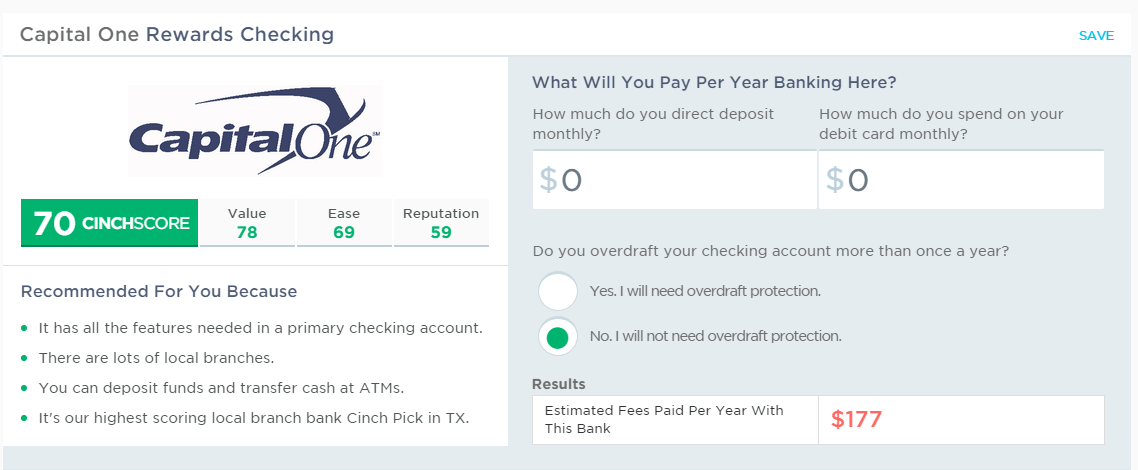
I really liked how it shows on the screen the results recommended for me, and it clearly spells out how much in fees I would pay with no direct deposit.
One thing I would like to have seen were more local recommendations and/or ways individuals can get a checking account for free, without direct deposit or a minimum balance.
Credit Cards
Overall, I thought the credit cards section of Cinch was probably the strongest feature available right now. To get personalized recommendations, you answer the questions below:
- Why are you looking for a new credit card?
- How much do you spend per month on your card?
- What kind of rewards would you prefer receiving?
- Do you spend more than $500 each month in specific listed categories?
- Estimated credit score?
After answering these questions, I was taken to a screen with my top 3 credit card picks. Shown below is a screenshot of one of the cards selected for me.

I really liked how it spells out how much I can increase my cash back rewards compared to my current favorite card (Chase Freedom). It was also refreshing to see that the three cards selected for me were ones that I hadn’t heard of. This was cool because I definitely have a habit of going to CreditCards.com every once and a while to see if there are any good looking new cards.
Auto Insurance
The auto insurance section of the site was about on par with utility as the banking section. You input some really quick information about yourself and your car, and then it lists top picks for auto insurance for you.
As with the credit card feature, it estimates the amount you could save by switching from your current auto insurance provider. An example screenshot of the auto insurance section interface/result is shown below:

Lastly, it is nice that the system saves your information that you input for 1) future use and 2) for other recommendations (ie you input your credit score range for home mortgage recommendations, and the system carries that information over if you were looking for recommendations for auto insurance).
Home Insurance and Mortgages
Overall, I thought that these two sections were the weakest / least robust of Cinch’s offerings. For home insurance, there were pretty limited choices that surfaced while searching. For mortgages, I thought that the recommendations weren’t as useful because the system did not list specific details of the potential mortgage I could qualify for from each specific provider that popped up.
How Much Does Cinch Financial Cost To Use?
Cinch is currently totally, 100% free.
I was also intrigued to find out that they do not currently try to monetize their site in order to maintain objective advice. It will be interesting to see how they decide to start making money (i.e. through affiliate linking like CreditCards.com, banner ads, or by charging for personalized recommendations in the future).
Bottom Line
So, what’s the bottom line here with Cinch Financial?
Overall, I would give it the thumbs up for folks to try out and see if they can either find new useful financial products or save some money vs. their current ones! It is free, after all, so what do you have to lose?

10 Ways to Save More Water

 The following post is by MPFJ staff writer, Melissa Batai. Melissa is a freelance writer who covers topics ranging from personal finance to business to organics to food. She blogs at Mom’s Plans where she shares her family’s journey to healthier living and paying down debt.
Water is a precious resource. Of course, I’ve always known this, but when I lived in the Midwest where water and rain are both abundant, I didn’t think much about it.
Last year, we moved to the middle of the desert in Tucson, Arizona, and my feelings about water have changed dramatically. Water here is literally liquid gold.
While the drought rages on in California, the news in Tucson is constantly about how we’ll be affected since California and much of Arizona share the same water supply—the Colorado River—which is shrinking rapidly.
However, Tucson is very good at finding ways to save water. Here are just some of the ways we’ve learned and are now utilizing to do our part in the water conservation battle:
1. Pick landscaping that is not water dependent
Our home, and almost all of the homes around us, have colorful stones on the yard instead of grass. Some people stop landscaping there (which is quite a boring look, I must say), but many others plant native cacti or trees that require very little water. I have seen only a handful of homes with grass, and by midsummer, after weeks and weeks of no rain and 100+ degree temperatures, the grass turns brown and patchy.
By planting landscaping that is not rain dependent, you’ll save a significant amount of water. According to Realty Times, “Water-efficient landscapes can help you save almost 10,000 gallons of water per year.”
2. Catch rain water
When we get rain here, which isn’t often, we usually get a quick deluge. My husband and I set out all of the empty buckets we have to catch the water and use it later in our garden or on our lawn vegetation. (You may not want to do this if you have very young children due to the risk of drowning.) If you wanted to carry this further, you can install a rain barrel that will hold more of the rainwater for a longer period of time.
We also put a bucket under the drip spout for our air conditioning condensation. During hot summer days, that bucket fills up twice a day and can be used on outdoor vegetation.
3. Conserve what would be wasted water indoors
The average family wastes a lot of water without thinking about it. If you have vegetables to rinse, for instance, you likely leave the water running while you scrub. All that precious water goes down the drain. The same is true when you turn on the water in the shower and let it run while it warms up to the appropriate temperature.
A simple change can save all that water. Some people have a clean 5 gallon bucket in the shower. They have the water spray into it until it is the right temperature. Then the water can be reused. When we wash vegetables, we now do so in a bowl full of water so later we can use the water to water our vegetation.
4. Turn off the water when you brush your teeth
Before I moved to Tucson, I was guilty of letting the water run while I brushed my teeth. What a waste! If you brush your teeth for the recommended two minutes, that’s over 8 gallons going straight down the drain. To put it in perspective, EPA Water Sense Kids states, “Just by turning off the tap while you brush your teeth in the morning and before bedtime, you can save up to 8 gallons of water! That adds up to more than 200 gallons a month, enough for a huge fish tank that holds 6 small sharks!” And that is just for one person. If you have more people in your household, imagine how much you are saving!
5. Turn off the water when you soap up and shampoo in the shower
My uncle, who served on a submarine, called these Navy showers. You rinse yourself completely, then turn off the water while you soap up and shampoo. Turn the water back on to rinse off completely. According to Tree Hugger, “A typical shower takes as much as 60 US gallons of water, while taking a navy shower can use as little as 3 US gallons; one person can save 15,000 US gallons per year!”
6. Take a five minute shower
If turning off the shower while soaping up doesn’t feel like a true shower or isn’t relaxing enough, try the five minute shower. Since most people shower for 10 minutes, the savings can be significant. Consider, “the average 5-minute shower takes 15-25 gallons of water—around 40 gallons are used in 10 minutes” (Glen Canyon Institute).
7. Install a low flow toilet
If you have a regular toilet, you may want to replace it with a low flow toilet. According to Bell Home Solutions, “If you have a slightly newer toilet from after 1980, it could use as much as 3.5 gallons per flush. You will save between 11,000 and 35,000 gallons of water per year just by upgrading your toilet. That’s a savings of between 55% and 77% of your water consumption from one simple upgrade.”
An even more efficient option is a dual flush toilet. These toilets use half the amount of water when flushing liquid waste and the regular amount when flushing solids. We have a dual flush toilet in our home and have found that the option that uses half the amount of water is sufficient in almost all cases. A manufacturer of dual flush toilets, Caroma, “estimates that you can reduce your toilet’s annual water usage by 80%. The average American uses more than 18 gallons of water for toilet flushing. With an 80% reduction, this amount is reduced to about 3.5 gallons, saving about 15 gallons per day, a dramatic decrease in water use and improvement in efficiency” (North Carolina Museum of Natural Sciences).
8. Run your dishwasher only when it’s full
If you wait until you’ve saved every space in your dishwasher, you could save yourself 1000 gallons a month (Squeeze Every Drop). If you’re single, you may have to wait a few days before running your dishwasher.
9. Wash towels every other use
If you have a family, you could run loads of towels several times a week if you wash them after every use. We’re a family of 5, and once the heat climbs above 100 degrees, we all take showers every day. However, I only wash our towels after every other use. That saves us half the amount of towel loads we would normally use.
10. Wash clothes on an as-needed basis
We don’t automatically wash our clothes every single day. My girls are 5 and 6 and don’t yet have body odor issues as adults do. If we have a low key day where we stay home, and their clothes are still clean at the end of the day, I have them wear them again the next day. This doesn’t always happen, but I’m guessing I reduce our laundry by about 1/3 by using this strategy.
Saving water just requires some simple changes. If you do so, not only will you help conserve water, but you will significantly reduce your water bill. How much depends on the rate your town charges, but remember, water rates are usually based on levels, so the more you use, the higher the average rate you have to pay.
How about you all? What strategies do you use to reduce your water consumption? How often do you wash your towels and clothing?
Share your experiences by commenting below!
***Photo courtesy https://www.flickr.com/photos/zaheerm/5392447566/

Buying A Car With Cash

 The following post is by MPFJ staff writer Travis, who blogs at Enemy of Debt where he candidly shares his family’s financial struggles, failures and successes. As a father and husband, he provides a unique perspective on balancing debt, finances, and family.
My son recently started his first part-time job at a grocery store. We told him that he could have this first two paychecks to buy whatever he wanted, after that we would talk about how much of each paycheck he would save towards his own car as him using one of ours is inconvenient at times.
I want him to have the right perspective when it comes to buying a car, so he’ll be required to have cash in hand to purchase his first car. I also wanted to set his expectations correctly as to what kind of car he would be able to purchase, so we sat down together and ran some numbers.
He’s currently working about 20 hours a week, or 40 hours a pay period. Making $9.75 an hour, after taxes his paychecks are about $330. We agreed that he would save half his paycheck. Thus each paycheck will inject $165 into his savings account or $330 per month.
We discussed when he thought he would like to buy his own car, and together we targed September of 2016, which is the beginning of his senior year of high school. Saving $330 a month for 15 months would give him $4950 to go car shopping.
I knew exactly what question he would be asking next; What kind of car could he buy for about $5000? I searched some of the car dealerships in my area, and found some cars available that he could theoretically afford:
- 2003 Silver Ford Focus with 124K Miles
- 2005 White Pontiac G6 with 167K Miles
- 2007 Blue Kia Electra with 87K Miles
- 2008 Silver Chevy Cobalt with 191K Miles
- 2005 Maroon Pontiac Grand Am with 95K Miles
Next, I wanted to show him what kind of car he could buy if he upped his savings just $50 a paycheck, or $100 a month. By doing so, he would raise his car budget to $6450 and significantly upgrade the type of vehicle he could afford. Here are some examples I found that fit within the recalculated budget:
- 2007 Metalic Honda Civic 167K Miles
- 2008 Silver Chevy Impala with 132K Miles
- 2007 Black Ford Fusion with 128K Miles
- 2005 Black Volkswagon Jetta with 134K Miles
- 2009 Yellow Pontiac G3 with 102K Miles
The hardest thing about paying cash for a car is finding a way to save up enough to pay cash for a vehicle. For my son it’s fairly easy because he doesn’t have many expenses, and he can just use one of our vehicles until he can afford his own. But for the rest of us it’s difficult to save a significant amount of money each month in addition to all the other financial commitments of every day life. But by following a few steps, it can be done.
Dump The Car Payment
If you currently have a car payment, consider selling the car if you can get at least as much as you owe on it. By getting rid of the car payment, you instantly have extra income to save.
Buy A Car
If there are proceeds from selling your existing car, buy one using only that cash. A friend of mine did exactly that, driving the completely paid for car as they saved up to buy a new vehicle with the time was right.
Buy a Clunker
Another friend of mine bought a $300 car that he drove around for 4 years before it finally died on him. It gives you transportation, and doesn’t cost a lot. If it requires major repair, junk it and find another.
Utilize Public Transportation
I was surprised to find out that the city bus goes right by my home that I could use to get to work, or virtually anywhere in town.
I want my son to start off right financially with his first vehicle. I wanted him to follow the same methodology that anyone would do that wants to get in the groove of paying cash for their vehicles.
- Eliminate any current car payments
- Find an alternative mode of transportation whether it be buying an older vehicle with cash, or using public transportation
- Determine how much to save each month and stick to it
- Determine how long you want to save before you buy a vehicle
- Be realistic about what kind of vehicle you will be able to afford
Even if some of these steps don’t apply to my son right now, we discussed them as well as the advantages of saving for your next car as opposed driving something technically owned by the bank, and paying interest on it.
How about you all? Do you finance your vehicles or have you taken the steps to pay cash? Have you ever thought about what it would feel like to pay cash for your next ride?
Share your experiences by commenting below!

Which Do You Prefer: Experiences or Things?

 The following post is by MPFJ staff writer, Melissa Batai. Melissa is a freelance writer who covers topics ranging from personal finance to business to organics to food. She blogs at Mom’s Plans where she shares her family’s journey to healthier living and paying down debt.
Growing up, my family didn’t have much money. Many of my clothes came from my three older cousins as hand-me-downs. One time, I hit the mother lode—a pair of Gloria Vanderbilt jeans was in the bag of clothes.
Woo hoo!
I finally had a pair of designer jeans. I wore them almost every day and felt like a million bucks. Once, my best friend asked to wear them, and I let her.
When they came back to me, they were covered with big white splotches. My friend had “accidentally” washed them when there was bleach in the washer. My jeans were ruined, and I was devastated.
Back to my unbranded jeans and my hand-me-down fashion.
In that instant, I learned how quickly the joy from material items can fade.
I’ve always been too cheap to buy designer anything. Why waste the money when the clothes will only last a little while? After my Gloria Vanderbilt jeans debacle, I never worried much about designer clothes.
In fact, I have decidedly not kept up with the Jones’ for much of my life. I drove a Toyota Tercel until it had 150,000 miles on it. Our current Toyota Sienna has 152,500 miles on it, and I have no plan to replace it any time soon.
I now regularly buy my clothes second hand, and in the world of big screen TVs, we make do with our 24 inch screen. Oh, we only have one television in our house.
My kids don’t have or play video games, and they have a very limited number of toys.
My husband and I have cheap flip cell phones with pay as you go minutes. No smart phones here.
We live a simple life, free of much materialism.
Sure, we’re on a tight budget, but mostly, my husband and I agree that we’d like to spend money on experiences rather than things.
I often feel alone in this thought process because many of the families around me have nice things—designer clothes, iPhones, new cars, etc. Yet, one researcher argues that my family and I are on to something:
“There’s a very logical assumption that most people make when spending their money: that because a physical object will lasts longer, it will make us happier for a longer time than a one-off experience like a concert or vacation. According to recent research, it turns out that assumption is completely wrong.
“‘One of the enemies of happiness is adaption,’ says Dr. Thomas Gilovich, a psychology professor at Cornell University who has been studying the question of money and happiness for over two decades. ‘We buy things to make us happy, and we succeed. But only for a while. New things are exciting to us at first, but then we adapt to them’” (FastCoExist.com).
This phenomenon explains why some people are always chasing the latest technology. You know the type. (Maybe you are one of them.) Even though your electronic gizmo, whether it be a phone, computer, video game, etc., is working just fine, you’ll put down your hard earned money to buy the next version. It’s a never ending quest to have the latest and greatest. I once worked with a man who had to get a part-time job on the side just to feed his technology habit.
However, Gilovich suggests, “Rather than buying the latest iPhone or a new BMW, you’ll get more happiness spending money on experiences like going to art exhibits, doing outdoor activities, learning a new skill, or traveling” (FastCoExist.com).
Even better, you won’t have a lot of clutter in your home because you’re not buying stuff.
Travel Experiences
In the year in between my undergraduate and graduate education, I had the opportunity to go to Switzerland to become a nanny for six weeks. I had never been outside the United States before. While being a nanny was pretty much a disaster (that could be an entirely different post!), I LOVED everything about traveling.
I can still remember my flight to Switzerland. I sat next to a man from Croatia who was a ship captain, and we talked almost the entire flight.
I had the chance to walk through downtown Zurich multiple times with the children, and I also took a trip by myself to the border of Italy. The journey was amazing.
Two years later, my cousin and I had the chance to go to China with one of my friends. We got to climb the Great Wall of China and visit Harbin for the annual ice sculpture exhibit. We rode a train for 20+ hours to get there. It was an experience I’ll never forget. To this day, my cousin and I can talk about that trip and instantly feel like we’re right back there again.
Dr. Thomas Gilovich acknowledges, “Shared experiences connect us more to other people than shared consumption. You’re much more likely to feel connected to someone you took a vacation with in Bogota than someone who also happens to have bought a $4,000 TV” (FastCoExist.com).
Two years after my trip to China, my husband and I traveled to Japan to visit his family before we became engaged. I’ll never forget walking out of the train station in Osaka and being fascinated by the busy traffic and all the different hair and fashion styles. I saw beautiful mountains and golden temples. It was definitely a trip to remember.
Family Experiences
Now that I’m older and have a family, worldwide travel isn’t as easy or as practical as it used to be. Instead, we try to travel locally and spend time showing the kids places rather than buying them things.
Since we moved to Tucson last summer, we’ve taken the kids to many different sites such as local missions, Old Tucson, and Tombstone. These trips weren’t always cheap, but they created memories that bond us as a family.
Why Are Experiences So Much Better than Things?
Think about your things. How many do you truly value? I can think of sentimental things that I love like a few of my late grandma’s possessions that I have or the ring I bought in Ireland, but honestly, there are not many material things that I’m attached to.
By contrast, I think fondly on all of my vacations, even a trip to Ireland where we stayed in a dank, damp cottage and found, in our beds that were so old that they sunk in the middle, many spiders. It wasn’t a good time while I was there, but now, all of us who went look back on the trip fondly and with laughter.
The Atlantic supports this idea, arguing, “Looking back on purchase made, experiences make people happier than do possessions. It’s kind of counter to the logic that if you pay for an experience, like a vacation, it will be over and gone; but if you buy a tangible thing, a couch, at least you’ll have it for a long time. Actually most of us have a pretty intense capacity for tolerance, or hedonic adaptation, where we stop appreciating things to which we’re constantly exposed. iPhones, clothes, couches, et cetera, just become background. They deteriorate or become obsolete. It’s the fleetingness of experiential purchases that endears us to them. Either they’re not around long enough to become imperfect, or they are imperfect, but our memories and stories of them get sweet with time. Even a bad experience becomes a good story.”
How about you all? What do you prefer? Possessions or experiences? Did you prefer one previously and now you prefer the other?
Share your experiences by commenting below!
***Photo courtesy https://www.flickr.com/photos/brianauer/2112309566/

How To Save Money on Gas

 The following is a post by MPFJ staff writer, Jeff. Jeff writes about reducing waste, saving money and building freedom at his website, Sustainable Life Blog.
I remember when I got my first car, I ended up with a cheap, used, gas guzzling SUV. It was around 2002, and gas was cheap (under $2) and I didn’t really care how bad my MPG was. Not long later, gas prices began to march up, and I started feeling the pinch. Instead of drive less, I just complained about the price and it didn’t really force any habit changes.
Not long after that I moved to go to school, and didn’t take car with me, I started to ride the bus or my bike everywhere. While I watched gas prices go up from the sidelines, it made me pretty happy that I didn’t have to pay them and I was left out of all the complaining about prices going up. Unfortunately, after I got my first job it was quite a ways away from where I lived, and I was once again bowing to the mercy of the gas prices. I was driving 100+ miles per day, so even small fluctuations could have a deep impact on what I was able to pay down in debt that month.
During that time, I figured out quite a few different ways to save money on gas, so here they are.
Drive Less
This is probably the most obvious, but no one ever takes it seriously. Think about how many trips you make that are less than a mile or 2 – those can easily be walked (if the environments are right) or they can be combined with other errands into one trip instead of multiple trips. If the distance is over 2 miles but less than 5 or so, look into hopping on your bike and running your errands. Most things that you head out to get can probably be put in a backpack for the trip home.
I’ve started doing this, and have really enjoyed it so far. In 2014, I bought approximately 7 tanks of gas, and 3 of those were purchased (and used) specifically so I could travel to the airport.
Driving less may seem odd at first, but it’s easy to get used to and it’s a great money saver. It will insulate you from price shocks when gas goes back up – and it will at some point.
Use the Cruise
When you’re driving at highway speeds, it can be tempting to sit and keep your foot on the gas and constantly adjust your speed. This is bad for gas consumption as it makes the engine work harder and use more fuel. Set the cruise control to a reasonable speed (at or near the speed limit) and enjoy the fuel savings from a consistent engine RPM.
Watch your In Town Driving
When I’m biking to work in the morning, I have about a mile commute, and since I’m traveling from a neighborhood to the CBD in my town, I go to a lot of the same places cars are going. You’d think that over that distance they would get there much quicker than I do, but I can beat them or get there at the same time because I don’t stop nearly as much as they do. Many cars floor it after the light turns green, only to advance a block or two and then come to a complete stop and wait, while I’m slowly pedaling towards them.
I time it perfectly so that when I get to the light the signal changes from red to green and I don’t have to stop on my bike at all. It takes a lot of power to get a vehicle moving again, and if you just drive a bit slower from one signal to the next and make sure you didn’t have to stop between them, you’ll save a bit of gas every time.
These are the three things that I’ve found are the most worth watching if you’re looking to save money on gas. They helped me during the times I was commuting long distances to work (I bike now) and were able to give me the cash to keep my debt repayment on track.
How about you all? What are your favorite gas saving tips? How much have you been able to save by implementing your own gas saving tips?
Share your experiences by commenting below!
***Photo courtesy https://www.flickr.com/photos/dok1/13229214115/