

- You are here:
- Home »
- Blog »
- Saving Money & Frugal Living »
- Want to Retire Well? Be Healthy
Groups I Am a Part Of



Want to Retire Well? Be Healthy
 The following is a post by MPFJ staff writer, Derek Sall. Derek is the owner of the blog, LifeAndMyFinances.com, where he teaches people how to get out of debt, save money, and become wealthy.
Do you know what the most common job was in the 1950’s? If you were alive back then, you probably wouldn’t be surprised to hear that most men worked in agriculture or industrial jobs. In other words, men were working hard. They got up early, used their strength the entire day, and then likely worked on their homes or vehicles at night. Their bodies were getting a work out every single day just through their occupation alone.
Guess what the common job title is today? A retail salesperson. Half of these salespeople likely sit behind their desk all day and greet people while perched on a stool. The other half are, at best, walking a total of five miles each day, and using absolutely no strength during their working hours. Put quite simply, we aren’t the physical specimens that we used to be and it’s killing us.

The Rise in Obesity
Over the past few decades, Americans have really noticed their waistlines growing. In fact, even since the quite recent year of 2008, the percentage of Americans that are considered obese has seen an obvious increase. With our more sedentary jobs today, it is becoming increasingly difficult to keep the pounds off, which in turn, is also making it harder to stay out of the doctor’s office.
Medical Issues Due to Overeating and Lack of Exercise
Nearly 10% of all medical spending stems from obesity. Diabetes, coronary disease, strokes, high blood pressure, and even cancer – these are all diseases that could be prevented if we just ate right and exercised more frequently. The remedy is really quite simple, and you’d think that more people would better their habits to save all that money from escaping their bank account. Perhaps you will be one of the smart ones.
The Rising Cost of Health Care
The cost of healthcare is increasing at an alarming rate. On average, an American individual spends just over $8,500 per year on health care. Isn’t that just insane?!
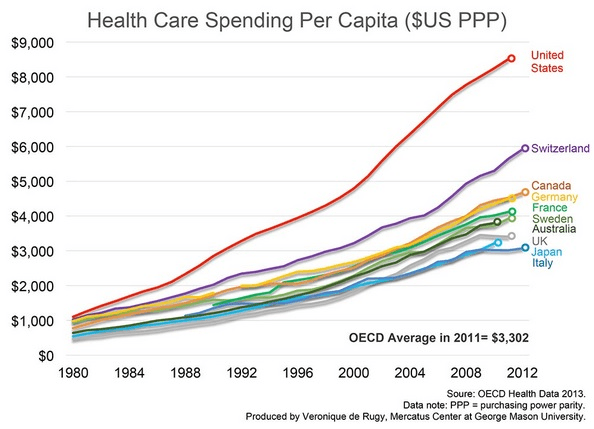
Source: http://mercatus.org/publication/us-health-care-spending-more-twice-average-developed-countries
Many people shrug their shoulders and act like there isn’t anything they can do about it, but that is completely untrue. If you are educated about your options, then there is certainly action that can be taken to reduce your health insurance costs both now and in the future.
1) Save Up a Large Emergency Fund
One of the best ways to save on your medical insurance premiums is to increase the deductible. But, before you raise your deductible to $7,000, you need to make sure that you have that much in the bank account (because accidents DO happen – that’s kind of why we buy insurance in the first place ;)). If you’re able to save up 3-6 months’ worth of expenses as a protection against job loss AND an additional $7,000 to cover your high deductible, then you are ready to raise that deductible and start saving some serious money every month. Sure, it might take a while to save up this much cash, but the savings could be as high as $300 a month, or $3,600 a year. Isn’t your retirement just looking better already?
2) Become Fit and Exercise Regularly
Truthfully, the only reason that you’d want to raise your deductible is if you are healthy. It’s a very important variable in this equation of living a long time with money in your bank account. Quality health takes time and effort (especially since many of us are sitting during work all day).
According to Mayo Clinic, our bodies need 150 minutes of aerobic exercise each week, which equates to a little more than 20 minutes per day. It might seem daunting, but a mere 20 minutes a day (helpful hint: turn off the TV a few times each week) could mean the difference between being healthy without a worry in the world and that triple bypass surgery that’s going to cost you $20,000 out-of-pocket (not to mention the risks this surgery has on your life).
If you want to live a healthy, wealthy life, then you’d better start moving and learning more about the potential health care costs in your future.
How about you all? Are you trying to live a more healthy lifestyle? How have these changes affected your health care costs?
Share your experiences by commenting below!
***Photo courtesy https://www.flickr.com/photos/11553519@N03/6220234414/
About the Author J. Irwin
Related Posts
What the ‘Hes’ Do Is More Valuable Than What the ‘Shes’ Do – Really??
Hospitality: Are You Ready for the Olympic Games?
Lost Your Job? Now What?
The Job Insecurity Principle: Are You Less Likely to Take Sick Leave?
6 Essential Tips for Budgeting and Buying a New Car
Popular posts
Session expired
Please log in again. The login page will open in a new tab. After logging in you can close it and return to this page.
I’ve got one of those lovely desk jobs you’re describing!!!! My waistline has definitely increased over the years and my exercise level is well…stuck to my chair. Lately I’ve been making more of an effort to at least walk 30 minutes a day and keep active. Makes a huge difference just being active vs just doing one 30 minute exercise a day.
Derek, I couldn’t agree more! Unfortunately, I only came to this understanding when retiring after a lifetime of eating badly and not exercising enough…already in poor health and forced to retire a few years early because of it. Now that I’ve seen the consequences, I’ve been changing my eating and exercise habits, but the medical expenses in my household are a whopping 30% of our budget. So my advice is don’t wait, make changes now. And don’t forget to see your doctor before you get sick. Prevention is the best medicine.
Gary @ Super Saving Tips recently posted…Are You Wasting Your Money?