

Category Archives for Saving Money & Frugal Living

4 Common Excuses For Not Enrolling In Your Company’s FSA
 The following is a guest post by James Yeung. James is a full-time software developer and a part-time Flexible Spending Account enthusiast. You can follow his adventures in trying to squeeze the most out of his FSA at FSATips.com. Enjoy!
I will take it for granted that the savvy readers of this blog are motivated money-savers. The folks here are the types who want to take charge of their financial journeys, but are also willing to put in a little effort to reach their goals. So perhaps my message today is just preaching to the choir; Nevertheless, it never ceases to amaze me what excuses people will give for leaving hard-earned money on the table.
Let’s take that health Flexible Spending Account, for example. You know, the one that is offered by your employer, which allows you to put away some of your pre-tax earnings to spend on eligible health-related products and services?
If you are already enrolled in one from your employer, congratulations, you understand the power of effectively getting a huge discount on goods that you may already purchase frequently. And if you are not, I want to use this opportunity to read your mind with 4 excuses that you are most likely harboring.
Excuse # 1 – FSAs are complicated, and I don’t get it
Just try to take a moment to understand it. You first decide any amount (up to $2,550 for 2015-2016) to contribute to your FSA account based on your estimate as to how much you or any family member might need for medical expenses that coming year. Your employer deducts a pro-rated amount (before taxes) from each of your paychecks and straight into your FSA, until it reaches the total amount you designated. Then starting from the benefit year, whenever you pay for a “qualified” medical expense used by anyone in your family, you’ll pay from your FSA account. (You’ll use an account-linked debit card, OR pay out-of-pocket up front and get reimbursed from your FSA later). Notice your FSA was funded by your salary before Uncle Sam takes his portion (taxed), which is the reason all of this is magic and worth your while. Your savings depends on what tax bracket your salary puts you in, but given the typical range of 20% to 40% for federal income tax, it’s sure worth it. There are rules to what qualifies as a medical expense, yes, sometimes it can be a drag to submit reimbursements. But like anything, if you learn the rules, it will become easy to save money.
Excuse # 2 – It’s just not worth the hassle of dealing with the paperwork
Let’s say I give you $2550 to put in either a savings account, the stock market, or an FSA for one year. Depending on your tax bracket, FSAs will guarantee a 20% to 40% return. If you can guarantee that on Wall Street, you’ll probably have a ton of wealthy clients wanting to invest with you. And let’s not even mention how that trounces the pitiful interest rates on savings accounts these days. So suppose your tax bracket is at 30% of your income. If you designate the max $2550 in your FSA and use it all up on qualified expenses, you’ll have a return of $765 this year. Is that worth learning how to use your FSA and navigate the documentation? It sure has been for me. Plus, it’s become easier to deal with reimbursements through FSA debit cards that reduces a lot of paperwork.
Excuse # 3 – Look, I don’t have enough medical expenses to bother
It’s probably like many of us to underestimate what we’ll spend on medical, dental and vision expenses.
But think for a minute: If you might see a doctor, dentist, or get an eye exam this year, know that your co-pay qualifies as an FSA expense. Wear contacts? Your pricey disposable contacts and contact solution (yea even the fancy kind that bubbles/oxidizes) is FSA-worthy. Want that latest pair of Warby Parker eye-glass frames this year? Thanks, FSA. How about that unplanned (aren’t they all) cavity that needs filling? You might have a pretty high deductible to pay to your dental insurance. Well, your FSA will relieve some of that pain by paying for it with its pre-tax goodness. You get the gist. Think of it as getting a 20% to 40% discount (again, depending on your tax bracket) on all this FSA-qualified stuff you already pay for on a regular basis.
Be sure, however, to check your FSA administrator’s guidelines for which eligible items require a doctor’s prescription and which do not. It’s not intuitive at all, for example: Contacts solution do not require a prescription, while over-the-counter drugs such as aspirin, allergy, cold/sinus, antacids, and laxatives DO require a doctor’s prescription to be eligible. The rules can seem arbitrary, so check your FSA guidelines or online resources.
Excuse # 4 – All sounds great, but I’ll end up losing what I haven’t used by the end of the year!
The much-feared “Use-It-or-Lose-It” rule USED to be a legitimate reason that scared folks off from using an FSA. Mainly because funds you didn’t use in the allotted benefit year expired and went straight to your employer’s pockets. But starting in 2014, the IRS decided to allow employers to either allow up to $500 of unused balance to rollover to the following year, OR offer a grace period (typically 2 and a half months). Great, huh? But even if your employer is really mean and doesn’t offer either of these, a little planning should give you confidence that you’ll be able to use up every penny of your contribution.
Convinced yet? My hope is that you will invest a little effort and give that FSA a shot this year. Luckily, there are more and more wonderful communities online, like this My Personal Finance Journey blog, to support you. Just remember, during this open-enrollment season with your employer, give the health Flexible Spending Account a chance to save you some hard-earned money!
How about you all? Do you currently take advantage of an FSA through your employer? If so, what do you like or dislike the most about it?
Share your experiences by commenting below!
***Photo courtesy of https://www.flickr.com/photos/84335369@N00/7543295456/in/photolist-4rBa75-dSK3tm-8BNp8N-cuzmWd

The Introvert’s Guide to Negotiating Car Sales

The following is a guest post by Kat Tretina. Kat is a freelance writer who became obsessed with personal finance after realizing how ridiculous her student loans were. She has her own site at www.ktretina.com. Enjoy!
When you’re an introvert, the thought of negotiating on anything can be terrifying. Facing off against a car salesman ranks up there with undergoing a root canal without anesthesia. But if you don’t negotiate, you will end up paying thousands more. Luckily for introverts, there is a way to negotiate effectively and get a great deal, without leaving your home. You’ll be in and out of the dealer within a half hour driving your new car.
We’ll cover the process so that you will be prepared for your next car purchase.
Do Your Research
This plan only works if you know what you want. If you think you want a sedan but aren’t sure what make or model, this process won’t work. You need to have a specific car in mind. Go onto sites like Kelley Blue Book to see what other people in your area have paid for the model you’re looking for. Kelley Blue Book will show you what a great deal looks compared to a poor one. This will give you a gauge of what to shoot for during negotiations.
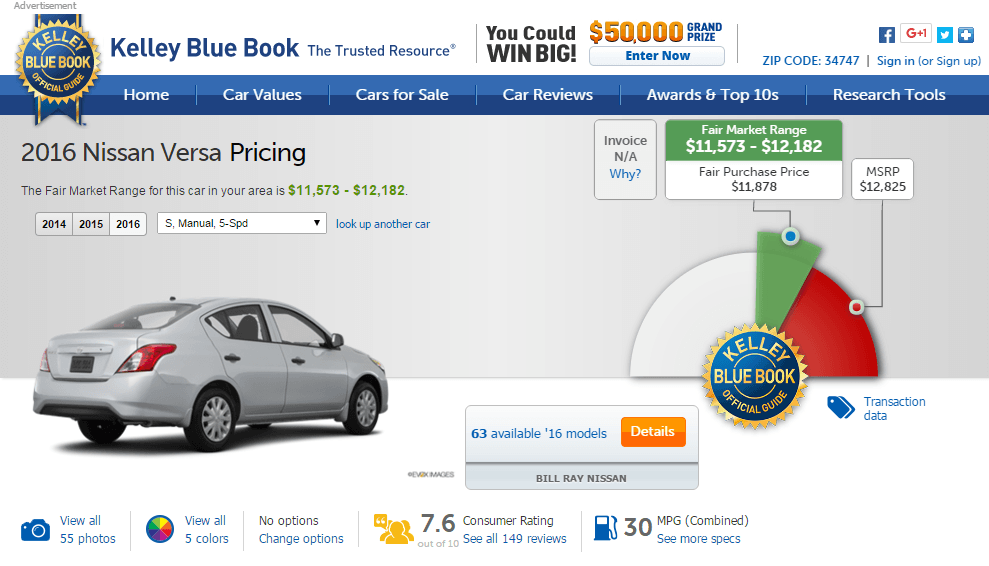
For this example, we’ll use a basic Nissan Versa (see below for screenshot). From this you can see that MSPR is 12,835, but people are not paying close to that. Instead, a fair price is considered to be between $11,573-$12,182, with the average at $11,878. We’ll be looking to beat that.
Plan Your Targets
Next, find dealers in your area that stock the car you want that have a decent reputation. I recommend identifying at least 5-10 dealers. Then pour yourself a cup of coffee and get ready to spend some time on email.
Send each dealer a note with this script:
“Hi there,
I am interested in buying the 2016 Nissan Versa, model S. I will definitely be buying it one way or another on Saturday, but I’m looking for the best deal in the area. Can you tell me what your best out-the-door price is—inclusive of all fees?”
You will get very prompt responses. Some will try to call you; tell them you prefer to keep things over email. Others will try to talk about monthly payments or financing and some will decline to negotiate over email at all, so scratch them off the list. But several will get back to you with a price. Go over each offer to ensure the price is inclusive of all fees.
Once you have a few offers, send a note to each dealer in turn. Tell them what the best offer is and ask them if they can beat it:
“Hi there,
City Nissan said they can give me the Versa for $11,800 with everything included; can you give me a better deal?”
At that point, some dealers will bow out. But others will come back with a lower offer, in which case you repeat the process again with the other dealers until everyone has bottomed out. At that point, you should be at the lowest end—or even lower—than the best price Kelley Blue Book listed.
Time to Pick Up Your Car
From there it’s very easy. Let the dealer know you’re on your way so they can clean up the car, print off the email with the final price you agreed to and stroll into the dealership. Show whoever comes to help you the email and they will connect you with their sales manager.
If they try to change anything you agreed upon—if they claim the car isn’t in stock, they have a similar model with certain upgrades, etc—you are to stand by that email and walk out if necessary. You have an offer in print, so this rarely happens at reputable dealers, but you should be prepared in case of surprises.
Once you know the car you want at the price you agreed on is there and ready, then you can discuss financing options if needed. Again, be careful here that they stick to the out-the-door price you agreed on and ensure they don’t add on extended warranties or service packages. Keep saying no until all of the paperwork is done.
With all of the negotiation and prep work out of the way, you should be in and out of the dealership with your new car in less than an hour. Congratulations! Despite a desire to hide from negotiations, you successfully argued down the price and got a great deal. This is a great way to buy a car without the hassle and stress of a high-pressure salesman.
How about you all? What have you found is the best approach for negotiating when buying a car?
Share your experiences by commenting below!

Money-Saving Tips for the Best College Christmas Gifts

 The following is a guest post by Savanna O’Conner. Enjoy!
Oh, Christmas, our joy and our wallets’ curse! No matter how much you love Christmas, it is almost impossible to ignore the fact that the winter holidays can be quite hurtful to our budgets. From the Christmas tree to the gifts and the dinner, everything can end up costing quite a lot of money. If you haven’t been thorough enough with your budget planning, you may find yourself scraping the bottom of the barrel – even more so if you’re a college student and your budget is limited.
So, how do you survive the Christmas season without turning from Santa Red to Sadness Blue? How do you offer gifts that are meaningful and budget-friendly?
Believe it or not, this is not Mission Impossible: The Winter Edition. It is doable, and achieving gift greatness will keep Christmas spirits higher than the Old Man’s reindeer-drawn sleigh.
Jingle your creativity, because your budget-friendly presents are going to be amazingly awesome!
Start Early
No, really, start early. The sooner you begin searching for gift ideas, the more time you will have to decide what presents your friends and relatives will genuinely love.
Not only that, but you will also have a better chance of saving money on gifts: running for the perfect present on Christmas Eve is not just exhausting, but it can be very pricy too. According to statistics released in 2014 by CreditCards.com, you are much more likely to over-spend when you are in a negative state – angry, for example, that you can’t find anything. It’s equally probable that you will over-spend when you’re in a good mood too, if you are overcome by Christmas spirit.
Add this to the fact that everything in supermarkets and stores is gorgeously arranged to tempt you to buy more during the holiday season, so you will almost definitely spend too much if you procrastinate on your gift buying plans.
Ready, Set, Hunt!
…for special offers, obviously!
The good news about the holiday season is that it starts with Thanksgiving. While this may be yet another holiday that pushes us to over-spend, you can use its aftermath the smart way – by keeping your eyes peeled for offers on Black Friday and Cyber Monday.
If you have a particular gift in mind (which may be a little over your budget), stay put and connect yourself to the aforementioned commercial events. You can get huge discounts on great products – and amaze your friends and family with gifts they will really enjoy.
This is not to say that you should buy everything you see on discount. Stay focused and hunt for those specific products you want to buy for Christmas – try to stay away from special offers you weren’t actually looking for.
Let Them Choose the Gift
Gift cards are an amazing way to save money and time, as well as making sure your Christmas gift will be warmly welcomed.
As long as you know that the recipient would buy from company “X”, giving them a gift card for its products will be more than well-received. Here are some ideas you could consider:
- A Netflix gift card.
- We all have that friend – the one who binge-watches TV shows and movies online. So why not provide him/her with the chance to do it completely free for the upcoming months?
- An airline gift card.
- Offering airline gift cards may sound like an awfully expensive thing to do, but here’s the trick: many airline companies accept credit card reward points/travel points, which you can use to buy gift cards from them. And there are many credit cards with special offers on reward points and travel points (Harvard Card, Venture from Capital One and BankAmericard Travel Rewards Credit Card, to name a few).
- A gift card for their favorite store.
- If your friend or relative likes shopping in a particular store, they would be more than happy to use a gift card there. This way, they can choose to spend the money on whatever products they want.
- An Amazon gift card.
- We all know that Amazon is the wonderland of everything you could ever need. So if you aren’t certain as to what someone would like, offering them this means the world is their oyster in terms of online shopping options.
Do It Yourself
Can you bake, sew, glue or knit?
If so, perfect – Pinterest is there to provide you with an almost infinite number of ideas! From the fanciest cake recipes to the cutest sweaters, the Internet can give you inspiration for just about anything you might be able to do with your own hands.
This type of gift works for people who are closer to you. They will appreciate the effort you’ve put into crafting a present from scratch. Plus, you know what they like and dislike, so you know what types of things they would enjoy more.
The key to making beautiful DIY gifts lies in making sure they are useful, unique and appealing. Avoid boring things people could easily buy from the store (e.g. a pair of handmade white socks). Don’t make presents people will never use (e.g. a crocheted photo frame). Last, but not least, don’t offer DIY gifts that are flawed or haven’t turned out as planned (e.g. a sweater that is smaller than you wanted it).
Be creative – not having the help of Santa’s reindeer and elves is the only limit when it comes to giving gifts that are appreciated and affordable! Have a Merry Christmas and a Happily Wealthy New Year!
How about you all? Do you have a college student on your Christmas gift list? What do you have in mind to get them?
Share your experiences by commenting below!
***Photo courtesy of https://www.flickr.com/photos/mattnazario/13971207088/in/
Most Ridiculous Myths About Structured Settlement Markets

The following post is a guest post. Enjoy!
Just like any other financial and legal instrument, there are numerous rumors and myths that float around about structured settlements. These myths only result in creating complete and utter confusion in the minds of those who are considering selling their structured settlements. If you are one of those people who are absolutely unsure of whether to go ahead with a structured settlement sale or not, here are a few myths about structured settlements markets we have busted for you.
Lawyers and attorneys should avoid recommending structured settlements to their clients as they are bound to cash out
It is a common misconception among lawyers, attorneys and even structured settlement payment recipients that lawyers should avoid recommending structured settlements to their clients as they are most likely to cash it out. On the contrary, it is a proven fact that an estimated 95% of structured settlement recipients avoid selling their structured settlement payments. It is only in a situation where the circumstances of the receiver drastically change from the time of the settlement that he or she may consider cashing out. So lawyers must urge clients to get structured settlements. By becoming a recipient of a structured settlement the client will also acquire guaranteed financial security.
If a recipient cashes out his structured settlement he is liable to pay tax on the lump sum amount
This is yet another misconception that people have in their minds. If your structured settlement payments are tax free, then he is not liable to pay tax on the lump sum amount when you cash out. The recipient is only liable to pay tax on the lump sum cash amount when his structured settlement is also taxable.
The court doesn’t carefully scrutinize the case before giving an approval
Some people believe that the court approves almost all cash outs without scrutinizing the case carefully. This is an absolutely ridiculous myth about structured settlements. Invariably, purchasers of structured settlements only take up deals that are more likely to get court approval. If the structured settlement purchase company has a strong reason to believe that the court will not give an approval to cash out, the company will not take up the case.
Companies that purchase structured settlements and the overall structured settlement industry are unregulated.
This is another major misconception that even lawyers and financial analysts have about structured settlements purchasing industry. Contrary to popular belief, companies that purchase structured settlements are subject to numerous taxation as well as other laws. Both the court as well as the income tax bodies thoroughly scrutinize the case before approval. Even if the structured settlement purchase company has complied with all the laws, if the court has reasons to believe that the transaction is not in the best interest of the annuitant, the court will not approve the application. Further the purchasing company will be liable to pay all the direct and indirect expenses such as filing fees, attorney costs, etc. Additionally if there is ever a situation wherein the purchase company does not comply with the law, they will be liable to pay heavy fines and penalties.
So if you had any doubts and hesitations about the structured settlement industry to countless myths that have floated around, you needn’t stress anymore. The structured settlement industry is a properly regulated industry that always aims at working in the best interest of the annuitant. So before you take any decision on cashing out your structured settlement please ask your attorney to clarify all the misconceptions and doubts you may have.

How to Buy a Car From a Car Rental Company

 The following is a post by MPFJ staff writer, Kevin Mercadante, who is a freelance professional personal finance blogger for hire, and the owner of his own personal finance blog, OutOfYourRut.com. He has backgrounds in both accounting and the mortgage industry.
Most people think that there are two places to buy a used car – a used car dealer or an individual. But there’s actually a third, and that’s a car rental company. They sell thousands of cars each year, offering many of the same advantages that you get in working with a car dealership, except you’ll usually pay thousands of dollars less for the car you want to buy.
We’re going to cover the basics of buying a car from a car rental company. We’re going to use Hertz as an example. Hertz has a dedicated web page for car sales, appropriately titled Hertz Car Sales. From that page, you can browse hundreds of cars in your area that are being offered for sale. Within 100 miles of Boston, Hertz has over 1,400 cars available, but you can pick any large city near you.
Lower Prices than Used Car Dealers
Car rental companies are not car dealers, so they aren’t looking to maximize the profit on the sale of their cars. They also don’t have commissioned sales people who need to be paid out of the proceeds. They mostly want to sell off their large fleets of existing cars to make room for newer models. Car rental companies generally use a car for two or three years, then it’s time to replace it. All of that works to your advantage when it comes to price.
Most of the cars offered for sale on the Hertz Car Sales page are one or two years old, and typically have between 30,000 and 60,000 miles on them.
Some examples of what’s available:
- 2014 Volkswagen Jetta SE with 46,000 miles, $10,375
- 2013 Chevrolet Cruze LT, 56,000 miles, $9,475
- 2015 Chrysler Town and Country Touring Van, 40,000 miles, $21,779
- 2014 Ford Fiesta SE, 41,000 miles, $8,900
- 2014 Honda Accord Sedan LX, 42,000 miles, $14,700
- 2014 Hyundai Elantra SE, 48,000 miles, $10,475
If you click on the link for each vehicle, you’ll be looking at a page that looks very similar to what you will see on a dedicated used car dealership page. They list all of the details of the car, including options, and provide multiple photos of the vehicle. You can also book a three day test rental, ask a question, or apply for financing – all on the same page.
Wider Selection than Used Car Dealers
Used car dealers typically have small numbers of cars of a certain model and make. Selection is limited by what ever type and number of vehicles that come to the lot. Car rental companies however buy fleets of cars. That means that they may have dozens of similar makes and models of the same car, almost the way new car dealers have new cars.
That means you will have more options than you will have with a used car dealer. If you don’t like the color, you can choose another (though admittedly, car rental companies have limited color selection as a general rule). Don’t like the sound system in one car? Move on to the next.
Car rental companies are almost unique in their ability to offer multiple options on used cars within the same make and model. The Hertz Car Sales page conveniently groups similar makes and models in the same place, so you can choose the car you like best.
And if you don’t see the option package in the make and model that you want, you can wait a few days. More inventory is always coming in.
Rent2Buy – A Chance to Test Drive the Car You May Buy
Hertz has a program called Rent2Buy that gives you a three day trial period to test drive the car. You rent the car for three days at the going rate, and if you decide you like the car, you can buy it. The three day rental charge will be waived upon completion of the sale.
This is a big advantage. Test driving a car for 15 or 20 minutes, as is the custom with used car dealers, is not nearly enough time to become familiar with how a car runs and feels. But with three days, you’ll have a much better idea if the car is right for you. You can even use that time to have the car thoroughly checked out by your mechanic to see if there are any hidden flaws. In fact, Hertz recommends that you do just that.
Warranties and Extended Warranties
Just as is the case with used car dealerships, cars sold by car rental companies come with remaining factory warranties. So if a car is two years old and has 40,000 miles on it, and the manufacturer warranty is seven years or 100,000 miles, it will be good for another five years or 60,000 miles, whichever comes first.
With Hertz, all vehicles come with a 12 month/12,000 mile powertrain limited warranty. And you can purchase extended protection plans from the company as well.
Yes, You Can Even Get Financing
Car rental companies don’t extend financing directly, but much like car dealerships, they work to match you with lenders to get the best rate and loan for you. Hertz even has an auto loan calculator tool on the site.
And once again, you can apply for financing directly from the Hertz website. The financing and all the paperwork will be handled online, which will also reduce the tension that often comes from face-to-face negotiations.
Accepting Your Car as a Trade-In
One other point worth mentioning: Hertz will accept your current vehicle as a trade-in toward the purchase of one of their cars. This is one of the primary reasons car buyers go to used car dealers, so that they can trade in their current vehicle hassle-free, or not have to sell it themselves.
The Hertz site doesn’t give details as to the terms of trade-in acceptance. For example, they don’t list any limits as to age, condition or mileage. But if there are any limits, you can always sell the car to CarMax (trust me, they’ll buy a car in any condition, year or mileage!) or a used car dealer in your area that buys cars even if you don’t by one from them.
So there you have the basics on buying a car from a car rental company. We’ve used Hertz as a model, but you can find similar opportunities at other car rental companies. Check them out when it’s time to buy a new car, I think you’ll be pleasantly surprised.
How about you all? Have you or someone you know purchased a car from a car rental company? What other tips do you have for purchasing a car from a car rental company?
Share your experiences by commenting below!
***Photo courtesy https://www.flickr.com/photos/44603071@N00/8135713685/sizes/q/

7 Ways to Maintain the Value of Your Car

 The following is a post by MPFJ staff writer, Kevin Mercadante, who is a freelance professional personal finance blogger for hire, and the owner of his own personal finance blog, OutOfYourRut.com. He has backgrounds in both accounting and the mortgage industry.
Even if you aren’t a car buff, you have a vested financial interest in maintaining the value of your car. At a minimum, you’ll need to either trade it in or sell it to provide at least part of the down payment on the next car that you will buy. You will want to keep the car in top shape, so that it will command its maximum value.
Age, condition, options, and mileage all figure significantly in determining the resale value of your car. You can even check how much impact each will have on your car’s value on websites such as Kelly Blue Book and Edmunds.com. You can run different value scenarios on either site to determine the value of your car, whether for trade-in or for sale to a private party.
With that in mind, here are seven ways to maintain the value of your car.
1. Keep to the Recommended Maintenance Schedule – and Keep Records
Your car owner’s manual should have a maintenance schedule, that will let you know when it’s time to change the oil, change the filters, have the brakes checked, and perform more serious maintenance. You should follow the schedule closely. Not only will it keep your engine running more smoothly, but it will prevent more severe repairs that can result from neglect.
In addition, the better the car runs, the more resale value it will have, particularly if it is more than a few years old. You should also keep a file with all of your maintenance records. A prospective buyer would be interested to know that the car has been well cared for.
2. Fix Whatever Is Broken as Soon as Possible
One of the unfortunate realities of automobile ownership is that problems don’t get better with age. Little problems can become big problems, and big problems can also have a negative effect on other systems in your car.
For that reason, fix whatever is broken as soon as possible. That will prevent the domino effect of car repairs that often causes the owner to sell the vehicle prematurely.
3. A Little Wash and Wax Goes a Long Way – And So Does Periodic Detailing
The appearance of your car will have a major impact on its resale value. All other things being equal, the prettier car will sell faster and for more money.
Much as is the case with buying a home, buying a car is largely an emotional decision. A person might make the choice to buy your car just because it has more curb appeal.
In order to have that curve appeal, it’s important to keep up appearances with your car throughout the time that you own it. Have the car washed and waxed regularly, so that with the paint job will get maximum protection from the elements. And having the car fully detailed at least once or twice per year will help prevent discoloration, wear and tear, and the accumulation of dirt that could make a car look a lot older than it really is.
And here’s another bit of maintenance advice I was given by a mechanic – if you live in a area that gets a lot of snowfall, have the undercarriage of the car washed a couple of times a year. Road salt can corrode the undercarriage in a few short years, causing serious damage.
4. Keep Your Mileage to a Minimum
In some cases, mileage plays a bigger role in the resale value of your car than the age does. For example, a 10-year-old car with 80,000 miles on it may have more market value than a seven-year-old car with 120,000 miles.
This creates a compelling reason to keep your mileage to a minimum. The average driver will drive between 10,000 and 15,000 miles per year. To the degree that your vehicle reflects higher usage, the value will drop according.
Get in the habit of consolidating trips, alternating vehicles, renting a car for long trips, and keeping casual cruising to a minimum. All of these habits can chop a couple thousand miles per year off your odometer. And that will make a big difference when it comes time to sell the car.
5. Drive It Easy
Cars have an uncomfortable habit of reflecting their owner’s driving patterns. Drive a car hard, and it will look the part. Drive it easy, and it will reflect more gentle ownership.
Let’s face it, not only does hard-driving cause parts and systems to wear out more quickly, but it often result in more dents, dings, cracks and scratches too.
Do your best to drive within speed limits, go easy on your brakes, and be careful where you park your car. All can have an impact on how well your car ages. You want to make sure that happens gracefully.
6. Give Your Car Periodic Facelifts
Maybe once a year, take a stroll around your car, and look at it as if you were going to buy it. Are there scratches or dents? Worn carpet or seats? Do the speaker buzz when the radio is on? Are the wheel covers cracked? Are any light bulbs out?
None of these items may bother you as the owner of the car. After all, none affect the driveability of the vehicle. But a buyer will look at each of those, and give them exaggerated importance. As the saying goes you are what you drive, and no one wants to think of themselves as tired and worn out, as reflected by the car they own.
Do this critical inspection once a year, and fix those small items that will likely infuriate a potential buyer. By doing it periodically, you can minimize the cost. But if you wait until just before you’re going to sell the car, it could cost hundreds more.
7. Use Your Garage for it’s Intended Purpose
I don’t have any hard and fast numbers here, nor do I know if a poll has ever been taken on this issue, but I’d be willing to bet that at least 50% of the people who have garages use them for some purpose other than storing their vehicles. Extra storage space is a common usage, as is a play area for children, or even use as a workshop. Some people even convert the garage into extra living space, which real estate agents always advise is a bad move (but that is a topic for another article!).
But if you have a garage, and you still park the car in the driveway or on the street, you are exposing it to the elements. That means scorching sunshine, whipping winds, rain, snow, hail, and even falling branches. At a minimum, that kind of exposure will gradually dull the paint job on the car. Worst-case scenario, it can result in very noticeable damage that will hurt the value of the car.
If you’re fortunate enough to have a garage, by all means, park your car in it. It’s a completely passive way to improve the value of your car.
Maintaining the value of your car is an ongoing activity. Put these strategies into use as early in your car’s life as possible. It will pay off in the end in the form of a higher resale value.
How about you all? Do you have another tip for maintaining the value of your car? What do you do to keep with the upkeep of your car?
Share your experiences by commenting below!
***Photo courtesy https://www.flickr.com/photos/greggjerdingen/14924958287/

7 Ways Keep From Becoming House-Poor

 The following is a post by MPFJ staff writer, Kevin Mercadante, who is a freelance professional personal finance blogger for hire, and the owner of his own personal finance blog, OutOfYourRut.com. He has backgrounds in both accounting and the mortgage industry.
Mortgage lenders operate with a litany of guidelines within which they will make loans to homebuyers. But here’s a newsflash: the fact that you qualify for a mortgage under those guidelines won’t protect you from becoming house-poor. It’s important to understand that mortgage lending guidelines aren’t necessarily designed to make sure that you can comfortably afford to own a certain home. No, they’re mostly aimed at stimulating homeownership on a national level. That may not do much good for your own personal finances.
Why should you worry about becoming house-poor? Apart from the very real possibility that it can land you in foreclosure, it’s not a very comfortable way to live.
Picture these scenarios:
- You’ve been faithfully cooking your meals at home for two weeks and would like to go out to dinner on Friday night – but you can’t, because the house payment is due on Monday and you’re already squeezed
- You need to get braces for one of your kids, but you put it off because the house needs a new roof
- You’re about to forgo summer vacation for the third year in a row, because the house payment and utilities are eating up any extra in your budget
- You’re having trouble paying down your credit cards, because there’s simply no fat left in your budget to cut
- Your emergency fund is empty, and has been for months
These are very real situations that can develop when too much of your budget is tied up in your house. For that reason, here are seven ways to keep from becoming house-poor. Most of them involve making a smart purchase decision upfront.
1. Buy a House That’s a Little Beneath Your Means
Forget about the $600,000 McMansions that all of your friends seem to be buying. If you qualify to buy a $300,000 house, buy a $250,000 house – or even a $200,000 house – instead.
Understand that the amount that you pay for your home will set in motion a long list of expenses, many of which will be directly or indirectly tied to the price of the home. Property taxes are a prominent example, but so is homeowners insurance. And since a higher price generally means a larger home, your utilities will be higher as well.
You can avoid the major factors that lead to being house-poor just by being more conservative in your choice of a home purchase. You will only have one opportunity to make that smart choice – don’t let it pass!
2. NEVER Close Broke!
I realize that it is virtually the American Way to break open every last cookie jar in order to buy a house. Unfortunately, if you’re broke when you leave the closing table, it could set a pattern in motion in which you’re perpetually broke thereafter.
The common mortgage lender guideline is that you have two months “reserves” after closing. In mortgage parlance, this means that you should have liquid assets equal to at least two months of your new house payment. But that’s pretty minimal.
A better idea is to go with the consensus on an emergency fund, that you should have at least three months of living expenses – which includes your new house payment – sitting in a very liquid account. And once you are in the house, keep that emergency fund growing – along with other savings vehicles.
3. Keep Your House Payment to Not More than 28% of Your Income
A common mortgage industry guideline is that your house payment should not exceed 28% of your stable monthly income. However, mortgage lenders will often allow you to exceed this percentage for various forms of “good behavior” in other areas of your financial profile (good credit, large down payment, long employment history, etc.).
The best advice however is to view the 28% guideline as the upper limit of your house payment, and not as a limit that you want to exceed. Even at 28%, more than a quarter of your gross monthly income will be going just for your base house payment – and that’s a lot to allocate for a single expense, even housing.
4. Keep Your House Payment Well Below 28% of Your Income
Forget about what a mortgage lender will allow you to do, set your own house payment limit, and make sure that it’s below 28%. Make it 25%, or 20% or even 15%. Always remember that the less of your income that is going into housing, the more you will have available for investing, for paying off debt, and for living the non-housing part of your life.
5. Qualify on Your Base Income Only
This is another area where homebuyers stretch the limits, and where mortgage lenders are perfectly willing to cooperate. They will often include extra income, such as bonuses, occasional commission payments, or a part-time job or business as part of your qualifying income.
The better strategy however is to qualify on your base income only. That will match up best with a fixed monthly payment, since it is almost certainly the most stable and predictable source of your income. That will also free up the extra income sources to handle contingencies and for non housing expenses.
6. Qualify Based on a Single Income
If you’re a couple, and each of you has an income, qualify on one income rather than on both. There are several advantages to this approach:
- In the event that one job is lost, you’ll be able to comfortably survive on one income
- Should a child arrive in your household, one partner would be able to handle the child-rearing responsibilities, without threatening family finances
- If one of you decides that you just need some time off, you can take it without fear that you might lose your home
I’ll admit that this is an unconventional way to qualify for buying a home, but it involves taking a more considerate view of what can or might happen in the future. And it builds flexibility into your finances – which is always well advised.
7. Keep Your Non-Housing Debt to a Minimum
Buying and owning a home is almost always more expensive than renting. Even if the house payment itself isn’t higher than rent, it’s still almost certain that your utilities will be higher, as will maintenance and repair costs, to say nothing of periodic major repairs.
For that reason, your non housing debt needs to be at an absolute minimum when you buy a home. Rest assured that if you are struggling with debt payments before buying a home, it won’t get any better later. And if you end up having to tap credit lines to pay unexpected housing expenses, the debt problem can get progressively more intense.
Payoff as much debt as you can before buying a home, and vow to become debt free, or as close to it as possible while you are a homeowner.
One final thought – it’s much easier to become house-poor than it is to escape it. So take at least some of these strategies and put them into action early in the game. Your future self will deeply appreciated it!
How about you all? Do you have other tips that have helped you or someone you know avoid becoming house-poor? What has or hasn’t worked for you in the past?
Share your experiences by commenting below!
***Photo courtesy https://www.flickr.com/photos/shankaronline/11932005065/sizes/q/

3 Simple Tips On Saving Money At The Grocery Store Without Going to Extremes

The following is a guest post by Mark Kirkpatrick.
Money is tight for many people nowadays, whether you’re a starving college student, a struggling young family on a tight budget or seniors who are on fixed incomes. Making ends meet can be challenging and some of us are resorting to new methods of making our dollars stretch even further, especially with rising food costs.
Often we think of clipping coupons, but in the shadow of such practices as “extreme couponing,” many of us don’t have the time or room in their homes for this type of reality. There are some other methods that take much less time, don’t require nearly as much space and can still show significant savings at the grocery store. Here’s three tips on keeping our food budgets in check:

1. The Dollar Store Dilemma
When it comes to getting the biggest bang for our buck, many shoppers are hitting the “dollar stores,” where everything is marked at $1 or less. But buyer beware, some of these bargains can be deceptive and they’re some simple guidelines to consider. Take Halloween for example, you’ll likely find many bags of candy for trick-or-treaters at a buck a bag, but they can come with some hidden costs.
For one thing, often these discounted treats aren’t usually very large in either weight or mass and sometimes their selection doesn’t include many brand name favorites or choices. Most drug store chains and national grocery outlets will offer popular brand name candies on sale before this Autumn holiday arrives that are a better bargain in bigger quantities.
2. Meat Markdowns
Going to the butcher for special cuts of meat, often one of the biggest expenditures on some people’s grocery lists, can add up quickly. But this doesn’t mean that we can’t save significantly on beef, pork and poultry at the market.
Most retail grocers have discount bins, even in the meat department, and in this case, these discounts usually come from food that is at or near the “date code” expiration time. Generally you’ll see these marked down anywhere from 20% to 50% or more. Remember that you’ll need to eat or freeze these purchases immediately so they don’t “go bad.” Also, fish and seafood, again unless you’ll be consuming it on that particular day, should never be refrozen, so make your selections carefully.

3. Brand Name Nemesis
One way that grocery costs can deepen the dip in our wallet is through the purchase of brand name products, which are almost always more expensive than the generic or store brand varieties. But just like the dollar store dilemma, it depends on what you’re purchasing.
For example, you may have seen detergents like Cascade ® or Dawn ® advertising that their soap goes further than the bargain brands and in most cases, this is correct. And for families with small children who like Kraft ® Macaroni and Cheese, if you buy the inexpensive varieties, kids might clam up before consuming the cheaper alternatives. Here the consumer should be patient and just wait until their favorite brands goes on sale and stock up.
There’s many ways to save more money at the grocery store, like signing up for their “club membership” programs online or in store. With a little bit of additional thought and effort on our parts, consumers can cut costs on their food expenses with these few tricks up their sleeve.
How about you all? What are some ways that you save money at the grocery store? What tips would you give to others trying to save money on food?
Share your experiences by commenting below!
***Photo 1 courtesy: http://www.shutterstock.com/pic-293925191/stock-photo-dollar-stretching-stretched-image.html?src=csl_recent_image-1
***Photo 2 courtesy: http://www.shutterstock.com/pic-326166404/stock-photo-butcher-weighing-some-meat.html?src=csl_recent_image-1

How To Read A Medical Explanation Of Benefits Statement

 The following post is by MPFJ staff writer Travis. Travis is a customer blogger for Care One Debt Relief Services, and also appears weekly at Enemy of Debt. Travis candidly shares his personal journey to pay off $109,000 of credit card debt and the tips he’s learned along the way. As a father and husband he provides a unique perspective on balancing debt, finances, and family. Note: Terms used are taken directly from the author’s explanation of benefits statement. Equivalent terms used by other insurance companies may be slightly different. Please refer to the glossary generally included with your explanation of benefits statement for further clarification.
A person flips through the mail, stopping at an envelope from their medical insurance provider. The envelope is ripped open, and after a brief glance it appears the mailing describes the charges for a recent doctor visit. However, the words “THIS IS NOT A BILL,” are plastered across the top of the page. Looking closer, there is no amount due or due date. The information is crumpled up and thrown in the trash in favor of waiting for the actual bill from the medical center.
Does this sound like you, or anybody you know?
The discarded document was an Explanation of Benefits Statement, which supplies patients with detailed information about the charges incurred during a visit to the doctor. In fact, it contains much more detail than the actual bill that will be received from the medical center’s billing department. A bill which likely won’t show up for several more weeks.
It’s important to understand how to read an Explanation of Benefits Statement. They provide us the opportunity to review what charges were incurred, how they were categorized, and how much we will be responsible to pay out of pocket. It can be inspected for errors, and the amount owed can be determined such that a patient can begin to plan financially to pay the bill when it finally does arrive.
Let’s take a look at some of the more important parts of an Explanation Of Benefits Statement:
Basic Information
Your name, policy number, and claim number should be easily located on the form. They should be verified to ensure the information is correct. The date of the medical visit should also be listed.
Description
A very brief description of each service provided. Example descriptions include Lab Tests and Medical Care. Many times there will be several itemized services for a single visit. For example, my explanation of benefits statement listed three several Lab Test services, one for each classification of blood tests that were performed. Additionally, there was another service labeled Medical Care that referred to the actual consultation and exam with the doctor.
Patients should look over each service provided and call their insurance company if they have any questions regarding specific medical services listed. For example, I once saw a sport’s medicine doctor for problems I was having with my feet while running. My explanation of benefits listed a charge labeled as surgery. During the office visit, the doctor taped my arches to try to hold them in place. Because he altered my body in some way, the service was classified as Surgery.
Amount Charged
This is the amount the medical provider charges for the service performed before any insurance benefits are applied. Think of this as the sticker price, or what you would pay for the service if you didn’t have any insurance.
Allowable Charges
This is the amount you are actually charged for the service based upon an agreement between your medical provider and your insurance company. It’s usually a discounted rate given to the insurance company because they bring volume business to the medical provider.
Copay
If your specific insurance plan specifies a set amount you will owe for a service, that will be shown here. This is common for Health Maintenance Organizations (HMOs). For example, if your plan specifies that you pay $15 for each office visit, that copay amount would be listed here. You are responsible to pay this amount.
Coinsurance
If your insurance plan specifies that you pay a percentage of each service, that will be shown here. This is common for Preferred Provider Organizations (PPOs). For example, if your plan specifies you pay 30% of each office visit, that amount would be listed here. You will have to pay this amount.
Applied to Deductible
Medical insurance plans have a deductible amount of varying sizes that patients are responsible for as medical bills accumulate during a calendar year. After that deductible has been fulfilled, generally plans then apply a higher level of coverage. For example, let’s say a plan has a deductible of $3200 for charges in that category. Once the patient has incurred $3200 of out of pocket expenses, the plan may then cover 100% of the charges. You are responsible for any amount listed here.
Amounts Not Covered
This column is reserved for services that are just not covered by your policy. You are responsible to pay this amount.
Amount Paid
Once the insurance benefits have been applied, the insurance company will send funds to the medical provider. This column shows the amount of insurance benefit sent to your medical provider.
How much will I owe?
You can determine your actual medical bill by adding up the liability columns for each service:
- Applied to Deductible
- Copay
- Coinsurance
- Amounts Not Covered
I typically write down the total on the bottom of the explanation of benefits document, and tuck the form away. When I receive the medical bill, I compare how much I owe to what I thought I would owe from the explanation of benefits.
The ability to read an explanation of benefits form is a skill that everyone should have. It allows patients to be informed as to how their medical benefits are being applied, and to review that it has been done correctly. If anything seems incorrect, it’s best to call the insurance company and ask questions as soon as possible.
How about you all? Do you carefully review your explanation of benefits forms, or do you just throw them in the trash and pay the bill when it comes? What are your habits in terms of reviewing benefits forms?
Share your experiences by commenting below.
****Photo courtesy of phasinphoto at FreeDigitalPhotos.net (http://www.freedigitalphotos.net/images/health-insurance-claim-form-photo-p249032)

Saving Money on Kids Clothing

 The following is a post by MPFJ staff writer, Jeff. Jeff writes about reducing waste, saving money and building freedom at his website, Sustainable Life Blog.
Just over a year and a half ago, my wife and I welcomed our first addition – a daughter. Since then, we have really enjoyed having her around and have been looking for ways to cut costs. People say that kids are expensive, and I’m not sure that is true, but the can be very expensive.
Since birth, our daughter has grown about 18″ and added on about 18 lbs, which as you can guess has meant she’s grown pretty fast. It’s a bit cold in Wyoming, so she can’t walk around with just a diaper on and we figured we’d need clothing. I didn’t realize how much we’d need and how soon, so quickly my wife & I came up with some strategies to get clothing for cheaper.
Hand Me Downs
This is the most popular one, and worked well for us. My wife’s sister had a child that’s 14 months older than ours, and she just sent us all of her kids clothing over in boxes as her kid got too small for it. We (my wife) sorted it by size, and we stored it away until we needed it and then put it in the drawer and shipped the old stuff back to my sister in law.
Used Clothing Store
Near us, there’s a store called Once Upon A Child (which I’m pretty sure is a franchise) and they have gently used children’s clothing of all sizes as well. While we don’t frequent this store because we get so much from our sister in law, we have not really needed much. Everything we have gotten from them has been top-notch though. Not only do they have clothing, they have all kinds of different baby and little kid stuff – toys, games, cribs, you name it and it’s all there.
Goodwill/Thrift Store
We occasionally check goodwill when the other two options have been exhausted and we still don’t have quite what we need (this has not happened often though). There’s always something there, and typically if your goodwill is large and fairly active, there will be a good price on it. I typically do a bit of my shopping there when we are there looking for things for our daughter as well. There’s nothing like saving a ton of money and killing two birds with one stone.
I think in about 2 years, we have probably spent less than $50 on new baby clothing, and many of those purchases were things that we didn’t even need to buy – they were more of impulse buys that we thought were really cute. I have also not yet found a future parent that has not been totally inundated with other baby clothes from people whose kids are older and have decided not to have any more kids. They don’t need the clothing, and new parents want it, so it’s made for a perfect exchange for years.
There really is no need to pay – simply ask friends and family who have kids first, then branch out to friends or try Craigslist if you don’t think you’ve got enough. Kids go through clothing typically faster than they can wear it out at this age, so you don’t have to worry about something you get being totally beat up.
How about you all? Do you have kids? If so, how have you saved on baby gear?
Share your experiences by commenting below!
***Photo courtesy https://www.flickr.com/photos/f8dy/93843796/