
- You are here:
- Home »
- Blog
Will Your Spending Habits Change When You’re Out of Debt?

The following post is by MPFJ staff writer Travis. Travis is a customer blogger for CareOne Debt Relief Services, and also appears weekly at Enemy of Debt. Travis candidly shares his personal journey to pay off $109,000 of credit card debt and the tips he’s learned along the way. As a father and husband he provides a unique perspective on balancing debt, finances, and family.
My wife and I are planning a surprise mini-vacation for the kids at a tourist place known for amusement parks of all types, but specializing in water rides. Even the hotels in the area have huge indoor water parks that people flock to during the winter months. As part of our planning, Vonnie and I were comparing prices and amenities of different hotels. One in particular was more expensive than the rest, but had a lot more things to do, including some activities for which guests have to pay extra.
We decided to cross that one-off our list, as the hotel was out of our price range, and we felt that the activities weren’t worth what they were charging. As we prepared to continue to discuss the remaining hotels on our list, my wife made a comment that shocked me.
“Why don’t we save that place for when we’re out of debt and paying $45 a person for a zip line tour won’t matter.”
Excuse me?
The reason I don’t want to stay at that hotel is because it’s overpriced. The rooms, the zipline, the go karts, the entire package is not worth what they’re charging. We can do the same activities at one of the amusement parks for less. That kind of spending with complete disregard of value is how we go into debt in the first place. So, no thank you to that hotel whether we have credit card debt or not. However, our conversation got me thinking.
Do my wife and I have the same spending expectations for after we are credit card debt free?
I honestly don’t think things should change all that much. The grocery budget will likely increase a little because I love food and I’m a firm believer that having great food at home prevents us from wasting our money eating out. Maybe we’ll take a family vacation here or there. But mainly I just think of being debt free as being convenient. Convenient that I don’t have to save up for months to host Thanksgiving dinner, or school clothes. The money will be there, sitting in our savings account ready to be used when we need it. The decision-making process as to what to spend out money on will remain the same. Value is value, wasting will still be wasting.
But does my wife have a different view?
I suddenly wonder if she dreams of the day when she can spend money just because it’s there. Will she impulsively buy a new pair of shoes just because they’re adorable only have them sit on the closet shelf because the right opportunity to wear them never arrives? Will she use rolls of twenty-dollar bills to start our fire pit?
Ok, I’m getting a little off track, but I think you get my point. Even after we have completed our debt management program I want us to still be smart with our money, and get the very most we can out of it. We had best have that discussion soon, as we are less than eight months away from eliminating our 109K mountain of credit card debt.
How about you, readers? How will your spending habits change when you get out of debt? Does your significant other share the same view?
Image courtesy of artur84 / FreeDigitalPhotos.net
4 Ways to Save on Pet Expenses
 The following post is by MPFJ staff writer, Melissa Batai. Melissa is a freelance writer who covers topics ranging from personal finance to business to organics to food. She blogs at Mom’s Plans where she shares her family’s journey to healthier living and paying down debt.
My family had pets for as long as I can remember–cats, dogs, even rabbits for a while. When I moved out on my own, I took my two cats with me. After they both died within 2 years of one another, my husband and I couldn’t stand how empty the house felt without a pet. Within 2 months, we adopted another cat, who we still have today.
Pets can certainly enrich your lives, but they can be expensive! Some financial experts recommend that if you have debt, you shouldn’t own a pet. I wouldn’t go that far, but I would suggest that you take steps to minimize the cost of owning a pet while still providing the pet with a good quality of life.
Luckily, there are many ways to save on pets and their care:
1. Consider pet insurance.
Just like humans’ medical care, animals’ medical care has advanced. It’s now possible to treat an animal’s condition that previously was untreatable. The problem is that you may not be able to financially afford the treatment. Pet insurance is one way to be able to afford more services, but consider this carefully.
Many people find that there are so many restrictions and upfront, out-of-pocket costs that pet insurance doesn’t really save them money.
A better idea, if you’re disciplined, may be to set aside money yourself to create your own “pet insurance” fund. If you own a cat, for instance, set aside $25 a month for the animal’s care. At the end of the year, you have $300, but the cat’s annual check-up and shots may only cost $150. Now you have $150 to roll over for next year. Do this for the first 7 years of the cat’s life, when most indoor only cats have very few medical needs, and you have over $1,000 in an emergency fund strictly for the animal’s care. Continue to put this money aside and let it grow, and when the cat is older, you’ll have the money to cover her care.
2. Find alternatives to boarding.
Another large expense can be finding someone to care for the animal when you’re gone. Sure, you could board your animal at a kennel or the vet’s, but that is not cheap. Instead, consider hiring the neighbor child to come in and feed and water your pet as well as taking him out to play, if necessary. If that’s not an option, you could also use a site like dogvacay.com. People who are vetted and insured are available to care for your animal for just $15 a day.
3. Find reasonably priced food.
Unless your dog or cat has a health condition, there’s no need to buy the most expensive food available at your veterinarians. While you probably don’t want to feed your animal the cheapest food available, keep in mind that there are several mid-priced brands that offer good quality food for a reasonable price. Often, shopping at Amazon instead of the grocery store or a pet store can make the price even lower.
4. Love your animal, but realize it’s not your child.
Some people go overboard when they become pet owners. They dress their animals in cute little outfits and buy them expensive, cozy beds. These animals get many presents under the tree at Christmas.
If you want to have a pet on a budget, realize that Fido is your pet, one you love very much, but he doesn’t have to be spoiled like that. Your wallet will thank you.
Owning a pet can be expensive, but there are ways to lower that cost and make pet ownership much more affordable. We still have debt that we’re working on paying down, but we wouldn’t miss being pet owners. Instead, we just monitor our costs carefully.
How about you all? What other ways do you save on pet expenses?
Share your experiences by commenting below!
***Photo courtesy of http://www.flickr.com/photos/randysonofrobert/2639402501/
How To Compromise On Finances In Your Marriage
 The following post is by MPFJ staff writer, Catherine Alford. Cat is a freelance personal finance writer who blogs at www.BudgetBlonde.com.
I write a lot about money and marriage because I think it’s such an important topic. Not only that, it’s something that can be constantly improved and worked on. Much like marriage itself, compromising on finances takes a significant amount of work and communication, and it’s definitely worth all the effort you put into it!
First, when it comes to money and marriage, I think it’s completely natural to want to do everything your way. For example, I always think my money ideas are the best ideas, never mind that my husband may have a few ideas of his own! However, I’ve realized over time that the whole point of a marriage is to work together on challenging issues, and becoming financially independent is one of the biggest obstacles and most rewarding goals in life. So, what’s required to achieve these goals is a lot of compromise, listening to each other’s viewpoints, and talking through important financial topics.
Below are some of the ways that I’ve compromised when it comes to money and marriage, and I’d love to hear some of the ways you’ve worked out money issues as well!
1. Short-Term Vs. Long-Term
When my husband and I got engaged, we had to go to a pre-marital weekend retreat to get married in the church. Instead of grumbling about this minor inconvenience, we decided to actually try to get something out of it, and it was actually really valuable.
One of the exercises that we did was sit back-to-back and answer important questions by raising our hands. For example, the proctor would ask a question like, “Who’s going to cook dinner most of the time in your house?” If you thought it was you, you had to raise your hand then turn around to see if your partner agreed.
We were doing pretty well with this exercise until we got to the questions about money. When the proctor asked, “Who will be handing the finances in your marriage?” both my husband and I shot our hands up. We both thought we should be the one handing it!
It was a funny moment, but it was also an important one. There we were just a few months from getting married after 4 years of dating, and we had never talked about who would handle the money!
The proctors had a great suggestion, one we use to this day. They said to have one person handle short-term finances and one person handle long-term finances. Ever since then, we’ve never wavered. He handles all of our investments, retirement funds, and makes decisions like choosing stocks. I pay all of our bills, handle our savings accounts, make money goals, and keep him updated on our progress. It really is the perfect balance, and it allows both of us to feel like we are contributing to our overall financial goals.
2. Have Your Own Money
Veteran couples swear by this tip. Let each person have a set amount of spending money every month. I didn’t do this at first. I thought that it wasn’t a big deal, until my husband finally told me that it really bothered him every time he had to ask for money. After all, he’s almost 30 years old and in medical school. I think he can probably handle a bit of cash! I didn’t even think about how our system affected to him until he told me that so ever since then, I split my money into envelopes when I get my paycheck, and I always give him money just for him to use, no questions asked.
This makes him feel like more of an adult, and it also helps alleviate the impression that I’m always looking over his shoulder when he buys things. Now, he can go on campus and buy himself a coke without feeling odd about it.
3. Forgive Each Other
When it comes to money and marriage, we’re all going to make mistakes. It’s unavoidable. I’ve paid my husband’s credit card late completely on accident and felt terribly about it. In the future, he might choose a stock that plummets the next day. It happens. It’s life.
Of course, some mistakes are worse than others. If your spouse drained your retirement fund to go to the casino, that’s a different story, but for day-to-day blips, it’s important not to blame each other and remember which team you’re on.
I’m sure there are many more tips out there for compromising when it comes to marriage and money. Essentially, it’s all about maintaining communication and respecting each other when you make decisions. In the future, I know my husband and I will have even more to learn about finances and marriage as we continue on our journey, but it makes me happy to know that I share my goals with someone who is just as willing to work hard to make them happen.
How about you all? How do you compromise when it comes to money in your relationships?
Share your experiences by commenting below!
***Photo courtesy of http://farm7.staticflickr.com/6235/6355220839_792984400f_o.jpg
Debt Free Direct Tour de Personal Finance 2013 – Final Championship Sprint on the “Parisian Champs-Élysées” of Personal Finance
 The 2013 Debt Free Direct Tour de Personal Finance has been an absolute 100% success (far beyond anything I could have imagined!). A big thanks goes out to everyone that has participated in the Stages and to the hundreds of voters who have stopped by to support their favorite authors/articles.
Later this upcoming week, I’ll write up a Tour de Personal Finance recap, post-race show, and awards ceremony to talk about what happened this year and how I envision the event growing in the coming years. But, that’s enough of that commentary for now!
Without further ado, let’s continue on with the Final Championship Sprint of the 2013 Tour de Personal Finance (to follow all of the action, click on the Tour de Personal Finance category link and scroll down to read all the posts involved in this subject).
We greatly appreciate Debt Free Direct for being the title partner of the 2013 event and for all their great support. If you’re interested in learning more about the help and advice Debt Free Direct offers to people in debt or their money-saving tips on how to prevent building up debt, click here.
A Quick Reminder On Prizes For The 2013 Competition
The 2013 edition of the Tour de PF is doubly exciting because we have some very nice cash prizes to give away to the winner and also to charity to continue helping the community.
These will be as follows:
- Yellow Jersey (1st Place) Winner of the 2013 Tour de Personal Finance will receive $100 cash via PayPal.
- In addition, the Yellow Jersey Winner will also get to decide what charity they want me to donate $700 to in honor of their efforts/victory.
To view the most up-to-date brackets of the competition, click the following link – 2013 Debt Free Direct Tour de PF Bracket
Going along with Tour de France cycling tradition, I’ve listed each competition within each stage as an “intermediate sprint” (one post versus another) along with the description provided by the blog author when the post was submitted.
Also, if applicable, I will give a brief description of the stage of the Tour de France that took place the same day as (or that has happened since the previous Stage of) the competition.
How to Vote
You can vote for the article you’d like to see win the Tour by commenting in the comments section below and telling which are your favorites. I’ve listed a keyword after each post title to make it easy to vote (as a made-up example, you can just comment: Sprint 1: Mutual; Sprint 2: 401k, etc.)
Be sure to comment which one you like the best out of each set of two! Criteria for the best article is completely up to you, but you can use these factors as a guide: 1) post of your favorite blogger, 2) most interesting post, 3) most thought-provoking post, 4) most unique post, or 5) most actionable post. Here are today’s competitions:
Voting will continue until July 24th for this Stage!
Championship Sprint
- My Husband is Now WORKING FROM HOME WITH ME!!! (Husband): It’s important to work out a plan before leaping into self-employment. It’s even more important when that entrepreneurial spirit hits both of the income earners of the household. But after running the numbers, looking at worst case scenarios, and mulling the idea over…it was time for us to put on our big girl panties and jump in.
 Here’s the post about the excitement and fear when we officially put all of our financial eggs in one basket and happily skipped away into the unknown…
 Here’s the post about the excitement and fear when we officially put all of our financial eggs in one basket and happily skipped away into the unknown…


VERSUS
- Is it Time to Get Out of the Stock Market? (Time): Whenever we see highs or lows in the stock market we see an increasing number of talking heads telling us what we should do with our portfolios. The problem with listening to them is they have no idea of your personal situation. That said, these are great times to analyze your portfolio while remembering the importance of maintaining a long-term view of your investing.
Tour de France Daily Recap
Today is also the last Stage for the riders in the 2013 Tour de France, with the riders traveling from the Versailles Palace to the Champs-Elysees in Paris.
Barring a major accident out on the open road, the Brit, Chris Froome, will end the day as the overall winner of the 2013 race. He really has raced aggressively this year to stamp his dominance all over the race. It’s been quite impressive. He has also won 3 stages!
Peter Sagan has pretty much clinched the green jersey competition, and the first-timer Colombian rider, Nairo Quintana has won the White Jersey Young Rider’s competition as well as the King of the Mountains Jersey as well! So, those jerseys are pretty much wrapped up, and there shouldn’t be too many surprises on today’s Stage.
***Photo courtesy of http://www.flickr.com/photos/peter-trimming/7692579848/
Reader Profile – Christine from The Pursuit of Green


Today, in the ongoing Reader Profile Series, we’re getting to know MPFJ.com reader and commenter, Christine, from the site, The Pursuit of Green. Let’s all give Christine a big round of applause for sharing her life with us and listen to her story. Enjoy!
Also, if you’re interested in sharing your own financial story/journey with us in a reader profile of your own, just shoot me a quick email, and we can get the ball rolling!
1. Please Tell Everyone a Little Bit About Yourself (Background, Education, Family Situation, etc).
Hi, I’m Christine! I’m an Ohioan who was born and raised there, then transplanted to Los Angeles after college. My parents are considered middle class now, but that wasn’t always the case. Growing up, I learned how to be frugal and make the best of what you have. It’s helped me a lot after I moved out to Los Angeles where the cost of living and rent is so much higher than in Ohio.
I went to school for digital design, which encompasses basically anything you do on a computer. I’ve been building up my career and last year decided to become self-employed.
Along the way, I started learning about personal finance to figure out the best way to manage the income I was earning. I also focused my time on doing more to be earth-friendly, minimizing my impact on the earth with every step I take. These two things have melded in the last few years as I found that a lot of times they go hand in hand. Many times I’ll do something to be earth-friendly and find that it saves money, and vice versa.
Earlier this year, I had a big party otherwise known as a wedding. It was a challenge for sure to keep from spending too much!
2. Describe Your Current Financial Situation (Who Works in Your Family, How Your Income Is, Your Expenses, etc).
My income has been fluctuating ever since I became self-employed. In my industry, the holidays are extremely slow times. I’ve had a few months where I haven’t found any work and months where I’m extremely busy. It’s definitely an eye opener to be your own boss. My hours are flexible, but there’s always that unknown of whether or not I’ll have work. I’ve also learned a lot in the last year about taxes. Paying your own taxes really does make you aware of how hard you work and how much goes toward the government.
Luckily, my husband has a steady full-time job. It helps to offset the unsteady aspect of self-employment and gives us assurance. We’ve worked out our finances so that we are able to live well under his income only. Any income I bring in every month is extra!
We’ve cut out a lot of expenses to reach our goals. That includes a lot of eating out. We both love food and that is one of the hardest expenses we’ve had to cut. Restaurants simply add up too much. We’ve also taken other measures such as canceling our cable, cutting his hair at home, and buying less clothing and unnecessary items. We’ve kept some of the cheaper items as indulgences; for example, my chocolate and the occasional dinner out at a reasonably priced place.
3. What Are the Current Financial Challenges You Are Facing (Saving, Paying Off Debt, Student Loans, Merging Finances After Being Married, etc)?
We’re still figuring out the finer points of merging finances. We have the same goals overall, but the way we get there is a bit different for both of us. My husband is in favor of throwing everything towards one goal. I like a more balanced approach where we have one main goal but also work towards longer term goals. We’re both learning to talk more about our financial goals together and compromise on how to get there.
Currently, we’re really trying to focus on saving up for a down payment on a house. We live in Los Angeles and the house prices here are insane. Just saving up for a down payment itself is pretty daunting, and we’ve been plugging away at it for two years now. Of course, buying a house will be another challenge to come!
Another goal we are working towards is making ourselves as ready as possible to start a family. Buying our own home is one thing that helps us there. The other is living off one income.
4. What Are Your Plans for the Future (Retire Early, Build Your Career, etc)?
It would be wonderful to be able to retire early! It’s something that I dream about but am not sure if it will happen. I’m steadily saving for retirement, but it’s hard to say anything. Most likely I will “retire,” but keep working in some form or another because I enjoy it.
Currently I am trying to build up my career so that I have a good portfolio where I can be self-employed with steady work. The traditional work place is definitely changing, so I am trying to be more flexible in the way I think about work. I mostly work on a computer and information is exchanged online, so it’s entirely possible to be self-employed doing this kind of job.
Eventually if everything goes well, then we’ll have fully funded retirement accounts, savings, a paid-off house, paid-off cars, and investments that create spending money.
5. What’s Your Best Piece(s) of Financial Advice and/or Your General Philosophy on Personal Finances?
While there are many financial goals that you should be working towards, remember to sit back and enjoy the present. I want to be happy when I retire, but I also want to be able to live life when I am young enough to not have creaky bones. The things you do today don’t have to be expensive or lavish, but it can still be fun and enjoyable. Live life in the present, but plan for the future. It’s all a matter of keeping everything in balance.

We Became a One-Car Household: Could You?

The following post is by MPFJ staff writer, Kelly Gurnett. Kelly runs the blog Cordelia Calls It Quits, where she documents her attempts to rid her life of the things that don’t matter and focus more on the things that do. You can also follow her on Twitter and Facebook.
Back in April, I said goodbye to my beloved first car, and my husband and I became something I never thought we would be: a one-car household.
As I’ve written about before, we lost half our income in April when my husband had to stop working due to his Fibromyalgia. (We’re currently applying for disability benefits.) This happened just as I was planning to make the leap from having a day job and working a side hustle to freelancing full-time—thus decreasing our income even further. I’d already made plans to sell my car when I was considering the leap, but once my husband lost his job, it went from a smart money-saving idea to a necessity.
We’ve now been a one-car household for a little over a month, and it’s had its pros and cons. Since I’m fortunate enough to work from home, and my husband doesn’t work at all anymore, our situation is certainly easier than couples who both have jobs outside the home (not to mention children, of which we have none except furry ones). That said, we have friends with more “standard” lives who are also one-car households, including a married couple who both hold down jobs with shifting schedules—and just had a baby.
So, it can be done. As with any other big financial/lifestyle change, it all comes down to what you’re willing to give up, and put up with, in order to gain certain tradeoffs.
For anyone considering becoming a one-car household, here are some of the big things to ask yourself:
What are your work schedules like?
Our friends who have jobs without set schedules never know what their hours will look like each week, so every week is a different balancing act of “Who’s going to need the car when?” If you have some flexibility over the days you work, or you both work different shifts, it’s much easier than if you both work standard 9-5s that can’t be negotiated.
At the same time, plenty of one-car households get around this by having one-half of the couple carpool or take public transit. The cost of a bus pass could be considerably less than the cost of paying for and maintaining a second vehicle.
Are you o.k. with not having instant mobility?
Gone will be the days of running out for a latte spur-of-the-moment (although that could be good for your budget, too). If your partner has the car, you’re homebound (or stuck wherever else you are) until it’s your turn or they can come pick you up. Some people will have serious problems with the lack of freedom and independence this poses.
Also, if you have an illness, children, or any other situation that makes you feel uncomfortable not being able to drive somewhere in an emergency, that’s something else to consider. Should something happen, do you have people you can call on to give you a ride? If your partner gets stuck late at work, how will you get the kids to soccer practice? These are all day-to-day logistics you should work out before you find yourself in theses situations.
Are you good at compromising with each other?
There will be times when you both need the car, and it can come down to either a game of rock-paper-scissors (followed by resentment by the loser) or a level-headed, adult conversation about whose needs take priority and how accommodations can be made.
If you think sharing a home with someone teaches you how to compromise and be patient, try sharing a car when you’ve each accidentally made plans for the same night. Just like everything else in your relationship, negotiating car turns can take sacrifice at times. If your relationship doesn’t already have a healthy level of give-and-take, you’d better be prepared to develop some pretty quickly.
So…Why exactly would we do this?
After considering questions like the above, you could understandably wonder this. Much like selling your house to downgrade to a smaller one or taking on a second job to pay off debt, going down to one car is a sacrifice, and the decision ultimately comes down to whether you will get more out of doing it than you will lose.
So, what will you get? In addition to saving on car payments, you’ve got all the incidental costs that come along with owning a car, like insurance, repairs, gas, registration fees, tolls, and parking. And if you own your car outright, selling it can get you a little extra cash. (We used the proceeds from my car to pay off my husband’s car and finish my debt repayment plan.)
For me personally, I also enjoy not having to deal with the stress of driving. Working from home, I can avoid the crazy rush hour commute altogether—but even if I still had my office job and my husband was working, I think I’d choose to let him have the car so I could ride the bus to work. No frustration over inconsiderate drivers, no worries about navigating through Buffalo snow storms, just a chance to sit back, do a crossword, and let someone else do the driving.
If you’re particularly green-oriented, losing a car is also a great way to reduce your carbon footprint.
So, do you think you could become a one-car household? Why/why not?
***Photo courtesy of http://www.flickr.com/photos/lescientist/8747173579/
What Do Workout Supplements and Credit Cards Have in Common?

 The following post is by MPFJ staff writer Travis. Travis is a customer blogger for CareOne Debt Relief Services, and also appears weekly at Enemy of Debt. Travis candidly shares his personal journey to pay off $109,000 of credit card debt and the tips he’s learned along the way. As a father and husband he provides a unique perspective on balancing debt, finances, and family.
For over two years, I operated on 4 hours of sleep a night.
I’d collapse into bed at midnight, and roll back out at 4:15am. In sleepy darkness, I’d stumble to the kitchen where I would mix a glass of water with pre-workout supplement powder. Thirty minutes later I’d pull out of the driveway, and feel the very large dose of stimulants kick in as I drove to the gym. By the time I got to my first weight lifting exercise I probably could have scaled the wall if I wanted to. This worked for a long time, but then I started to experience some very undesirable side effects.
A change was needed, so I made the decision to completely quit taking any kind of pre-workout supplement. I expected the workouts to be harder, but I wasn’t ready for how much the lack having my body pumped full of stimulants early in the morning would affect my entire day. All of a sudden it was very hard to get out of bed early in the morning, and I found myself being tired all day. The stimulants had artificially been giving me the energy to push through the day with little sleep. It really shouldn’t have been any surprise that my body eventually began to break down.
I can’t help but notice the parallels between my experience with pre-workout supplements and my financial journey.
For the first thirteen years of marriage, our finances were artificially kept afloat by supplementing our income with credit cards. Eventually, our credit card payments grew so large that we could no longer meet our monthly financial commitments.
A change was needed, so we enrolled in a Debt management Program and quit credit cards. We knew that living within our means for the first time ever was going to be tough, but we had no idea how hard it would really be. Suddenly, we had to cut out of our lifestyle things that we had become accustomed to doing at will such as lavish vacations, leaving for the weekend and staying in hotels, purchasing material items at will, and dining out several times a week.
In both cases, an artificial stimulant was used to keep things moving forward. A huge dose of pre-workout supplements not only gave me the energy to workout, but it also masked the fact that I wasn’t getting enough sleep. A huge dose of funds from credit cards allowed us to spend without limits for years. It allowed us to do whatever we wanted, whenever we wanted. It also masked the long-term damage we were doing to our family’s finances.
With the stimulants removed, we had to start doing things the right way.
I am making a concerted effort to get more sleep. Going to bed a little earlier, and sleeping in a little later. I’m still not getting as much sleep as I probably should, but on most nights I now average about 6 hours of sleep. Research has shown that getting too much sleep can actually be detrimental to your health and that sleeping for between 6.5 and 7.4 hours per night is the perfect amount. I have also learned that sleep debt is a very real condition, much like financial debt. In order to pay off sleep debt, you must sleep more than 7.4 hours per night until you have caught up. Once you have caught up, however, it is best to schedule your sleep for about 7, or in my case, 6 hours per night to reduce your chances of heart disease, diabetes, and stroke. Between the increased sleep and an improved diet, I now naturally have the energy to work out and get through my day. Sometimes, I miss the head spinning buzz that I got from the supplements, but long-term I know this is what’s best for my body.
My wife and I have cut expenses deeper than we had imagined we ever would need to, and have worked very hard to find additional sources of income. Add to that the teamwork we’ve developed in creating and sticking to a budget and our finances have never been in better shape. Sure, we sometimes think of the days where we spent without a care in the world, but we know that we are on the right track for a bright financial future.
We are accomplishing our goals with nothing but our own hard work and determination. It feels right. It feels good.
How about you, readers? Are you surviving financially through artificial means? What are you going to do about it?
***Image courtesy of stockimages / FreeDigitalPhotos.net
Debt Free Direct Tour de Personal Finance, Stage 21 – Round 5, Posts 33-64

Without further ado, let’s continue on with the 21th Stage (there are only 4 blogs left the 2013 event) of the 2013 Tour de Personal Finance (to follow all of the action, click on the Tour de Personal Finance category link and scroll down to read all the posts involved in this subject).
We greatly appreciate Debt Free Direct for being the title partner of the 2013 event and for all their great support. If you’re interested in learning more about the help and advice Debt Free Direct offers to people in debt or their money-saving tips on how to prevent building up debt, click here.
A Quick Reminder On Prizes For The 2013 Competition
The 2013 edition of the Tour de PF will be doubly exciting because we have some very nice cash prizes to give away to the winner and also to charity to continue helping the community.
These will be as follows:
- Yellow Jersey (1st Place) Winner of the 2013 Tour de Personal Finance will receive $100 cash via PayPal.
- In addition, the Yellow Jersey Winner will also get to decide what charity they want me to donate $700 to in honor of their efforts/victory.
To view the most up-to-date brackets of the competition, click the following link – 2013 Debt Free Direct Tour de PF Bracket
Going along with Tour de France cycling tradition, I’ve listed each competition within each stage as an “intermediate sprint” (one post versus another) along with the description provided by the blog author when the post was submitted.
Also, if applicable, I will give a brief description of the stage of the Tour de France that took place the same day as (or that has happened since the previous Stage of) the competition.
How to Vote
You can vote for the two articles (one from each intermediate sprint) you’d like to see proceed in the Tour by commenting in the comments section below and telling which are your favorites. I’ve listed a keyword after each post title to make it easy to vote (as a made-up example, you can just comment: Sprint 1: Mutual; Sprint 2: 401k, etc.)
Be sure to comment which one you like the best out of each set of two! Criteria for the best article is completely up to you, but you can use these factors as a guide: 1) post of your favorite blogger, 2) most interesting post, 3) most thought-provoking post, 4) most unique post, or 5) most actionable post. Here are today’s competitions:
Voting will continue until July 20th for this Stage!
Intermediate Sprint
- Is it Time to Get Out of the Stock Market? (Time): Whenever we see highs or lows in the stock market we see an increasing number of talking heads telling us what we should do with our portfolios. The problem with listening to them is they have no idea of your personal situation. That said, these are great times to analyze your portfolio while remembering the importance of maintaining a long-term view of your investing.
VERSUS
- Financial Lessons Learned from The Bachelor (Bachelor): I’m a fan of the TV show, The Bachelor, on ABC. After a few episodes, I realized that not only is the show about finding love, it can teach us about investing, debt and general personal finance as well. So what financial lessons has The Bachelor taught you?
Tour de France Daily Recap
The Tour de France in real life continues today with a mountain time trial of 32 km. The favorite today has to be Chris Froome, who seems to be both time trialing and climbing the best of the overall contenders. Should be exciting!
How Do You Analyze A Penny Stock?

If you’ve been reading MPFJ for a while, you’ve probably heard me mention before that I am not a big advocate of people investing large amounts of their own money in active management, either through the buying and selling of individual stocks yourself, following the advice of a newsletter, with the help of a “professional” investment advisor, or through an actively managed mutual fund.
Why do I shy away from large investments in individual stocks? Simple. Because the track record of individuals (even professionals) selecting individual stocks does not show proof positive that it is worth the cost involved. In fact, 70% of the stock professionals fail to beat out the market, so why would I think I can do this consistently?
Having said that, I do, however, think that analyzing individual stocks for investing using smaller amounts of play money is a fascinating exercise, and it’s something that I would like to believe in. I just haven’t seen proof that it can be done consistently in an efficient manner, but maybe someone will prove me wrong one day and cause me to switch from my current approach of passive investing using index mutual funds and ETFs.
Anyhow, recently, I received an email from a blog reader asking about how I analyze an individual penny stock and also what my thoughts were on the specific stock, PLC Medical Systems, Inc. (OTCQB symbol: PLCSF). Since other readers may also be curious of what approach I take to analyze a penny stock for potential investment (or not – using only very small amounts of play money of course!), I figured this would be a good topic for a blog post and to also answer the reader’s question at the same time.
Step 1 – 30,000 Foot Elevation View of the Company and Long-Term Price Performance
To get a very high level overview of the company, I first turn to Google, Reuters, and/or Yahoo Finance to simply look up the ticker symbol.
On these sites, I specifically am looking at 3 things – 1) the long-term price history, 2) the financials, and 3) the company overview/description. I also like to use Yahoo Finance for all of my historical pricing data when performing historical backtests.
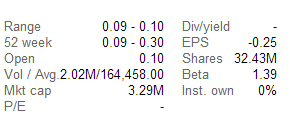
Shown below are these three items for the stock that the reader wanted me to take a look at, PLCSF. From these screens, I can conclude the following things for this specific stock:
- Because of the low stock price per share (around 9-10 cents per share), low institutional ownership, low market cap (only $3.39 million, and horrible looking financials (margins and ROA in the negative hundred to thousands of percent range), this stock is an extremely speculative play, with a very high level of risk involved.
- In reading the general description provided, it is easy enough for me to understand what PLC Medical Systems does and what product(s) they offer as a medical device company.
- The company has been around for a long time now. In reading the company history, it was started back in 1987.
- From what I could tell, the company went public quite a long time ago (~10-20 years). However, it is hard to find readily available historical pricing data for this stock going back prior to 2008. I’m not sure if this is simply due to the fact that it’s a penny stock and isn’t covered as closely by Yahoo Finance and Google Finance, or if something else happened internally with the company between 2000-2008 that took the company public to private and then back public more recently. This will be something I would want to check on also.
- In addition, if the company has in fact been around so long, it makes me wonder why is their stock still only worth less than 10 cents per share?
- In looking at the price history graph below, the stock price has decreased 200-300% since 2008. During these 5 years or so, there have been 3 sharp downturns and 2 sharp upturns on the stock. The first downturn between 2008-2009 was likely associated with the overall market. However, I want to investigate why the company couldn’t sustain the 2 upward runs that it had in 2009 and again in 2012.
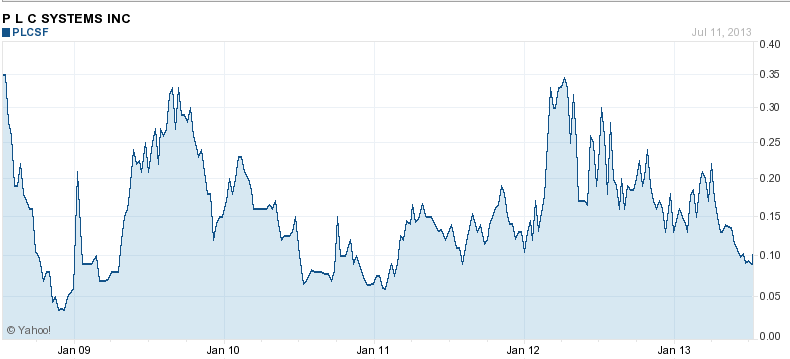 |
| PLC Systems Long Term Stock Price History |
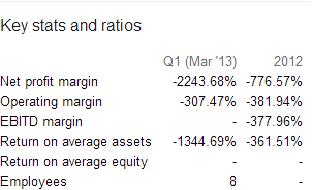  |
| PLC Systems Financials |
 |
| PLC Systems Company Overview/Description |
Step 2 – See How the Stock Fits Within Phil Town’s Rule # 1 Investing Analysis System
As I mentioned previously in my 6 month test run of Phil Town’s Rule # 1 investing system (which showed that its usage did not deliver a market beating return due to the trading commissions involved), I do not believe that Phil’s system is the “magic formula” for beating the market. However, Phil’s approach does involve some very prudent technical and fundamental analysis which I feel can give me a deeper understanding of how the company would function as a potential investment.
- Phil Town Criteria # 1 – Only invest in companies that you would be proud to own, trade for > $1 per share, and have > 500,000 average daily trading volume. The type of companies you should invest in should be at the intersection of what you love to do, what you are good at doing, and what you can earn money doing.
- PLC Systems is trading for much less than $1 per share (9-10 cents per share) and only has an average daily trading volume of 164,000 shares, which means that it is not very liquid and also can swing many percentage points each trading day. In regards to these metrics, PLC would not qualify under Phil Town’s standards.
- Since PLC Systems Inc is involved in the medical field, I would be interested in owning the stock.
- Phil Town Criteria # 2 – Identify if the company has a “moat” – What he explains we are looking for here is >10% annual growth rate over 10 years for the following things: 1) Return on investment capital, 2) sales revenue, 3) EPS growth, 4) Equity per share, and 5) free cash flow growth. We also make sure that the company has enough current free cash flow to be able to pay back it’s long-term debt in 3 years or less.
- A great place to get all of this 10 year historical data in one place is Stock2Own.com. If you type in the ticker symbol of the stock you’d like to analyze in the box at the top, it will then automatically display the 10 year data for these ratios. These can be accessed by clicking the Annual Statements option on the left sidebar. This data for the PLCSF stock is shown in the figure below:
- For PLCSF, unfortunately, the financial calculations above do not look very good because of all of the negative values it is carrying, and as such, are definitely NOT in line with Phil Town’s criteria. Return on investment capital, sales revenue, EPS, Equity per share, and free cash flow growth rates are all either deeply negative or zero. Furthermore, the company has negative free cash flow, but at the same time, they have no long-term debt.





Even though PLC does not meet the 10 % / 10 year average growth rate criteria set forth in the Phil Town method, this is not very surprising because as I mentioned above, it is expected to be a more speculative play (as a very cheap penny stock), not a rock solid, long term investment.
Because of this, we must also examine the actual financial figures shown in the bar graph above over the past ten years a little more in-depth.
As you can clearly see in the chart above, many of the numbers are negative, which is definitely a bad thing. Furthermore, if you examine the CHANGE TRENDS closely from left to right, it can be seen that the company does not really seem to be heading in the right direction since EPS, Book Value Per Share, and Free Cash Flow have all been steadily decreasing for the past 10 years or so. Although Sales and ROE have started to rebound only recently in the past 2-3 years, in my opinion, this does not take away the negative trends seen with EPS, FCF, and BVPS mentioned above.
- Phil Town Criteria # 3 – Calculate the appropriate sticker price, or what the stock should be selling at given it’s current EPS and EPS growth rate. We then calculate the Margin of Safety price (MOS) to make sure that we buy the stock at a significant enough (50%) discount to shield ourselves from mistakes and be able to achieve higher returns.
- Fortunately, the tool listed above, Stock2Own.com also has a handy feature that automatically calculates the sticker price (Value Price) and Margin of Safety (MOS) price.
- To view this in Stock2Own, simply click the Value Price option in the left sidebar.
- Unfortunately, for PLC, since their EPS is negative, a MOS/Value Price cannot be calculated, so we don’t have this gauging point to base our decisions off of.
- Phil Town Criteria # 4 – Use technical analysis tools to make sure you are either buying or selling at the right time. Phil recommends using three technical tools to make sure of this – 1) 8-17-9 MACD indicator, 2) 14K, 5D Slow Stochastic Oscillator, and the 3) 10-day moving average. Phil recommends that you only buy when all 3 of the tech. indicators say “buy.”
- To generate these three graphs for a stock analysis, I again use Google Finance. To set it up, you simply click, “Technicals,” at the bottom of any Google Finance stock price history window, and fill out the fields as shown in the below screenshot:
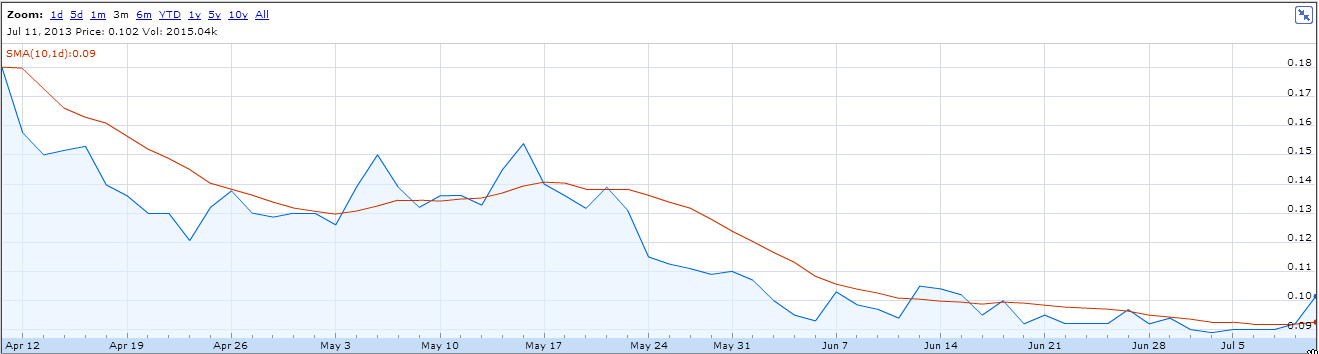
- Once you’ve set up the indicators, view the 3 month history graphs for the stock you’re analyzing. Three months seems to be a good time period in order to clearly see whether the technical indicators are saying “buy” or “sell.”
- For analyzing PLC, we’ll go through the technical indicators one by one. First, the 10 day simple moving average, as shown below (red line), compared to the actual stock price (blue line). With the simple moving average, a “buy” signal is indicated by when the stock price line crosses above the moving average. In the case of PLC, the stock price is currently above the moving average, indicating that we would want to buy right now.
- PLC’s 14K, 5D Slow Stochastic Oscillator is shown below. With stochastic, the K line (blue) is the “buy” line, and the D line (red) is the “sell” line. With this technical indicator, a “buy” signal is indicated by when the buy/K line crosses above the sell/D. In the case of PLC, the K line is currently above the D line, indicating that we would want to buy right now.

- PLC’s 8-17-9 MACD indicator is shown below. With this technical indicator, a “buy” signal is indicated by when the MACD line crosses above the EMA line. In the case of PLC, the MACD appears to be above the EMA, indicating that we would want to buy right now.

Step 3 – Qualitative Research on the Company, the Management (CEO Especially), Current News, and That No Insider Selling is Happening
As the title above suggests, the next step I take to analyze a company is to perform some qualitative research about what they do and how they do it. This is also a good time to research any questions that have popped up from the more quantitative investigations discussed above.
Listed below is how I tackle this step, using the stock, PLC, as an example:
- Management Analysis (done through Google Finance and Reuters.com) – The current CEO of PLC, Mark R. Tauscher, joined the company in 2000, bringing 20 years or sales/marketing (non-technical) experience in the medical device industry to the company. I performed an in-depth search around the Internet on Mark Tauscher and how he’s been doing as CEO of PLC Systems. I also reviewed several interviews he has done.
- Although he seems to be doing a “sufficient” job as CEO, I could not find anything mentioning that he has had a STELLAR impact on PLC or that he was a superb leader. Because of this, it makes me think that he isn’t the magnificent officer that would ideally be running the company with big hairy audacious goals!
- Insider Trading (done through company website or MSN Money) – In looking at the recent transactions of company insiders at PLC, it appears that there has been no activity (buying or selling) since several of the officers purchased shares back in 2009. In my opinion, this is probably not the best sign, since it may mean that the officers aren’t placing their own money in their personal efforts.
- It was interesting to read that recently, 3 large institutional investors have parked a great deal of money in PLC Systems, signifying that they are betting on it for the future.
- Additional Clarity About What the Company Does/Its Current Position (find the “news” columns on Reuters, Yahoo/Google Finance, etc after you bring up the chart for a specific stock) – On the PLC company website, I found a presentation from 2013 and a company fact-sheet that enabled me to learn a little more depth about what PLC does as well as what milestones and goals it is trying to accomplish.
- The company has only 1 product – RenalGuard.
- During heart procedures, a contrast dye is used to enable the doctor to see what he or she is doing. In 10-20% of the people having these procedures, they are at risk to developing toxicity to dyes.
- RenalGuard works to flush out these dyes from the patient’s system to prevent this toxicity from happening.
- In my opinion, this sounds like a great product – fairly easy to understand, answers an unmet need, and doesn’t really have any competition.
- The future success of the stock depends on receiving FDA approval for RenalGuard use in the USA. However, it looks promising that this will be obtained.
- Lastly, as I mentioned in my high level review, I had several questions about PLC’s stock price performance history.
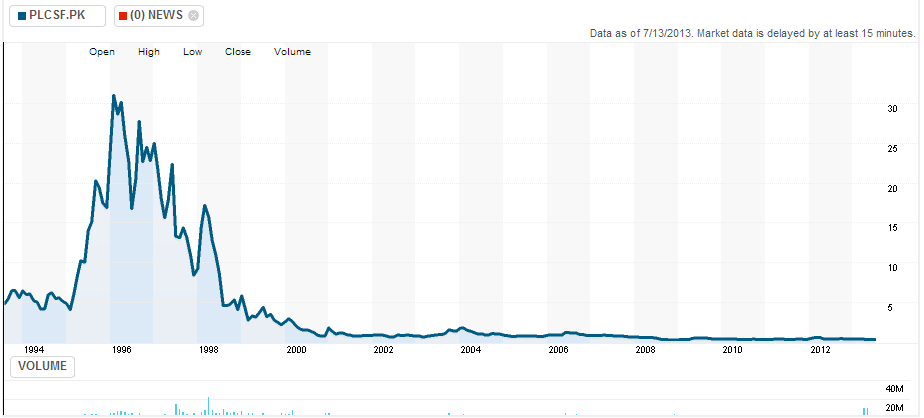
- On Reuters.com, I was lucky to find a more-lengthy stock price history for PLC Medical Systems (shown in the figure below).
- As you can see, from 1995-1996, the stock price ran up to the $30 per share range, which is quite incredible!
- And, ever since then, it has trickled along in the penny stock range.
- Unfortunately, despite extensive searching, I couldn’t find any articles or interviews explaining why PLC has been unable to increase it’s stock price during this 20 year period or so. Essentially, I wanted to know, “What makes the company different now that it is worth investing in compared to before when nothing happened?”
- To me, this is a fairly big red flag. It makes me
Step 4 – Review and Decision to Buy or Not
Having now completed all of the analysis, it’s now time to bring it all together, summarize the findings, and make a decision for if I would buy a specific stock using a very small amount of play money or not.
Using our example of PLC Systems, here are my conclusions:
- Seems like an understandable and good business model (now that I have performed a little more analysis).
- Even though the company only has one product, it answers a good unmet need and would have fairly little competition. Furthermore, it seems promising that it will receive FDA approval on the trial being conducted eventually.
- All 3 of the technical indicators dictate that NOW is a good time to buy shares of PLC.
- Even though the company’s product has potential, the CEO does not seem to be a “superstar.” I also was not satisfied with finding a compelling reason to invest in PLC Systems now compared to their past history when their stock has not gone anywhere since the 1990’s.
- Since the long-term financials are not very good and/or negative, the investment involves a lot of risk. In addition, it is not promising to see that most of the recent trends are still pointing downwards for PLC.
- Because of the items in red above, my final conclusion for this play is to NOT buy PLC Systems, symbol PLCSF right now.
- It may become a good play in the future, but until the financials are firmed up and the company story is more logical/compelling, I would hold off.
How about you all? What is your approach to analyzing individual penny stocks for potential investment? How much of your money do you allocate to individual stocks vs. mutual funds?
Share your experiences by commenting below!
Debt Free Direct Tour de Personal Finance, Stage 20 – Round 5, Posts 1-32

 Without further ado, let’s continue on with the 20th Stage (there are only 4 blogs left the 2013 event) of the 2013 Tour de Personal Finance (to follow all of the action, click on the Tour de Personal Finance category link and scroll down to read all the posts involved in this subject).
We greatly appreciate Debt Free Direct for being the title partner of the 2013 event and for all their great support. If you’re interested in learning more about the help and advice Debt Free Direct offers to people in debt or their money-saving tips on how to prevent building up debt, click here.
A Quick Reminder On Prizes For The 2013 Competition
The 2013 edition of the Tour de PF will be doubly exciting because we have some very nice cash prizes to give away to the winner and also to charity to continue helping the community.
These will be as follows:
- Yellow Jersey (1st Place) Winner of the 2013 Tour de Personal Finance will receive $100 cash via PayPal.
- In addition, the Yellow Jersey Winner will also get to decide what charity they want me to donate $700 to in honor of their efforts/victory.
To view the most up-to-date brackets of the competition, click the following link – 2013 Debt Free Direct Tour de PF Bracket
Going along with Tour de France cycling tradition, I’ve listed each competition within each stage as an “intermediate sprint” (one post versus another) along with the description provided by the blog author when the post was submitted.
Also, if applicable, I will give a brief description of the stage of the Tour de France that took place the same day as (or that has happened since the previous Stage of) the competition.
How to Vote
You can vote for the two articles (one from each intermediate sprint) you’d like to see proceed in the Tour by commenting in the comments section below and telling which are your favorites. I’ve listed a keyword after each post title to make it easy to vote (as a made-up example, you can just comment: Sprint 1: Mutual; Sprint 2: 401k, etc.)
Be sure to comment which one you like the best out of each set of two! Criteria for the best article is completely up to you, but you can use these factors as a guide: 1) post of your favorite blogger, 2) most interesting post, 3) most thought-provoking post, 4) most unique post, or 5) most actionable post. Here are today’s competitions:
Voting will continue until July 19th for this Stage!
Intermediate Sprint
- My Husband is Now WORKING FROM HOME WITH ME!!! (Husband): It’s important to work out a plan before leaping into self-employment. It’s even more important when that entrepreneurial spirit hits both of the income earners of the household. But after running the numbers, looking at worst case scenarios, and mulling the idea over…it was time for us to put on our big girl panties and jump in. Here’s the post about the excitement and fear when we officially put all of our financial eggs in one basket and happily skipped away into the unknown…
VERSUS
- How My Retirement Plans Got Derailed – Big Time! (Derailed): I left my secure job at a major bank to open a small retail store with my husband. We struggled along for three years, using up almost all our savings and making the terrible mistake of financing the business with our many credit cards. Eventually we gave up and closed the store. With no money and over $100,000 in credit card debt, we sank to our lowest point of despair.
Tour de France Daily Recap
The Tour de France in real life continues today after a rest day yesterday with a medium-mountains Stage taking the riders 168 km from Vaison-la-Romaine to Gap. There shouldn’t be too many big changes today in the overall standings, but you never know these days now that most of the riders are clean of drugs! It makes the thing a little more unpredictable! haha 🙂
***Photo courtesy of http://www.flickr.com/photos/28149760@N04/9274241979/in/photolist-f8wV2M-cQzHuy