

- You are here:
- Home »
- Blog
How To Save Money on Food
The following article is by MPFJ staff writer, Miss T from Prairie Eco-Thrifter. If you want to learn how to live your dream life in a sustainable, healthy, and money savvy way, check out her site here.
I’m guessing most families and households find that food represents a huge chunk out of the weekly budget.
Let’s face it, food is one thing we simply cannot live without, and so the expenditure is one that has to be justified. Luckily there are numerous ways to save money on food, so let’s look at a few of them here.
Before we start, let’s get one thing clear; I’m not about advocating saving money on food by scrimping on quality or adopting a less than healthy diet. Having training in nutrition has made me even more determined that my family will eat well through a healthy, nutritionally-balanced diet that will enable us all to remain fit, happy and healthy. My focus is on buying quality foods, fresh and local where possible, and organic is preferable in in order to avoid as many food additives as I can.
It’s almost impossible to spend less if you don’t have a household budget. Food will form an important part of the budget, so it is vital that you set a realistic food budget amount and stick to it every time you shop. If you easily succumb to temptation, only take the set amount of money with you into the store and pay for your food by cash only. This one step was pivotal in turning my food spending around.
Maybe you have also found that the more often you go into a grocery store, the more money you spend on food in total. An important trick to saving money on food is to shop just once a week, or every two weeks if you can, to cut down on the temptation to buy more. While some economists and bloggers advocate grocery shopping only monthly, I find that I need my fresh produce more often than that. I have partly found a way around this by buying my fresh veggies and fruit at local farmers’ market on the weekends as often as possible. Make sure you stick strictly to the budget you have set for this section of your food purchases.
Unless you are an absolute whiz with mental arithmetic (which I am not!), take a calculator with you when you do the grocery shopping. This way you know exactly when you have reached your limit and won’t feel the need to pull out the credit card if the cash register total is higher than you thought. This works both ways, of course; after you have shopped everything on your list, you might still have money left over and so you can buy that bulk container of washing powder or that yummy fancy ice cream as a treat.
Now, about that list; if you want to save money on food, you simply must shop with a list and refuse to buy anything not on it, even if you realize that you might need it. I have a basic list of the items I know we use every week, in the quantities that I buy. This includes things like butter, flour, sugar, eggs, milk, coffee and bread for me but your staples list could be different. I’ve made up a document on my computer that is a shopping list with my basics already listed; I simply print it out and add the other items to it. As you walk the aisles, focus on the list and think before you add anything to your cart.
Of course, you can’t have an accurate list if you don’t know what meals you are going to be having, so a planned menu is important. Get the whole family involved in this and let everyone have a say in the dishes that will be prepared. Some people like to set out a day–by-day menu while others (like me) are happy to list what meals will be prepared at some time during the week. Once you have decided on your menu, you add the necessary ingredients to your list, after checking your pantry to make sure of what you have in stock. One great idea I learned years ago was to have a “pantry meal” every so often; the meal is prepared using items that are already in the pantry. This helps to prevent a build-up of seldom-used, older products.
Meals prepared in the home kitchen cost a fraction of pre-prepared food, whether they are take-out or frozen. Make cooking part of your food plan and again, get the whole family involved. Older kids can easily make a simple meal and, if everyone takes a turn, it doesn’t all fall on the one person. Take back control over what your family eats and cook at home, using fresh produce where possible.
Take advantage of store specials when you can but only if you normally use what is on special. The same applies to buying in bulk – only buy bulk if you regularly use that product, otherwise it will be wasted and wasted food is wasted money. Shop around different stores to find the best deals but remember, keep within your food budget. Produce in season will be cheaper, fresher and more nutritious so try and eat seasonally, like our grandmothers did.
Saving money on food doesn’t mean that you miss out on treats or that meals have to be plain and boring. With a little creativity and ingenuity, you can save money on food while enjoying exciting, varied, healthy and nutritious meals.
How about you all? What techniques do you find most effective at saving money on food? Have you used any of the ones above?
Do you ever find it hard to eat healthy and also save money at the same time?
Share your experiences by commenting below!
Think Outside The “Big 4” To Find A Cheaper Wireless Phone Option

This is a post by MPFJ staff writer, Jeff. Jeff writes about Sustainable living and finances at his website, Sustainable Life Blog. Jeff really enjoys traveling with his wife as much as he can, to wherever he can.
I’ve been a Verizon customer for almost 15 years.
For the first 4 years, my parents paid the bill. Since then, I’ve been on my own and paying it myself. I always had a low number of voice minutes and unlimited texting up until I got a smart phone in early 2010. Before I got a smart phone, my bill was around $55 per month, with a 18% employee discount. When I got a smart phone, my then girlfriend (now wife) and I decided that we would get on the same plan, and we both got smart phones. Our bill raised up to $150/mo, of which my share was $75. We still had the 18% discount, even though I no longer worked for that employer.
We currently have unlimited data (because we still have the same phone that we got in Jan 2010) and the lowest number of voice minutes per month, as well as unlimited texts. Neither of us have had any problems with our phone, so we’ve ignore the occasionally gentle (and sometimes firm) nudges from Verizon to get a new phone. We didn’t really see the reason because nothing is wrong with our current phones (except they are getting slow and the operating system is very old), and I wasn’t that excited to lose unlimited data.
Recently though, we’ve finally decided that it’s time to get rid of these phones. We are running a version of Android 2.3 that I hacked our phones to for an upgrade, and now many apps will not download because our operating system is so out of date. We don’t have 4G or any of those bells and whistles, and after almost 4 years, it’s about time.
Since we are in the market for a new phone and I keep hearing people paying way less per month than us, I decided to do some investigating about our various options outside of the biggest 4 cell phone companies – AT&T, Verizon, T-Mobile, and Sprint.
What Are The Choices Aside From The “Big 4” Cell Phone Companies?
There are some competitors to the “big 4” cell phone companies, and they do things way different. They still provide cell service, but some are prepaid, some charge you based on what resources you use at the end of the month, and some route all your calls/texts/data over a wireless network whenever possible. After looking into it a lot, I realized that this is probably the way to go for my wife and I. Here are just a few of the options available, and the ones that I looked closest at.
Republic Wireless
Right now, Republic Wireless only has one phone out, the Motorola Defy XT. It’s a very old phone (but newer than mine) and still runs android version 2.X. With Republic, there are 2 pricing options. For the first, you pay full price for the Defy ($199) and then you pay $19 per line, per month for unlimited everything (though I believe they don’t do MMS). If you’re balking about the high up front cost of the phone, you can choose to pay $79 for the phone, then $29 per month. Pretty simple and easy to understand.
They can make this so cheap because Republic assumes (correctly for me, and most people I’d guess) that whereever you are, you’re near a wireless network that you can use. Your house, the coffee shop, a hotel or whatever and they run your call over the wireless network. When you’re not near a wireless network or not logged on to one, you place calls on Sprint’s network (and when you’re out of Sprint’s network, you roam on the tower of another provider – in my case it would be Verizon most of the time).
Unfortunately though, Republic’s phone is very old. They have been saying since April that they are coming out with new phone in “summer 2013” but I’m not too sure when that will be.
Check the website here to learn more about Republic Wireless.
Ting
Ting is another carrier that’s very simple to understand. You can bring any Sprint eligible phone to Ting (though not iPhones, yet) and use their service. You will be operating off of Sprint’s mobile network when you’re in range, and you can text, voice call, etc. However, when you leave Sprint’s network and roam on another carrier, they block your data access – but you still can make calls and send text messages.
For rates, Ting is easy to understand. At the beginning of the month, you start out with 0 minutes used, 0 texts, 0 data, and at the end of the month, they total all your usage then drop you into one of the categories. If you want to add an extra line, that’s an extra $6 dollars. You can see the categories in the picture below, as well as the costs.
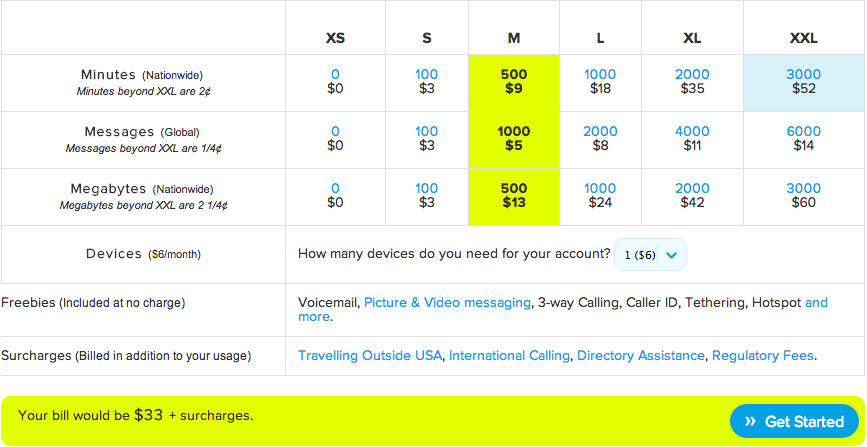
I looked over some of my wife and I’s older bills, and it looks like we would fall into the Medium bucket for voice, and the large buckets for both data and text, bringing us to a total bill of around 56 dollars before tax. This is currently less than half of what we are paying Verizon, but unfortunately more expensive than Republic.
You can, however, use any phone you like – which is a big plus for me.
Check the website here to learn more about Ting.
Straight Talk
Straight Talk is a prepaid carrier, and offers $45 per month for unlimited everything like Republic Wireless. They use the same towers that the Big 4 use, and offer a very different price. You can set yourself up for auto refill, which will ensure that there’s no coverage dropped when your prepaid time runs out. Essentially it’s like having a phone contract, but without the restrictive contract, and for 1/2 of the cost of one of the big 4. With the unlimited plan, you can keep your current phone number as well.
The billing is simple and easy to understand, and you can purchase prepaid cards if you are not interested in using the auto refill option.
Check out their website here for all the details
My wife and I have not decided on much, except that it is highly unlikely that we stay with Verizon. At this point, we are biding our time until Republic releases their new phones, and then will make a decision from there.
How about you all? Do you have any of these services? If so, what do you think about them? Would you ever try one of them?
How much does your current wireless plan cost per month?
Share your experiences by commenting below!
Four Insurance Policies That Aren’t Worth The Cost

 The following is a post by MPFJ staff writer, Toi Williams, who is a professional personal finance blogger of Fine Tuned Finances. She has backgrounds in personal finance, sales, and real estate.
Today, insurance is a fact of life for most people. At times, it can seem like there is an insurance policy available for everything, and that is almost true. People can buy insurance policies for their homes, cars, vacations, pets, valuables, and nearly anything else that you can think of. Many people love having insurance because of the protection it provides to them and their families. While some of these insurance policies can be very beneficial and provide a great amount of assistance when you need it the most, some insurance policies are not worth the paper they are printed on.
Here are some insurance policies that are not worth what you must pay for them.
Whole Life Insurance
One insurance product that most people should stay away from is whole life insurance. These life insurance policies are sold with the promise that it will be an investment in your future and that your investment will grow to the point that the policy will pay for itself. Unfortunately, investment results are never guaranteed and you could end up spending a lot more than you realize because these insurance policies are very expensive.
There are several reasons why purchasing a whole life insurance policy is so expensive. The biggest reason is that there is a savings element built into the policy over and above the cost of coverage. You are basically using the life insurance policy as a savings account for additional money that you may have. There are also various fees and commission charges that are added to the cost of the policy as well, significantly increasing the price.
Many people who choose this type of life insurance policy do not have the coverage that they need because the policies are so expensive. Not having enough coverage is almost as bad as having no coverage at all. While there are a few people who could benefit from purchasing a whole life insurance policy, most people can’t and won’t. Instead of purchasing a whole life insurance policy, choose a reasonably priced term life insurance policy that has enough coverage to replace several years’ worth of your income in the event that the unthinkable happens.
Accidental Death Insurance
Another type of insurance policy to avoid is accidental death insurance. People purchase these policies thinking that it will help their family if they die suddenly in a tragic accident but fail to realize that the chances of this happening are extremely low. Companies that sell accidental death insurance policies know that they will rarely have to pay out money to beneficiaries, so they keep premium rates just low enough to entice you into buying the policy. By using scare tactics and coercion, they convince consumers that this is a type of insurance that they actually need.
The truth is that you probably don’t need an accidental death insurance policy. The chances of you dying in an accident is slim. Even if you do have an accident that causes your death, there is no guarantee that it would be an accident that is covered under the policy. You would do better to get the term life insurance coverage that you need and keep the insurance in effect throughout the term to ensure your family’s financial security if you were to die suddenly.
Children’s Life Insurance
Children’s life insurance is another insurance product that you can do without. Insurance agents sell these policies as an investment in your kids that will benefit them with they get older, but you could do the same thing with a savings account and be earning interest instead of paying money out of your pocket. In some cases, parents buy these policies so that they will not have large out-of-pocket costs to bury their child if they should die from an illness or injury while they are young. Once again, placing that premium payment into a savings account will accomplish the same thing with much lower costs associated with it.
Rental Car Insurance
If you have ever rented a car, you will be familiar with the rental car insurance policies that the rental company tries to sell you when you go to pick up the car. Renters are told that the policy protects them in the event that they have an accident or the car becomes damaged while in the renter’s possession and are encouraged to sign for the insurance when they get the keys to the car. What many people do not know is that they may already be covered by insurance when they rent a car, so purchasing additional insurance from the rental company is a waste of money.
Before you sign for the optional insurance from the rental company, check to see if you are already covered under your current auto insurance policy. Many car insurance policies contain coverage for the covered driver whether they are in their own car or a car rented in their name. Whether you are covered will be disclosed in the terms and conditions of the policy you purchased, so review your paper copy of the terms, look up the terms for your policy online on the auto insurance company website, or call a customer service representative and ask if you are covered.
If you use a credit card to reserve and pay for the rental car, you may also have insurance coverage for the car rental available to you from the credit card company. Many credit card companies offer coverage for rental cars whose costs are charged to the card, but this insurance is generally secondary to the rental car insurance that is available to you under your regular car insurance policy. Review the terms and conditions for your credit card or call the credit card company to see if this coverage is available to you.
How about you all? Do you think there are good reasons to buy these types of policies? Why or why not?
Share your experiences by commenting below!
***Photo courtesy of http://www.flickr.com/photos/86530412@N02/8266216454/sizes/m/in/photostream/
How to Save Money Around The Home With DIY

 The following article is by MPFJ staff writer, Miss T from Prairie Eco-Thrifter. If you want to learn how to live your dream life in a sustainable, healthy, and money savvy way, check out her site here.
DIY, or Do It Yourself, is something I discovered a few years ago and I have to admit that I got a bit carried away and went around DIY-ing everything I could find.
Luckily, this frenzy wore itself out, but I remain committed to doing as much as I can around the house myself. The other day, it got me thinking about just how much money I save around the home with DIY instead of hiring a tradesman or buying ready-made.
There are a number of reasons why people consider DIY, but probably the most common one is to save some money. Others want to reduce chemicals and toxins in their home; some want the thrill of knowing that they did it themselves; while others want something a little different that may not be available in the stores. Whatever your reason, rest assured that you can save money by doing it yourself.
One of the biggest DIY changes we made in our family was to cook our own meals at home. This wasn’t something we had ever really done before, relying on packaged, pre-prepared and frozen foods, ordering take-out or simply eating out at family-friendly restaurants. A few years ago, we were re-working our household budget and were shocked at how much we regularly spent on food; we started to investigate alternatives. We gradually changed over to home cooking and haven’t looked back. We save hundreds of dollars a month, eat much more healthily, and have heaps of fun and family time in the kitchen. Everyone has a say in the menu planning and even the kids take their turn at cooking meals. It’s one of the best family decisions we have ever made!
Cooking at home led to starting a vegetable garden in the back yard, yet another DIY way of saving money at home. It was actually one of the kid’s ideas, and it started out as her project, but soon, we were expanding the beds and growing more. Many of our favorite dishes are based around what is in season in the garden, and it has given all of us a greater appreciation of where our food comes from. The cost of seeds and seedlings is a fraction of what we used to spend on the same fruit, vegetables and herbs, so there is quite a cash saving there. We compost scraps and grass clippings and have a worm farm to supply all the nutrients for the garden.
When we started out, there wasn’t much money for expensive furniture, and we learned to make do with second-hand. Now, I seek out secondhand and used furniture and accessories because I love to create new from old with some DIY techniques I’ve learned along the way. Timber furniture is a passion of mine, and I love to strip off old paint and varnish, repair any damage, and refinish the piece with modern colors and stains. Secondhand furniture costs a fraction of the price of new and with a little bit of work, you can produce unique, attractive pieces for your home and have fun doing it. My latest interest is in natural stains and I have experimented with coffee, tea, vinegar and berries to give unique, non-toxic finishes.
Many people are concerned about the amount of chemicals and toxic substances they use around the home and the impacts these can have on our health. While searching for non-toxic alternatives to the chemical cleaning products we used to buy, I discovered the effectiveness and of some very simple ingredients. Instead of buying all of the one product/one job cleaners we used to spend so much money on, we now use things like vinegar, sodium bicarbonate, essential oils, and citrus peel to clean the home. There are websites with recipes for these cleaning products and you will be amazed at how well they work and the hundreds of dollars you can save every year, not to mention how much safer and healthier your home will be.
Hiring a tradesman for jobs around the house can be an expensive exercise, but it is necessary when the problem could be dangerous or has to be done by a licensed expert for legal reasons. However, there are many home maintenance tasks that can easily be done by the householder with dollar savings as a big incentive. Garden maintenance, house painting, gutter cleaning (not on a high roof maybe) and some renovations can easily be undertaken by someone with basic skills and knowledge. Safety is paramount, of course, and you need to take every precaution to prevent and avoid accidents or further damage to the house. With tradesmen charging up to $100 an hour, you can see how you will be able to save money by doing some of these jobs yourself.
These are just some of the projects my family and I have undertaken and we have seen how we can save money around the home with DIY. There is lots of information available to help you as you start these projects for the first time. For maintenance jobs, I found the staff at the stores where I purchased the necessary supplies were very willing to help me with information and advice.
How about you all? In thinking about your home, what ways could you save money by doing things DIY? What things do you do DIY already?
How much money do you think you are/could save by doing things yourself?
Share your experiences by commenting below!
***Photo courtesy of http://prairieecothrifter.com/wp-content/uploads/2013/08/iStock_000001831162XSmall-300×199.jpg
How To Ease Your Budget Into The Start Of A New School Year

 The following post is by MPFJ staff writer Travis. Travis is a customer blogger for CareOne Debt Relief Services, and also appears weekly at Enemy of Debt. Travis candidly shares his personal journey to pay off $109,000 of credit card debt and the tips he’s learned along the way. As a father and husband he provides a unique perspective on balancing debt, finances, and family.
We thought we’d already bit the financial bullet to get ready for the new school year, but we were WRONG.
We had all the necessary supplies for both kids purchased weeks ago. Last weekend, we hit up a few sales and bought some new clothes and planned to stage the purchase of cooler weather clothes over the next few months. But, there’s another major expense that needs to be accounted for. It goes by several names: Meet the Teacher Day, Orientation, or Schedule Pickup, but the result is the same.
The checkbook is going to get a workout. Listed below is what was on tap this time around:
School Pictures: In elementary school, picture day is a few weeks into the school year. But, for middle and high school, picture day is on schedule pickup day as the same picture is used for their student ID, which is printed and handed to the students immediately. Cost: $25.75 for a moderately priced package.
Gym Clothes: Shorts and Shirt adorned with the middle school logo. $14 for the shirt/short combo.
Parent Teacher Association: Want to have a voice in how things are done at school and help out with some of the events? You can, in exchange for a check for $8.
Yearbook: You won’t receive the yearbook until May, but we can reserve our copy now for only $23.50!
Instrument Rental: Students must be in Orchestra, Band, or Choir. Our incoming middle school student chose to play the Viola. $50 to rent one from the school for the year.
School Lunch Account: You can put as much as you’d like into their account, but the recommended amount is a month’s worth, or around $50.
For those adding in their heads, that totals up to $171.50 for just our daughter who is entering middle school. The potential fees for our High School Freshman are similar. As with any expenditure, Vonnie and I really scrutinized the cost and made the best decision based upon value and the funds we had available.
Let’s look at each of those potential expenses again and discuss which ones we went with and which we said “no” to.
School Pictures: I may not agree with how much they cost, but the grandparents love getting them, so we buy them. Purchased.
Gym Clothes: As I was about to start writing out a check, it was announced that purchasing gym clothes from the school was no longer required. Students could wear their own athletic shorts and t-shirt. Skipped Permanently.
Parent Teacher Association: We’ve joined almost every year, and hardly ever gone to meetings. Skipped Permanently.
Yearbook: They really want you to pay up and reserve your copy on schedule pickup day, but you don’t have to. The due date on the form given is actually several weeks away. Additionally, they’ll send the SAME form home in the spring asking again. No need to decide this now. To be decided later.
Instrument Rental: The orchestra teacher actually preferred that we send the check on the first day of school, which conveniently is after our next payday. Deferred to Next Pay Period.
School Lunch Account: We can add funds to the school lunch accounts online at anytime. This is usually handled as a bi-monthly expense of $25. We decided to add funds right before school starts, which as stated is after our next payday and in our next budget cycle. Deferred to Next Pay Period.
Out of a potential total of $171.50 worth of expenses, we walked out of the school only spending $25.75 for school pictures. The rest of the expenses we either skipped permanently or deferred to the next budget cycle. There are people that hop from table to table writing out each check as if it was a necessity, then complain about how much they have to shell out on a single day. But by asking some questions, and evaluating the importance and timing of each expense we were able to lessen our overall total, and spread out the payments to soften the blow on any single budget cycle.
Well readers, how does Schedule Pickup day (or whatever your school district calls it) work in your area? How crazy are the expenses for you and how do you handle them?
Share your experiences by commenting below!
Image courtesy of Stuart Miles / FreeDigitalPhotos.net
True or False: Money is the Root of All Evil

 The following post is by MPFJ staff writer, Catherine Alford. Cat is a freelance personal finance writer who blogs at www.BudgetBlonde.com.
I feel like the word “money” sometimes comes with a negative connotation. Do you sometimes feel that way, as if it’s immoral to want it or strive for having lots of it?
After all, our parents warn us against worshiping it. Some say it’s the least important thing in the world. Others caution us to respect it and understand it. Then, of course, there’s the saying that it’s the root of all evil.
If you think about it, that’s a pretty serious accusation!
It can certainly be argued that a desire for money has led to some pretty catastrophic events. Some that come to mind include wars, murder, Ponzi schemes and a slew of other things that we don’t like to mention in polite conversation.
However, what about the good that money can bring? What about all the great things that it can do when there’s lots of it?
I can think of a few situations where money isn’t the root of all evil at all. In fact, it can be a ray of hope. I’ve listed of few of these below:
1. Donations to Worthy Causes
Monetary donations can absolutely change lives. To cite an extreme example, Warren Buffett recently donated a large portion of his overall wealth to the Bill and Melinda Gates Foundation.
Even something small like paying for the food of the person behind you in the drive through can brighten their day. Have you ever noticed that around Christmas time, people are always paying for groceries and giving back? Wouldn’t it be nice if that was the norm all the time? This example actually shows that you don’t need a lot of money at all to make someone happy or improve their day.
Another example of donations is donating to your church. Many people give 10% of their income or more to their church, and that’s used for worthwhile causes in the community. You can also donate to other organizations all over the world and help people who are not as fortunate as we are.
2. Investing in a Business You Believe In
Another great way to help others using money is investing in businesses that you believe are worthwhile and promising. Small business owners often can’t even get their ideas off the ground without the help of investors, and they are often extremely appreciative of the help they receive.
Of course, investing in a small business is definitely risky because you don’t know if they will succeed, but with enough research and enough forethought, an experienced investor will be able to spot the good ideas and help them come to fruition.
3. Paying For Others To Travel
When I was in college, I was the recipient of a need-based scholarship to study abroad. An older couple in the community gave it. They pledged $5,000 to a student who wanted to visit and study in another country, and that lucky student was me!
Their generous donation changed my life, and sparked a desire to see the world even more. I’ve even been living abroad for over two years now. I might not have had the confidence to move abroad without the generosity of that couple who helped me travel all those years ago.
4. It’s an Excellent Motivator
Many people older and wiser than I am will say that you shouldn’t be motivated by money; however, I’m not sure that’s true. It would be hard to find someone who isn’t motivated by their income.
Don’t we all work hard so that we do well in our careers so that we can bring home an income to feed our families? If we don’t do well at work or we slack off, we could get laid off or fired!
So, while I don’t think money should be your only motivator to work hard, I think it’s okay for it to be one of your motivators.
Another example of being motivated by money is trying to raise money for a cause. For example, Jacob has his Give 10% Back Project. He is motivated to raise money. Money isn’t the actual motivator, but donating money is. In that way, I feel like we can be motivated by the numbers without losing ourselves in the process.
As evidenced by the examples above, money doesn’t have to be associated with “evil.” I know that the quote generally means that money is the root or the motivating factor behind most evil acts. However, it’s also the motivation for some of the most charitable, life altering, and generous acts of kindness around. I’ve been the recipient of them.
How about you all? Have you been the recipient of generous acts of kindness involving money? Do you think money is the root of all evil?
Share your experiences by commenting below!
***Photo courtesy of http://www.flickr.com/photos/jono2k5/2495905416/sizes/m
Save Money By Taking A Camping Vacation

 This is a post by MPFJ staff writer, Jeff. Jeff writes about Sustainable living and finances at his website, Sustainable Life Blog. Enjoy!
Summer is almost over, and for those of you still looking to get a quick and enjoyable vacation in but don’t really have a lot of money in your budget for one, consider heading out to do one of my favorite frugal vacation activities: Camping.
For those of you that have never been, or have not been for an extended amount of time, camping is a great way to save quite a bit of money on one of the biggest expenses that you can generate while travelling – lodging. Some campgrounds are free, and some charge a nominal fee – I think that the most that I’ve paid was $18 per night while camping, and a lot of times its less than $10, or free.
What you’ll need
Obviously, you can’t just toss a few blankets in the car and head up to the forest or the nearest national park and toss them on the ground where you see fit and call it good. First, you could get rained on, which would make you miserable and probably never want to camp again. You also could be causing significant damage to plants and animals (or life-sustaining desert bacteria).
Below are a few things you’ll need to get camping:
- Sleeping bag – They sell these in different temperature ratings, I’d suggest getting one that suits your area well and the seasons you plan on camping. Don’t get a -20F bag if you live in Florida.
- Tent – Keeps the rain and bugs out
- Flashlight – For when it gets dark
- Optional – Foam pad or Thermarest for sleeping on – they help a lot.
You’ve probably already got a flashlight laying around the house, and if you need anything else, I’d check your local Craigslist or perhaps a second-hand sporting goods store. Typically, people get tired of the smaller tents or grow out of them, and they still work just fine. Once you get all of your gear collected, it’s time to find a spot to go camping at.
Finding a Spot to Camp
I live in a state that’s owned about 66% by the federal government, so there is a lot of BLM lands for camping, as well as national parks and forest service land. In addition to all those, I believe all states have state park systems that allow camping. Some areas have campgrounds where there are a lot of tents/rv’s and campers in the lot, or others are “dispersed” which simply means that you find a good spot to pitch your tent and stay there for the time being.
Finding a place to camp is no easier or more difficult than finding a hotel – it will just vary depending on the area. Obviously, you’re not going to find any good places to camp in downtown San Francisco if you were interested in soaking up the city, but there are plenty of places to camp out in the country where the scenery is different (and there are not a lot of hotels.
Once you are at your camp site, the real fun begins. There are usually hikes to go on or great scenery to see. If you’re camping at a national park, there are ranger walks to teach you about the area, a visitors center with history of the park and a small gift shop.
If you’re worried that you don’t have a camping stove or anything like that, it’s not really necessary. You can take sandwiches or other foods that are served cold for dinner, and prepare breakfast burritos for the morning. If you’re dying for a hot meal, wrap your burritos in a few layers of foil and place them near (not in) the fire for a minute or two, and make sure to flip it around.
All in all, camping is a great way to have a frugal family vacation, and with the summer winding down many campers have headed home for the year so you could get the place all to yourselves.
How about you all? Do you enjoy camping? What is your favorite spot to camp, and what sort of activities do you normally do when camping?
Share your experiences by commenting below!
Costs of Long-Term Disability & The Social Security Benefits Application Process / Payout – Lessons From Personal Experience

 The following post is by MPFJ staff writer, Kelly Gurnett. Kelly runs the blog, Cordelia Calls It Quits, where she documents her attempts to rid her life of the things that don’t matter and focus more on the things that do. You can also follow her on Twitter and Facebook.
More than 9 million Americans are currently on or applying for Social Security Disability benefits due to long-term illnesses and medical conditions. And my husband is one of them.
In April of this year, his Fibromyalgia (a neurological disorder that manifests itself in a myriad of unpredictable symptoms) finally got the better of him, and he had to stop working for good. He’d been powering through his symptoms for a while as they got progressively worse, but finally it got to the point where he just couldn’t do it anymore. When he finally sat me down and said he’d reach his breaking point, I knew he was right.
There was no question whether or not he should stop being a hero and apply for disability; the only question was how on earth we were going to afford the process and everything that comes with it.
Applying for Benefits
The disability application process, on average, can take anywhere from 2-3 years.
It’s pretty much a given that your first application will be denied. In fact, our disability attorney actually told us to make our initial application on our own and just keep him in the loop, since there was no point racking up attorney’s fees when he already knew we’d be denied. Once we are denied, then he’ll take over for the appeal.
I understand that people try to take advantage of the system, and that the government needs to be stringent to keep this from happening. But sometimes the red tape put in place to keep out scammers winds up hurting those who really do qualify. I recently watched my sister’s boyfriend, who was in Hospice care with terminal cancer, battle the endless information requests and double-checks of a process that didn’t believe he merited disability status. So I knew going in that this wouldn’t be a quick or easy road for us.
For anywhere between 2-3 years, we’ll be surviving on one income, plus all the costs that come from having a disability and undergoing the application process. It can be incredibly overwhelming. Which is why I wanted to share with you what we’ve learned so far, so that if you or a loved one are considering applying, you know exactly what you’re in for.
Loss of Income (and Potential Gain of Debt)
You can’t work during the Social Security Disability application process—which, as we’ve seen, can be quite long. So, from the moment you decide to apply (and you should do it sooner rather than later due to the time period), you should brace yourself for a long haul without one of your income streams. If you live with a spouse, partner, roommate, or family, you can rely on their incomes to at least cover some of the household expenses. But you’re still one full income short, and that’s never easy.
A former coworker whose brother also suffers from Fibromyalgia told me that, over the course of his brother’s application and appeals process, he racked up so much credit card debt just trying to meet monthly expenses that he wound up having to declare bankruptcy. This situation is, unfortunately, more common than you’d like to think.
Drastically Reduced Income Once You Do Have Benefits
Even if you are granted benefits, it hardly solves all your financial problems. The amount you’re awarded depends on how long you’ve been working and how much you’ve earned over that period, but it will only be a percentage of what you were used to bringing in each month. You can use these calculators to see how much you would receive. After you have received Social Security Disability Insurance for 2 years (there are ways to qualify for Medicaid in the interim – click here to learn more) you will automatically qualify for Medicare coverage, which helps a little, although your spouse and any children will still have to find their own coverage.
There is no hard and fast rule of thumb for calculating benefits, as the Social Security Administration (SSA) uses “a complex weighted formula.” According to the site, Disability Secrets, “Most SSDI recipients receive between $300 and $2,200. The average SSDI payment in 2013 is $1,132. The maximum disability benefit in 2013 is $2,533.”
Should you decide you want to try taking on a part-time job once you’ve been granted benefits, there’s a cap on how much you can earn per month. This amount is currently $750. If you wind up earning more than $750 per month, there’s a process of various “trial” and “extended” periods during which the government basically waits to see if you can sustain that level of earnings for a substantial period of time. When your earnings stay too high for too long, you lose your benefits.
With my husband’s condition, most part-time jobs won’t work for him. He’d be great working in a movie or video game store, but he can’t stand for very long and gets tired after being “on call” for too long. He could deliver pizzas, but then (as with pretty much any part-time job), you’re on a set shift schedule, and his symptoms are so unpredictable he’d wind up missing too many assigned days and would inevitably be fired.
If he is able to find something he can realistically do, he’ll probably try to—but our household income will still be considerably less than it was when we were both working full-time.
Medical Expenses
Having a disability or lifelong medical condition, by its nature, means you’ve got more the average amount of medical costs. Since my husband’s condition exhibits itself in a wide range of nebulous symptoms—from muscle pain to heat sensitivity to exhaustion to nausea—he has a number of specialists, frequent check-ins with his primary doctor, and a list of prescriptions so long we have to write them down so he remembers to take them on time.
These things are not cheap, even with insurance. My husband has several doctors’ visits a month, at a cost of $30 a pop under our copay. He needs to have blood work and other tests done, and (as aforementioned) is on a ridiculously long list of medications. One new experimental drug he’s trying costs $150/month with insurance. (Although we found out after he bought his first month’s supply that the manufacturer offers a discount if you can get your doctor to prescribe three months’ worth at a time.)
Oh, and that insurance coverage we have? Since I’m a freelancer and we used to get our coverage through my husband’s employer, we’re now getting COBRA coverage at an out-of-pocket cost of $808 a month. That’s nearly how much he used to bring home in a two-week pay period. But, with a condition like his, not having any coverage is out of the question. And the way New York State health care works, the cheapest independent coverage we could find for two people wasn’t much cheaper than COBRA and only covered emergency situations (not regular doctor’s visits or prescriptions)—which was basically worthless to us.
Begin to see how easy it is to go bankrupt during this process?
The Application Process Itself and Attorney Fee Structure
In the appeals process, the government is extremely tough on you as they try to prove why you do not qualify for disability. For instance, you will have a court hearing with a federal “career expert” who will try to testify that you could technically do certain jobs, even with your disability.
This “expert” is often operating from a handbook that has not been updated since…well, let’s just say that our attorney was representing a client in the early 2000s who was told he could be a “phonograph repairman.” (I kid you not.) The running joke between my attorney and his staff is that they could wheel a client in on a hospital bed, hooked up to life support, and the “career expert” would still tell them that he could work as a stamp licker. To get through the red tape, anticipate road blocks like this and know how to get around them, having an attorney on your side who is well-versed in the appeals process is your best bet.
We don’t have to pay our attorney any fees upfront (except for occasional disbursements like postage if he needs to send something via Certified Mail to Social Security). After all is said and done, if my husband is awarded benefits, our attorney will get a percentage of his awarded amount (25%), to be capped at $6,000. So technically, nothing out of our pocket, although our initial awarded amount will be reduced. Once he’s gotten his fees, however, any future payments we get from Social Security will be 100% ours.
Benefits will be retroactive to when my husband applied, which will help us greatly if and when we do receive them but doesn’t do much for us now—or over however many months (or years) it will take to qualify for them.
What Can You Do to Prepare Yourself? – Emergency Funds and Private Disability Insurance!
Some disability situations—like a car accident or a sudden diagnosis—can’t be planned for. But others, like my husband’s, you might be able to see coming.
As I talked about in a previous post, we both knew in the back of our minds that eventually the time would probably come when he would have to stop working. But neither of us expected it would happen so soon, and my husband kept the severity of his decline to himself so he wouldn’t worry me. So we weren’t prepared for it to happen as soon as it did.
Start an Emergency Fund!
If you or your partner has a medical condition you can foresee leading to disability, start putting money aside for an emergency fund now. It can help soften the blow when you stop working and carry you through some of the lean times during the application process.
Sign up for Private Disability Insurance
Also be sure to sign up for disability insurance. My husband qualified for short-term disability insurance through his employer, so we’re fortunate enough to be eligible for 6 months of benefits so long as his doctor provides regular updates on his condition. The amount we get is only a fraction of what his salary used to be, but at least it’s something. Once those 6 months run out, we’ll have to find some way to cover that extra gap in our income.
When it comes to short-term private disability coverage (like we have), it usually maxes out at 6 months, and it takes much longer than that on average to have your Social Security Disability application approved, so using both in conjunction is rarely even an issue. If you purchase long-term disability insurance, it’s up to your individual policy whether they’ll pay out if you’re getting SSDI, but it does not affect whether SSDI will pay you. So yes, you can receive SSDI and payments from a private long-term disability plan, and it won’t affect how much you receive from SSDI. The government will not take that into consideration when determining your benefits.
The costs of short- and long-term disability insurance plans vary. Most will cost you between 1-3% of your gross income. In our case, we were paying I believe $20-something per month (which came straight out my husband’s paycheck). But, you’d need to check to see if your employer offers this benefit (if not, you’ll have to pay for it privately) and what the specific details are.
Finally, when you do file for benefits, I’d recommend going the route we are and making your first application on your own. Setting up a no-cost initial meeting with an attorney who can answer any questions you might have can help, but there’s no point in paying extra fees until you get to the appeals point and really do need expert help. The initial application is largely a matter of filling out a lot of paperwork about your condition. It’s a pain in the neck, but it isn’t something you need a law degree to do.
And please, please be careful about which attorney you hire. The big-name disability firm we called first—who we knew of because their name is plastered over every possible advertising medium in our area—told us they wouldn’t even talk to us until my husband had been out of work for a full 12 months. (Although when I asked, “How are we supposed to survive those 12 months?” they were more than happy to transfer me over to their bankruptcy department!) When our current attorney was not only willing to meet with us just 2 weeks after my husband lost his job, but told us upfront there was “no point lining his pockets” until we needed his help with an appeal, we knew we’d found one of the good guys.
Bottom line? Nothing to do with a disability—from its financial repercussions to the daily toll it takes on you and your loved ones, both physically and emotionally—is easy. But, if you arm yourself with the right information and make smart decisions, it is possible to make it through the process. Be willing to make some serious budget cuts, be patient, and don’t lose hope.
How about you all? Have you or a loved one applied for disability benefits? What advice would you give others from your experience?
Share your experiences by commenting below!
***Photo courtesy of http://www.flickr.com/photos/safari_vacation/8020820411/sizes/m/in/photostream/
Cavalcade of Risk #190 – August 21st, 2013 Edition

 Welcome everyone to the (190th!) August 21st, 2013 edition of the Cavalcade of Risk. The Cavalcade of Risk (or Cav of Risk for short), as is implicated by the name, is a bi-weekly blog carnival that features the top articles regarding risk management. Several of the realms of risk management covered relate to finances, insurance, and health.
My Personal Finance Journey is honored to be hosting the Cav this week! I hope you enjoy the articles below and can stop by my site on my non-carnival days as well. If you’re interested in receiving email updates of my posts, simply click here to sign up.
Without further ado, let’s get on with the Carnival. Listed below are this week’s Top 3 Editor’s Picks! Enjoy!
1. Matt from Mom and Dad Money presents, My Life Insurance Mistake, saying, “Just about two years ago, my wife and I found out that we were pregnant with our first child. After a few weeks of pure excitement, we got down to the business of planning. Finances were of course at the forefront of my mind. One of the first big things I knew we needed was life insurance. While I had a decent understanding of the general principles of life insurance, it was not something I had ever bought before and I felt a little uncertain as to how to go about it the right way. This uncertainty, combined with an anxiety to get things done quickly, led me to make some classic mistakes..”
2. RJ from Weissins presents, If You’re About To Hit One Of These 6 Milestones In Life, You Can Save Money On Auto Insurance, saying, “When it comes to saving money on auto insurance, timing can be just as important as which company you go with. Here’s six milestones in life in which you’re likely tio be able to save money on auto insurance soon after. .”
3. Bob from Worker’s Compensation presents, Why Men are More Likely to be Killed by Lightning (on the Job), saying, “A study just released shows that an overwhelming percentage of US lightning strike deaths are male, with a ratio of 6 to 1 over female strike deaths. I conducted my own analysis to parlay work related death information from this study, and came to some unique conclusions regarding why this may be..”
And, listed below are the rest of this week’s submissions. Enjoy!
Claire from The Insurance Information Institute presents, Many Companies See Value in Cyber Insurance, saying, “A majority of companies now rank cyber security risks as greater than natural disasters. However, only 31 percent of risk management professionals at companies surveyed by the Ponemon Institute say they have a cyber insurance policy. Companies with no plans to purchase this coverage (43 percent of respondents) say that it’s because of cost and too many exclusions, restrictions and uninsurable risks. Yet among those who do buy cyber insurance 62 percent believe the premiums are fair given the nature of the risk. Satisfaction with policies also runs high, the Ponemon study found..”
Jason from Healthcare Economist presents, Behavioral Hazard, saying, “Many familiar with insurance will know about the concept of moral hazard, but what is behavioral hazard? The Healthcare Economist explains..”
Well – that concludes this edition. Thanks for tuning in!
You can submit your blog article to the next edition of Cavalcade of Risk (hosted by Julie Ferguson at Worker’s Comp Insider) using the handy carnival submission form.
Also, if you are interested in hosting the Cavalcade of Risk in the future, just send Henry (the organizer) an email by clicking here.
***Photo courtesy of http://www.flickr.com/photos/obvio171/1056667567/sizes/m/in/photolist-2BnGsk-2BnMoD-2BnW8B-2Bo1uM-2B
Have You Considered Buying an Electric Car?

 The following is a post by MPFJ staff writer, Kevin Mercadante, who is a professional personal finance blogger, and the owner of his own personal finance blog, OutOfYourRut.com. He has backgrounds in both accounting and the mortgage industry.
If you know much about electric cars, then you know that the technology hasn’t entirely been perfected. They lack the power of gas-powered cars, they tend to be on the small size (commuter cars for the most part), and perhaps most disappointing here in the US, they have very limited range.
But as the years pass, the technology is improving, if only slowly, and the prices are becoming more reasonable in relation to conventional vehicles. Is it time to consider an electric car, even if they aren’t perfect?
Why now might be a good time to buy an electric car
Despite the limitations of electric cars, there are some strong advantages to owning one even now. This is especially true if you don’t drive great distances, and tend to keep your driving to less than 100 miles a day. If that describes your driving habits, here are some benefits to consider:
Saving money on gas. This is the most obvious and tangible benefit of owning an electric car. At current prices, if you are buying 15 gallons of gas to operate your vehicle every week (or driving about 300 miles per week), then you’re spending over $50 per week on fuel. That’s over $2,600 per year that you won’t have to pay if you have an electric car. Sure, your electric bill will increase to cover the cost of charging your car, but it won’t approach the amount of money you are currently paying for gasoline.
Protecting the environment. Since emissions from gas-powered cars are the leading source of air pollution, you’ll be doing your part to clean up the environment by driving an electric car. There is some environmental impact from the electricity that is being used to power your car, but since much of that comes from hydroelectric and nuclear power – an increasing amounts from solar and wind – the negative impact will be far less than for gas-powered cars.
Avoiding the worst of the next gas crisis/price spike. You’ll the counting your blessings if another gas crisis or major price spike hits and you already have an electric car. As a result, you will miss the worst effects of the rise in the price of fuel, but also of the endless hours waiting in line for a reduced amount of gas (we had that situation here in Atlanta in 2008, but it also happened twice in the 1970s). At a minimum, an electric car will allow you to get to and from work so that you will be able to earn a paycheck during the worst of crisis.
Getting in ahead of the herd. If some sort of gas crisis does occur – and you shouldn’t bet against it – an electric car may turn out to be a strategic asset. The price of these cars will soar as gasoline prices rise, but since you purchased yours already, you will have one in the lower price.
Electric car prices are falling steadily
As the technology improves and electric cars gain popularity and sales, prices on them are coming into line with that of conventional vehicles. While they are still more expensive than comparable economy cars, electrics are now reasonably priced compared to other vehicle types. If you are looking at full-sized cars, luxury cars, or SUVs, you may want to take a look at electrics. They can be less expensive, and provide many or all of the benefits listed above.
As a way to increase sales of electric cars, some manufacturers have even cut their prices, or are offering preferred financing deals, and even selling the cars at a loss. They see electrics as the wave of the future and worth subsidizing for the time being.
According to Kelly Blue Book, here are prices for five popular electric vehicles:
- 2014 Chevy Spark EV $29,650
- 2013 Nissan Leaf $27,495
- 2013 Fiat 500e EV $32,600
- 2013 Ford Focus EV $35,995
- 2014 Chevrolet Volt $39,995
Admittedly, these prices will rise with the addition of certain options. And electric cars are not without their limitations. The Nissan Leaf is unable to drive as many as 100 miles per day (a common limitation of electrics) and may not work if your job is upwards of 50 miles from home, or you like to go on long trips.
But all limitations notwithstanding, electric cars offer certain undeniable advantages. And as prices come into range with other vehicle types, those advantages become worth paying for.
How about you all? What do you think about electric cars? Has the time finally come? Or, do you think that the technology and price structure still need more time?
Share your experiences by commenting below!
***Photo courtesy of http://www.flickr.com/photos/chryslergroup/8229193772/sizes/