

- You are here:
- Home »
- Blog
Does The Research Favor Investing In High Dividend Yield Stocks?
The following is a guest post by Squiggle over at www.financesquiggle.com. To read further on investing strategies, see his post on the best way to invest $10,000. Enjoy!
Talking to most stock investors, you’ll hear of attempts to maximize returns or beat the index. Those who strictly adhere to the Efficient Market Hypothesis (EMH) contend that the stock market is too competitive and that stock prices reflect all readily available information, making consistently above average returns impossible. Hand-in-hand with EMH supporters, Random Walk Theory proponents will tell you stock prices are simply too random for you to achieve above average returns in the long-run.
The research is mixed, however. Many studies show that certain types of stocks tend to have better returns. Below is a summary of some of the evidence supporting investing in stocks with high dividend yields.
Research Highlights in Favor of High Dividend Yields
Tweedy, Browne Company LLC published a fascinating paper strongly in favor of investing in stocks with high dividend yields. One study in the U.K found that from 1955 to 1988, the decile of stocks with the highest dividend yields had a compound annual return of 19.3% compared to 13.0% for the index.
O’Shaughnessy Asset Management has a similar paper supporting high dividend yields. In a US study from 1930 to 2011, the top decile of dividend yield stocks had a compound annual return of 11.6% vs. 10.2% for all US stocks. Even more exciting, from 1990 to 2011, the top decile of dividend yield stocks worldwide had a compound annual return of 14.8% vs. 6.9% for the index of all stocks. The top decile beat the benchmark in 100% of the 5 year rolling periods throughout.
Credit Suisse published another promising paper on the topic, with an added twist. The firm examined the returns in 12 countries and reached the same conclusion that high dividend yields produce superior returns. They also examined a second variable of payout ratio (the percentage of net income paid out as dividends). In the majority of the countries studied, the combination of high yield, low payout ratio produced the best returns (in a few cases high yield, high payout won). For example, in the United States from 1990 through 2008, the high dividend yield, low payout ratio portfolio had the highest compound annual return of 15.4%, while the S%P 500 returned 8.4% annually.
Recent Performance of High Dividend Yield Funds
Despite the research, high dividend yield funds haven’t been fairing well in the last several years. Here are three examples vs. the S&P 500 since their inception.
From March 20th, 2007 to December 16th, 2013 the S&P 500 beat the Vanguard High Dividend Yield Index Fund (VHDYX) 28.8% to 16.57%.

From October 19, 2007 to December 16th, 2013, the S&P 500 beat Tweedy, Browne’s Worldwide High Dividend Yield Value Fund (TBHDX) 14.69% to 10.47%.

From September 17, 2010 to December 16, 2010, the S&P 500 beat the O’Shaughnessy Enhanced Dividend Fund (OFDIX) 61.0% to 23.32%.

Final Thoughts
Unfortunately, high dividend yield funds have not been performing well in the last several years. However, the research in favor of stocks with high dividend yields is robust. Those with high dividend yields tend to outperform those with low dividend yields handily (especially those with a low payout ratio). As with most strategies that have shown outperformance over the long run, there are periods of underperformance.
Despite this recent lag, decades of sound research make this strategy worthwhile as part of your portfolio for the long-term. Diversification is one of the cornerstones of personal finance, so it’s best to dedicate only a fraction of your investments to high dividend yield stocks. Additionally, research shows that funds with low fees outperform those with higher fees over long periods. Accordingly, dedicating part of your portfolio to the Vanguard High Dividend Yield ETF (VYM), with a low expense ratio of 0.10%, is an excellent investment choice.
How about you all? Do you think it is possible to beat the market returns by investing in high yield dividend stocks or a dividend-based index fund? Share your experiences by commenting below!
References
Patel, Pankaj N., Souheang Yao, and Ryan Carlson. “Quantitative Analysis: Global Dividend Strategy.” Credit Suisse, 23 Jan. 2009. Web.
“The High Dividend Yield Return Advantage.” Tweedy, Browne Company LLC, 2007. Web. 16 Dec. 2013.
Viswanathan, Ashvin. “Dividend Yield vs. Dividend Growth.” O’Shaughnessy Asset Management, 20 Sept. 2012. Web. 16 Dec. 2013.
Take a Baby Step to Improve Your Financial Life in the New Year

 The following post is by MPFJ staff writer, Melissa Batai. Melissa is a freelance writer who covers topics ranging from personal finance to business to organics to food. She blogs at Mom’s Plans where she shares her family’s journey to healthier living and paying down debt.
The New Year is right around the corner. Will you be among the millions of Americans to make New Year’s resolutions? If you do make them, do you keep them?
When I was younger, I always made lofty, ambitious New Year’s resolutions, and, of course, I failed miserably. Why? Often my goals were unrealistic, and I didn’t make any plans for how I would reach the goals I set. I just decided sheer will would carry me through and change my behavior.
It didn’t.
If this sounds familiar, why not try to make just one financial goal this year? Make it one that is attainable but helps you change your behavior and improve your financial life.
Not sure what goal to set? Here are a few ideas to get you started:
1. Have a frugal fast.
The basic premise is that one week a month, don’t spend ANY money. You’ll want to buy enough groceries to last the week and have your car gassed up before you start. Then, that week if you’re at work and your colleague asks you out to lunch, you’ll need to decline. If friends asks you out to a movie, see if they want to come over to your house instead and do something you already have available.
If a one week frugal fast is too much for you, in January, take just one day of the month to not spend anything. In February make it two days. In March, make it three days. Continue doing this until you are having a frugal fast for a month.
To make it even more productive, estimate the amount of money you saved during the fast. For instance, if you didn’t go out with your colleague, you saved $15. If you didn’t go to the movies, you saved $10. Add up all the money you saved and put that money in your savings account or apply it to your debt.
Little by little, you’ll be changing your behavior and teaching yourself to say no to temptation and unplanned expenditures.
2. Take the 52 Week Money Challenge.
You may have seen this idea floating around the web last December. The idea is that each week you save one dollar more than you saved the week before. So, week 1, save $1. Week 2, save $2; week 3, save $3. You get the idea. It doesn’t look like much, but by the end of the year, you will have saved $1,378. If you don’t currently have an emergency fund, you’ll have a nice little one at the end of the year.
If you plan to take this challenge, consider joining Jeff Rose of Good Financial Cents’ 52 Week Money Challenge. Simply sign up, open a Capital One 360 bank account, have your money automatically deposited each week, keep track of your progress and send in a screenshot of your final balance at the end of the year, and you could win a matching $1,378.
This challenge is excellent because you learn to have discipline to routinely save. Who knows, after you’ve met your goal and saved $1,378 in 2014, maybe you’ll be able to save even more in 2015!
3. Do some financial housekeeping.
If you have children, do you have your financial house in order?
Do you have life insurance? If you don’t, make this the year that you get it. There are several online calculators that can help you determine how much life insurance you need to meet your family’s needs. A 20 year term policy is not that expensive, especially if you’re fairly young and in good health.
If you do have life insurance, do you have enough? Having some life insurance is good, but you want to make sure your family is properly covered. My dad died right after his 38th birthday, and my parents had inadequate life insurance. My mom had enough to pay off the small mortgage they had, but not much more than that. Within a year of his death she had to go back to work full-time, and because she hadn’t worked outside the home for 18 years, she had a difficult time finding a job with a living wage. She continued to struggle for many years after that. If you die unexpectedly, you don’t want your spouse to struggle this way, especially when he or she is already grieving your loss.
Do you have private life insurance? If you think you’re covered because you have a free or low cost life insurance policy through work, I urge you to think again. You could always develop a medical condition that makes you uninsurable or makes the price of life insurance out of reach. If you leave your job or get let go, you would then be without life insurance. A company policy is fine as a supplement, but make sure you get your own private life insurance policy, too.
Do you have a will? If you don’t yet have this document in place, make sure to do so in 2014. No one likes to think of their demise, but don’t you want to protect your children? Life insurance can help support them until they are of age, and a will can help you make sure that your children will be raised by the person you’ve chosen, not by the courts.
Best of all, once you have life insurance and a will, you’re done. You don’t have to think of these tasks again unless you need to buy more insurance or update your will.
4. Learn to invest.
One of the best ways to grow the money you do have is through investments, but too many of us find investing intimidating. If you don’t want to learn how to do it yourself, find a good financial planner who can work with you and help you invest.
If you’d like to learn more about investing, there are plenty of ways to do so. If you’re a woman, you may enjoy the book, I’m on My Own and So Are You: Financial Security for Women by Judy Resnick. This book contains a comprehensive chapter on investing that covers the basics in easily understood terminology.
Of course, there are many other investing books that you could check out from the library.
There are also investing courses online. Morningstar offers 172 free investing courses on a range of topics including stocks, bonds, funds, and portfolios. You must sign up for a free Morningstar account, and as you complete classes, you’ll earn credits toward 60 days of Premium Morningstar for free. Of course, this is just one of many free online investing courses available.
If you know someone who is passionate about investing, consider asking that person to mentor you. Online classes are good, but supplementing with a mentor who can give advice and answer your questions will help you learn that much faster. If you don’t have a mentor, you can always read blogs like this one that discuss investing and investing strategies in depth.
So, which challenge will you take this year to improve your financial life?
Remember that significant change begins with one single action. The question is, which action will you take in the new year?
***Photo courtesy of http://www.flickr.com/photos/felixmontino/4233020807/sizes/l/
What You Need To Know About Nonprofit Debt Relief Providers

 The following post is by MPFJ staff writer Travis. Travis is a customer blogger for CareOne Debt Relief Services, and also appears weekly at Enemy of Debt. Travis candidly shares his personal journey to pay off $109,000 of credit card debt and the tips he’s learned along the way. As a father and husband he provides a unique perspective on balancing debt, finances, and family.
Struggling with debt is a very stressful. I can attest to that, as I’ve lived through it.
Deciding to take a step forward and get help is extremely difficult, and knowing where to get help from can be confusing. Commercials for debt relief providers can be heard on the radio, seen on TV, and pop up at any time when surfing the internet.
There are seemingly countless debt relief providers willing to help people get out of debt.
People looking for a way out of their financial problems can be vulnerable because they are desperate to do anything to improve their situation and get their life back on track. Not only could they easily fall victim to a scam, but they could also enroll into a debt consolidation program based upon misinformation.
One of the most prevalent pieces of misinformation is that nonprofit debt relief companies will serve you better than companies that are for profit. Here are some of the more common myths associated with nonprofit debt relief providers:
- Nonprofit Debt Relief Providers Charge Less: The fee structure determining what debt relief companies can charge are generally dictated by individual states. They are mostly based upon the amount of debt owed, or the number of accounts enrolled in a debt relief program. When compared against each other, nonprofit and for profit debt consolidation providers charge almost identical fees to customers.
- Nonprofit Debt Relief Providers Are Charities : Many people equate nonprofit with being a charity, which is not true. Nonprofit only refers to a company’s tax reporting status. If they are able to meet the qualifications to be 501(c)(3) certified, they are nonprofit.
- Nonprofit Debt Relief Providers Don’t Make Any Money: Being nonprofit certified does not mean they don’t make money. What it means is that they use the proceeds of doing businesses for other means such as increasing salaries of their employees, or providing additional services for their customers.
- Nonprofit Debt Relief Providers Cannot Be Scams : Being able to meet the IRS’s guidelines to be labeled as nonprofit says nothing about the integrity of the people running the company or their ability to scam vulnerable people out of their money.
These statements expose commonly held myths regarding nonprofit debt relief providers, yet we continue to have large numbers of providers get certified as nonprofit, and make sure potential customers know it.
Why? There are several advantages to being certified as nonprofit.
- Attract Customers : The above myths continue be perpetuated and believed by consumers. Debt relief providers know the positive connotation associated with the term nonprofit, and use it to their advantage to appear more attractive to potential customers.
- Some States Require It : Some states require a debt relief company to have nonprofit status to operate in their state. Lawmakers seem to believe the very misguided assumptions listed above assuming that having a nonprofit status somehow protects consumers from having their money taken away by a crooked company. For profit debt relief providers have been trying for years to change these laws.
- Tax Exceptions : Nonprofit companies receive tax except status, which gives them tax breaks from the IRS as well as from many states.
- Fair Share Payments from Creditors : When a person falls upon hard financial times, there’s a good chance that they may just stop paying creditors and eventually declare bankruptcy leaving creditors holding balances that will never be paid. Getting some of their money is better than none, so creditors give a kick back to debt consolidation companies for each payment made to them through a debt consolidation program. The amount used to be in the neighborhood of 15%, however in recent years this amount has been reduced to the 3 to 4% range. This kick back is called a fair share payment, and is made in the form of a contribution to a “charitable organization,” ie a nonprofit debt relief company.
Fair share payments are a huge point of contention within the debt relief industry. Many industry experts believe that a debt relief provider getting a kick back from the creditors represents a conflict of interest. They fear that fair share payments could result in debt relief providers steering customers towards debt consolidation instead of another solution (such as debt settlement or bankruptcy) that may be better for a customer’s unique circumstances. This point continues to be debated between the parties involved, as with the government agencies that regulate them.
Nonprofit debt relief providers aren’t inherently any worse, or better than their for profit equivalents. The point is that their nonprofit/for profit status shouldn’t heavily way into your decision as to what provider to use.
Here are a few things that do matter when deciding which debt relief provider to use:
Fees: Find out what fees they charge, and how much they are. This will vary a little from state to state, so ensure you tell them what state you reside in. Many debt relief providers will charge a one time administration setup fee, and then a monthly program fee.
24 Access to Data: You should be able access information about your program at any time. This information should include (but not be limited to):
- Your accounts enrolled in the program
- How much you are paying
- Payment history
- Estimated time until completion
Better Business Bureau Rating : If a company has a bad rating with the BBB, it’s a definite red flag.
Better Business Bureau Complaints: You should not only investigate how many complaints they have had in the last year, but just as important is how many they have successfully resolved. There will always be some amount of people that have a bad experience, even more so with debt relief. But it’s a good sign if the provider is successfully resolving their complaints.
Testimonials: If you know someone that has used a debt relief provider, ask them about their experience. Nothing is more valuable than first hand testimonials. Search the internet, and even check the provider’s site to see if they have an online forum or community. Spend time reading what their customers are saying about them. There will always be spectacular reviews, as well as the horrible experiences. Read enough reviews to get a feel for what the overall “voice” is saying about the provider.
The best thing someone can do before starting down any debt relief path is to become as educated as possible. Know what programs are available to you, know what the differences are about the different types of providers, and thoroughly research each provider that you are contemplating using. The important thing to remember is that while they may be in the business of helping people, their primary object is to make money.
How about you readers, have you used a debt relief program? Have you ever heard any of the myths of nonprofit companies?
Image courtesy of Stuart Miles / FreeDigitalPhotos.net
Cashback Sites Worth Checking Out

 The following post is by MPFJ staff writer, Kelly Gurnett. Kelly runs the blog Cordelia Calls It Quits, where she documents her attempts to rid her life of the things that don’t matter and focus more on the things that do. You can also follow her on Twitter and Facebook.
Every year, more and more people make the switch from doing their holiday shopping in-store to doing it online. And it’s hard to blame them. With the crowds, the traffic, the lines, and the stress of shopping in-store, shopping cozily in your PJs can be hard to beat.
Not only is online shopping easy, quick, and on your own terms, but the ability to browse the entire Internet to find the best deals is enough to make many frugalistas start clicking away. But to really double-team the savings, you should also make use of the cashback sites that offer you rewards for doing the shopping you were going to do anyway. It just takes a couple more clicks to access a store through these sites rather than going straight to the store’s website, and the savings can add up fast—especially during a heavy shopping season like the holidays.
So, start filling your stocking along with friends’ and loved ones’ by checking out the following popular cashback sites. There are enough cashback sites out there to make your head spin, but these are some of the biggies if you’re looking for somewhere to start. Rather than overwhelm yourself with choices, it’s usually best to pick a few sites you like and stick with those to build up your rewards.
Ebates
One of the best-known cashback sites (you may have seen their commercials on TV), Ebates lists over 1,000 online retailers where you can receive anywhere between 1% – 25% of your purchase back in real dollars and cents. Many other sites use points that translate to certain amounts, which isn’t as straightforward to understand when you’re trying to figure out what you’re really making for each purchase.
Ebates also sends you their famous “big fat check” every quarter with whatever amount you’ve accumulated to that point. It’s not quite as convenient as receiving points you can transfer directly to PayPal, but it is fun to suddenly receive a check in the mail without even having to request it—especially if you’ve forgotten one is coming.
Similar sites: For other sites that give you back either a percentage of your spending or an equivalent number of points, which can be converted to a check or PayPal transfer once you reach a certain threshold, also check out:
Swagbucks
If you’re looking for something a little different, Swagbucks rewards you for a number of different activities. In addition to earning points (or Swagbucks) for shopping through the site’s retailer directory, you can also earn points for doing searches with their toolbar, taking daily polls and surveys, watching videos, and finding special “Swag codes.”
Swagbucks can be redeemed for a variety of merchandise in the rewards store, as well as for gift cards, gas cards and even charity donations. If you’re looking for a site that gives you more ways to generate some free cash, Swagbucks is a fun option site to consider.
Similar sites: If you like the idea of sites that allows you to generate points for multiple activities, also see:
CashbackHolics
Want to skip the “hunting” part of bargain hunting and skip straight to whichever site has the best reward for whatever you’re looking for? Try this site, which shows you 160+ popular stores’ sites and where you on which site you find the best cashback reward for each. This site compares not only cash-back sites, but also rewards from credit cards and airline miles programs.
Similar sites: We all have different preferences when it comes to which interfaces we like best, so here are a few more options to choose from:
- Cashback Comparison Tool
- Cashback Monitor
- Cashback Watch
How about you all? Have you used any other cashback sites you’d add to this list? What do you like about them?
Share your experiences by commenting below!
image: http://www.flickr.com/photos/68751915@N05/6848823919
Startups That Make Financial Management Easier

 The following is a post by MPFJ staff writer, Toi Williams, who is a professional personal finance blogger of Fine Tuned Finances. She has backgrounds in personal finance, sales, and real estate.
People receive financial advice in a number of ways. Some people turn to friends and loved ones that they perceive as being successful financially for advice on how to manage their finances. Others choose the assistance of a financial advisor who is paid to help them manage their finances effectively. Now, there are dozens of new investing and personal finance-themed startups that are designed to make financial management easier for all consumers.
These companies offer everything from algorithm-based investment advice to online financial advisor search tools to online financial planning and budgeting tools.
LearnVest
LearnVest originally started as a budgeting Web site directed at women.
Today, LearnVest offers both online financial advisor services as well as free budgeting tools. In the four years that the company has been in operation, it has provided comprehensive and conflict-free financial advice to the middle class.
Founder Alexa von Tobel wanted to make financial advice as widely available and affordable as any other mass-produced consumer product or service. LearnVest charges a $399 upfront fee and $19 a month, or $608 annually, for its financial planning services. Customers that are just interested in reaching a particular financial goal, like paying off debt or starting a budget, can obtain help for less.
LearnVest recently received another large round of financing from investors which will allow the company to expand its hiring as well as open a training and adviser hub in Phoenix. The company will be releasing a newly designed product, a seven-step customized financial plan, in the near future. The company is also working on a potential deal with American Express, one of its new investors, and is working with employers and financial planning firms to sell its program within 401(k)’s.
Betterment
Betterment offers straightforward online tools that allow savers to manage their investments themselves. Betterment allows people to roll over their personal or corporate retirement plan and they can connect their bank accounts to Betterment’s own systems. People who move their retirement or savings accounts to Betterment can choose from index and exchange-traded funds from Vanguard and iShares. Customers also have the choice to leave most of the decision-making to Betterment’s software by inputting information about their goals and risk tolerance.
Betterment charges an annual fee on the assets it manages. The fee for Betterment’s no-minimum account begins at 0.35% annually. Customers who can afford to put more in and elect to maintain higher account balances are charged lower rates. The company currently manages more than $200 million in assets for thousands of customers, mostly in the form of savings and retirement accounts.
Betterment CEO Jon Stein believes the financial services industry should use crisply designed technologies that make financial management easier, smarter and more efficient. Betterment is very user-friendly, so if someone doesn’t have any specific financial goals set, the site will suggest some based on what other users with a similar income level or profession profile are saving for. Betterment tries to cut through the complexity to make financial decisions as easy as possible for the account holder.
SigFig
Sigfig offers algorithm-based investment advice based on users’ aggregated accounts. The company’s advice gives investors recommendations for how to optimize their investment portfolio with regards to fees, management expenses, and risk adjusted returns. SigFig allows its user to link accounts from more than 100 different brokerages. The company also offers weekly suggestions for saving money and improving investment performance.
SigFig was initially known as Wikinvest, an investment tracking wiki. The company changed to its current advisory business model in May 2012 after becoming an SEC-licensed Registered Investment Advisor (RIA). According to co-founder and CEO Mike Sha, the company relies on data-driven analysis to deliver “unbiased, scientific portfolio recommendations.”
SigFig utilizes a business-to-business-to-consumer (B2B2C) distribution model. The company licenses its Web and mobile investment tools to publisher partners in exchange for a revenue share. SigFig also generates referral fee revenue when a consumer switches to investment advisors recommended by the company. The company doesn’t take commissions on trades or collect an asset management fee.
Jemstep
Jemstep is a money-management website that lets retail investors import their retirement-account data and get automated advice. The company was founded in 2008 by Michael Blumenthal, a former stockbroker who is now the company’s co-chief executive officer. Today, the company has a membership of around 2,000 users, including employees at Google and EBay.
In January, Jemstep began offering its automated portfolio manager to the public as a free service. For suggestions about specific funds to buy and sell, the company charges a flat monthly fee that starts at $18 per month and is based on the size of the user’s retirement portfolio. Advice on asset allocation is free.
The service will remain free for those managing less than $25,000 in retirement assets, but for those managing larger portfolios, the cost can be as high as $70 per month. However, those with larger portfolios also get to take advantage of the company’s portfolio analysis service as well as tracking and rebalancing advice.
How about you all? What do you think of these services? Have you used LearnVest, Jemstep, Betterment, or Sigfig?
Share your thoughts with us. Share your experiences by commenting below!
Photograph: http://www.flickr.com/photos/68751915@N05/6848822477/
Reader Profile – Emily from Urban Departures

 Today, in the ongoing Reader Profile Series, we’re getting to know MPFJ.com reader and commenter, Emily, from the site, Urban Departures. Let’s all give Emily a big round of applause for sharing her life with us and listen to her story. Enjoy!
Also, if you’re interested in sharing your own financial story/journey with us in a reader profile of your own, just shoot me a quick email, and we can get the ball rolling!
1. Please Tell Everyone a Little Bit About Yourself (Background, Education, Family Situation, etc).
Our story begins in our second year of university. A boy sat next to a girl in fluid mechanics class and asked to copy her homework. While I don’t recommend that as a pick-up line, it worked in this particular boy’s favor. A decade later, the girl and boy have been married for five years, traveled to over 17 countries together, and have a little toddler following them around.
Yours truly was born and raised in Toronto and a city girl through and through. Daniel was born raised in three countries but acts like he’s from a small town. I like fashion, art and design, and making the space around me pretty. He’s into all things geeky, like Star Wars, Star Trek, Stargate and Battlestar. The little one likes cars, pasta and the Hokey Pokey.
We both grew up in modest middle class families who valued the importance of hard work. They sacrificed to support and provide the best for their families. We were taught to never spend more than what was earned, to live below our means, and to avoid debt like the plague. Their lessons were valuable and it paved the way for a better standard of living for us. We left university with a pair of engineering degrees. My parents paid for my education and I was debt free. Daniel, on the other hand, had $30K in student loans. With a frugal lifestyle, we paid off the loan within a couple years post-graduation, saved enough to cover our wedding and put a down payment on a condo. We both work at large firms and make decent salaries that allow for everything we need and more. Other than our mortgage, we have no outstanding loans.
Urban Departures was born of our desire to leave behind a consumer mentality and set our sights on pursuing things of personal importance. We live a blessed life, and we want to be better stewards of our money and learn to manage it wisely. We want to be able to save and spend in a way that aligned with our values: to live simply, serve a community and create memorable experiences.
2. Describe Your Current Financial Situation (Who Works in Your Family, How Your Income Is, Your Expenses, etc).
Daniel works in oil and gas industry while I’m in environmental consulting. We enjoy the work and find it rewarding despite working in the corporate world, confined to our cubicles.
We live in a big city by choice. We love the conveniences of the City- arts and culture within a public transportation ride away and a gazillion restaurants serving authentic ethnic food within walking distance- but the expenses add up quickly. 80% of our monthly budget goes towards our expenses with the majority going towards our mortgage and daycare (as a reference, daycare in the area averages $1600/month).
The arena of personal finance is chalk full of those diligently working their way out of debt and those further along in the journey skillfully balancing their portfolios. We’re right in the middle- out of debt but naught a clue when it comes to investing for the future- and looking to chart our path forward. We plan to educate ourselves in the area of personal finance and pass along our findings, successes and failures in our writing.
3. What Are the Current Financial Challenges You Are Facing (Saving, Paying Off Debt, Student Loans, Merging Finances After Being Married, etc)?
One of our main challenges is saving for a bigger home- a house with enough yard for a small vegetable, please. We currently live in an 850sqft condo that suits our needs but will become a bit of a squeeze if a second little one decides to show. Housing in Toronto is as much as 85% overvalued when compared to rental rates; townhomes in our area, for example, start at $700k. We’ve reduced our mortgage amortization from 25 years to 10 years but will most likely be taking on more debt when we decide it’s time for an upgrade.
Our biggest financial difficulty is striking the right balance between spend and save. On one end of the scale we’re looking to cut expenses without eroding our current standard of living. On the other end, we want to increase our rate of savings to reach financial independence earlier. Part of our current solution is to use our allowances and to buying things at retail value.
4. What Are Your Plans for the Future (Retire Early, Build Your Career, etc)?
For the near future, we’re looking to further our careers. Our work stretches and challenges us and allows us to learn and grow. But as much as we find value in our careers, we hope to one day pursue other ambitions. If we play our cards right- be diligent with our savings and invest wisely- early “retirement” is certainly achievable.
I daydream about living in a small farmhouse in France and painting in my vegetable garden. Daniel wants to play soccer, make music and contribute to humanitarian efforts. Baby, even though he doesn’t know it yet, is training to be an astronaut surgeon, a real-life Dr. Leonard “Bones” McCoy. We haven’t fully defined our plans- they seem to evolve as we grow- but we are set out to live an adventure. And travel, of course- we love to travel.
5. What’s Your Best Piece(s) of Financial Advice and/or Your General Philosophy on Personal Finances?
Define values. Identifying values gives clarity and focus. These values lay a foundation on which it’s possible to confidently make decisions and goals, including financial ones. Should I buy the Chanel lambskin quilted clutch or should I put the money towards a travel fund? Should you buy a 4 bedroom house for your family of 2 or settle for a smaller place and save more? Only you can decide what is important.
Make time. Life is busy. After a hard day at work and the endless rounds of singing “ye-wo suma-ween” (The Beatles), the last thing I want to do is read about portfolio diversification. But, in order to be good at anything, we need to first invest the time to develop the skills required to succeed. In short, spend the time to learn how to manage money; this will determine the steps needed to achieve your financial goals.
5 Ways To Stay Organized This Holiday Season

 The following post is by MPFJ staff writer, Shondell of Call Me What You Want, Even Cheap. She blogs about her recent car loan and mortgage pay off and a whole bunch more. Check out her blog right here.
In a perfect world, the holiday season should be filled with moments of sheer joy, unmatched happiness, and complete relaxation!
In the real world, it often becomes a source of stress especially because of all the shopping that needs to be done and all the preparations you need to take care of.
The key to a successful stress-free holiday season is planning, and here are 5 ways to make that happen:
1. Always know exactly what you are going to buy before leaving your house
A big mistake that almost everyone makes during the holiday season is leaving the home without any plan whatsoever. Many times, they don’t even know where they’ll be shopping not to mention having a list of things to buy and a well defined budget.
It’s hard to expect a relaxing holiday season if you are shopping for whatever looks more attractive with no concern to what you can really afford? The hole in your finances will be difficult to cover if you have no idea what you are going to buy.
Make detailed lists with the gifts you want to buy and the persons who will get the gifts. Include groceries, decorations, clothing, and everything else you need this holiday season in your list. Adjust the list to your budget by cutting here and there. Most importantly, make sure you stick to your lists.
2. Leave the kids at home
We all love our kids, but they are not the best partners when shopping. They have a way of seeing the most useless and expensive little things that they simply must have.
They have a way of asking for it that it makes it impossible for you to even try to say no. No matter how much you would like to make your kids happy, you need to stay organized and make sure you respect your budget. The holiday season should be more about the time you get to spend together than the gifts you are purchasing.
3. Only bring the cash you are going to need, and leave the credit cards at home
Credit cards are really dangerous items when it comes to Christmas shopping.
When you are surrounded by so many wonderful things, it is almost impossible to resist temptation, especially when you know you can always use your credit cards even if the cash you have on you is not enough. Credit cards make it harder for you to stick to your budget and the amount that you can truly afford to spend over the holiday season. It is easy to pay with your credit cards but remember that there comes a time when you have to pay it all back plus interest. If you don’t bring them with you, you can’t use them.
4. Try online shopping for decorations and Christmas gifts
Going to the malls during the holiday season feels like heaven if you have a fortune to spend.
However, very few people can afford to spend a considerable amount of money on holiday gifts and decorations. As you pass through the store, it becomes more and more difficult to stick to your budget and only buy the things you actually need to buy. A safe way to buy decorations and Christmas gifts and save money and time at the same time is shopping online. There are a lot of venues that you can visit online. Comparing prices is also a lot easier.
5. Take a day off work to get everything done
The best way to handle all of your Christmas shopping this season is to do it all in one day. If you carefully plan everything and you know what you need to buy and which stores you need to visit it shouldn’t be difficult to get everything done in one day. You should avoid the wonderful days of Sunday and Saturday and take a weekday off to handle all of your shopping needs. Stores are less packed with people, streets are less packed with cars and you are more likely to see clearly the things that you need to buy. When you’re relaxed and you know you have the whole day at your disposal to shop in an organized fashion it shouldn’t be too difficult.
Organizing your Christmas shopping and all the preparations that come with this wonderful holiday offer you the opportunity to enjoy more of the Christmas spirit rather than get annoyed and stressed out because of the Christmas spirit. Planning doesn’t mean that you don’t know how to have fun; on the contrary, it means that you know the secret to gaining the time and money to have fun during the Christmas season and after.
How about you all? How do you stay organized around Christmas time?
Share your experiences by commenting below!
***Photo courtesy of Picture by Tom Saunders
The Asset Location Decision – Should That Mutual Fund Be Held in a Tax-Sheltered or Taxable Account?

 A question that is very important and often overlooked (I know I have messed this up before big time) is, “In what type of account should I place the mutual fund that I am thinking of buying?”
A general guiding rule is that as many equity mutual funds as possible should be held in taxable accounts, and taxable bond funds and REITs should be placed in tax-advantaged accounts. Of course, this assumes that you have the choice/flexibility to do this, that you have also first funded your tax-advantaged retirement accounts, and have enough money in taxable accounts to fund short-term needs.
Page 150 of Bill Bernstein’s The Intelligent Asset Allocator provides a very nice, succinct summary of where each type of mutual fund should go. This list is shown below for the Vanguard family of mutual funds:
For Tax-sheltered Accounts (401k, Annuity, or IRA)
In general, value funds and REITs should only be held in tax-sheltered accounts due to the following reasons:
- Value funds have high turnover (selling stocks and buying others). Turnover can kill your profits with taxable accounts.
- REITs obtain most of their long-term returns from dividends. The taxes on dividends can kill your profits in a taxable account.
–Vanguard Value Index Fund
-Vanguard Short-Term or Intermediate Term Inflation Protected (TIPS) Fund
-Vanguard Extended Market Index Fund
-Vanguard Small-Cap and Small-Cap Value Index Funds
-Vanguard REIT Index Fund
-Vanguard Short, Long, or Intermediate-Term Bond Index Fund
-Vanguard Total Bond Market Index Fund
These funds should only be held in tax-sheltered accounts because they have a good amount of buying and selling involved in maintaining the index representation, which can in turn increase your tax risk.
For Taxable Accounts Only
There are several types of funds which make zero sense to hold in a tax-deferred account, since these funds manage taxes in such a way that give you a lower return in exchange for less tax liability.
–Vanguard Tax-Managed Growth and Income Fund
-Vanguard Tax-Managed Small-Cap Fund
-Vanguard Tax-Managed International Fund
-Vanguard Tax-Exempt [Anything – Bonds, etc] Fund
For Tax-Sheltered and/or Taxable Accounts
Although it is acceptable to hold equity mutual funds in tax-sheltered accounts, if possible and with all else being equal, it is best to try to hold them in taxable accounts. This is especially true for international equity funds since they allow investors to use a foreign tax credit to offset some US taxes owed.
Another general rule is that the broader the definition of the asset class mutual fund, the more tax-efficient it will be (for example, emerging markets vs. total international stock fund). Also, large cap funds are more tax-efficient than small-cap funds.
The following feature makes holding equity funds in taxable accounts preferable:
- Tax-deferred accounts like 401ks and traditional IRAs convert long term capital gains and reinvested qualified dividends (taxed at a lower rate if held in a taxable account) to a ordinary income (taxed at a higher rate) upon account liquidation during retirement.
–Vanguard S&P 500 Index Fund
-Vanguard Total Stock Market Index Fund
-Vanguard European Stock Index Fund
-Vanguard Pacific Stock Index Fund
-Vanguard Emerging Markets Stock Index Fund
-Vanguard Total International Stock Index Fund
Order of Preference in the Asset Location Decision
Since starting to employ this concept in my personal finances 3-4 years ago, I have realized that optimizing the asset location decision is not very straight forward (read: not as cut-and-dry as the groupings above would lead on to be) because of many complicating factors, including setting up different accounts at different times, balancing the need to fully fund retirement accounts prior to taxable ones, and mutual fund minimum balances.
As such, I wanted to share a very useful listing I found in Larry Swedroe’s book, The Only Guide You’ll Ever Need for the Right Financial Plan, that ranks mutual fund classes by the preference to hold the fund in a tax-deferred/tax-advantaged account.
In other words, #1 below = the fund asset class having the highest priority/need to be housed in a tax-advantaged account, and #14 = asset class that does better in a taxable account.
- REIT
- TIPs
- Taxable Bond Funds
- US Value Equity
- US Small Cap Equity
- Emerging Market Value Equity
- Emerging Market Small Cap Equity
- Emerging Market Equity (Total/Core)
- International Small Cap Equity
- International Value Equity
- US Equity (Total/Core)
- US Large Cap Equity
- International Equity (Total/Core)
- Tax-Exempt and Tax-Managed Funds
How about you all? When you are first buying a mutual fund, do you consider what type of account it should be placed in for maximal tax efficiency, or is your buying/location decision based on other factors?
Do you follow asset location principles similar to the ones mentioned here or another strategy?
Share your experiences by commenting below!
***Photo courtesy of http://www.flickr.com/photos/rmgimages/4882451618/sizes/m/in/photolist-8rrQLj-gXa2Mf/
How Can Normal Folks Make Their Child A Millionaire? – Part 2 – Which Savings Account/Vehicle Should Be Used?

 In this post series, we are examining questions that came up while recently reading Kevin McKinley’s book entitled, Make Your Kid a Millionaire: 11 Easy Ways Anyone Can Secure a Child’s Financial Future.
As the title suggests, the book’s overall message is that if you take some well-timed steps, it’s easy to accumulate a large amount of wealth for your child by the time the he or she reaches retirement. While there were many specific points covered in the book, the two key questions/themes that I am exploring in this post series are listed below:
- Question # 1 – What, when, why, and how should you start saving for your child’s financial future/retirement?
- Question # 2 – Having established a savings strategy, what is the best type of account/vehicle in which to save money for your child?
In Part 1 of this series, we found that because of the power of compounding interest, saving $1 per day starting when your child is conceived through the time he or she graduates from college can yield almost $2 million for them by the time they are ready to retire.
Having been convinced of the importance of starting to save for your child’s financial future and developed a strategy, the question then becomes, “In what type of account/savings vehicle do you place your child’s retirement savings?”
Let’s explore this concept a little more in-depth today!
Requirement Criteria for Savings Vehicles
Let’s face it – there are a myriad of options available in today’s competitive market place for savings vehicles. So, how does one decide which type of account is best to use?
In order to help with the selection, I’ve listed the criteria I would use to help narrow down the options:
Criteria #1 – Account must have low cost, passively-managed equity index mutual funds. As we’ve established many times before, index funds beat 70% of professional active money managers, so I have no business trying to actively manage my funds as a part-timer. We want to have the account eligible for equity (stock-based) mutual funds because our investment time horizon is 65 years, meaning that we can shoulder a lot of risk during that time period and do not need to add much in the way of fixed income instruments. As such, this rules out products such as whole life insurance and a tax-exempt municipal bond fund.
Criteria # 2 – Account will not be used for short-term child financial needs, but rather for the child’s financial future near/during retirement. As we discussed in Part 1, the goal of saving $1 per day for your child is not to cover the ever-expensive cost of raising a kid (nor would it yield a sufficient amount of money in a short period), including sending them to whatever college they choose. As such, tax advantaged college savings plans, including Coverdells, 529s, UTMAs, etc, are disqualified from the selection.
Criteria #3 – Account has no income requirements and is not required to be transferred out of your personal control at a set point and/or is owned by the child. If all goes according to plan, the $1 per day that you gradually save will be transferred to your honest, hard-working, deserving child when they reach a ripe retirement age. However, if your child turns out to be someone who misuses money and cannot be trusted, you want to make sure that you can retain control over the savings. Taking this criteria in to consideration exludes IRAs / 401ks in the child’s name from the running. Even though you could technically save money in YOUR OWN IRA/401k and simply use it for your child once you are retired, we will work under the assumption that YOU need your retirement savings.
Having laid out these 3 criteria, where does that leave us?
Essentially, 3 options remain – a taxable/regular mutual fund account in your name, a variable annuity in your name, or some form of trust set up by a lawyer. While I do believe that trusts are a suitable option (will be covered in an upcoming post by one of our staff writers, Jeff), this post is aimed at things normal folks can do. Thus, we’ll limit it to accounts that can be set up without paying lawyer fees.
Deciding Between a Taxable Mutual Fund Account and a Variable Annuity
In his book, McKinley’s calculations come to the conclusion that a variable annuity will result in more money during retirement for a child vs. a taxable mutual fund account.
The reasoning provided behind this is that the tax-deferral in an annuity provides more money to be eligible for compounding vs. a mutual fund. However, in his calculations, McKinley assumes that the taxable mutual fund earns 10% each year and distributes all of these gains as normal taxable income. He then proceeds to say that this calculation may not accurately represent how mutual funds today operate. Thus, I wanted to see what was really going on here.
Having covered the ins and outs of annuities pretty in-depth in a recent post, I just wanted to provide a brief summary of annuity characteristics:
- Annuity contributions are after-tax and grow tax-deferred until withdrawal eligible at the age of retirement (59.5 years of age).
- Your savings/contributions and/or earnings are NOT accessible prior to the age of 59.5 without a 10% penalty.
- Since in this instance, we are not interested in withdrawing money prior to the child retiring, the 10% penalty can be ignored.
- Ordinary income tax is owed on all withdrawals (early or after age 59.5) of annuity earnings but never for recovering your contributions/basis.
- Annuities can have higher fees.
For our comparison, we’ll assume:
- 10% gross annual return on mutual funds inside the annuity and taxable investment account.
- Invest $1 per day from 1 year pre-birth to when the child graduates college at age 23.
- Fees/Expense Ratios:
- Taxable account mutual fund charges a fee of 0.17% per year (same as Vanguard Total US Stock Index Fund).
- Variable annuity charges a fee of 0.48% per year (assumes we are investing in a low cost Vanguard annuity, Total Stock Market Index Portfolio option).
- Ignore gift taxes/the cost to transfer the savings to your child at retirement age and transaction fees.
- Constant level total ordinary income tax bracket = 35%.
- All dividends and capital gains distributions are re-invested back to the vehicle. For the regular mutual fund account, we’ll assume that you reinvest the dividend after using it cover the taxes owed for that year.
A Detailed Look at What Taxes Are Owed on Regular Mutual Fund Holdings in a Year
Before we proceed, we need to obtain an in-depth understanding of exactly what tax liability we are responsible for each year by holding the Total Stock Market Index mutual fund in a regular account.
In other words, if we assume a 10% increase in account value each year, how much of that gain will be owed in taxes in the specific year that will affect our compounding interest power? My first guess is that it is not the full 10% account value increase…
To review, there are 3 primary ways that an equity mutual fund can result in taxes that you have to pay:
- #1 – The mutual funds issues you a dividend, or a set percentage of each share’s value that you are holding.
- Ordinary dividends are taxed as ordinary income at your normal income tax rate (%35 in our example).
- Qualified dividends are taxed at a reduced, 15%, level.
- #2 – You did NOT sell any shares of your mutual fund, however, you still may owe capital gains taxes for the underlying stock transactions the fund managers executed throughout the year (reported on 1099-DIV form).
- # 3 – You (or your estate) sells your shares of your mutual fund directly when you are ready to hand the money over to your child in retirement, causing you to owe (mostly long-term) capital gains taxes (reported on 1099-B form / Schedule D).
- In either #2 or #3, there are 2 levels of capital gains taxes that can be paid.
- Short-term (less than 1 year, 1 day) capital gains taxed at ordinary income/ordinary dividend tax rate (35% in our case).
- Long-term capital gains taxed at lower, 15%, rate.
To figure out how much tax the dividends and capital gains distributions would translate to on a per year basis to pay, I looked back on my 1099-DIV for 2010, 2011, and 2012 from Vanguard for a similar fund.
- In all 3 of these years, 100% of the dividends I received were qualified, meaning they would be taxed at the lower, 15% tax rate provided I didn’t sell any of the shares shortly after the ex-dividend date.
- According to this site, the >100 year average dividend yield for the overall stock market is 4.40%, meaning about 1/2 of our assumed return comes from dividends. I very much doubt dividends will be this high going forward, but I cannot predict the future, so we’ll use this.
- In all 3 of these years, I received $0.00 in total capital gains distributions.
- Therefore, we’ll ignore capital gains distributions and assume a 4.40% annual qualified dividend in our example.
- Essentially, this means that this mutual fund is VERY tax efficient, just as the passive investing books say it is.
- Intriguingly, in looking back at my Vanguard transactions for the past few years, the ONLY capital gains distributions I have incurred were with bond funds. Crazy eh?!
So, Which Vehicle Will Give Your Child More Money When They Retire?
As we’ve seen so far, deciding between a deferred variable annuity and a regular taxable mutual fund account for long term savings for your child’s retirement is not exactly simply. Furthermore, it requires quite a bit of knowledge of the tax code as well.
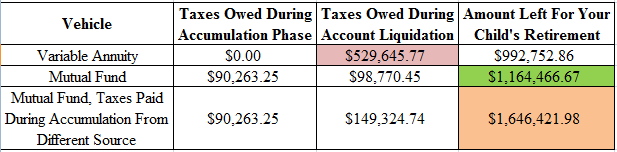
To make some final conclusions about which vehicle is better, we need to run some calculations using what we’ve learned. A copy of the spreadsheet that I put together is shown here, and I highlighted the key findings in the summary table below.
I included 3 scenarios – annuity, regular mutual fund, and a regular mutual fund where each year’s taxes are paid from another source other than distributed dividends.
Annuity
The first calculation I ran was for the stand alone variable deferred annuity. Even though the annuity did have a >2x higher expense ratio than the mutual fund account, the nice thing was that all of the money was able to compound free of taxes until withdrawal.
However, the annuity gets killed by taxes on the withdrawal side (see red highlighted box in table above), and results in the lowest amount of money left to your child.
Even though the contributions/premiums you paid in to the annuity are tax free to withdrawal, every bit of appreciation in account value beyond that gets taxed as ordinary income at 35% when it comes out.
This is somewhat unfair because much of that increase in account value has been due to dividends (which would have been qualified if held outside of the annuity) and long term capital gains on shares you have held for MANY MANY years. However, these all get lumped as “earnings” in annuity language, which are taxable at the ordinary rate. It hurts!
Regular Mutual Fund
Even though the regular, taxable mutual fund account has a lower expense ratio than the annuity, the account gets beat out during the accumulation phase by the annuity since a portion of the distributed 4.40% annual qualified dividend are being used to pay the 15% tax on said ordinary dividend.
However, the benefits on the liquidation side make up for any accumulation shortcoming, allowing for the final after-tax amount of the mutual fund to be >17% higher than that of the annuity (green highlighted cell in above table).
“How does this happen?” – you might be asking.
Essentially it boils down to 2 things:
- The total stock market mutual fund is very tax-efficient during holding, since it only resulted in qualified dividends (which are taxed at a lower, 15% rate) and no capital gains distributions during accumulation, and
- The preferential treatment given during liquidation regarding reinvested dividends and sales from long-term stock holdings that are not allowed in the annuity structure:
- If you remember, with the annuity, all increase in account value beyond what you paid in as contributions/premium got converted to normal income @ the 35% income tax rate.
- For the regular stock mutual fund, you only pay 0.13% of the account’s pre-liquidated accumulation value at a higher 35% short term capital gains rate, whereas in the the annuity, you paid ~35% of the accounts value in taxes at the higher rate.
- This is because in the mutual fund, the only short term holding held less than one year will be the penultimate reinvested dividend. The rest is either recovery of cost basis or taxed at the long term capital gains rate of 15%.
- Regarding dividends, with the annuity, dividends earned by the sub-accounts are viewed as earnings and are therefore taxed at withdrawal as normal income. With the mutual fund, the qualified dividends are distributed to the investor, which then you can use to purchase additional shares, increasing your ending cost basis.
Regular Mutual Fund, But Paying The Qualified Dividend Tax From Another Source
One of the books that I recently read was Ric Edelman’s (one of my favorite authors in finance) book, The Truth About Money. In the book (page 84 to be exact), he mentions that, “In all our 1,000+ collective years of practice as financial planners and investment advisors, having worked with thousands of clients and with $5 billion in client assets, we have never seen a client sell a bond or liquidate a bond fund in order to raise the cash needed to pay the taxes that Schedule B are owed.”
And, reading this got me thinking about how it might apply to this strategy of saving money for a child’s retirement. What this means is that in practice, normal folks might pull the money for the dividend taxes owed on the mutual fund from another source vs using the account value and/or dividend to do so. And, if this were the case, I was curious what financial ramifications it woudl have for the child’s retirement savings.
Taking this in to consideration, I put together the 3rd scenario analysis listed in the table above.
Using this strategy, having a similar liquidation scheme as the regular mutual fund scenario described previously, your child would end up with >61% more money (tan cell in above table) than the annuity strategy, and >41% more money than the mutual fund strategy where account value is used each year to pay taxes. Not too shabby, right?!
Conclusions
In summary, we have laid out several criteria needed for an appropriate account/savings vehicle in which to place the $1 per day that we discussed in Part 1 that could make your child a millionaire by the time he or she retires. By doing this, we narrowed down the options to 2 vehicles – 1) a deferred variable annuity and 2) a regular, taxable mutual fund.
From there, we found that even though annuities defer taxes during the accumulation phase, the fact that all increases beyond contributions are treated as earnings/ordinary income causes annuities to be more expensive to access during retirement than a taxable mutual fund. The end result is that from a mathematical perspective, saving the $1 per day in a regular mutual fund allows you to be better off.
Of course, there are some instances outside of the realm of mathematics where annuities may indeed make sense. For example, since annuities are classified as insurance contracts, they are likely to be more shielded from creditors than a traditional mutual fund account. Further, many offer some sort of death benefit guarantee. Finally, the fact that annuities do have the 10% withdrawal penalty can be beneficial if you are the type of person that might be tempted to access a mutual fund account prematurely.
However, it is my belief that for the majority of “normal” folks, saving the $1 per day in a regular mutual fund account with Vanguard or Fidelity will beat out an annuity.
How about you all? What type of savings vehicle do you use to save money for your child’s financial future?
If you don’t currently save in this fashion, hypothetically, which type of savings account do you think would be best suited for your needs if you were to do so?
Share your experiences by commenting below!
***Photo courtesy of http://www.flickr.com/photos/86530412@N02/7960787444/sizes/m
How Can Normal Folks Make Their Child A Millionaire? – Part 1 – The $1 Per Day Automatic Transfer

 Recently, I read a fairly intriguing book by Kevin McKinley, CFP, entitled, Make Your Kid a Millionaire: 11 Easy Ways Anyone Can Secure a Child’s Financial Future.
As the title suggests, the book’s overall message is that if you take some well-timed (early), pro-active steps, it is possible for people of many economic backgrounds to easily accumulate a large amount of wealth for their child by the time the child reaches retirement.
While there are many specific points covered in the book regarding trusts, taxes, rules of children earning income, etc, there are key two questions/themes that I wanted to explore as a result of reading this book. These are listed below:
- Question # 1 – What, when, why, and how should you start saving for your child’s financial future/retirement?
- Question # 2 – Having established a savings strategy, what is the best type of account/vehicle in which to save for your child?
Part 1 of this series will cover Question #1. Let’s get started!
Chapter 1 of McKinley’s book starts off with a brief ~100 word mentioning of a very potent savings strategy to set up a bright financial future for your child. And, I feel it is worthwhile to spend some more time discussing/elaborating on it. He states that setting aside “$1 every day will result in a millionaire kid later,” however, does not really get in to any additional specifics to execute this strategy.
Why Saving $1/Day For Your Child Can Create A Millionaire
In a nutshell, saving only a small amount of money each day can lead to a large amount later due to the concept of Time Value of Money (TVM), or as it’s often coined, the Miracle of Compounding Interest. Both of these terms have been discussed several times previously on my site.
This is the idea that saving (instead of spending) money today will accumulate to be worth more later in time because interest is earned each period, which then is eligible to earn future compounding interest on top of itself.
What is the Best Way to Save $1/Day For Your Child?
If you’ve been reading this blog for a while, you likely know what my take will be on the best way to save small amounts of money, consistently, over long periods of time.
That’s right – Automatic, pre-scheduled transfers from your checking account to your savings account/vehicle of choice (accounts will be discussed in-depth in part 2 of this series).
The reasoning behind using automatic transfers is 1) so you don’t forget to make the transfer each day/week/month and 2) to play a little psychological “trick” on your financial mind to cause you to miss the money less.
While each financial institution/account will do things slightly different, the ones I have experienced thus far will, unfortunately, not allow you do make 31 daily $1 transfers each month. Instead, many of them will have either $10 or $50 transfer minimums. This is not a show-stopper. You simply adjust the contribution frequently to match what $1 per day would equal and then proceed as planned, accounting for it in your zero-based budget.
When to Start Saving $1/Day For Your Child
Of course, the ideal answer here is “as soon as possible,” stemming from the fact that the earlier you can get compound interest working for you, you will have almost exponentially more money in the end. Unfortunately, I don’t think that is very realistic if you’re in a situation where you don’t plan on having kids for several years in to the future.
However, a good compromise to utilize going forward might be to start saving the $1/Day 9 months to 1 year before the child is born.
So, Just How Much Money Can $1/Day Translate To For Your Child’s Retirement Years?
To my fortunate surprise, saving just $1 per day translates to more money than I would have guessed before beginning this analysis.
For illustrative purposes, I put together the Google Docs worksheet at the following link for you all to download and play around with if desired – How Much Money Can $1 Per Day Lead To?
According to The Washing ton Post, the average age a person has their first child today is between the ages of 25-26 years old. If we assume that a parent starts stashing away $1 per day at the age of 25 (~1 year before the baby is born) and invests the money in a stock market mutual fund earning 10% per year, the following results are obtained:

- Saving $1 per day until your child finishes college (~ age 23) will yield >$1.9 million for your child when he or she reaches retirement age.
- If you wanted to be aggressive and save $1 per day PER PARENT ($2 per day) for your child in the same fashion, this would translate to >$3.9 million.
Intriguingly, and also demonstrating that compound interest over long time periods is the key factor in savings growth here is the observation that if you were to continue saving $1 per day for your child until they are AGE 65 (the parent is age 91), it results in a nest egg of $2.1 million, only 11% more than if you stopped contributing 40 YEARS EARLIER when the child was 23 years old. Crazy, eh?!
Conclusions / Looking Ahead to Savings Vehicles (Part 2)
Clearly, just a little bit of foresight/financial knowledge and only several minutes of your time to execute the strategy of saving just $1 per day for your child can lead to a significant amounts of money for his or her future due to the workings of 65 years of compounding interest.
Of course, these calculations do not take inflation in to consideration, meaning that being a millionaire when your child retires may not mean the same as it does now. In addition, if you want your child to go to a fancy private university that costs $40k per year, saving just $1 per day is not going to be sufficient, as you’d only have around $40k saved up by the time your child goes to college.
We’ll take this in to consideration in Part 2 of this series when we examine which is the most appropriate vehicle/account to save money in when trying to make your child a millionaire. Stay tuned!
How about you all? What sort of money saving strategies, if any, do you employ for your children?
Share your experiences by commenting below!
***Photo courtesy of http://www.flickr.com/photos/85583346@N00/167558529/sizes/