

- You are here:
- Home »
- Blog »
- Invest & Retire »
- How Can Normal Folks Make Their Child A Millionaire? – Part 2 – Which Savings Account/Vehicle Should Be Used?
Groups I Am a Part Of


How Can Normal Folks Make Their Child A Millionaire? – Part 2 – Which Savings Account/Vehicle Should Be Used?
 In this post series, we are examining questions that came up while recently reading Kevin McKinley’s book entitled, Make Your Kid a Millionaire: 11 Easy Ways Anyone Can Secure a Child’s Financial Future.
As the title suggests, the book’s overall message is that if you take some well-timed steps, it’s easy to accumulate a large amount of wealth for your child by the time the he or she reaches retirement. While there were many specific points covered in the book, the two key questions/themes that I am exploring in this post series are listed below:
- Question # 1 – What, when, why, and how should you start saving for your child’s financial future/retirement?
- Question # 2 – Having established a savings strategy, what is the best type of account/vehicle in which to save money for your child?
In Part 1 of this series, we found that because of the power of compounding interest, saving $1 per day starting when your child is conceived through the time he or she graduates from college can yield almost $2 million for them by the time they are ready to retire.
Having been convinced of the importance of starting to save for your child’s financial future and developed a strategy, the question then becomes, “In what type of account/savings vehicle do you place your child’s retirement savings?”
Let’s explore this concept a little more in-depth today!
Requirement Criteria for Savings Vehicles
Let’s face it – there are a myriad of options available in today’s competitive market place for savings vehicles. So, how does one decide which type of account is best to use?
In order to help with the selection, I’ve listed the criteria I would use to help narrow down the options:
Criteria #1 – Account must have low cost, passively-managed equity index mutual funds. As we’ve established many times before, index funds beat 70% of professional active money managers, so I have no business trying to actively manage my funds as a part-timer. We want to have the account eligible for equity (stock-based) mutual funds because our investment time horizon is 65 years, meaning that we can shoulder a lot of risk during that time period and do not need to add much in the way of fixed income instruments. As such, this rules out products such as whole life insurance and a tax-exempt municipal bond fund.
Criteria # 2 – Account will not be used for short-term child financial needs, but rather for the child’s financial future near/during retirement. As we discussed in Part 1, the goal of saving $1 per day for your child is not to cover the ever-expensive cost of raising a kid (nor would it yield a sufficient amount of money in a short period), including sending them to whatever college they choose. As such, tax advantaged college savings plans, including Coverdells, 529s, UTMAs, etc, are disqualified from the selection.
Criteria #3 – Account has no income requirements and is not required to be transferred out of your personal control at a set point and/or is owned by the child. If all goes according to plan, the $1 per day that you gradually save will be transferred to your honest, hard-working, deserving child when they reach a ripe retirement age. However, if your child turns out to be someone who misuses money and cannot be trusted, you want to make sure that you can retain control over the savings. Taking this criteria in to consideration exludes IRAs / 401ks in the child’s name from the running. Even though you could technically save money in YOUR OWN IRA/401k and simply use it for your child once you are retired, we will work under the assumption that YOU need your retirement savings.
Having laid out these 3 criteria, where does that leave us?
Essentially, 3 options remain – a taxable/regular mutual fund account in your name, a variable annuity in your name, or some form of trust set up by a lawyer. While I do believe that trusts are a suitable option (will be covered in an upcoming post by one of our staff writers, Jeff), this post is aimed at things normal folks can do. Thus, we’ll limit it to accounts that can be set up without paying lawyer fees.
Deciding Between a Taxable Mutual Fund Account and a Variable Annuity
In his book, McKinley’s calculations come to the conclusion that a variable annuity will result in more money during retirement for a child vs. a taxable mutual fund account.
The reasoning provided behind this is that the tax-deferral in an annuity provides more money to be eligible for compounding vs. a mutual fund. However, in his calculations, McKinley assumes that the taxable mutual fund earns 10% each year and distributes all of these gains as normal taxable income. He then proceeds to say that this calculation may not accurately represent how mutual funds today operate. Thus, I wanted to see what was really going on here.
Having covered the ins and outs of annuities pretty in-depth in a recent post, I just wanted to provide a brief summary of annuity characteristics:
- Annuity contributions are after-tax and grow tax-deferred until withdrawal eligible at the age of retirement (59.5 years of age).
- Your savings/contributions and/or earnings are NOT accessible prior to the age of 59.5 without a 10% penalty.
- Since in this instance, we are not interested in withdrawing money prior to the child retiring, the 10% penalty can be ignored.
- Ordinary income tax is owed on all withdrawals (early or after age 59.5) of annuity earnings but never for recovering your contributions/basis.
- Annuities can have higher fees.
For our comparison, we’ll assume:
- 10% gross annual return on mutual funds inside the annuity and taxable investment account.
- Invest $1 per day from 1 year pre-birth to when the child graduates college at age 23.
- Fees/Expense Ratios:
- Taxable account mutual fund charges a fee of 0.17% per year (same as Vanguard Total US Stock Index Fund).
- Variable annuity charges a fee of 0.48% per year (assumes we are investing in a low cost Vanguard annuity, Total Stock Market Index Portfolio option).
- Ignore gift taxes/the cost to transfer the savings to your child at retirement age and transaction fees.
- Constant level total ordinary income tax bracket = 35%.
- All dividends and capital gains distributions are re-invested back to the vehicle. For the regular mutual fund account, we’ll assume that you reinvest the dividend after using it cover the taxes owed for that year.
A Detailed Look at What Taxes Are Owed on Regular Mutual Fund Holdings in a Year
Before we proceed, we need to obtain an in-depth understanding of exactly what tax liability we are responsible for each year by holding the Total Stock Market Index mutual fund in a regular account.
In other words, if we assume a 10% increase in account value each year, how much of that gain will be owed in taxes in the specific year that will affect our compounding interest power? My first guess is that it is not the full 10% account value increase…
To review, there are 3 primary ways that an equity mutual fund can result in taxes that you have to pay:
- #1 – The mutual funds issues you a dividend, or a set percentage of each share’s value that you are holding.
- Ordinary dividends are taxed as ordinary income at your normal income tax rate (%35 in our example).
- Qualified dividends are taxed at a reduced, 15%, level.
- #2 – You did NOT sell any shares of your mutual fund, however, you still may owe capital gains taxes for the underlying stock transactions the fund managers executed throughout the year (reported on 1099-DIV form).
- # 3 – You (or your estate) sells your shares of your mutual fund directly when you are ready to hand the money over to your child in retirement, causing you to owe (mostly long-term) capital gains taxes (reported on 1099-B form / Schedule D).
- In either #2 or #3, there are 2 levels of capital gains taxes that can be paid.
- Short-term (less than 1 year, 1 day) capital gains taxed at ordinary income/ordinary dividend tax rate (35% in our case).
- Long-term capital gains taxed at lower, 15%, rate.
To figure out how much tax the dividends and capital gains distributions would translate to on a per year basis to pay, I looked back on my 1099-DIV for 2010, 2011, and 2012 from Vanguard for a similar fund.
- In all 3 of these years, 100% of the dividends I received were qualified, meaning they would be taxed at the lower, 15% tax rate provided I didn’t sell any of the shares shortly after the ex-dividend date.
- According to this site, the >100 year average dividend yield for the overall stock market is 4.40%, meaning about 1/2 of our assumed return comes from dividends. I very much doubt dividends will be this high going forward, but I cannot predict the future, so we’ll use this.
- In all 3 of these years, I received $0.00 in total capital gains distributions.
- Therefore, we’ll ignore capital gains distributions and assume a 4.40% annual qualified dividend in our example.
- Essentially, this means that this mutual fund is VERY tax efficient, just as the passive investing books say it is.
- Intriguingly, in looking back at my Vanguard transactions for the past few years, the ONLY capital gains distributions I have incurred were with bond funds. Crazy eh?!
So, Which Vehicle Will Give Your Child More Money When They Retire?
As we’ve seen so far, deciding between a deferred variable annuity and a regular taxable mutual fund account for long term savings for your child’s retirement is not exactly simply. Furthermore, it requires quite a bit of knowledge of the tax code as well.
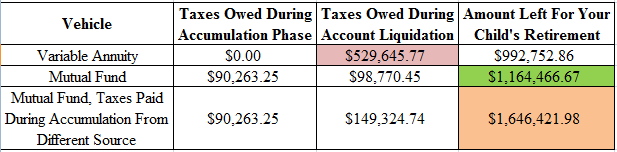
To make some final conclusions about which vehicle is better, we need to run some calculations using what we’ve learned. A copy of the spreadsheet that I put together is shown here, and I highlighted the key findings in the summary table below.
I included 3 scenarios – annuity, regular mutual fund, and a regular mutual fund where each year’s taxes are paid from another source other than distributed dividends.
Annuity
The first calculation I ran was for the stand alone variable deferred annuity. Even though the annuity did have a >2x higher expense ratio than the mutual fund account, the nice thing was that all of the money was able to compound free of taxes until withdrawal.
However, the annuity gets killed by taxes on the withdrawal side (see red highlighted box in table above), and results in the lowest amount of money left to your child.
Even though the contributions/premiums you paid in to the annuity are tax free to withdrawal, every bit of appreciation in account value beyond that gets taxed as ordinary income at 35% when it comes out.
This is somewhat unfair because much of that increase in account value has been due to dividends (which would have been qualified if held outside of the annuity) and long term capital gains on shares you have held for MANY MANY years. However, these all get lumped as “earnings” in annuity language, which are taxable at the ordinary rate. It hurts!
Regular Mutual Fund
Even though the regular, taxable mutual fund account has a lower expense ratio than the annuity, the account gets beat out during the accumulation phase by the annuity since a portion of the distributed 4.40% annual qualified dividend are being used to pay the 15% tax on said ordinary dividend.
However, the benefits on the liquidation side make up for any accumulation shortcoming, allowing for the final after-tax amount of the mutual fund to be >17% higher than that of the annuity (green highlighted cell in above table).
“How does this happen?” – you might be asking.
Essentially it boils down to 2 things:
- The total stock market mutual fund is very tax-efficient during holding, since it only resulted in qualified dividends (which are taxed at a lower, 15% rate) and no capital gains distributions during accumulation, and
- The preferential treatment given during liquidation regarding reinvested dividends and sales from long-term stock holdings that are not allowed in the annuity structure:
- If you remember, with the annuity, all increase in account value beyond what you paid in as contributions/premium got converted to normal income @ the 35% income tax rate.
- For the regular stock mutual fund, you only pay 0.13% of the account’s pre-liquidated accumulation value at a higher 35% short term capital gains rate, whereas in the the annuity, you paid ~35% of the accounts value in taxes at the higher rate.
- This is because in the mutual fund, the only short term holding held less than one year will be the penultimate reinvested dividend. The rest is either recovery of cost basis or taxed at the long term capital gains rate of 15%.
- Regarding dividends, with the annuity, dividends earned by the sub-accounts are viewed as earnings and are therefore taxed at withdrawal as normal income. With the mutual fund, the qualified dividends are distributed to the investor, which then you can use to purchase additional shares, increasing your ending cost basis.
Regular Mutual Fund, But Paying The Qualified Dividend Tax From Another Source
One of the books that I recently read was Ric Edelman’s (one of my favorite authors in finance) book, The Truth About Money. In the book (page 84 to be exact), he mentions that, “In all our 1,000+ collective years of practice as financial planners and investment advisors, having worked with thousands of clients and with $5 billion in client assets, we have never seen a client sell a bond or liquidate a bond fund in order to raise the cash needed to pay the taxes that Schedule B are owed.”
And, reading this got me thinking about how it might apply to this strategy of saving money for a child’s retirement. What this means is that in practice, normal folks might pull the money for the dividend taxes owed on the mutual fund from another source vs using the account value and/or dividend to do so. And, if this were the case, I was curious what financial ramifications it woudl have for the child’s retirement savings.
Taking this in to consideration, I put together the 3rd scenario analysis listed in the table above.
Using this strategy, having a similar liquidation scheme as the regular mutual fund scenario described previously, your child would end up with >61% more money (tan cell in above table) than the annuity strategy, and >41% more money than the mutual fund strategy where account value is used each year to pay taxes. Not too shabby, right?!
Conclusions
In summary, we have laid out several criteria needed for an appropriate account/savings vehicle in which to place the $1 per day that we discussed in Part 1 that could make your child a millionaire by the time he or she retires. By doing this, we narrowed down the options to 2 vehicles – 1) a deferred variable annuity and 2) a regular, taxable mutual fund.
From there, we found that even though annuities defer taxes during the accumulation phase, the fact that all increases beyond contributions are treated as earnings/ordinary income causes annuities to be more expensive to access during retirement than a taxable mutual fund. The end result is that from a mathematical perspective, saving the $1 per day in a regular mutual fund allows you to be better off.
Of course, there are some instances outside of the realm of mathematics where annuities may indeed make sense. For example, since annuities are classified as insurance contracts, they are likely to be more shielded from creditors than a traditional mutual fund account. Further, many offer some sort of death benefit guarantee. Finally, the fact that annuities do have the 10% withdrawal penalty can be beneficial if you are the type of person that might be tempted to access a mutual fund account prematurely.
However, it is my belief that for the majority of “normal” folks, saving the $1 per day in a regular mutual fund account with Vanguard or Fidelity will beat out an annuity.
How about you all? What type of savings vehicle do you use to save money for your child’s financial future?
If you don’t currently save in this fashion, hypothetically, which type of savings account do you think would be best suited for your needs if you were to do so?
Share your experiences by commenting below!
***Photo courtesy of http://www.flickr.com/photos/86530412@N02/7960787444/sizes/m
About the Author Jacob A Irwin
Hi folks! My name is Jacob. I am the owner and operator of My Personal Finance Journey. I started this blog in January of 2010 and have enjoyed the journey ever since. Since finishing up graduate school in Virginia in 2014, I have been working in biopharmaceutical development in Colorado. You can read more about me and this site here. Please contact me if you have any questions!
Related Posts
Maximizing Your Nest Egg: How to Make the Most of IRA Investments
Conversations to Have Before Your Child Goes to College
Is Your Employer’s Group Life Insurance Enough?
Three Tax Strategies to Consider Before Selling an Investment Property
4 Dumb Mistakes Smart People Make with Their Money
Popular posts
Session expired
Please log in again. The login page will open in a new tab. After logging in you can close it and return to this page.
Even though he’s only 12, we trust that our kid will not become a spendthrift in his later years. We thus plan to contribute dollar-for-dollar to a Roth IRA for him, up to the contribution limits, as soon as he has earned income. That should give him the most money over time.
Bryce @ Save and Conquer recently posted…The Most Popular Retirement Investment