

All posts by Jacob A Irwin
Save Money By Taking A Camping Vacation
 This is a post by MPFJ staff writer, Jeff. Jeff writes about Sustainable living and finances at his website, Sustainable Life Blog. Enjoy!
Summer is almost over, and for those of you still looking to get a quick and enjoyable vacation in but don’t really have a lot of money in your budget for one, consider heading out to do one of my favorite frugal vacation activities: Camping.
For those of you that have never been, or have not been for an extended amount of time, camping is a great way to save quite a bit of money on one of the biggest expenses that you can generate while travelling – lodging. Some campgrounds are free, and some charge a nominal fee – I think that the most that I’ve paid was $18 per night while camping, and a lot of times its less than $10, or free.
What you’ll need
Obviously, you can’t just toss a few blankets in the car and head up to the forest or the nearest national park and toss them on the ground where you see fit and call it good. First, you could get rained on, which would make you miserable and probably never want to camp again. You also could be causing significant damage to plants and animals (or life-sustaining desert bacteria).
Below are a few things you’ll need to get camping:
- Sleeping bag – They sell these in different temperature ratings, I’d suggest getting one that suits your area well and the seasons you plan on camping. Don’t get a -20F bag if you live in Florida.
- Tent – Keeps the rain and bugs out
- Flashlight – For when it gets dark
- Optional – Foam pad or Thermarest for sleeping on – they help a lot.
You’ve probably already got a flashlight laying around the house, and if you need anything else, I’d check your local Craigslist or perhaps a second-hand sporting goods store. Typically, people get tired of the smaller tents or grow out of them, and they still work just fine. Once you get all of your gear collected, it’s time to find a spot to go camping at.
Finding a Spot to Camp
I live in a state that’s owned about 66% by the federal government, so there is a lot of BLM lands for camping, as well as national parks and forest service land. In addition to all those, I believe all states have state park systems that allow camping. Some areas have campgrounds where there are a lot of tents/rv’s and campers in the lot, or others are “dispersed” which simply means that you find a good spot to pitch your tent and stay there for the time being.
Finding a place to camp is no easier or more difficult than finding a hotel – it will just vary depending on the area. Obviously, you’re not going to find any good places to camp in downtown San Francisco if you were interested in soaking up the city, but there are plenty of places to camp out in the country where the scenery is different (and there are not a lot of hotels.
Once you are at your camp site, the real fun begins. There are usually hikes to go on or great scenery to see. If you’re camping at a national park, there are ranger walks to teach you about the area, a visitors center with history of the park and a small gift shop.
If you’re worried that you don’t have a camping stove or anything like that, it’s not really necessary. You can take sandwiches or other foods that are served cold for dinner, and prepare breakfast burritos for the morning. If you’re dying for a hot meal, wrap your burritos in a few layers of foil and place them near (not in) the fire for a minute or two, and make sure to flip it around.
All in all, camping is a great way to have a frugal family vacation, and with the summer winding down many campers have headed home for the year so you could get the place all to yourselves.
How about you all? Do you enjoy camping? What is your favorite spot to camp, and what sort of activities do you normally do when camping?
Share your experiences by commenting below!
Costs of Long-Term Disability & The Social Security Benefits Application Process / Payout – Lessons From Personal Experience

 The following post is by MPFJ staff writer, Kelly Gurnett. Kelly runs the blog, Cordelia Calls It Quits, where she documents her attempts to rid her life of the things that don’t matter and focus more on the things that do. You can also follow her on Twitter and Facebook.
More than 9 million Americans are currently on or applying for Social Security Disability benefits due to long-term illnesses and medical conditions. And my husband is one of them.
In April of this year, his Fibromyalgia (a neurological disorder that manifests itself in a myriad of unpredictable symptoms) finally got the better of him, and he had to stop working for good. He’d been powering through his symptoms for a while as they got progressively worse, but finally it got to the point where he just couldn’t do it anymore. When he finally sat me down and said he’d reach his breaking point, I knew he was right.
There was no question whether or not he should stop being a hero and apply for disability; the only question was how on earth we were going to afford the process and everything that comes with it.
Applying for Benefits
The disability application process, on average, can take anywhere from 2-3 years.
It’s pretty much a given that your first application will be denied. In fact, our disability attorney actually told us to make our initial application on our own and just keep him in the loop, since there was no point racking up attorney’s fees when he already knew we’d be denied. Once we are denied, then he’ll take over for the appeal.
I understand that people try to take advantage of the system, and that the government needs to be stringent to keep this from happening. But sometimes the red tape put in place to keep out scammers winds up hurting those who really do qualify. I recently watched my sister’s boyfriend, who was in Hospice care with terminal cancer, battle the endless information requests and double-checks of a process that didn’t believe he merited disability status. So I knew going in that this wouldn’t be a quick or easy road for us.
For anywhere between 2-3 years, we’ll be surviving on one income, plus all the costs that come from having a disability and undergoing the application process. It can be incredibly overwhelming. Which is why I wanted to share with you what we’ve learned so far, so that if you or a loved one are considering applying, you know exactly what you’re in for.
Loss of Income (and Potential Gain of Debt)
You can’t work during the Social Security Disability application process—which, as we’ve seen, can be quite long. So, from the moment you decide to apply (and you should do it sooner rather than later due to the time period), you should brace yourself for a long haul without one of your income streams. If you live with a spouse, partner, roommate, or family, you can rely on their incomes to at least cover some of the household expenses. But you’re still one full income short, and that’s never easy.
A former coworker whose brother also suffers from Fibromyalgia told me that, over the course of his brother’s application and appeals process, he racked up so much credit card debt just trying to meet monthly expenses that he wound up having to declare bankruptcy. This situation is, unfortunately, more common than you’d like to think.
Drastically Reduced Income Once You Do Have Benefits
Even if you are granted benefits, it hardly solves all your financial problems. The amount you’re awarded depends on how long you’ve been working and how much you’ve earned over that period, but it will only be a percentage of what you were used to bringing in each month. You can use these calculators to see how much you would receive. After you have received Social Security Disability Insurance for 2 years (there are ways to qualify for Medicaid in the interim – click here to learn more) you will automatically qualify for Medicare coverage, which helps a little, although your spouse and any children will still have to find their own coverage.
There is no hard and fast rule of thumb for calculating benefits, as the Social Security Administration (SSA) uses “a complex weighted formula.” According to the site, Disability Secrets, “Most SSDI recipients receive between $300 and $2,200. The average SSDI payment in 2013 is $1,132. The maximum disability benefit in 2013 is $2,533.”
Should you decide you want to try taking on a part-time job once you’ve been granted benefits, there’s a cap on how much you can earn per month. This amount is currently $750. If you wind up earning more than $750 per month, there’s a process of various “trial” and “extended” periods during which the government basically waits to see if you can sustain that level of earnings for a substantial period of time. When your earnings stay too high for too long, you lose your benefits.
With my husband’s condition, most part-time jobs won’t work for him. He’d be great working in a movie or video game store, but he can’t stand for very long and gets tired after being “on call” for too long. He could deliver pizzas, but then (as with pretty much any part-time job), you’re on a set shift schedule, and his symptoms are so unpredictable he’d wind up missing too many assigned days and would inevitably be fired.
If he is able to find something he can realistically do, he’ll probably try to—but our household income will still be considerably less than it was when we were both working full-time.
Medical Expenses
Having a disability or lifelong medical condition, by its nature, means you’ve got more the average amount of medical costs. Since my husband’s condition exhibits itself in a wide range of nebulous symptoms—from muscle pain to heat sensitivity to exhaustion to nausea—he has a number of specialists, frequent check-ins with his primary doctor, and a list of prescriptions so long we have to write them down so he remembers to take them on time.
These things are not cheap, even with insurance. My husband has several doctors’ visits a month, at a cost of $30 a pop under our copay. He needs to have blood work and other tests done, and (as aforementioned) is on a ridiculously long list of medications. One new experimental drug he’s trying costs $150/month with insurance. (Although we found out after he bought his first month’s supply that the manufacturer offers a discount if you can get your doctor to prescribe three months’ worth at a time.)
Oh, and that insurance coverage we have? Since I’m a freelancer and we used to get our coverage through my husband’s employer, we’re now getting COBRA coverage at an out-of-pocket cost of $808 a month. That’s nearly how much he used to bring home in a two-week pay period. But, with a condition like his, not having any coverage is out of the question. And the way New York State health care works, the cheapest independent coverage we could find for two people wasn’t much cheaper than COBRA and only covered emergency situations (not regular doctor’s visits or prescriptions)—which was basically worthless to us.
Begin to see how easy it is to go bankrupt during this process?
The Application Process Itself and Attorney Fee Structure
In the appeals process, the government is extremely tough on you as they try to prove why you do not qualify for disability. For instance, you will have a court hearing with a federal “career expert” who will try to testify that you could technically do certain jobs, even with your disability.
This “expert” is often operating from a handbook that has not been updated since…well, let’s just say that our attorney was representing a client in the early 2000s who was told he could be a “phonograph repairman.” (I kid you not.) The running joke between my attorney and his staff is that they could wheel a client in on a hospital bed, hooked up to life support, and the “career expert” would still tell them that he could work as a stamp licker. To get through the red tape, anticipate road blocks like this and know how to get around them, having an attorney on your side who is well-versed in the appeals process is your best bet.
We don’t have to pay our attorney any fees upfront (except for occasional disbursements like postage if he needs to send something via Certified Mail to Social Security). After all is said and done, if my husband is awarded benefits, our attorney will get a percentage of his awarded amount (25%), to be capped at $6,000. So technically, nothing out of our pocket, although our initial awarded amount will be reduced. Once he’s gotten his fees, however, any future payments we get from Social Security will be 100% ours.
Benefits will be retroactive to when my husband applied, which will help us greatly if and when we do receive them but doesn’t do much for us now—or over however many months (or years) it will take to qualify for them.
What Can You Do to Prepare Yourself? – Emergency Funds and Private Disability Insurance!
Some disability situations—like a car accident or a sudden diagnosis—can’t be planned for. But others, like my husband’s, you might be able to see coming.
As I talked about in a previous post, we both knew in the back of our minds that eventually the time would probably come when he would have to stop working. But neither of us expected it would happen so soon, and my husband kept the severity of his decline to himself so he wouldn’t worry me. So we weren’t prepared for it to happen as soon as it did.
Start an Emergency Fund!
If you or your partner has a medical condition you can foresee leading to disability, start putting money aside for an emergency fund now. It can help soften the blow when you stop working and carry you through some of the lean times during the application process.
Sign up for Private Disability Insurance
Also be sure to sign up for disability insurance. My husband qualified for short-term disability insurance through his employer, so we’re fortunate enough to be eligible for 6 months of benefits so long as his doctor provides regular updates on his condition. The amount we get is only a fraction of what his salary used to be, but at least it’s something. Once those 6 months run out, we’ll have to find some way to cover that extra gap in our income.
When it comes to short-term private disability coverage (like we have), it usually maxes out at 6 months, and it takes much longer than that on average to have your Social Security Disability application approved, so using both in conjunction is rarely even an issue. If you purchase long-term disability insurance, it’s up to your individual policy whether they’ll pay out if you’re getting SSDI, but it does not affect whether SSDI will pay you. So yes, you can receive SSDI and payments from a private long-term disability plan, and it won’t affect how much you receive from SSDI. The government will not take that into consideration when determining your benefits.
The costs of short- and long-term disability insurance plans vary. Most will cost you between 1-3% of your gross income. In our case, we were paying I believe $20-something per month (which came straight out my husband’s paycheck). But, you’d need to check to see if your employer offers this benefit (if not, you’ll have to pay for it privately) and what the specific details are.
Finally, when you do file for benefits, I’d recommend going the route we are and making your first application on your own. Setting up a no-cost initial meeting with an attorney who can answer any questions you might have can help, but there’s no point in paying extra fees until you get to the appeals point and really do need expert help. The initial application is largely a matter of filling out a lot of paperwork about your condition. It’s a pain in the neck, but it isn’t something you need a law degree to do.
And please, please be careful about which attorney you hire. The big-name disability firm we called first—who we knew of because their name is plastered over every possible advertising medium in our area—told us they wouldn’t even talk to us until my husband had been out of work for a full 12 months. (Although when I asked, “How are we supposed to survive those 12 months?” they were more than happy to transfer me over to their bankruptcy department!) When our current attorney was not only willing to meet with us just 2 weeks after my husband lost his job, but told us upfront there was “no point lining his pockets” until we needed his help with an appeal, we knew we’d found one of the good guys.
Bottom line? Nothing to do with a disability—from its financial repercussions to the daily toll it takes on you and your loved ones, both physically and emotionally—is easy. But, if you arm yourself with the right information and make smart decisions, it is possible to make it through the process. Be willing to make some serious budget cuts, be patient, and don’t lose hope.
How about you all? Have you or a loved one applied for disability benefits? What advice would you give others from your experience?
Share your experiences by commenting below!
***Photo courtesy of http://www.flickr.com/photos/safari_vacation/8020820411/sizes/m/in/photostream/
Cavalcade of Risk #190 – August 21st, 2013 Edition

 Welcome everyone to the (190th!) August 21st, 2013 edition of the Cavalcade of Risk. The Cavalcade of Risk (or Cav of Risk for short), as is implicated by the name, is a bi-weekly blog carnival that features the top articles regarding risk management. Several of the realms of risk management covered relate to finances, insurance, and health.
My Personal Finance Journey is honored to be hosting the Cav this week! I hope you enjoy the articles below and can stop by my site on my non-carnival days as well. If you’re interested in receiving email updates of my posts, simply click here to sign up.
Without further ado, let’s get on with the Carnival. Listed below are this week’s Top 3 Editor’s Picks! Enjoy!
1. Matt from Mom and Dad Money presents, My Life Insurance Mistake, saying, “Just about two years ago, my wife and I found out that we were pregnant with our first child. After a few weeks of pure excitement, we got down to the business of planning. Finances were of course at the forefront of my mind. One of the first big things I knew we needed was life insurance. While I had a decent understanding of the general principles of life insurance, it was not something I had ever bought before and I felt a little uncertain as to how to go about it the right way. This uncertainty, combined with an anxiety to get things done quickly, led me to make some classic mistakes..”
2. RJ from Weissins presents, If You’re About To Hit One Of These 6 Milestones In Life, You Can Save Money On Auto Insurance, saying, “When it comes to saving money on auto insurance, timing can be just as important as which company you go with. Here’s six milestones in life in which you’re likely tio be able to save money on auto insurance soon after. .”
3. Bob from Worker’s Compensation presents, Why Men are More Likely to be Killed by Lightning (on the Job), saying, “A study just released shows that an overwhelming percentage of US lightning strike deaths are male, with a ratio of 6 to 1 over female strike deaths. I conducted my own analysis to parlay work related death information from this study, and came to some unique conclusions regarding why this may be..”
And, listed below are the rest of this week’s submissions. Enjoy!
Claire from The Insurance Information Institute presents, Many Companies See Value in Cyber Insurance, saying, “A majority of companies now rank cyber security risks as greater than natural disasters. However, only 31 percent of risk management professionals at companies surveyed by the Ponemon Institute say they have a cyber insurance policy. Companies with no plans to purchase this coverage (43 percent of respondents) say that it’s because of cost and too many exclusions, restrictions and uninsurable risks. Yet among those who do buy cyber insurance 62 percent believe the premiums are fair given the nature of the risk. Satisfaction with policies also runs high, the Ponemon study found..”
Jason from Healthcare Economist presents, Behavioral Hazard, saying, “Many familiar with insurance will know about the concept of moral hazard, but what is behavioral hazard? The Healthcare Economist explains..”
Well – that concludes this edition. Thanks for tuning in!
You can submit your blog article to the next edition of Cavalcade of Risk (hosted by Julie Ferguson at Worker’s Comp Insider) using the handy carnival submission form.
Also, if you are interested in hosting the Cavalcade of Risk in the future, just send Henry (the organizer) an email by clicking here.
***Photo courtesy of http://www.flickr.com/photos/obvio171/1056667567/sizes/m/in/photolist-2BnGsk-2BnMoD-2BnW8B-2Bo1uM-2B
Have You Considered Buying an Electric Car?

 The following is a post by MPFJ staff writer, Kevin Mercadante, who is a professional personal finance blogger, and the owner of his own personal finance blog, OutOfYourRut.com. He has backgrounds in both accounting and the mortgage industry.
If you know much about electric cars, then you know that the technology hasn’t entirely been perfected. They lack the power of gas-powered cars, they tend to be on the small size (commuter cars for the most part), and perhaps most disappointing here in the US, they have very limited range.
But as the years pass, the technology is improving, if only slowly, and the prices are becoming more reasonable in relation to conventional vehicles. Is it time to consider an electric car, even if they aren’t perfect?
Why now might be a good time to buy an electric car
Despite the limitations of electric cars, there are some strong advantages to owning one even now. This is especially true if you don’t drive great distances, and tend to keep your driving to less than 100 miles a day. If that describes your driving habits, here are some benefits to consider:
Saving money on gas. This is the most obvious and tangible benefit of owning an electric car. At current prices, if you are buying 15 gallons of gas to operate your vehicle every week (or driving about 300 miles per week), then you’re spending over $50 per week on fuel. That’s over $2,600 per year that you won’t have to pay if you have an electric car. Sure, your electric bill will increase to cover the cost of charging your car, but it won’t approach the amount of money you are currently paying for gasoline.
Protecting the environment. Since emissions from gas-powered cars are the leading source of air pollution, you’ll be doing your part to clean up the environment by driving an electric car. There is some environmental impact from the electricity that is being used to power your car, but since much of that comes from hydroelectric and nuclear power – an increasing amounts from solar and wind – the negative impact will be far less than for gas-powered cars.
Avoiding the worst of the next gas crisis/price spike. You’ll the counting your blessings if another gas crisis or major price spike hits and you already have an electric car. As a result, you will miss the worst effects of the rise in the price of fuel, but also of the endless hours waiting in line for a reduced amount of gas (we had that situation here in Atlanta in 2008, but it also happened twice in the 1970s). At a minimum, an electric car will allow you to get to and from work so that you will be able to earn a paycheck during the worst of crisis.
Getting in ahead of the herd. If some sort of gas crisis does occur – and you shouldn’t bet against it – an electric car may turn out to be a strategic asset. The price of these cars will soar as gasoline prices rise, but since you purchased yours already, you will have one in the lower price.
Electric car prices are falling steadily
As the technology improves and electric cars gain popularity and sales, prices on them are coming into line with that of conventional vehicles. While they are still more expensive than comparable economy cars, electrics are now reasonably priced compared to other vehicle types. If you are looking at full-sized cars, luxury cars, or SUVs, you may want to take a look at electrics. They can be less expensive, and provide many or all of the benefits listed above.
As a way to increase sales of electric cars, some manufacturers have even cut their prices, or are offering preferred financing deals, and even selling the cars at a loss. They see electrics as the wave of the future and worth subsidizing for the time being.
According to Kelly Blue Book, here are prices for five popular electric vehicles:
- 2014 Chevy Spark EV $29,650
- 2013 Nissan Leaf $27,495
- 2013 Fiat 500e EV $32,600
- 2013 Ford Focus EV $35,995
- 2014 Chevrolet Volt $39,995
Admittedly, these prices will rise with the addition of certain options. And electric cars are not without their limitations. The Nissan Leaf is unable to drive as many as 100 miles per day (a common limitation of electrics) and may not work if your job is upwards of 50 miles from home, or you like to go on long trips.
But all limitations notwithstanding, electric cars offer certain undeniable advantages. And as prices come into range with other vehicle types, those advantages become worth paying for.
How about you all? What do you think about electric cars? Has the time finally come? Or, do you think that the technology and price structure still need more time?
Share your experiences by commenting below!
***Photo courtesy of http://www.flickr.com/photos/chryslergroup/8229193772/sizes/
Gazelle Intensity Is Like Crash Dieting: Great For The Short-Term, But Not For The Long-Term

 The following post is by MPFJ staff writer, Melissa Batai. Melissa is a freelance writer who covers topics ranging from personal finance to business to organics to food. She blogs at Mom’s Plans where she shares her family’s journey to healthier living and paying down debt.
Have you ever gone on a crash diet before? You know, the kind where you eat grapefruit every day or you slash your calories to 1,000 or fewer a day?
Chances are, your extreme diet works great for the short-term, say a few weeks at most. If you need to lose 10 pounds to fit in your wedding dress, a crash diet may be just what you need.
On the other hand, if you need to lose 100 pounds, a crash diet will likely set you up for failure because you can’t thrive on such restriction over the long haul. Ultimately, you’ll likely follow your strict diet, and then, within a few weeks (or a few months if you’re really dedicated), you’ll be unable to take the deprivation any longer. You’ll be so ravenous that you’ll overeat. Sometimes you might overeat a lot. Before you know it, your weight is right where it was when you started the diet, or even higher.
How Paying Off Debt Can Be Like a Crash Diet
I know what you’re thinking. This is a personal finance blog. What does dieting have to do with finances?
Actually quite a lot, especially where debt is concerned.
Around the personal finance sphere, the most common advice that you’ll see is to pay off your debt first and as quickly as possible. Slash your spending and pay off the debt before you save for retirement or even build an ample emergency fund. Be disciplined, suffer through the deprivation, and then go on with your financial life when the debt is gone.
Just like a crash diet, this is great advice if you have, say $5,000 to $10,000 of debt to pay off. Depending on your income and discipline level, this can be knocked out in a few months to a year. Sure, you can put off emergency and long-term savings for 12 months. You can even live a life of deprivation for a few months to a year.
But, what if you have a lot of debt to pay off? What if you have $50,000 in debt to pay off (besides your mortgage) and you only make $50,000 a year? You can be as frugal as possible, but that debt isn’t going anywhere fast. In this case, you’re like the person trying to stay on a crash diet to lose 100 pounds.
Putting your life on hold, not saving for a rainy day and pouring all your money into the debt isn’t going to work in the long-term.
Change Behaviors First
We’re creatures of habit. Our habits can be good or bad. Just like an overweight person probably got that way by eating too much and eating the wrong foods, the same is probably true of someone in debt. If you’re in debt, you likely spend more than you earn each month, and you may be reliant on credit cards to buy something NOW rather than waiting and saving your money or finding a cheaper alternative.
If you’re going to successfully pay off debt and stay out of debt the rest of your life, that means you need to change your behaviors.
You need to be able to save money in an emergency fund. You need to be able to save for a replacement vehicle if your car is old and you know it will need to be replaced in the next few years. You need to save your money for smaller purchases that you want to buy like a new computer so you don’t go further into debt.
You need to get rid of the all or nothing view on debt repayment. Despite what bloggers and Dave Ramsey say, throwing all of your money on debt might not be the best idea if you have a large amount of debt to pay off.
Our Experience
I was a gung-ho-gazelle-intensity debt payer. My husband and I have credit cards and student loans to pay off, and we wanted the debt gone as soon as possible. I worked too many hours and my health and our relationship suffered.
I pulled back a little on the work and tried to reduce my stress, but I still embraced gazelle intensity. Over the next year, we made good headway on our debt while leaving our emergency fund at a measly $1,000. (Not smart, in my opinion, if half of your family income is variable as mine is and you also have children.)
As you can guess, we were hit by some unexpected expenses, and our emergency fund wasn’t enough. We went a few thousand dollars back in debt.
We recovered from that bump in the road and continued on with gazelle intensity. About 6 months later, we were hit with nearly $3,000 in-car repairs, and my income had a large dip for four months. This time, we went several thousand dollars back in debt.
After this, I decided enough is enough. I finally realized that for us, gazelle intensity just doesn’t work. Like someone who has 100 pounds to lose, we had too much debt to go gazelle intense for years and years.
Our car is 9 years old and has 120,000 miles on it. Even if we don’t replace it for several more years, it will likely have expensive repairs. A $1,000 emergency fund isn’t going to cut it.
My recent income cuts showed me that I was risking my family’s security by skating by on such a small emergency fund.
Simply put, Life wasn’t waiting for us to pay off our debt.
Instead, we agreed to make a plan to get out of debt completely in 5 years.
Here’s what we have done:
- Now, we’ve created a one month buffer.
- We have enough in our checking account to pay this month’s bills with last month’s income.
- We’re also saving for expenses like a car replacement/repair fund as well as our irregular expenses.
- While we are paying down debt on our 5 year plan, my husband’s employer is taking 8% of his gross salary out for our retirement savings. I recently rolled over my retirement (complete with employer match) from my previous job, so luckily, we’re on track for retirement savings. When we’re on better financial footing, we’ll begin to also invest in a Roth IRA.
Why This Works
Let’s go back to the overweight person trying to lose 100 pounds. If she learns to make smart food choices and to eat just when she’s hungry and to stop when she’s full, she’s already instituted the behaviors she needs to be a thin person who stays thin. Yes, she has extra weight on her that is a reminder of her old lifestyle, but that weight will take care of itself as a byproduct of her new lifestyle.
If you take the steps to live a financially responsible life by living within your means, setting aside emergency money, setting aside money for replacement items and irregular experiences, your lifestyle will support a healthy financial life. The debt, just like the weight, will eventually be gone.
You might not be debt free in an incredible 18 months had you been gazelle intense, but you have something even better. You have changed your behavior and mindset, which sets you up for financial success for the rest of your life. Perhaps it takes you 5 years to get rid of all your debt like it will take us.
That’s fine.
Let me say it again.
That’s fine.
The debt will be gone, and you won’t go into debt again. You will have freed yourself from the shackles of debt for life. That sounds infinitely better to me than racing to pay off debt just to go back in the hole because you haven’t prepared for the future and changed your habits.
How about you all? What do you think? Change behaviors and pay off debt slowly or knock it out with gazelle intensity?
Share your experiences by commenting below!
***Photo courtesy of http://www.flickr.com/photos/sklathill/
How To Stop Emotional Spending

 The following post is by MPFJ staff writer, Catherine Alford. Cat is a freelance personal finance writer who blogs at www.BudgetBlonde.com.
Emotional spending is when someone, fueled by a particular impulse, feels like they have to shop. It can be something as complicated as getting into an argument with a spouse and spending a fortune at the mall or something as small as going to get a manicure just because you’re bored.
While spending money is not necessarily a bad thing in moderation, it’s important to be mindful of emotional spending since it’s one of the easiest ways to get your finances off track.
Below are some of the most common thoughts that emotional spenders have and tips on how to combat them.
1. I’m bored.
You know the drill: It’s the weekend. You don’t have to work. You don’t have any plans. So, you head to the mall and start browsing. Pretty soon, you’ve spent $200.00 on shoes and have to face the reality of a credit card bill a few weeks later.
Solution: Identify the cause of your boredom. Are you bored because you don’t have any plans for that day? Call up your friends and make some! Are you bored because you finished all of your work? Then, by all means, take a nap, watch a movie, or enjoy a glass of wine to reward yourself. Essentially, this emotion is all on you. You can’t rely on others to keep you entertained. Do the things that you enjoy when you’re bored, whether it’s reading a book or watching your favorite TV show, and stay away from the malls.
2. I’m feeling down.
I can definitely understand why many people shop when they are down or depressed. That small moment when you get to put a new skirt in a shiny new shopping bag can definitely lift your spirits. However, this is a dangerous habit to get used to, since your automatic response to every crisis will become shopping.
Solution: Whenever you are feeling down and want to shop, ask yourself if shopping will make you feel better long-term. Sure, you might get exhilarated by finding something great on sale, but will your happiness last after you go back home? If the answer is no, take some time to tackle the real issue and try not to mask it by swiping your credit card.
3. I want to celebrate!
I definitely think it’s important to treat yourself when something great happens like a promotion or your birthday, but many people who are prone to emotional spending turn everything into a celebration.
Solution: It’s great to acknowledge when things are going well and even more fun to reward yourself. However, if you are on a budget and are trying to stop emotional spending, try treating yourself to a cozy night at home or a nice bubble bath instead. Even better, have a picnic outside with your significant other or take your kids to the park. Essentially, special treats don’t have to cost anything!
4. I’m really angry.
This emotion applies mostly to relationships. Often times, couples will get into arguments, and one will go shopping just to spite the other one. Or, a college student might get mad at their parents and swipe their parents’ card just to prove a point. All of these behaviors aren’t going to make anyone feel better in the long run, and it’s best to avoid them.
Solution: If you feel angry enough to shop till you drop, first take a deep breath and try to calm down. Usually time alone to think through the problem will be enough to quell your shopping craving. You can also remind yourself that shopping won’t fix the issue at hand. Only talking through problems and working on major issues will help you in the long run.
5. I want that right now!
Impulsive emotions are definitely the riskiest form of emotional spending. Seeing something that’s awesome or interesting and buying it on the spot is okay from time to time. However, if it becomes a habit or you never deny yourself anything, it can definitely hurt you financially.
Solution: Tell yourself no as often as possible. Whenever someone asks me for my number one piece of financial advice, that’s what I tell them. Every time you say no, you are saying yes to a bigger savings account. Ask yourself if you really need the item in front of you or if you are just buying it because you like the way it looks.
Essentially, emotional spending is something everyone struggles with, and it’s important to know which type of emotional spending you most likely experience. Once you know which one sparks a need to shop, you can better tackle that issue head on. Remember, shopping is great for a little bit of temporary happiness, but once that fades, the problem you were running away from is unfortunately still there.
How about you all? Are you an emotional spender? How do you try to combat those tendencies?
Share your experiences by commenting below!
***Photo courtesy of http://www.flickr.com/photos/alexk100/350644178/sizes/
How A “Fixer-Upper” House Can Turn Into A Nightmare

The following is a post by MPFJ staff writer, Kevin Mercadante, who is a professional personal finance blogger, and the owner of his own personal finance blog, OutOfYourRut.com. He has backgrounds in both accounting and the mortgage industry.
One of the very best ways to get a r eal deal on a new home is by buying a “fixer upper”. This provides the opportunity to buy a house that’s in less-than-perfect condition, but also at well below the going market rate for similar properties.
But at the same time, the fixer-upper house can turn into a nightmare. Here are some of them, as well as suggestions on how to avoid them.
The biggest problems can be the ones you don’t see
An ideal situation is to buy a house that is only in need of cosmetic repair. But, cosmetic repairs can hide other problems. There can be significant structural problems behind the cosmetic ones that you won’t discover until you’re in the property and making the repairs.
This happens because fixer-upper’s typically come to the market following a period of neglect. This is easy to see when you consider the typical situations that bring a fixer-upper to the market:
- A foreclosure
- A distressed sale
- An estate sale
In each of the above situations, it is highly likely that the sale of the property was preceded by a prolonged period – perhaps several years – where the previous owner lacked either the physical capability or the financial wherewithal to properly maintain or repair it. As a result, small problems became big problems, and big problems are often the reason why the property is being sold.
Whatever the purpose that is driving the sale, the seller typically lacks the ability or willingness to make the needed repairs, even as a requirement of sale. If you’re buying a fixer upper, the burden of making necessary repairs will be squarely on your shoulders.
It can be difficult to get mortgage financing
As a result of all the above, it is often difficult to get mortgage financing on a fixer-upper property. In order to grant a mortgage on any property, lenders require that the property has no significant issues in regard to safety or livability. Unfortunately, the fixer-uppers often have problems on both fronts.
So much of your ability to get the mortgage on such property will depend upon a specific condition of the house. If the problems are primarily cosmetic, you will generally be able to get financing without issue. But if there’s anything more significant, financing will be anywhere from difficult to impossible to obtain.
Borrowing money to finance repairs is close to impossible
One of the biggest problems in buying a fixer-upper is that you’ll need a significant amount of cash even after you close on the house. This will be especially true if you are unable to perform many or most of the necessary repairs yourself. Borrowing money through a home equity line of credit or a second mortgage on a property that is essentially damaged goods will be more difficult than getting the purchase money first mortgage.
If you’re buying a fixer-upper, you should obtain a finely detailed home inspection report – at a cost of several hundred dollars – before closing on the property. The home inspection will tell you specifically what is wrong with the property, but it can also give you a list of what it will cost to remedy them. Pay close attention to these costs – whatever you cannot fix on your own, you’ll have to pay for – out of your own resources.
Even though a fixer-upper may ultimately be a better investment value, it generally will require more money up front than buying a house in better condition.
The house may not be immediately livable, rentable or salable
Once again, the specific condition of the property is most important. It is possible that the house may not even be livable, if you are planning on occupying it. But if you’re planning to buy it as a rental, or to quickly flip it at a profit, your plans will go up in smoke if the house is neither rentable nor sellable. How quickly after the sale you’ll be able to get the house into an acceptable condition will be part of your success or failure in the venture.
DIY repairs could turn into a full-time job
If you do plan to do most of the work on the house yourself, you need to give yourself a realistic estimate as to how long this will take. Fixing the property could turn into the equivalent of full-time job, and if you have a demanding occupation to begin with, you may not have the time that you need to do the work that needs to be done.
And on the topic of time, whatever amount you estimate you will need to fully repair the property, double it! Deferred maintenance usually means that the depth of repair work will be greater than you initially estimate. For example, when going to replace rotted drywall, you may find the studs behind are also rotted. Now you’re no longer repairing a wall, but tearing it down and replacing it. The situation is not at all uncommon with fixer-upper’s.
The house could become a money pit
This is the nightmare scenario that could develop as a result of buying fixer-upper. The property can turn out to be more deteriorated than your early expectations, and require both more time and money than you budgeted for the project.
Worse, you may discover issues with the property that were either undiscovered or unknowable at the time of the home inspection. For example, recently installed wood paneling in the basement could hide the fact that the basement is subject to flooding. And you may not learn until you began tearing down walls that the house has structural deficiencies that will cost many thousands of dollars to fix.
If you do plan to buy a fixer-upper, here are a few things that you’ll need to make the project a success:
- An extremely accurate idea of what the real value of the property is – a house is not a bargain just because it is a fixer-upper and you should be able get it for well below the prevailing market.
- A very detailed home inspection, from a trusted inspector.
- Any supplemental inspections that the home inspector recommends (don’t cut corners here!)
- A pile of cash, or access to a pile of cash, to cover at least twice the expected repair costs.
- The ability to perform the repair work yourself.
- The time to do the repair work yourself.
- Realistic expectations as to the amount of money that it will cost, the time will take, and how long it will be before you can recover your investment.
Armed with each of the above, a fixer-upper can be an excellent investment. But, if you’re missing even one or two, take your time and get them before proceeding.
How about you all? Have you ever purchased a fixer-upper house? How did it work for you? What would you recommend to someone who is planning on buying one?
Share your experiences by commenting below!
***Photo courtesy of http://www.flickr.com/photos/29766902@N00/387371265/
Is Emergency Roadside Assistance Worth The Cost?

 The following post is by MPFJ staff writer Travis. Travis is a customer blogger for Care One Debt Relief Services, and also appears weekly at Enemy of Debt. Travis candidly shares his personal journey to pay off $109,000 of credit card debt and the tips he’s learned along the way. As a father and husband he provides a unique perspective on balancing debt, finances, and family.
Both hands held a suitcase, and additional bags were hanging off each arm as I walked through the parking lot. We had stayed overnight in a hotel out-of-town and I was packing up the van to head home. It was a struggle to click the button on the key to open the back-end, but after several attempts I finally heard the familiar beep that meant the door would be swinging upward momentarily.
With quick flick of my wrist I flung the van key which landed inside the van and then bounced a few inches forward. I strategically placed the bags inside the van, and slammed the hatch door closed. As soon as the door latched I knew I had made a mistake. Checking all the doors I confirmed my fear, I had locked the keys in the van.
Insert several moments of very colorful language.
I then remembered that during a recent review of our auto insurance, I was reminded that we had emergency roadside assistance that covered just this kind of incident. It would be slight inconvenience, but at least my mistake wouldn’t cost me out anything out-of-pocket.
I dialed up the number on the back of my insurance card and explained what had happened. They asked me for some information, and then using the GPS capability on my phone, they were able to pinpoint my location. They stated that they would contact someone in the area to unlock my vehicle, and they would call me directly when they were on their way. Less than 10 minutes later, a tow truck pulled into the hotel parking lot and unlocked my doors. I thanked the man as he jumped back into his truck and pulled away without even needing a signature from me.
Being the curious guy that I am, I wanted to find out what kind of value I was getting out of my emergency roadside assistance insurance. I later called up the towing company sent to help me and found that they would have charged me $45 had it not been covered by my insurance. Since I pay $9.40 per year for emergency roadside assistance, I just recouped about 5 years of my premium payments. But, even more valuable than that is the peace of mind and convenience my insurance provides.
1.) In an unfamiliar area, I don’t have to worry about finding a service that is affordable or even open at the time need it.
2.) I do not have to pay for the expense out-of-pocket. It turns an unexpected expense, into an expected monthly expense.
For a guy that has a habit of locking the keys in his car, these are very important points.
Additionally, my roadside assistance insurance covers:
1.) Towing of a disabled vehicle
2.) Roadside assistance for running out of gas
Every couple of months my wife and I scrub our monthly expenses looking for things to cut to save us money. Emergency roadside assistance has been discussed more than once, but happily it has always made the cut. It’s not a matter of if we’ll need it, it’s a matter of when.
How about you readers, do you have roadside assistance insurance? How often have you used it?
Share your experiences by commenting below!
***Photo courtesy of anankkml / FreeDigitalPhotos.net
8 Reasons To Always Carry Cash

 The following is a post by MPFJ staff writer, Kevin Mercadante, who is a professional personal finance blogger, and the owner of his own personal finance blog, OutOfYourRut.com. He has backgrounds in both accounting and the mortgage industry.
There’s an open question on the debate between credit cards and debit cards. But, let’s throw a monkey wrench into the conversation, and add cash to the mix.
There are at least eight reasons to always carry cash, no matter how convenient plastic may be, or what benefits it may offer.
1. In case your credit or debit card is denied
There are a number of reasons why a credit or debit card can be denied. Though the most likely reason is insufficient cash on a debit card, or a maxed-out line on a credit card, those are hardly the only reasons. Here are some others:
- A merchant’s card reader may be malfunctioning.
- There could be a technical problem with the issuing bank.
- There could be a problem with the merchant’s bank.
- Your card may be damaged and unreadable – a deactivated magnetized strip is hardly uncommon.
- There could be a mysterious computer glitch anywhere in the process.
- A general power outage could shut down everything.
Having some cash in your wallet, or at home, could come in handy in any of these situations.
2. Giving to a homeless person or charity collection
How many times have you come across a homeless person or someone collecting money for charity, but found yourself unable to give because you have no cash in your wallet? That’s the kind of thing happens when we become completely reliant upon plastic to pay for everything. Opportunities to give will be blown for a lack of a small amount of cash.
3. Spitting a bill at a restaurant
If you have ever been out to dinner with family or friends, and one of them paid the entire meal on plastic, splitting the bill after the fact can be very difficult unless you have cash. Sure, you can get around this easily if each party puts up a credit or debit card at the time of payment. But sometimes in the confusion of the moment, one person puts out their card in an attempt to keep things simple. If you have no cash to pay your portion, that can lead to an uncomfortable situation of leaving the restaurant owing someone money.
4. The gas station dilemma
Many gas retailers have a minimum balance requirement in order for you to pay at the pump with a debit card. It is very typical for example for a gas station to require a minimum balance of $100 in your account in order for you to use the pump. This is likely because the computer does not know how much the sale will be when you begin the transaction – it has to make the worst-case assumption, and $100 will generally cover the largest sale possible. If you only have $95 in your account, you will be unable to pay at the pump.
You can get around this is simply by using your credit card – but who wants to spend the next 10 years paying for gas in a tank that will be empty in a week? You can also go to the attendant and swipe your card for a flat amount, but that’s no more convenient than paying with cash.
5. Tolls and vending machines
Toll takers and vending machines generally don’t take credit cards. If you live in an area with toll roads, or work in a place where vending machines might be the only source of nourishment between meals, having some cash in your wallet will be an oasis in the desert.
6. There are still few places that only take cash
Even in an increasingly cashless society, there are still a few places out there were you can’t pay with plastic. Some examples include street vendors and fruit and vegetable stands. This is also quite typical at fairs and street festivals. While you may find some merchants and vendors will accept plastic, there are still many who work on a cash only basis. Still another place is garage sales – they don’t take plastic, and if they’re smart, they won’t take checks either.
7. If you have kids
If you have kids, you must have cash – period. Even if your child already has a credit or debit card, there are always situations were they need cash. It might be a minor purchase at school, a school related collection effort, or a school fair. Credit and debit cards won’t work in these situations, and you can’t be writing checks for every little thing that happens.
In addition, if the kids want go out with their friends – to go to the movies, bowling, or even just to the mall – you probably won’t hand them your credit card, and checks won’t do them any good. You’ll have to have some cash on hand to fork over, and usually on very short notice.
8. Minimizing identity theft
I’ve saved this for last because it may be the most important.
Every time you make a purchase using a credit or debit card, a paper trail is created. That is an open opportunity for identity theft, particularly since much of it is perpetrated by employees who have access to the trail. You can minimize the chance of identity theft by at least making small purchases in cash, rather than by plastic. Identity thieves hate cash!
How much cash should you carry?
The answer to this question will be different for everyone. Much depends upon what your situation is – for example, how frequently you encounter tolls, how many kids you have, and how likely you are to frequent vendors who only accept cash.
For most people who fall somewhere in the middle, carrying $50-$100 in cash in your wallet will get the job done. Alternatively – to minimize the damage from the theft or loss of your wallet – usually $20-$30 in your wallet, while keeping $100 or so at home.
And whatever you keep either in your wallet or at home, should be held in small bills. A $100 bill will do you little good at a vending machine, or if one of your kids wants $20 to go to movies.
How about you all? Do you carry cash, or do you prefer to go completely cashless? If you do carry cash, how much do you think is enough?
Share your experiences by commenting below!
***Photo courtesy of http://www.flickr.com/photos/jmrosenfeld/2903513401/sizes/n/in/
GainsMaster Investing and Market Timing Approach – Does It Work Or Is It Futile Like All The Others?

If you’ve been reading MPFJ for a while, you’ve probably heard me mention before that I am not a big advocate of people investing large amounts of their own money in active management/market timing, either through the buying and selling of individual stocks yourself, following the advice of a newsletter, with the help of a “professional” investment advisor, or through an actively managed mutual fund.
Having said this, I do find it fascinating to learn about and test out techniques people have developed which claim to be able to “beat the market.” While these methods often seem sound and look good in historical analyses, in real-life practice, these methods fail. For example, I did a 6 month test run of Phil Town’s Rule # 1 investing system, which showed that its usage did not deliver a market beating return due to the trading commissions involved).
Recently, I was reading yet individual stock market investing book called, Invest to Win. This book describes a strategy to investing called the GainsMaster Approach (of course you have to trademark a fancy name when you come up with a strategy for investing so it sells better, haha). Reading through the book, the logic seems sound. However, as we often see with efficient markets, logic does not guarantee that you will be able to outperform the overall stock market.
Anyhow, since the logic seemed sound and the technique very interesting to me, I figured I would give the GainsMaster Approach a detailed run-through to see if it has merit!
The first step in the GainsMaster Approach to individual stock investing is to determine if the overall market is in a GO (bull) state or STOP (bear) state, so essentially timing is the market is going up or down in the near future. This post will be dedicated to discussing the signs associated with this market timing portion of the GainsMaster Approach.
Let’s get started!
Step 1 – Evaluate Whether the Current Price of the S&P 500 Index Has Crossed ABOVE or Crossed BELOW the 12-Month Moving Average
As discussed in the title, the first step in the GainsMaster market timing method is to pull up the S&P500’s 12-month (or 252 trading day) Simple Moving Average on a chart and compare the current S&P500 price.
- If the current S&P500 price crosses ABOVE the 12 month moving average, this is a bullish/GO sign.
- If the current S&P500 price crosses BELOW the 12 month moving average, this is a bearish/STOP sign.
The current chart for the S&P500 is shown below. I obtained this from Sogotrade.com, but this data can be obtained for free from almost any financial website like Google Finance, Yahoo Finance, MSN Money, etc. The red line is the 252 day / 12 month Simple Moving Average. As you can see, the S&P500 index crossed ABOVE the moving average (red) line, meaning that the market is probably in a GO mode.

Step 2 – Determine if the S&P 500 Index Average True Range (ATR) Has Been Increasing or Decreasing Over The Past Two Months to Gauge Current Market Volatility
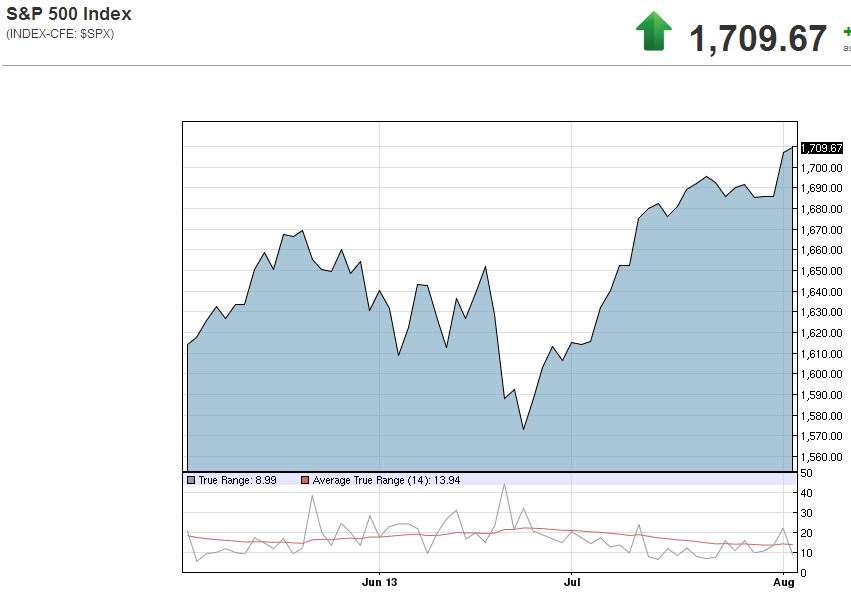
Next, the GainsMaster Approach recommends examining the S&P500 Index’s Average True Range to assess the level of nervousness/volatility in the market. In times of upward market trends, investors are generally less nervous. The opposite is true before a big downturn in the market.
Personally, I hadn’t heard of the ATR before reading this book, but I learned that the True Range is the difference between highest and lowest prices traded during a single day. The Average True Range is the average of the daily True Range value over a certain time period, usually 14 days.
Below are the signs we’re looking for:
- A GO (bull) sign is indicated by the 14-Day ATR showing a downward trend (decreasing nervousness/decreasing volatility) over the past 2 months.
- A STOP (bear) sign is indicated by the 14-Day ATR showing an upward trend (increasing nervousness/increasing volatility) over the past 2 months.
ATR data is a little trickier to find than the other indicators described in this post. Unfortunately, I did not see that the usual finance sites like Google Finance and Yahoo Finance had ATR data. The authors of the GainsMaster Approach recommend that you look to your online brokerage for ATR data. For me, I found this data in my Sogotrade.com online account. In searching around the Internet, I found that you can also access this data for free (already compiled in chart format for the S&P500) by clicking here or clicking here. Or, if you’re a math nerd like me, you can click here to learn how to calculate it for yourself from historical price data.
The ATR chart for the current S&P500 index is shown below. The red line in the small bottom graph is the 14 day ATR. As you can see, during the past two months, the ATR has decreased slightly. This is a GO sign!
Step 3 – Gauge Safety-Seeking Behavior By Assessing Whether the S&P500 Index Has Over- or Under-Performed the Dow Jones Utility Average (DJU) Over The Past 2 Months
Prior to a change in market mood, the authors explain that there is almost an accompanying change in the preference of investors’ safety-seeking behavior.
Since utility stocks are stable and pay good dividends, they are often used by investors who feel the markets are dangerous at the current time and want safety. On the other hand, when investors feel the market is strong, they will be investing in regular stocks.
Thus, the GainsMaster Approach recommends keeping an eye on the relative performance of the S&P500 Index (proxy for regular stocks) vs. the Dow Jones Utility Index / Average (proxy for utility stocks). Specifically, we are looking for the following signs.
- GO (bull) Sign = When the S&P 500 index is outperforming the Dow Jones Utilities Index over the past two months
- STOP (bear) Sign = The Dow Jones Utilities index is outperforming the S&P 500 Index over the past two months
You can quickly generate a graph of this 2 month performance comparison in Google Finance. The current comparison chart is shown below. As you can see in the graph, the DJU has outperformed the S&P500 over the past 2 months by a narrow margin, so this is a STOP sign (although a weak one).

Step 4 – Put All of The Indicators Together to Time the Market – Assess Weekly or Monthly
Having gone through all of the mechanics of how this potential market-timing technique works, let’s now just briefly review how it should be executed, as recommended by the developers of the GainsMaster Approach.
- Periodically (I’m going to monitor weekly), watch for a crossing of the 12-month moving average of the S&P500 Index, as explained in Step 1.
- If there is not currently a crossing, just assume that the current market trend (GO/bull currently as of 3-August-2013) will continue.
- If there is a crossing of the 12 month moving average, proceed as described below:
- If there is a crossing of the 12-month moving average, evaluate the Average True Range (Step 2 above) and Dow Jones Utility Average (Step 3) trends described previously.
- Remember that BOTH Average True Range and Dow Jones Utility Average Steps have to show a GO or STOP sign that MATCHES the 12-month moving average crossing direction to indicate a change in the market mood.
- If the 12-month moving average crosses with one signal, but is not confirmed by BOTH of the same signals from the ATR and DJU, then expect the current market mood to continue (but you want to keep monitoring the signals weekly to see if a matching GO or STOP signal pops up).
So, Does This Market Timing Strategy Actually Work? – A Look at Past Performance
In the book that details this strategy, the authors claim that this technique would have correctly timed every major market switch since 1990. They even show graphs/data backing up their claim. However, most of the time with these market timing techniques, it is too good to be true. It’s fairly easy to develop a strategy and make it work retrospectively when the data is under your control, but the real test is how it would play out going through it as a normal individual investor.
Anyhow, I wanted to just examine if this claim about being able to correctly predict the market is true.
Unfortunately, when it comes to pulling up the 3 indicators mentioned above, although it is fairly easy to pull them up in graphical format for recent data, it is a little more difficult to find it for historical backtests. Because of this, I had to take the more manual approach and assemble the 252 day simple moving average and 14-day Average True Range myself from S&P500 historical pricing data (obtained from Yahoo Finance) dating back to 1950.
- After calculating these values, I then set Conditional Formatting in Excel to signal me when the current S&P500 price line crossed the 12 month SMA (Step 1 above).
- Once a crossing occurred, I then weekly monitored the ATR (Step 2 above) and DJU (Step 3 above) change trends to determine if the Gainsmaster Approach predicts that I should be in the market (buy/market increasing) or out of the market (sell/market decreasing).
Next, the question became which historical period to analyze. Since the GainsMaster book did not analyze the 1980’s, I decided to focus my analysis on that 10-year period.
The chart below displays the results of when the GainsMaster Approach dictates an investor should be “in” (green highlighted areas) or “out” (red highlighted areas) of the market.
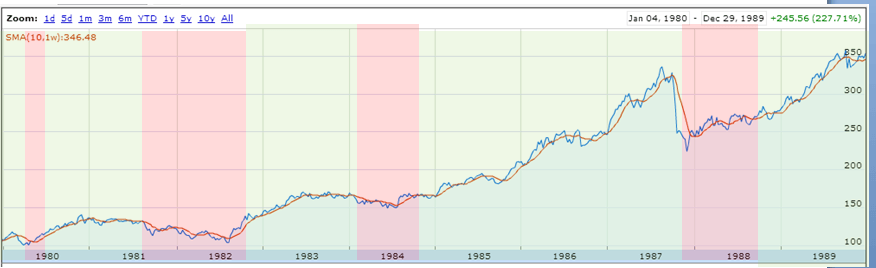
Using the GainsMaster market timing method, you would have been invested in the market during 5 time periods during the 1980’s. While the method seems to be directionally correct in predicting ENORMOUS swings in the market, it doesn’t respond quickly enough all of the time. Additionally, when you’re actually going through this in real-time, it’s impossible to know what is going to be an ENORMOUS swing and what is going to be more subtle.
Let’s take a look at a few examples.
- I will give this method credit that it would have saved investors during the large 1987 market downturn. It dictated getting out of the market on 10/16/1987, and then back in again on 9/26/1988. During this time, the market decreased 5%.
- However, this was really the only time that it was beneficial to use this market timing method vs. passive investing during the 1980’s.
- The GainsMaster approach dictated being out of the market in 1980, 1981-1982, and then again in 1984. During each of these respective periods, the market increased 10%, 7%, and 4% respectively.
- This means that the GainsMaster approach did not work most of the time. It saved you 5% during 1987, but costed you over 20% gains during the rest of the decade.
Overall, if you had invested $10,000 initial investing in an S&P500 index fund on Jan 1st, 1980 and simply held it for ten years, you would have experienced a 206% increase in your money. Conversely, if you had used the GainsMaster approach to market timing, you would have only had an increase on your money of 171%.
If you’re interested in viewing all of the details of my analysis, you can download copy by clicking here.
So, the bottom line here is that GainsMaster market timing Approach, like every other market timing/individual stock picking strategy I’ve seen so far (even though they make logical sense), fails to outperform the market and passive investing with index funds. So, please avoid these strategies and make yourself some real money!
How about you all? Have you ever found a market timing or individual stock investing approach that you think will work, but didn’t end up panning out when you started doing it or got in to analyzing the real data?
Share your experiences by commenting below!