
All posts by Jacob A Irwin
Currency Update – August 2013
 The following is a guest post. Enjoy!
The euro and the pound were within touching distance for most of the week, the euro strengthening by about quarter of a cent. Against the US dollar, it was down by half a cent. The eventual outcome was determined partly by a new crisis in Club Med but mostly by a change of tack at the European Central Bank.
The crisis appeared quite suddenly in Lisbon, with the resignation of two government ministers, apparently because of their disillusionment with austerity. Were the coalition government to collapse, investors fear the abandonment of austerity and a possible sovereign default. The Outright Monetary Transactions (OMTs) (government bond purchases) envisaged by European Central Bank President Mario Draghi in his “whatever it takes” strategy could not be brought into play because Portugal cannot borrow money without external assistance. Even though a default by Portugal is not the most likely outcome, even the outside possibility weighed on the euro.
It was a much different burden that the ECB president placed on the euro’s shoulders at his monthly press conference. Throwing aside the mantra of the last two decades which had it that the Bank “never pre-commits” to monetary policy, Sig. Draghi stunned his audience and the world’s investors by doing exactly that. In his prepared speech he said; “The Governing Council expects key interest rates to remain at present or lower levels for a considerable period of time.” As the reasons for this approach he cited a subdued outlook for inflation, broad weakness in the real economy and subdued monetary dynamics. Sig. Draghi refused to enlarge on how many months there might be in “a considerable period of time” but it was fairly clear he was thinking of double figures.
The ECB is not alone in providing this sort of “guidance” to future policy. That same day the new governor at the Bank of England issued a statement saying much the same thing and the US Federal Reserve has been at it for more than a year. But the ECB’s pledge is a first and it looks as though the central bankers in Frankfurt are hunkering down for the long haul. This latest development might not send the euro lower but it is hard to imagine how it could send it higher.
***Photo courtesy of http://www.flickr.com/photos/epsos/8453271596/sizes/m/in/photostream/
Carnival of Personal Finance #425 – Price of Tour de France Bikes – August 5th, 2013 Edition
 Welcome to this week’s Carnival of Personal Finance, a weekly listing of the top personal finance articles around the blogosphere in the following categories – taxes, money management, investing, career, debt, frugality, credit, economy, finance, real estate, saving, and budgeting.
With the Tour de France and Tour de Personal Finance finishing only about a week or so ago, I thought a fun theme for today’s carnival would be to review some of the market prices for the “top-of-the-line” bikes that the professional cyclists in the Tour de France get to ride for free as part of their sponsorship deals. The prices for the 4 bikes shown below can be seen in the red caption below each picture. Enjoy!
I hope you enjoy the posts and that you can stop by My Personal Finance Journey on my non-carnival days as well!
Listed below are this week’s top 3 editor’s picks. Congrats to the three winners! Some truly great articles here!
1. PK from Don’t Quit Your Day Job… presents Do You Make More Money Than You Did 6 Years Ago?, and says, “Other than a brief spike as people pulled income forward to avoid tax increases in December, Americans have been below their peak disposable income in real terms for some time now. Although we saw the other day that folks have more wealth than 2007, how is America doing in the income department?”
2. Pauline from Reach Financial Independence presents Early retirement in the US vs abroad, and says, “Early retirement can be easily achieved in a country with low costs of living. Is it worth it?
3. Mr PoP from Planting Our Pennies presents Just Out Of School, Deep In Debt, Job Sucks. What To Do?, and says, “Mr PoP provides real, actionable steps that he took to go from a low-paying job fixing computers to a job in B2B sales where he made over $100K last year. And all of this, with a “worthless” philosophy degree. ”

Alberto Contador’s Specialized S-Works Tarmac SL4 – $8,000
And, listed below are the rest of this week’s great article submissions.
Glen Craig from Free From Broke presents Diplomatically Say No to Friends and Family That Want to Borrow Money – 6 Tips, and says, “They want to borrow money from you. It’s tough when friends or family come asking. How do you say no without risking your relationship. See how.”
Matthew from Investing Five Daily presents DRIP Update, and says, “An update on the power of DRIP investing.”
Kristen from My Dollar Plan presents How to Save Money on Textbooks, and says, “If you know someone headed back to school in a few weeks, this is a must-read!”
Emily from Evolving Personal Finance presents Just Make a Decision, and says, “It’s often better to make a decision and carry it out than to delay inordinately, even if it’s not the 100% perfect solution.”
Michael Kitces from Nerd’s Eye View presents IRS Opens Door In PLR 201330016 For 1035 Exchange By Beneficiary Of Fixed And Variable Inherited Annuities, and says, “Using annuities for retirement income has become increasingly popular in recent years, which one unfortunate caveat: whatever annuity was used during life was the type of annuity the beneficiaries were stuck with in the future. But no longer – with a recent ruling, the IRS has opened the door for annuity beneficiaries to change to a new annuity that better suits their own needs and circumstances!”
Nicole from Nicole and Maggie: Grumpy Rumblings presents Ask the grumpies: Demographic stats for the self-employed, and says, “Ever wonder what it’s really like for the average self-employed person? Nicole and Maggie break out the stats on self-employment demographics.”
Jason Hull from Hull Financial Planning presents Use Anti-Motivation to Pay Down Debt, and says, “Sometimes the carrot works to help us pay down debt, but sometimes we need to bring out the stick. This article explains how to use the stick to motivate yourself to get out of debt.”
Evan from How Much Money At One Time Would Change Your Life? presents How Much Money At One Time Would Change Your Life?, and says, “I need a bigger and bigger number to make a difference in my life. My guess it is only natural.”

Nairo Quintana’s Pinarello Dogma 65.1 Think 2 – $12,000
Pauline from Make Money Your Way presents Make More Money During The Holidays, and says, “Be it summer holidays, long weekends or Christmas, there are plenty of opportunities to make extra money if you are willing to work when the majority rests.”
Miss T. from Prairie Eco Thrifter presents On Environmentalism Becoming Consumerism, and says, “Environmentalism and sustainable living isn’t about buying a product to make yourself more green or friendly to nature. All the consuming in the world isn’t going to help one bit. It’s about changing major parts of your lifestyle for the good of the planet and its inhabitants.”
Jon from Novel Investor presents Stock Basics: The P/E Ratio, and says, “Investors like ratios and the P/E ratio or price to earnings ratio is the most popular. The P/E ratio tells us how much investors will pay for earnings.”
Daniel from What Was The Last Thing You Bought In A Store? presents What Was The Last Thing You Bought In A Store?, and says, “I have gotten so used to purchasing everything online, it is hard for me to remember what the last is that I bought in a store. Can you remember?”
Eric from Narrow Bridge Finance presents Cash Back or Frequent Flyer Miles Credit Card?, and says, “I’ve had a few conversation with friends lately about cash back credit cards and miles credit cards. I recorded my first ever video blog post to explain which one I think is better.”
Ray from Squirrelers presents Take Cash In Hand Instead of a Promise of Future Payment, and says, “Promises are often kept, but not always. This is why it’s important to consider the advantage of choosing upfront cash instead, as discussed in this post.”
Bryce from Save and Conquer presents How Much Cash Do You Keep on Hand?, and says, “I do not keep a stash of cash at home. We can always get cash at an ATM or grocery store that accepts ATM purchases. it appears that quite a few people, more than I would have expected, do keep something like $1000-$2000 in cash at home for emergencies. If there is an emergency and ATMs don’t work, we will make do with what is in our wallets and in our pantry.”

Mark Cavendish’s Tour de France Specialized Venge – $18,000
Daisy from When Life Gives You Lemons, Add Vodka. presents Get 2.5% Interest on Your Savings Account, and says, “It’s a good option to consider ING in order to get 2.5% interest on your savings account.”
Oscar from Money is the Root presents Retirement Saving Tips for Married Couples, and says, “Enjoy your golden years together without worrying about money.”
DPF from Digital Personal Finance presents 2 Different Reasons People Use Credit Cards: Which Applies to You?, and says, “Many people use cards to delay payment and buy things they can’t afford. What about using them simply for convenience as the primary purpose?”

Thomas Voeckler’s Colnago C59 Team Edition – $12,500
Lance from Money Life and More presents How Getting Married Changed Our Finances, and says, “Guess what happened while you guys weren’t paying attention? We got married! So now that the secret is out, I figured I’d share how getting married has changed our finances.”
Roger Wohlner from The Chicago Financial Planner presents Is My Pension Safe?, and says, “The city of Detroit recently filed the largest municipal bankruptcy in history. One of the potential casualties of this situation will likely be retired city workers receiving pensions. While pension payments are promises made by the employer, should the bankruptcy go through the city will be free to cut pension benefits as part of the restructuring of the city’s finances. In light of this situation, how safe is your pension?”
Well, that concludes this week’s edition of the Carnival of Personal Finance! To all of this week’s participants – it was an honor to be able to read and get involved with such high quality articles! Please remember to link back to this post if your article was included here and to promote via social media when possible.
Next week’s carnival (#426) is scheduled to take place on August 12th, 2013. Be sure to submit your articles for next week’s edition, using the following handy submission form.
Also, if you’re interested in hosting a future edition of the Carnival of Personal Finance, you can apply using this form.
5 Tips For Turning Your Home Into A Vacation Rental
 The following post is by MPFJ staff writer, Shondell of Call Me What You Want, Even Cheap. She blogs about her recent car loan and mortgage pay off and a whole bunch more. Check out her blog right here.
If you live in an area frequented by tourists and vacationers, then it may not be a bad idea to turn your house into a vacation home.
Vacation rental is a huge industry and offers you the opportunity to supplement your income during the holiday seasons. In fact, many people with a home (or homes) in tourist areas make a major portion of their annual income from renting out their homes. This allows you to attend to your other businesses while your house quietly makes money for you. However, not every house can be profitably turned into a vacation rental; therefore, you have to do some research and may have to carry out a few modifications before turning your house into one.
Here are 5 tips for turning your home into a vacation rental:
1. Determine if your home is suitable:
Your home should be in or near a tourist area for it to be suitable for a vacation rental. It should provide easy access to all the things vacationers come for, such as the beach, landmarks, theme parks and great outdoors. It should also have modern amenities such as a telephone, internet, a fully equipped kitchen, air conditioner (for hot weather) and heating system (for cold weather). A house that is not in the right place and doesn’t have any comfort features will find very few takers, if at all.
2. Prepare your house:
Once you have determined that your home is suitable for a vacation rental, you should prepare it for the same. This requires some money, but you can quickly recover your investment once your house is rented. First, clean the house thoroughly. Hire a cleaning service if you are not up to the task. Repair or replace the furniture, carpets, doors, windows and electrical fittings if they are broken or worn out. Paint the walls and ceilings with attractive colors if necessary. Your home should be neat, clean and attractive before you can show it to any would-be tenants.
3. Set a suitable price:
After you have prepared your home for rent, research the market to find the right price for your home. Find out the amount charged by similar-sized homes in your area and determine whether you can set the same or a slightly different price. When setting the price, you should consider your home’s location, size, accessibility, amenities and the kind of people you want to have as guests. If you are targeting affluent vacationers, then you can set the price a notch or two higher than the average price, but that should be backed by a great location and plenty of amenities.
4. Advertise:
If your home is in a busy location, then vacationers will come looking for you. Otherwise, advertising is the only way to find tenants quickly. You can advertise either in the local papers or on the internet or both. Word-of-mouth is also a good idea if you have a small budget. Whatever you decide to do, you need to create an attractive ad with beautiful photos of both the interior and exterior of your house. Also, do not forget to mention the amenities and your home’s proximity to parks, malls, diners and other places of interest.
5. Screen the tenants carefully:
Although money is important, you don’t want to invite trouble by renting your home to the wrong people. The worst thing you can do is harbor criminals and terrorists, which can easily land in trouble with the law. So do not hurry to rent your house out to the first people who come knocking on your door. Screen every would-be tenant carefully. Ask them where they are from, what they do for a living, why they wish to rent your place, who they will be living with and whether they will be having parties. If you are doubtful, you may also ask for a small security deposit, which is quite the norm.
Ideally, you should be able to leave everything to the tenants’ care after they move in. But that is often not the case as problems relating to things like water, electricity, telephone and security often arise. The first thing you should do after handing over the keys to your home is give the tenants your telephone or cell phone number so they can contact you if any emergency occurs. You should also inform your neighbors and relatives so they will know what is happening. If your tenants have any complaints or concerns, you should attend to them immediately. Once the word spreads that you are a great landlord, you will get good tenants every holiday season.
How about you all? Would you consider renting out your home to vacationers?
Share your experiences by commenting below!
***Photo courtesy o fhttp://farm2.staticflickr.com/1230/4724901591_0400dc3e99_o.jpg
Do You Still Need Soft Skills in Technical Positions?
 The following is a guest post. Enjoy!
Information technology has become a fundamental fixture within nearly every possible professional environment, creating a massive demand for people with the relevant skills to fill a wide range of different IT positions.
Although some smaller companies will only have one or two IT professionals to carry out general tasks, larger businesses will often have dozens of specialist positions requiring a very specific set of skills and qualifications.
As demand for these skills continues to grow, reports from the BBC have explained that there is still a skills deficit in the industry within even large corporations like Facebook and Google struggling to find suitable candidates.
If you’re looking to work in IT then it’s vital you have both the technical aptitude and the soft skills – but just what are they?
Communication skills
Remember that every project an IT professional works on will be related to helping employees within the company communicate effectively and securely. Therefore, it makes perfect sense that IT professionals should be skilled communicators, being able to understand and appreciate their employees’ specific IT needs. This will allow them to develop bespoke solutions to certain issues and become more responsive to problems which may arise in the future.
Training skills
IT professionals will usually be the first within every company to experience a new piece of technology and become acquainted with how it works. Therefore when the new technology is rolled out to the company at large, it will be the IT professionals tasked with preparing instructional and educational material to help other employees understand how to use it effectively.
This will also inevitably involve plenty of troubleshooting sessions with the employees as they gradually become acquainted with the new tools. This relies on a good degree of patience and willingness to appreciate the fact that non-technical people are likely to have issues.
Compromising
For every project within a company, there are likely to be many different ways that IT can provide solutions to make things more effective. It’s important to regularly compromise your own initial ideas with what works best for the other employees and the wider business.
For example, although you may favour a particular operating system for certain tasks, this may cause problems with employees who don’t feel comfortable using it on a regular basis. You should compromise and find a solution which everyone is happy with while still helping employees to work more effectively.
Thinking creatively
Remember that all IT Jobs involve different skills depending on the nature of the company’s business and you’ll often need to develop technology solutions which are specific to that particular organisation. It’s important to keep an open mind about creating new processes rather than following familiar ones which you’ve implemented in the past elsewhere.
How about you all? What “soft skills” are important for you in your line of work?
Share your experiences by commenting below!
***Photo courtesy of http://upload.wikimedia.org/wikipedia/commons/6/6c/Rajive_Kaul,_Rana_Kapoor_and_Suni_Godhwani_(Horasis_Global_India_Business_Meeting_2010).jpg
Issues With 401k Plans And How To Compensate For Them
 The following is a post by MPFJ staff writer, Toi Williams, who is a personal finance blogger over at Fine Tuned Finances. She has backgrounds in personal finance, sales, and real estate.
Over the past decades, the defined-benefit pension plan has been replaced with the 401k plan as the dominant retirement plan saving vehicle for most workers in the United States.
While 401k plans give the workers more control over their retirement income by allowing workers to save more for retirement and decide which investments to include in their plans, there are a number of issues that have arisen with these plans over the years that workers should be aware of. Some of these issues require additional actions to compensate for the issue while other issues should be avoided completely if possible.
Here are the issues that you should be aware of regarding 401k plans and how to compensate for them:
Long Time Horizons For Investments
One of the biggest issues found with 401k plans is that there are extremely long time horizons for your investments, making it very difficult to choose the best investments for your plan. Developing a long-term strategic asset allocation based on a time horizon that will typically exceed a decade in length is complicated enough, but adding in the fact that the portfolio managers and the funds available in the plan are likely to change during that time makes smart investing even harder. You will have to find the balance between the shorter-term tenure of the portfolio managers and the longer-term investment holding period.
Many investors use index funds to make that balance. However, if there are not many index funds offered in your 401(k) plan, you have a couple of other options that can be used to address this problem. One option is to develop a tactical asset allocation contingency plan that can be put into place in the event one of your portfolio managers relinquish responsibility. Another option is to open a traditional IRA or Roth IRA that has index fund strategies that are not available in your 401k plan and contribute up to the legal limit.
Flaws In The Structure Of The Plans
There are a number of structural flaws in 401k plans that can be devastating to the unwary investor. Many people invest in their 401k accounts using the dollar cost averaging methodology, meaning that they buy a fixed dollar amount of a particular investment on a regular schedule regardless of the share price, which they believe will allow them to prudently build their retirement nest egg over time. This is a good method to use when the market is trending up, but can cause you to lose a significant amount of money when the market is trending down.
Instead of using an automatic investment method like dollar cost averaging, take control of your investing by directing all of your retirement plan contributions into a conservative investment option. Then, you can make a strategic investment allocation of the cash that you have accumulated into a promising fund offered in your 401k plan when the time is right. The investments chosen for your 401k plan are your responsibility, so you should be active in choosing how to allocate your money into different investment choices.
Fees And Administrative Charges
Many employer-sponsored 401k plans are expensive. Because of the number of compliance issues that have to be monitored, it is important for the plans to be administered correctly and that can cost a lot of money. The plan administrator is required to conduct a number of ongoing service and administration functions and must provide plan participants with a variety of education and communication services. To pay for these services, many plan participants are charged participant fees, supplemental asset based charges, and other itemized costs for services.
Developing a tailored retirement plan strategy can help you mitigate some of the costs of your 401k plan. Instead of using your 401k as your primary retirement savings vehicle, only contribute to the plan up to the point where you receive 100% of your employer’s matching contribution. Then, you can open a low-cost IRA with a brokerage firm or through a local bank in your area and contribute up to your legal limit. In nearly all cases, the various investment options available through an IRA will be much less expensive than the options available through an employer-sponsored 401k plan.
Recordkeeping Issues
Recordkeeping for the assets accumulated in your 401k plan is a labor-intensive endeavor, even in today’s technological age. In most cases, the records have been generated for many years and may contain errors and omissions due to the mistakes of the people tasked with compiling these records. Typically, retirement plan providers will provide only what the law requires in your statements, and what is required by law may not necessarily be what you need to make an accurate financial assessment of your investment strategy.
If your retirement plan provider does not provide the information you need in an investor-friendly statement, you may want to take care of your recordkeeping yourself. The simplest way to do this is to build a spreadsheet that you can use to track your information. To create your spreadsheet, you can use the important information from your monthly or quarterly statements, such as your beginning account balance, the amount contributed to your retirement plan account by you and your employer, the amount of any transfers or withdrawals made during the period, the amount of any gains or losses experienced and the ending balance of the account. After inputting the information, you can manually calculate your annualized rate of return. This will help you see whether you are on track in terms of meeting your long-term financial goals.
How about you all? What issues have you run into with your 401k plan? What have you done to fix or compensate for them?
Share your experiences by commenting below!
Picture: http://www.flickr.com/photos/76657755@N04/7067724529/
Making Business Conference Venues Run Smoothly
 The following is a guest post. Enjoy!
Organizing a business conference is a high-pressure task, and we’re sure you’re already expecting the pre-launch-day jitters/nightmares. Remember not to take all the tasks onto your shoulders – spread around the responsibility to ease the burden. And try to get some rest – you’ll need it!
Your Venue
The venue should reflect what your company is all about. For example, if you’re a very modern business, you might want to choose a posh hotel with state-of-the-art interior design. Whichever venue tickles your fancy, make sure that it has bags of space.
Transport
If your venue is out in the middle of nowhere, choose somewhere with suitable transport links and hand out detailed directions in advance, so no-one gets lost. There should also be ample parking for guests.
Internet
Getting together the best and the brightest in business is no mean feat, but you better make sure they have a reliable Wi-Fi connection, otherwise you may have a mutiny on your hands. Also, if any of your presentations rely on online sources, let’s not embarrass ourselves with a poor internet signal.
Technology
To hold everyone’s attention, you’re going to need technology on your side. Your venue should either come with all the gadgets you need to hold a great conference or you need to be able to install them yourself. Either way, make sure presenters have microphones and projectors to work with.
Climate
The environment usually makes or breaks a conference. If everyone is boiling or freezing cold, they won’t be paying much attention to the presentation and they will associate negative feelings with your company. Keep everyone comfy with climate control and fantastic seating.
Refreshments
Most businesses run on caffeine, so always have a platform full of tea and coffee for your guests. Also, keep everyone in good supply of water and snacks. We don’t want cranky business people at the conference.
Man The Ship
Get as many employees as you can muster to help run the conference on the day. You’ll be amazed at how many pairs of hands you’ll need. If you don’t have enough members of staff, try enlisting work experience students to help you out.
Stagger The Day
Don’t hit the conference guests with a wall of presentations. Allow them regular toilet, tea, and leg-stretching breaks. Even if you’re keeping to a tight schedule, the guests’ comfort should come first.
Be Interesting
The last thing you want to do is bore everyone senseless. Keep things interesting by letting your company’s personality shine through. When providing character for a business conference, you need to deliver an experience that will stick in everyone’s minds. Be different to everyone else and stand out from the crowd.
Don’t Make Assumptions
Don’t assume that everyone will arrive fully prepared. Have a stash of notebooks, pens, refreshments, and cards ready to hand out to your guests. They’ll be thankful if they run out of ink or they miss breakfast!
How about you all? Have you ever organized a conference for your personal hobbies or full time job? How did it go? What lessons did you learn?
Share your experiences by commenting below!
***Photo courtesy of http://upload.wikimedia.org/wikipedia/commons/7/73/Chicago_Campus_Conference.JPG
How Do You Analyze Individual Stocks? – Part 2 – The Periodic Check-In
If you’ve been reading MPFJ for a while, you’ve probably heard me mention before that I am not a big advocate of people investing large amounts of their own money in active management, either through the buying and selling of individual stocks yourself, following the advice of a newsletter, with the help of a “professional” investment advisor, or through an actively managed mutual fund.
Why do I shy away from large investments in individual stocks? Simple. Because the track record of individuals (even professionals) selecting individual stocks does not show proof positive that it is worth the cost involved. In fact, 70% of the stock professionals fail to beat out the market, so why would I think I can do this consistently?
Having said that, I do, however, think that analyzing individual stocks for investing using smaller amounts of play money is a fascinating exercise, and it’s something that I would like to believe in. I just haven’t seen proof that it can be done consistently in an efficient manner, but maybe someone will prove me wrong one day and cause me to switch from my current approach of passive investing using index mutual funds and ETFs.
Anyhow, back in February of this year, I did a post sharing my strategy for how I perform the preliminary analysis of individual stocks for potential buying opportunities, using the specific stock, MGT Capital Investments, Inc. (AMEX/NYSE symbol: MGT), as an example.
Today, I wanted to continue this series/investigation by sharing the method that I use for another very important part of the individual stock investing process, the periodic check-in. Again, I’ll be using the stock, MGT Capital Investments, as an example for consistency.
Basically, what we want to do with the periodic check-in process is to compare where the company is now vs. where it was when the preliminary analysis was performed to determine if it still makes sense for you to be holding the stock.
As a brief recap, in my preliminary analysis of MGT’s stock, my conclusion was that since the company has a good business model, strong leader in their CEO, and the recent key financial number change trends were pointing upwards, MGT would be a speculative “buy” when the 3 technical indicators I use turned positive.
Step 1 – 30,000 Foot Elevation View of the Company and Price Performance
To get a very high level overview/update on how the company is doing, I first turn to Google Finance and look up the ticker symbol.
On Google Finance, I specifically am looking at 3 things – 1) price history since I last analyzed the stock and 2) the current financials. I like to use Google Finance for this purpose because all of these items are displayed on a single page, making it very easy to navigate.
Shown below are these two items for the stock that I’m using as an example, MGT, as well as the appropriate screen shots from Google Finance. I’ve also left in the February 2013 screen shots for comparison as well.
- Since I first assessed this stock on Feb 20th, 2013, MGT has experienced quite a run up in price.
- Between February and now in July 2013, the stock price has increased from $2.85 to $4.37 per share, a growth of close to 60%!
- While this growth was hard to predict exactly, it is not totally surprising, considering the things mentioned in my preliminary analysis about the company having good recent financial change trends.
- Regarding the high-level financial figures, the overall change seems to be positive / in the correct direction.
- Although EPS has decreased, pretty much all of the financials seem to have improved in the past 5 months or so – with market cap, trading volume, shares outstanding, margins, ROE, and ROA all increasing.
- In addition, it also appears that they have downsized two employees, since they now have 7 employees, down from 9 previously. This will be something I want to investigate from a qualitative perspective as well.
- It is also worthwhile to note that MGT still has a very small number of shares outstanding (only 3 million). What this means is that the stock is potentially very ill-liquid / volatile.
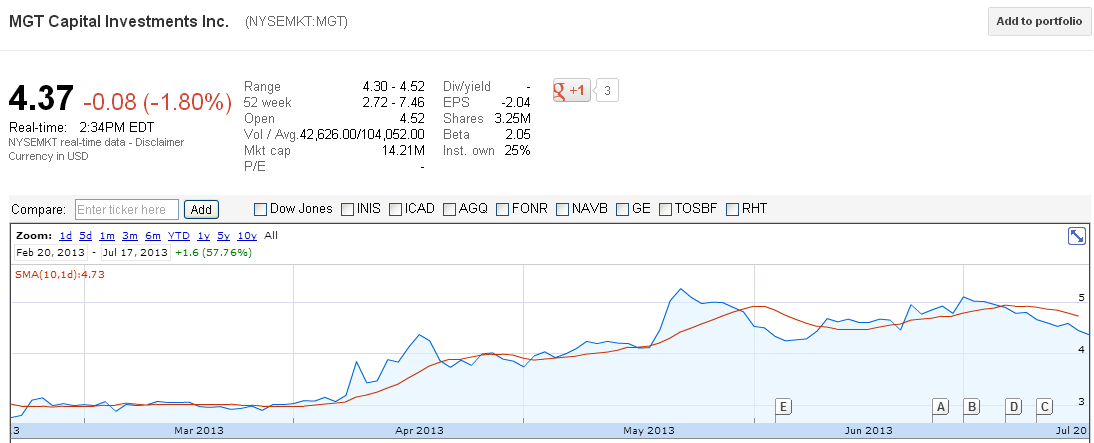 |
| MGT Stock Price History |
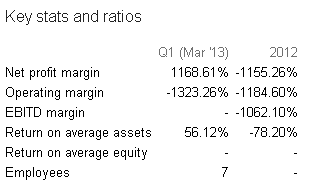 |
| MGT Financials |
Step 2 – See If There Have Been Any Changes Regarding How the Stock Fits Within Phil Town’s Rule # 1 Investing Analysis System
As I mentioned previously in my 6 month test run of Phil Town’s Rule # 1 investing system (which showed that its usage did not deliver a market beating return due to the trading commissions involved), I do not believe that Phil’s system is the “magic formula” for beating the market. However, Phil’s approach does involve some very prudent technical and fundamental analysis which I feel can give me a deeper understanding of how the company is functioning as an investment.
- Phil Town Criteria – Identify if the company has a “moat” – What he explains we are looking for here is >10% annual growth rate over 10 years for the following things: 1) Return on investment capital, 2) sales revenue, 3) EPS growth, 4) Equity per share, and 5) free cash flow growth. We also make sure that the company has enough current free cash flow to be able to pay back it’s long term debt in 3 years or less.
- A great place to get all of this 10 year historical data in one place is Stock2Own.com. If you type in the ticker symbol of the stock you’d like to analyze in the box at the top, it will then automatically calculate all of these five financial ratios for you. These can be accessed by clicking the Annual Statements option on the left sidebar.
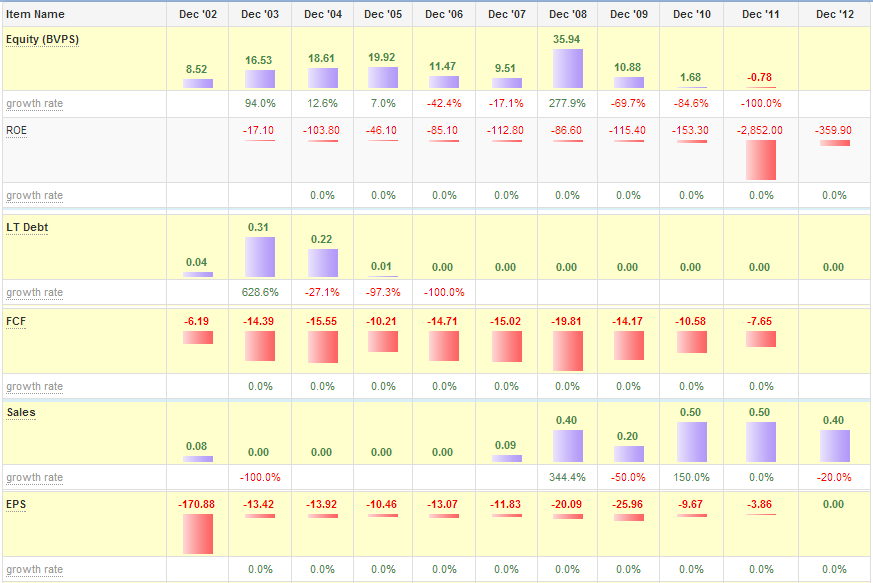
- The data for MGT is shown in the attached screenshot below.
- As I mentioned previously for MGT (and as is still the case), the 10-year average financial calculations above do not look very good because of all of the negative values it is carrying, and as such, are definitely NOT in line with Phil Town’s criteria. Return on investment capital (or ROE), EPS growth, and free cash flow growth are all either deeply negative or zero. Furthermore, the company has negative free cash flow,but at the same time, they still have no long term debt.
- At ~31% annual growth over the past 10 years, sales revenue does fit the “moat” criteria.
- At 11.9% annual growth over the past 9 years, Equity per share does fit the “moat” criteria.
- These growth rates are a slight improvement from the way the company looked in February of 2013.
Even though MGT still does not meet the Return on Investment Capital, EPS, and Free Cash Flow moat criteria set forth in the Phil Town method, this is not very surprising because it is a speculative play.
- Phil Town Criteria # 3 – Calculate the appropriate sticker price, or what the stock should be selling at given it’s current EPS and EPS growth rate. We then calculate the Margin of Safety price (MOS) to make sure that we buy the stock at a significant enough (50%) discount to shield ourselves from mistakes and be able to achieve higher returns.
- Fortunately, the tool listed above, Stock2Own.com also has a handy feature that automatically calculates the sticker price (Value Price) and Margin of Safety (MOS) price.
- To view this in Stock2Own, simply click the Value Price option in the left sidebar.
- Unfortunately, for MGT, since their EPS is still negative (as it was back in Feb of this year), a MOS/Value Price cannot be calculated, so we don’t have this gauging point to base our decisions off of.
- In the case of MGT, since their EPS is negative, we also cannot gauge effectively whether or not the stock is now “overvalued” now that the price has increased to around the $4 per share range. In fact, since the EPS is negative, this means that the stock has been OVERVALUED the entire time (even during the preliminary analysis! haha).
- While this is unfortunate, there is not much else we can do but soldier on and make our decision with the other information available to us.
- Phil Town Criteria # 4 – Use technical analysis tools to make sure you are either buying or selling at the right time. Phil recommends using three technical tools to make sure of this – 1) 8-17-9 MACD indicator, 2) 14K, 5D Slow Stochastic Oscillator, and the 3) 10-day moving average. Phil recommends that you only buy when all 3 of the tech. indicators say “buy.”
- To generate these three graphs for a stock analysis, I again use Google Finance. To set it up, you simply click, “Technicals,” at the bottom of any Google Finance stock price history window, and fill out the fields as shown in the below screenshot:
- Once you’ve set up the indicators, view the 3 month history graphs for the stock you’re analyzing. Three months seems to be a good time period in order to clearly see whether the technical indicators are saying “buy” or “sell.”
- For analyzing MGT, the SMA, MACD, and SSTO technicals are all shown on the combined chart below:
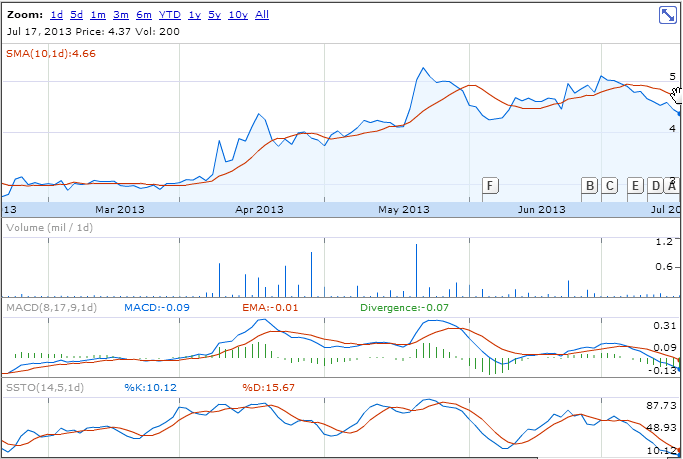
- First, the 10 day simple moving average (red line), compared to the actual stock price (blue line). With the simple moving average, a “buy” signal is indicated by when the stock price line crosses above the moving average.
- In the case of MGT, the stock price is currently below the moving average, indicating that we do not want to buy right now.
- MGT’s 14K, 5D Slow Stochastic Oscillator. With the stochastic, the K line (blue) is the “buy” line, and the D line (red) is the “sell” line. With this technical indicator, a “buy” signal is indicated by when the buy/K line crosses above the sell/D.
- In the case of MGT, the K line is currently below the D line, indicating that we do not want to buy right now.
- MGT’s 8-17-9 MACD indicator is shown below. With this technical indicator, a “buy” signal is indicated by when the MACD line crosses above the EMA line.
- In the case of MGT, the MACD appears to have decreased below the EMA, indicating that we do not want to buy right now.
Step 3 – Qualitative Research On The Company, The Management (CEO especially), Current News, and That No Insider Selling Is Happening
As the title above suggests, the next step I take in the periodic check-in is to analyze how the company I’m following is performing compared to when I last researched about it and check in on how the noteworthy events mentioned in my preliminary analysis unfolded. This is also a good time to research any questions that have popped up from the more quantitative investigations discussed above.
Listed below is how I tackle this step, using the stock, MGT, as an example:
- Management Analysis (done through Google Finance and Reuters.com) – As was the case in my preliminary analysis of MGT, the current CEO is still Robert Ladd. He joined the company in 2010 as a director and became CEO in early 2012. This occurred almost exactly the same time at which the stock price for the company increased from almost $0 to $4 per share. There was also a stock split at this same time. At a high level, this appears that the market took the news of a new CEO as good and that Mr. Ladd was assessed as a good leader. Ladd also has a long history of investment analysis, which is important in his role as head of a holding company where he is making investments as his primary business. I also found another article stating that Mr. Ladd is “responsible for rejuvenating the company. As far as I can tell, Ladd continues to do a stellar job at the head of MGT.
- Insider Trading (done through company website or MSN Money) – In looking at the recent transactions of company insiders, the CEO, Robert Ladd, sold off ~5% of his total shares (20,000 shares sold) during mid June 2013 (around $100k worth). This is not necessarily the best thing to see, since it might indicate that the CEO sees the current stock price as the highest it will get for a while. However, Robert Ladd continues to the largest shareholder (with ~400,000 shares), meaning that the management goals are indeed aligned with shareholder benefit. It is still encouraging to note that the management only have reported income that they pay themselves of $200 per year or so, so it appears that their salary is heavily weighted in stock options/stock performance.
- Additional Clarity About What the Company Does/Its Current Position (find the “news” columns on Reuters, Yahoo/Google Finance, etc after you bring up the chart for a specific stock) –
- In reading a May 2013 investor presentation, I found out that MGT acquired a majority stake in April 2013 in an online fantasy sports wagering platform called, Fan Throwdown. In addition, they purchased Hammercat Studios in May 2013, which will eventually give them exposure to earn money from a mobile platform for skills-based game wagering.
- Both of these purchases are encouraging to see, as it represents good growth opportunity potential for the company.
- It also represents a logical diversification stream of revenue in to the sports and skills-based wagering realms to complement their gambling side of the business.
- I had found out during my preliminary February 2013 analysis that MGT is selling off its medical holdings because it did not fit and wasn’t profitable for them. They have decided only to focus on their gaming patent development for now.
- In searching around online, I found out that the company has completed the sale of its medical imaging patents. They were sold to the Samsung Corporation for $1.5 MM. Of this, the company expects to report a gain on the sale of $750k. This is good progress to see!
- This sale of MGT Medical is likely responsible for the decrease in employees from 9 previously to 7 now.
- Finally, the company is still awaiting the Markman Hearing to see if they will get any money from potential patent infringement against one of their gambling patents they own. However, there has apparently been a court date decided. It will be June 5th, 2014, so quite a long time to wait!
- Overall, it seems that the company is at a point where they are building for long-term success. As such, the recent increase in price doesn’t seem to hinge on some high-risk project being undertaken by the company, which is a good thing.
- In reading a May 2013 investor presentation, I found out that MGT acquired a majority stake in April 2013 in an online fantasy sports wagering platform called, Fan Throwdown. In addition, they purchased Hammercat Studios in May 2013, which will eventually give them exposure to earn money from a mobile platform for skills-based game wagering.
Step 4 – Review and Decision Hold, Buy More, or Sell Your Current Positions
Having now completed all of the steps I do in the periodic check-in, it is time to review what has been seen and decide if I would hold or sell shares I already have or buy more shares.
Using our example of MGT, here are my conclusions:
- MGT’s stock price has increased significantly (60%) since the preliminary analysis was performed 5 months ago in February 2013.
- Unfortunately, since MGT’s EPS is/has been negative, we cannot calculate a margin of safety/sticker price to determine if the stock selling for a good price or not. Technically, since the EPS is negative, it has been and continues to be HIGHLY OVERVALUED.
- Even though several of the important financials for MGT are in fact “in the red,” the change trends over the past 1-3 years continue to point towards that the company is heading in the right direction.
- All three technical indicators dictate that now is NOT a good time to buy MGT shares.
- From a qualitative perspective, the company still has a great CEO, has made some very nice (and logical) investments in recent months to expand their business in to skill-based and sports-wagering, and has made good progress with selling off their medical holdings.
- Because of all these considerations, I would hold my current MGT shares and buy more when the 3 technical indicators mentioned above give the green light.
How about you all? What is your approach to periodically checking in on individual stocks for potential investment? How much of your money do you allocate to individual stocks vs. mutual funds?
Share your experiences by commenting below!
Considering Refurbishment Instead of Redevelopment in Difficult Economic Times
 The following is a guest post. Enjoy!
Of course, a redevelopment project is always attractive for businesses who like to stay contemporary in an ever-changing market. But, there’s a compelling argument for opting for refurbishment, when money is tight. Companies have to be cautious about spending cash on superfluous projects, as we head further into a double-dip recession. So how can a refurbishment help you when the chips are down in tough economic times?
Remember That You Have a Pre-Existing Asset
Instead of investing money in new projects, consider this: have you modernized and enhanced your existing asset? You’d be amazed at how effectively refurbishment can add value to your current property. It would seem a waste to pool all your money into a completely new project, when you can give your property a complete overhaul and make it more desirable. Get the most out of your properties.
Speed Is Of The Essence
Nobody wants to embark on a costly and lengthy redevelopment, if there are other viable options available. Refurbishment could have your property looking good as new, between 15% and 70% times quicker than a new build. When time is money, speed is your best friend.
Risk and Return
In this current economic climate, it’s not wise to start taking giant risks. Instead, enhance what you already have. This will give you a greater balance between risk and return. There’s no need to put your business in jeopardy at such a financially tumultuous time. Investing doesn’t have to make you vulnerable. Already existing assets deserve your attention.
Reduce Carbon Footprint
If you go down the green route, this is a great opportunity to make your property more energy-efficient. Sustainability is a cost-saving and attractive path to take. It also makes your company look great.
A completely new build isn’t exactly the most environmentally friendly option open to you. Reuse what you have by refurbishing. There’s no need to widen your carbon footprint and it’ll attract socially conscious tenants.
Affordability
At the end of the day, refurbishment will mean cheaper bills coming through your letterbox. At a time where your business is cutting costs, extravagant invoices aren’t really what the financial doctor ordered.
Refurbishment is a more fiscally viable option. Wait until the market picks up to consider new builds. Refurbishment could save you between 10% and 75% the total price of a redevelopment. Don’t over-extend your coffers.
Make Use Of Space
By refurbishing your current property, you can really open up rooms to make use of space that wasn’t there before. Any tired, uneconomical buildings can be revamped into stylish, profitable, and efficient venues.
Before you begin, understand what tenants want. This will mean talking to people and getting your head around what they value the most. This could be anything from more natural light to fantastic storage options. Every property is different, so play-up its strengths. Use your time and money wisely during the recession!
Understanding the complexities of the current economic environment can help businesses advance their operations and systems, increasing workplace productivity at the same time.
***Photo courtesy of http://upload.wikimedia.org/wikipedia/commons/d/d8/
Debt Free Direct Tour de Personal Finance 2013 Post-Race Show – $1,400 Ceremony, Race Recap, and Goals for the 2014 Tour
 On June 25th, I announced the coming arrival of the 3rd annual Tour de Personal Finance with an introductory post laying out several goals I had for the event.
Over one month later, the 2013 Debt Free Direct Tour de Personal Finance has ended, a winner has been crowned, $1,400 in prizes has been dished out, and I can decisively say that the 2013 edition of the event has been a great success! The success could not have been possible without tremendous support from the participants and readers/voters. A big round of applause is in order for all of you! **Cheers fill the streets!**
We greatly appreciate Debt Free Direct for being the title partner of the 2013 event and for all their great support. If you’re interested in learning more about the help and advice Debt Free Direct offers to people in debt or their money-saving tips on how to prevent building up debt, click here.
Awards Ceremony and Charity Selections
In the Tour de France, there are 4 main winners’ jerseys that are fiercely contested. These include the Yellow Jersey (overall winner), Green Jersey (best sprinter), Polka-Dot Jersey (King of the Mountains), and White Jersey (best-placed young cyclist).
As such, along with crowning the overall winner with the Yellow Jersey and the 2nd and 3rd podium placements, the Tour de Personal Finance will recognize 3 additional winners, as described below:
- Yellow Jersey – Winner of overall competition. Article voted “best” by readers. Way to go!
- The Yellow Jersey winner for 2013 is John from Frugal Rules with his article entitled, “Is it Time to Get Out of the Stock Market?” (from the Savings / Investing group of articles). A brief description of the article is shown below:
- “Whenever we see highs or lows in the stock market we see an increasing number of talking heads telling us what we should do with our portfolios. The problem with listening to them is they have no idea of your personal situation. That said, these are great times to analyze your portfolio while remembering the importance of maintaining a long-term view of your investing.”
- As the Yellow Jersey winner, John received $100 cash via Paypal. Thanks so much for all your hard-work, John, throughout the month of July.
- The Yellow Jersey winner for 2013 is John from Frugal Rules with his article entitled, “Is it Time to Get Out of the Stock Market?” (from the Savings / Investing group of articles). A brief description of the article is shown below:
- Yellow Jersey Charity Selection – As the Yellow Jersey winner, John also decides which charity he wants to have receive the $700 charity give back amount.
- John elected for the $700 to be donated to the Trisomy 18 Foundation in memory of his son, Isaac Joseph Schmoll, who they lost to the Trisomy 18 genetic disorder.
- This disease is caused by the presence of an extra 18th chromosome (so 3 instead of the normal 2).
- It is my honor to be able to donate to a charity/cause that is very near and dear to John and his family’s hearts. Great stuff! 🙂
- In addition to this, I donated an extra $200 to the National Multiple Sclerosis Society for this event.
- Podium Placings – The 2nd and 3rd placed articles that are on the podium with John are shown below. Congrats for making it so far in to the competition!
- 2nd Place – Crystal from Budgeting in the Fun Stuff with her article entitled, “My Husband is Now WORKING FROM HOME WITH ME!!!” A short description of his article is shown below:
- “It’s important to work out a plan before leaping into self-employment. It’s even more important when that entrepreneurial spirit hits both of the income earners of the household. But after running the numbers, looking at worst case scenarios, and mulling the idea over…it was time for us to put on our big girl panties and jump in.
 Here’s the post about the excitement and fear when we officially put all of our financial eggs in one basket and happily skipped away into the unknown…”
 - At first, I wasn’t planning on doing any prizes for the 2nd place podium finisher. However, Crystal did such an inspirational job in the event, that I felt something was due to honor that excellent performance.
- As such, as the 2nd place podium finisher, I donated $200 to the charity chosen by Crystal (the Houston SPCA). In addition, she matched this contribution with another $200, so $400 total went to the Houston SPCA to help their mission to save pet lives. Great stuff!
- “It’s important to work out a plan before leaping into self-employment. It’s even more important when that entrepreneurial spirit hits both of the income earners of the household. But after running the numbers, looking at worst case scenarios, and mulling the idea over…it was time for us to put on our big girl panties and jump in.
- 3rd Place – Boomer and Echo with their article entitled, “How My Retirement Plans Got Derailed – Big Time!” A brief description is as follows:
- “I left my secure job at a major bank to open a small retail store with my husband. We struggled along for three years, using up almost all our savings and making the terrible mistake of financing the business with our many credit cards. Eventually we gave up and closed the store. With no money and over $100,000 in credit card debt, we sank to our lowest point of despair.”
- A hearty applause to all our podium finishers!!! 🙂
- 2nd Place – Crystal from Budgeting in the Fun Stuff with her article entitled, “My Husband is Now WORKING FROM HOME WITH ME!!!” A short description of his article is shown below:
- White Jersey – Goes to highest placing, new blog (blog that was started less than one year ago).
- The White Jersey winner for 2013 is Matt Becker from Mom and Dad Money. His article (“My Life Insurance Mistake“) made it to the 4th Round of the competition, which is NO SMALL FEAT. Nice work Matt! I’m sure we’ll see some great things from in the future!
- Green Jersey – Goes to the blog whose article wins a single stage “the fastest.” In other words, the Green Jersey goes to the blog who wins a single stage by the biggest margin against their competitor.
- The Green Jersey winner for 2013 is David from Marotta on Money. His article entitled, “How Much Should I Save Toward Retirement If I’m Starting Late?,” won one of the Stages in which it was competing by 12 votes over his competitor! Quite impressive! Nice work David! The sprinters of the Tour de France (such as Andre Greipel and Mark Cavendish) would be proud of you! Your next goal will have to be to win 6 stages like Cavendish did in the 2011 Tour de France!
- The Green Jersey winner for 2013 is David from Marotta on Money. His article entitled, “How Much Should I Save Toward Retirement If I’m Starting Late?,” won one of the Stages in which it was competing by 12 votes over his competitor! Quite impressive! Nice work David! The sprinters of the Tour de France (such as Andre Greipel and Mark Cavendish) would be proud of you! Your next goal will have to be to win 6 stages like Cavendish did in the 2011 Tour de France!
- Polka-Dot Jersey – Goes to the best placing blog article entered which details information on “climbing” out of the debt “mountain”.
- The Polka-Dot Jersey winner for 2013 is J Money from Budgets Are Sexy with his article entitled, ”Which Is Harder: Paying off Debt or Saving Money?” J’s post made it to the 4th Round of competition. Nice work J Money!
 Here’s the post about the excitement and fear when we officially put all of our financial eggs in one basket and happily skipped away into the unknown…”


Race Recap
The 2013 Debt Free Direct Tour de Personal Finance began on June 26th (a few days before the start of the first Stage of the 2013 Tour de France) with a full complement of 64 participants/blogs (up from 52 in 2012!).
In order to start and finish in the same approximate time period as the actual Tour de France, the competition proceeded quickly through the first round with 8 blogs (4 intermediate sprints) per day. Each sprint was given 3 days for voting to occur throughout the competition.
You can view the complete story of how each Stage played out by viewing the 2013 Debt Free Direct Tour de PF Bracket.
When all was said and done, the ~ 1 month-long event featured the following statistics:
- 22 total Stages
- 36 blog posts, up from 32 in 2012.
- 1,111 total comments/votes – Wow! That is an awesome amount of participation (greater than 2x the 544 from 2012)! Thanks to everyone involved!
- 3,081 page views of Tour de Personal Finance Stages and posts, almost 2x the 1,798 from last year.
- 2,176 unique visitors to Tour de Personal Finance Stages and posts, up from 1,500 last year .
2013 Reflections and Goals for 2014 Tour de Personal Finance
I think that overall, the 2013 edition of this event was finally to the point of being “almost perfect.” I had learned quite a bit in how to host this event by doing it twice before, which was good to draw on in this, the third edition. (Third time’s a charm, right?!)
Listed below are the things that I very much enjoyed about this event the past month/went well:
- It’s enabled me to interact and get to know many new bloggers and readers.
- I’ve learned a lot by reading some of the best articles from each blogger’s site that have participated in this competition.
- I liked how the start and end of the race stages more or less coincided with the start and finish of the 2013 Tour de France (even though we had to start a few days early due to the large number of articles competing).
- Due to a great suggestion by Lance @ Money Life and More from last year, this year, I organized all of the posts by subject matter and grouped them together for the first round. That worked pretty nicely, and I’ll keep that going forward for next year!
- We did a great job this year at increasing awareness of the prizes and charity donations on offer to the winners of the competition.
- To do this, we included the prize information on pretty much every stage post article and also on each and every notification email sent out the participants. Even though this probably seemed like a broken record after a while, I do think that the repetition helped, so I’ll be looking to repeat that in coming years (which all hinges on needing to finalize the prizes early on).
- We were able to get a larger number of blogs involved in the event this year (64 vs. 52 blogs/articles last year). This was really great since it enabled all of the brackets to be nice and rounded out! Super stuff!
- I figured out that the key to getting the target number of 64 is to start early.
- This year, I started opening up submissions the first week of June and just barely got in a couple by the deadline for the event to start because of summer vacations and all.
- As such, I think that next year, I’ll start opening up submissions in mid May for the July event start date.
- We were able to get several sponsor partners on board this year.
- Again, the key here was getting an early start.
- I started sending out the details for this the first week of May for the July start to the event. I think that timing worked just about right, and will be looking to repeat that next year!
- A big thanks to all our supporters this year!
Listed below are some things that I see as areas for improvement:
- Spreading the competition’s prizes out a little more among the podium finishers (and maybe even the other Jersey winners if feasible).
- This year, as you might have noticed, it was sort of “all of nothing” when it came to the prizes in the competition since the Yellow Jersey was the only podium placing I planned on giving awards to.
- However, due to the amount of work it can take to get to 2nd or 3rd place in the competition, it definitely makes things jive a little better to spread out the prizes a little more between the top winners. I’ll be looking to incorporate in to the 2014 event from the very beginning instead of adding it in on the backside.
How about you all? What did you think of the 2013 Tour de PF? What would you like to see the different or the same for next year’s event?
Share your experiences by commenting below!
***Photo courtesy of http://upload.wikimedia.org/wikipedia/commons/5/59/Tour_de_Romandie_2013_2013_-_Stage_5_-_Christopher_Froome.jpg
When Can You Cash In On Your 401k?

 The following is a guest post. Enjoy!
Financial turmoil is likely to hit us all at some point throughout our lives and having a fund like a 401k saved away can be a tempting option to dig you out of a hole when it’s most needed.
A 401k is a retirement fund that you take out with whatever company you are working for. They then, usually, match whatever you put into it, up to the value of around 3-6% of your annual salary. The money invested into the 401k is put into stocks, shares, bonds, and many other different facilities to aid in its growth over time. You are not taxed on the money that you invest until you withdraw it during retirement.
However, one of the downsides of a 401k is that you can’t access your money, even in an emergency, until you are 59 ½ unless you are willing to incur the charges that come with cashing it early, and they aren’t cheap.
Firstly, you will lose 30% of whatever is in it due to taxes. So, for example, if there is $5000 in your 401k, you will lose $1500 of that straight away, before any penalties have been applied. Doesn’t sound like such a wise move anymore, right?
If you are still employed by the company that you took the plan out with, ie the people who are matching your contributions, you cannot take out your 401k. Once you have left the company, you can then opt to withdraw your 401k, which is usually the time that people start playing around with the idea due to being out of work.
There are a few scenarios where you won’t have to pay your 10% fee if you withdraw before the designated age and these are deemed as a period of hardship in your life, but again, if you are still employed by the company your began the plan with, you can’t.
Situations of hardship include:
- If you incur medical bills equal to over 7.5% of your salary
- You become permanently disabled
- Your work is terminated in the year you turn 55 or older
- In the event of your death; the 401k is then paid to your designated beneficiary
- You have to pay a tax on the 401k yourself
Financially, it is a poor decision to cash in your 401k, and it should always be seen as an absolute last resort and not a pot to tap into if you feel like going on holiday. It is a relatively wise investment, and it should stay that way until it has matured properly.
In short, if you want to cash out your 401k early expect the following factors:
- 20-45% taxed as ordinary income.
- A 10% penalty fee
A key point is to always try and remember why you took out a 401k in the first place; for your future. If you cash in early, that future won’t look as bright.
How about you all? Have you ever taken a withdrawal from your 401k or other retirement account? Do you regret the decision, or do you think it was the right thing to do?
Share your experiences by commenting below!