

All posts by Jacob A Irwin
How To Save Money on Food
The following article is by MPFJ staff writer, Miss T from Prairie Eco-Thrifter. If you want to learn how to live your dream life in a sustainable, healthy, and money savvy way, check out her site here.
I’m guessing most families and households find that food represents a huge chunk out of the weekly budget.
Let’s face it, food is one thing we simply cannot live without, and so the expenditure is one that has to be justified. Luckily there are numerous ways to save money on food, so let’s look at a few of them here.
Before we start, let’s get one thing clear; I’m not about advocating saving money on food by scrimping on quality or adopting a less than healthy diet. Having training in nutrition has made me even more determined that my family will eat well through a healthy, nutritionally-balanced diet that will enable us all to remain fit, happy and healthy. My focus is on buying quality foods, fresh and local where possible, and organic is preferable in in order to avoid as many food additives as I can.
It’s almost impossible to spend less if you don’t have a household budget. Food will form an important part of the budget, so it is vital that you set a realistic food budget amount and stick to it every time you shop. If you easily succumb to temptation, only take the set amount of money with you into the store and pay for your food by cash only. This one step was pivotal in turning my food spending around.
Maybe you have also found that the more often you go into a grocery store, the more money you spend on food in total. An important trick to saving money on food is to shop just once a week, or every two weeks if you can, to cut down on the temptation to buy more. While some economists and bloggers advocate grocery shopping only monthly, I find that I need my fresh produce more often than that. I have partly found a way around this by buying my fresh veggies and fruit at local farmers’ market on the weekends as often as possible. Make sure you stick strictly to the budget you have set for this section of your food purchases.
Unless you are an absolute whiz with mental arithmetic (which I am not!), take a calculator with you when you do the grocery shopping. This way you know exactly when you have reached your limit and won’t feel the need to pull out the credit card if the cash register total is higher than you thought. This works both ways, of course; after you have shopped everything on your list, you might still have money left over and so you can buy that bulk container of washing powder or that yummy fancy ice cream as a treat.
Now, about that list; if you want to save money on food, you simply must shop with a list and refuse to buy anything not on it, even if you realize that you might need it. I have a basic list of the items I know we use every week, in the quantities that I buy. This includes things like butter, flour, sugar, eggs, milk, coffee and bread for me but your staples list could be different. I’ve made up a document on my computer that is a shopping list with my basics already listed; I simply print it out and add the other items to it. As you walk the aisles, focus on the list and think before you add anything to your cart.
Of course, you can’t have an accurate list if you don’t know what meals you are going to be having, so a planned menu is important. Get the whole family involved in this and let everyone have a say in the dishes that will be prepared. Some people like to set out a day–by-day menu while others (like me) are happy to list what meals will be prepared at some time during the week. Once you have decided on your menu, you add the necessary ingredients to your list, after checking your pantry to make sure of what you have in stock. One great idea I learned years ago was to have a “pantry meal” every so often; the meal is prepared using items that are already in the pantry. This helps to prevent a build-up of seldom-used, older products.
Meals prepared in the home kitchen cost a fraction of pre-prepared food, whether they are take-out or frozen. Make cooking part of your food plan and again, get the whole family involved. Older kids can easily make a simple meal and, if everyone takes a turn, it doesn’t all fall on the one person. Take back control over what your family eats and cook at home, using fresh produce where possible.
Take advantage of store specials when you can but only if you normally use what is on special. The same applies to buying in bulk – only buy bulk if you regularly use that product, otherwise it will be wasted and wasted food is wasted money. Shop around different stores to find the best deals but remember, keep within your food budget. Produce in season will be cheaper, fresher and more nutritious so try and eat seasonally, like our grandmothers did.
Saving money on food doesn’t mean that you miss out on treats or that meals have to be plain and boring. With a little creativity and ingenuity, you can save money on food while enjoying exciting, varied, healthy and nutritious meals.
How about you all? What techniques do you find most effective at saving money on food? Have you used any of the ones above?
Do you ever find it hard to eat healthy and also save money at the same time?
Share your experiences by commenting below!
Think Outside The “Big 4” To Find A Cheaper Wireless Phone Option

This is a post by MPFJ staff writer, Jeff. Jeff writes about Sustainable living and finances at his website, Sustainable Life Blog. Jeff really enjoys traveling with his wife as much as he can, to wherever he can.
I’ve been a Verizon customer for almost 15 years.
For the first 4 years, my parents paid the bill. Since then, I’ve been on my own and paying it myself. I always had a low number of voice minutes and unlimited texting up until I got a smart phone in early 2010. Before I got a smart phone, my bill was around $55 per month, with a 18% employee discount. When I got a smart phone, my then girlfriend (now wife) and I decided that we would get on the same plan, and we both got smart phones. Our bill raised up to $150/mo, of which my share was $75. We still had the 18% discount, even though I no longer worked for that employer.
We currently have unlimited data (because we still have the same phone that we got in Jan 2010) and the lowest number of voice minutes per month, as well as unlimited texts. Neither of us have had any problems with our phone, so we’ve ignore the occasionally gentle (and sometimes firm) nudges from Verizon to get a new phone. We didn’t really see the reason because nothing is wrong with our current phones (except they are getting slow and the operating system is very old), and I wasn’t that excited to lose unlimited data.
Recently though, we’ve finally decided that it’s time to get rid of these phones. We are running a version of Android 2.3 that I hacked our phones to for an upgrade, and now many apps will not download because our operating system is so out of date. We don’t have 4G or any of those bells and whistles, and after almost 4 years, it’s about time.
Since we are in the market for a new phone and I keep hearing people paying way less per month than us, I decided to do some investigating about our various options outside of the biggest 4 cell phone companies – AT&T, Verizon, T-Mobile, and Sprint.
What Are The Choices Aside From The “Big 4” Cell Phone Companies?
There are some competitors to the “big 4” cell phone companies, and they do things way different. They still provide cell service, but some are prepaid, some charge you based on what resources you use at the end of the month, and some route all your calls/texts/data over a wireless network whenever possible. After looking into it a lot, I realized that this is probably the way to go for my wife and I. Here are just a few of the options available, and the ones that I looked closest at.
Republic Wireless
Right now, Republic Wireless only has one phone out, the Motorola Defy XT. It’s a very old phone (but newer than mine) and still runs android version 2.X. With Republic, there are 2 pricing options. For the first, you pay full price for the Defy ($199) and then you pay $19 per line, per month for unlimited everything (though I believe they don’t do MMS). If you’re balking about the high up front cost of the phone, you can choose to pay $79 for the phone, then $29 per month. Pretty simple and easy to understand.
They can make this so cheap because Republic assumes (correctly for me, and most people I’d guess) that whereever you are, you’re near a wireless network that you can use. Your house, the coffee shop, a hotel or whatever and they run your call over the wireless network. When you’re not near a wireless network or not logged on to one, you place calls on Sprint’s network (and when you’re out of Sprint’s network, you roam on the tower of another provider – in my case it would be Verizon most of the time).
Unfortunately though, Republic’s phone is very old. They have been saying since April that they are coming out with new phone in “summer 2013” but I’m not too sure when that will be.
Check the website here to learn more about Republic Wireless.
Ting
Ting is another carrier that’s very simple to understand. You can bring any Sprint eligible phone to Ting (though not iPhones, yet) and use their service. You will be operating off of Sprint’s mobile network when you’re in range, and you can text, voice call, etc. However, when you leave Sprint’s network and roam on another carrier, they block your data access – but you still can make calls and send text messages.
For rates, Ting is easy to understand. At the beginning of the month, you start out with 0 minutes used, 0 texts, 0 data, and at the end of the month, they total all your usage then drop you into one of the categories. If you want to add an extra line, that’s an extra $6 dollars. You can see the categories in the picture below, as well as the costs.
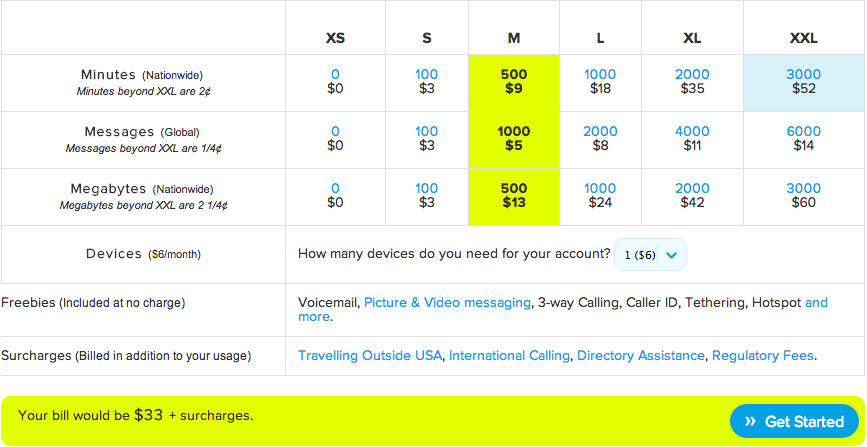
I looked over some of my wife and I’s older bills, and it looks like we would fall into the Medium bucket for voice, and the large buckets for both data and text, bringing us to a total bill of around 56 dollars before tax. This is currently less than half of what we are paying Verizon, but unfortunately more expensive than Republic.
You can, however, use any phone you like – which is a big plus for me.
Check the website here to learn more about Ting.
Straight Talk
Straight Talk is a prepaid carrier, and offers $45 per month for unlimited everything like Republic Wireless. They use the same towers that the Big 4 use, and offer a very different price. You can set yourself up for auto refill, which will ensure that there’s no coverage dropped when your prepaid time runs out. Essentially it’s like having a phone contract, but without the restrictive contract, and for 1/2 of the cost of one of the big 4. With the unlimited plan, you can keep your current phone number as well.
The billing is simple and easy to understand, and you can purchase prepaid cards if you are not interested in using the auto refill option.
Check out their website here for all the details
My wife and I have not decided on much, except that it is highly unlikely that we stay with Verizon. At this point, we are biding our time until Republic releases their new phones, and then will make a decision from there.
How about you all? Do you have any of these services? If so, what do you think about them? Would you ever try one of them?
How much does your current wireless plan cost per month?
Share your experiences by commenting below!
Four Insurance Policies That Aren’t Worth The Cost

 The following is a post by MPFJ staff writer, Toi Williams, who is a professional personal finance blogger of Fine Tuned Finances. She has backgrounds in personal finance, sales, and real estate.
Today, insurance is a fact of life for most people. At times, it can seem like there is an insurance policy available for everything, and that is almost true. People can buy insurance policies for their homes, cars, vacations, pets, valuables, and nearly anything else that you can think of. Many people love having insurance because of the protection it provides to them and their families. While some of these insurance policies can be very beneficial and provide a great amount of assistance when you need it the most, some insurance policies are not worth the paper they are printed on.
Here are some insurance policies that are not worth what you must pay for them.
Whole Life Insurance
One insurance product that most people should stay away from is whole life insurance. These life insurance policies are sold with the promise that it will be an investment in your future and that your investment will grow to the point that the policy will pay for itself. Unfortunately, investment results are never guaranteed and you could end up spending a lot more than you realize because these insurance policies are very expensive.
There are several reasons why purchasing a whole life insurance policy is so expensive. The biggest reason is that there is a savings element built into the policy over and above the cost of coverage. You are basically using the life insurance policy as a savings account for additional money that you may have. There are also various fees and commission charges that are added to the cost of the policy as well, significantly increasing the price.
Many people who choose this type of life insurance policy do not have the coverage that they need because the policies are so expensive. Not having enough coverage is almost as bad as having no coverage at all. While there are a few people who could benefit from purchasing a whole life insurance policy, most people can’t and won’t. Instead of purchasing a whole life insurance policy, choose a reasonably priced term life insurance policy that has enough coverage to replace several years’ worth of your income in the event that the unthinkable happens.
Accidental Death Insurance
Another type of insurance policy to avoid is accidental death insurance. People purchase these policies thinking that it will help their family if they die suddenly in a tragic accident but fail to realize that the chances of this happening are extremely low. Companies that sell accidental death insurance policies know that they will rarely have to pay out money to beneficiaries, so they keep premium rates just low enough to entice you into buying the policy. By using scare tactics and coercion, they convince consumers that this is a type of insurance that they actually need.
The truth is that you probably don’t need an accidental death insurance policy. The chances of you dying in an accident is slim. Even if you do have an accident that causes your death, there is no guarantee that it would be an accident that is covered under the policy. You would do better to get the term life insurance coverage that you need and keep the insurance in effect throughout the term to ensure your family’s financial security if you were to die suddenly.
Children’s Life Insurance
Children’s life insurance is another insurance product that you can do without. Insurance agents sell these policies as an investment in your kids that will benefit them with they get older, but you could do the same thing with a savings account and be earning interest instead of paying money out of your pocket. In some cases, parents buy these policies so that they will not have large out-of-pocket costs to bury their child if they should die from an illness or injury while they are young. Once again, placing that premium payment into a savings account will accomplish the same thing with much lower costs associated with it.
Rental Car Insurance
If you have ever rented a car, you will be familiar with the rental car insurance policies that the rental company tries to sell you when you go to pick up the car. Renters are told that the policy protects them in the event that they have an accident or the car becomes damaged while in the renter’s possession and are encouraged to sign for the insurance when they get the keys to the car. What many people do not know is that they may already be covered by insurance when they rent a car, so purchasing additional insurance from the rental company is a waste of money.
Before you sign for the optional insurance from the rental company, check to see if you are already covered under your current auto insurance policy. Many car insurance policies contain coverage for the covered driver whether they are in their own car or a car rented in their name. Whether you are covered will be disclosed in the terms and conditions of the policy you purchased, so review your paper copy of the terms, look up the terms for your policy online on the auto insurance company website, or call a customer service representative and ask if you are covered.
If you use a credit card to reserve and pay for the rental car, you may also have insurance coverage for the car rental available to you from the credit card company. Many credit card companies offer coverage for rental cars whose costs are charged to the card, but this insurance is generally secondary to the rental car insurance that is available to you under your regular car insurance policy. Review the terms and conditions for your credit card or call the credit card company to see if this coverage is available to you.
How about you all? Do you think there are good reasons to buy these types of policies? Why or why not?
Share your experiences by commenting below!
***Photo courtesy of http://www.flickr.com/photos/86530412@N02/8266216454/sizes/m/in/photostream/
How to Save Money Around The Home With DIY

 The following article is by MPFJ staff writer, Miss T from Prairie Eco-Thrifter. If you want to learn how to live your dream life in a sustainable, healthy, and money savvy way, check out her site here.
DIY, or Do It Yourself, is something I discovered a few years ago and I have to admit that I got a bit carried away and went around DIY-ing everything I could find.
Luckily, this frenzy wore itself out, but I remain committed to doing as much as I can around the house myself. The other day, it got me thinking about just how much money I save around the home with DIY instead of hiring a tradesman or buying ready-made.
There are a number of reasons why people consider DIY, but probably the most common one is to save some money. Others want to reduce chemicals and toxins in their home; some want the thrill of knowing that they did it themselves; while others want something a little different that may not be available in the stores. Whatever your reason, rest assured that you can save money by doing it yourself.
One of the biggest DIY changes we made in our family was to cook our own meals at home. This wasn’t something we had ever really done before, relying on packaged, pre-prepared and frozen foods, ordering take-out or simply eating out at family-friendly restaurants. A few years ago, we were re-working our household budget and were shocked at how much we regularly spent on food; we started to investigate alternatives. We gradually changed over to home cooking and haven’t looked back. We save hundreds of dollars a month, eat much more healthily, and have heaps of fun and family time in the kitchen. Everyone has a say in the menu planning and even the kids take their turn at cooking meals. It’s one of the best family decisions we have ever made!
Cooking at home led to starting a vegetable garden in the back yard, yet another DIY way of saving money at home. It was actually one of the kid’s ideas, and it started out as her project, but soon, we were expanding the beds and growing more. Many of our favorite dishes are based around what is in season in the garden, and it has given all of us a greater appreciation of where our food comes from. The cost of seeds and seedlings is a fraction of what we used to spend on the same fruit, vegetables and herbs, so there is quite a cash saving there. We compost scraps and grass clippings and have a worm farm to supply all the nutrients for the garden.
When we started out, there wasn’t much money for expensive furniture, and we learned to make do with second-hand. Now, I seek out secondhand and used furniture and accessories because I love to create new from old with some DIY techniques I’ve learned along the way. Timber furniture is a passion of mine, and I love to strip off old paint and varnish, repair any damage, and refinish the piece with modern colors and stains. Secondhand furniture costs a fraction of the price of new and with a little bit of work, you can produce unique, attractive pieces for your home and have fun doing it. My latest interest is in natural stains and I have experimented with coffee, tea, vinegar and berries to give unique, non-toxic finishes.
Many people are concerned about the amount of chemicals and toxic substances they use around the home and the impacts these can have on our health. While searching for non-toxic alternatives to the chemical cleaning products we used to buy, I discovered the effectiveness and of some very simple ingredients. Instead of buying all of the one product/one job cleaners we used to spend so much money on, we now use things like vinegar, sodium bicarbonate, essential oils, and citrus peel to clean the home. There are websites with recipes for these cleaning products and you will be amazed at how well they work and the hundreds of dollars you can save every year, not to mention how much safer and healthier your home will be.
Hiring a tradesman for jobs around the house can be an expensive exercise, but it is necessary when the problem could be dangerous or has to be done by a licensed expert for legal reasons. However, there are many home maintenance tasks that can easily be done by the householder with dollar savings as a big incentive. Garden maintenance, house painting, gutter cleaning (not on a high roof maybe) and some renovations can easily be undertaken by someone with basic skills and knowledge. Safety is paramount, of course, and you need to take every precaution to prevent and avoid accidents or further damage to the house. With tradesmen charging up to $100 an hour, you can see how you will be able to save money by doing some of these jobs yourself.
These are just some of the projects my family and I have undertaken and we have seen how we can save money around the home with DIY. There is lots of information available to help you as you start these projects for the first time. For maintenance jobs, I found the staff at the stores where I purchased the necessary supplies were very willing to help me with information and advice.
How about you all? In thinking about your home, what ways could you save money by doing things DIY? What things do you do DIY already?
How much money do you think you are/could save by doing things yourself?
Share your experiences by commenting below!
***Photo courtesy of http://prairieecothrifter.com/wp-content/uploads/2013/08/iStock_000001831162XSmall-300×199.jpg
How To Ease Your Budget Into The Start Of A New School Year

 The following post is by MPFJ staff writer Travis. Travis is a customer blogger for CareOne Debt Relief Services, and also appears weekly at Enemy of Debt. Travis candidly shares his personal journey to pay off $109,000 of credit card debt and the tips he’s learned along the way. As a father and husband he provides a unique perspective on balancing debt, finances, and family.
We thought we’d already bit the financial bullet to get ready for the new school year, but we were WRONG.
We had all the necessary supplies for both kids purchased weeks ago. Last weekend, we hit up a few sales and bought some new clothes and planned to stage the purchase of cooler weather clothes over the next few months. But, there’s another major expense that needs to be accounted for. It goes by several names: Meet the Teacher Day, Orientation, or Schedule Pickup, but the result is the same.
The checkbook is going to get a workout. Listed below is what was on tap this time around:
School Pictures: In elementary school, picture day is a few weeks into the school year. But, for middle and high school, picture day is on schedule pickup day as the same picture is used for their student ID, which is printed and handed to the students immediately. Cost: $25.75 for a moderately priced package.
Gym Clothes: Shorts and Shirt adorned with the middle school logo. $14 for the shirt/short combo.
Parent Teacher Association: Want to have a voice in how things are done at school and help out with some of the events? You can, in exchange for a check for $8.
Yearbook: You won’t receive the yearbook until May, but we can reserve our copy now for only $23.50!
Instrument Rental: Students must be in Orchestra, Band, or Choir. Our incoming middle school student chose to play the Viola. $50 to rent one from the school for the year.
School Lunch Account: You can put as much as you’d like into their account, but the recommended amount is a month’s worth, or around $50.
For those adding in their heads, that totals up to $171.50 for just our daughter who is entering middle school. The potential fees for our High School Freshman are similar. As with any expenditure, Vonnie and I really scrutinized the cost and made the best decision based upon value and the funds we had available.
Let’s look at each of those potential expenses again and discuss which ones we went with and which we said “no” to.
School Pictures: I may not agree with how much they cost, but the grandparents love getting them, so we buy them. Purchased.
Gym Clothes: As I was about to start writing out a check, it was announced that purchasing gym clothes from the school was no longer required. Students could wear their own athletic shorts and t-shirt. Skipped Permanently.
Parent Teacher Association: We’ve joined almost every year, and hardly ever gone to meetings. Skipped Permanently.
Yearbook: They really want you to pay up and reserve your copy on schedule pickup day, but you don’t have to. The due date on the form given is actually several weeks away. Additionally, they’ll send the SAME form home in the spring asking again. No need to decide this now. To be decided later.
Instrument Rental: The orchestra teacher actually preferred that we send the check on the first day of school, which conveniently is after our next payday. Deferred to Next Pay Period.
School Lunch Account: We can add funds to the school lunch accounts online at anytime. This is usually handled as a bi-monthly expense of $25. We decided to add funds right before school starts, which as stated is after our next payday and in our next budget cycle. Deferred to Next Pay Period.
Out of a potential total of $171.50 worth of expenses, we walked out of the school only spending $25.75 for school pictures. The rest of the expenses we either skipped permanently or deferred to the next budget cycle. There are people that hop from table to table writing out each check as if it was a necessity, then complain about how much they have to shell out on a single day. But by asking some questions, and evaluating the importance and timing of each expense we were able to lessen our overall total, and spread out the payments to soften the blow on any single budget cycle.
Well readers, how does Schedule Pickup day (or whatever your school district calls it) work in your area? How crazy are the expenses for you and how do you handle them?
Share your experiences by commenting below!
Image courtesy of Stuart Miles / FreeDigitalPhotos.net
London On The Cheap

 The following post was written by Alex Sebuliba. Enjoy!
There is no doubt that London is a fantastic city to visit, regardless of whether you’re visiting from a different country or a Brit from a different part of the UK. Tower Bridge, the Shard, Hyde Park, Piccadilly Circus and Covent Garden are just a few of the numerous tourist attractions that draw millions of people to London each year.
And while all capital cities are known for and expected to have higher prices, with shopkeepers and business owners looking to take advantage of the tourist trade, wouldn’t it be fantastic if you could have a holiday in London on the cheap?
Well, it’s not impossible! Follow our tips below and you can visit one of the greatest cities on earth for a lot cheaper than you probably thought possible.
Where to sleep
The first consideration that most holidaymakers make about visiting a new place is how they’re going to get there, when really it’s accommodation that can be the most expensive segment. While many holidaymakers still choose to stay in a hotel, did you know that you can make considerable savings by staying in a self catering apartment?
If you’re travelling in a group, an apartment can be a fun, inexpensive place from which to base your trip, as instead of being confined to hotel rooms you can enjoy a communal living space, while saving a great deal by cooking most of your meals in the kitchen.
Where to shop
Shopping in London, even for the basics, can be very expensive. But if you’re just looking for a snack, a drink or some food that you plan to cook in your apartment, then you can save a small fortune by opting to shop at the national supermarkets such as Tesco, Sainsbury’s or Morrisons. As these are national chains they set prices on a national level, meaning you don’t pay a mark up just for choosing to buy in central London or from the shop owners who are fully aware that they can take full advantage of tourists with their ridiculously high prices.
How to get around
The London Underground is the oldest underground railway in the world, and this year it celebrated its 150th birthday. You’d think, with it being so old and, at busy times, uncomfortable, that it might be fairly cheap. Wrong. As a general rule, taking a bus is a much cheaper option for getting around London.
The city’s bus network is extensive, and some buses run all the way through the night. The TFL website allows you to find which bus you’ll need and, what’s more, the top deck of a red London bus can be a fantastic vantage point from which to view the sites and do some people watching.
If you do have to take the tube, then consider investing in an Oyster Card – for a £2 charge you’ll be able to top up your card and enjoy cheaper fares every time you’re in the city.
Don’t get caught in the trap
Every big city in the world has its share of tourist traps, and London is no different. If you know you’re heading to a trap, such as Piccadilly Circus, take a bottle of water with you – don’t choose to buy one when you’re there as the likelihood is that you’ll be ripped off.
Additionally, consider alternative ways to see things. The Shard, which opened earlier this year, charges £25 for an adult to enjoy its viewing platform. But you don’t need to go that high to enjoy great views – the view from Primrose Hill, or Greenwich Park, can be just as breathtaking if you’re there at the right time of day – and they won’t cost you a penny.
How about you all? Have you ever been to London? If so, did you find that it cost more money than you expected?
How did you save money?
Share your experiences by commenting below!
***Photo courtesy of http://www.flickr.com/photos/timmorris/3103896345/sizes/m/in/photolist-5Jhhfe-61cFWM-61cG1F-62aLAf-62zuBt-62zzu
Saving Money In The Kitchen With Energy-Efficient Refrigerators and Freezers

 The following is a guest post. Enjoy!
In the month of August, my family’s electric bill was $141.17. Even though I have spent a lot of time in the past dissecting and optimizing my budget and expenses, I realized that I have never actually dug in to the breakdown of how the various rooms/appliances in my house contribute to the overall costs of the electric bill. Specifically, I have never looked at how the KITCHEN of my house contributes to the electricity bill, with the main appliances which are on all year long being the freezer and refrigerator.
As such, the purpose of this post will be to look at how much a refrigerator and freezer contributes to the overall electric bill of the household and how much money can be saved by making sure you have an energy-efficient freezer and refrigerator.
What % of the electric bill originates from the kitchen?
According to this article, the average home electric bill is $2,000 per year. And, according to this article, the refrigerator/freezer alone contributes nearly 20% of this total, or $400 per year. That’s quite a nice little chunk of change if you ask me! Clearly, the kitchen is a place that deserves some focus in trying to cut down your family’s expenses.
How much money can be saved by using an energy-efficient freezer and refrigerator?
The first article above mentions that by purchasing energy-efficient freezers and refrigerators, you can save yourself $280 per year in electricity, cutting the $400 per year electric bill above in half! Pretty amazing stuff!
In the event that, like me, you’re a little bit of a nerd at heart, you may be interested in learning about HOW these energy-efficient appliances are able to save money compared to the older models. By doing a little searching around the Internet, I found out that a lot of technology/research has been put in to finding better ways to insulate energy-efficient refrigerators/freezers. One particularly interesting case was a refrigerator that featured vacuum panels to provide effective insulation and keep the coolness in.
How about you all? How much money do you think your family spends in kitchen energy use each year? Have you ever tried to save some money by buying energy-efficient refrigerators and/or freezers?
Share your experiences by commenting below!
***Photo courtesy of http://www.flickr.com/photos/24736216@N07/7160436218/sizes/m/in/photolist-bUK7dS-8Uzv5m-cNLHg3-fBuiVa-fBJCH5-8VoFF5-aqUWoA-8zgC3n-fkciG1-93t9Lp-fjPucc-dXVopT-fk4CFL-fjPuzH-9Xvyyq-fk4CPq-fk4CN7-dpwJrk-8eGyZV-8eGyYF-8eGyVT-9yrbL1-b8p8p4-8uHZ9s-asdvUM/
True or False: Money is the Root of All Evil

 The following post is by MPFJ staff writer, Catherine Alford. Cat is a freelance personal finance writer who blogs at www.BudgetBlonde.com.
I feel like the word “money” sometimes comes with a negative connotation. Do you sometimes feel that way, as if it’s immoral to want it or strive for having lots of it?
After all, our parents warn us against worshiping it. Some say it’s the least important thing in the world. Others caution us to respect it and understand it. Then, of course, there’s the saying that it’s the root of all evil.
If you think about it, that’s a pretty serious accusation!
It can certainly be argued that a desire for money has led to some pretty catastrophic events. Some that come to mind include wars, murder, Ponzi schemes and a slew of other things that we don’t like to mention in polite conversation.
However, what about the good that money can bring? What about all the great things that it can do when there’s lots of it?
I can think of a few situations where money isn’t the root of all evil at all. In fact, it can be a ray of hope. I’ve listed of few of these below:
1. Donations to Worthy Causes
Monetary donations can absolutely change lives. To cite an extreme example, Warren Buffett recently donated a large portion of his overall wealth to the Bill and Melinda Gates Foundation.
Even something small like paying for the food of the person behind you in the drive through can brighten their day. Have you ever noticed that around Christmas time, people are always paying for groceries and giving back? Wouldn’t it be nice if that was the norm all the time? This example actually shows that you don’t need a lot of money at all to make someone happy or improve their day.
Another example of donations is donating to your church. Many people give 10% of their income or more to their church, and that’s used for worthwhile causes in the community. You can also donate to other organizations all over the world and help people who are not as fortunate as we are.
2. Investing in a Business You Believe In
Another great way to help others using money is investing in businesses that you believe are worthwhile and promising. Small business owners often can’t even get their ideas off the ground without the help of investors, and they are often extremely appreciative of the help they receive.
Of course, investing in a small business is definitely risky because you don’t know if they will succeed, but with enough research and enough forethought, an experienced investor will be able to spot the good ideas and help them come to fruition.
3. Paying For Others To Travel
When I was in college, I was the recipient of a need-based scholarship to study abroad. An older couple in the community gave it. They pledged $5,000 to a student who wanted to visit and study in another country, and that lucky student was me!
Their generous donation changed my life, and sparked a desire to see the world even more. I’ve even been living abroad for over two years now. I might not have had the confidence to move abroad without the generosity of that couple who helped me travel all those years ago.
4. It’s an Excellent Motivator
Many people older and wiser than I am will say that you shouldn’t be motivated by money; however, I’m not sure that’s true. It would be hard to find someone who isn’t motivated by their income.
Don’t we all work hard so that we do well in our careers so that we can bring home an income to feed our families? If we don’t do well at work or we slack off, we could get laid off or fired!
So, while I don’t think money should be your only motivator to work hard, I think it’s okay for it to be one of your motivators.
Another example of being motivated by money is trying to raise money for a cause. For example, Jacob has his Give 10% Back Project. He is motivated to raise money. Money isn’t the actual motivator, but donating money is. In that way, I feel like we can be motivated by the numbers without losing ourselves in the process.
As evidenced by the examples above, money doesn’t have to be associated with “evil.” I know that the quote generally means that money is the root or the motivating factor behind most evil acts. However, it’s also the motivation for some of the most charitable, life altering, and generous acts of kindness around. I’ve been the recipient of them.
How about you all? Have you been the recipient of generous acts of kindness involving money? Do you think money is the root of all evil?
Share your experiences by commenting below!
***Photo courtesy of http://www.flickr.com/photos/jono2k5/2495905416/sizes/m
Top 10 Questions to Ask Your Mortgage Broker

 The following is a guest post by Lara Seers. Enjoy!
Your home loan is one of the most important financial arrangements you’ll ever set up. It’s important to get the correct financing in place and find a good person to handle the job. Here are 10 questions to ask a mortgage broker to help track down the right lender and the right loan for your needs.
Loan Questions
What is the Interest Rate on the Home Loan?
The interest rate is the most important part of a home loan. This is the cost of borrowing money to buy a house. The higher the interest rate on a loan, the more the buyer will end up paying to the lender. Since a home loan is for so much money and lasts for so long, the interest payments add up fast. Try to find the lowest rate possible.
What Other Costs Will There Be?
While the primary cost of a home loan is the interest rate, other charges also can come up. The lender and/or the mortgage broker could charge an extra fee to start-up the loan. These fees are typically a percentage of the home cost and usually need to be paid up front. Lenders often market a “low” interest rate that also has many other fees. Be sure to consider all these costs before making a decision.
Will the Interest Rate Be Locked in or Not?
Some home loans lock in the interest rate so it stays the same during the entire loan. Others do not. They use a variable rate which means the rate can change over time. A variable home loan is a bit riskier because the future cost could change quite a bit. It’s important to find this out before taking out a loan.
What Do I Need to Qualify for a Loan?
Qualifying for a home loan isn’t guaranteed. The mortgage broker should have a very good understanding of what it takes to qualify for a home loan. Your broker should let you know ideally how large your down payment should be, what type of credit score is needed, and how high your income needs to be for a loan. This way, you’ll know in advance if you’ll qualify.
When Will My Loan Be Approved?
A home loan application takes time and can change depending on how many people are applying for loans at the same time. The mortgage broker should give you a good estimate of when your loan will be ready so you can coordinate with your home search.
Mortgage Broker Questions
How Long Have You Been in the Business?
It takes time to learn the mortgage business. Ideally, your broker should have at least a few years of experience. If you run into any complications, it helps to work with someone who has seen these issues before.
Can You Provide References?
If a mortgage broker did a good job in the past, there’s a good chance this professional will come through for you too. Talking to a few previous clients should give you an idea what kind of service to expect.
How Are You Compensated?
Some brokers charge an upfront commission. Others lump their fee in as part of the home loan interest rate or fees. It’s important to find out whether your broker is getting paid just from a specific institution so you can make sure there isn’t a conflict of interest.
Do You Handle Refinancing?
You may want to switch your home loan later on with a refinance. Ideally, your mortgage broker would be able to handle this future job as well.
Will You Stay in Contact with Me after the Deal is Complete?
A true professional will keep an eye out for you after your home loan is set up. See if your mortgage broker has a plan to keep in touch with you somehow and will be watching out for a better deal for you down the road.
These 10 questions are a great way to evaluate your home loan and mortgage broker options. The answers will make it very clear whether a choice is a good one.
How about you all? When you went through the process to obtain a home loan, what questions did you make sure to ask your broker first?
Share your experiences by commenting below!
***Photo courtesy of http://www.flickr.com/photos/68751915@N05/6869769579/sizes/m/in/photostream/
How Do Chattel Mortgage Payments Work?

 The following is a guest post. Enjoy!
Buying a car is almost essential for living anywhere in Australia except the most central of urban dwellers. But cars these days are expensive, and budgets are tight. One consideration is the chattel mortgage, which may be the perfect option for your next car purchase. It’s also known as an equipment loan or a bill of sale.
What is a chattel mortgage?
You might be used to hearing the term ‘mortgage’ in relation to homes. But in this case, the same idea is applied to a car. Instead of having a loan out for the car, a bank or financier gives you the funds in full to purchase the car. Then the bank creates a mortgage on the car itself, in this case called a “chattel” (which is just an old English word for ‘property’). The specifics of the agreement depend on the contract; in some cases legal ownership is with the bank, and in others it is with the purchaser.
The terms of the mortgage will state that should the purchaser default on their payments, the bank can take back ownership of the chattel. And just like in a normal mortgage, when the payments have been made in full, the car owner is free and clear and can trade the car in for another or sell the car.
Why should you get a chattel mortgage?
Chattel mortgages are often used by business owners, as the Goods & Service Tax (GST) can be claimed up front, and then as the loan repayments are made, interest payments can also be deducted, so there’s a significant tax benefit there. Other benefits of a chattel mortgage include:
- Monthly payments are fixed
- Lower interest rates
- More flexible terms of contract (loans range from less than 12 months, up to five years)
- Overall costs can be reduced with a trade-in or down payment
In general, you have a better idea up-front of all your costs and fees with a chattel mortgage, as opposed to other lending methods.
When considering the chattel mortgage option, it is good to speak with not only your bank but your accountant to understand how the costs will break down, since you wouldn’t be able to switch to a different kind of loan after-the-fact. Some banks and financiers have online calculators you can use.
How about you all? Have you ever heard of and/or used a chattel mortgage payment to purchase a vehicle?
Share your experiences by commenting below!
***Photo courtesy of http://www.flickr.com/photos/59650561@N08/5454148183/sizes/m/in/photolist-9iXWeD-akTCzp-7P7EZe-94oVFW-94kQKH-94kQuZ-dNd85p-a8MEFX-ddF8Wi-ddF9Bg-9iESa7-89sJM3-dWGvgv-biHxvt-aMeAxz/