

- You are here:
- Home »
- Blog »
- Relationships »
- Why You Need a Will and How to Get One
Groups I Am a Part Of


Why You Need a Will and How to Get One
 The following post is by MPFJ staff writer, Marie. You can read more of Marie’s articles over at her own blog, Family Money Values. Enjoy!
For much of my adult life, I didn’t have a will. Even after I had children, my spouse and I neglected to make a will. Only after dealing with my Mom’s estate did we decide to get one. We were lucky that we didn’t die without a will.
Here is why:
If we died at the same time, our children would have gone to child services until a guardian could be appointed by the courts. The government in our state would not let anyone watch the kids unless they had a legal right to do so, even just for awhile after (for instance) the car wreck that killed us. Not only would our two sons have been dealing with the trauma of their parents deaths, but they would also have possibly been subjected to care by strangers or care in an institution.
Repeat that about 20 times. To me, the main purpose in having a will is to influence who will care for your children on your death.
Of course, there are other reasons to draw up a will. For instance, to distribute your assets (if you have any that would pass through probate and if you want them distributed differently than your state would) or to shorten up probate time.
But, you can distribute assets the way you want without a will. You can avoid probate altogether. You just have to know how.
To distribute your assets without a will you can (choose one or more):
- Put them in a joint account,
- Put them in a trust,
- Title them as ‘transfer on death’ or ‘pay on death’ or
- Designate a beneficiary.
To avoid you can having a will and going through probate if you have a really small estate (in some states) or if you have all assets titled so they flow directly to someone else.
But there is no other way to legally state your wishes as to who will raise your children if both parents are dead.
When I say ‘state your wishes’, in many of the US states, I mean just that. State law governs guardianship rules. Many states do not automatically grant the wish you state in your will. Some states retain the right to appoint whoever they feel is best for the minor, others vary in degrees of automatically abiding by your wishes – but still retain the right to appoint someone else if there are issues with the person you chose.
Still, your wishes have weight and will at least be considered by most courts in most states. Typically the judge will allow for providing letters of guardianship to those you designated.
If someone does try to raise your child without letters of guardianship, she will struggle – even with something as simple as getting medical care.
How to draft a will
Writing and recording a will doesn’t have to be expensive or time consuming. In many states, you can simply write out what you wish done, sign it in front of a notary and you are done. BUT, since you won’t be around to make sure things go as you wish, you should spend some time and at least a bit of money to make sure your will is legal in your state.
Step 1 – Figure out what you want done.
Coming up with a name for a guardian for your children is never easy. You and your spouse may differ on which person should do so, making things even harder.
You may want one person to be the one who raises them, lives with them and etc and another to be the custodian of the finances you may be leaving to help your guardian with the costs of raising your kids.
Include some kind of language to let the guardian know how you want your kids raised (religion, education, and etc).
You will revisit this as you go through life, needs change as might your idea of the best guardian may.
Writing down what you want done with your assets is somewhat easier.
Step 2 – Make sure what you want is within the laws of your state.
We consulted a lawyer for this step, but you could use one of the software packages available now on sites such as Nolo.com. A compromise would be to draft up the will using software but have a lawyer give it a look before you make it final. That way, you use fewer lawyer hours but still have some additional assurance that you are within the bounds of law.
Step 3 – Draft the language.
A lawyer will do this for you, or as stated above you could use one of the many software packages available for this purpose. Legal Zoom for instance, has one for around $70 which includes a review of the document (not a legal review, more like an editor review).
If both of those are out of your reach, visit your local library and checkout books like Kiplinger’s estate planning : the complete guide to wills, trusts, and maximizing your legacy or Estate planning basics.
Some of these have forms you can fill in – one for each state.
Step 4 – Sign it so it is legal.
Most all states require that a witness also sign the document. A notary public signature is best and can be obtained for a small fee at most banks.
Step 5 – Let your guardian and heirs know you have a will.
After you have gone through all four steps above, it would be a shame if you died and no one even knew you had a will, let alone what was in it or where it was.
Asking someone to care for and raise your kids is a very big deal. They deserve the right to decline the honor. Let them know in Step 1 – right after you settle on that person.
Don’t squirrel your will away in some unknown or unreachable (in the event of your death) spot.
We have ours in a drawer at home, with copies to both of our sons. Some folks leave theirs with their lawyer.
Step 6 – Explain what you want done.
Let your heirs know (if they are old enough to understand) what you have set out. If you are dividing your assets unequally, get it out in the open, along with your rationale. Otherwise, there are likely to be fights on your death – including lengthy and costly court battles.
Step 7 – Review periodically.
Change is constant. What you had and wanted when you first drafted your will could change. Laws can also change. Review your will periodically to make sure it still satisfies your wishes and is still legal.
Our solution
My spouse and I have combined multiple estate planning techniques. We do each have a will (but since our children are grown, they do not have words about guardians). We also each have a living, revocable trust. In addition, certain of our assets, such as our IRA’s will pass directly to one or more beneficiaries.
Our wills both have “pour over” language in them. At our death, any assets titled solely in the deceased’s name will pour over into the trust. The trust becomes irrevocable at death and dictates how our assets will be distributed. Any assets titled in the name of the trust will be distributed by our successor trustee. My spouse and are are currently each trustees of our own and of each others trust, so that we can operate just as we would if the assets were held in a joint account. When the first of us dies, the other continues as trustee. If both of us die, the successor trustee (one of our son’s) becomes trustee. In addition, should one or both of us become unable to manage our affairs, the trustee or successor trustee can step in to do so.
As long as we keep assets titled to the trust, our heirs should be able to avoid having to use probate court to distribute our estate.
We also meet as an extended family at least once a year to provide an opportunity to share information with our adult heirs about our plans and our assets.
How about you all? Have you started your estate plan? What is your estate planning strategy?
Share your experiences by commenting below!
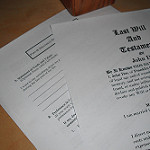
***Photo courtesy https://www.flickr.com/photos/ken_mayer/5599532152
About the Author J. Irwin
Related Posts
Maximizing Your Nest Egg: How to Make the Most of IRA Investments
Everything You Need to Know About Payday Loans
6 Tips on How You Can Manage by Not Getting a Lot of Debt While You Are a Student
Popular posts
Session expired
Please log in again. The login page will open in a new tab. After logging in you can close it and return to this page.
This is something that, sadly, we have still yet to do. But we know we need to. Ah, procrastination!
Money Beagle recently posted…7 Steps To Improve Your Credit Score
Lots of people put this off. Sadly, we all come to the same end, but we just never know when! When we are young, we all think death is something that only happens to others, until it strikes down someone close.