

- You are here:
- Home »
- Blog »
- Saving Money & Frugal Living »
- What are Your Options for Tax-Advantaged Non-Retirement Savings and Investments?
Groups I Am a Part Of


What are Your Options for Tax-Advantaged Non-Retirement Savings and Investments?
————————————————————————————————————————
Welcome to My Personal Finance Journey! If you are new here, please read the “About” or “First-Time Visitor” pages to find out more about us. If you would like to receive free updates on articles like this by email, then sign up here or you can subscribe to the RSS feed. Also, check us out on Twitter or Facebook. Thanks for visiting! Keep on learning!
————————————————————————————————————————
A few days ago, I wrote a post describing the various options available on the market today that people can use for tax-advantaged retirement savings/investing.
Tax-advantaged vehicles provide us as normal individuals, a very powerful strategy to try to optimize the taxes that we ultimately have to pay over our lifetime. However, there are two big problems I have encountered over the past few years (and ones that I am guilty of as well) circling in the air around how people utilize tax-advantaged money vehicles:
- Problem 1 with the Way People Use Tax-Advantaged Vehicles – People focus far too much on the advantages, while forgetting to really have the disadvantages sink in.
- Problem 2 with the Way People Use Tax-Advantaged Vehicles – People don’t fully understand all of the various tax-advantaged vehicle options at their disposal (i.e. getting focused solely on one with the exclusion of the others).
In order to address these two problems I have experienced, the purpose of this post will be to review the tax-advantaged savings options on the market today. While doing this, we’ll cover both the advantages and disadvantages of each, but I’ll try to more blatantly call out some of the disadvantages of each vehicle in order to help people know what they are getting in to with the use of red text. I’ll also include my take on how I will or will not incorporate each in to my personal investing/saving strategy at the end of the post.
Let’s get started!
Tax-Advantaged Vehicles – Non-Retirement Accounts
Having covered tax-advantaged retirement vehicles in the post several days ago, we will now continue on with our discussion with several possible options I’ve been investigating recently that are tax-advantaged, but that are not designed so that we are penalized 10% if we want to withdraw our money/earnings prior to 59.5 years old.
As we work through the options, you’ll likely notice that there are some other tax-advantaged investments that I have excluded. Several of these include tax-managed mutual funds/ETFs, Master Limited Partnerships, US Savings Bonds, and REITs. I left these off the list intentionally so I could focus on the vehicles which, in my non-professional opinion, seem to offer the most significant tax-advantages.
Side Note: Before we too deep in to this discussion, I want to point out that these are only options that are tax-advantaged. In other words, if you do not need the tax shelter and are simply looking to aggressively grow your money for long term needs (but you don’t want to be potentially penalized for pulling money out early if needed prior to retirement), a very good option that you can choose is to simply invest in a taxable mutual fund investing account. Any major brokerage offers these. The best offerings in my opinion are with Vanguard and Fidelity due to the low cost nature of their index mutual funds and the fact that you are not charged a trading commission when you purchase their name brand funds. In these taxable accounts, you can invest in pretty much the same equity mutual funds that you can inside an IRA/401k with these same companies. What I’ve realized is that a lot of people forget to consider this option when looking for places to invest their long term savings. Don’t let this happen to you! 🙂
Whole Life Insurance
The first tax-advantaged non-retirement account that I want to discuss is whole life insurance. Lately, I’ve spent between 70-100 hours total analyzing whole life insurance as a potentially good place to save money long term. Since sharing that analysis would be a lengthy discussion, I’ll share that in a separate post – on the way soon!
For the purposes of today’s post, we’ll just skim the surface about what whole life insurance offers:
- You pay a monthly or annual premium, and over time, this builds up a cash value along with securing a certain amount of death benefit for the insured’s whole life, hence the name.
- Each year, your account is guaranteed a certain base interest rate (usually 3.5%), and then you potentially receive dividends based on insurance company performance. The total average annual internal rate of return on your cash value is around 4.5% historically.
- Even though your premiums are made after-tax, your cash value accumulates tax-deferred, and the death benefit is also tax-free in the event that you die.
- Policy loans can be taken against your policy’s cash value balance, and these loans are tax-free.
Despite some very significant benefits, whole life insurance is not without its respective disadvantages.
- It’s complex and headache-producing. In order to find a properly structured policy, you have to REALLY know a lot about what you’re doing because the traditional insurance agent makes more money with a policy that is worse for you. Nice right?! After 100 hours of studying whole life insurance, it’s still not clear to me all of the complexities surrounding it.
- Even though the loans are made tax free, there will often be a spread interest rate that you have to pay on the difference between what the cash value is earning and what the loan rate is.
- Internal cash value rates of return are often decreased in the first 20 years of a policy (even a well-structured one) due to the cost of securing your lifetime death benefit. While this can be viewed in a lot of ways as positive, it must be taken in to consideration.
Tax-Exempt Municipal Bonds and Money Market Accounts (Or Mutual Fund/ETF Versions)
A fairly interesting tax-advantaged investing vehicle that I have only begun to investigate in depth recently is tax-exempt municipal bonds (and the mutual/ETF fund versions therein).
At a high level, municipal bonds (and securities) are issued by local, county, or state government entities to help fund the various projects and improvements they want to take on. These can include building school, highways, sewer systems, or simply funding day-to-day activities.
- They offer a nice tax-advantage for non-retirement investing and savings in the regard that the income/interest/dividend you make from municipal bonds are exempt from federal income taxes.
- This income is generally also exempt from state and local taxes, provided that you pay taxes in the state/municipality in which the bond was issued.
Even though it may not be absolutely the most efficient, I would prefer to hold bond mutual funds or ETFs instead of the actual bonds themselves. More specifically, if I were to invest in municipal bonds, I would likely want something that is very secure, i.e. short-term bonds.
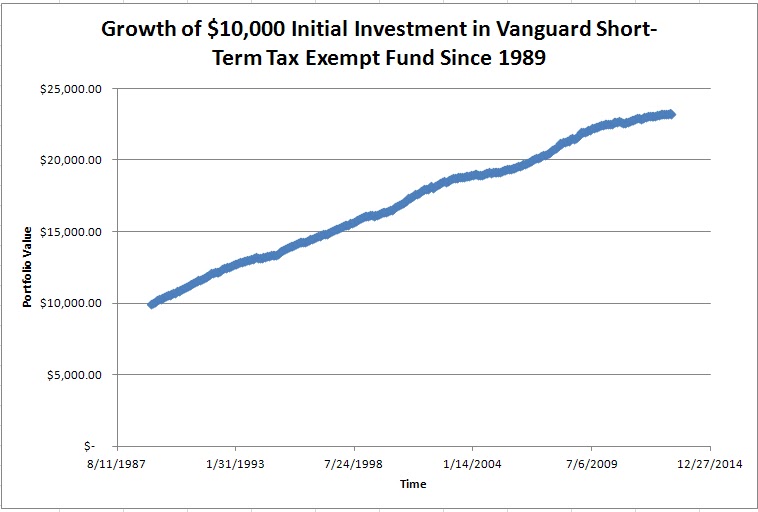
Since I like Vanguard, I would likely invest in the Short-Term Tax Exempt Bond Fund, Ticker Symbol, VWSTX. The chart below shows how $10,000 initially invested in this mutual fund would have grown from 1989 to the present day.
As you can see below, the growth is very steady, with some leveling off during the hard economic times when interest rates went down to get the economy jump started with easier lending, but hardly any decrease in value. The 22 year average annual return was 6.07%. Pretty solid, right?!
In looking at the numbers in detail, I found that the most money you would have lost in any one month during this 20+ year period was $117.13, corresponding to roughly a 0.56% decrease. Not much at all compared to the volatility of the stock market and that you have $10,000 to start off with! If you’re interesting in look at my investigation in more detail, click here for the Google Docs spreadsheet.
Of course, the tax-shielding and stability (with short term) of municipal bonds is not a free lunch (i.e. there are some disadvantages).
- Municipal bonds are not ALWAYS exempt from ALL taxes. For example, the Alternative Minimum Tax still applies, and if any capital gains occur, you still will owe capital gains taxes on those as well. Good articles to read more about the potential taxes on municipal bonds can be found here and here. Because of this, be sure to know how the tax laws apply for your specific situation!
- Because of the tax shielding, municipal bond yields will be significantly lower than their taxable counterparts.
- Even though you can manage the amount of price volatility/risk by maturity matching, there is no absolute guarantee that you won’t lose money, as is the case with life insurance.
Higher Education Savings Plans Where You Maintain Complete Control over the Money
Everyone hopes that their child will get a full scholarship to go to college, but the odds these days do not seem stacked in our favor enough to TOTALLY depend on one of these awards.
By opening a college savings fund through an institution like Vanguard, you can take advantage of tax deferred growth within the account, while still having the luxury to direct the investments the way you want. Just remember that you will want to match the maturity of the investment instrument with the time horizon associated with whenever you child will be going to college in order to maximize returns.
It is also important to remember that although all parents I’m sure would prefer to help their children pay for college, they should only save for their children’s higher education if and only if they are completely satisfied in their progress in saving enough money to secure their own retirement first! None of us will do our children any good if we are depending on them for everything financially for the last 35 years of our lives, right?! Children also have more options in the form of student loans to assist in paying for college, along with having a long time frame that they can use to pay back this form of debt.
Let’s examine some of the specifics of college savings accounts/plans:
- There essentially two main types of college savings plans – 529 accounts and Coverdell ESA’s.
- 529 Accounts –
- With 529 accounts, you as the parent, open and control the account ALWAYS, regardless of the age of the beneficiary. You then designate a beneficiary (who can be any age from newborn to adult) that the money will go to for higher education expenses. One of the cool things about this account is that you, yourself, can be the beneficiary if you plan to go back to school at some point!
- You can contribute a fairly large amount each year, but once the account balance reaches $370,000 (a problem we would all like to have, right!?), you can no longer put in money, but your earnings can keep compounding.
- Essentially, the standard gift tax rules apply with these accounts. In other words, you can contribute $13,000 per year on a regular basis to one beneficiary, or you can make one contribution of up to $65,000, but you cannot make any more contributions for the next 5 years.
- Certain states (like Virginia where I live) allow you to deduct your contributions (up to a maximum amount, $4,000 in Virginia) on your state income taxes (not federal income taxes though).
- Earnings grow tax-deferred, and withdrawals are free from federal income tax if used only to pay for qualified higher education expenses (this means the standard tuition, fees, books, room/board, etc).
- Also, if you invest in a state-sponsored plan in which you earn income, the withdrawals will also be state income tax free as long as they are qualified!
- One good thing is that like Roth IRA’s, you as the account owner, can withdraw your contributions (not earnings) at ANY time for ANY qualified or non-qualified reason without paying any taxes or any penalties.
- Friends and family can also contribute to the beneficiary (future student).
- You can also change the beneficiary to another member of your family if needed.
- The account is considered an asset of the account controller (parents) when taking in to consideration financial aid eligibility. This can improve your child’s chances!
- There are NO income limitations on who can establish/contribute to an account.
- If the beneficiary decides not to go to college or gets a big scholarship, there are a couple of options for how to handle this. A good article explaining these things can found accessed here.
- Coverdell ESA’s –
- In general, Coverdell ESA’s have the majority of the characteristics discussed above with 529’s with two important exceptions:
- 1) You can only contribute $2,000 per year per beneficiary, much less than with a 529 plan.
- 2) Along with using Coverdell money for higher education purposes, Coverdell assets can be used for qualified education expenses at the elementary and secondary education level. Nice! 529 plan assets can only be used for higher education purposes. The qualifying education expenses are much more broadly defined in the case of Coverdell ESA’s as well.
Some negative aspects / disadvantages to keep in mind about higher education savings vehicles:
- Contributions are made on an after-tax basis, so they won’t do anything to reduce your current tax burden, unless your state has special allowances for this.
- Earnings on non-qualified higher education expense withdrawals are taxed as normal income and subject to a 10% penalty, so this is something to watch out for!
- IRS rules dictate that you can only change around the allocation of assets in a 529 plan once per year. While this shouldn’t be that big of a deal because re-balancing happens only about 1x per year, this is something to keep in mind.
- Your investment options inside the 529 account can be limited to certain types of funds. However, seeing as how Vanguard offers 529’s, the options likely aren’t all that bad. Coverdell ESA’s offer many more options.
- With Coverdell ESA’s, you are required to transfer ownership of the assets to the beneficiary by age 30 in order to not incur taxes and the 10% penalty. With 529’s, there is no such requirement.
- You can only contribute fully to a Coverdell ESA account if you make below $95,000 per year.
Well – that about wraps things up for tax-advantaged NON-retirement accounts!
In an upcoming post, I’ll also work through two other tax-advantaged options that I did not have room to cover here – trusts and custodial accounts. Keep an eye out for that – on the way soon!
How about you all? Which of these tax-advantaged non-retirement accounts is your favorite/do you use the most and why?
How much do you have invested in retirement accounts vs. non-retirement accounts at the moment?
Share your experiences by commenting below!
***Photo courtesy of http://upload.wikimedia.org/wikipedia/commons/1/17/Singer_City_Investing_Hudson_Terminal_1909_crop.jpg
About the Author Jacob A Irwin
Hi folks! My name is Jacob. I am the owner and operator of My Personal Finance Journey. I started this blog in January of 2010 and have enjoyed the journey ever since. Since finishing up graduate school in Virginia in 2014, I have been working in biopharmaceutical development in Colorado. You can read more about me and this site here. Please contact me if you have any questions!
Related Posts
16 Free or Low-Cost Ways to Keep Your Kids Entertained This Summer
4 Ways to Help Your Kids Get Into the Habit of Saving
What to Know When Your Minor Child Gets a Job
Popular posts
Session expired
Please log in again. The login page will open in a new tab. After logging in you can close it and return to this page.
I have been meaning to do more specific research on municipal bonds, but haven't really gotten to it yet. For now, however, I have my wife's med school debt to pay off, so our non-retirement savings is going there and in real estate.
My recent post Retire Early or Work With Less Stress?
Thanks for sharing! Yeah, I've been considering short term muni bond funds as a potential place to park money that I can access quickly but may be able to take a little more risk on than say my money market savings.
What type of real estate do you invest in? Is it just your own house or do you have a rental?
My recent post What are Your Options for Tax-Advantaged Non-Retirement Savings and Investments?
I kept my first house as a rental and have one more. Hoping to get a third before rates start going up.
My recent post It’s a Sweat Equity Weekend!
That's great that you kept the first one as a rental. Do you have a property management company take care of it for you or do you do everything yourself?
My recent post I'm On My Own and So Are You: Financial Security for Women by Judy Resnick – A Book Review
I hate to say it, but none of these options really impress me. The educational savings accounts might be useful if you know that you (or your kids) are going to college in the future. I haven't done the numbers on these to see if they're really worth the effort yet.
I have my doubts that the whole life insurance policy will ever achieve returns on par with the stock market. Without seeing the annual distributions, I can't say if the insurance policy will be on par with dividend stocks.
The bond fund has a hideous rate of return. I checked the website. The 10 year annual average is about 2.2% and the current dividend yield is about 1%/year, that's almost on par with inflation.
My recent post A Brief Primer on Dividend Growth Stocks Part 2: Basic stock screening
Thanks for sharing myfijourney! Yeah, the ESA seems pretty cool, especially since the assets can be used for non-college expenses as well.
One important thing to note about whole life and the short term tax exempt bond is that they really aren't intended to outperform the stock market/dividend stocks. They are more designed to be stable sources of money without the ups and downs, but you're right, along with that reduction in risk comes a reduction in return.
My recent post What are Your Options for Tax-Advantaged Non-Retirement Savings and Investments?