

- You are here:
- Home »
- Blog »
- Saving Money & Frugal Living »
- What Size Pond Do You Want For Your Fish-Metaphored Life?
Groups I Am a Part Of


What Size Pond Do You Want For Your Fish-Metaphored Life?
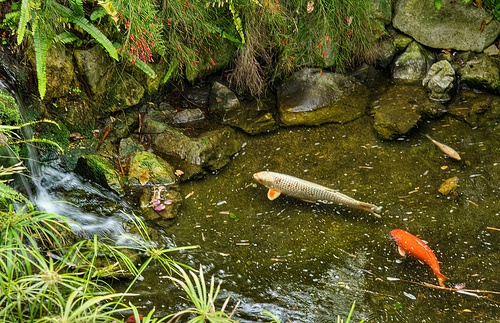
This post topic has been on my radar to do for quite a while now, as it’s been something that I’ve thought about quite a few times in my life, moving different places, meeting new folks from different backgrounds, etc.
What am I talking about here? Well, it relates to the very common metaphorical question that we’ve no doubt all heard at one point in our lives – “Would you rather be a big fish in a little pond or a little fish in a big pond?
Essentially, it is the idea that how successful we perceive our lives to be is based more on how we compare ourselves relatively to people around us vs. the absolute value of our outputs on a global scale.
A great money-based example of this metaphor is the age-old question of rather you would prefer to make $50,000 per year when all your friends are only making $30,000 per year, or if you would rather be making $200,000 per year, but all your friends make $1 MM per year?
More specifically, I am interested in how this metaphor applies to a person’s schooling, career, and personal finances throughout various life stages. Assuming that you are a “big” fish, I want to explore answers to the following questions:
- Is it better to attend an undergraduate college that is a “big” pond or a “little” pond?
- Is it better to attend a graduate school that is a “big” pond or a “little” pond?
- Should the first few years of your career experience be in a “big” or little” pond?
- Should the later/more senior years of your career be in a “big” or “little” pond?
- Should you physically live in a “big” or “little” pond?
- Or, perhaps for these various stages, there is a happy “medium” size pond that is just right….
Let’s take a look at each of these life stages and examine some of the advantages and disadvantages presented by being in the different pond sizes at that specific time in life. I’ll start off by describing the working definition I’ll use for a big pond and little pond in each specific set of circumstances.
Undergraduate College Degree
Definition of big and little pond sizes in this context: For the context of undergraduate college degrees, I will define a big pond as a school which requires top-of-the-line entrance testing scores and grades to get in and is also very selective in the ratio of applicants vs. accepted for admittance. In other words, a school where pretty much all students are STELLAR. A little pond would be on the opposite end of this spectrum.
Advantages of a Big Pond
- As you can imagine, there are many benefits of attending a top-tier school for your undergraduate degree.
- You will be surrounded by incredibly smart student-colleagues and world-renowned professors from which you can learn countless valuable things.
- In addition, you will have a much easier time than your little pond contemporaries in finding a job and/or internship, as many high quality/high paying companies will likely be recruiting directly from your door stop. All you will have to do is saunter on down to the career fair at your school with your resume in hand!
- Along these same lines, it has been my experience that several specific types of jobs pretty much unofficially “require” you to have attended a top-tier undergrad school in order to land the job. Investment banking is one type of job that comes to mind where this is more or less the case.
Advantages of a Small Pond / Disadvantages of a Big Pond
One of the key things that sparked my curiosity/motivation in finally writing this article was a recent newspaper column covering the entrance statistics of the Fall 2013 entering class (the one graduating in 2017) of a public Ivy undergrad school, which is ranked approximately 2nd in public undergrad schools in the US according to World News. This article stated that, “The Class of 2017 averages an SAT math and verbal score of 1349, keeping close with the Class of 2016’s 1350. Ninety-two percent of incoming students were in the top 10 percent of their high school classes.”
Now, I’m not sure how you all did in high school and on your college entrance testing, but I would be very below average (a TINY fish) in the midst of the standards of this BIG pond grouping of undergrads.
Being a graduate student at this institution and having been through undergrad teaching assistant orientation, I also have been told that the prevalence of depression, anxiety, and usage of the psychological counseling services are higher at this school than other schools in the same state. One of the reasons the orientation teachers offered was that the undergrads that come here are often top notch students in high school, but then come to college and are simply average or below average because of the high caliber of the overall student population.
Overall, I do think it is a very good thing to surround yourself with other top notch people at least once (or even multiple times) in your life. However, the aforementioned example brings up the following question – since your personality/self-confidence/sense of individuality is not yet fully formed at the fragile age of 18 when you start undergrad, would it not be better to delay the likely possibility of feeling of below average until later in life when you are a little more sure of yourself? In other words, by putting yourself in a smaller pond at such a young age, you can allow your self-confidence to develop on its own.
Furthermore, if you put yourself in a smaller pond during undergrad, it is possible to temporarily immerse yourself in a big pond through a competitive/challenging internship, during the summer or a single semester.
From a personal finance perspective, another disadvantage of a big pond undergraduate degree is that you are more likely to end up with additional student loan debt since the amount of scholarships they give out/that you will be eligible for will likely be less than at a smaller pond where the school desires your big fish talent.
Graduate School and/or The First Few Years of Your Working Career
Definition of big and little pond sizes in this context:
- For the context of graduate school, I will use the same definition of a big pond and little pond as for the undergraduate section above, except that the entrance scores and other criteria would be shifted to fit the graduate school setting.
- However, the definitions in the context of a career will be slightly different.
- A big pond in the case of a job setting will be defined as working at a company/organization that is considered one of the best in the world, often termed a “name brand” employer (one that is recognized by everyone).
- Their ratio of people hired / total job applicants is much less than 10%, and they can only hire from very selective target schools if they so desired.
Advantages of a Big Pond
Similar to what I discussed above with big pond undergraduate schools, swimming in a big pond for your first job or for graduate school will allow you to be surrounded by top-notch talent and smart people. You will be able to connect, network, and make friends with big-time current and future generation influencers that will benefit your career for years to come. Perhaps even more importantly, you will learn how to do things THE RIGHT WAY (ie the way that the best in the world do it), so that you can elevate your career “game” and skill set to match. Lastly, having the widely-recognized big pond employer on your resume will be easily recognized by future employers as a common meter of the caliber of your talent.
Advantages of a Small Pond / Disadvantages of a Big Pond
A potential pitfall of being in a big pond for your first job, on the other hand, is that you run the risk of potentially not standing out from the crowd and being recognized for your talent. In other words, even if you are a big fish, you’re in a big pond, and your complete talent set may not be leveraged if you are surrounded by other stellar people. The opposite would be true of a small pond career/grad school setting.
However, even if you were to be only “below average” in a big pond, in theory by this time in your personal development, you will have enough self confidence to not let this bother you, and simply accept that you’re doing your best and that it’s OK to be mediocre when surrounded by other top notch people.
Later Working Years of Your Career
Using the same working definitions of a little and big pond as we employed in the above jobs section, let’s analyze how the pond size might play a role when your career is a little more mature. For this thought experiment, we will assume that you have been successful in your career and have still emerged/remained as a big fish!
Advantages of a Big Pond
As a top notch, senior-level big fish, what advantages are there of teaming up with a big pond organization/company?
- First, I think that it would likely make your job as a supervisor/boss a little easier. Assuming that you can recruit top notch talent, you theoretically will be able to find people to execute your ideas and follow your strategical plans more easily.
- As a result, this might make the absolute amount of projects you accomplish higher than if you were in a little pond.
- Second, the big pond organization will likely pay you more since they theoretically would have more money to obtain/keep your big-fish, top-notch talent.
Advantages of a Small Pond / Disadvantages of a Big Pond
One clear advantage of working in a small pond environment later in your career is that your contributions will likely have a greater breadth of impact across an entire organization versus in a big pond where you will have a large impact, but in a very specific area of the company. For example, if you are a top-notch senior engineer at a big pond company, you might be perfectly qualified to perform as a Vice President or CEO of a smaller, start-up company.
Living Location
The big pond vs. little pond decision when it comes to location is one of my favorites to think about.
Essentially, what I’m talking about here is if you are moving to a new city and money is not much of a consideration (because after all, you are a big fish, remember!), is it better to live in a neighborhood where you’re surrounded by normal, everyday folks (little pond), or is it better to live in a subdivision where your McMansion is only 1 out of 100 the same size and everyone around you is successful (big pond)?
On one hand, in the big pond location, you will likely be surrounded by very smart, successful people that can become your friends, help you in the future, etc. In addition, the school system in the area may be better since the property tax base is higher. However, a negative would be that in this setting, you likely would be more inclined to increase your spending. After all, you can’t be seen in a Honda Civic when your neighbors have the Porsche, right?! This of course wouldn’t be an issue in the little pond setting.
Conclusions
In the interest of wrapping this post up, I was trying incorporate my usual personal tie-in where I state how I will apply this topic to my personal life. However, I became somewhat stumped on this one. As such, I have unfortunately concluded that I am not yet sure what type of pond size, big or little, I want for my various future life stages. I’ll have to let time play out to help me figure out what is best I think.
How about you all? Were you in a “big pond” or a “little pond” for your undergraduate, graduate, first real job, senior career, and/or physical location life stages?
If you could do it over again, would you do anything differently?
Are there specific life stages when it’s generally better to be in a big pond vs. a little pond?
Share your experiences by commenting below!
***Photo courtesy of http://www.flickr.com/photos/wildlife_encounters/8024090659/sizes/m/in
About the Author Jacob A Irwin
Hi folks! My name is Jacob. I am the owner and operator of My Personal Finance Journey. I started this blog in January of 2010 and have enjoyed the journey ever since. Since finishing up graduate school in Virginia in 2014, I have been working in biopharmaceutical development in Colorado. You can read more about me and this site here. Please contact me if you have any questions!
Related Posts
Maximizing Your Nest Egg: How to Make the Most of IRA Investments
Conversations to Have Before Your Child Goes to College
Is Your Employer’s Group Life Insurance Enough?
The F.I.R.E. Movement: Is It the Financial Strategy for You?
Popular posts
Session expired
Please log in again. The login page will open in a new tab. After logging in you can close it and return to this page.
I’ve been in big ponds in my high school, college, and now grad school. At each stage, I have seen that I’ve ‘coasted’ off the advantages I gained from the previous big pond, particularly by making my big-pond grad school smaller by switching from a very mathy to less-mathy field (people seem impressed by my undergrad major, when I know the reason I’m not doing it any longer is that I wasn’t good at it). I think it’s finally going to catch up with me in my first post-PhD job and I either won’t be able to land a big-pond job or I’ll not do well in one. I’d be interested in trying to work in a small pond at some point, but I think I might not like it – I’m not comfortable feeling like a big fish when I’ve been a small one for 15 years-ish.
It was very interesting for me to see my college classmates, and to some extent my grad school classmates, struggle with realizing that they had transitioned from being big fish to small fish, and the blows they took to their self-esteem. I had my academic self-esteem battered during HS so that transition was not difficult for me, but I also think that I now am a bit deficient in ambition because I am well aware of how many capable people are all vying for the same careers.
Emily @ evolvingPF recently posted…The Cost of an In-Town Move Part 2
Thanks for sharing Emily! good for you in transitioning programs in grad school to something you are happier with!
Jacob A Irwin recently posted…How To Learn More About Finance Without Boring Yourself to Tears
Interesting analysis that you presented. I had never really thought of it this way but I think throughout my life, I have been a combination of both. Undergraduate was a little pond… we had relatively small classes and I was always among the top students. I was even separated from everyone and placed into an honors program that didn’t allow me to study with my former classmates. Career wise I feel like I’m in a big pond. There’s so many fish in the field and I’m not any more experienced nor worse than anyone, just about average. But next year, I’m planning on attending Harvard for an MA – so where does that place me? Academics have always been enjoyable and easy for me, so even among other challengers, I can see myself being the big fish.. it will be an interesting experience to judge.
Ronnie @ All the Frugal Ladies recently posted…6 Affordable Winter Getaways
Thanks for sharing Ronnie. That’s a good point you make about having different levels of comfort about the size of the pond throughout different points in life.
Good luck at Harvard. I would say that will be a big pond! haha
This is a very interesting question. For me, the “medium” size pond is just fine. Why? Because being in a big pond can almost be a bit like trying to “keep up with the Joneses.” Yes, I realize we aren’t just talking about material possessions here. But you can’t always try to have or accomplish what others have or are doing. In other words, always try your best, but trying to be THE BEST can be a never ending fruitless endeavor. At some point, you have to be satisfied with who you are and what you’ve done in life.
Mr. Utopia @ Personal Finance Utopia recently posted…Personal Finance Utopia Reboot
I like a nice challenge so for the undergraduate and first working years I’d chose a big pond and grow myself and my skills to be a big fish. After that, I’d taper off and go big fish in a small pond, say in running my business…there I’d want to have all the competitive advantage I can get.
I think it depends with the person ultimately, their temperament and their life situation at the moment of making the choice.
Simon @ Modest Money recently posted…Is Camping For Black Friday A Good Investment
There is a saying here that small villages are big hell. I prefer to live in a big town for anonymity, here it is impossible to move a finger without the whole village commenting about it. But it has its perks too, the cost of living is much, much lower and when people know you they also help you in more ways than you can imagine. Nothing is perfect.
Pauline @RFIndependence recently posted…How to Create a College Student’s Monthly Budget
Thanks for sharing Pauline! How many people live in your village there?
Jacob A Irwin recently posted…How To Learn More About Finance Without Boring Yourself to Tears
Is there a medium sized pond? I would like to develop my career in a medium sized pond which is big enough to allow for growth and challenges (seaweed?), but not so big that no one has the time to teach and mentor me or that I get pigeon-holed into a specific responsibility.
In terms of living, I see a little pond being one where all the fish are the same, whether middle class or upper. I want to raise my child in a mixed pond, interacting with people from income levels to gain perspective. I grew up with people coming from more or less same financial situation and while I know there are people more wealthy and some less, I feel like I lived in a bubble and am often surprised that there are people living differently than how I grew up (i.e. “what do you mean they live from pay cheque to pay cheque?! what do you mean air conditioning is a luxury?!”)
Emily @ Urban Departures recently posted…Why I Avoid Sales and Buy Retail
Interesting point Emily about the benefits of a medium sized pond.
For graduate school, I choose to go to what could be deemed an upper-medium sized pond in terms of prestige since in my field, the hiring process isn’t too snobby that you can only get in to work somewhere from a big pond.
Jacob A Irwin recently posted…How To Learn More About Finance Without Boring Yourself to Tears
It’s a very interesting question. For me in work & study, having a bit of challenge is an important driver to try improving my skills. But when the difference is too big it become quickly demotivating. So a slightly bigger pond would be good.
And when I get old, a smaller pond to be the rock-star of the pond without any stress, living off my previous hard work
For living place a.k.a. material show-off, the smaller the better 🙂 I don’t want to show-off with car or living in a castle. (I prefer a fat emergency fund & healthy amount of stocks)
jp @cashsnail recently posted…From socialist to (ex)communist country, a guide to expatriation: cost comparison
Well said, thanks for sharing JP!
I think for me, as long as I was able to recognize that the people I am competing against in a big pond are top notch, it wouldn’t bother me too much to be “average” and get the challenge!
Jacob A Irwin recently posted…How To Learn More About Finance Without Boring Yourself to Tears