

Category Archives for Invest & Retire
The Five Hottest Housing Markets in 2014 – How Does Yours Stack Up?
 The following is a post by MPFJ staff writer, Kevin Mercadante, who is a professional personal finance blogger, and the owner of his own personal finance blog, OutOfYourRut.com. He has backgrounds in both accounting and the mortgage industry.
Back in January The Motley Fool did one of those five hottest real estate market lists that media outlets like to run. You don’t need click through to the link, here’s the list – it‘s based on projected price gains for 2014:
- Vallejo, Calif. — 23.9%
- Stockton, Calif. — 22.7%
- Merced, Calif. — 21.4%
- Modesto, Calif. — 21%
- Yuba City, Calif. — Projected gains of 20.3% in 2014
- Orlando, Fla. — 10.1% (The hottest market outside of California)
I’m of the opinion that most of these highest this, lowest that, worst this lists are more interesting than useful. After all, though the top five on the list are all expected to see price gains of more than 20%, it hardly matters to the rest of us unless we’re in those high flying markets.
More relevant is what’s happening in your own area. Over the past two or three years, the real estate market has been a mixed bag. Many areas have done little more than stabilize (at reduced levels) since the real estate collapse, and a few have even continued to decline. Others have seen modest price recoveries, but not back to their former peaks.
The hottest housing markets, it seems, are taking place in what were some of the worst hit markets during the price crash. Notice that all of the top areas are small market cities in California? They all got clobbered during the crash (Stockton in particular). The strongest market outside California is Orlando, another hard hit market. In fact, California and Florida in general were at the epicenter of the meltdown. After taking such heavy price declines, they’re natural candidates for impressive rebounds – though none have fully recovered their peak market prices.
Let’s forget about the five hottest markets, and zero in on the housing market where you live. Would you say your local market is booming, treading water – or somewhere in between?
How far did prices fall after the market peak in 2006?
A common characteristic of each of the markets on the list is that prices fell by at least 50% from the market peak in 2006. This at least partially explains the spectacular rebounds – there‘s simply more room to go up.
Not all markets fared as badly as those in California or Florida. Some experienced only modest price declines during the collapse. How bad did prices get during the real estate price collapse in your market? Anything close to a 50% decline?
How has price appreciation been in your market in recent years?
If you bought your house after the price collapse, say around 2009 or 2010, any price appreciation since has improved your net worth. But if you bought (or did a cash out refinance) around the top of the market, in 2006 or 2007, the value of your home may not have fully recovered to its peak levels. And depending upon where you live, you might still be “underwater” on your mortgage.
How is the situation in your local housing market? Have you been seeing steady price appreciation in the past two or three years?
How does your current value compare to 2006 or when you bought your home?
It’s fair to say that rising house prices over the past few years signal a recovery in the housing market. However for many people, full recovery won’t be considered until prices return to pre-crash peaks.
Has the market in your area returned to the price levels of 2006? If not, about how much of the price decline has been recovered since? Or do you live in an area that has more than recovered to 2006 levels?
How quickly do you think you could you sell your home?
It’s possible that we could focus all attention on price gains as a barometer of the strength of the local market. But just as important is how quickly you could sell your home if you need to.
To a large degree, house price appreciation has been driven by the lowest mortgage rates in history. The lower mortgage rates are, the more house people can afford to buy based on their incomes. That is more a function of price level, rather than on how quickly a house can be sold in a given market.
How long does it take to sell a house in your area, and how much does price level affect how quickly that can happen? Within the same market, there can be a boom at one price range, and a bust at another.
I can tell you that where I live, house prices have recovered somewhat, but they’re doing so on very low sales volume. I live in a neighborhood with 66 houses, and not a single one of them is up for sale. In fact, only one has sold in the past 12 months. There aren’t nearly as many houses for sale in the entire area as there were before the crash.
If you had to sell your house quickly, how long would it take based on market activity in your area?
Do you have enough equity in your home to purchase a new one?
This may be the most telling indicator of a housing recovery. What has hurt the housing market in the past few years has been the fact that current homeowners don’t have enough equity to be able to trade up to a higher-priced house. I suspect that factor is having a material effect on low sales volume in my area.
What is your personal situation? Do you have enough equity in your home right now to enable you to come up with the down payment on a trade up house?
We can look at national or regional statistics all we want, but they may not tell us the true state of the housing market in our own areas. Hopefully, the answers to the questions above will provide a better picture as to what’s really going on.
Feel free to offer your input on any or all of the questions above as they relate to your own market.
***Photo courtesy of http://www.flickr.com/photos/59937401@N07/5474453551/sizes/n/
The Basics of Common Stocks

If you’re new to the world of personal finance and investing, one of the first and seemingly most overwhelming topics you likely will encounter is investing in the common equity stock market shares of publicly traded companies.
While overwhelming at first, if you simply arm yourself with an understanding of the basics of common stocks and a few facts about the stock market, you can set yourself up for greater long term success.
What is a Common Stock Market Share?
Simply put, owning a share of common stock means that you own a portion of the equity of a publicly traded company.
Naturally, the next logical question to ask after this definition is, “What is equity?” Essentially, equity is what remains of the company’s assets after all of the debt (liabilities) is paid off. This is elegantly represented with the accounting equation, Assets – Liabilities = Equity. Therefore, as a shareholder, you have a claim on the company’s assets after all debt holders are paid off. Since companies have valuable assets, the stock market shares also have residual value, and you hope that this value will increase, making you money. All that make sense? Good!
Another thing to know about is how common stock issuing benefits the company itself. By issuing additional shares of stock (selling to investors in exchange for money), the company garners additional funds it can use on the other side of the accounting equation to buy new assets or pay off debt.
Facts About The Stock Market
The stock market is a very interesting animal. Listed below are several statistics:
- Total amount invested in the global stock market = $15 trillion
- Number of publicly traded companies = 5,008 in the USA alone
- Average number of daily stock market transactions = 682 million shares on the NYSE
- Average long term stock market return = ~ 10 % annually
Conclusion
In today’s economy, you will no doubt encounter and enter the world of common stock investing at some point in your personal finance history. While it can be easy to feel overwhelmed by all the financial media, knowing a few of the basics will set you up on the path to success.
How Would A Properly Structured Asset Allocation Portfolio Have Fared During The 2002 and 2009 Market Downturns?

Here lately, we’ve been having some great debate on a post I wrote in April 2013 looking at the Infinite Banking Concept, which employs whole life insurance as a savings vehicle.
One of the biggest draws of using whole life insurance in this manner is that your money can grow at a modest 4.5% average annual rate (historical average return / cash value increase rate), while at the same time, being guaranteed that your cash value will not decrease. Since life insurance companies are perhaps the most stable in our economy, it goes without saying that your money is very secure.
Naturally, this security and opportunity for a modest growth rate has attracted many risk-adverse investors, particularly ones that were “burned” during the 2002 and/or 2009 market downturns. Many of these folks cite that their retirement portfolio “became worthless” as a result.
However, would your portfolio really have become worthless during one or both of these market downturns if it was a properly allocated passive investing portfolio of index mutual funds? Or, were the people that have these type of “horror stories” over-allocated to stocks, investing too much in individual stocks (a losing game in and of itself) and/or risky IPOs?
The purpose of today’s post will be to look in to how a CORRECTLY STRUCTURED portfolio would have fared during the two market downturns after the millennium.
Structure of Example Portfolio / Asset Allocation Target %’s
Because I am curious how my portfolio would have fared during these time periods, we will use my current asset allocation %’s as an example for our analysis. This is not to say my portfolio is perfect by any means, but I do have a little bit of experience with passive investing!
Listed below are the specific index fund components I employ in my investing strategy. I use a 70% equity / 30% fixed income asset allocation split, with good exposure to international stocks as well. Although I use a mixture of money market mutual funds and online high yield savings accounts for the cash portion of my asset allocation, for simplicity, we will just assume here that my cash is earning 0% (so not a + or – return).
- Cash (Target 10%)
- Vanguard Short Term Bond Index (MUTF:VBISX) (Target 12%)
- Vanguard Inflation-Protected Secs (MUTF:VIPSX) (Target 8%)
- Vanguard Total Intl Stock Index (MUTF:VGTSX) (Target 10%)
- Vanguard Emerging Mkts Stock Idx (MUTF:VEIEX) (Target 11%)
- Vanguard Total Stock Mkt Idx (MUTF:VTSMX) (Target 7%)
- Vanguard Small Cap Index (MUTF:NAESX) (Target 7%)
- Vanguard Small Cap Value Index (MUTF:VISVX) (Target 13%)
- Vanguard Value Index (MUTF:VIVAX) (Target 12%)
- Vanguard REIT Index (MUTF:VGSIX) (Target 10%)
Defining Worst Case Time Periods
As a first step, we need to define the periods in which we’ll analyze the portfolio performance. In looking at the S&P 500’s history, the time periods shown below represent the worst case high to low transition periods during the 2002 and 2009 market downturns.
- September 1st, 2000 –> October 4th, 2002, during which time, the S&P 500 declined in value by 47%.
- October 5th, 2007 –> March 6th, 2009, during which time, a market decline of 55% occurred.
From these facts alone, it is important to realize that already, a 50% downturn, although terrible, does not equate to a portfolio “becoming totally worthless,” provided only that you invested in an S&P 500 index fund instead of individual stocks.
Having defined the example portfolio’s components along with the target analysis time periods, I then proceeded to extract historical pricing data from Yahoo Finance for the mutual funds listed above.
You can view of the data for the analysis in this post at the Google Drive spreadsheet link below:
Analysis # 1 – No Rebalancing
The first thing I was curious to investigate is how the individual portfolio/asset allocation components performed on their own during the 2000-2002 and 2007-2009 periods without any rebalancing. For simplicity, throughout this investigation, I assumed a $100,000 starting portfolio value at the beginning of each market decline and that no additional funds were added to the portfolio at any time.
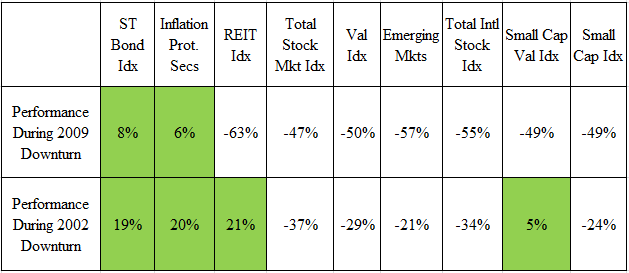
The table below displays the % increase or decrease (- % value) that portfolio components experienced during the 2 market downturn periods. From this table, there are several fascinating observations that can be made:
- The 2002 market downturn was much more “forgiving” compared to the 2009 one. For example, in the 2002 event, even though the overall stock market had decreased close to 40%, small cap value, REIT, TIPS, and bonds all experienced pretty significant positive returns that would have greatly stabilized your portfolio.
- Unfortunately, in the 2009 crisis, the only two portfolio components in the positive return range were the TIPS and short-term bond funds, which is what they are designed to do.
Having looked at the performance of the individual components in isolation, the next step was to examine the overall portfolio performance when all of the asset classes are combined, as it would be in “real life.”
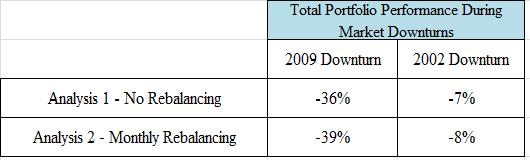
The return data for the combined portfolio can be seen in the table below (Analysis 1 – No Rebalancing line).
- As we mentioned previously, from September 1st, 2000 –> October 4th, 2002, the S&P 500 declined in value by 47%.
- However, if you had a diversified, passive investing portfolio like the one mentioned above, your portfolio would have only declined by 7% in value. This represents an 85% improvement in performance over the market!
- From October 5th, 2007 –> March 6th, 2009, the S&P 500 declined 55%.
- Similarly, a properly diversified portfolio would have saved you during the 2009 crisis as well, although not by as drastic of a margin as in 2002, with the diversified portfolio declining in value by 36% by 2009 vs. the 55% decrease of the S&P 500.
So again, we see that a properly structured retirement portfolio would not have “become worthless” during either of these market declines.
Analysis # 2 – Monthly Rebalancing
As a next step, I wanted to investigate the impact that monthly rebalancing (back to your asset allocation targets) would have on portfolio performance during these periods. The results can been seen in the table below (Analysis 2 line).
Intriguingly, rebalancing did not have that significant of an effect during both of the market downturns, and when it did have an effect, it was slightly negative. This may have been due to the majority of the equity asset classes declining in value in a correlated/together manner, instead of one going up while another goes down.
Another thing that is important to point out is in relation to the decision when you first construct a portfolio of how much equity vs. fixed income exposure you want / how much risk you can take.
- For example, on page 171 of Larry Swedroe’s book, The Only Guide to a Winning Investment Strategy You’ll Ever Need, there is a table that I used to help me determine how much equity allocation I should carry in my portfolio.
- For an equity allocation of 70%, it says that you should be able to withstand/tolerate/expect a decline in portfolio value of 30% in a single year. For an equity allocation of 60%, this value decreases to a 25% decline.
- Since the 2009 and 2002 downturns occurred over more than a year, you could say that the % decreases in the table above of the overall portfolio values (for a 70% equity portfolio) can almost be “expected” at some point or another, given the amount of risk you’ve exposed yourself to.
Conclusions
Overall, it’s clear to say that the 2002 and 2009 market downturns were depressing and full of desperation.
However, if we construct a passively managed portfolio (avoiding the risk of individual stocks) with a proper asset allocation and objectively compare the portfolio performance during the decline periods, we see that the portfolio behavior reverts to same risk/return tradeoff that must be considered upon first creating a portfolio.
To me, this really just highlights the importance of considering the risks of investing when you first start, not get too greedy or hyper-nervous, and make sure to give yourself adequate fixed income allocation to provide safety for you to sleep well at night.
How about you all? How did your overall portfolio do during the 2009 and 2002 market declines? Do you currently have a sufficient asset allocation for your risk tolerance?
Share your experiences by commenting below!
Is It Worth It to Make a Non-Deductible, Non-Roth IRA Contribution?

 The following is a post by MPFJ staff writer, Kevin Mercadante, who is a professional personal finance blogger, and the owner of his own personal finance blog, OutOfYourRut.com. He has backgrounds in both accounting and the mortgage industry.
The widespread popularity of 401(k) plans has made IRAs – at least traditional IRAs – something of a minor league play these days. Most people will take them only if they are able to get a tax deduction for the contribution. If they can’t – or they merely think they can’t – they may not even bother making a contribution of all.
That’s not always the right choice. In fact, in most cases, it’s the equivalent of leaving money on the table. Here’s why…
The Basics of Traditional IRAs
For 2014, you can contribute up to $5,500 toward an IRA, plus an additional $1,000 under the “catch-up provision” if you’re 50 or older. This is unchanged from 2013. You can make a full contribution, and deduct the full amount of the traditional IRA contribution from your income taxes, if neither you nor your spouse are covered by a pension plan through your employer.
But even if you or your spouse are covered by a retirement plan at work, you can still contribute the full amount to an IRA, but there are limits as to how much of the contribution you can deduct for income tax purposes.
If you are covered by an employer sponsored retirement plan. If you are single, you can deduct the entire amount of the IRA contribution for tax purposes if your modify adjusted gross income, or MAGI (click here for a definition of MAGI;), does not exceed $60,000. At that income level, your deduction begins to phase out, up to $70,000, where disappears completely.
If you are married filing jointly, you can take the full IRA deduction on a MAGI of up to $96,000. At that income level, your deduction begins to phase out, up to $116,000, where disappears completely.
If you are NOT covered by an employer sponsored retirement plan, but your spouse is. You can take a full IRA deduction if your combined MAGI does not exceed $181,000. At that income level, your deduction begins to phase out, up to $191,000, where it disappears completely.
Statistically at least, that means that most people are entitled to take a tax reduction on the full amount of their traditional IRA contribution, even if they or their spouse are covered by an employer pension plan.
But what if your income level exceeds these limits? Is it still worth it for you to make a traditional IRA contribution – even if you won’t get a tax deduction for it?
Absolutely.
Your traditional IRA contributions may not be tax deductible, but your investment gains will still be tax deferred
People often forget that while the tax deductibility of retirement contributions is a nice feature, the real power of tax-sheltered retirement plans is the ability of your money to grow on a tax-deferred basis. Any money that you put into a retirement plan – including an IRA – can grow without regard to tax consequences. That enables faster growth as a result of the full compounding of investment returns.
This is a benefit that you should never forgo, even if the actual contributions are not deductible for income tax purposes.
Building tax diversification into your retirement plan
While it’s true that the inability to deduct your IRA contributions is a limitation, there is a back-end benefit that kicks in when you retire. The non-deductible contributions that you made into your IRA will not be subject to income tax when the money is withdrawn. No tax savings on the way in, no tax paid on the way out. Simple.
This means that at least some of your retirement portfolio will come back to you free from tax consequences. This will provide you with a certain amount of tax diversification, already built into your retirement portfolio.
More rapid accumulation of retirement assets
There’s an even more obvious benefit to putting money into an IRA even if it isn’t tax-deductible. The more money that you save for retirement, the more quickly it will grow.
Imagine making the maximum 401(k) contribution each year. Now calculate in the impact of annual contributions of $5,500, or $6,500, on top of that. If you’re maxing out your 401(k) contribution at $17,500 per year, adding an additional $5,500 through an IRA will increase your annual retirement funding by more than 30%.
With or without a tax deduction for the actual contributions, adding money to an IRA is a way of getting more investment capital into a tax sheltered investment plan. That’s always a solid strategy, and a necessity if early retirement is a goal.
Having more control over your retirement assets
Though 401(k) plans are the best way to accumulate large amounts of retirement capital for most people, they’re not always the best investment vehicles. Since the plan is run by your employer – or your employer’s trustee – you will have little control over the plan, other than deciding allocations. And those allocations are usually restricted to a limited number of investment options.
An IRA, by contrast, is completely under your control and therefore self-directed. You can choose the investment company that you hold the account with, and do so in a way that will not only maximize investment choices, but also give you the ability to trade what you want.
For example, let’s say that you like to trade individual stocks. A typical 401(k) plan won’t provide that ability. Your investment choices are typically limited to a small number of funds, a single family of funds, or maybe company stock. But with your IRA, you’ll be able to trade not only stocks, but also funds in any fund family you choose.
An IRA will provide you with the kind of investment flexibility that a 401(k) plan – or other employer-sponsored retirement plan – typically won’t.
Consider contributing to an non-deductible IRA even if you can’t take the tax deduction for the contributions you’re making and do not qualify for contributing to a Roth IRA. There are just too many advantages to doing so.
How about you all? Have you ever made non-deductible IRA contributions? Why or why not? What do you feel some of the advantages or disadvantages would be?
Share your experiences by commenting below!
Reference sources: IRS IRA Contribution Limits, 2014 IRA Contribution and Deduction Limits – Effect of Modified AGI on Deductible Contributions If You ARE Covered by a Retirement Plan at Work, and 2014 IRA Contribution and Deduction Limits – Effect of Modified AGI on Deductible Contributions if You are NOT Covered by a Retirement Plan at Work.
***Photo courtesy of http://www.flickr.com/photos/lendingmemo/11745940785/sizes/n/
Can You Invest In Real Estate With An IRA or 401(k)?

 The following is a post by MPFJ staff writer, Kevin Mercadante, who is a professional personal finance blogger, and the owner of his own personal finance blog, OutOfYourRut.com. He has backgrounds in both accounting and the mortgage industry.
The short answer to this question is yes. But, the real question that needs to be answered is why would you even want to? That’s the issue were going to take a look at here.
You can – but you probably can’t invest in real estate through your 401(k) plan
Confused? Though the IRS does not specifically prohibit investing in real estate through a 401(k) plan, employers and plan trustees are almost unanimous in avoiding it. This is particularly true when it comes to investing in a specific piece of property for the benefit of a single plan participant. There are technicalities and prohibitions (discussed in more detail below) that make direct investing in real estate a nightmare for retirement plan trustees. You can inquire of your plan trustee whether or not this will be permitted, but it’s 99.9% certain that the answer will be no.
There are articles and experts who will advance the cause of buying real estate with a 401(k) plan, but there’s some sleight-of-hand involved in the discussion. What is typically advocated is borrowing against your 401(k) plan to provide at least some of the funds for the purchase of a specific piece of property.
Under IRS regulations, 401(k) plans are permitted to loan out up to 50% of the participants plan value – to a maximum of $50,000 – to the participant. This money can be used as a down payment for the purchase of property.
However, even if you are going to engage in this practice, you will be leveraging your retirement plan in order to buy a real estate investment which itself will be further leveraged.
Let’s say that you borrow $50,000 from your 401(k) to make a 20% down payment on a $250,000 property. The remaining $200,000 will come from a mortgage directly secured by the property itself. That means that your investment in the property – which itself is a risk investment – will be 100% leveraged. That’s an even bigger risk.
If the investment blows up for any reason, you’ll not only lose money on the property, but you also lose some or all of the money borrowed from your retirement plan.
I believe that’s called double jeopardy.
You can with an IRA – and also SEP or SIMPLE IRAs, or Solo 401(k) plans
What do all these plans have in common? They’re all self-directed plans. For that reason it’s theoretically possible to invest directly in a specific piece of real estate through the given retirement plan. Since you have direct control over the plan, you can structure it in a way that will permit you to do this.
But there are some restrictions, and that’s where this gets messy.
When you purchase real estate in your retirement plan, all funds used to purchase the property must come out of that specific retirement plan. Any income earned by the property – including proceeds from the ultimate sale of the property – must be returned to the retirement plan.
There’s an even bigger restriction: if you purchase real estate in your retirement plan, you cannot personally manage the property in any way. This is the limitation that makes ownership of real estate through a retirement plan technically impossible for small real estate investors.
If you are buying a property for the purpose of managing and profitably selling for a big gain, you’ll automatically disqualify both the investment – and your retirement plan. All investment within a retirement plan must be handled on an arm’s-length basis. That means that in order to comply, you’ll have to hire a management company to run the real estate investment for you.
You won’t be able to manage property any way. You will not be able to work on physical maintenance or remodeling of the property, market rentals, screen tenants, collect rents, or pay bills. With those restrictions, you’re better off making a paper investment in real estate through third-party sources.
Direct management of the property is considered a prohibited transaction under IRS retirement plan rules. And there are other such prohibited transactions (For a more detailed discussion of prohibited transactions, please check Retirement Plans FAQS Regarding IRA Investments).
If you engage in a prohibited transaction with your retirement plan – something that is very easy to do when investing in real estate – the IRS can literally invalidate your plan. If they do, your entire plan will be considered distributed, and you’ll be subject to ordinary income tax, plus a 10% early withdrawal penalty.
Should you invest in real estate with your retirement plan?
In a word, nope! Even though the IRS says you can invest in real estate with certain retirement plans, that doesn’t mean you should. There are too many reasons why you shouldn’t.
Losses are not tax deductible. This is a risk of all capital investments, but much more so with real estate. For starters, real estate often operates at a loss especially in the early years. You won’t be permitted to deduct those losses. And if the entire investment goes sour, you won’t have the benefit of capital loss deductions. There’s no upside to investing in real estate through a retirement plan if the investment goes bust.
Real estate is not a liquid investment. One of the difficulties with real estate in general is a fact that it‘s not particularly liquid. Not only can it be difficult to sell an individual property, but you may need to hold onto it for many years before it becomes truly profitable. That will crowd out other potential investment opportunities.
Excessive capital allocation. Since you will have to make the entire real estate investment through your retirement plan, an inordinate amount of the plan will be invested in single asset. Diversification of the portfolio will be close to impossible.
Potential for trouble with the IRS. This gets back to those prohibited transactions we talked about above. The risk of this is substantial.
It will be difficult to find a trustee who will allow it. Just because the IRS permits real estate investment for certain retirement plans doesn’t obligate trustees to offer it. For all the reasons listed above – plus an almost impossible administrative burden – most retirement plan trustees will not permit you to hold real estate in the plans.
Investing in real estate through your retirement plan – an interesting concept, most definitely – but not one you should participate in. As an alternative, you can hold real estate investment trusts (REITs) in your retirement plan, as well as stocks and funds that are primarily engaged in real estate related activities. Or you can purchase investment real estate with non-retirement funds, and enjoy a whole lot more flexibility – as well as generous tax benefits.
How about you all? Have you ever thought about investing in real estate with one of your retirement accounts? Do you know anyone that has done this type of thing?
Share your experiences by commenting below!
***Photo courtesy of http://www.flickr.com/photos/9731367@N02/6988181354/sizes/n/
International Micro Lenders – Do They Have a Loan for You?

 The following is a post by MPFJ staff writer, Kevin Mercadante, who is a professional personal finance blogger, and the owner of his own personal finance blog, OutOfYourRut.com. He has backgrounds in both accounting and the mortgage industry.
If you haven’t heard of international micro lenders, you’re in good company.
The majority of Americans haven’t, and for good reason. Micro lending has it’s origins in poor and developing countries, and has only surfaced in the US in the past few years. The concept has been brought into the US by people who, unable to get traditional bank loans, must rely on alternate sources to get credit. This development has particular meaning for upstart entrepreneurs, who are the target market of micro lending.
What is a Micro Lender?
Micro lending started in Third World countries precisely because bank loans and other sources of traditional credit were never available in those regions. The practice is forming into an identifiable industry only in recent decades. Early on, it was a decentralized form of lending, often done at a very local level. Today, there several hundred micro-lenders worldwide, and they are now moving from Third World and developing countries into wealthier places such as the United States.
Given the traditional markets that they serve, the typical loan size is just a few hundred dollars. But in Third World regions, that represents the type of capital that will enable a would-be entrepreneur to build a successful business. Here in the US, the average micro-loan size is in the range $12,000.
Micro-lenders are typically nonprofit organizations, established for the primary purpose of enabling the lowest income groups to make the transition from poverty into entrepreneurship. In many areas of the world, there are simply no jobs, and the only way out of poverty is starting a business. Micro lenders have developed in order to facilitate this process.
Micro lending in the US
The operation of micro lending organizations in the United States is more complicated. Banks are the traditional lenders, and have built a battery of commonly accepted lending guidelines. Most people in the US are able to qualify for loans from banks, or at least have revolving credit lines available to tap for relatively small amounts of credit.
But just as it does in the Third World and developing countries, micro lending exists to serve those who do not have access to credit.
And though a few hundred dollars doesn’t go very far in the US, a loan of just a few thousand dollars is often all that is needed to launch an upstart business. This is particularly true today, since most businesses are either service related, or launched online where fixed costs are lower than with a typical bricks-and-mortar business.
Banks have avoided servicing this clientele, because of their preference for making much larger loans. The cost associated with a bank loan of just $5,000 or $10,000 make profitability problematic. However, since banks often want to reach out to the lower income market as a way of building future clientele, they sometimes partner with micro lenders as a way of beginning those relationships. In addition, many banks are participating with micro-lenders as a way of fulfilling their obligations under the federally enacted Community Reinvestment Act, which requires lenders to actively participate in lower-income neighborhoods.
As you might imagine, micro lending represents a very small percentage of total lending that occurs in the United States. However, micro lending is a relatively recent phenomenon in the US, but it has been growing steadily, and is expected to double the next decade or so.
Here is just a small sampling of the hundreds of micro lenders that currently allow investors from the US to invest in international micro loan.
Kiva
Kiva; operates with the mantra of Empower people around the world with a $25 loan. That is the minimum loan amount, but the average loan is $414 and they’ve made them to more than 1 million people.
Kiva is a non-profit micro lender that started in 2005. It operates in 73 countries and has over $500 million in outstanding loans. The organization reports a repayment rate of nearly 99%, which is common in the industry.
United Prosperity
United Prosperity is a very small micro lender, providing just $280,000 in loans to 1,300 families, which works out to be just over $200 per loan.
The organization works a little like Lending Club, in that it solicits capital from supporters who put up the money that’s lent out, except that profit isn’t the motive – philanthropy is. The majority of money put up by supporters is returned through loan repayments, and the supporter has the option to remove his or her money from the program, or recycle it back for future loans.
Accion
Founded in 1961 in Venezuela, Accion is one of the oldest and largest international micro lenders in the world. The organization came to the US in 1991, and is now the largest micro lender in the country, making loans of $305 million to 26,500 borrowers. That works out to an average loan size of about $12,000 – a more credible amount for a high cost country like the US. They are active in more than a dozen states.
They will make loans in the US in amounts ranging from $500 to $50,000, and their site not only asks some general credit related questions, but also makes clear that they will run a credit report on you. One of the questions is “do you have a credit score of over 525” and while they don’t explicitly say so, the implication is that this is something of a threshold. So if you’re credit is really bad, you may not have much luck with them.
Count Me In
Count Me In started in 1999 and lends specifically to women, primarily for business purposes. Their partners include well known organizations, such as Capital One and Sam’s Club. Founder and President Nell Merlino is an international expert and advocate for women’s leadership, business growth and empowerment, and the creator of Take Our Daughters to Work Day.
The organization provides business assessment, coaching, peer groups, expert advice, and financing. Thought the organization’s website doesn’t disclose it, Bankrate reports Count On Me will make fixed rate loans from $500 to $10,000 at two points above prime, and terms ranging from 12 to 84 months.
How about you all? Have you ever worked with a micro lender? How was the experience?
Share your experiences by commenting below!
***Photo courtesy of http://www.flickr.com/photos/iamagenious/3177371445/sizes/l/
Is Setting Up a Trust Right For You?

 This is a post by MPFJ staff writer, Jeff. Jeff writes about Sustainable living and finances at his website, Sustainable Life Blog. Jeff really enjoys traveling with his wife as much as he can, to wherever he can.
A lot of people think that trusts are only for people with huge amounts of wealth, and they simply don’t bother looking into them because they have more important things (financially) to worry about.
People just like me, who own a house, have a few assets in various retirement accounts and money in the stock market and a net worth of around 6 figures don’t think that trusts are for them.
Here’s the thing though – a trust may be just the thing for you (and me). Trusts are great for handing down assets to your children or spouse while lowering your tax burden. Another great reason for a trust is so that your family can have immediate access to your assets. If you simply have a will, the estate may end up in probate court and could take quite a while for your heirs to get access to. In addition to access delays, they can also cost you (your trust) money. Raise your hands if you like paying lawyers even more money……Anyone? Thought so.
So, Why Should You Create A Trust?
A trust is simply a tool to help you lower your tax burden when transferring assets.
They also help make sure that your wishes are carried out after your death. For instance, if you really like the charity Performing Animal Welfare Society, and want to see a significant portion of your assets passed on to that charity a trust can do that for you. A trust can also ensure that your assets are directed to the right person when you pass on. You can leave the majority of the trust to your second wife, and make sure that the children from your first marriage are taken care of.
One of the most important benefits of a trust (in my mind) is privacy. With a will, everyone will see what your holdings are and how they are distributed among your loved ones. That is not so with a trust.
Two Main Types
There are two main types of trusts that we will talk about – revocable trusts and irrevocable trusts.
An irrevocable trust is something that can not be changed once the trust is set up unless the beneficiary approves it. For instance, if you wanted to fund a trust for your child or spouse and created an irrevocable trust, your child or spouse would be the only ones who could change things within the trust. Once you create the trust, the assets are officially out of your control.
A revocable trust (sometimes called a revocable living trust) is a trust where the grantor (you) can change the terms if need be. The trust also dispenses income to the grantor (you) until your death, and then the trust and income go to the beneficiaries. The dispensation of funds from the trust can also happen when and how you specify. Lets say you set up a trust with 1 million in it, and happen to pass on while your twin children are in high school. Instead of them waking up one day parentless millionaires, the trust can be set up to pay for their schooling, then hold and grow the money until an age specified by you – say 25% of assets when they are 24, 50% of assets when they are 35, and the remaining 25% when they are 42. That way, you wont present an 18 year old with a half million dollars and have them wonder where it went in 4 years.
All in all, while trusts are more expensive than wills to set up, they do offer significant benefits even if you don’t have a lot of assets. Trusts can assist with your asset distribution and help your estate avoid a costly probate. Trusts can also make sure that your assets are distributed how you want them to be.
There are many types of trusts, but these are the two most common for middle and lower income households looking to preserve and pass on wealth.
How about you all? Do you have or have you ever thought of setting up a trust for you and your family? Why or why not?
Share your experiences by commenting below!
****Image courtesy of http://cdn.morguefile.com/imageData/public/files/c/cohdra/preview/fldr_2008_11_08/file0001508044668.jpg
My Personal Mortgage Refinance Journey

 The following post is by MPFJ staff writer Travis. Travis is a customer blogger for Care One Debt Relief Services, and also appears weekly at Enemy of Debt. Travis candidly shares his personal journey to pay off $109,000 of credit card debt and the tips he’s learned along the way. As a father and husband he provides a unique perspective on balancing debt, finances, and family.
My wife and I have been working through the process of refinancing our home over the last few months. Our current mortgage is split across two loans, the first being an adjustable rate mortgage, the second being an interest only home equity line of credit. This creative financing was done when we built the house to keep our payment as low as possible allowing us to build the house we wanted.
We are approaching the ten year mark when our home equity line of credit, as per the terms, will also be converted to an adjustable rate mortgage. With rates beginning to climb, we decided to investigate refinancing.
Refinancing Goals
Before our initial meeting with a mortgage banker, Vonnie and I made a list of goals and objectives we had for the refinance:
Affordable Monthly Payment: Our current monthly payment of our first and second mortgage combined is $1882. With the end of our debt management program less than two months away, we could swallow an increase in our montly payment, but we’d like to minimize it as much as possible.
One Mortgage Payment : We really wanted to get both loans combined into a single mortage. That way it’s all under one loan, with the same terms.
Fixed Rate: With interest rates climbing, we want to lock in our interest rate for the life of the loan. We’re done playing the adjustable rate game, and the interest only second mortgage has 20% of our mortgage making no progress towards the balance.
No Personal Mortgage Insurance (PMI): PMI is insurance for the lender in case you default. For the borrower it’s like flushing money down the toilet each month, which we definitely do not want to do.
20 Year Term or Shorter: A 20 year term would have us paying off our home when we are 60 years old. It’s scary to think we wouldn’t own our home until we’re that age, but it’s still before retirement age.
The Options
After meeting with a mortgage banker at our bank regarding our we were presented with two different options to refinance our combined mortgage balance of $262,000.
Option 1: 30 year, fixed rate mortgage with PMI at 4.875%
This was the most conventional loan option presented to us. We would be required to pay PMI until our loan to house ratio was at 78%. We would pay $171 per month in PMI premiums for about 72 months if we didn’t make any additional principal payments.
Monthly Payment: $2046
Total Interest + PMI: $255,056
Option 2: 30 year, fixed rate mortgage with no PMI but with a higher interest rate of 5.5%
The bank did have an option that did not require PMI, but to compensate for that the interest rate is higher.
Monthly Payment: $1977
Total Interest: $278,967
We decided to investigate further options, so we talked to a second bank which presented us with two additional options.
Option 3: 30 year fixed rate mortgage with no PMI but with a higher interest rate
Our second bank’s PMI providers do not work with borrowers that are working with debt relief programs. They could, however, offer us a 30 year “in house” loan with no PMI, however it comes with a higher interest rate (5%).
Monthly Payment: $1923
Total Interest: $251,789
Option 4: Split Mortgage with no PMI
30 year fixed rate mortgage on 80% of loan at 4.75%
20 year fixed rate mortgage on 20% of loan at 5.99%
Combined Monthly Payment: $1957
Total Interest: $235,181
Because our monthly debt to income ratio is high until we complete our debt management plan, neither bank would offer us any mortgage options with a term of 20 years or less. Unfortunately, that meant that one of our goals would not be met.
As we worked through the underwriting process in parallel with both banks we were disappointed to be informed that the second bank declined to officially approve us for either of the two options our banker initially thought we had a chance with. Therefore we were left with only the first two options.
The Analysis
Both options one and two gave us a single affordable mortgage payment with a fixed rate. Option two did not have PMI, however in the long run would cost us $23,000 more in interest over the term of the loan. Given this analysis, we told our banker to move forward with option one.
It took several weeks of gathering additional tax forms, asset statements, and explanation forms for items on our credit report, but eventually the first bank did approve us for option #1.
The Final Numbers
The whole process took two and a half months, much longer than I had anticipated. Several payments were made as we navigated the mortgage refinance path, so our final numbers ended up being slightly different than originally projected:
Principal + Interest: $1400.00
Property Taxes: $ 340.00
Homeowner’s Insurance: $ 119.00
PMI: $ 171.00
Total: $2030.00
Our new payment is $148 higher than our current payment, but it’s well worth it to have it all combined under a single fixed rate. Plus, after we reach a 78% loan to home value ratio, we can have PMI removed and our mortgage payment will be reduced to $1859, which is lower than what our payment is now.
The 20 Year Plan
It was all settled and our closing date was set, however one thing was missing from our mortgage refinance. Our new 30 year mortgage would mean we would have a house payment until we were 70 years old. Using a mortgage calculator we determined that we could have our mortgage paid off in 20 years by increasing our monthly payment manually by $300. This is easily within our reach once we complete our debt management plan at the end of February. Our first mortgage payment is due March 1st, and we plan to pay an extra $300 on our mortgage starting with the very first payment. The papers may describe the loan as a 30 year loan, but that doesn’t mean we have to treat it that way.
On January 10th, we signed the papers and closed on our refinanced mortgage. We celebrated that evening with a movie and an inexpensive bottle of champagne knowing that we have one more piece of the puzzle in place towards getting our finances completely on track.
How about you all? Have you considered refinancing your home loan mortgage? Why or why not?
Share your experiences by commenting below!
***Image courtesy of Stuart Miles / FreeDigitalPhotos.net
What To Do If You Have a Lousy 401(k) Plan at Work

 The following is a post by MPFJ staff writer, Kevin Mercadante, who is a professional personal finance blogger, and the owner of his own personal finance blog, OutOfYourRut.com. He has backgrounds in both accounting and the mortgage industry.
Just because you have a 401(k) plan at work doesn’t mean that it’s a good one. While it can be argued that any 401(k) plan is better than none at all – let’s face it – there are some out there that are just plain lousy.
You can accumulate a decent amount of retirement savings even in a lousy 401(k) plan, but there’s no question that you’re missing out on the opportunity to do much better if only you had a better plan.
What makes a 401(k) plan lousy
There are a number of factors that can make or break an employer-sponsored 401(k) plan. Whether a plan is good, lousy, or somewhere in between really depends on a combination of factors. Some of those factors include:
- Low contribution limits. Maybe you have a contribution limit of only 8% or 10% of your annual income. If you make $40,000 per year, your contributions will be limited to somewhere between $3,200 and $4,000. That’s substantially less than what you can contribute to an IRA.
- High fees. The fund may include high investment fees, including steep transaction fees. There may be no options for no-load funds.
- Limited investment choices. Some plans offer very limited investment choice. In fact, some might have a single fund available in each of a half dozen categories. For example, there may be no funds available in various individual sectors.
- Poor investment choices. What investment choices are available, are in underperforming investments. There may also be the option to invest in company stock, which has not done particularly well.
- Single investment provider. The fund maybe held in a plan that only allows you to invest in the funds of a single investment broker.
- No company match. If in addition to all the above, the company offers no matching contribution, you may be in a 401(k) plan that is without redemption.
Few 401(k) plans out there incorporate all of the negatives above. But many include certain features that might make the plan particularly undesirable. If that is the case with your employer plan, what can you do to overcome it?
Maximize your contributions to offset poor investment choices
Since you may not be able to rely very much on strong investment returns – due to limited or poor investment choices – you might be able to at least partially offset this by maximizing your contributions to the plan.
Even if you don’t like the investment choices available, you can always put the money in something safe, like a money market fund, or a short-term bond fund. Even bad plans typically provide these options. The idea is to build up as much money in the plan as you can for the day when you will leave the company, at which time you can roll the money over into either a self-directed IRA, or a better 401(k) plan at another employer. With either choice, if you maximize your contributions to the plan, and invest the money conservatively, you’ll have a larger chunk of money to roll over into the new plan when the day comes.
This is not an entirely ridiculous strategy either. Very few people stay with a single employer for more than a few years. Either they quit and move on, the company has layoffs, or it’s bought out by a new company that will offer a new and hopefully improved 401(k) plan.
Maximizing your contributions – though they won’t grow through investment returns – will have you fully prepared for the day when that happens.
Start your own retirement plan
One of the very best ways to deal with a lousy employer sponsored 401(k) plan is to supplement it with your own plan on the outside. Generally speaking this will mean that you should open up either a traditional IRA or a Roth IRA.
Since you are already covered by a retirement plan at work, a traditional IRA may or may not be tax-deductible as far as your contributions are concerned. It will depend entirely upon your income level. Contributions to a Roth IRA, of course, are not tax-deductible at all. However any money that you place into either account will be allowed to grow on a tax-deferred basis until you begin making withdrawals in retirement.
One bonus of the Roth IRA or a nondeductible traditional IRA is that the contribution amount you have made to the plan will not be subject to taxation upon withdrawal.
But apart from the circumstances that may govern deductibility, either a traditional or Roth IRA is an excellent supplement to a poorly performing 401(k) plan. You can contribute up to $5,500 per year (or $6,500 per year if you’re age 50 or older). If you have a low contribution percentage available for your 401(k) plan, your IRA contributions can be higher than what you’re contributing to the company plan each year.
Most important, you can set up your IRA with the brokerage firm of your choice, allowing you to have the widest possible investment options at the lowest cost you can find. You can come to think of your 401(k) plan as primarily a cash accumulation account, while your IRA is your main investment growth account. When the time comes that you separate from your current employer, for whatever reason, you will have a waiting IRA to roll the 401(k) proceeds over into.
Start a side business and create your own 401(k) plan
One of the best ways to counter a lousy employer-sponsored 401(k) plan is to start your own side business, complete with its own dedicated retirement plan. You can set up a solo 401(k) plan, that will allow you to contribute up to $17,500 per year (or $23,000 if you’re age 50 or older). Best of all, with the Solo 401(k) plan, there is no contribution limit. You can make contributions on a dollar for dollar basis up to those maximums, before any percentage based contribution limits will apply.
And much like an IRA, the Solo 401(k) can be invested with the brokerage firm of your choice, and in investments of your choice.
There’s not much you can do to actually fix a lousy 401(k) plan, but there’s plenty that you can do outside the plan to compensate for it.
How about you all? What do you think about your employer 401(k) plan? If you don’t like it, what are you doing to overcome it?
Share your experiences by commenting below!
***Photo courtesy of http://www.flickr.com/photos/68751915@N05/6629001111/sizes/n/in/
Jacob’s 2014 Financial Goal Setting and Automation


Happy New Year Everyone! It is that time again. That’s right – time to set my financial goals for 2014. It’s hard to believe that 2014 is already upon us. Just one more year, and we’ll be to the year that they traveled to in the movie, Back to the Future II (one of my personal favorites!).
I do this once every year as part of my goal to create what author David Bach calls a Purpose Focused Financial Plan. The goal of this system is to employ money in your life in a way that matches your life values and dreams. It is a very cool idea!
You can read more about my journey to create this system at the following links – Creating a Purposed Focused Financial Plan and My Personal Finance Journey’s Investment Strategy.
As is the case with many things in life, a good portion of financial goals are long-term commitments requiring attention in each passing year. As such, you might see many similar goals that I was trying to or did achieve in 2013 listed for 2014. I am perfectly fine with having some of the same goals year-to-year, provided that I believe in the causes they represent (which I ponder each year, and all of the ones listed below definitely do meet that criteria!).
2014 is looking like it will be a challenging year. Not in a bad/negative way, but just in regards to experiencing a lot of changes with me getting married, finishing my PhD and potentially moving if a job presents itself out of town, and potentially selling my condo. And, for someone like me who is accustomed to controlling my finances with an exacting hand, change requires me to take a significant amount of time to learn about new things before acting.
So, here goes, the unveiling of Jacob’s 2014 financial goals. In addition to the normal listing and associated commentary that I traditionally include in this type of post, I have also included the various automation steps that I take to maximize my chances of carrying out all of these activities. So, enjoy, and I look forward to reading any comments you all have!
Short Term (Less Than 1 Year) Goals
- Continue building, optimizing, and balancing a Three-Legged Stool for Retirement.
- Since I am in the 15% tax bracket (and recently confirmed that I will likely be again for 2014 taxes), my strategy is to first finish off my individual Roth 401k contributions for 2013.
- Normally, contributing to a Roth IRA would be the first priority since Roth IRA contributions can be taken out for any reason and at any time. However, since I only have a few more thousand $ to go, and Roth 401k contributions for 2013 are only accepted until April 2014, this step got bumped up in the priority order.
- Anyhow, after that, I will move towards maxing out my Roth IRA contributions for 2014.
- My next move will be to contribute an equivalent amount in an after-tax investment account in order to have money that is accessible for needs prior to retirement. This is particularly important this year since, if my fiance and I move after graduation, we will likely be looking to purchase a house and need at least a little bit of cash for a downpayment.
- If I still have any money available for investing after the steps above, I will then focus on contributing to my Roth 401k account for the 2014 tax year.
- Since my graduate school fellowship income does not count as “earned Income” for retirement plan contribution purposes, I have to make sure that my combined Roth IRA and 401k contributions for 2014 are less than my net blogging income minus the deductible part of self-employment taxes.
- Automation Step: No automation needed for this specifically, since automation will be handled in steps below.
- 1) Contribute maximum allowed for 2013 Roth Individual 401k. This amounts to me needing to contribute $1,819.08 more prior to the April 2014 deadline.
- Automation Step: Placed a monthly reminder on my Outlook calendar from now until April 2014 to max out my 2013 contributions. The timing of this reminder is directly after I receive my monthly paycheck.
- 2) Contribute $5500 (or ~$458 per month) to my Roth IRA with Vanguard this year (maximum allowed, which remained the same from last year. I was hoping it would keep increasing like it did from 2012-2013! ).
- Automation Step: Placed a monthly recurring reminder on the 23rd of each month (day I get paid) to contribute $5.5k to Roth IRA for 2014 / a monthly minimum of $458.
- 3) After maxing out Roth IRA for 2014, contribute equivalent amount ($5,500) in taxable Vanguard mutual fund account.
- Automation Step: Placed a monthly recurring reminder on the 23rd of each month (day I get paid) to invest money in this fashion after contributing to my Roth IRA for 2014.
- 4) If have additional funds available after completing #3 above, contribute >=20% of blogging income to Individual Roth 401(k) with Vanguard.
- Automation Step: Placed an automatic monthly recurring reminder on my Outlook calendar for this purpose.
- With this goal, I will need to keep in mind the maximum contribution allowed given the level of “earned” income I realize in 2014 (not including graduate school fellowship income).
- Reach short-term net worth target for this year (1.10X my current net worth).
- Automation Step: Already have monthly reminder on Outlook calendar to calculate net worth each month.
- Automation Step: Already have monthly reminder on Outlook calendar to calculate net worth each month.
- Maintain target 6-9 months of expenses in cash reserve emergency fund in Dollar Savings Direct account.
- Automation Step: Already have monthly reminder on Outlook calendar to calculate net worth each month, and the current level of my emergency fund is included in this.
- However, with me getting married in September 2014 and then potentially moving and/or starting a new job shortly after, I added a reminder to re-evaluate my emergency fund level in the October 2014 time frame.
- Put together Purpose-Focused Financial Plan together with fiance, including long-term and short-term financial goals. Also read up on marriage/couples/family finance books as well.
- Automation Step: Placed a recurring monthly Outlook reminder on my calendar to tackle this item beginning in the late March time frame, when the 1st-of-the-year busyness and tax return preparations have calmed down a bit.
- Organize new joint / individual financial accounts for fiance and I. Integrate our two finances together.
- Automation Step: Set up bi-weekly Outlook calendar reminders for this purpose so I can stay on top of this.
- Evaluate whether or not to rollover some of tax deferred retirement accounts to Roth status since tax bracket low.
- Automation Step: Added a recurring Outlook calendar reminder every 2 months to evaluate whether this type of conversion is appropriate/feasible or not.
- Rebalance mutual fund portfolio to meet asset allocation target %’s (70% equity, 30% fixed income overall).
- Automation Step: Already have monthly reminder on Outlook calendar to calculate net worth each month, and included in this is a check on asset allocation levels.
- Keep maintaining zero-based budget that I have set up to strategically manage my personal finances.
- Automation Step: I already automatically do this every month, so no further automation step is required.
- Towards end of 2014/after get married, evaluate if need to obtain life, disability, and long-term care insurance.
- Automation Step: Placed monthly recurring Outlook reminder on my calendar starting in November 2014 to evaluate this action.
- Have draft of my will + fiance’s will (which she needs to draft) reviewed by a lawyer. Also try to use same lawyer to create wedding contract for our wedding in September 2014.
- Automation Step: Placed recurring monthly reminder on Outlook calendar to follow through on the items involving a lawyer.
- Create and keep updated a Google Document listing out all of fiance and I’s account types/locations in event either of us is injured.
- Automation Step: I just created this Google Document for my personal accounts and added a reminder to have fiance update the doc with her accounts in the next few months. In addition, I added a recurring yearly reminder to update the Google Doc as things change periodically.
- Continue to save $50 per month for trip to Grand Canyon or Niagara Falls as part of freedom life values account.
- Automation Step: Created an automated monthly transfer from my checking account to a saving account set up for this purpose at Ally Bank.
- Automation Step: Created an automated monthly transfer from my checking account to a saving account set up for this purpose at Ally Bank.
- Invest $500 in Microloans with Microplace.com to support Latin American micro entrepreneurship. This equates to $42 to invest per month.
- Automation Step: Placed recurring monthly reminder to process this investment on my Outlook calendar as well as added it to my monthly zero-based budget spreadsheet.
- Recently, I shopped around for other international microloan providers to see if the 2-2.5% annual interest I am earning with Microplace is competitive, and was quite surprised to find out that Microplace.com was the only provider that offers an actual interest rate return on investment.
- The majority of the other providers are set up where the money from individual lenders is a donation, not an investment. There are also several that offer return of principal, but not an interest rate. Interesting stuff!
- In another twist of events, as of Jan 14th, Microplace has stopped accepting new investments. Thus, I’ll have to invest my money elsewhere.
- Invest $25 each month ($300 total for year) in Lending Club A Safety Grade Person-2-Person loans.
- Automation Step: Set up monthly auto transfer to Lendingclub account for $25, starting Feb 3rd, ending Jan 5th, 2015. Also, placed recurring reminder on outlook calendar to select a lending note each month, day 15th.
- Donate $1,500 to Multiple Sclerosis Foundation in 2014 (5% of take-home pay in my graduate school research assistantship job).
- Automation Step: I already have this money saved up and ready to donate, so all I need to do is to process the contribution. Pretty easy here!
- Fund raise $5000 for MS 150 bike event in June 2014.
- Automation Step: Fundraising is a pretty manual process, and I am pretty good about remembering to do it. Thus, no automation step is needed.
- Save 3% of take home pay each month (after taxes) for Dream Account.
- Automation Step: Set up automatic monthly transfer for the correct amount from my checking account to my Dream Account located over at Capital One 360.
- Automation Step: Set up automatic monthly transfer for the correct amount from my checking account to my Dream Account located over at Capital One 360.
- $30 per month save for doing running races / bike rides as part of health life values account.
- Automation Step: Set up automatic monthly transfer from Bank of America checking account to Ally Bank life values savings account.
- Automation Step: Set up automatic monthly transfer from Bank of America checking account to Ally Bank life values savings account.
- $20 per month save for buying fresh vegetables as part of health life values account.
- Automation Step: Set up automatic monthly transfer from Bank of America checking account to Ally Bank life values savings account.
- Save ~20% of (blogging income minus amount of income deferred to Individual 401k with Vanguard plus untaxed graduate fellowship income from my research job) in a DollarSavingsDirect.com online savings account in preparation for 2014 taxes and to pay quarterly estimated taxes.
- I just ran some predicted numbers, and it appears that even with me getting married and potentially starting a job later this year, I will very likely remain in the 15% marginal tax bracket. Therefore, saving 20% of my income for unpaid taxes / estimated tax payments still seems appropriate.
- Automation Step: Evaluating my required unpaid income tax savings is already a part of my monthly business transaction consolidation, so no further action is required there. However, I just added a reminder to re-evaluate my 2014 tax bracket after I finalize the details/salary of the job I will start later this year.
- $30 per month save for trips to visit friends/family in other states as part of friends/family and freedom life values account.
- Automation Step: Set up automatic monthly transfer from Bank of America checking account to Ally Bank life values savings account.
- $10 per month save for purchasing food for backpacking trips in the Blue Ridge Mountains once a month as part of health life values account.
- Automation Step: Set up automatic monthly transfer from Bank of America checking account to Ally Bank life values savings account.
- Execute any business tax deductions I can for 2013 taxes.
- Automation Step: No automation needed, as I have secured a good accountant to help me with my 2013 tax return, and she is familiar with the types of business deductions I want to process.
- Automation Step: No automation needed, as I have secured a good accountant to help me with my 2013 tax return, and she is familiar with the types of business deductions I want to process.
- Send out 1099-MISC for staff writers for 2013-2014 taxes.
- Automation Step: Not needed since I am already in talks with accountant to send these out by the Jan 31st, 2014 deadline.
- Use 1% home value home maintenance fund to fix various small things that are broken around my condo after 3.5 years of use. These things include a closet door off the hinges, the light-switch in the bathroom not working all the time, the bathroom towel rack holder coming unscrewed, and some pipes under the sink that need to be re-caulked. This will especially be important if we sell our condo this year in the event of a move. Once I get these things repaired, I will then need to replenish the depleted funds in the home maintenance account.
- Automation Step: Placed a recurring monthly reminder on my Outlook calendar to look in to this item.
- Automation Step: Placed a recurring monthly reminder on my Outlook calendar to look in to this item.
- Execute 4 estimated tax payments for blogging + graduate research fellowship income on the following dates – 1) April 15, 2014, 2) June 16, 2014, 3) Sept. 15, 2014, and 4) Jan. 15, 2015.
- Automation Step: Placed reminder of calendar on each of dates above + a reminder 1 month before each date to allow lead time to send in payment.
- Maintain a total of $1600 for health expenses for dogs we adopted (for annual health checkup, Frontline/Interceptor, and miscellaneous health emergencies/treatments needed.
- Automation Step: Placed recurring monthly reminder on Outlook calendar to check that this account balance stays at $1600 (level it is currently as well).
- Automation Step: Placed recurring monthly reminder on Outlook calendar to check that this account balance stays at $1600 (level it is currently as well).
- Help friends become debt-free.
- Automation Step: Placed recurring monthly Outlook calendar reminders to follow up on their current balances, monthly payments, interest rates, and to advise them on best path forward.
- Continue investing in long-term content growth of blog.
- Automation Step: As part of my normal monthly zero-based budgeting process, I always check to make sure the correct amount of savings for staff writer payments is present, so no further automation steps are needed here.
- Determine if it is more efficient to file taxes jointly or separately once fiance and I get married in September 2014. Also optimize (minimize) tax bracket by balancing tax-free and tax-deductible/deferred retirement savings.
- Automation Step: Added reminder on calendar to evaluate this in December of 2014.
- Save >50% of after-tax / take-home income.
- Automation Step: No additional automation step is needed for this goal since saving is incorporated elsewhere.
- In 2013, I was able to save 55.38% of my take-home income, so I am hoping to continue this trend!
- Save $1 per day in Making Future Child a Millionaire Account, invested in the Vanguard Total World Stock Market ETF.
- Automation Step: Unfortunately, Vanguard taxable ETF brokerage accounts do not allow you to schedule automatic transfers. Therefore, I had to set this up manually. Each month as part of my zero-based budgeting efforts, I will manually initiate a transfer for $31 to my account. Next, I placed an automatic monthly reminder to invest the money in the Total Word ETF above several days after the deposit has been made.
- Save $10 per day as a sneaky trick to stash away even more money.
- Automation Step: Already have this automated. The way I do it is to set up automatic weekly transfers 5 days a week for $10-$20 to my Capital One 360 Savings Account. $10 per day on Monday, Tuesday, and Wednesday, and then $20 per day on Thursday and Friday to make up for no transfers on the weekend.
Mid-Term (3-5 years out) Goals:
- Continue contributing maximum allowed to Roth IRA and Individual Roth/Traditional 401k each year using dollar cost averaging.
- Reach intermediate net worth target (~2.2X my current net worth).
- Own a rental property by 2018.
Long-Term (greater than 5 years out) Goals:
- Obtain a net worth of $1,000,000.
- Own a home free of mortgage payments.
- Own a vacation home in the mountains or a ski resort.
- Accumulate enough funds not have to work, but will probably anyways because I would get bored.
How about you all? What goals have you laid out for yourself in 2014? What technique do you find is most effective in holding yourself accountable for your goals you set?
Share your experiences by commenting below!
***Photo courtesy of http://www.flickr.com/photos/pickinjim/525129498/sizes/l/