

- You are here:
- Home »
- Blog »
- Invest & Retire »
- How Would A Properly Structured Asset Allocation Portfolio Have Fared During The 2002 and 2009 Market Downturns?
Groups I Am a Part Of


How Would A Properly Structured Asset Allocation Portfolio Have Fared During The 2002 and 2009 Market Downturns?
Here lately, we’ve been having some great debate on a post I wrote in April 2013 looking at the Infinite Banking Concept, which employs whole life insurance as a savings vehicle.
One of the biggest draws of using whole life insurance in this manner is that your money can grow at a modest 4.5% average annual rate (historical average return / cash value increase rate), while at the same time, being guaranteed that your cash value will not decrease. Since life insurance companies are perhaps the most stable in our economy, it goes without saying that your money is very secure.
Naturally, this security and opportunity for a modest growth rate has attracted many risk-adverse investors, particularly ones that were “burned” during the 2002 and/or 2009 market downturns. Many of these folks cite that their retirement portfolio “became worthless” as a result.
However, would your portfolio really have become worthless during one or both of these market downturns if it was a properly allocated passive investing portfolio of index mutual funds? Or, were the people that have these type of “horror stories” over-allocated to stocks, investing too much in individual stocks (a losing game in and of itself) and/or risky IPOs?
The purpose of today’s post will be to look in to how a CORRECTLY STRUCTURED portfolio would have fared during the two market downturns after the millennium.
Structure of Example Portfolio / Asset Allocation Target %’s
Because I am curious how my portfolio would have fared during these time periods, we will use my current asset allocation %’s as an example for our analysis. This is not to say my portfolio is perfect by any means, but I do have a little bit of experience with passive investing!
Listed below are the specific index fund components I employ in my investing strategy. I use a 70% equity / 30% fixed income asset allocation split, with good exposure to international stocks as well. Although I use a mixture of money market mutual funds and online high yield savings accounts for the cash portion of my asset allocation, for simplicity, we will just assume here that my cash is earning 0% (so not a + or – return).
- Cash (Target 10%)
- Vanguard Short Term Bond Index (MUTF:VBISX) (Target 12%)
- Vanguard Inflation-Protected Secs (MUTF:VIPSX) (Target 8%)
- Vanguard Total Intl Stock Index (MUTF:VGTSX) (Target 10%)
- Vanguard Emerging Mkts Stock Idx (MUTF:VEIEX) (Target 11%)
- Vanguard Total Stock Mkt Idx (MUTF:VTSMX) (Target 7%)
- Vanguard Small Cap Index (MUTF:NAESX) (Target 7%)
- Vanguard Small Cap Value Index (MUTF:VISVX) (Target 13%)
- Vanguard Value Index (MUTF:VIVAX) (Target 12%)
- Vanguard REIT Index (MUTF:VGSIX) (Target 10%)
Defining Worst Case Time Periods
As a first step, we need to define the periods in which we’ll analyze the portfolio performance. In looking at the S&P 500’s history, the time periods shown below represent the worst case high to low transition periods during the 2002 and 2009 market downturns.
- September 1st, 2000 –> October 4th, 2002, during which time, the S&P 500 declined in value by 47%.
- October 5th, 2007 –> March 6th, 2009, during which time, a market decline of 55% occurred.
From these facts alone, it is important to realize that already, a 50% downturn, although terrible, does not equate to a portfolio “becoming totally worthless,” provided only that you invested in an S&P 500 index fund instead of individual stocks.
Having defined the example portfolio’s components along with the target analysis time periods, I then proceeded to extract historical pricing data from Yahoo Finance for the mutual funds listed above.
You can view of the data for the analysis in this post at the Google Drive spreadsheet link below:
Analysis # 1 – No Rebalancing
The first thing I was curious to investigate is how the individual portfolio/asset allocation components performed on their own during the 2000-2002 and 2007-2009 periods without any rebalancing. For simplicity, throughout this investigation, I assumed a $100,000 starting portfolio value at the beginning of each market decline and that no additional funds were added to the portfolio at any time.
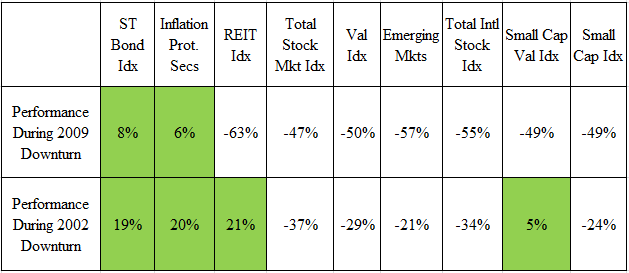
The table below displays the % increase or decrease (- % value) that portfolio components experienced during the 2 market downturn periods. From this table, there are several fascinating observations that can be made:
- The 2002 market downturn was much more “forgiving” compared to the 2009 one. For example, in the 2002 event, even though the overall stock market had decreased close to 40%, small cap value, REIT, TIPS, and bonds all experienced pretty significant positive returns that would have greatly stabilized your portfolio.
- Unfortunately, in the 2009 crisis, the only two portfolio components in the positive return range were the TIPS and short-term bond funds, which is what they are designed to do.
Having looked at the performance of the individual components in isolation, the next step was to examine the overall portfolio performance when all of the asset classes are combined, as it would be in “real life.”
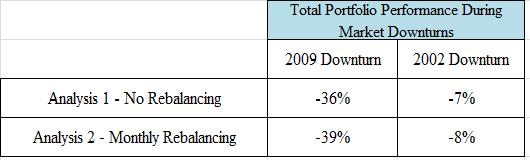
The return data for the combined portfolio can be seen in the table below (Analysis 1 – No Rebalancing line).
- As we mentioned previously, from September 1st, 2000 –> October 4th, 2002, the S&P 500 declined in value by 47%.
- However, if you had a diversified, passive investing portfolio like the one mentioned above, your portfolio would have only declined by 7% in value. This represents an 85% improvement in performance over the market!
- From October 5th, 2007 –> March 6th, 2009, the S&P 500 declined 55%.
- Similarly, a properly diversified portfolio would have saved you during the 2009 crisis as well, although not by as drastic of a margin as in 2002, with the diversified portfolio declining in value by 36% by 2009 vs. the 55% decrease of the S&P 500.
So again, we see that a properly structured retirement portfolio would not have “become worthless” during either of these market declines.
Analysis # 2 – Monthly Rebalancing
As a next step, I wanted to investigate the impact that monthly rebalancing (back to your asset allocation targets) would have on portfolio performance during these periods. The results can been seen in the table below (Analysis 2 line).
Intriguingly, rebalancing did not have that significant of an effect during both of the market downturns, and when it did have an effect, it was slightly negative. This may have been due to the majority of the equity asset classes declining in value in a correlated/together manner, instead of one going up while another goes down.
Another thing that is important to point out is in relation to the decision when you first construct a portfolio of how much equity vs. fixed income exposure you want / how much risk you can take.
- For example, on page 171 of Larry Swedroe’s book, The Only Guide to a Winning Investment Strategy You’ll Ever Need, there is a table that I used to help me determine how much equity allocation I should carry in my portfolio.
- For an equity allocation of 70%, it says that you should be able to withstand/tolerate/expect a decline in portfolio value of 30% in a single year. For an equity allocation of 60%, this value decreases to a 25% decline.
- Since the 2009 and 2002 downturns occurred over more than a year, you could say that the % decreases in the table above of the overall portfolio values (for a 70% equity portfolio) can almost be “expected” at some point or another, given the amount of risk you’ve exposed yourself to.
Conclusions
Overall, it’s clear to say that the 2002 and 2009 market downturns were depressing and full of desperation.
However, if we construct a passively managed portfolio (avoiding the risk of individual stocks) with a proper asset allocation and objectively compare the portfolio performance during the decline periods, we see that the portfolio behavior reverts to same risk/return tradeoff that must be considered upon first creating a portfolio.
To me, this really just highlights the importance of considering the risks of investing when you first start, not get too greedy or hyper-nervous, and make sure to give yourself adequate fixed income allocation to provide safety for you to sleep well at night.
How about you all? How did your overall portfolio do during the 2009 and 2002 market declines? Do you currently have a sufficient asset allocation for your risk tolerance?
Share your experiences by commenting below!
About the Author Jacob A Irwin
Hi folks! My name is Jacob. I am the owner and operator of My Personal Finance Journey. I started this blog in January of 2010 and have enjoyed the journey ever since. Since finishing up graduate school in Virginia in 2014, I have been working in biopharmaceutical development in Colorado. You can read more about me and this site here. Please contact me if you have any questions!
Related Posts
Maximizing Your Nest Egg: How to Make the Most of IRA Investments
Unlocking the Power of Tax Refund Loans: Accelerating Financial Growth with Smart Borrowing
Conversations to Have Before Your Child Goes to College
4 Dumb Mistakes Smart People Make with Their Money
6 Tips on How You Can Manage by Not Getting a Lot of Debt While You Are a Student
Popular posts
Session expired
Please log in again. The login page will open in a new tab. After logging in you can close it and return to this page.