

- You are here:
- Home »
- Blog
What are Your Options for Tax-Advantaged Non-Retirement Savings and Investments?
————————————————————————————————————————
Welcome to My Personal Finance Journey! If you are new here, please read the “About” or “First-Time Visitor” pages to find out more about us. If you would like to receive free updates on articles like this by email, then sign up here or you can subscribe to the RSS feed. Also, check us out on Twitter or Facebook. Thanks for visiting! Keep on learning!
————————————————————————————————————————
A few days ago, I wrote a post describing the various options available on the market today that people can use for tax-advantaged retirement savings/investing.
Tax-advantaged vehicles provide us as normal individuals, a very powerful strategy to try to optimize the taxes that we ultimately have to pay over our lifetime. However, there are two big problems I have encountered over the past few years (and ones that I am guilty of as well) circling in the air around how people utilize tax-advantaged money vehicles:
- Problem 1 with the Way People Use Tax-Advantaged Vehicles – People focus far too much on the advantages, while forgetting to really have the disadvantages sink in.
- Problem 2 with the Way People Use Tax-Advantaged Vehicles – People don’t fully understand all of the various tax-advantaged vehicle options at their disposal (i.e. getting focused solely on one with the exclusion of the others).
In order to address these two problems I have experienced, the purpose of this post will be to review the tax-advantaged savings options on the market today. While doing this, we’ll cover both the advantages and disadvantages of each, but I’ll try to more blatantly call out some of the disadvantages of each vehicle in order to help people know what they are getting in to with the use of red text. I’ll also include my take on how I will or will not incorporate each in to my personal investing/saving strategy at the end of the post.
Let’s get started!
Tax-Advantaged Vehicles – Non-Retirement Accounts
Having covered tax-advantaged retirement vehicles in the post several days ago, we will now continue on with our discussion with several possible options I’ve been investigating recently that are tax-advantaged, but that are not designed so that we are penalized 10% if we want to withdraw our money/earnings prior to 59.5 years old.
As we work through the options, you’ll likely notice that there are some other tax-advantaged investments that I have excluded. Several of these include tax-managed mutual funds/ETFs, Master Limited Partnerships, US Savings Bonds, and REITs. I left these off the list intentionally so I could focus on the vehicles which, in my non-professional opinion, seem to offer the most significant tax-advantages.
Side Note: Before we too deep in to this discussion, I want to point out that these are only options that are tax-advantaged. In other words, if you do not need the tax shelter and are simply looking to aggressively grow your money for long term needs (but you don’t want to be potentially penalized for pulling money out early if needed prior to retirement), a very good option that you can choose is to simply invest in a taxable mutual fund investing account. Any major brokerage offers these. The best offerings in my opinion are with Vanguard and Fidelity due to the low cost nature of their index mutual funds and the fact that you are not charged a trading commission when you purchase their name brand funds. In these taxable accounts, you can invest in pretty much the same equity mutual funds that you can inside an IRA/401k with these same companies. What I’ve realized is that a lot of people forget to consider this option when looking for places to invest their long term savings. Don’t let this happen to you! 🙂
Whole Life Insurance
The first tax-advantaged non-retirement account that I want to discuss is whole life insurance. Lately, I’ve spent between 70-100 hours total analyzing whole life insurance as a potentially good place to save money long term. Since sharing that analysis would be a lengthy discussion, I’ll share that in a separate post – on the way soon!
For the purposes of today’s post, we’ll just skim the surface about what whole life insurance offers:
- You pay a monthly or annual premium, and over time, this builds up a cash value along with securing a certain amount of death benefit for the insured’s whole life, hence the name.
- Each year, your account is guaranteed a certain base interest rate (usually 3.5%), and then you potentially receive dividends based on insurance company performance. The total average annual internal rate of return on your cash value is around 4.5% historically.
- Even though your premiums are made after-tax, your cash value accumulates tax-deferred, and the death benefit is also tax-free in the event that you die.
- Policy loans can be taken against your policy’s cash value balance, and these loans are tax-free.
Despite some very significant benefits, whole life insurance is not without its respective disadvantages.
- It’s complex and headache-producing. In order to find a properly structured policy, you have to REALLY know a lot about what you’re doing because the traditional insurance agent makes more money with a policy that is worse for you. Nice right?! After 100 hours of studying whole life insurance, it’s still not clear to me all of the complexities surrounding it.
- Even though the loans are made tax free, there will often be a spread interest rate that you have to pay on the difference between what the cash value is earning and what the loan rate is.
- Internal cash value rates of return are often decreased in the first 20 years of a policy (even a well-structured one) due to the cost of securing your lifetime death benefit. While this can be viewed in a lot of ways as positive, it must be taken in to consideration.
Tax-Exempt Municipal Bonds and Money Market Accounts (Or Mutual Fund/ETF Versions)
A fairly interesting tax-advantaged investing vehicle that I have only begun to investigate in depth recently is tax-exempt municipal bonds (and the mutual/ETF fund versions therein).
At a high level, municipal bonds (and securities) are issued by local, county, or state government entities to help fund the various projects and improvements they want to take on. These can include building school, highways, sewer systems, or simply funding day-to-day activities.
- They offer a nice tax-advantage for non-retirement investing and savings in the regard that the income/interest/dividend you make from municipal bonds are exempt from federal income taxes.
- This income is generally also exempt from state and local taxes, provided that you pay taxes in the state/municipality in which the bond was issued.
Even though it may not be absolutely the most efficient, I would prefer to hold bond mutual funds or ETFs instead of the actual bonds themselves. More specifically, if I were to invest in municipal bonds, I would likely want something that is very secure, i.e. short-term bonds.
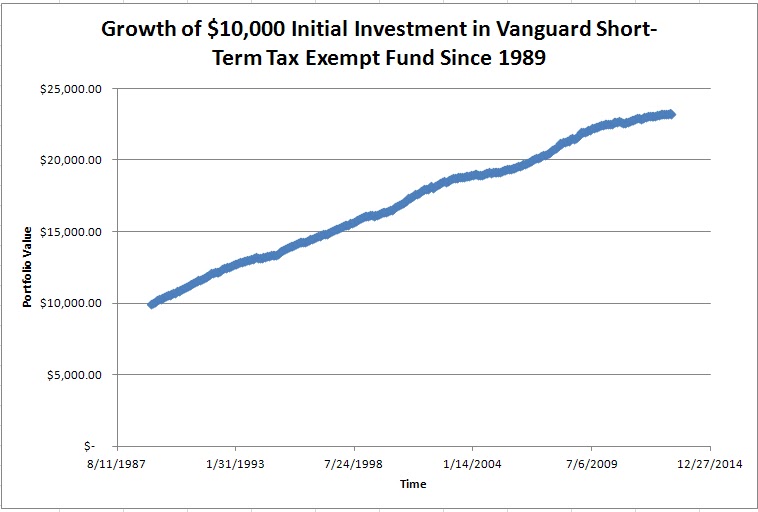
Since I like Vanguard, I would likely invest in the Short-Term Tax Exempt Bond Fund, Ticker Symbol, VWSTX. The chart below shows how $10,000 initially invested in this mutual fund would have grown from 1989 to the present day.
As you can see below, the growth is very steady, with some leveling off during the hard economic times when interest rates went down to get the economy jump started with easier lending, but hardly any decrease in value. The 22 year average annual return was 6.07%. Pretty solid, right?!
In looking at the numbers in detail, I found that the most money you would have lost in any one month during this 20+ year period was $117.13, corresponding to roughly a 0.56% decrease. Not much at all compared to the volatility of the stock market and that you have $10,000 to start off with! If you’re interesting in look at my investigation in more detail, click here for the Google Docs spreadsheet.
Of course, the tax-shielding and stability (with short term) of municipal bonds is not a free lunch (i.e. there are some disadvantages).
- Municipal bonds are not ALWAYS exempt from ALL taxes. For example, the Alternative Minimum Tax still applies, and if any capital gains occur, you still will owe capital gains taxes on those as well. Good articles to read more about the potential taxes on municipal bonds can be found here and here. Because of this, be sure to know how the tax laws apply for your specific situation!
- Because of the tax shielding, municipal bond yields will be significantly lower than their taxable counterparts.
- Even though you can manage the amount of price volatility/risk by maturity matching, there is no absolute guarantee that you won’t lose money, as is the case with life insurance.
Higher Education Savings Plans Where You Maintain Complete Control over the Money
Everyone hopes that their child will get a full scholarship to go to college, but the odds these days do not seem stacked in our favor enough to TOTALLY depend on one of these awards.
By opening a college savings fund through an institution like Vanguard, you can take advantage of tax deferred growth within the account, while still having the luxury to direct the investments the way you want. Just remember that you will want to match the maturity of the investment instrument with the time horizon associated with whenever you child will be going to college in order to maximize returns.
It is also important to remember that although all parents I’m sure would prefer to help their children pay for college, they should only save for their children’s higher education if and only if they are completely satisfied in their progress in saving enough money to secure their own retirement first! None of us will do our children any good if we are depending on them for everything financially for the last 35 years of our lives, right?! Children also have more options in the form of student loans to assist in paying for college, along with having a long time frame that they can use to pay back this form of debt.
Let’s examine some of the specifics of college savings accounts/plans:
- There essentially two main types of college savings plans – 529 accounts and Coverdell ESA’s.
- 529 Accounts –
- With 529 accounts, you as the parent, open and control the account ALWAYS, regardless of the age of the beneficiary. You then designate a beneficiary (who can be any age from newborn to adult) that the money will go to for higher education expenses. One of the cool things about this account is that you, yourself, can be the beneficiary if you plan to go back to school at some point!
- You can contribute a fairly large amount each year, but once the account balance reaches $370,000 (a problem we would all like to have, right!?), you can no longer put in money, but your earnings can keep compounding.
- Essentially, the standard gift tax rules apply with these accounts. In other words, you can contribute $13,000 per year on a regular basis to one beneficiary, or you can make one contribution of up to $65,000, but you cannot make any more contributions for the next 5 years.
- Certain states (like Virginia where I live) allow you to deduct your contributions (up to a maximum amount, $4,000 in Virginia) on your state income taxes (not federal income taxes though).
- Earnings grow tax-deferred, and withdrawals are free from federal income tax if used only to pay for qualified higher education expenses (this means the standard tuition, fees, books, room/board, etc).
- Also, if you invest in a state-sponsored plan in which you earn income, the withdrawals will also be state income tax free as long as they are qualified!
- One good thing is that like Roth IRA’s, you as the account owner, can withdraw your contributions (not earnings) at ANY time for ANY qualified or non-qualified reason without paying any taxes or any penalties.
- Friends and family can also contribute to the beneficiary (future student).
- You can also change the beneficiary to another member of your family if needed.
- The account is considered an asset of the account controller (parents) when taking in to consideration financial aid eligibility. This can improve your child’s chances!
- There are NO income limitations on who can establish/contribute to an account.
- If the beneficiary decides not to go to college or gets a big scholarship, there are a couple of options for how to handle this. A good article explaining these things can found accessed here.
- Coverdell ESA’s –
- In general, Coverdell ESA’s have the majority of the characteristics discussed above with 529’s with two important exceptions:
- 1) You can only contribute $2,000 per year per beneficiary, much less than with a 529 plan.
- 2) Along with using Coverdell money for higher education purposes, Coverdell assets can be used for qualified education expenses at the elementary and secondary education level. Nice! 529 plan assets can only be used for higher education purposes. The qualifying education expenses are much more broadly defined in the case of Coverdell ESA’s as well.
Some negative aspects / disadvantages to keep in mind about higher education savings vehicles:
- Contributions are made on an after-tax basis, so they won’t do anything to reduce your current tax burden, unless your state has special allowances for this.
- Earnings on non-qualified higher education expense withdrawals are taxed as normal income and subject to a 10% penalty, so this is something to watch out for!
- IRS rules dictate that you can only change around the allocation of assets in a 529 plan once per year. While this shouldn’t be that big of a deal because re-balancing happens only about 1x per year, this is something to keep in mind.
- Your investment options inside the 529 account can be limited to certain types of funds. However, seeing as how Vanguard offers 529’s, the options likely aren’t all that bad. Coverdell ESA’s offer many more options.
- With Coverdell ESA’s, you are required to transfer ownership of the assets to the beneficiary by age 30 in order to not incur taxes and the 10% penalty. With 529’s, there is no such requirement.
- You can only contribute fully to a Coverdell ESA account if you make below $95,000 per year.
Well – that about wraps things up for tax-advantaged NON-retirement accounts!
In an upcoming post, I’ll also work through two other tax-advantaged options that I did not have room to cover here – trusts and custodial accounts. Keep an eye out for that – on the way soon!
How about you all? Which of these tax-advantaged non-retirement accounts is your favorite/do you use the most and why?
How much do you have invested in retirement accounts vs. non-retirement accounts at the moment?
Share your experiences by commenting below!
***Photo courtesy of http://upload.wikimedia.org/wikipedia/commons/1/17/Singer_City_Investing_Hudson_Terminal_1909_crop.jpg
Cavalcade of Risk #179 – March 20th, 2013 Edition

————————————————————————————————————————
Welcome to My Personal Finance Journey! If you are new here, please read the “About” or “First-Time Visitor” pages to find out more about us. If you would like to receive free updates on articles like this by email, then sign up here or you can subscribe to the RSS feed. Also, check us out on Twitter or Facebook. Thanks for visiting! Keep on learning!
————————————————————————————————————————
Welcome everyone to the (179th!) March 20th, 2013 edition of the Cavalcade of Risk. The Cavalcade of Risk (or Cav of Risk for short), as is implicated by the name, is a bi-weekly blog carnival that features the top articles regarding risk management. Several of the realms of risk management covered relate to finances, insurance, and health.
My Personal Finance Journey is honored to be hosting the Cav this week! I hope you enjoy the articles below and can stop by my site on my non-carnival days as well. If you’re interested in receiving email updates of my posts, simply click here to sign up.
Without further ado, let’s get on with the Carnival. Listed below are this week’s Top 5 Editor’s Picks! Enjoy!
1. Jeff Root presents Life Insurance with E-Cigarettes, and says, “E-Cigarettes are the biggest trend in the smoking community. This article explains how life insurance companies are viewing e-cigarette use and some tips on finding the best rates.”
2. Louise from Colorado Health Insurance Insider presents Let Medicare Negotiate Drug Prices And The Government Can Afford Health Insurance Subsidies, and says, “And that seems like a perfect segue into a recent Center for Economic and Policy Research report that projects a government savings of up to $541 billion over the next ten years if Medicare could negotiate drug prices with pharmaceutical companies. Even on the low end, the CEPR reports a savings of at least $230 billion, which would cover half of the funds needed for the health insurance subsidies over the next decade. But on the high end, the savings from allowing Medicare to negotiate drug pricing (the way it does with other services, and the way other industrialized countries do) would more than offset the funds needed for the health insurance subsidies.”
3. Health Business Blog presents, Social media and doctors: Q&A with Doximity CEO Jeff Tangney, and says, “Online doctor/patient relationships are the new frontier in social media. A report earlier this year discussed how medical boards would respond to different sorts of potentially inappropriate activity on social media. I asked Jeff Tangney, CEO of a professional online network for physicians called Doximity, to discuss the risks and approaches to mitigation.”
4. Henry Stern from InsureBlog presents Crop (Insurance) Report: Timely Update, and says, “InsureBlog reports on the latest developments in an on-going crop insurance scandal.”
5. Jason from Healthcare Economist presents The end of the FDA?, and says, “The FDA is charged with protecting patients against the risk of harmful drugs. Will a recent court ruling hamstring their efforts to control off-label use of pharmaceuticals? The Healthcare Economist investigates.”
Well – that concludes this edition. Thanks for tuning in!
You can submit your blog article to the next edition of Cavalcade of Risk (hosted by Michael Stack at Reduce Your Workers Comp) using the handy carnival submission form.
Also, if you are interested in hosting the Cavalcade of Risk in the future, just send Henry (the organizer) an email by clicking here.
***Photo courtesy of http://pixabay.com/get/2e0071ad1077b829c32e/1363792014/risk-89.jpg
The Stock Market Hit an All-time High – Where Do We Go From Here?

————————————————————————————————————————
Welcome to My Personal Finance Journey! If you are new here, please read the “About” or “First-Time Visitor” pages to find out more about us. If you would like to receive free updates on articles like this by email, then sign up here or you can subscribe to the RSS feed. Also, check us out on Twitter or Facebook. Thanks for visiting! Keep on learning!
————————————————————————————————————————
The following is a post by MPFJ staff writer, Kevin Mercadante, who is professional personal finance blogger, and the owner of his own personal finance blog, OutOfYourRut.com. He has backgrounds in both accounting and the mortgage industry.
The Dow Jones Industrial Average is back to setting record highs. Good news? Sure!
But it also means that we are now in uncharted territory. There are no charts to look back at and say “this is how the market behaved the last time the Dow was this high…” This is a whole new dimension that requires a different way of looking at the market.
Just as with any other level of the Dow, or any other index, the market can either continue to rise, to float sideways for very long time, or to decline, even substantially. But what makes a record high unique – and a bigger question – is that the directions can carry greater weight.
The market can continue to ride the same euphoria that blasted the Dow past the 14,000 level, all the way up to 20,000 and even beyond. It can enter a period of confusion, not knowing where to go, because of the conflict between optimism and the unknown. Or you can get a sudden fear of heights, where millions of investors decide to lock in the profits and cash out, dropping the market several thousand points.
Where will it go? Who knows – but it’s best to have a strategy for any one of three scenarios.
If you anticipate that the market will continue moving higher
If you believe that the market will continue to go higher, the best strategy will be to continue doing what you’ve done so far, with only minimal modifications to be prepared for changing circumstances.
For example, if your portfolio has at least kept up with the general market, you may want to keep most of your money in the stocks and funds where already is. The same factors that have carried them this far will probably keep them growing.
But as market leadership tends to change as markets advance, this is also an excellent time to begin looking at other sectors and companies. While certain sectors may lead the market to new highs, leadership may shift over to sectors and companies that have not performed quite as well. This is because investors and investment managers will be looking for new opportunities as the market advances.
If you believe it will be range-bound
If you believe that the market will go sideways for a prolonged period time, perhaps as it consolidates for the next move up or down, you may also begin looking for a change in leadership among sectors and companies. In a range bound market, some sectors can fall as others begin rise. The stocks that brought market up to the top may not be the ones that will lead the way in the next surge.
Again you will want to look at sectors and companies that have strong fundamentals, but did not perform quite as well on the run up.
This may also be the time when you look to take profits. You may want to sell off some of your better performing assets, and move them into somewhat more conservative investments.
This is not a time to begin exiting the market, but you might want to consider investments that will provide you with a steady income, while enabling you to participate in the next move up. Growth and income type stocks and funds can be the perfect choice. You’ll earn income from dividends – which will also provide at least some price protection – and if the market does resume its rise, you’ll be in a position to take advantage of that.
This can also be an excellent time to look for value stocks, and funds that invest in them. There are stocks in companies that are fundamentally sound, but they didn’t do as well as the Nifty Fifty stocks that drove the market to a new record. Prices of these stocks can be relatively low compared to the better performing competitors. They will also represent of the best opportunities in a range bound market. As the market looks for new leadership, value stocks are a natural choice.
If you think the market will fall for a long time
If you think that the market has run its course, and may be ripe for a multi-year decline, then this is the time to put diversification into high gear.
You never want to leave the stock market completely, but this will be the time to begin reducing your positions. Because the market is in record territory, it will be the best time to sell and take profits. Even if the market rises another 2,000 or 3,000 points, you’ll still have made rich profits.
You can build positions in sectors and companies that are likely to do well in the current economic environment – value stocks and funds would be a perfect choice. Even in declining markets, capital is always going somewhere, and it’s usually when markets decline that investment managers start looking for bargains.
You’ll also want to begin moving money out of the market. This will not only be a matter of protecting your profits, but it will also free up cash so that you will be able to buy bargains later on after the market has fallen.
Any type of interest-bearing investments would be suitable for this purpose. It could be treasury bills, certificates of deposit or money market funds – any place where your principal will be protected, and you can earn some income while you were waiting out the market transition.
How about you all? Where do you think the market is headed now, and what do you think is the best way to react to the various possibilities?
Share your experiences by commenting below!
***Photo courtesy of http://www.flickr.com/photos/83532250@N06/7651028854/sizes/s/in/photostream/
Working From Home – Is it a Money Saver or Money Loser?

————————————————————————————————————————
Welcome to My Personal Finance Journey! If you are new here, please read the “About” or “First-Time Visitor” pages to find out more about us. If you would like to receive free updates on articles like this by email, then sign up here or you can subscribe to the RSS feed. Also, check us out on Twitter or Facebook. Thanks for visiting! Keep on learning!
————————————————————————————————————————
But there are also the financial considerations. If you’re seriously considering making the switch to working from home, you’ve (hopefully) already thought about the big things like salary differences and how you’ll get health insurance. (If not, stop right here and do those things, immediately.)
But, as someone who juggles a part-time office job and a part-time freelance business, I can tell you that there’s more to the financial balance sheet than that.
Here’s a quick list of the ways you may not have considered that working from home can both save you and cost you in the budget department:
Savings
Commuting costs. If you take public transit to get to and from work, that’s one level of savings. But if you drive? You’ll save in lots of areas: gas, tolls, parking, even the repairs that come as a result of the added wear and tear being put on your car. And if you can get rid of a second car altogether by working from home, you’re also saving on car payments and insurance and registration fees. It can add up quickly!
Food and drinks. How many times do you grab a coffee on the way in to work or go out for lunch because you haven’t had time to make anything at home? How often have you felt pressured to eat out to escape a stressful office or an annoying coworker? And (admit it!) how many times have you guiltily raided the vending machines for a pick-me-up?
When you work from home, you can be more careful about your food spending. You have time to reheat leftovers, make salads and sandwiches from scratch, and keep a pot of Joe warm for whenever you need a lift.
Wardrobe and toiletries. While it’s not recommended that you stay in the same pair of sweats for several days straight, working from home does give you a little more leeway in how you can dress. You’ll still want to have a good outfit or two in the event that you need to do a video conference call or have a face-to-face client meeting—but for the most part, you can wear whatever you want while you’re writing your monthly report, and no one will be any the wiser. So keep a few timeless staples like a suit and a nice button-down shirt with slacks, and you no longer need to worry about continually updating your wardrobe to keep up with the trends. (You’ll also save on dry cleaning costs.)
And ladies? No need to straighten/curl/style your hair and do the full makeup routine every morning, which means you’re spending less on beauty products, too. (It’s up to you if you want to put on a little mascara and lip gloss in case the UPS guy comes to the door, but it’s still minimal compared to your usual routine.)
Child care. If your kids are of the age where they don’t need constant supervision (or you’re a master at getting work done during nap times), you have the potential to save quite a bit on child care costs. If you still need some alone time to concentrate on your work, you might be able to reduce the number of days you pay for child care, only having the kids home some of the time. Even a day or two a week can equal big savings.
Costs
Utilities. Now that you’re home all day, no more setting the thermostat program to kick down 10 degrees when you’re at work. (Unless you enjoy working in fingerless gloves and a hat, which is certainly your prerogative.) You’ll also be using more electricity, water, you name it.
The good news is that if you have a dedicated home office—a room (or even just a desk) used for work and only for work—you can claim a percentage of your utility expenses when you file taxes. (You’d calculate the percent of your home’s square footage made up by your office, then calculate that percent of your year’s utility bills.) Still, on a month-to-month basis, be ready for an up tick in this area of your budget.
Equipment costs. If you’ve already got all the tech gear you need to work from home, you’re golden. However, chances are you’re going to need something extra once you start working from home full-time. You may need to upgrade your PC, buy a multifunction printer, or invest in a mic and web cam for video conferencing.
Again, these upgrades can be claimed as deductions as long as the equipment is used used for business—or, if you’re a remote worker for a company, your company may offer you reimbursement options. But you’re still potentially shelling quite a bit out pocket initially.
Taxes. Speaking of taxes, if you’re working from home as a freelancer, business owner, consultant, or any other work that qualifies as self-employment, get ready for your relationship with Uncle Sam to change drastically.
How about you all? Do you work from home? What other savings/costs have you noticed that a regular employee wouldn’t experience?
Share your experiences by commenting below!
***Photo courtesy of http://farm4.staticflickr.com/3466/3289898604_8301851433.jpg
Types of Vehicles That Affect Car Insurance Rates

————————————————————————————————————————
Welcome to My Personal Finance Journey! If you are new here, please read the “About” or “First-Time Visitor” pages to find out more about us. If you would like to receive free updates on articles like this by email, then sign up here or you can subscribe to the RSS feed. Also, check us out on Twitter or Facebook. Thanks for visiting! Keep on learning!
————————————————————————————————————————
The following is a guest post. Enjoy!
We all know that there are many different factors that play a role in establishing your car insurance rates. From your experience, driving record, your decision to go to driving school and whether or not you decide to test the market and get an insurance quote; there is no shortage of things to think about.
One thing that is often overlooked but plays a large role on the amount of money you pay for your auto insurance is the vehicle that you drive.
Most people are often caught up with the features of the vehicle and seldom think about the impact of their vehicle choice on their insurance rates. But, this is something that more people need to pay attention to if they want to save money on insurance.
The truth is finding out how much insurance you will have to pay for a vehicle is simple and straightforward. All you have to do is take your list of cars that you are thinking about buying and ask your insurance company for a quote. A little work can go a long way to saving you money.
Vehicle Factors That Affect Car Insurance Rates
The type of vehicle you choose to drive plays a large role in your insurance costs. Why? There are a number of vehicle features that insurance companies look at to determine the rates they charge to insure vehicles. Insurance companies factor in the make and model of your vehicle in terms of what the risk factors associated with it might be.
Some important vehicle features to consider include:
- Vehicle type: Whether you drive a car versus driving an SUV, pick-up truck, Crossover, or any other type of vehicle will set a baseline for the amount you can expect to pay.
- Model: The model of car that you drive will impact your rates. Obviously, driving a sports car will cost more money than regular Sedan. This is why you need to put things in perspective when thinking about insurance costs.
- Age: The age of your car plays a large role in not only the price, but also in terms of the type of coverage you need. Since newer and more expensive cars cost more to replace if they are damaged, they are inherently more expensive to insure.
- Safety Rating: The safety and collision rating will impact your rates, so it is a good idea to do some research in this area. Vehicles that have a better safety rating will cost less for coverage.
- Theft rating: Vehicles that regularly appear on the most stolen vehicle list will cost more money because insurance companies view them as being a car that is associated with a higher risk.
If you really want to save money on your insurance rates, you need to be conscious of the type of vehicles that are preferred by insurance companies. Vehicles that are well built are known for requiring minimal repairs and have a great safety rating will cost you less money in the long run.
How about you all? Has the potential cost of car insurance been a significant factor in influencing any of your past car purchases?
Share your experiences by commenting below!
Jacob’s Thoughts – Listed below are my random thoughts as I was reading this article.
- Although I haven’t ever personally compared car insurance costs on different car models, I definitely have heard that the type of car you have makes a difference in your costs.
- For example, I have heard that a fast sports car will likely have a higher insurance cost than say, a Volvo wagon, just because of the nature of how the respective types of cars are generally driven.
- I’m curious to hear everyone else’s experience with this as well!
***Photo courtesy of http://upload.wikimedia.org/wikipedia/commons/e/eb/FEMA_-_38927_-_Cars_at_Cruise_ship_parking_lot_damaged_by_Hurricane_Ike.jpg
Comparison of Popular Online Stock Brokers

————————————————————————————————————————
Welcome to My Personal Finance Journey! If you are new here, please read the “About” or “First-Time Visitor” pages to find out more about us. If you would like to receive free updates on articles like this by email, then sign up here or you can subscribe to the RSS feed. Also, check us out on Twitter or Facebook. Thanks for visiting! Keep on learning!
————————————————————————————————————————
The following is a post by MPFJ staff writer, Kevin Mercadante, who is professional personal finance blogger, and the owner of his own personal finance blog, OutOfYourRut.com. He has backgrounds in both accounting and the mortgage industry.
There is no shortage of online brokerage firms these days, and you can be blinded by all the options they offer. Most have low fees, and there are slight differences between each that make all the difference in the world (funny how that works sometimes, right?!), depending on what type of trader you are, and how larger your portfolio will be.
Before you move your money into any of these accounts, it is important to check out the specials that they are offering – and they all seem to be offering them an ongoing basis. Most will at least reimburse you for exit fees paid to your current broker, but some firms also offer free- or lower cost-trades, either for a certain amount of time or a limited number of transactions.
Special offers aside, here are the basics on some of the more popular online stock brokers.
Scottrade
Scottrade offers basic stock trading at $7, and reasonable transaction costs for most other trades. In addition to stocks, you can also trade options, mutual funds, exchange traded funds (ETF‘s), certificates of deposit, and foreign securities.
You can also open a range of IRAs, including traditional, rollover, Roth, and SEP accounts. Scottrade is also offering banking services, including checking, savings, and money market accounts.
The service offers real-time stock quotes, free research, and phone apps. The minimum to open and account is $500.
Sharebuilder
One of the advantages of Sharebuilder is that it has no minimum balance requirement, and that opens the service to the smallest of investors. Basic stock and ETF trades are $6.95, and mutual funds trades are $19.95. You can trade options at $6.95 plus 75 cents per contract.
You can have both individual and joint investment accounts, and also education savings accounts (ESA’s), traditional and Roth IRAs, and rollover- and small business-401(k)’s.
E*trade
Probably the best known online brokerage service – due to its aggressive advertising campaigns – E*Trade offers two commission structures on stock and option trades. The standard fee is $9.99 per trade, but if you’re an active trader – meaning that you execute more than 150 trades per quarter – the transaction fee drops to $7.99 per trade.
The company offers stocks, bonds, options, mutual funds, and ETF’s. You can hold an IRA with no fees and no minimum deposit requirements. The company also offers full service banking. There is a minimum deposit requirement of $500 to open a taxable account.
E*Trade offers trading in more than 7,600 mutual funds, which includes 1,100 no-load/no transaction fee funds.
The company’s Power E*Trade Account is available if you make at least ten trades per month, or 30 trades per quarter. This service provides advanced tools including advanced charts, and screening- and analytical-tools.
TradeKing (Which Now Includes Zecco.com After the Merger)
TradeKing offers one of the lowest transaction fees available for online brokers (the only one lower than this I know of is SogoTrade.com, which offers $3 trades). The basic fee of $4.95 applies to stocks, mutual funds, and options (plus $.65 per contract). There is no minimum amount to open up an account.
The company also offers trades in stocks, ETF’s and more than 8,000 mutual funds. There is no annual maintenance fee, however, if you do not execute any trades within a 12 month period, and the balance in your account is less than $2,500, you will be charged a $50 inactivity fee.
SmartMoney gave TradeKing it’s highest customer service rating in 2012, and when you combine that with some of the lowest transaction fees in the industry, it’s a tough combination to beat.
TradeMONSTER
TradeMONSTER offers transaction trading fees that are (at $7.50 per trade) about middle-of-the-road as far as online brokers go. The company offers both individual and joint investment accounts, as well as no-fee IRAs. You can also trade stocks, options, mutual funds, and ETF’s. There are no FOREX offerings, and futures can only be traded through a separate account.
The company reportedly has excellent customer service, including research tools, portfolio analysis and reporting tools. On the negative side, they do require a minimum of $2,000 to open an account, and there are no extended trading hours, nor do they offer access to international exchanges.
Bringing it all together
The various account terms and fee structures can be confusing, so here’s a chart with a side-by-side comparison of each of the five brokers from above. Just be sure to do some deeper research into each company before making a decision. Some companies may offer even lower prices if you are a more active trader.
How about you all? Have you used any of these brokers, and if so, how has your experience with them been?
Share your experiences by commenting below!
***Photo courtesy of http://www.flickr.com/photos/perspective/186512551/sizes/s/in/photostream/
How to Save Money in the Kitchen

————————————————————————————————————————
Welcome to My Personal Finance Journey! If you are new here, please read the “About” or “First-Time Visitor” pages to find out more about us. If you would like to receive free updates on articles like this by email, then sign up here or you can subscribe to the RSS feed. Also, check us out on Twitter or Facebook. Thanks for visiting! Keep on learning!
————————————————————————————————————————
The following article is by MPFJ staff writer, Miss T from Prairie Eco-Thrifter. If you want to learn how to live your dream life in a sustainable, healthy, and money savvy way, check out her site here.
These days, money is tight, and many people are constantly looking for ways to save some cash. While it’s hard to find any big savings around the house, I have found that it’s possible to save small amounts in several different areas that add up to a considerable sum.
Here are some ideas to help you save money in the kitchen:
There are numerous areas where you can save money in the kitchen, but in this article we’ll look at energy and water consumption.
Energy and Water Saving Idea # 1 – Reduce Your Usage
Because you pay for what you use in electricity, gas and water, the obvious way to save money is to reduce how much you use. Teach yourself, and other household members, the basics of reducing your everyday energy and water usage in the kitchen. These include turning off the lights when you leave the room, turning appliances off at the wall when not in use to avoid them using power while on stand-by, changing some settings on your appliances, and using the least amount of power and water to cook your food.
Energy and Water Saving Idea # 2 – Utilize Newer, More-Efficient Lighting Technology
The type of lighting you use in the kitchen can help you save electricity costs. Change the old incandescent light bulbs for newer energy-efficient types, such as CFLs, LEDs, and halogens. Manufacturers of these types of light bulbs claim that we can save up to $6 in power costs for every incandescent light bulb we replace. That really appeals to me, and it is so simple to do!
In a kitchen, use a CFL (Compact Fluorescent Lamp) in your central light fitting, to light up the whole room. These use about 70% less power and last up to ten times longer than incandescent bulbs, so you will be saving money right there. According to the EPA, replacing a 60 watt incandescent bulb for a 13 watt CFL (which will give you the same strength of light) will save you $30 in electricity costs for the life of that bulb. That fact alone was enough to send me off to buy CFLs, and I was surprised at how much cheaper they are now.
Halogen bulbs give a direct, spotlight type of bright light and are ideal for placing above a kitchen counter where you do most of your food preparation. This is what I did, having a row of 7 halogens recessed into the ceiling above the main counter top. These are so effective that we rarely use the central light at all. LEDs (Light Emitting Diodes) are also increasingly being used in a similar way to halogens and will also save you money on your electricity costs.
Energy and Water Saving Idea # 3 – Optimize Your Refrigerator
Did you know, appliances account for around 13% of your energy bill? This information comes from the Energy Star organization, so it would be pretty accurate. The major kitchen appliance, the refrigerator, is responsible for 8% of this figure so I thought that this could be an area where I would be able to save money. When I did some research, I found that refrigerators generally use more power than lights, which dented my belief that I could save the most money by controlling how many lights were used in the house.
I also found that most people run their refrigerators too cold for most of the year. The ideal temperature for a refrigerator is between 36 and 40 degrees, but many people keep the temperature lower than this. The EPA says that if your refrigerator is 10 degrees or more below the optimum temperature, it could be increasing your power bill by 25%. This is one easy way to save money in the kitchen – check the temperature inside your refrigerator with a thermometer and adjust it accordingly. Also adjust it in the different seasons as the ambient air temperature can determine how cold you need to set the refrigerator.
Other money saving tips for the refrigerator include:
- Not putting hot food in; cool it first.
- Thaw frozen foods inside the refrigerator to reduce power usage.
- Limit the number of times you open the door.
- Position the appliance away from a heat source such as the oven.
- Have a space around the refrigerator to allow the heat from the motor to escape
- Give the condenser a good clean every six months or so.
- Check the seals are intact and replace them if necessary.
- When it comes time to replace your old refrigerator, choose one with the highest energy rating you can afford.
Energy and Water Saving Idea # 4 – Optimize Your Dish Washer
The dishwasher is probably the next big appliance in the kitchen. Most people know it is more efficient to run the dishwasher when it’s full, but did you also know that you can adjust some of the settings on many models to reduce energy usage?
Check the manual to see if you can lower the temperature your dishwasher heats the water to; 120 degrees is adequate to properly clean the dishes. Turn off the “Rinse Hold” button if the dishes aren’t very dirty. This function alone uses between three and seven gallons of water. If there is an automatic air dry switch on your machine, use it to let the dishes dry naturally. If not, turn the control to ‘off’ after the rinse cycle has completed and open the door slightly to allow the dishes to air dry.
Energy and Water Saving Idea # 5 – Optimize Your Freezer
If you have a separate freezer like we do, there’s also cost-saving strategies you can use with it. Keep the temperature at 5 degrees for effective freezing unless you have a unit especially for long-term storage of food, in which case it needs to be at zero degrees. Freezers work most efficiently when they are full, unlike refrigerators that work most efficiently when not overly packed.
Energy and Water Saving Idea # 6 – Limit Use of Hot Water
Water usage is another big area where you can save money in the kitchen. Limit the number of times you use the hot water faucet, especially when you only need a little water. The water that comes out of the hot faucet is cold at first, but you are using energy to heat the water taken from the water heater, so only use the hot faucet when you need a bigger quantity of hot water. Fix dripping faucets by replacing washers to avoid wasting water. Scrape dishes rather than rinsing them and only use the amount of water needed when hand dishwashing, rather than filling the sink.
Energy and Water Saving Idea # 7 – Check Your Cooking Appliances
Cooking appliances is the final area I considered when looking for ways to save money in the kitchen. With gas cookers, try to buy one with electronic ignition rather than one that needs a pilot light to be constantly burning gas. Check the color of the flame of natural gas appliances – blue is good; yellow means that it is not burning efficiently and may need some adjustment.
Make sure you keep all burners and reflectors on your range clean so they will reflect the heat and use less energy. Always cover kettles, pots and pans when bringing them to the boil as they heat faster and use less energy. Your appliance will work more efficiently if you choose a pan that is the same size as the actual heating element. When cooking small amounts of food, it is more energy-efficient to use a small appliance like a toaster or convection oven or an electric pan than firing up the big stove. These smaller appliances can use up to 50% less power than a large oven.
I hope you can use some of these methods to save money in the kitchen in your home. a great side benefit is that, while you are saving yourself some cash, you are also helping the environment in many cases. That’s a win all round in my book.
How about you all? What changes have you made in your kitchen to help you save money? Have you ever used any of these tips above?
Share your experiences by commenting below!
***Photo courtesy of http://prairieecothrifter.com/wp-content/uploads/2012/09/iStock_000019244916XSmall.jpg
Easy Places to Find Extra Money for Unbudgeted Expenses

————————————————————————————————————————
Welcome to My Personal Finance Journey! If you are new here, please read the “About” or “First-Time Visitor” pages to find out more about us. If you would like to receive free updates on articles like this by email, then sign up here or you can subscribe to the RSS feed. Also, check us out on Twitter or Facebook. Thanks for visiting! Keep on learning!
————————————————————————————————————————
The following post is by MPFJ staff writer, Melissa Batai. Melissa is a freelance writer who covers topics ranging from personal finance to business to organics to food. She blogs at Mom’s Plans, where she shares her family’s journey to healthier living and paying down debt.
Potential Money Sources
Raid the Emergency Fund?
Instead, we decided to find some ways to generate the money. Here’s how we did it:
How to Find Money for Unbudgeted Expenses
Other Places to Look for Extra Cash
How about you all? What are your favorite ways to “find” extra money?
Share your experiences by commenting below!
***Photo courtesy of http://www.flickr.com/photos/73416633@N00/490624619/lightbox/
The Top Online Savings Accounts with the Best APY

————————————————————————————————————————
Welcome to My Personal Finance Journey! If you are new here, please read the “About” or “First-Time Visitor” pages to find out more about us. If you would like to receive free updates on articles like this by email, then sign up here or you can subscribe to the RSS feed. Also, check us out on Twitter or Facebook. Thanks for visiting! Keep on learning!
————————————————————————————————————————
The following post is by MPFJ staff writer, Shondell of Call Me What You Want Even Cheap. At her site, she blogs about her recent car loan, mortgage pay off, and a whole bunch more. Check out her blog right here!
Online banks work on the same premises as traditional banks. Both types of banks accept deposits from customers, lend money to borrowers at high interest rates, and return a small portion of their profit to the depositors as Annual Percentage Rates (APR) or an Annual Percentage Yield (APY).
However, there is a big difference in the way they operate. Online banks exist only on the Internet and, as such, come with their own flexibilities and difficulties.
Because online banks have only a fraction of the overhead that traditional banks have, they are able to give a higher rate of interest and also waive most of the fees. Whereas traditional banks give an APY in the range of 0.25% (at the highest), online banks usually give a bit of a higher rate. This is enough to make online savings accounts highly attractive for most people. You can check your account at any hour of the day and night from the comfort of your home. You can also pay bills and make online transfers instantly.
If you have never opened an online savings account, then it is natural for you to be suspicious about the security of your money. However, there is no reason to be worried as online banks are totally legal entities and have several layers of security features to make your money extremely safe and secure. As long as the bank does not fail (their failure rate is no higher than that of traditional banks), your money will be in safe hands and working to make more money for you. The majority of these online banks are also FDIC insured, just the same as traditional brick and mortar banks (more on this discussed below).
The popularity of online savings account has given rise to many online banks, including Ally Bank, American Express, EmigrantDirect, EverBank and HSBC Online, which are some of the most well-known. Some of them are divisions of traditional brick-and-mortar banks and others work in collaboration with the latter. For example, HSBC Online Savings is a service of HSBC. This is necessary as deposits and withdrawals (of cash) are still done through traditional accounts linked to the online accounts.
When choosing an online bank, you should compare the APY (which varies from day to day and bank to bank), customer service (whether you will be able to talk to a person in times of need), fees and service charges (whether there are any; in theory, there should be very few, if at all), and FDIC insurance (your online savings accounts must be insured by the FDIC). Do not trust any online bank that is not insured by the FDIC.
Here are brief descriptions of some of the top online banks:
Ally Bank:
Ally Bank is a division of the General Motors Acceptance Corporation (GMAC), whose business interests include insurance, commercial finance and direct banking. This popular online bank offers a variable APY of around 0.95% on online savings accounts and doesn’t charge any maintenance fees and service charges apart from overdraft fees. You can open an account with a zero balance and your deposit is insured by the FDIC by up to $250,000.
American Express:
American Express is the largest issuer of credit cards in the world and its online savings account has one of the best interest rates. The American Express High-Yield Savings account offers an APY of around 0.80% on any amount of deposit (no minimum deposit required). There are no maintenance fees and service charges, and your deposit is insured by the FDIC for up to $250,000.
EmigrantDirect:
EmigrantDirect is a division of Emigrant Bank, whose business interests include direct banking, commercial finance and real estate. The bank offers a variable APY of around 0.50% on any amount of deposit and doesn’t charge any fees, service charges and penalties. There is no minimum balance to open an account and your deposit will be insured by the FDIC by up to $250,000.
EverBank Online:
EverBank Online is a division of EverBank, whose business interests include direct banking, retail banking, Forex and commodities. The bank offers one of the best interest rates in the banking industry along with no monthly fees. Its High Yield Online savings account returns a variable APY of 1.25% on your deposit, which is insured by the FDIC for up to $250,000.
However, it’s important to note that unlike some of the other accounts mentioned here, there is a $1,500 minimum account balance to open an account.
HSBC Online Savings:
HSBC Online Savings is a service of HSBC, which is one of the largest banks in the world with presence in over 80 countries around the world. The business interests of the bank include commercial finance, retail banking and global banking. The bank offers a variable APY of around 0.40% on online savings account and your deposit is FDIC-insured for up to $250,000. There is no minimum balance and no maintenance fees and service charges except for overdraft.
How about you all? Who do you bank with for your online savings accounts?
Share your experiences by commenting below!
***Photo courtesy of http://www.callmewhatyouwantevencheap.com/wp-content/uploads/2013/03/online-banking.jpg
What are Your Options for Tax-Advantaged Retirement Savings and Investments?

————————————————————————————————————————
Welcome to My Personal Finance Journey! If you are new here, please read the “About” or “First-Time Visitor” pages to find out more about us. If you would like to receive free updates on articles like this by email, then sign up here or you can subscribe to the RSS feed. Also, check us out on Twitter or Facebook. Thanks for visiting! Keep on learning!
————————————————————————————————————————
One of my favorite overused sayings is the one that states, “There are only two things certain in life – death and taxes.” However, I suppose this statement is used so frequently for the reason that it really does hold true. You are going to die, and you are going to in some way or another pay tax on your income now or in the future.
I personally have not heard of anyone that has ever been bankrupted or kept from reaching millionaire/billionaire wealth status because of taxes alone. Even so, that doesn’t mean that the effect of taxes should be ignored. Quite the opposite in fact – the effect of taxes is significant. As savers and investors responsible for self-directing our own money, I believe we have a fiduciary responsibility to ourselves to optimize our finances in such a way that we pay the fewest taxes required by current laws.
One very potent strategy that we, as normal individuals, have at our disposal in performing the aforementioned optimization is to utilize various tax-advantaged savings/investing vehicles. As I mentioned several days ago in my post about blindly saving for retirement without considering the withdrawal process, there are two big problems I have encountered over the past few years (and ones that I am guilty of as well) circling in the air around how people utilize tax-advantaged money vehicles:
- Problem 1 with the Way People Use Tax-Advantaged Vehicles – People focus far too much on the advantages, while forgetting to really have the disadvantages sink in.
- Problem 2 with the Way People Use Tax-Advantaged Vehicles – People don’t fully understand all of the various tax-advantaged vehicle options at their disposal (i.e. getting focused solely on one with the exclusion of the others).
In order to address these two problems I have experienced, the purpose of this post will be to review the tax-advantaged savings options on the market today. While doing this, we’ll cover both the advantages and disadvantages of each, but I’ll try to more blatantly call out some of the disadvantages of each vehicle in order to help people know what they are getting in to with the use of red text. I’ll also include my take on how I will or will not incorporate each in to my personal investing/saving strategy at the end of the post.
Let’s get started!
Tax-Advantaged Vehicles – Retirement Accounts
The first group of tax-advantaged savings/investing options that are available can be grouped in to the broad category of “retirement accounts.” Essentially, these carry this label, as you probably know, because they are designed to be vehicles that are only tapped/accessed/have money withdrawn from DURING RETIREMENT (hence the name!). With the possible exception of annuities, all of these retirement accounts are self-directed in the regard that you more-or-less have discretion in investing the funds as you want.
In general, it can be said that these have significant tax advantages, but you have the distinct disadvantage that your money is not quite as accessible as if it were in a taxable account. Having said that, let’s now work through each of these one by one:
Traditional and Self-Employed 401k
This is the tax-advantaged savings/investing retirement account that is most often used (in my experience) by workers at mid to large-sized companies.
- It has the significant advantages of contributions being on a pre-tax basis and your earnings accumulating on a tax-deferred basis.
- This is nice because you don’t have to worry about the possibility of triggering a taxable event when you go to re-balance your asset allocation each year.
- Another big advantage (one that you definitely want to capitalize on) is that employers often match contributions up to a certain % of your income. Don’t ever let free money pass you by!
- They also do not have a low-income requirement like Roth IRA’s.
Yes, putting money in to your 401k is super easy (done by your employer before it ever hits your bank account), and since it is pre-tax, it allows you to save 30% more money minimum! However, these benefits come with a price, i.e. disadvantages that I feel need to be highlighted more than they often are:
- All amounts withdrawn (contributions + earnings) from a 401k are taxed as ordinary income at the state and federal level.
- At first glance, this may not seem like that big of a deal because, hey, after all, you got a tax break on the funds that you put in to the 401k in the first place.
- However, if we dig a little deeper in to an example, it becomes obvious that pre-tax 401k contributions are not perfect since at the withdrawal point, you’re paying taxes on a large amount of earnings that have accumulated after 40+ years (we’ll take a look at an example in the Roth IRA section below).
- Just consider that you’ve got $1 million accumulated in your 401k for retirement. You’re feeling pretty good about your future. However, don’t be surprised when you find out that you really only have $600,000 because you need to pay 30% in federal income tax and 10% in state taxes prior to the money hitting your bank account in retirement.
- Your savings/investments are NOT accessible prior to the age of 59.5 without a 10% penalty.
- Unless you meet one of the specific IRS exceptions such as disability, death, or unemployment (a good article explaining the different exceptions can be found here), you will not only pay the ordinary income tax on 401k withdrawals, but you will also pay a 10% penalty for early access. This could amount to 40-50% of your withdrawals! Quite steep if you are needing the cash to capitalize on other needs or opportunities.
- This penalty alone would personally keep me from tapping my 401k with the exception of if it were an extreme emergency. This would be somewhat inconvenient in the event that something comes up where I need a good chunk of my savings – a child getting married/going to college, buying a rental property, etc.
- You are required to make RMD’s, or Required Minimum Distributions, after the age of 70.5.
- If you don’t make these distributions, you’ll be hit with a 50% penalty (essentially, a penalty + income tax at a high bracket) on the money that you should have been distributing.
SEP, Traditional, and Rollover IRA
The next tax-advantaged retirement vehicle that we come to is the group that go by the name, Individual Retirement Accounts (IRA’s). From a taxation and savings withdrawal perspective, SEP, Traditional, and Rollover IRA’s are treated very similar to the Traditional 401k described above (although the contribution limit for a SEP IRA is generally higher):
- They have the advantage of contributions being on a pre-tax basis, and your earnings accumulate on a tax-deferred basis.
- They do not have a low-income requirement like Roth IRA’s.
Also like with Traditional 401k’s, the benefits of these three types of IRA’s come with a price, i.e. the same disadvantages discussed previously:
- All amounts withdrawn (contributions + earnings) from a 401k are taxed as ordinary income at the state and federal level.
- Your savings/investments are NOT accessible (excludes exemptions) prior to the age of 59.5 without a 10% penalty.
- Unless you meet one of the specific IRS exceptions such as disability, death, first-time home-buying, higher education, or unemployment (a good article explaining the different exceptions can be found here), you will not only pay the ordinary income tax on IRA withdrawals, but you will also pay a 10% penalty for early access.
- However, the good news is that compared to the penalties for 401k withdrawals, the rules regarding what situations avoid the penalty for IRA’s are much more lenient (encompass more situations). See the link mentioned above for more details.
- You are required to make RMD’s, or Required Minimum Distributions, after the age of 70.5.
Roth IRA
Having covered the more traditional pre-tax retirement vehicles, we can now move on to some well-established, but perhaps less widely-employed/known retirement accounts that approach taxes from a different angle.
First, let’s discuss the Roth IRA – my favorite and perhaps the most powerful tax-advantaged savings vehicle currently available.
- A really cool thing about Roth IRA’s is that they are tax-advantaged in a way that they are in fact tax free!
- Although the contributions are made after-tax, your money accumulates tax-free, and withdrawals of contributions + earnings are tax free after the age of 59.5, provided that you opened and funded your first Roth IRA more than 5 years ago. What this means is that if your current Roth IRA balance is $1 million, all 1 million of those Dollars can actually hit your bank account and are not subject to taxes skimming 40% right off the top.
- Aside from the withdrawals in retirement not being taxed, the distributions also DO NOT increase your Adjusted Gross Income, meaning that distributions don’t cause your general tax bracket to increase.
- Due to the power of compound interest, I’ve read that at retirement age, retirement accounts consist of 90% earnings and 10% contributions. Because of this, it makes sense to at least consider the desire to only pay taxes on the 10% contribution part in exchange for skipping the taxes on the 90% earnings side.
- An example is useful to illustrate this difference. Let’s say that a 22 year old lands her first job after college and saves $1000 in a Roth IRA. Assuming a level 30% tax bracket during her lifetime, this would equate to contributing $1300 on a pre-tax basis to a 401k.
- After 40 years of 10% annual compounded growth on the contributions, the $1000 Roth IRA contribution would have grown to ~$45,000, while the $1300 invested in the 401k would have grown to ~$59,000. (Note: $1000 is approximately 2% of the total account value of $45,000)
- The Roth IRA amount could be withdrawn free of taxes, so the $45,000 balance is still intact. However, since the 401k amount is exposed to taxes, that balance gets reduced to ~$42,000.
- So, this means that if you assume a constant tax bracket (which is not realistic because being 22 years old, you are likely in a lower tax bracket than at retirement), you still end up with a higher balance in retirement with a Roth IRA.
- Of course, this example also operates under the assumption that the 22 year old does indeed invest the larger amount in the pre-tax 401k account since that is before taxes. In my experience, I have found that people do NOT indeed take this tax difference in to account when they invest. They simply want to invest $XXX.XX and don’t think about it’s current worth on a pre or post tax basis.
- A very powerful, yet little-known aspect of Roth IRA’s is that you can actually take out your CONTRIBUTIONS at ANY TIME without tax and without penalty.
- If you think about it, this can be huge! If you have a contributed to your Roth IRA for 20 years at $5,000 per year, you could have $100,000 to remove and use as you want without tax and without penalty. And even better, whatever earnings this money has accumulated in the Roth IRA at the time will continue growing in the account tax-free. Pretty cool if you ask me!
- This is a stark difference from the IRA’s and 401k’s discussed already where earnings and contributions withdrawn prior to 59.5 years of age are not only taxed but also subject to a 10% penalty!
- Rollover Roth IRA contributions can be withdrawn after a 5 year seasoning period without taxes or penalties.
- Unlike the other vehicles discussed above, you are NOT required to make RMD’s, or Required Minimum Distributions, after the age of 70.5.
As I mentioned above, no retirement vehicle is totally perfect, and the Roth IRA is not exception in that it does have certain distinct disadvantages.
- You have to pay taxes in the current year on the contributions you make to a Roth IRA (since they are made with post tax Dollars).
- This could be a BIG disadvantage if you make a lot of money now and will not have much income in retirement when you take the withdrawals.
- Unlike the 401k’s/IRA’s discussed above, you must have a sufficiently low income to qualify to make Roth IRA contributions.
- Full Roth IRA contributions can only be made if you are single and make $110,000 per year or married filing jointly making $173,000 per year.
- However, if you do make over these income levels, you can still have a Roth IRA by performing a backdoor Roth IRA conversion by converting Rollover/Traditional IRA’s (which do not have income requirements) to a Roth IRA.
- The earnings on your savings/investments are NOT accessible (excludes exceptions) prior to the age of 59.5 without a 10% penalty on top of ordinary income tax.
- Mike from Oblivious Investor explained this better than I ever could, so I will refer you all to his post here for more detail.
- Briefly, if you do not die, become disabled, or purchase a home for the first time, withdrawal of your earnings in your Roth IRA prior to the age of 59.5 will be subject to normal income taxes. This is not a good thing since you already paid the taxes on that money, right?!!?
- Further, if you don’t fall in to the exception category, on top of income taxes, you will also owe a 10% penalty for withdrawal of earnings.
- Essentially, what this means is that unless you have a “qualifying” reason for withdrawing earnings from a Roth IRA, you pretty much won’t be able/won’t want to take out your earnings.
Roth 401k
Another tax-advantaged retirement account that utilizes Roth-style tax treatment is the Roth 401k. What I’ve read is that these accounts were pretty slow to catch on after their introduction in 2006, but due to a 2010 extension that kept these plans in place, they are becoming more and more popular. Indeed, I think they are a very promising option for long term investing/savings.
Let’s take a look at some of their characteristics:
- As with a Roth IRA, contributions are made after-tax.
- Your money accumulates tax-free, and withdrawals of contributions + earnings are tax free after the age of 59.5, provided that you opened and funded this specific Roth 401k more than 5 years ago (Note: this is different than with Roth IRA’s where the 5 year rule counts from the time that you funded your first ever Roth IRA).
- You can contribute much more money each year than with a Roth IRA. For 2013, employee’s can contribute up to $17,500 to their Roth 401k. Nice! You can also have/contribute to both Traditional and Roth 401k’s, provided that the combined yearly contribution is less than $17,500.
- Along these same lines, there are no low-income limitations that prevent higher income earners from contributing to a Roth 401k, like there are with a Roth IRA.
- Roth 401k contributions are still eligible for employer matches. However, the employer match money will sit in a pre-tax traditional 401k account. Even with this, it’s hard to turn down free money!
- After you terminate your employment with your employer, you can roll over Roth 401k balances to a Roth IRA. This is very useful to avoid the Required Minimum Distributions after age 70.5 (more on this in disadvantage section below).
Along with some strong advantages, the Roth 401k is also not without its respective shortcomings/disadvantages.
- You are required to make RMD’s, or Required Minimum Distributions, after the age of 70.5.
- However, as I mentioned above, you can get around this by rolling over your Roth 401k to a Roth IRA, a vehicle which does not have RMD’s. Nice!
- You have to pay taxes in the current year on the contributions you make to a Roth 401k (since they are made with post tax Dollars).
- Your savings/investments are NOT accessible prior to the age of 59.5 without a 10% penalty + ordinary income tax. In other words, you have the same access to a Roth 401k as you do with a Traditional 401k. No more, no less.
- The rules regarding Roth 401k withdrawals are particularly dizzying, even for me as a PF blogger who enjoys learning about this stuff! 🙂 This is likely due to the fact that people have not fully adopted the use of this financial account yet enough to write much about it in plain English. I tried reading the IRS’s Q&A page, but found it of no use really. Surprise surprise, right?
- A very important difference between the Roth IRA and the Roth 401k is that Roth 401k contributions CANNOT be withdrawn at any time tax and penalty free.
- Unless you died, became disabled, have huge amounts of medical bills, or are unemployed for a long time, ALL WITHDRAWALS prior to the age of 59.5 will be subject to a 10% penalty. A good article explaining the different exceptions to the 10% penalty can be found here.
- The taxation on withdrawals made prior to the age of 59.5 are confusing as well.
- The amount of taxable income on withdrawals of any size (even if they are less than the total amount you have contributed over the years) is calculated based on the % composition of the earnings in the Roth 401k account at the time of the withdrawal.
- For example, say at age 69.5, you have a total balance of $100,000 in your Roth 401k, consisting of $90,000 of earnings and $10,000 in contributions.
- If you were to take a $10,000 withdrawal before the age of 59.5, 90% or $9,000 of the withdrawal would be taxed as ordinary income, even though it is less than your total $10,000 contribution made over the years. A good description of this process can be found here.
Stand-Alone Annuity
Our last stop on our tour of the various tax-advantaged retirement vehicles brings us to the somewhat-controversial annuity. As is the case with whole life insurance, the thing that makes these products so controversial is that the people offering them often do not have a fiduciary responsibility to get you hooked up with the most optimum product, since ones that are poorly designed will make the person selling them more money and you less money. There are, however, fairly good no-load annuities out there, such as the ones offered by Vanguard. At least that is my 2 cents…
- As mentioned in my previous post about investing in annuities, annuities are essentially a mix between an investment instrument and an insurance policy. You (the investor) opens up an annuity account, funds it, and in return, the insurance companies gives you a guarantee that you will receive a regular stream of monthly payments/income and/or return for a set amount of time, depending on how the annuity is structured.
- In the account, your contributions grow tax-deferred until withdrawal at the age of retirement (59.5 years of age).
- Annuities have no annual maximum contribution limit.
- Contributions to an annuity are after-tax. However, once in the annuity account, your contributions can grow tax deferred until withdrawal.
- Another good thing about annuities is that they are currently being offered in many different flavors. Some give you a fixed interest rate, some invest in equity mutual funds, some start paying out immediately, and some accumulate for years before paying out guaranteed income.
As usual, along with these beneficial characteristics, the annuity has some significant disadvantages as well.
- Your savings/investments are NOT accessible prior to the age of 59.5 without a 10% penalty.
- Ordinary income tax is owed on all withdrawals (early or after age 59.5) of annuity earnings but never for recovering your contributions/basis.
- This is a definite disadvantage because even though you put post-tax money in to the annuity, you still will owe income tax on the earnings when you withdraw even during retirement (Note: this is different than the Roth IRA/Roth 401k above).
- Annuities can be complicated and have decreased visibility of their inner-workings.
- Often, you have to deal with sales-people that don’t necessarily have your best interest in mind.
- Because of this, you’ll likely need to really study up to make sure that the annuity product you are picking out is indeed right for you.
- Annuities are also complicated because it is difficult to understand how/if a guaranteed return is applied. This is especially true for variable annuities, and it makes all the more reason for the investor to know the right questions to ask before buying.
- Another thing I don’t like about annuities is that they are not as transparent as a mutual fund. In other words, you cannot simply go on Google Finance and look up the performance of an annuity, I don’t think at least…Because of this, you just have to trust that the information the agent or broker is provided you is correct. This is the same situation of trust/lack of trust with whole life insurance as well.
- Annuities can have higher fees.
- Because of the insurance wrapper around an annuity, there is going to be a cost involved.
- For Vanguard’s annuity products, the cost is between a 0.5-1% expense ratio. While that expense ratio isn’t bad, I wasn’t able to tell if that included the return guarantee. If it didn’t, I was reading something about it possibly costing an extra 2-3% of my holding values each year. Yikes!
Conclusions and Path-Forward
If you’re fairly confused after reading this, you’re in good company! We’re all human. After writing about all of these products in one post, I became a bit dizzy as well and had to go drink some wine with dinner!
All of these products have so many things in common, yet have so many small things (that could potentially be significant on the money withdrawal side) as differences, that it is indeed hard for people to not be scratching their heads at this point.
In an effort to clear some of my personal confusion and indeed try to place some finality to this post, I’ve listed my brief personal opinions/verdicts/bottom lines/path-forwards for each of these tax-advantaged retirement vehicles below:
- We must never pass up free money, so the first place that I would commit my money is to fund my 401k to the maximum that is matched by your employer.
- In focusing on what I would do next, I cannot underestimate the power and flexibility that the Roth IRA allows in that I can access my contributions at any time tax and penalty free. Thus, my second move would be to fully fund my Roth IRA. Since I fully funded my Roth IRA, I cannot contribute to a Traditional IRA, so I don’t have to worry about that option.
- If I had more money left to invest during the year, I would at this point need to ask myself the question – “Do I have enough money saved outside of retirement accounts that I can access without penalty for any needs before the age of 59.5?” (I need to work this out – keep an eye out for a post on the way soon!).
- If I determined that I had enough money accessible in non-retirement accounts, the third thing I would focus on would be fully funding my Self-Employed Roth 401k with Vanguard. I established a Self-Employed 401k back in 2011, but at the time, they didn’t offer a Roth 401k feature. However, I looked again recently, and low and behold, the option was there! Since I am a big fan of paying taxes in the current tax year in exchange for in the future, I would go with this option. If you currently have a Traditional 401k with your employer, I would highly recommend calling HR to see if a Roth 401k option is available.
- Due to the higher fees and increased complexity, investing in annuities would be something that I would only do if I was completely maxing out all of my other retirement account options (a nice situation to be in!). I do like the guaranteed return that annuities offers, so that might be more valuable as I age. However, if I wanted to stability right now, I could simply invest more in my short-term bond index mutual funds, which even in the turmoil faced in recent years only varies in price by 2% or so.
Well – that about wraps things up for tax-advantaged retirement accounts!
In an upcoming post, I’ll detail the various non-retirement tax-advantaged vehicle options that investors have on the market these days. Keep an eye out for that – on the way soon!
How about you all? Which of these tax-advantaged retirement accounts is your favorite/do you use the most and why?
Do you feel you’re possibly using one of them too heavily?
Share your experiences by commenting below!
***Photo courtesy of http://farm5.staticflickr.com/4047/5120304358_72af165e30.jpg