

- You are here:
- Home »
- Blog
How to Sell Your Items on Craigslist
————————————————————————————————————————
Welcome to My Personal Finance Journey! If you are new here, please read the “About” or “First-Time Visitor” pages to find out more about us. If you would like to receive free updates on articles like this by email, then sign up here or you can subscribe to the RSS feed. Also, check us out on Twitter or Facebook. Thanks for visiting! Keep on learning!
————————————————————————————————————————
The following is a post by MPFJ staff writer, Kevin Mercadante, who is professional personal finance blogger, and the owner of his own personal finance blog, OutOfYourRut.com. He has backgrounds in both accounting and the mortgage industry.
This is America, a place where most of us are blessed to have more stuff than we can ever want, need, or use. Sadly, a lot of the stuff that we want to get rid of ends up in landfills. That’s exactly what happens when you put your stuff out for garbage pickup!
But, you can easily convert your junk to cash on Craigslist, while keeping it out of the landfills.
I know – you’ve probably heard a few Craigslist horror stories, and you don’t want to get tied up with it. In truth, Craigslist is really nothing more than the traditional local newspaper classified ads gone cyber. People are hardly reading local newspapers anymore, which is making it almost impossible to either buy or sell through the print media classifieds. That’s why there’s Craigslist!
Whether you love or hate Craigslist, it is quickly turning into the preferred place to buy and sell secondhand merchandise at the local level.
I know this to be true because I have been increasingly working on Craigslist in recent years, and that is on both the buying and selling side. Not only can you sell your used items for cash, but you can also buy good secondhand items for a small fraction of their retail price. And sometimes, you can even buy an item on the cheap and sell it for profit.
Learn what sells on Craigslist – and what doesn’t
As a rule, you can sell anything on Craigslist that you can sell in the classified section of your local newspaper. You can easily learn what types of items sell by perusing the Craigslist site. There you will find everything from books to automobiles.
Common items in good working condition are an excellent start. Higher-priced, more exotic items that you might find on eBay are usually not good choices. There just aren’t enough people looking for those items through the site. But anything like furniture, computers, entertainment equipment, appliances – items of practical everyday use – are good candidates.
Clean up your merchandise and get it ready for sale
If you try to sell junk on Craigslist, you will probably waste a lot of time meeting with prospective buyers but not making the sale. People are looking for items that work and will fill a need in their lives. You can sometimes sell defective items if they have a high value, but simply need some work. But, you will have to disclose that in your ad and price it accordingly.
Whatever you are trying to sell, clean it up as well as you can, and make sure that it is in good working order. If you have the original paperwork and/or manuals that go with it, that will be a plus.
Make sure your title is descriptive and direct
Your title should be as descriptive and direct as possible, and avoid marketing fluff. The reason for this is that your ad will be one among many, and people will scan the titles to determine if they’re even going to click through to your ad. That being the case, your title must describe exactly what it is they’re looking for in as few words as possible.
You can be more explicit in the description section. There you can give more details on the item, as well as its finer points. Just be careful not to overstate your case – people who shop on the site tend to be very practical minded, and will be turned off by too much sales jargon (this is important!).
If you are not sure what to write, check out other ads on the site and see what they have used. Another little secret: go to the manufacturer’s website, look for the product description for the item, and use some of the more factual language from that.It’s worth repeating: people who shop on Craigslist are looking for facts, not fluff!
They also like photos. You can easily take pictures of your item using a digital camera or your cell phone. Craigslist will allow you up to eight photos per ad, and as a rule, eight is the number of photos you should have. Take the pictures from different angles, as well as close-ups of significant features.
Make sure you stay within the posting guidelines! Familiarize yourself with the Craigslist terms of use to make sure you aren’t violating them. For example, don’t call an item “new” if it isn’t, and even avoid using the term “like new”. Be sure to place your ads in the right section. Don’t place furniture in auto parts because you think you’ll get more activity there. If complaints are filed, Craigslist can flag your account. Too many flags can lead to a temporary or permanent ban from the site.
Once your ad is up and running, it will be good for 30 days. After that you can renew it as many times as you like. Best of all, there is no fee for running an ad on Craigslist!
Price your merchandise reasonably
When you’re pricing your items for sale, always remember that the people who come to the site are looking for a bargain. They are not the least bit interested in paying you an inflated price for an item because you need to get a certain minimum amount for it. These are savvy bargain hunters who know how much the item is worth.
Find out what the retail price is for the item you’re selling, but understand that you must price it substantially lower than that. Also check to see what comparable items are going for on the site, and adjust for quality and condition. If you price too low, you would be losing money. But price it too high, and you will not make a sale.
Be available, and be fully prepared to negotiate
Craigslist gives you different options for customer contact. The most common is email, but you do not need to give your personal email in the ad. Once you register with the site, your email will be on record, but a specific site email address will be used to preserve your privacy. You can of course disclose your actual email, but that is entirely unnecessary.
You can also list your cell phone number, but a lot of people don’t for security reasons. I always include my cell phone number, because the easier it is to reach you, the more likely it is that you will make a sale. And for what it’s worth, most of the people will respond by text, rather than with a phone call.
Price negotiations often begin on the first contact – as I said, Craigslist shoppers are practical minded people looking for bargains. In fact, I generally prefer to handle negotiations before meeting with anyone. It establishes the fact that they are serious, and that the price will be reasonable.
In negotiating, you must be prepared to compromise! Wheeling and dealing is part of the process, and you must get comfortable with it. If you insist on getting your asking price you’ll almost certainly come away with no money at all. I generally set my prices 20% to 30% above what I hope to get for the item, and negotiate down from there. However, there have been a few times where I got full price! Just never expect that to be the rule.
Meet your buyers at a safe but remote location
Unless you are selling a large object, such as a large appliance or piece of furniture, it is best to meet prospective buyers at a remote location. There are two reasons for doing this:
- You don’t want people coming to your house unless it is absolutely necessary, and
- it is usually easier for people to find a common commercial location than a home.
Whenever possible, I try to meet people at Starbucks. For one thing, their stores are all over the place. For another, buyers tend to feel more comfortable at a commonly recognized meeting place. It also means that there are other people around, which minimizes the possibility of anything bad happening. I will usually meet people in the parking lot, but very close to the building. Occasionally I have met people inside the store, but I try to avoid it as a rule.
Payment: Never – never – accept checks!!!
Finally we come to payment, and here is the absolute rule of Craigslist: cash on the barrel only! Never violate this rule because that’s where trouble can happen. If you accept checks – even once – you expose yourself to the possibility of a bounced check. When you’re dealing with strangers, you have no idea if they are the true issuers of the check, or if they are passing you a bogus check from a closed account or another party. If the check bounces, you will not only be out the amount of money that you should have gotten from the sale of your item, but you’ll be hit with a bounced check fee on top. I suspect that this is where Craigslist’s bad reputation comes from. People are overly trusting, accepting checks and get burned. Make sure that all of your transactions are in cash that way there will be no repercussions later. That goes for buying as well. If you write a check to pay for item that you buy, you’ll be turning important personal information over to a potential thief. The check contains your name, address, your personal account number, the bank routing number, and your signature. That will be handing your identity to an identity thief on a silver platter.
How about you all? Have you ever bought or sold on Craigslist? What advice would you give to someone was never done it before?
Share your experiences by commenting below!
***Photo courtesy of http://upload.wikimedia.org/wikipedia/commons/3/3b/Craigslist02.jpg
When Disaster Strikes: The Importance of an Emergency Fund

————————————————————————————————————————
Welcome to My Personal Finance Journey! If you are new here, please read the “About” or “First-Time Visitor” pages to find out more about us. If you would like to receive free updates on articles like this by email, then sign up here or you can subscribe to the RSS feed. Also, check us out on Twitter or Facebook. Thanks for visiting! Keep on learning!
————————————————————————————————————————
That vacation we really want to take this year trumps our retirement plan savings. (Retirement’s such a long way off, and you’ve got your whole life to plan for it, anyway.)
Enjoying that new raise a little (haven’t we worked hard for it?) trumps putting that extra money away into our emergency fund—at least for now. We’ll do it later, for sure. And really, how likely is it we’ll suffer some devastating tragedy?
But the unfortunate truth is that disaster can strike at any time, and in any form—illness, job loss, unforeseen home repairs. Successfully clearing expenses each month may seem like enough as long as long as things are smooth sailing—but should the unexpected happens, you could find yourself wishing you’d put aside more of your money while you had it.
I’ve learned this firsthand recently.
Losing Half Our Income
We assumed it would be years and years down the road—we’re both only 31. Turns out, the timeline had its own plans.
My husband stopped working earlier this month because the symptoms just became too overwhelming. He’d been pushing himself to the limit and beyond for months without saying anything, not wanting to worry me, and finally, his body couldn’t do it anymore.
And just like that, with no warning and no adjustment period, we went from being a two-income household to a one-income household. (With half of my income coming from freelancing, which means Uncle Sam takes a hefty chunk out of it quarterly for self-employment taxes.)
Before my husband lost his job, we thought we were doing pretty well, all things considered. We hadn’t been personal finance pros in the past, but we were fixing things now, and it looked like we were on the path to financial stability. I was just about to finish paying down my credit card debt through a credit counseling program, after which my husband’s debt would be next, leaving us both credit-card-debt free by the age of 35. We were putting a little bit aside whenever we could (we had accumulated an emergency fund of around 1 month of expenses). Things were a bit tight since I’d recently switched to part-time freelancing, but we were doing better and better each month, and we had a plan in place to keep the growth going. It was only a matter of time before our ship righted itself once and for all and we started coming out ahead of the game.
Then that ship crashed. And we weren’t ready for it.
Batten Down the Hatches While You Can
The good news is that there were some things we were enjoying in our old lifestyle that weren’t necessities—a nice cable package, dinners out on the weekends, a second car. (No need for that anymore now that only one of us is working.) We weren’t living the high life by any means, but we weren’t depriving ourselves, either. We were your average middle of the road, middle class couple. Meaning, there was a little fat that could be trimmed from the old budget. Everyone has some.
The bad news is that, even after slashing those unnecessary items from our expenses, it still wasn’t nearly enough to cover the difference of an entire lost salary—especially considering my husband was also the one carrying our health insurance coverage. (Did I mention that applying for disability benefits is a process that, on average, takes 2-3 years to fight out?)
What I wouldn’t give to travel back in time a few years and tell myself to start squirreling things away ASAP—anything, everything, even if things already felt a little tight. But hindsight is always 20/20. That’s why I’m sharing mine with you—not to make you feel sorry for me (we’ll find a way to make this work), but so that you don’t feel the need to go back and warn your past self.
We will make it through this. People make it through much worse all the time, and thankfully, our financial house was already getting back in order before we took this hit. But it could have been less difficult. We could have given ourselves a little more security.
So if you keep telling yourself you’ll start working on that emergency fund “later”—don’t. You are never too young to start (and it’s also never too late). You can’t predict what’s coming down the road, so do your future self a favor and prepare for the worst. Hopefully it will never come, but if it does, you’ll be o.k.
How about you all? Do you have an emergency fund in place? If not, what could you do now to start putting something aside for one?
Share your experiences by commenting below!
***Photo courtesy of http://www.flickr.com/photos/76657755@N04/6881502016/
What Asset Allocation Level Should You Use for Real Estate Investment Trusts (REITs)?

Over the past few weeks, we’ve been discussing several interesting aspects of asset allocation and portfolio design. For example, we’ve explored how gold/precious metals, international equities, short-term bonds, and intermediate-term bonds perform as asset classes and if/how they should be weaved into your asset allocation.
Continuing this investigation on portfolio construction, I wanted today to look into the question of “what level, if any, of your portfolio should be allocated to Real Estate Investment Trusts (more commonly referred to as REITs in an effort to reduce the mouthful of words!)?”
Let’s get started!
Why Bother Considering the Addition of REITs at All?
To begin, the first question that I suppose we should address is the question of why it’s even worth considering adding REITs to your portfolio in the first place.
As is the case with many elements of Modern Portfolio Theory and portfolio construction in general, REITs provide a favorable diversification benefit when incorporated with other components of your portfolio.
What Do the Experts Say About Adding REITs to Your Portfolio?
Before getting too far into my own asset allocation analysis, I generally like to quickly review and summarize the thoughts that people much more qualified than I am have on a subject.
As such, listed below is a summary of what has been recommended in the books of several well-respected asset allocation authors regarding the incorporation of REITs into a portfolio:
- Larry Swedroe (probably my favorite investing author I have found to date)
- In Larry’s book, What Wall-Street Doesn’t Want You to Know, Swedroe recommends an allocation towards REITs equal to 10% of the equity portfolio (NOT total portfolio). So, in a 70/30 split equity/fixed income portfolio, for example, REITs would make up 7% of the total portfolio.
- In Larry’s other book, The Only Guide to a Winning Investment Strategy You’ll Ever Need, Swedroe recommends an allocation of 6-10% (of total portfolio) towards REITs, depending on your risk tolerance being moderate to highly aggressive.
- Burton Malkiel
- In his famous and amazing book (2003 edition), A Random Walk Down Wall Street, Malkiel provides example asset allocations with between 10-15% of the total portfolio allocated to REITs.
- William Bernstein (my 2nd favorite investing author I have found to date)
- In his 2002 book, The Four Pillars of Investing, Bernstein displays sample portfolios/asset allocations with REITs representing 6-10% of the total portfolio.
- He also mentioned that because REITs are poorly correlated with the total stock market, investors generally will have tracking error if their REIT allocation is greater than 15% of your equity position. In other words, REITs should be kept to less than 15% of the equity allocation.
- This perspective was approximately echoed in his 2001 book, The Intelligent Asset Allocator, as well.
- Rick Ferri
- In his 2006 book, All About Asset Allocation, Rick provides sample portfolios containing 10% allocation to REITs during working years, and 5% allocation during retirement.
Conclusion from Literature – So, after looking through all of the books that have helped me build my portfolio over the years, the consensus seems to be that REITs should make up between 10-15% of an investor’s equity allocation in order to get the diversification benefit but not risking the introduction of tracking error. Of course, this number will change as your life cycle allocation adjusts during different life stages.
How Have REITs Performed in the Past Compared to Other Portfolio Components?
In this case especially, the literature seemed to provide rather definitive guidelines about what is a good amount an investor should allocate to REITs. This is nice, since it takes some of the guesswork out of my analysis.
The first thing that is interesting to examine when seeing how REITs have performed compared to other common asset classes is to see how an investment made a long time ago (~40 years in this case) would have grown.
As such, shown below is the hypothetical growth of a $10k starting investment in REITs (red line), the Total US Stock Market (blue line), and US Short-Term Treasuries (green line) between the years of 1972-2011.
As you can see, the investment in a REIT surprisingly produced a MUCH higher ending portfolio value than the investment in the Total US Stock Market ($400k vs. $850k with the REIT).
If we look at the actual return data that produced the graph above, the superior performance of REITs during this time period is also confirmed. REITs had an average return of 13.4%, compared to only 11.3% for the Total US Stock Market.
Intriguingly, REITs delivered this higher return with almost exactly the same volatility as the Total US Stock Market, meaning that it was highly efficient. Of course, this efficiency was likely what caused the ending portfolio value to be so much higher for REITs compared to the Total Stock Market.
REIT Allocations in a 3-Component Portfolio Design
More important to us as portfolio design “engineers” is how an asset class will behave and/or benefit us when incorporated in a realistic portfolio/asset allocation.
To assess this for the REIT asset class, I re-ran the portfolio analysis during the 1972-2011 period using a portfolio consisting 30% of fixed income Short-Term Treasuries and then varying allocations of REITs (between 0-70% of the total portfolio). The remaining allocation was filled up with the Total US Stock Market asset class.
Shown below is the average annual return vs. risk graph that resulted from the analysis.
And, shown below is the exact data that was used to construct the return / risk curve above.
If we examine this data a little more closely, we see that every increase in REIT allocation results in an increase in average return, as we might expect since this asset class did better than Total Stock Market during the time period analyzed.
However, more importantly, we see that adding up to 70% allocation to REITs results in the same risk level as a non-REIT portfolio. In terms of return/risk efficiency, we see that a portfolio containing 40-50% REITs is the most efficient.
You can view the complete set of numbers/calculations for my analysis by accessing the Google Docs Spreadsheet here.
Conclusions from 3-Component Portfolio Analysis –
Unfortunately, just because this analysis I ran above shows that a 40% REIT asset allocation is most efficient, it doesn’t mean that we want to rush out and buy as many REIT shares as we can.
This is due to two things – historical data and tracking error.
- During the past 40 years (even though this is a huge chunk of time), REITs have performed phenomenally well compared to historical standards for real estate.
- For example, in Rick Ferri’s book, All About Asset Allocation, he provides long term returns for real estate and the total stock market between 1930-2004. The data shows that the Total Stock Market (9.7% average annual return) has outperformed real estate (9.3% average annual return) by 0.4% per year.
- In general, the consensus in almost every other long term study I have read indicates that real estate / REITs should be expected to have long term returns roughly the same as common stocks.
- Thus, we cannot rely on the stellar REIT results from the past 40 years to continue.
- Next, we must also consider tracking error.
- Since REITs have low correlation with the general stock market, myself (and likely other investors) would not have the discipline to stick with a 40-50% REIT allocation over a long term period.
Conclusions about REIT Asset Allocation and My Personal Path Forward
So, after sifting through all this analysis, what’s the overall verdict on what asset allocation should be committed to the REIT asset class?
Listed below are my key takeaways from this investigation:
- REITs provide a strong diversification benefit due to their low correlation of returns with other asset classes, and thus, are good to include in your portfolio. They also have an attractive return / risk efficiency profile.
- Even though REITs have nicely outperformed the total stock market in the past 40 years, over the long run, history suggests that we realistically should expect REITs to produce returns more equivalent to common stocks.
- An appropriate asset allocation to REITs is between 10-15% of an investor’s equity allocation in order to get the diversification benefit of the asset class, but not risk the introduction of tracking error. This is the recommendation from the literature as well.
My Personal Path Forward – I want to lastly share how this analysis affects me personally. I currently use a 70/30 equity-fixed income asset allocation. 10% of my total portfolio (or ~14% of my equity position) is allocated to REITs. Thus, I’m pretty much already in line with my conclusion above. So, no action is needed at this time. I do, however, need to make a note to track this asset class as a % of my equity position going forward.
How about you all? Do you have any exposure to real estate or REITs in your investing portfolio?
If so, what % of your portfolio does it constitute?
Share your experiences by commenting below!
What Exactly Are Bitcoins and Are They Right For You?

————————————————————————————————————————
Welcome to My Personal Finance Journey! If you are new here, please read the “About” or “First-Time Visitor” pages to find out more about us. If you would like to receive free updates on articles like this by email, then sign up here or you can subscribe to the RSS feed. Also, check us out on Twitter or Facebook. Thanks for visiting! Keep on learning!
————————————————————————————————————————
Click here to enter my free $50.53 giveaway for a chance to win 5% of My Personal Finance Journey blog income and give another 5% to a charity of your choosing! Deadline to enter is April 30th, 2013.
This is a post by MPFJ staff writer, Jeff. Jeff writes about Sustainable living and finances at his website, Sustainable Life Blog. Jeff really enjoys traveling with his wife as much as he can, to wherever he can.
If you’ve been poking around the news lately, it has been pretty hard to avoid hearing something about bitcoins. I vaguely knew what they were before a few months ago, but this week, they have just been all over the news. I figured that lots of people would be curious, so here’s some information on bitcoins.
What is a bitcoin?
A bitcoin is a currency unit (like a dollar) that is not backed by a central bank or country, but instead is a decentralized currency that you can use to pay anyone, anywhere, for anything. There is a set amount of bitcoins available (~21 million) and you can earn them by lending your computer to do complex computations that ensure that the bitcoins currently being spent are legit (this takes quite a while to earn a bitcoin from) or you can buy them on the market at the current trading price. While I’ve never mined a bitcoin, there’s been lots of speculation that it costs bitcoin miners more in energy to get a bitcoin than a bitcoin is worth. All bitcoins have a transaction history (that can be kept anonymous), so bitcoins are difficult to forge.
What Can I buy with a bitcoin?
Well, you can buy anything with a bitcoin, but as of now not many retailers accept them as payment. You can pay friends back with them or the like. However, because they are untraceable, they are frequently used for trade in drugs and guns.
Why Bitcoins?
Well, as of the writing of this article, the price of bitcoins was surging (and crashing) over economic news such as the Bank of Cyrpus depositors funds being converted into bank shares over certain amounts, and speculation about the future of the currency (people buying bitcoins because they thought the value would rise, not so they could spend them). Another reason is that people are looking at bitcoins because of the QE policies that were enacted after the “great recession” around the world.
How to Use Bitcoins?
To use bitcoins, you first need a bitcoin wallet, which you can download for your smart phone or your computer off of the Internet. This will allow you to make bitcoin transactions with anyone else online, pending they also have a bitcoin wallet for you to send them bitcoins. You can send just about any bitcoin (BTC) denomination (down to .0000001 BTC). There are no fees associated with most transactions, and small fees associated with some of the transactions, depending on the size of the transaction. You can also invest in bitcoins (like the famed winklevii twins)
For me right now, I don’t plan on purchasing any bitcoins or using them – it’s just kind of something interesting that’s going on in the world that could change the way that currency changes hands in the future. It’s interesting to see how (if at all) it will effect traditional fiat currencies going forward.
How about you all? What do you think about bitcoins? Have you heard of them or used them at all? If so, what did you think?
Share your experiences by commenting below!
***Photo courtesy of http://commons.wikimedia.org/wiki/File:Bitcoin.png

Is the Infinite Banking Strategy Using Whole Life Insurance Right for You?

Several months ago, I became fascinated with the Infinite Banking Concept.
Since then, I have committed probably something to the tune of 100 hours in to researching the Concept, reading books about it, talking to professionals/bloggers in the personal finance field, as well as discussing the concept with three life insurance agents who specialize in the strategy. It has been a really good learning process, and one that I have truly enjoyed since personal finance is a hobby of mine!
My purpose of this post will be to share with you what I (as someone whose living is in no way dependent on the Concept – I do Alzheimer’s disease research as my primary day job) have learned over the past few months of investigating the highly controversial, highly mysterious, and often highly unknown financial strategy called the Infinite Banking Concept.
Since it’s entirely too hard to find unbiased investigations on this subject due to the sea of commissions that are available to sales agents through this strategy, another goal of this post will be to provide a place where people can share their first-hand experiences and/or questions about Infinite Banking (in the comments), but I will ask that everyone quickly disclose any financial affiliation with this Concept (if any) before approving each comment. This is to help ensure that people receive objective perspectives.
Let’s get started!
What is Infinite Banking – From a “30,000 Foot” Perspective?
The Infinite Banking Concept is a very creative/genius idea utilizing whole life insurance as a savings accumulation vehicle created by former insurance salesperson Nelson Nash in the 1980’s and popularized in his famous book, Becoming Your Own Banker.
In an effort to have full disclosure, it is significant in my mind to note that Nelson Nash, who invented this strategy, mentions in his book that he made a fortune as an insurance salesperson, and that his “income tripled” after beginning to promote this strategy. Thus, we must always consider for better or for worse that the creator himself (and any other insurance salesperson you’ll encounter for that matter) has a competing/non-fiduciary-responsibility-to-the-end-client financial interest in seeing this strategy succeed.
From a very general perspective, the Infinite Banking Concept involves…
- 1) Overfunding (with after-tax money) a specially-designed high-cash value whole life insurance policy from a mutual life insurance company which is guaranteed never to decrease in value,
- 2) Having it accumulate (on a tax-free basis) cash value over the years with a conservative-but-respectable-interest-rate, and then
- 3) Taking tax-free loans (that don’t necessarily ever need to be paid back) against the policy’s cash value to put money to use in other investments that come along your way or simply to pay for regular living expenses.
The Concept has the word “Banking” in the title for several reasons. First, you are potentially able to mimic the way a bank operates by borrowing money at one (lower) interest rate, putting it to use, and then earning a return at another (higher) interest rate. Second, when you borrow money from your policy’s cash value, it technically is still working for you by continuing to earn dividends in the policy even though you are using it elsewhere. Of course, one big difference between how a bank operates and how the Infinite Banking Concept works is that banks utilize other people’s money, whereas here, you will only be using your own money.
What’s the Purpose of Infinite Banking and Why Was I Interested in It?
In reading the general description of the Infinite Banking Concept above, you might be able to imagine why I became so interested in it.
Here we potentially have a system that is highly tax-efficient, delivers a competitive interest rate for how stable it is, can never decrease in value, and not only that, but in it, my money will continue to work for me inside the policy while I am using it elsewhere!
In my mind, I was thinking that this seemed like a perfect option for saving money in a stable way that allowed me to have tax-free access to my cash.
Having said this, I think it is a good time to point out what the true/intended purpose of Infinite Banking is. Contrary to what some people think about the Concept being “too good to be true” (I’ve read some horror stories about people taking equity out of homes and pouring ALL of their money in to this strategy), Infinite Banking is NOT intended as a long-term investment that will enable you to aggressively accumulate money for retirement. It is NOT something that is going to make you rich quickly, deliver 10% annual returns, replace your real estate investments/stock investments, etc.
Instead, the purpose is to provide a place where money starts.
- In other words, the purpose of Infinite Banking is to be your personal savings system, where the money grows in a stable/conservative manner, is guaranteed never to decrease in value, and can be dependably accessed tax-free through policy loans at any time.
In portfolio / asset allocation terminology, I like to think of Infinite Banking as being part of the fixed income (short-term bonds) portion of an investor’s portfolio. Indeed, if I was to adopt this strategy in my life, that is how I would count the cash value of the insurance policy in my asset allocation calculations.
The Mechanics / Details of Infinite Banking – Is the Devil is in the Details?
So, having gotten on the same page about what the often-misunderstood purpose of Infinite Banking is, we now need to get into the “knitty-gritty” of how Infinite Banking works.
The reason? For me, it was only after sifting through all of the very minute details of this strategy, that I was able to determine if it was right for me or not.
Many people I talked to (especially ones that were selling whole life insurance policies) said that “whole life insurance could be as simple or as complex as you wanted it to be.” However, in my experience, I felt like I really needed to understand every little minute complexity of the strategy in order to avoid being taken advantage of by the life insurance agents, simply due to the nature of how it is set up. Indeed, I think that the reason most people get in trouble with whole life insurance policies is that they simply go along with whatever the insurance agent recommends, which is a bad idea because the insurance agent does not have a fiduciary responsibility to help the client accumulate the most money.
The following sections include the mechanics of Infinite Banking I have learned from a variety of books and Internet article sources, listed below (along with their affiliation, if any, in parentheses):
- Becoming Your Own Banker by R. Nelson Nash (life insurance salesperson)
- Financial Independence in the 21st Century by Dwayne Burnell (life insurance salesperson)
- The New Life Insurance Investment Advisor by Ben Baldwin (life insurance salesperson)
- Missed Fortune 101 by Douglas Andrews (life insurance salesperson)
- Tax Free Retirement by Patrick Kelly (has a business that teaches insurance agents how to use life insurance as a retirement vehicle, so some competing interest)
- Becoming Your Own Bank.com – has some great articles and webinars showing the exact mechanics of how Infinite Banking works. Some good honest guys at that site too! (life insurance salespeople)
- Life Insurance Advisors, Inc.com – some of the best and most reliable articles I found on the web about how to efficiently structure whole life policies (fee-only insurance advisor, meaning they do not sell policies).
Mechanics of Infinite Banking – A Properly Structured Whole Life Insurance Policy
At the core of making the whole Infinite Banking Concept work is a properly structured whole life insurance policy.
At this point, you may be thinking, “That doesn’t sound too hard.” In my experience, it SHOULDN’T be hard to obtain, but it is.
The reason for this is because you essentially have to trust an insurance agent, someone who does not have an incentive to act in your best interest, to directly reduce the amount of money he or she gets paid in commissions in exchange for you being able to accumulate more money in the long run. This is almost the equivalent of asking a stock-broker, who gets paid on a per transaction basis, to buy an index mutual fund for you and never make any transactions again.
Because of this conflict of interest, the investor/saver looking at whole life insurance has to have a very solid idea of what kind of policy is properly structured for Infinite Banking.
Listed below are the aspects required in a whole life insurance policy to make Infinite Banking work most efficiently:
- Be a policy with a mutual insurance company that has close to or more than 100 years of consistent dividend payments and good financial ratings (even through recessions / The Great Depression).
- Mutual insurance companies are owned by their policyholders (unlike non-mutual insurance companies which are owned by their common stock shareholders, to whom the profit is passed), and therefore, will have more incentive to pass dividends (excess premiums) back to the policyholders instead of to common stock shareholders.
- You can view a list of mutual insurance companies at Wikpedia here.
- Several companies that fall in to this category that are commonly used for Infinite Banking include NY Life, Mass Mutual, Northwestern Mutual, Guardian Life, and Lafayette Insurance.
- Policy is eligible for policy loans, at a varying interest rate (more on this in policy loan section below).
- Policy is “participating,” meaning it is paid a dividend (more on this in Expected Rate of Return section below).
- Policy does NOT reach / become a Modified Endowment Contract (MEC) after a short amount of time (this causes growth to become taxable).
- Should be a blended / over-funded / high-cash value policy
- Most traditional whole life insurance policies are structured so that you get the maximum possible death benefit from day 0 for the amount of premium you want to pay in.
- For the Infinite Banking Concept, you DON’T want to be traditional. Instead, you want to structure your whole life insurance policy so that it has a minimal amount of death benefit in the beginning along with the highest amount of cash value at day 0.
- In insurance terminology, you want what is called a “blended” policy containing a minimal amount of whole life insurance and maximal amount of paid-up level term insurance (Paid Up Additions rider). The paid-up insurance adds immediate cash value to your policy because you have purchased full death benefit insurance all at once with no insurance or premiums cost.
- By structuring a policy this way, you will reduce your insurance agent’s commission by 80% or more.
- According to several articles I read by fee-only insurance consultants, you should make sure that your 1st year cash value is 50% or greater of the premium paid your first year. In several of the illustrations I had run for me, I personally saw that it was possible to get 60-90% cash value access of your first year premium.
- With a traditionally-structured whole life insurance policy illustration I had run for me, I only got access to around 14% of my first year premium during the first year. Big difference, right?!
- Has a reduced-paid-up option
- This is a commonly overlooked option that is available from almost all whole life policies.
- It enables a policy holder after a set amount of time (usually around 7 years) to exercise the “reduced-paid-up” option, which simply uses the policy’s current cash value to purchase the equivalent amount of paid-up insurance. Once the option is exercised (cannot be reversed), the policy then does not have any required future premium payments (irregardless of future dividends), but still accumulates dividends.
- In a lot of instances, this can be a much better “out” strategy than cancelling your policy all together!
If all of these details about policy structure sounds like a headache, join the club! Still, when I sort through the details of whole life insurance, I become a little confused myself. However, there are several things you can do to improve your chances that you’re getting the best structure. Two options are listed below:
- Talk to several different life insurance agents, of whom represent several different insurance companies.
- This will give you different perspectives that you can put together to decide which is right for you and what is the truth vs. a myth.
- Pay a fee-only insurance advisor to review / fine tune your policy before signing the contract.
- To find one, simply Google “fee only insurance advisor, and a couple will pop up.
- If you’re really serious about being with this strategy for the long-haul, isn’t it worth spending a few hundred Dollars to get some professional, objective advice?!
Mechanics of Infinite Banking – Expected Policy Growth Rate / Internal Rate of Return
Perhaps one of the most difficult things about the Infinite Banking Concept is getting an objective measure of how much your money, if any, will grow each year.
The reasons this is so hard to obtain are because 1) you can never quite tell if the interest rates figures being shown to you by the insurance company are before or after fees and death expenses, 2) different rates (guarantees vs. non-guaranteed) are shown, and 3) insurance companies are allowed to do what almost no other financial institution in the world can do, which is show forecasts of future performance given current dividend rates.
In an effort to shed some light on what investors can expect as far as growth from a whole life insurance policy, I’ve compiled a summary the interest rates I’ve found from various studies and sources:
- After talking with an insurance agent representing Lafayette Life, he and I agreed that a 4.5% annual internal growth rate of cash value was realistic to expect.
- A historical dividend study from Mass Mutual displayed actual internal rates of returns between 1980-2008 of 4.5-6.5% per year average over the 28 year period.
- In an often-used study by life insurance agents, it is reported that a 40 year 4.5% internal rate of return is realistic given the current economic environment.
- In article in Kiplinger’s Personal Finance Magazine titled, “Life (Insurance) Begins at 50,” they report cash value internal rates of return between 2.62%-4.41% per year of how total premiums paid have translated in to annual cash value growth from Northwestern Mutual, New York Life, Thrivent, MassMutual, and Guardian over a 20 year period.
It is important to note that these are all after-tax returns, since the cash value in whole life policies can be accessed tax-free using policy loans. So, from the reported numbers above, I came to the conclusion that I can only expect a very long-term (30+ years) average after-tax rate of return of 4.5% from a whole life insurance policy.
However, it is crucial to note that this is only if I hold the policy for 30 years or more. Even with the most efficiently-structured whole life insurance policy, there is going to be a “capitalization” period of 5-7 years minimum where your rate of return on current cash value will be negative.
This “break even” phenomena can best be seen using the screenshot below of a real-life illustration I had drawn up for me by one of the life insurance agents I spoke too. I want to focus on three columns – the one labeled Guaranteed Net Cash Value (no dividends) on the left hand side, the Cumulative Premium paid column in the center highlighted in red, and the Non-Guaranteed Cash Value (including dividends) on the right hand side.
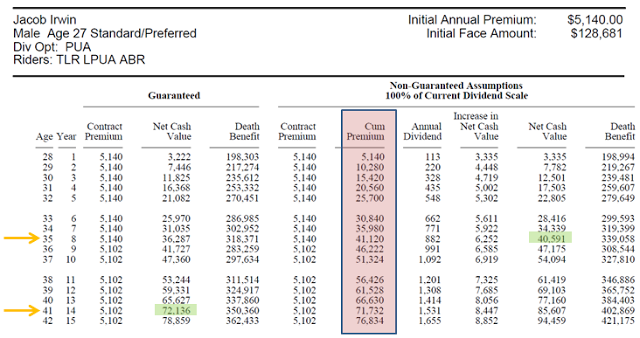
As you can see in the table above, if we assume the current 100% dividend rate of the company, it will take 8 years for me to break even (in other words, to have my current cash value accessible = amount of premiums I have paid in to the policy). If we exclude the non-guaranteed dividends, it takes even longer, at 14 years.
This is a significant phenomena to take in to consideration. Essentially, what it means is that in order to start earning the 4.5% long-term internal rate of return found in the studies shown above, we have to “wade through” 8-20 years of lower returns before we start averaging what the studies show.
In the policy illustration above, I manually calculated the guaranteed and non-guaranteed internal rates of return that you experience at various time points in owning the policy. Below is a summary of what I found (Please note that these are the cash value returns in a specific year only. The overall average return would be lower due to poor returns in the beginning years):
- In Year 2, you have a guaranteed return of -28.4% and a non-guaranteed return of -20.8%.
- In Year 5, you have a guaranteed return of -2.6% and a non-guaranteed return of 0.9%.
- In Year 10, you have a guaranteed return of 1.7% and a non-guaranteed return of 4.1%.
- In Year 20, you have a guaranteed return of 2.5% and a non-guaranteed return of 4.3%.
- In Year 30, you have a guaranteed return of 2.5% and a non-guaranteed return of 4.3%.
So, as you can see by these return calculations, the internal rate of return including dividends seems to be converging on the long-term reasonable assumption of 4.5% average return per year. Thus, I think that for once, the current whole life insurance illustrations are pretty conservative/accurate, and maybe even a little bit lower than what you might actually observe by living the policy long-term!
Mechanics of Infinite Banking – Policy Loans
While having your cash value accumulate at the respectable 4.5% after-tax internal rate of return mentioned above is good, the thing that makes the Infinite Banking Concept really work is being able to access the cash value tax-free, at any time, through policy loans. Thus, you want to make sure the whole life policy you’re looking in to does, in fact, offer policy loans!
Having made sure that the policy does in fact offer loan provisions, there are several other issues that need to be considered as well:
Policy Loan Issue # 1 – Direct vs. Non-Direct Recognition – Is There a Difference?
The first thing to look in to regarding policy loans is whether the life insurance company you’re dealing with does loans on a direct or non-direct recognition basis. Non-direct recognition companies continue to pay you a dividend even if you have taken out a loan on your policy, whether direct recognition companies do not pay a dividend on loaned money.
At first glance, it seems that if you’re doing Infinite Banking and taking policy loans, it’s a no-brainer that you’d want to use a non-direct recognition company (MassMutual, Lafayette Life are two examples of non-direct recognition outfits).
However, it actually turns out not to be so straight forward. As pointed out by this person who has both direct and non-direct whole life insurance, there is essentially zero difference mathematically between the two at the bottom line. It just differs in how they adjust the numbers. See explanation below for more details:
- With a direct recognition company, a policy loan does not decrease your death benefit, so the amount you receive in dividends as a percent of your ownership (death benefit) with the company, decreases.
- With a non-direct recognition company, a policy loan lowers your death benefit (ownership in the company), so the amount you’re paid in dividends as a percent of your ownership in the company stays the same.
Policy Loan Issue # 2 – Make Sure You Get a Policy With a Varying Loan Interest Rate
When I talked to a local Northwestern Mutual life insurance agent and had him run some policy illustrations for me, there were several things wrong with the structure that I later figured out on my own. First, the policy he had drawn up for me was designed to MEC out at Year 14, sooner than I would have liked, but never would have caught on to if I hadn’t of had another agent look at the policy design.
The second thing that was sub-optimal about the policy design was that it contained a fixed 8% loan provision, a fairly common thing for Northwestern Mutual policies. You can view where this fixed rate loan provision is stated in the policy illustration screenshot below:
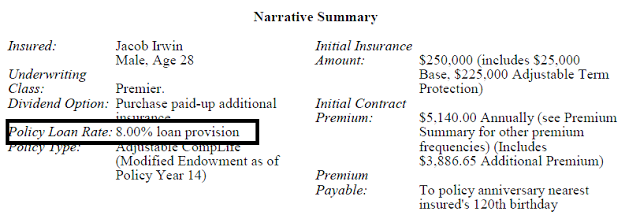
Of course, it’s easy to understand why having a fixed 8% loan rate (especially in today’s low interest economy) is not optimal. Sure, if interest rates increase to what they were in the 1980’s, you would be golden. However, since you’re only going to be earning 4.5% average return from your policy, you would be in quite the hole if you had to pay out a full 8% on the money you loaned out to execute the Infinite Banking Concept.
When I asked the agent about this potentially issue, he said that it was possible to have a variable loan rate with Northwestern Mutual, you just had to know to set it up that way.
So, in order to prevent this whole issue, make sure that the whole life insurance policy you are looking at contains a variable loan interest rate that goes up and down depending on what the current Fed Funds Rate is and correspondingly, what the insurance company is currently seeking in terms of required return.
Policy Loan Issue # 3 – A Policy Loan Is Not A Free Lunch
As mentioned above, taking out a policy loan using your cash surrender value is not without costs.
For example, if you have a whole life insurance policy with a non-direct recognition company, the money that you take out as a loan will still be earning a dividend/interest rate on it. However, you will also be charged a loan interest rate that you are responsible for paying (to the insurance company, not to your own policy) at some point in life or death. What this means is that you are essentially financially responsible for covering the spread, or the difference between the interest rate you’re charged and the interest rate you’re earning on the loaned money.
From my experience talking with several life insurance agents of non-direct recognition company, the spread seems to be fairly minimal (less than 1%). An agent from one company showed me a table that listed historical loan interest rate vs. cash value returns, and even though the spread seemed to fluctuate between positive or negative (so the difference between a loan making you money vs. costing you money), it seemed to generally be between 0.5-1%.
One eBook I read by an Infinite Banking practitioner mentioned that the spread that a policy holder generally must cover is between 0.5% – 0.67%.
Policy Loan Issue # 4 – Paying Yourself Back? Or Not?
One of the nice things about policy loans from whole life insurance is that you pretty much can define your own loan repayment terms. You either a) pay the loan back with interest as soon as possible or b) manage your loans in a way so that you never pay them back until you die. If you decide to do the later method, please note that when you die, your death benefit will be reduced by the outstanding loan balance + accrued interest.
However, it is definitely to your benefit to in fact pay back your policy loans + interest because it frees up more of your cash value to be used for future things/investments/expenses.
What Are Other People Recommending Regarding Infinite Banking? Is it A “Go” or “No-Go?”
By now, we’ve gone through the basics + the advanced mechanics of how the Infinite Banking Concept works.
As a next step, I now want to review the opinions of several people I talked to about whether or not this strategy is good to use:
- I talked to 1 Lafayette Life, 1 MassMutual, and 1 Northwestern Mutual life insurance agent, and they were all big fans of the idea, provided people could stick to the strategy and be comfortable with it. But, they all mentioned that it is not for everyone.
- I talked to one CPA who said that, “So far, every analysis I’ve encountered from sources I trust has shown it not to be worth pursuing. So, I haven’t done any additional research myself.”
- I talked to one personal finance blogger who does have a whole life insurance policy with Northwestern Insurance and is satisfied with it. He didn’t take out the policy specifically to do Infinite Banking though.
- I talked to one fee-only financial planner who said, “I’m not a fan at all of the Infinite Banking Concept. It’s glorified whole life insurance. I don’t like whole life in any of its shapes, forms, or variants unless you either a) have a special needs dependent and will need something close to permanent insurance to ensure a special needs trust is properly funded, or b) you’re going to have a net worth in excess of what gift tax exemptions currently allow for. The rest of the reasons cited by the whole life promoters are to line the pockets of the sales reps. If you can find someone who signs a legally binding fiduciary oath and sells whole life insurance, then you have found either a) the financial services equivalent of Sasquatch, or b) someone who is very, very ignorant about the risks he/she has just taken in signing that document.”
- I talked to another fee-only financial planner who said, “I’ve read a bit about it, but I have to say I’m skeptical. The whole concept I believe is based upon projections/illustrations that the policies will return. Most illustrations I see are rather ambitious which ruin the whole concept. I probably need to do more research to verify some of the specifics, but that’s my general take on it.
- I talked to two doctors who mentioned that they were using the Infinite Banking Concept because they wanted to further diversify their other investments, and since they had extra income that they wanted to invest after investing other places, it was a good fit. They also wanted a permanent death benefit for their children if they died.
Essentially, what I found from talking to these people can be summed up in one long sentence.
Unless I specifically need a permanent death benefit and/or am already maxing out essentially all of my other investment options (which I am not, but may be in the future when I’m making more money), the only people that are telling me that Infinite Banking is a good idea are the people who will directly receive money by me purchasing a policy.
This is a huge red flag for me personally.
Is the Infinite Banking Concept Right For You?
Clearly, the consensus from talking with others is that Infinite Banking is not something that would be worthwhile to look in to. However, in an effort to ultimately make a decision, I wanted to run my own analysis using 2 scenarios:
Scenario 1 – Saving money and having life insurance coverage using the Infinite Banking Concept with a whole life insurance policy.
Scenario 2 – Buying term life insurance for all my life insurance needs for the next 30 years and investing the difference between what the term life insurance costs vs. whole life premiums.
Analysis Assumptions – In order to simplify things to get started on an analysis, we need to lay out some things we’ll assume throughout.
- I do NOT need life insurance after I am around the age of 60.
- If you do need life insurance around this time, your best bet will be to have whole life since term life will be prohibitively expensive.
- I have $5,102 per year to either save or pay life insurance premiums.The time frame that will be analyzed is 30 years.
- I require $446,000 of life insurance coverage for the next 30 years to cover my family in the event that I die prematurely. This is the median death benefit shown on the policy illustrations drawn up for me between now and 30 years from now.
- The whole life insurance cash value accumulates at the rate of 4.5% per year discussed in the previous section.
- In Scenario 2, I will invest the difference in a vehicle with an approximately equivalent risk profile and tax treatment to whole life insurance (that is – very stable and tax advantaged).
- In this case, I will choose the Vanguard Short-Term Tax Exempt Bond Fund, which invests in federal tax-exempt municipal bonds with 1-2 year maturities.
- Since inception in 1977, it has averaged a before-tax return of 4.33% per year, which equates to a 4.05% after-tax return once a 6.5% state tax is subtracted out. In this time, it has been very stable, and according to the Simba back testing data, has not had a negative return during a 31 year period from 1985-2011.
- In Scenario 1, we will assume a level/constant cost of a 0.5% spread per year to access the whole life policy cash value through loans during retirement. We will also ignore the capitalization period for the first 7-11 years of the policy.
- In Scenario 2, we will obtain term life insurance quotes using State Farm’s life insurance quote system. For level-premium 30 year term coverage for $446,000, the annual preferred non-tobacco rate quote that popped up was $719 per year.
I assembled the table shown below to summarize the results of my analysis. You can also view the numerical results in spreadsheet form by clicking here.
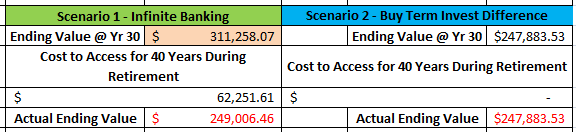
While this analysis is by no means perfect, I think it shows us in a good enough way how things would play out using Infinite Banking versus the alternative that I would choose in its place. Essentially, what we see is that because the whole life policy has a higher after-tax return, it actually results in a higher nominal ending value after the 30 year period analyzed.
However, since the cash value of a whole life policy is only accessible using policy loans (which carry a 0.5% spread cost that you must cover), it is quite costly to have access to that money during your retirement years. In effect, what we see is that you end up about the same with Scenario 1 and Scenario 2 after a very long run.
So, the question then becomes which would I choose? Clearly, why would I bother with all of the headaches of a whole life policy, potentially being done-over by a life insurance agent, the low/negative returns during the accumulation period, and all of the inflexibility that would go along with a whole life, when I can get about the same performance with something I firmly understand?
For me, it is clear that Infinite Banking is not right for me (and likely the vast majority of normal folks reading this) because…
- It doesn’t result in “stellar” performance that I cannot obtain on my own (as we saw above).
- It is difficult to understand, there are a lot of complexities that could easily mess the whole thing up, and gives me a headache trying to wrap my head around.
- I could not find anyone that is not being paid a life insurance commission that could convince me it was a good idea.
Who is a Good Fit for the Infinite Banking Concept?
Unlike others who have reviewed Infinite Banking and decided it wasn’t suited for themselves or indeed the vast majority of people, I do NOT think this strategy is the “devil walking the Earth.” In fact, there are some valuable things to learn from the strategy, and I think that the aim of it (having steady, reliable, tax-free access to cash) is well-intended.
More specifically, there are some really good instances where Infinite Banking would be nicely suited. I’ve listed a few of these below:
- People that do not have the discipline to “invest the difference”
- If you really have trouble saving money for retirement and are the type of person that needs some external encouragement, being required to send in a monthly/yearly premium to the life insurance company might not be the worst thing ever.
- People that really need a death benefit in retirement
- For most people, I think that having a death benefit in retirement is likely a nice thing to have, but probably not a requirement.
- However, if you are someone that really does need a death benefit during retirement since you have people that depend on you financially (and your savings cannot cover it), whole life insurance is really your best bet to obtain this.
- People that are pretty wealthy and are looking for another place to diversify, stash money, and avoid estate taxes.
- As I mentioned above, if I was to the point where I had so much money that I needed to find a place to put money tax-free, I wouldn’t be all that opposed to using whole life insurance.
- However, in this case, it really wouldn’t be Infinite Banking, but more just using whole life insurance…
How about you all? Have you ever heard of the Infinite Banking Concept?
What are your thoughts about it and whole life insurance in general as a savings vehicle?
Share your experiences by commenting below!
***Photo courtesy of https://www.flickr.com/photos/pictures-of-money/16678590844/sizes/l
Five Frugal Living Tips Everyone Can Follow

————————————————————————————————————————
Welcome to My Personal Finance Journey! If you are new here, please read the “About” or “First-Time Visitor” pages to find out more about us. If you would like to receive free updates on articles like this by email, then sign up here or you can subscribe to the RSS feed. Also, check us out on Twitter or Facebook. Thanks for visiting! Keep on learning!
————————————————————————————————————————
Click here to enter my free $50.53 giveaway for a chance to win 5% of My Personal Finance Journey blog income and give another 5% to a charity of your choosing! Deadline to enter is April 30th, 2013.
The following is a guest from Trudy Swann, a regular money saving blogger making the most of life’s frugal ways. Enjoy!
1. Swap the coffee shop for your own coffee/espresso maker
2. Make your own lunch
3. Swap the gym for the great outdoors
The majority of individuals that own gym passes and don’t use it is phenomenal.
Many purchase a yearly sports pass with all the right intentions in mind, however both work and home commitments make getting there more effort than it’s worth. Unfortunately, gyms are not cheap, and my monthly membership fee was proving to cause a huge dent in my salary. Working out shouldn’t solely be about the gym and there are plenty of other non-gym based activities available, most of which will easily fit into your current schedule. A lot of them are free too.
4. Grow your own vegetables
5. Swap the bus for the bike
How about you all? What are your favorite ways to save money each month? Do you use any of the things mentioned above?
Share your experiences by commenting below!
Jacob’s Thoughts – Listed below are my random thoughts as I was reading this article.
- With the exception of # 4 above (growing your own garden), I utilize all of the tips above quite effectively each month.
- I bike to work instead of driving a car and/or paying for a parking pass.
- I do not pay for a gym membership since it is included in my student activity fees as a graduate student.
- I bring and/or eat lunch at home almost every day of the work-week. The only time I don’t is once every couple of weeks when I go out to eat with a group of friends.
- Lastly, I make my own coffee at home so that I don’t have to buy it at the coffee shops on campus.
***Photo courtesy of http://farm2.staticflickr.com/1394/4605158343_a2c4873f90_o.jpg
Reader Profile – Jenny from Frugal Guru Guide

————————————————————————————————————————
Welcome to My Personal Finance Journey! If you are new here, please read the “About” or “First-Time Visitor” pages to find out more about us. If you would like to receive free updates on articles like this by email, then sign up here or you can subscribe to the RSS feed. Also, check us out on Twitter or Facebook. Thanks for visiting! Keep on learning!
————————————————————————————————————————
Click here to enter my free $50.53 giveaway for a chance to win 5% of My Personal Finance Journey blog income and give another 5% to a charity of your choosing! Deadline to enter is April 30th, 2013.
Today, in the ongoing Reader Profile Series, we’re getting to know MPFJ.com reader and enthusiastic commenter, Jenny, from the site, Frugal Guru Guide. Let’s all give Jenny a big round of applause for sharing her life with us and listen to her story. Enjoy!
Also, if you’re interested in sharing your own financial story/journey with us in a reader profile of your own, just shoot me a quick email, and we can get the ball rolling!
1. PLEASE TELL EVERYONE A LITTLE BIT ABOUT YOURSELF (BACKGROUND, EDUCATION, FAMILY SITUATION, ETC).
2. DESCRIBE YOUR CURRENT FINANCIAL SITUATION (WHO WORKS IN YOUR FAMILY, HOW YOUR INCOME IS, YOUR EXPENSES, ETC.).
3. WHAT ARE THE CURRENT FINANCIAL CHALLENGES YOU ARE FACING (SAVING, PAYING OFF DEBT, STUDENT LOANS, MERGING FINANCES AFTER RECENTLY BEING MARRIED, ETC.)?
4. WHAT ARE YOUR PLANS FOR THE FUTURE (RETIRE EARLY; BUILD YOUR CAREER, ETC.)?
5. WHAT’S YOUR BEST PIECE(S) OF FINANCIAL ADVICE AND/OR YOUR GENERAL PHILOSOPHY ON PERSONAL FINANCES?
Why Entertainment Is an Essential Part of Your Budget

————————————————————————————————————————
Welcome to My Personal Finance Journey! If you are new here, please read the “About” or “First-Time Visitor” pages to find out more about us. If you would like to receive free updates on articles like this by email, then sign up here or you can subscribe to the RSS feed. Also, check us out on Twitter or Facebook. Thanks for visiting! Keep on learning!
————————————————————————————————————————
Click here to enter my free $50.53 giveaway for a chance to win 5% of My Personal Finance Journey blog income and give another 5% to a charity of your choosing! Deadline to enter is April 30th, 2013.
The following post is by MPFJ staff writer Travis. Travis is a customer blogger for Care One Debt Relief Services, and also appears weekly at Enemy of Debt. Travis candidly shares his personal journey to pay off $109,000 of credit card debt and the tips he’s learned along the way. As a father and husband he provides a unique perspective on balancing debt, finances, and family.
I dropped 25 pounds in just six weeks, and was within 5 pounds of my goal weight. My results slowed significantly after that. I struggled through another two months of the program without losing another pound, and it wasn’t difficult to figure out why. The program had a very restrictive diet, and after a while I grew tired of selecting my meals from a very short list. I began eating things not on the list, and eventually gave up on the program.
How about you all? Where do you draw the line between aggressively saving / paying off debt and making sure you actually are enjoying life?
Share your experiences by commenting below!
***Photo courtesy of Stuart Miles / FreeDigitalPhotos.net
When is the Best Time for Couples to Combine Finances?

————————————————————————————————————————
Welcome to My Personal Finance Journey! If you are new here, please read the “About” or “First-Time Visitor” pages to find out more about us. If you would like to receive free updates on articles like this by email, then sign up here or you can subscribe to the RSS feed. Also, check us out on Twitter or Facebook. Thanks for visiting! Keep on learning!
————————————————————————————————————————
Click here to enter my free $50.53 giveaway for a chance to win 5% of My Personal Finance Journey blog income and give another 5% to a charity of your choosing! Deadline to enter is April 30th, 2013.
The following post is by MPFJ staff writer, Greg Johnson. Greg is a proud husband, father, and debt crusader who is in the process of becoming debt free. Along with his wife, Greg co-founded the personal finance blog, Club Thrifty, where they encourage readers to “Stop Spending. Start Living.”
The topic of love and money has been a hotly debated topic for years.
It seems like every blogger in the personal finance world has an opinion on it. For some reason, the topic triggers very vocal opinions from both bloggers and non-bloggers alike. Chase Card Services decided to stir the pot in January and came out with their “Chase Blueprint for Valentines Day Survey.” Among other things, the survey specifically asks if people should discuss finances on the first date and reports that only 21 percent of respondents said that they would help pay down their significant others debt – which I find kind of shocking. The results have set off a firestorm of response posts in the personal finance sphere and got me thinking about when couples should begin sharing their finances.
In the past, I’ve made no secret that I believe that married couples should be sharing their finances. I believe that talking about money and handling your money together is one of the keys to building a strong relationship. When couples decided to get married, they are agreeing to share their life together. They are no longer individuals, but a unit that acts as one – both emotionally and legally. They share their lives, children, and property, so it boggles my mind that couples would choose not to share their finances. In fact, from a strictly sanitized viewpoint, one of the biggest advantages to getting married is the ability to combine your incomes and accomplish things as a team that would be unreachable for each individual alone.
Money issues are the number one cause of divorce in North America. With the divorce rate in the United States near the 50% mark, it should be painfully clear that communication about handling money is a key element in the success of one’s marriage. One may argue that not sharing finances is a way to keep arguments about money to a minimum. I completely disagree. Sharing your finances forces couples to be on the same page when it comes to money. On the other hand, not talking about money is one way to breed resentment toward each other.
Look, I’m sure that there are marriages out there where the finances are kept separate and are working just fine. However, for the vast majority of couples, I think this is a way to get into some serious money and relationship troubles. By not sharing finances, you can avoid taking responsibility for your actions. You are not forced to hold yourself or your partner accountable for handling money in the proper way – which is where both money and relationship problems can begin.
Since the finances of each partner affect the family as a whole, I find it absolutely insane that married couples would not help their spouses pay off debt. Whether you do or whether you don’t, the money is all coming out of the family’s pot anyway. You’re just playing a shell game of shifting money from one place to the other, so why not just openly pay the debt off together – particularly if it is student loan debt? The income which that debt helps to generate is theoretically helping the entire family. Why shouldn’t the entire family help to pay it off? Be a team, help each other, and avoid the possibility of resentment from either side.
When Should Couples Combine Their Finances?
If we assume that sharing finances is the way to go, when is the best time to merge those finances together? Should couples begin sharing their finances before marriage? Should you help your future spouse pay off their debt before you take the plunge?
Honestly, I think there is quite a bit of gray area here. In an ideal world, nobody would have any debt and couples would not have to combine their finances until the day that they are married. However, I’m not sure that is realistic. While I wouldn’t advocate somebody paying off their significant other’s debt after dating for only a few months, if you have made a commitment to each other and are engaged to be married, you may want to think about starting to pay that debt off before you tie the knot. Once you marry a person, you marry their debt as well, so why not start helping them pay it off?
Of course, this would also depend upon the size of the debt your partner has accrued. You want to be very careful about giving others your money before you are married. Paying off $1,000 in credit card debt before the wedding is helpful. Paying off a $15,000 car may not be the best choice to make. Always remember that if you choose to help a significant other financially before you are married, essentially, you are giving them a gift. Should you break up, they probably are not going to be required to give you back the money. While helping them out is noble and may help you both in the long run, you could also lose a big chunk of money if anything happens to the relationship.
So, there you have it. What do you think about my take on couples and finances? Should married couples pay off each other’s debts? When do you think couples should combine their money?
Let me know in the comments below!
***Photo courtesy of http://www.flickr.com/photos/allyrose18/179537772/sizes/z/in/photostream/
Planning Ahead for Retirement Expenses

————————————————————————————————————————
Welcome to My Personal Finance Journey! If you are new here, please read the “About” or “First-Time Visitor” pages to find out more about us. If you would like to receive free updates on articles like this by email, then sign up here or you can subscribe to the RSS feed. Also, check us out on Twitter or Facebook. Thanks for visiting! Keep on learning!
————————————————————————————————————————
Click here to enter my free $50.53 giveaway for a chance to win 5% of My Personal Finance Journey blog income and give another 5% to a charity of your choosing! Deadline to enter is April 30th, 2013.
The following is a guest post. Enjoy!
There are some things that are never too early to think about, retirement being a good example. Retirement can be a difficult time if you don’t plan ahead. There is usually a lot to think about; in short, whatever age you’re at, there’s always something you can do to plan ahead or look into. Several things to think about specifically include understanding your budget, looking into retirement homes, and looking for any potential offers and benefits.
Pensions, Retirement Plans, and Budgets
Retirement homes
Offers and Benefits
How about you all? What steps are you taking at this point in your life to prepare for retirement?
Share your experiences by commenting below!
Jacob’s Thoughts – Listed below are my random thoughts as I was reading this article.
- Being fairly young (at the current age of 27 years old), I’m not yet to the point of thinking about the specifics of where I’ll live during retirement, etc.
- The main thing I’m focusing on right now is aggressively saving money in a three-legged stool mixture of tax-free, tax-deferred, and after-tax accounts to not only ensure I have enough money in retirement, but I will be able to draw on my savings in a tax-efficient manner.
***Photo courtesy of http://farm3.staticflickr.com/2551/4088699532_a154e1bfbf_o.jpg