

- You are here:
- Home »
- Blog

Why Stocks Are Your Best Inflation Hedge
 The following is a post by MPFJ staff writer, Kevin Mercadante, who is a professional personal finance blogger, and the owner of his own personal finance blog, OutOfYourRut.com. He has backgrounds in both accounting and the mortgage industry.
Any talk about the effects of inflation on investing will move into the realm of precious metals at some point in the discussion. And while precious metals do have a history of responding favorably to periods of high inflation, they tend to languish or even fall during times of low-inflation.
But, if we look at the long-term trend, stocks are your best inflation hedge.
Though that may seem counter-intuitive, there’s plenty of evidence to support the case for stocks as the best long-term inflation hedge.
Stocks Do Well In the Low Inflation Environment That’s More Typical
Over the past 100 years they have been a couple of periods that involved relatively high inflation. Those occurred in the early 1940’s (due to World War II), and the entire decade of the 1970’s. Apart from those two periods, inflation has been pretty tame for the other 85 years.
That’s not a small point, either. When we look at the effects of inflation, we have to consider it in terms of what it does to money that is invested over decades, and not just years. And in most of the low inflationary years, stocks outperformed precious metals.
The best example has been the performance of stocks since the early 1980’s. Inflation has been tame during the entire period, staying mainly below 5% and usually much lower. According to the Bureau of Labor Statistics Inflation Calculator general price levels have increased by about 250% since 1982. But during that time frame, stocks have risen from a low of Dow 800, to the current level of nearly 18,000. That’s an increase of more than 2,200%.
That performance has more than overcome the stagnation that stocks experienced between 1970 and 1982. If you were a young person saving and investing for retirement since and during the 1970’s and early 1980’s, you would have done much better on the inflation front investing in stocks than just about any other asset class.
Commodities Aren’t the Inflation Hedges That We Assume Them to Be
There’s no question that commodities performed very well during the 1970’s, certainly much better than stocks. But looking at the same time frame used above, gold averaged roughly $400 an ounce in 1982. It currently trades at about $1,200, which is to say that it’s 300% higher than it was in 1982.
Now to be sure, gold has acted as a true inflation hedge, increasing by 300% while general price levels increased by 250%. But it didn’t do much more than keep up. Compare gold’s 300% price increase with the 2,200% increase in stocks (as measured by the Dow), and decide which has been the better inflation hedge.
We have to remember that inflation isn’t marked just by the times when it is particularly high. When you’re investing for the long run, you have to account for inflation over the course of your lifetime. When viewed from that angle, stocks are the better inflation hedge.
Bonds Are a Guaranteed Money Loser to Inflation
Whether stocks or commodities are a better inflation hedge, one thing is certain: bonds are an inflation train wreck. Probably no investment security is more vulnerable to inflation than bonds.
Here’s why…
Bonds are priced at a specific amount, say $1,000. They also carry a fixed interest rate, say 3%. If inflation rises and causes bond rates to rise to 4%, the value of the bond will fall. The reason that it will fall is so that its price drops low enough that the yield on its market value will produce a 4% return to match market level returns.
If you bought a 30 year bond for $1,000 at 3% ($30 per year), and rates increased to 4%, the value of the bond would have to fall to $750 to support a 4% yield ($30 divided by $750 equals 4%).
Inflation is the primary factor driving higher interest rates. When inflation rises, so do interest rates – and that causes bond prices fall.
Translation: Bonds are not an inflation hedge. They’re more of a classic inflation victim.
Real Estate is a Good Inflation Hedge – But Stocks are Easier
Much like stocks, real estate can be an excellent inflation hedge. This is true not the least of which because it can be easily leveraged For example, if you can buy a property for $200,000 with a 20% down payment (plus a $160,000 mortgage), and the value of the house doubles to $400,000 in 20 years, you will get a 600% return on your investment.
You put $40,000 down on the property ($200,000 X 20%), and you’re equity grows from $40,000 to $240,000 (the $400,000 current value, less the original mortgage of $160,000). The calculation becomes even more impressive if you factor in the pay down on your mortgage.
So far so good. But real estate is not necessarily an easy investment, and that’s true whether it is an investment property or the home that you live in. You will pay real estate taxes, insurance, and utilities, as well as the costs to maintain, repair, and upgrade the property over those 20 years.
None of those complications exist with stocks. You invest your money with only very small costs (transaction fees and investment expenses), and because your investments are highly liquid, you can move in and out of them virtually any time that you want.
Real estate may be as effective as stocks as an inflation hedge over the long-term, but stocks are the easier solution. This is even more true when you consider that real estate goes through periods of illiquidity, when it is close to impossible to sell out at any price. That’s never true for stocks, or at least hasn’t been up to this point.
The Track Record of Stocks Speaks for Itself
When you look at the track record of stocks, it’s hard to argue against them on any level. The historic rate of return on stocks as measured by the S&P 500 is somewhere between 9.60% (geometric) and 11.53% (arithmetic) for the period from 1928 through 2014. Either is an impressive number, especially when you consider that it covers 86 years.
That time frame includes periods of growth, inflation, depression (deflation), wars and political crises. That’s the precise type of investment that you want to be in for the long-term, and certainly for retirement planning.
Different Stocks for Different Inflationary Environments
There’s one other aspect of stocks in regard to inflation that doesn’t get much coverage. Unlike most other investments, stocks are highly segmented. That means that the potential exists to hold stocks even during periods of high inflation, and still come out ahead.
You can do this by investing a larger percentage of your portfolio into sectors that specifically benefit from inflation. This can include stocks and funds that are invested in precious metals, energy, food, and other commodities. This kind of investment strategy can enable you to continue earning outsized returns even during a period of inflation that may not be beneficial to the stock market in general.
So in the event that high inflation returns, you don’t need to dump your stocks – you’ll just have to shift the allocations to take advantage of the new trend.
How about you all? What do you utilize in your investing portfolio for hedging your bets against inflation?
Share your experiences by commenting below!
***Photo courtesy of https://www.flickr.com/photos/101332430@N03/9681099086/in/

Are You Becoming Wealthy, What’s Next?

 The following is a post by MPFJ staff writer, Derek Sall. Derek is the owner of the blog, LifeAndMyFinances.com, where he teaches people how to get out of debt, save money, and become wealthy.
Today, it seems that everyone’s ambition is to go on expensive trips, acquire a bunch of stuff, and live in a huge house. After all, that’s what our friends and family are doing as well.
But, is this really the best way to live? Is this the way to wealth? If you ask me, I say certainly not!
The Road to True Wealth
For those that measure wealth with their stuff, they will likely have a bunch of toys, but will always be worried about paying all the bills when the end of the month comes. This should be obvious to you that this is not the road to true wealth.
So what does wealth really mean? It comes as a surprise to many, but wealth is not just measured in dollars, but is also measured in time and relationships. But, without first taking care of the dollars side, the two other areas of wealth can be difficult to attain. For example, I know of a few doctors that have million dollar houses and nice cars in the driveway, but in order to fund their lifestyle they must continue to work their butts off, day in and day out. By spending all of their time at work, they clearly aren’t enjoying a wealthy lifestyle of extra time. And, their relationships with their spouse, kids, and friends probably aren’t the best either.
So how can someone become truly wealthy, with money, time, and great relationships? Well, in order to have true wealth, it is often best to start by getting your finances in order.
Fixing Your Financials – 7 Steps
It’s pretty hard for me to hide, and you probably suspected this already, but I am a huge Dave Ramsey fan. On his site and in many of his books, he mentions seven steps to becoming getting out of debt and becoming rich, and I have not found any major holes in his teaching yet. In order to increase your cash flow situation, one should follow the below seven steps:
1) Set up a $1,000 Emergency Fund
2) Pay off all consumer debt with the snowball method
3) Save up a large emergency fund with 3-6 months of expenses
4) Put 15% of your income into investments
5) Save up for your children’s education
6) Pay off your mortgage
7) Become rich
I have personally gone through all seven steps of this plan and it flat out works to become rich! But, as we have discussed before, the financial aspect is only a portion of what it takes to be truly wealthy.
Building Relationships and Freeing Up Time
Money without time or friends is a pretty huge bummer and doesn’t qualify as a wealthy lifestyle in my book. Money should be earned in order to grow a more passive income – either with the stock market or with a side business. By forgoing an immediate possession or two (which will only hurt your net worth as it drops in value), your money can grow even more money, which will allow you to decrease your work without sacrificing a sizable income. With this mentality, time can be freed up, which will then add to your overall wealth.
The relationship side of the equation is a little more difficult because we are not all blessed with the gift of communication. And honestly, some of us think that a life in the woods away from people might be more fitting for us. But, we were not created to be hermits. Instead, we were meant to befriend and love others, to be selfless and give of ourselves. And somehow, this adds to our happiness and wealth in this world (I can’t explain it, but personal experience proves this to be true).
So what do you think the main ingredient of relationships is? You got it: giving. It may seem oxymoronic, but in order to be truly wealthy, we must learn how to give, both financially and physically. By giving of ourselves and our blessings, others may benefit and reciprocate that gift either back to you or to someone else. And, when you take your focus off of yourself for just one minute you can begin to understand how much you really have to be thankful for.
How about you all? What do you think about this equation for wealth? Do you agree with it?
Share your experiences by commenting below!
***Photo courtesy of https://www.flickr.com/photos/42931449@N07/5299199423/

What You Need To Know Before Switching Mobile Phone Carriers

 The following post is by MPFJ staff writer Travis. Travis is a customer blogger for Care One Debt Relief Services, and also appears weekly at Enemy of Debt. Travis candidly shares his personal journey to pay off $109,000 of credit card debt and the tips he’s learned along the way. As a father and husband he provides a unique perspective on balancing debt, finances, and family.
I could tell by the tone of their Facebook status that my friends were frustrated. They had used Sprint as their cell phone carrier for a couple of years, and frankly were not happy with the service they had received from them. When their contract was up, they went shopping for a new carrier. While Sprint did honor the request to unlock their phones, they found that leaving Sprint might not quite be as easy as they had thought.
Do You Speak My Language?
There are actually two different types of mobile phone networks used in the United States. Global Systems For Mobile Communication (GSM) networks are used by T-Mobile and AT&T, while Code Division Multiple Access (CDMA) network are used by Sprint and Verizon. Mobile phones manufactured for specific carriers identical at their core, but a special smart card is then added that enables the phone to talk to the type of network used by a specific carrier.
It is possible to use a GSM enabled phone with any carrier that uses a GSM based network. Similarly, it is possible to use a CDMA enabled phone with any carrier that uses a CDMA based network. However, since the two networks essentially speak different languages, you cannot take a GSM phone and use it with a CDMA network carrier.
For example, my friends were seriously contemplating switching to T-Mobile. Unfortunately, even though Sprint unlocked their phones, since their phones speak CDMA, they would not work on T-Mobile’s GSM based network.
There are a select few phone models that have the ability to talk to both network types. Some Blackberry phones, as well as the Apple iPhone 4s were dual mode phones. For phones that can cost over $500, it likely isn’t cost effective to put hardware into a phone that may never be used.
Carriers Want You To Think You NEED Their Phone
While it is possible to take a phone from one carrier, and use it with another carrier that uses the same type of network, that doesn’t mean they make it easy for you. I received a T-Mobile Galaxy S4 as part of a blogging promotion to try out Walmart Family Mobile, which runs on the T-Mobile GSM network. When the blogging opportunity was over, I wanted to take my new phone and use it with AT&T, with whom I was under contract at the time. I got the phone unlocked, and slid my SIM card into the phone. I was instantly able to make calls, but there were a few functions that didn’t work:
- No Data: I couldn’t access the internet at all through the AT&T network, which was disappointing since the Galaxy had the largest and nicest screen of any mobile phone I had ever owned. AT&T support was unable to help me, citing the standard line that they do not guarantee that a non AT&T phone would work on their network. Despite their unhelpfulness, I found that I simply had to reconfigure the phone to use AT&T’s data server.
- No MMS Messaging: I could receive normal text messages, but multi-media messages could not be sent or received. Another call to AT&T, and another claim that it was likely just a limitation of the phone since it was not made specifically for the AT&T network. This issue took a bit more searching, but buried deep in an Android forum I found network access point settings that finally made my phone fully functional.
What This Means To Consumers
Carriers obviously want to make it as unappealing as possible to leave them for another carrier. They used to force you to sign a contract. Once you signed it, you were theirs for two years unless you wanted to pay a hefty early termination fee. Now that the new rage is the no contract service, what power to carriers have over you to make you stay? Given the information I’ve provided, the answer is obvious; the price of a new phone.
Let’s revisit my friends that want to switch carriers, who really have two options:
- Move To Another CDMA network carrier: If they take this route, they could defer the cost of a new phone until they were ready and willing to spend the money. That assumes that their new carrier will aid them in getting their old phones running seamlessly with their new carrier. Which is a huge IF.
- Move to a GSM network carrier: This decision will render their current phones useless. To purchase new smart phones for each member of a family of four would be a hefty price tag. That’s certainly not a decision to take lightly.
After careful consideration, our friends decided to jump ship and sign on with a GSM carrier which required them to buy four new phones. For them it wasn’t entirely about cost as it was about service coverage and reputation of better customer service also played a huge role in their decision.
It’s easy to jump to a different mobile phone carrier because of a promotion,or because they can offer a better monthly plan for a lower price. However, the monthly plan price isn’t the only thing that requires consideration. The ability to use your existing phone with your new carrier, or the need to buy a new phone could be a major factor in whether switching carriers is worth it.
How about you readers? Did you know there were different, non-compatible mobile phone networks? Have you ever switched carriers for a cheaper plan only to find out you had to shell out your hard earned cash because you needed to buy a new phone?
Share your experiences by commenting below!
Is It Time to Take a Serious Look at Energy Stocks?

The following is a post by MPFJ staff writer, Kevin Mercadante, who is a professional personal finance blogger, and the owner of his own personal finance blog, OutOfYourRut.com. He has backgrounds in both accounting and the mortgage industry.
Oil prices have been collapsing since the middle of 2014. There have been front page stories, and widespread speculations, that the price is heading still lower. But in an ironic twist, that applies to oil in particular – and energy in general – the sector may be worthy of buying into. It really is time to take a serious look at energy stocks.
The Time to Buy is When the “Blood is Running in the Streets”
That saying has been credited to Baron Rothschild (of the Rothschild family financial dynasty), and it has been a mantra on Wall Street since he was first believed to have said it back in 1871. As gruesome as it sounds, it makes perfect sense. It’s a crude version of another popular investment saying, buy when everyone else is selling, and sell what everyone else is buying. Or more simply buy low, sell high.
Right now the energy sector has entered a low phase when the rest of the stock market has pushed forward into still higher record territory. There are few sectors in the market where a buying opportunity has become more obvious than is the case right now with energy.
After a gradual multi-year increase in the price of oil, the price has collapsed since June of last year. That has largely flushed the speculators out of the energy sector, leaving prices based on the fundamentals of the underlying companies. If you are a value investor, this is exactly the type of investments you’ll be looking for.
An industry-wide purge like what energy is now seeing presents a sector-wide buying opportunity that comes along no more than once in a decade.
Oil Has Always been Volatile
This is an excellent time to remember that the price of oil has always been volatile. This
Crude Oil Price History Chart proves the point. The trend lines on this chart look like the teeth of a very jagged saw. There are times of price spikes, followed by a steep declines, which are then followed by a more steady recovery in price, sometimes to new record highs.
The most recent spike pattern took place in 2008, which isn’t that long ago. In June of that year, the price of oil people up over $133 a barrel. But by December of the same year, it was down to $41. But then notice that by May of 2011 – less than 2.5 years later – the price of oil climbed back to over $110. From there it traded in a narrow range of between $88 and $106 a barrel until June of 2014. It has since fallen to the $50 range and even lower.
If we look at the historic performance of oil, it’s clear that it is currently trading near a major multi-year low. Yes, it can certainly continue falling from where it is right now. But the likelihood of some sort of significant price recovery – one of several years in duration – is much more likely.
The Industry has been Purged – There are Deals Everywhere
As measured by the Dow Jones Industrial Average, general stock prices are up roughly 5% since the middle of 2014. However, in looking at the performance of the Vanguard Energy Index Fund (VENAX), energy related investments are down about 20% in the same space of time.
The entire energy investment spectrum has been purged by the dramatic fall in oil prices. This has created investment opportunities of the sort that come along only about once in a decade.
With the rest of the market being richly priced, energy is one of the few major sectors that represents a buying opportunity in the current market environment. And since we know that oil prices will bounce back – sooner or later – it’s one step short of guaranteed play, at least for the long-term investor.
The World Still Can’t Live Without Oil
There’s always the possibility that oil prices could fall even more than they have so far. A deep global recession can depress the demand for oil, that will cause prices to continue falling. There’s also the possibility that one or more cash dependent oil producing nations could ramp up production in an attempt to gain greater market share.
But there’s also at least an equal possibility that political instability in one or more oil rich countries could take most or even all of that country’s production off-line. If that were to happen, the price of oil would spike immediately. And an improvement in the global economy would have a similar effect, though it would happen more slowly.
The bottom line is that the world still cannot live without oil. All of the technological changes that have occurred in the past 40 years have not altered that fact. Oil is a basic economic and industrial commodity and it’s here to stay. Anytime the price of a base commodity tanks, that’s a sign to begin looking for investment opportunities in that sector.
Energy May be An Excellent Diversification Against a General Market Decline
Commodities have often been viewed as a counter play on stocks. Though precious metals – gold in particular – get most of the attention in this area, energy is probably even more significant.
Commodities are seen as more valuable at times when paper assets are losing their value. That certainly would be the case in a general decline in the stock markets. Market disruptions cause money to move from one asset class to another. And in general, money tends to move into underperforming assets during such a decline.
Given that energy is an underperforming asset during an otherwise strong market, it could become part of a general flight to safety in a major market decline. That can make it an excellent diversification against a disruption in the stock market.
That doesn’t mean that it’s time to go headlong into energy-related investments. But this is clearly a time to begin investigating the possibilities in the sector. The speculation has largely been driven out of energy investments, providing a clearer picture of the strength of the underlying companies. It’s likely that there are some investment candidates out there that will give you continued bullish returns even when the overall market turns bearish.
How about you all? Do you currently invest in energy stocks/ETFs/mutual funds? Why or why not?
Share your experiences by commenting below!

Are the Low Costs of Oil Good or Bad for the United States?

The following is a post by MPFJ staff writer, Derek Sall. Derek is the owner of the blog, LifeAndMyFinances.com, where he teaches people how to get out of debt, save money, and become wealthy.
The price of oil has made a recent comeback from its historic lows, but oil is still far cheaper than what it used to be just a year ago. The stock analysts certainly think it’s a big deal, as we hear about the rise and fall of oil on a daily basis, but what is the true effect on the price of oil? Should we be rooting for a continued low price or a high one? Which one is best for our long-term success?
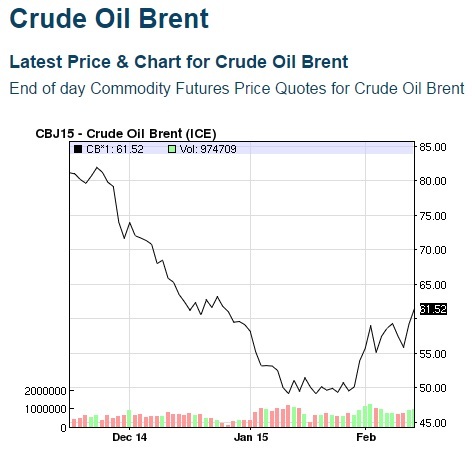
Source: Nasdaq.com
The Low Cost of Oil For the Consumer
To be completely honest, I have been loving the money savings at the pump each time I roll up. Gas was not really that big of an issue for me before, since I drive a gas-sipping Honda Civic and my drive to work is only about 8 miles, but filling my tank for less than $20 has made me exceptionally happy during these fall and winter months of 2014.
I dare say that you have had the same experience as well. According to the experts, the average American citizen has saved over $1,800 at the pump last year, which is like putting that cash money directly into your pocket. Now THAT’s a nice chunk of change! It is pretty safe to say that this decrease in the price of oil has been an excellent benefit for the consumers.
The Low Cost of Oil for the United States
What is good for the consumer is not necessarily good for the United States as a whole. First of all, the United States is the largest producer of oil in the world (seems strange right? But totally true!), so the decrease in oil prices are hindering the domestic oil production companies. Beyond this though, stems an even larger problem for the United States that many are not yet seeing.
While I don’t want to get too technical in this post, I want to help you understand the long-term impacts of this extreme drop in oil prices. We have already established that the falling oil prices has negatively impacted the United States’ oil companies, and it has definitely hurt some, but this one shift is not really harming the overall Gross Domestic Product of the United States. However, it is impacting many other countries that depend heavily on the production of oil. This includes the mid-eastern countries and also our friendly neighbor, Canada.
So what does this have to do with the U.S.? Foreign exchange rates. Yeah, I know, nobody wants to talk about FX rates, so I’ll make it quick. Because so many countries have depended on the price of oil to carry their economies, their currencies has fallen with the reducing oil prices, but the U.S. currency has not, making our dollar much stronger than almost every other country out there. This stronger dollar is great if you want to take a vacation to a foreign country because you can buy more stuff, but what will this do to our nation’s exports? It’s going to halt them completely, because who wants to buy expensive American goods? Nobody.
The future U.S. economy is going to be a struggle with a reduced demand for our exports. From this, many foreign companies selling into the U.S. will likely thrive, but sales from the U.S. to outer countries are likely to suffer.
How about you all? What are your investment plans in 2015 and 2016? Does this analysis impact your thoughts?
Share your experiences by commenting below!
Who Can Invest in Hedge Funds and Hedge Fund-Like Alternatives?

For the beginner investor, hedge funds can be very intimidating. Hedge funds are basically a lump sum of money from many investors that gets invested into securities or other investments in hopes of getting positive returns. The hedge fund can also be described as a “private partnership” between different individual investors that is managed by an individual person (i.e. a money manager). Hedge funds are set up this way so that in the event the company in which the investments lie goes bankrupt, collectors can’t go after the individual investors for money.
Who can invest in hedge funds?
Investing in hedge funds is no simple task. It is certainly something that requires a lot of prior research before jumping in head first.
In general, there are a few different ways you can invest in hedge funds, many of which are going to require that you have a lot of assets or a large income in order to invest.
The Accredited Investor
First, most of the time, if you want to invest in hedge funds you need to become an accredited investor. According to the U.S. Securities and Exchange Commission, an accredited investor is one who:
- …“earned income that exceeded $200,000 (or $300,000 together with a spouse) in each of the two prior years, and reasonably expects the same for the current year” …OR…
- …”has a net worth over $1 million, either alone or together with a spouse (excluding the value of the person’s primary residence)”.
In addition to individuals that met these criteria, other entities that can become accredited investors are banks, partnerships, corporations, nonprofits, and trusts. In order for any of these entities to be considered accredited investors, they must fulfill these criteria:
- …”any trust, with total assets in excess of $5 million, not formed to specifically purchase the subject securities, whose purchase is directed by a sophisticated person”….OR…
- …”any entity in which all the equity owners are accredited investors”.
Note: A “sophisticated person” is basically someone that is highly knowledgeable about investing and about the company in which the investors are putting their hedge funds.
Aside from becoming an accredited investor, you still might not be able to get your hands dirty with hedge fund investing. For example, hedge fund partners can allow whoever they want into their “circle”, so even if you’re an accredited investor, they can easily say “no”.
Also, even if you meet the requirements to become an accredited investor, you still might not meet the minimum requirements for specific hedge funds themselves. Some require a $100,000 minimum, which if you become an accredited investor you obviously fulfill, but some hedge funds require upwards of a $25 million minimum investment, so if that’s the hedge fund you want, you won’t be able to invest if you don’t have those kinds of funds.
Hedge Funds For The Not-So-Super-Rich
For the longest time, hedge funds were only available to those with significant funds or assets as described above. However, in the more recent past, other opportunities to invest in hedge fund-like programs have become available for people who may not have the significant cash flow as tradition requires.
Now, these opportunities are not true hedge funds by SEC definition, however, for those people wishing to invest in hedge funds but simply can’t since they don’t qualify to become accredited investors, these similar programs may be a good way to increase their net worth so that one day they may qualify.
Alternative Mutual Funds
Dubbed “Hedge Fund Lite” by the Wall Street Journal and many others, these alternative mutual funds are probably as good as it gets for those people wanting to invest in hedge funds but can’t due to lack of funds. Similar to hedge fund strategies, these alternative mutual funds use long/short investing strategies. They allow you to invest in individual stocks that are “going up” and profit from individual stocks that are “going down”.
While these “hedge fund lite” programs don’t require the high performance fees that hedge funds do, they do require annual management fees that can reach upwards of 4% of your assets.
Replicating Returns
Sometimes called “liquid beta” or “replication funds”, replicating returns programs are another way for individuals to invest in a similar manner as hedge funds without requiring the massive income as assets as required for accredited investors.
These “liquid beta” fund programs try to follow a similar path as hedge fund benchmarks by “’backtest[ing]’ their portfolios of stocks, bonds, currencies, and other assets…until they approximately copy the trailing returns of the average hedge fund as tracked by research firms” (Source: WSJ).
Copycat Investing
Copycat investing is basically a way for non-hedge fund investors to act like hedge fund investors. With copycat investing, you in essence are shadowing the investing behavior of real hedge fund investors and trying to move investments the way you see them moving their investments. One issue here becomes is that once you get the information regarding what the real hedge fund investors did, it may be too late for you to perform the same action, thus potentially putting your assets in jeopardy of going bye-bye.
Conclusions
Unless you meet the requirement of becoming an accredited investor, which means you have to have a very large income and assets, you can’t truly invest in hedge funds. However, there are some similar types of investment strategies like the ones briefly described above, that can allow people without significant sums of money to invest in similar hedge fund-like manners.

Control Your Food Spending with These Tips

 This following is a post by MPFJ staff writer, Jeff. Jeff writes about sustainable living and finances at his website, Sustainable Life Blog. Jeff really enjoys traveling with his wife as much as he can, to wherever he can.
For the longest time, my wife and I couldn’t get our food spending under control. While our food spending seemed to go up and down at times, it was always higher than we’d like. We were never as bad as one blogger who used to spend $600 per month on fast food but we still seemed to spend quite a bit.
The worst part about our food spending is that when our fast food spending would go up, our grocery budget would stay the same – we expected it to go down as we were eating less at home, but it wouldn’t budge. We’d end up spending more money on fast food when we were over-scheduled or too busy, but that’s not a great excuse to spend $200-300 per month – I’d much rather have the money. We had to find a strategy to lower our spending and eventually settled in on a few good ideas that have helped us.
First, we figured out when we were hitting up the local fast food joints – it was mainly non-breakfast meals on the weekend (both days), and weeknights when we didn’t have a meal planned or some protein needed to be defrosted and was not or something like that. Once we identified when we were doing all this extra spending, we were working towards figuring out why were doing all that extra spending – it was simple. We didn’t plan and we didn’t make time to cook.
Get a Crock Pot
Our first step was to start taking the time to prep a few meals ahead. We noticed we were always busy (though self imposed, and we’ve been working on that too). We’ve gotten into a great routine on Sundays where we get both of our crock pots going. One crock pot has a meal for dinner that day (something like a soup) and let that cook all day. Usually if we get it in early enough we can eat it for lunch, but that doesn’t always happen. Since we have 2 crock pots, the other one gets filled with another recipe that I let cook all day and portion it out at the end of the night for lunches for the week.
Whatever is leftover from crock pot 1 also gets portioned out individually for lunches for the week. So with relatively little effort, We have 10+ servings of food for lunches for the week, as well as dinner (and sometimes lunch). This is a great and easy way to save some money and avoid eating out.
Here’s a few simple recipes for the crock pot – Barbacoa & Pulled Pork.
Set a Budget
The most important thing that we did to reduce our spending on fast food and dining out was to go all cash. My wife and I have been using credit cards for all spending (and paying them off every month, of course) but we switched to cash for this category. We set a monthly limit of $50, and at the beginning of the month I go to the ATM and get that amount of cash from our checking account and we set it on the counter. We both decide on when we will use it, and it has worked really well for us so far. We even seem to have more money left over at the end of the month from our $50! We were spending well over $150 before, and now we’ve got leftovers off of $50! So crazy!
If you aren’t sure what amount to budget, look at where you’ve been spending and set something lower than that. It needs to be low enough to make a difference and hurt a bit. Keep cash and stick to your budget and reap the savings.
Plan Your Meals
Our third breakdown was when we didn’t have a plan for what we were going to do for dinner, so we would just default to running out and picking something up quick. That’s not the cheapest option or the healthiest, so we were really working to cut that out. We’ve started planning our meals bi-weekly and have been going to the grocery store once per week to keep up on food. The planning really makes it easy as we go home and don’t have the “what’s for dinner” conversation.
How about you all? Do you plan your meals or budget your dining out expenses? Or what other tricks do you have to keep dining out spending low?
Share your experiences by commenting below!
***Photo courtesy: https://www.flickr.com/photos/59937401@N07/5930043516/

8 Ways to Get a Free College Education Even If Obama’s Free Community College Proposal Fails

 The following post is by MPFJ staff writer, Melissa Batai. Melissa is a freelance writer who covers topics ranging from personal finance to business to organics to food. She blogs at Mom’s Plans where she shares her family’s journey to healthier living and paying down debt.
If you’ve been to college, you know how expensive it can be. I graduated from college 20 years ago, and even with a scholarship that paid all of my tuition and fees at a community college for two years AND generous grants when I transferred to a four year institution, I still, after graduate school, left college with $20,000 in student loan debt. It took me 13 years to pay off that debt.
Now, college is even more expensive, and, unfortunately, out of reach for many perspective college students. In his recent State of the Union address, President Obama said that he wants every student to have access to a free, two year community college education providing that they maintain at least a 2.5 GPA and take at least a half-time load of classes.
Most experts don’t think this will happen.
Even if it doesn’t, there are still ways that you can get your education for free or at a greatly discounted price. Keep in mind, not all of these tips are simple, but they all do help you reach the end goal of a low-cost education.
Take advantage of a “Promise” opportunity
Many locations are now offering free college tuition. For instance, the Kalamazoo Promise offers all Kalamazoo, Michigan school graduates who reside in the district of Kalamazoo County a free college education at a Michigan college or university. The student must have graduated from a Kalamazoo district high school and must maintain at least a 2.0 GPA in college. The amount of tuition received is prorated based on the number of years a student attended a Kalamazoo public school. (If the student only attended a Kalamazoo high school, he’ll receive 65% of his tuition paid. If he attended K-12, he’ll receive 100% free tuition.)
However, Kalamazoo isn’t the only place offering this type of promise. All El Dorado High School students in Arkansas are offered tuition in a program very similar to Kalamazoo’s. In addition, there is the Pittsburgh Promise. (CollegeSavings.com).
Sometimes an entire state offers free tuition including West Virginia and Tennessee. What’s interesting about Tennessee’s Promise is that homeschool students are also eligible.
Become a resident of the state first
If you have your heart set on attending an out-of-state college, there are ways to overcome the high cost of out-of-state tuition. If you’re willing to delay starting college, you can move to the state after high school and get a job. Most states require that you live and work in the state for a year before being considered a resident for college application purposes. After you’ve met the year requirement, apply for college. If you’re accepted, you will only pay in-state tuition.
Work at the college you want to attend first
Another option is to work at the school that you want to attend. Many colleges offer tuition discounts to employees. If you work full-time at the college or university, you may be able to get your tuition for free.
Of course, you’ll still be working full-time while getting your degree, so you likely won’t finish in four year. You may take as many as eight years to complete your degree, yet when you have it, you will likely be debt free.
Another option is to have a parent work at the university or college so that she can get free tuition for her dependents. My husband is currently employed at a university, and our plan is for our children to attend the university that he works at so they can get their tuition for free. Of course, our kids can decide to attend a different university, but we won’t be able to help them much financially.
Take advantage of employer-based tuition programs
Another option is to work for an employer that will help pay for your college education. For instance, if you’re an elementary school teacher with a bachelor’s degree, your employer likely will help you pay for a master’s degree. There are also many employers who will help their employees pay for a bachelor’s degree.
Consider an honors scholarship to a community college
There are many, many community colleges that offer honors scholarships. I, myself, received one when I attended a community college. I had to have an interview, write an essay, complete an application, and submit my transcript and ACT/SAT scores. I was awarded free tuition for two years, which helped me financially. I hate to think how much more I would have had in student loans if I hadn’t been accepted to this program.
Being in the program gave me the opportunity to take smaller honors classes with a lower student-to-teacher ratio. In addition, the program, along with my GPA at the community college, helped me transfer to a top university in my state.
Apply for scholarships
You may think it’s not worthwhile applying for scholarships because you don’t have a 4.0 or higher GPA. However, there are many scholarships available, and not all of them are based on grades alone.
You may be surprised how quickly the scholarships can add up, even if they are only for small amounts. “One mother forced her daughter to apply for two scholarships every day as if it were her job. She didn’t have great grades, but kept sending applications in—winning enough to pay for the first three years of college alone” (America’s Money Smart Family).
Attend a free college
Yep, you read that right. There are free colleges out there. Some of them include:
- College of the Ozarks,
- Berea College,
- Curtis Institute of Music,
- Alice Lloyd College,
- Webb Institute,
- Deep Springs College,
- United States Military Academy,
- United States Coast Guard Academy,
- United States Naval Academy,
- United States Air Force Academy,
- United States Merchant Marine Academy (US News).
As you may guess, admission to these colleges is highly competitive.
In addition, the old adage “Nothing in life is free” does apply to these schools. For many of the colleges, students are required to work on campus 10 to 15 hours a week. In addition, there are sometimes residency restrictions. For instance, Alice Lloyd College only offers free tuition to students who live in the Central Appalachian service area.
Finally, those who get a free ride to the United States military academies must also serve in the military after graduation.
Join the military
If you are interested in the military but can’t get into one of the elite military academies, you can choose to join the military and, as a perk, benefit from tuition discounts or even free tuition. How much you receive and when depends on many factors.
Another option is to join the military after you complete college. The Army, Navy, and Air Force all have plans to help you pay off your loans. For instance, “in the full-time-duty Army, soldiers can qualify to have their loans repaid by the Military at the rate of one-third of the loan for each year of full-time duty served (maximum loan repayment is $65,000)” (Today’s Military).
Even though, in 2012, 7 out of 10 students graduated with loan debt averaging $29,400 (The Institute for College Access and Success), it doesn’t have to be this way. If you’re willing to compromise on your college choice and take a non-traditional path to college, you CAN graduate without college debt, regardless of the passage of Obama’s free community college tuition.
How about you all? How do you plan to, or how did you, keep your own college costs low?
Share your experiences by commenting below!
***Photo courtesy of http://pixabay.com/en/dartmouth-college-campus-school-292587/

Traveling By Train: An Alternative to Expensive Air Travel

 This following is a post by MPFJ staff writer, Jeff. Jeff writes about sustainable living and finances at his website, Sustainable Life Blog. Jeff really enjoys traveling with his wife as much as he can, to wherever he can.
While I was traveling to visit family over Christmas, my family and I were able to experience something that we’ve never been able to do before: take a train to get to our destination. My wife’s sister lives in western New York State, and we were headed out to stay with the family in the Finger Lakes region. Unfortunately, all of the flights to nearby airports were about $450 per PERSON, round trip and much more than I was willing to pay.
After talking with my wife, we decided to take a flight for $200 (going into NYC and out of Buffalo), save ourselves a ton of money and then take Amtrak from NYC to the Finger Lakes. I’d never been on a train before and was quite excited. We ended up being rather late due to track sharing & a disabled train headed the other direction that we had to pick up, but I was still impressed and left wanting more.
Travel By Train
I’ve always wanted to take the train, and when I look at the prices it makes me want to even more. At first though, I was wondering how people were able to take so much time off to take the train from point A to point B (a few days) and then spend time enjoying point B before returning home (on an airplane). The train seemed like so much fun and would be a great trip, and I mentioned that to a friend of mine who’s a huge travel guy. He said they were fun and worthwhile, but that I was thinking about them all wrong. Make the train THE trip, instead of making it a mode of transportation to where you want to go.
So for example, instead of taking the train to Chicago to see Chicago, I should take the train to see what is between here and Chicago.
Even though the train is slower, I found the travel to be much more comfortable than most of my recent plane flights. The seats are comfortable and wide, and something that I didn’t mind sitting in for 8 hours. There are enough electrical outlets on the train, as well as WiFi, so you can be productive while you ride as well. You’re able to move, and you can go get food from the cafe car on the train after it opens. It’s a much more comfortable experience than air travel, and I look forward to getting to take the train over a longer trip (2-3 days).
Cost
One nice thing about traveling by train is that it’s often fairly cheap. The ticket may seem a bit more expensive than it is to fly, but keep in mind that you’re also using this as sleeping quarters for 2-3 days as well, meaning you wont have to pay for a hotel or other place to stay while there.
The sleeper rooms, while not huge, look good enough, and they have huge windows that you’ll be able to look out of. I hear that the Amtrak Empire Builder serves up a pretty nice ride as it goes from Chicago through Minnesota, Wisconsin, North Dakota, Montana (including Glacier National Park), Idaho, and then to a final destination of Portland (OR) or Seattle (WA).
Final Thoughts
While it’s probably not the first idea you had in mind for a family vacation, I’d strongly encourage you to look at the train routes as a vacation idea next time you’re planning. You’ll have the opportunity to see some amazing parts of the country that are typically considered “flyover” and most people don’t get the chance to see. While it wont be the fastest way from point A to point B, its a good value and will provide you and your family with lasting memories for years to come.
How about you all? Do you have any plans to travel by train anywhere? Have you done it before? If so, what do you enjoy about it?
Share your experiences by commenting below!
***Photo courtesy http://www.flickr.com/photos/springfieldhomer/12580852/

An Investors’ Guide To Investing In Peer-To-Peer Loans

 The following is a post by MPFJ staff writer, Toi Williams, who is a professional personal finance blogger of Fine Tuned Finances. She has backgrounds in personal finance, sales, and real estate.
Many investors are being drawn to investing in peer-to-peer loans as a passive investing method that provides higher than average returns. For conservative investors, the least risky notes on the lending platforms offer substantially better returns than bank certificates for slightly higher risk. For investors that are comfortable taking on more risk, the platforms also include notes with correspondingly higher risk profiles.
Peer to peer loan platforms categorize their loans into different investment grades based on the amount of risk inherent in the loan. Each peer-to-peer loan platform has a minimum credit score requirement for borrowers to reduce the risks of investing in loans on the platform. Loans requested by people with high credit scores receive higher investment grades than loans requested by people with average credit scores.
For many investors, the best thing about investing in peer-to-peer loans is how easy it is. In many cases, the minimum investment amount for a single peer-to-peer loan is around $25. Some investors use services that use proprietary algorithms to pick their notes for them. Others choose to use the reinvestment programs of the lending platform to reinvest their returns from the platform.
It is important for potential investors to remember that they will be holding on to their investments for a period of three to five years. Once money has been invested in a loan, the investor must keep the investment until the end of the term. The notes that the investors are investing in are unsecured, so if a borrower defaults on the loan, the investor could be out of a considerable amount of money. Many investors mitigate this risk by diversifying their holdings by investing small amounts into a large number of loans.
These peer-to-peer lending platforms are considered to be the best ones for investors due to their vigorous underwriting processes and returns for investors.
Lending Club
Lending Club is currently the largest of the P2P platforms, arranging about 56,600 loans totaling $791 million in the first quarter of 2014. Lending Club loans range from $1,000-$35,000 with the average loan amount reaching $13,913. The platform has some of the most stringent underwriting standards in the industry, with over 80 percent of applicants rejected for not meeting the criteria. To be approved, the applicant must have a FICO score higher than 660 and a debt-to-income ratio of not more than 30 percent.
Applicants that are approved are grouped into seven loan grades assigned a letter from A through G and further categorized into five sub-grades numbered 1 through 5 based on an assessment of their credit history. Applicants graded A1 get the lowest interest rates, currently 6.78 percent APR for 36-month notes and 7.3 percent for 60-month notes. G5 rated borrowers pay the highest interest rates, currently 29.99 percent APR for 36-month notes and 28.69 percent APR for 60-month notes.
Investors can also invest in Lending Club through private investment funds. There are two funds that are proving to be very popular for investing in Lending Club – the Conservative Consumer Credit Fund and the Broad Based Consumer Credit Fund. The Conservative Consumer Credit Fund has a minimum investment of $500,000 and invests in only the two least risky grade notes on the platform. Returns for the fund have averaged a 5.69 percent trailing 12-month net fund return. The Broad Based Consumer Credit Fund also has a minimum investment of $500,000, but it invests in all loan grades. The fund has invested in more than 16,000 36-month and 60-month consumers loans and returns for the fund have averaged a 9.36 percent trailing 12-month net fund return.
Prosper Marketplace
Launched in February 2006, Prosper was the first peer-to-peer lending company operating in the United States. Prosper is allowed to offer loans in 47 of the 50 states and in Washington, D.C. Investors must invest in a minimum of $25 per note, but any investment amount of at least $25 is allowed. Prosper has a Quick Invest feature that allows investors to choose the loan grade or other filtering criteria and invest with just four clicks.
Prosper offers loan terms ranging from 12 months to 60 months and allows borrowers with credit scores as low as 600 to use their platform. Prosper charges even higher rates than Lending Club for borrowers with lower credit scores, with interest rates ranging from a low of 5.65 percent up to a maximum of 31.99 percent. The average interest rate for loans on the site is 19.2 percent.
Peerform
Founded in 2010, Peerform is a newer peer-to-peer lending platform. Investors can invest in whole loans or fractional loans on the platform. Peerform offers personal loans with 3-year terms ranging from $1,000 to $25,000. Borrowers must have a minimum credit score of 600 and a debt-to-income ratio below 40 percent. They also cannot have any current delinquencies or judgments on their credit history.
Borrowers are sorted into 16 risk grades ranging from AAA to DDD. AAA graded borrowers have credit scores of 720 or above when they apply for their loan through Peerform. AAA graded borrowers are offered interest rates of about 6.4 percent while DDD graded borrowers pay an interest rate of about 24.2 percent.
Additional Resources For Investors
- Interest Radar – www.interestradar.com – Analytical tools for peer-to-peer loan investors
- Lend Academy Investments – www.lendacademy.com – Introduction to investing in peer-to-peer loans by Peter Renton
- LendingRobot – www.lendingrobot.com – Automated investment tool for peer-to-peer loan investors
- Nickel Steamroller – www.nickelsteamroller.com – Risk management tools for peer-to-peer loan investors
How about you all? Do you have any experiences with peer-to-peer loans? Do you have any resources not listed above that have worked well for you in the past?
Share your experiences by commenting below!
**Photo courtesy http://pixabay.com/en/executive-businesswoman-world-510513/