

- You are here:
- Home »
- Blog

3 Keys to Live a Minimalist Lifestyle
 The following is a post by MPFJ staff writer, Derek Sall. Derek is the owner of the blog, LifeAndMyFinances.com, where he teaches people how to get out of debt, save money, and become wealthy.
We hear the term thrown around all the time, but what is minimalism anyway? According to the gentlemen over at theminimalist.com,
“Minimalism is a tool used to rid yourself of life’s excess in favor of focusing on what’s important so you can find happiness, fulfillment, and freedom.”
There are no defined rules of minimalism. There’s no one that says you can’t own a house or a car and still be a minimalist. Minimalism is different for each person. Some people choose to own less than 100 items, and others own a house in the suburbs and drive a car, and there are (of course) many people mixed everywhere in between.
To be a minimalist, you just need to unbind yourself from the stuff in this world. For those minimalists that own homes, their house does not define who they are and they certainly aren’t struggling from month to month to make the payments. They live far below their means each month so that they can be free from life’s daily struggles. They choose to live on far less than they earn so that they have options to do whatever it is that they please. By getting rid of the excess, they find out what is truly important to them.
The Keys to Live a Minimalist Lifestyle
Minimalism isn’t for everyone. If you like the way your neighbors look at you when you drive past in your new luxury car, then you’re probably not ready to live a minimalist lifestyle. If, however, you question yourself monthly (you know, when all those bills come due) and wonder why you keep torturing yourself with all of those payments, then it’s probably time to start considering a pseudo-minimalist lifestyle.
So if minimalism intrigues you, where should you start? That’s easy – start with the stuff that pains you the most – those big ticket items.
1) Downsize Your House
There are so many people out there that are house poor. They have this huge mansion of a house, which looks awesome, but it comes with such a large monthly payment that it cripples them financially, and they can’t ever have any fun because they are stuck making that stupid payment each month.
This is certainly not the way to live. If you are discontent with the mortgage payment on your home, then why not consider downsizing? Or maybe you could even rent a small apartment above someone’s garage. Think about it. What kind of freedom would you have if you cut your house payment in half? What if you got rid of it entirely? By downsizing your home, you could probably save yourself a thousand dollars a month. Wouldn’t that be such a freeing feeling?
2) Downgrade Your Car
The second largest expense for most people is their car. It often comes with a monthly payment, high insurance costs, maintenance costs, and fuel costs. It’s not uncommon for a person to spend nearly $10,000 per year on their vehicle alone.
What if you went from owning a $20,000 car with payments to a $5,000 that you paid for with cash? Your monthly payments would be gone, your insurance would go down, and your maintenance costs and fuel costs will likely remain the same. By downgrading your ride, you could save yourself around $5,000 per year.
3) Buy Quality Food for Less
People waste so much money on food. Instead of frying up an egg themselves for $0.10, they go to a restaurant and pay $3.00. Or, for the so-called “wise” consumer, they’ll go the grocery store for their eggs instead. But, instead of going to the discount grocery store where eggs are $1.29 a dozen, they’ll go to the nearby grocer where they’re selling for $1.79. Why? Because they feel too sophisticated to shop at a discount grocery store. In my option, that’s just downright stupid.
If you want to save big money on food, avoid restaurants and shop at discount grocery stores like Aldi or Save-A-Lot. The food is good, the prices are cheap, and you’ll save a bunch of time as well (I’m often in and out in less than 10 minutes). Instead of spending $1,000 on food each month, you could just follow this simple advice and cut that bill in half, saving you $6,000 per year. That’s huge!
Final Key Points to Live a Minimalist Lifestyle
To save even more money, do your best to combine all three of these points. If you decide to downsize or move into an apartment, pay careful attention to where it’s located. To save the maximum amount of money, you should find a place that’s within three miles from work and three miles from the nearest discount grocery store. This will allow you to do without your car much of the time, and maybe even allow you to get rid of it entirely! This simple move will save you money in gas, insurance, and also means that your car doesn’t even have to be very expensive since you could bike or walk everywhere anyway!
How about you all? Are you ready to live a minimalist lifestyle? What will you reduce in your life?
Share your experiences by commenting below!
***Photo courtesy https://www.flickr.com/photos/mes_regards/12167414035/
Review: Cinch Financial Free Financial Product/Account Locator and Savings Tool

Recently, I had the opportunity to be exposed to a new (well, new for me anyhow!) free financial website/tool called Cinch Financial. As such, today, I wanted to share a little about some of the features it offers, as well as my opinion on its real-world utility.
What is Cinch Financial?
From what I can tell, Cinch has three primary functions/features with which users can engage on the site:
- First, it allows individuals to upload copies of their personal bills and/or account statements.
- The documents are then reviewed by someone at Cinch, and they issue personal recommendations back to the user on if/how they can save money based on their current state.
- Second, the team at Cinch has taken the time to review the myriad thousands of banking, credit cards, auto insurance, home insurance, and mortgage account providers out there, and whittled the confusion down to providing less than 5-10 top picks (called Cinch Picks) for users.
- This is quite powerful, as in my opinion, there is a high degree of information overload that often prevents individuals making decisions to reach their financial goals.
- Third, users can get personalized recommendations for the financial products mentioned in #2 above by answering 5-10 very simple and quick questions about their specific financial situation.
- With both #2 and #3, the interface allows you to input a current product you are using, and it will provide an estimate of how much you can save or how much more you can earn with another product.
- Although I have not yet tried the 1st feature (uploading a statement/bills), I was able to try out the 2nd and 3rd. Below is screenshot of what this section of the website looks like.
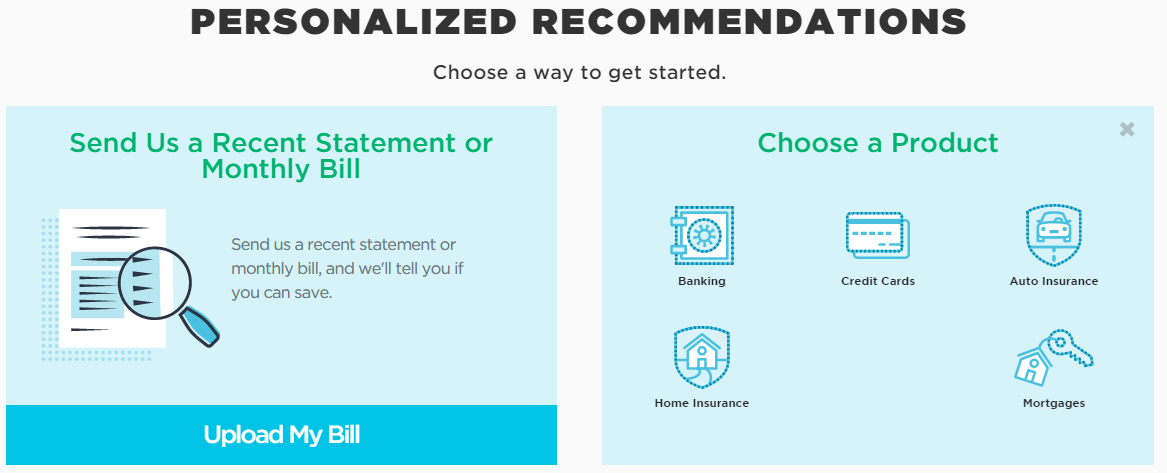
Personalized Recommendations for Financial Products
In my opinion, my favorite feature of the site was the interface that provides personalized recommendations for financial products that can most benefit me.
Banking
After clicking on the button indicating that you want to get a personal recommendation for banking financial accounts, you will then be taken to easy-to-interface with screens (only 1 question per screen!) where you answer the following questions:
- What is your zip code?
- The biggest drawback for the personalized recommendations is that Cinch currently only covers the following states for local financial products and providers: MA, NY, TX, IL, and CA.
- How much do you direct deposit monthly?
- How much do you spend on your debit card monthly?
- Will you use the bank account as a primary checking account or an extra account?
- Do you want access to a local bank branch?
- What ATM features do you want?
- Do you want overdraft protection?
- Rank several account features in order of importance
After answering these questions, you will be taken to your personalized bank account recommendations. Below is an example of what one of the recommendation screens looks like:
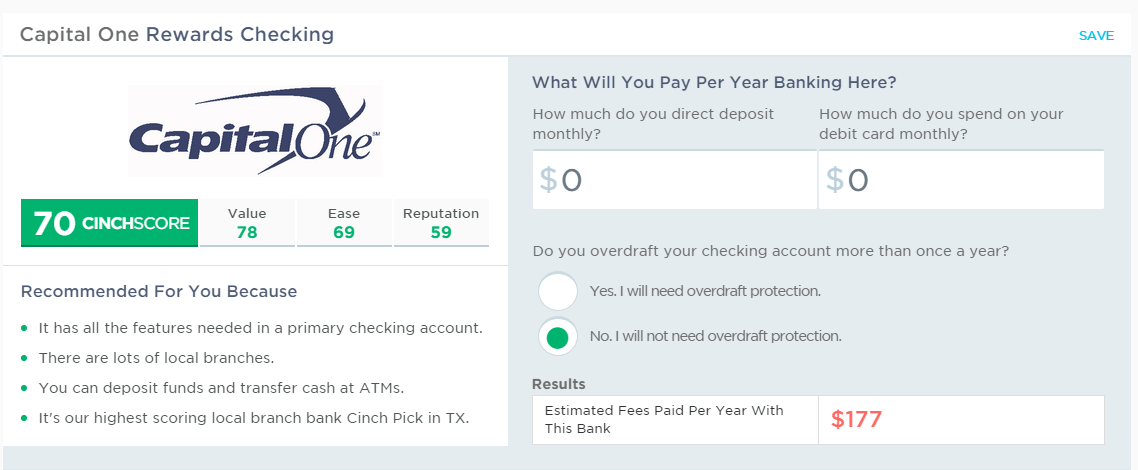
I really liked how it shows on the screen the results recommended for me, and it clearly spells out how much in fees I would pay with no direct deposit.
One thing I would like to have seen were more local recommendations and/or ways individuals can get a checking account for free, without direct deposit or a minimum balance.
Credit Cards
Overall, I thought the credit cards section of Cinch was probably the strongest feature available right now. To get personalized recommendations, you answer the questions below:
- Why are you looking for a new credit card?
- How much do you spend per month on your card?
- What kind of rewards would you prefer receiving?
- Do you spend more than $500 each month in specific listed categories?
- Estimated credit score?
After answering these questions, I was taken to a screen with my top 3 credit card picks. Shown below is a screenshot of one of the cards selected for me.

I really liked how it spells out how much I can increase my cash back rewards compared to my current favorite card (Chase Freedom). It was also refreshing to see that the three cards selected for me were ones that I hadn’t heard of. This was cool because I definitely have a habit of going to CreditCards.com every once and a while to see if there are any good looking new cards.
Auto Insurance
The auto insurance section of the site was about on par with utility as the banking section. You input some really quick information about yourself and your car, and then it lists top picks for auto insurance for you.
As with the credit card feature, it estimates the amount you could save by switching from your current auto insurance provider. An example screenshot of the auto insurance section interface/result is shown below:

Lastly, it is nice that the system saves your information that you input for 1) future use and 2) for other recommendations (ie you input your credit score range for home mortgage recommendations, and the system carries that information over if you were looking for recommendations for auto insurance).
Home Insurance and Mortgages
Overall, I thought that these two sections were the weakest / least robust of Cinch’s offerings. For home insurance, there were pretty limited choices that surfaced while searching. For mortgages, I thought that the recommendations weren’t as useful because the system did not list specific details of the potential mortgage I could qualify for from each specific provider that popped up.
How Much Does Cinch Financial Cost To Use?
Cinch is currently totally, 100% free.
I was also intrigued to find out that they do not currently try to monetize their site in order to maintain objective advice. It will be interesting to see how they decide to start making money (i.e. through affiliate linking like CreditCards.com, banner ads, or by charging for personalized recommendations in the future).
Bottom Line
So, what’s the bottom line here with Cinch Financial?
Overall, I would give it the thumbs up for folks to try out and see if they can either find new useful financial products or save some money vs. their current ones! It is free, after all, so what do you have to lose?

Financial Steps to Take Before You Turn 30

 The following is a post by MPFJ staff writer, Jeff. Jeff writes about reducing waste, saving money and building freedom at his website, Sustainable Life Blog.
I have recently turned 30, and since this happened I’ve been looking over my finances and thinking about where I was when I started my 20s, and where I am now and if I would have done anything different. Given that you’re so used to living a very cheap life in your early 20s and progress in your career (and earnings) typically increases. This affords many options for people, and expenses typically go up as your age increases and you stop living like a student.
Here are the things that I think are most important to master when you’re in your 20s to set yourself up for a good financial future.
Contribute Up to the Match of Your 401k as Soon as You’re Able
This is something that is vastly important for two reasons.
The first reason is that if you don’t contribute up to the max your employer offers to match you’re turning down free money. It’s as if someone was handing out ten dollar bills and you decided to walk by and not take as many as they were willing to give to each person!
Huge mistake. If you start your first job at a modest 40k per year and your employer matches your contributions up to the first 3%, that doubles your investment from 1,200 to 2,400 bucks in your first year.
The second thing you’re missing out on is the compound interest. There are some calculators here to figure out how much money after you have let your interest compound over years and years, but needless to say it’s a lot.
I’m sure you’ve heard the story of the 2 people saving for retirement, and one person puts away 3k per year from 22-30, then nothing until 65, and the other person that started putting away 10k per year at age 30 all the way until 65, and they both about have the same amount of money when they finish at age 65.
Pay Off All Consumer Debt
Debt will do nothing but handicap you as you continue your financial journey. Paying off all debt incurred in college on credit cards will free up a lot of space in your budget, as well as allow you to build up savings for emergencies and further advancing your goals. Instead of paying someone else interest money, you can use your spare cash to earn it. Paying off debt includes all non-mortgage debt: credit cards (pay these first), student loans and car loans.
Yes, student loans are a big deal and many people are leaving college with high balances, but you’ve probably been living on less than 12,000 per year for your entire life. Keep in the same mindset and focus all of your energy and extra money on buying your freedom from debt. I paid off the last of my student loans right after I turned 29, and it allowed my huge amounts of freedom.
Build a 6 Month Emergency Fund
As they said on Forrest Gump; “$hi# Happens”, and you can bet that at some point its going to happen to you. You’ll never know when or how much it’s going to set you back, but you’ll want to make sure that you’ve got the cash to cover it instead of falling back on your credit cards and paying huge amounts of interest to bail you out of whatever issue you’re in.
You wont know what you’ll need, but here are a few things you should cover: your health and car insurance deductible amount, at least 3 months of bare bones living expenses, and if you have any special conditions you should account for those as well.
How about you all? How many of these did you hit before your 20s ended? Can you think of other things you should do before you turn thirty to help with your financial journey?
Share your stories by commenting below!
***Photo courtesy https://www.flickr.com/photos/ky_olsen/5145374771/

10 Ways to Save More Water

 The following post is by MPFJ staff writer, Melissa Batai. Melissa is a freelance writer who covers topics ranging from personal finance to business to organics to food. She blogs at Mom’s Plans where she shares her family’s journey to healthier living and paying down debt.
Water is a precious resource. Of course, I’ve always known this, but when I lived in the Midwest where water and rain are both abundant, I didn’t think much about it.
Last year, we moved to the middle of the desert in Tucson, Arizona, and my feelings about water have changed dramatically. Water here is literally liquid gold.
While the drought rages on in California, the news in Tucson is constantly about how we’ll be affected since California and much of Arizona share the same water supply—the Colorado River—which is shrinking rapidly.
However, Tucson is very good at finding ways to save water. Here are just some of the ways we’ve learned and are now utilizing to do our part in the water conservation battle:
1. Pick landscaping that is not water dependent
Our home, and almost all of the homes around us, have colorful stones on the yard instead of grass. Some people stop landscaping there (which is quite a boring look, I must say), but many others plant native cacti or trees that require very little water. I have seen only a handful of homes with grass, and by midsummer, after weeks and weeks of no rain and 100+ degree temperatures, the grass turns brown and patchy.
By planting landscaping that is not rain dependent, you’ll save a significant amount of water. According to Realty Times, “Water-efficient landscapes can help you save almost 10,000 gallons of water per year.”
2. Catch rain water
When we get rain here, which isn’t often, we usually get a quick deluge. My husband and I set out all of the empty buckets we have to catch the water and use it later in our garden or on our lawn vegetation. (You may not want to do this if you have very young children due to the risk of drowning.) If you wanted to carry this further, you can install a rain barrel that will hold more of the rainwater for a longer period of time.
We also put a bucket under the drip spout for our air conditioning condensation. During hot summer days, that bucket fills up twice a day and can be used on outdoor vegetation.
3. Conserve what would be wasted water indoors
The average family wastes a lot of water without thinking about it. If you have vegetables to rinse, for instance, you likely leave the water running while you scrub. All that precious water goes down the drain. The same is true when you turn on the water in the shower and let it run while it warms up to the appropriate temperature.
A simple change can save all that water. Some people have a clean 5 gallon bucket in the shower. They have the water spray into it until it is the right temperature. Then the water can be reused. When we wash vegetables, we now do so in a bowl full of water so later we can use the water to water our vegetation.
4. Turn off the water when you brush your teeth
Before I moved to Tucson, I was guilty of letting the water run while I brushed my teeth. What a waste! If you brush your teeth for the recommended two minutes, that’s over 8 gallons going straight down the drain. To put it in perspective, EPA Water Sense Kids states, “Just by turning off the tap while you brush your teeth in the morning and before bedtime, you can save up to 8 gallons of water! That adds up to more than 200 gallons a month, enough for a huge fish tank that holds 6 small sharks!” And that is just for one person. If you have more people in your household, imagine how much you are saving!
5. Turn off the water when you soap up and shampoo in the shower
My uncle, who served on a submarine, called these Navy showers. You rinse yourself completely, then turn off the water while you soap up and shampoo. Turn the water back on to rinse off completely. According to Tree Hugger, “A typical shower takes as much as 60 US gallons of water, while taking a navy shower can use as little as 3 US gallons; one person can save 15,000 US gallons per year!”
6. Take a five minute shower
If turning off the shower while soaping up doesn’t feel like a true shower or isn’t relaxing enough, try the five minute shower. Since most people shower for 10 minutes, the savings can be significant. Consider, “the average 5-minute shower takes 15-25 gallons of water—around 40 gallons are used in 10 minutes” (Glen Canyon Institute).
7. Install a low flow toilet
If you have a regular toilet, you may want to replace it with a low flow toilet. According to Bell Home Solutions, “If you have a slightly newer toilet from after 1980, it could use as much as 3.5 gallons per flush. You will save between 11,000 and 35,000 gallons of water per year just by upgrading your toilet. That’s a savings of between 55% and 77% of your water consumption from one simple upgrade.”
An even more efficient option is a dual flush toilet. These toilets use half the amount of water when flushing liquid waste and the regular amount when flushing solids. We have a dual flush toilet in our home and have found that the option that uses half the amount of water is sufficient in almost all cases. A manufacturer of dual flush toilets, Caroma, “estimates that you can reduce your toilet’s annual water usage by 80%. The average American uses more than 18 gallons of water for toilet flushing. With an 80% reduction, this amount is reduced to about 3.5 gallons, saving about 15 gallons per day, a dramatic decrease in water use and improvement in efficiency” (North Carolina Museum of Natural Sciences).
8. Run your dishwasher only when it’s full
If you wait until you’ve saved every space in your dishwasher, you could save yourself 1000 gallons a month (Squeeze Every Drop). If you’re single, you may have to wait a few days before running your dishwasher.
9. Wash towels every other use
If you have a family, you could run loads of towels several times a week if you wash them after every use. We’re a family of 5, and once the heat climbs above 100 degrees, we all take showers every day. However, I only wash our towels after every other use. That saves us half the amount of towel loads we would normally use.
10. Wash clothes on an as-needed basis
We don’t automatically wash our clothes every single day. My girls are 5 and 6 and don’t yet have body odor issues as adults do. If we have a low key day where we stay home, and their clothes are still clean at the end of the day, I have them wear them again the next day. This doesn’t always happen, but I’m guessing I reduce our laundry by about 1/3 by using this strategy.
Saving water just requires some simple changes. If you do so, not only will you help conserve water, but you will significantly reduce your water bill. How much depends on the rate your town charges, but remember, water rates are usually based on levels, so the more you use, the higher the average rate you have to pay.
How about you all? What strategies do you use to reduce your water consumption? How often do you wash your towels and clothing?
Share your experiences by commenting below!
***Photo courtesy https://www.flickr.com/photos/zaheerm/5392447566/

Buying A Car With Cash

 The following post is by MPFJ staff writer Travis, who blogs at Enemy of Debt where he candidly shares his family’s financial struggles, failures and successes. As a father and husband, he provides a unique perspective on balancing debt, finances, and family.
My son recently started his first part-time job at a grocery store. We told him that he could have this first two paychecks to buy whatever he wanted, after that we would talk about how much of each paycheck he would save towards his own car as him using one of ours is inconvenient at times.
I want him to have the right perspective when it comes to buying a car, so he’ll be required to have cash in hand to purchase his first car. I also wanted to set his expectations correctly as to what kind of car he would be able to purchase, so we sat down together and ran some numbers.
He’s currently working about 20 hours a week, or 40 hours a pay period. Making $9.75 an hour, after taxes his paychecks are about $330. We agreed that he would save half his paycheck. Thus each paycheck will inject $165 into his savings account or $330 per month.
We discussed when he thought he would like to buy his own car, and together we targed September of 2016, which is the beginning of his senior year of high school. Saving $330 a month for 15 months would give him $4950 to go car shopping.
I knew exactly what question he would be asking next; What kind of car could he buy for about $5000? I searched some of the car dealerships in my area, and found some cars available that he could theoretically afford:
- 2003 Silver Ford Focus with 124K Miles
- 2005 White Pontiac G6 with 167K Miles
- 2007 Blue Kia Electra with 87K Miles
- 2008 Silver Chevy Cobalt with 191K Miles
- 2005 Maroon Pontiac Grand Am with 95K Miles
Next, I wanted to show him what kind of car he could buy if he upped his savings just $50 a paycheck, or $100 a month. By doing so, he would raise his car budget to $6450 and significantly upgrade the type of vehicle he could afford. Here are some examples I found that fit within the recalculated budget:
- 2007 Metalic Honda Civic 167K Miles
- 2008 Silver Chevy Impala with 132K Miles
- 2007 Black Ford Fusion with 128K Miles
- 2005 Black Volkswagon Jetta with 134K Miles
- 2009 Yellow Pontiac G3 with 102K Miles
The hardest thing about paying cash for a car is finding a way to save up enough to pay cash for a vehicle. For my son it’s fairly easy because he doesn’t have many expenses, and he can just use one of our vehicles until he can afford his own. But for the rest of us it’s difficult to save a significant amount of money each month in addition to all the other financial commitments of every day life. But by following a few steps, it can be done.
Dump The Car Payment
If you currently have a car payment, consider selling the car if you can get at least as much as you owe on it. By getting rid of the car payment, you instantly have extra income to save.
Buy A Car
If there are proceeds from selling your existing car, buy one using only that cash. A friend of mine did exactly that, driving the completely paid for car as they saved up to buy a new vehicle with the time was right.
Buy a Clunker
Another friend of mine bought a $300 car that he drove around for 4 years before it finally died on him. It gives you transportation, and doesn’t cost a lot. If it requires major repair, junk it and find another.
Utilize Public Transportation
I was surprised to find out that the city bus goes right by my home that I could use to get to work, or virtually anywhere in town.
I want my son to start off right financially with his first vehicle. I wanted him to follow the same methodology that anyone would do that wants to get in the groove of paying cash for their vehicles.
- Eliminate any current car payments
- Find an alternative mode of transportation whether it be buying an older vehicle with cash, or using public transportation
- Determine how much to save each month and stick to it
- Determine how long you want to save before you buy a vehicle
- Be realistic about what kind of vehicle you will be able to afford
Even if some of these steps don’t apply to my son right now, we discussed them as well as the advantages of saving for your next car as opposed driving something technically owned by the bank, and paying interest on it.
How about you all? Do you finance your vehicles or have you taken the steps to pay cash? Have you ever thought about what it would feel like to pay cash for your next ride?
Share your experiences by commenting below!
Creating a Lifestyle of Financial Independence, Whatever That Means to You

The following is a guest post. Enjoy!
This is a personal goal, but it’s something that a lot of people share. Financial independence means different things to different people. For some, it means never working again. To me, it means doing the work that I choose, that gives me pleasure, and never putting enormous energy into something I don’t believe in. Because let’s face it, many of us are raised in a system where we’ve got to pour all of our energy into pursuits we care nothing about. That first dawned on me in high school at my private school and at my first job at a fast food chicken restaurant.
Lots of us just get used to doing things we hate. “That’s life,” we say. And that isn’t wrong. That’s a principle of many philosophies and religion. Buddhists hold as a central tenet that life, itself, is suffering. Now, while I don’t mind sitting down with that thought and mulling it over for awhile, I’m not going to let that sort of thinking lock me in to life and work that is boring, painful, or soulsucking. That doesn’t mean I’m not going to work, or even work really really hard. But it means I’m going to work for something that I feel matters.
But in order to do that, you’ve got to be able to pay the rent. If you already have a job that you love, that affords you a lifestyle you enjoy, then congratufreakinlations. Not everybody is there, though. For those of you who are not, and who don’t have a specific direction in mind to get out of this cycle, here are some practical steps.
- Replace Horrible Tasks With Less Horrible Tasks. If you hate your job, get a job you hate less. If you can’t find one, simple try to get one that pays better. If you can’t do that and your job is draining you of all energy, quit. Quitting puts you in survival mode. You’ll have to take stock of yourself, your skills, and ways you can work to survive. I did it once, and started my writing career which, within a year, had doubled my income from my previous job. Quitting is extreme, but it’s better to accept lower pay for something that doesn’t sap your life force. You’ll have energy to make better decisions, to help yourself along, than you will if you stay at a terrible job just for the money. Slowly find ways to replace income, and replace those with better fit or better paying tasks, till you are busy with stuff that at least pays well and hopefully gives you enjoyment.
- Activate Your Own Creativity. Find something you can create, and create it, no matter what. You can try different things: starting a blog, doing woodworking, writing and recording songs, starting a small business. But stick to it for a year and see where it leads you. Don’t put any financial expectations on this work, just let it develop. In time, chances are you’ll be making money on this thing, perhaps enough to replace your normal income with.
The end goal is fulfillment. If you enjoy your work, you’ll be a lot closer to enjoying your life. You won’t have to sustain an expensive lifestyle to give yourself happiness shots in the arm every few hours. You’ll just be happy. From there, financial independence comes a lot easier. You can save and invest much easier.
Savings and Investment will further buoy your new lifestyle. You won’t be so worried about bills, and you’ll have extra income and financial security from your investments. Eventually, investments like the ones I’ve mentioned may bring in a lot of extra income, enough to replace some of the leftover work that you may have to do but don’t enjoy. In a way, this is a financial dream, but it’s a dream that thousands of people are living. You’ve got to work and make it a priority, but in the end you are the priority. This is your life. Make it work the way you want.

4 Things You Need to Know About Your Fiancé Before You Tie the Knot

 The following is a post by MPFJ staff writer, Derek Sall. Derek is the owner of the blog, LifeAndMyFinances.com, where he teaches people how to get out of debt, save money, and become wealthy.
My first marriage failed about three years ago. Since then, I have met an amazing woman and have proposed yet again. Our big date is coming up in July, and to be completely honest, I’m starting to shake in my boots a little. Am I making a better decision this time? What about those certain areas that we don’t agree on? Can we stay together forever? These thoughts are racing through my head as I think about our past and our future together. Thankfully I have some comfort in knowing that we align on the four biggies in marriage:
- Money
- Children
- Religious Beliefs
- In-laws
Let’s take a moment and dive into each one of these categories to get a clearer picture on whether or not you are in alignment with your future spouse.
Money
For starters, how much money do you have, and how much does your fiancé have? Do you have $100,000 in debt and he/she has absolutely no debt? Are do you have a huge net worth and he/she is dirt poor? Without some early communication, these areas could become very stressful for both of you, especially if one of you feels that your debt is your debt, and they have no responsibility for it. Figure this out early or it will turn into a huge problem later.
Are you both savers? Are you both spenders? Or is one of you a spender and the other a saver?
If you are both savers, awesome, life will probably be pretty easy in the money department. If you’re both spenders, life can start out fun, but when retirement time approaches, one of you will likely freak out and want to save something, while the other wants to keep spending, so this naturally will present a future problem. If you two are opposites (one saver and one spender), life can really be trying and might result in constant bickering and stress.
As an overarching rule, you should have a common money goal with your spouse. Do you both want to retire with millions of dollars and move to Arizona? Or, maybe you both want to be self-employed and live simply. Whatever the case may be, make certain that you are both heading toward a common future goal in the money department. With this goal, both of your paths should at least be heading toward the same general area.
Children
Do both you and your fiancé want to have children? If so, when and how many? Are you open to adopting or is this your preferred method of becoming parents? If so, where will you adopt from and how much are you willing to spend? With children, will one of you become a stay-at-home parent, or will you both work and put your child in daycare?
There are a ton of questions surrounding children, but if one of you wants no children and the other wants three, this is a huge red flag! Between my fiancé and I, she would like to have two, where I would rather have three. Thankfully, our numbers aren’t too far off and one of us can adjust when the time comes to decide on the third or to stick with two.
Religious Beliefs
If you plan to have kids, the issue of different religions is quite serious and can often divide your family. If you are Catholic and your partner is an atheist, how will your kids be raised? Do you present them with all of the beliefs and let them choose? Does the more dominant parent just take control and teach them their religious beliefs? What if all the kids choose one parent’s belief system and then leave the other parent as the outsider?
The absolute best way to succeed in marriage (even if you don’t have kids) is to marry someone that has similar religious beliefs. Do not marry someone with the expectation that they will conform to your beliefs. This is not fair to them and it probably won’t work out for you.
In-Laws
Oh the in-laws… Without a doubt, your fiancé’s parents are different than yours. They might be more outgoing, they might be habitual liars, and they might be more prone to argue with one another. But, no matter the differences, you must be okay with who they are when you are going into the marriage.
While you might not see them all the time, they will definitely have an impact on your life between you and your spouse. Plus, with children (yes, again with the kids), you must be okay with letting your in-laws take the kids once in a while. If, at this point, you are uncomfortable with how your in-laws treat you, then chances are that things are not going to go over so well when they start talking to your children.
When you marry your fiancé, you aren’t just marrying him/her, you’re marrying into their family. Is that exciting or terrifying? Hopefully it’s the former and not the latter.
How about you all? How do you and your fiancé align within these four categories? What other factors to consider before getting married?
Share your experiences by commenting below.
***Photo courtesy https://www.flickr.com/photos/kumon/43128198/
Why You Can’t Take a Binary Options Platform for Granted

The following is a guest post. Enjoy!
Making it as a binary options trader takes a lot of hard work. While this form of investing is certainly preferable to a lot of other versions, that doesn’t mean it’s a walk in the park either. You’ll need to put in the time it takes to learn the ropes and, of course, practice in real world situations. However, without the help of a quality binary options platform, none of this will add up to much. Even a good broker can’t replace the importance of the right platform.
Platforms Are How You See the Market
Trading options well demands that you see the market clearly. This is one of the main things a binary options platform does. You have to be able to follow various underlying assets and the market as a whole in order to know which option to purchase. Otherwise, you’re just taking stabs in the dark and might as well be spending your money at the roulette wheel.
It Decides How Much You Earn
A binary options platform will control how much you earn on your investments in two very important ways. First, as we touched on above, the better the platform, the better you’ll be able to do. A low-quality platform will always mean you make less money with binary options.
However, platforms are often linked to your payouts too, like when they come with your broker. In that case, they affect the percentage you’ll get for every win. No platform or broker will pay out 100%. The amount you get can go up to around 85% or a whole lot lower. It’s definitely worth taking the time to find out how much you’ll be able to expect from your platform.
It Limits What You Can Trade
Another way your binary options platform will affect your earnings is by controlling what you’re able to trade. You don’t have to be in investing for long to know that you always want to diversify your portfolio. With options, you can choose to trade just about anything, including commodities, stocks and currency.
Ideally, you want a platform that can handle as many as possible and supports a number of different currencies too. This will give you a lot of room to move depending on how the market is acting. While most people love that options allow you to make money no matter how the world’s economies are doing, it’s still a good idea to give yourself plenty of possibilities to work with.
High Security
Finally, don’t use any binary options platform that doesn’t come with a high level of security. You want 128-bit SSL encryption at the very least and it should come from a top provider in the industry. Otherwise, your funds will always be at risk.
Once you have a quality platform to trade from and a decent broker, you’ll have a much easier time pulling in profits from binary option trading.

Well-Known Franchises That Are Cheap to Start

 The following is a post by MPFJ staff writer, Derek Sall. Derek is the owner of the blog, LifeAndMyFinances.com, where he teaches people how to get out of debt, save money, and become wealthy.
Have you ever thought about going into business for yourself, but didn’t necessarily want to start from scratch? A franchise may just be what you need in your life. In its basic form, a franchise is a business that has already been formed and has a proven system that anyone can replicate.
One of the first successful franchises in the United States dates back to the 1960s when Ray Kroc (then a multi-mixer salesman) bought the rights to the restaurant, “McDonald’s” and sold the franchise over and over again to willing entrepreneurs. All Ray asked for was a portion of their sales volume. Many succeeded and the popularity of the franchise was born.
If you want to sign up as a McDonald’s franchisee today, you’re a little late to the party. Not only do you need millions of dollars to start one, you need to already be an owner of an existing franchise. So, since this obviously isn’t going to happen, what are your other options? There must be some well-known franchises that are cheap to start. Indeed there are. Take a look at the five successful franchises below that still have a reasonable price tag.
1) Chick-Fil-A
Chick-Fil-A is a fantastic franchise – so much so that there are over 20,000 applicants a year to become the next franchisee. Since the company cares more about the success of their business and their franchisees, they obviously do not allow every applicant to become an owner. Instead, they select between 75-80 new operators per year. Of those selected, 95% of them are a success and stick with the business for the long term.
The initial cost to the new owner-operator is $10,000 plus 15% of sales for the rent of the building, and then another 50% of the pre-tax profits. It sounds like a lot, and it is, but the start-up costs are next to nothing so almost anyone can become an owner of their very own franchise!
2) Subway
Subway has been a hot franchise ever since Jared shed hundreds of pounds on his “Subway diet”. In certain areas, there are almost too many Subway franchises and the market is becoming saturated, but if you can find a location that doesn’t have a Subway, then it could certainly become a great opportunity for you!
The franchise fee of a Subway is $15,000 and you have to foot the cost of the building (often $250k or more). They require you to pay royalties of 8% of gross sales and an advertising fee of 4.5%. The prices seem a little bit steep initially, but if you decide to call it quits, you will likely have equity in the building when you sell.
3) Cold Stone Creamery
Cold Stone Creamery opened their first store in 1988. The slow-churned ice cream became a hit quite quickly and the franchise was born.
If you want to start a Cold Stone Creamery today, you’ll need to have a net worth of $250,000. If you’re clear here, then you’ll have to come up with just $27,000 for the franchise fee, which is pretty meager compared to the costs of a full-fledged start-up. Of course, you’ll need a down-payment on the building (as is the case with most franchises), and you’ll have to pay 6% of your sales for royalties and 3% for national advertising.
4) Quiznos
The main rival to Subway, Quiznos offers subs that are considered less of a “fast-food” taste and more of a sandwich that would make your mouth water. Overall, the franchise is doing pretty well and offers its franchisees a pretty good deal to get started.
The initial cost of a Quiznos is $25,000 for the franchise fee and then they charge you 7% of sales for the royalty costs. And, as is typical, the cost of the building is yours too. But, even with that, the rates are quite cheap for an almost guaranteed business start-up!
5) Dairy Queen
Dairy Queen has been around for 75 years and is still a favorite today. The name is obviously recognizable, so if you want to start a franchise that is instantly known, then this is a strong possibility for you.
To start a Dairy Queen franchise, you’ll need to have $35,000 for the initial franchise fee and a down payment for the building. Once you open the doors and start earning all that cash, you’ll have to dish out 4% of gross sales for royalties and 6% for marketing expenses.
Summary
Each one of these options is feasible, but the absolute cheapest option is obviously the Chick-Fil-A franchise. Plus, notice where the royalty fees are pulled from: profits, not sales. That is a huge difference. With all other franchises, you could be losing money, but you would still owe money to the franchise because they take a percentage of your overall sales.
Chick-Fil-A on the other hand, wants to be sure that you earn money first and foremost, and then will accept half of your profits. If you want to put up very little money initially and have a very high success opportunity, then Chick-Fil-A would be the opportunity for you.
How about you all? Are you considering a franchise opportunity? What steps have you taken so far to move forward?
Share your experiences by commenting below!
***Photo courtesy: https://www.flickr.com/photos/informant/32974814/

$779.13 – Community and Charity 10% Monthly Blog Income Give Back #’s 32-45 – May 2014-May 2015 Edition

 The 10% give back giveaway fun rolls on for the month of May 2015.
The past year has been one of major life changes for me. I finished my graduate school degree in August 2014, got married in September, moved to Colorado in November, started a new job in December, and bought a single family home in January 2015. With all of these changes, I have gotten a little behind with running give backs on MPFJ. In fact, my records showed that I haven’t done one since April 2014.
As such, we need to do some catch up!
In case you missed the first 31 editions of the 10% Blog Income Give Back, after doing some thinking at the beginning of October 2011 about what direction I want this blog to grow and evolve towards in the future, I decided that any income made from this blog would have more significance to me at a personal life values level if I knew that a portion were being given back to the following places:
- 1) The readers – Obviously, without you here to read my articles and interact with my ideas, there would be no blog in the first place (let alone blog income). As such, it is only fitting that you receive a portion of any blog income.
- 2) Charitable organizations – If you’ve read my blog before, you know that I’m a big believer in donating a portion of my money to charity. Each year, I donate between 5-10% of my income to the National Multiple Sclerosis Society as part of the Bike for MS fundraiser that I do. Beyond the good that is done by donating your money, getting used to contributing to charity is also a good practice to emulate the actions of affluent individuals (T. Harv Eker discusses this in his book, Secrets of the Millionaire Mind, which I would definitely recommend reading if you have a few hours).
Because of these considerations, I’ve decided that each month going forward, I’m going to give away 10% of my net (after-tax) blogging income/profit to My Personal Finance Journey readers (5%) and to charity (5%). Listed below is a summary of the results we’ve achieved together thus far through this give back effort:
- After each calendar month passes, I’ll tally up my net blog income and determine what Dollar value correlates to 10%.
- So far, I’ve been very happy with the success of the October 2011 – April 2014 give backs. Listed below is a summary of what we’ve accomplished so far with the give back effort.
- Current total given to charity = $2,570
- Current total given to blog readers = $1,266
So, that’s the overall flow of things and a brief recap of what’s happened so far with the give back initiative. Now, let’s get in to the specific details for this month’s (May 2014-May 2015 catch up!) giveaway.
Details of May 2014-May 2015 10% Blog Income Giveaway
- $779.13 total blog income to give away – $389.57 to 2 My Personal Finance Journey readers and $389.57 to the National Multiple Sclerosis Society of Colorado.
- $389.57 in the form of 2 prizes available to 2 readers as follows –
- 1) Grand Prize = $250 USD Cash Via PayPal.
- 2) Runner-Up Prize = $139.57 USD Cash Via PayPal.
- $389.57 in the form of 2 prizes available to 2 readers as follows –
How to Enter the Giveaway – Deadline to Enter is 11:59 PM, June 15th, 2015
Like previous months, I’ve decided to use the RaffleCopter giveaway management tool to handle sign-up facilitation for this giveaway, so simply go through the steps listed in the widget below to enter the running for the prize and accumulate entry points.
There is no limit to the amount of points you can earn. If you refer 10 subscribers – your name will have accumulated 50 entry points! Or, if you link to the giveaway more than once, you can accumulate those 5 entry points multiple times. In the event of a tie, I will be using a random number generator to select the grand prize and runner-up (2nd place) prize winners.
Important instructions: After you complete an entry method, make sure to click and fill out the “I Did This” or “Enter” button in the widget so that I have a record of your points.
Remember, the deadline for entries will end at 11:59 PM, June 15th, 2015 (~4 weeks from today – the start of the give back). Good luck to you all! Please contact me if you have any questions. After the deadline for entries passes, the grand prize and runner-up prize winners (one with the most points and second most points accumulated, respectively) will be contacted via email to receive their prizes.