

- You are here:
- Home »
- Blog

Five Steps to Recover from Holiday (Financial) Overindulgence
 The following is a post by MPFJ staff writer, CJ, who blogs at thesingledollar.com about personal finance, budgeting, frugality, and debt repayment.
I don’t know about you, but I woke up on December 26 to a budget bursting at the seams. At Christmas 2014 I was finishing up a year of debt payoff and I was very strict about buying presents, going out to brunch, and so on. But I got a little too relaxed this year; I bought gifts for more people, went out several times with friends, and generally had a hard time saying “no” to myself.
Luckily, I have a plan for what to do next. Just like after you eat too many Christmas cookies (I may have done that too this week, not saying!), recovery and restabilization is key.
Assess the Situation
Just how bad is it? Did you go into debt, or did you just spend all your “slush” money? This isn’t the time for regrets; even if you bought too many presents for your kids, or spent $30 on a meal out that wasn’t delicious, you can’t undo it now. Just make a list of any debts you have to pay off (credit card balances, money you borrowed from relatives or friends…) and prioritize them. If you don’t have debt, heave a sigh of relief and list your upcoming expenses.
Raise Cash/Store Credit
You’ll need to find some spare cash. You may have received gift cards or cash, or you can do some quick freelance work at sites like Swagbucks, Fiverr, or Usertesting. But one of my favorite ways to get back on track is to return unwise purchases to stores. If you bought presents for yourself (guilty!), do you still have the receipt and is the item unworn/unopened? Go get that money back! If you were given gifts that you won’t use, that can also be helpful. If you can tell where it came from (for example, a sweater from a specific retailer) then you can often take it back for store credit which you can use for things you really need. It’s nice if this is Target or Walmart so you can use the store credit for groceries.
Slim Down (Your Budget)
If you overindulged at Christmas, you’ll have to spend the next month or two tightening your belt. Look for places that you can cut back. The easiest way for me to do this is to cut down on food purchases: either I don’t go out as much, or I focus on making very cheap meals at home. If your family eats a lot of meat normally, try eating more pasta, rice, and beans. Or skip going to the movies and watch DVDs you already have. There are lots of places you can cut back a little for a month or two.
Follow Through
This step is simple: take the money you recoup from steps #2 and #3, and use it for the priorities you came up with in step #1. Pay off debts in order of importance, and pay necessary bills. Cross each item off your list as you pay it, as a great motivational tactic. When everything is crossed off, you’re back on your feet.
Plan For Next Year
Once you and your bank accounts are back on your feet, make sure you don’t make the same mistake again. Open a sub-account or a new line in your budget and name it “holiday.” Then set aside a pre-determined amount every month — say, $25 or $50. When December comes again, you’ll be able to have a good time without the yearly regret-filled reckoning.
How about you all? How did you do financially over the holidays? Any good tips for pulling yourself back together?
Share your experiences by commenting below!
***Photo courtesy https://pixabay.com/en/savings-bank-christmas-savings-pig-919859/

Should You Use A Short-Term or Regular Inflation Protected (TIPS) Bond Fund For Your Portfolio?

 For several years now, one of the topics on my list of research topics has been to evaluate the potential of several “new” Vanguard index mutual funds for inclusion to my investing portfolio.
Of course, these funds are not necessarily new (several have been around for multiple years now), but they are NEW to me. Listed below are the current Vanguard mutual funds I use to make up my investing strategy:
1. Cash – Various online high yield savings accounts
2. Vanguard Short Term Bond Index (MUTF:VBISX)
3. Vanguard Inflation-Protected Secs (MUTF:VIPSX)
4. Vanguard Total Intl Stock Index (MUTF:VGTSX)
5. Vanguard Emerging Mkts Stock Idx (MUTF:VEIEX)
6. Vanguard Total Stock Mkt Idx (MUTF:VTSMX)
7. Vanguard Small Cap Index (MUTF:NAESX)
8. Vanguard Small Cap Value Index (MUTF:VISVX)
9. Vanguard Value Index (MUTF:VIVAX)
10.Vanguard REIT Index (MUTF:VGSIX)
Vanguard Short-Term Inflation-Protected Securities Index Fund (VTIPX) Features
The first Vanguard fund on my list to evaluate is a shorter maturity version of the regular-maturity TIPS fund I currently invest in (Vanguard Inflation-Protected Secs (MUTF:VIPSX)). Mike from Oblivious Investor gives a good description of the short-term fund and the differences between the regular TIPS option.
Listed below are a few key features/details of the Short-Term Fund:
Maturity/Risk
This fund, the Vanguard Short-Term Inflation-Protected Securities Fund, has been around since October of 2012. It features an average maturity of around 2.4 years, much shorter than the regular TIPS fund, which features ~ 9 year average maturity. As you would expect, the short-term TIPS fund carries much lower risk, and also lower return, than the regular TIPS fund.
Cost/Fees
With a low 0.20% expense ratio and no purchase or redemption fee, the expenses of this fund can be considered approximately equivalent to the regular TIPS fund (which also has a 0.20% expense ratio).
Inflation Protection
According to a Vanguard white paper and also several commenting threads in the Bogleheads forums, the consensus is that the Short-Term TIPS fund provides better tracking/protection against inflation. This is due to the fact that the shorter-term TIPS have less interest rate fluctuations.
Should The Short-Term TIPS Fund Be Incorporated in To Your Portfolio?
Overall, in researching this question, the answers have been quite mixed.
The general consensus is that this is a “small potatoes” decision, meaning that you will likely be just fine in either a regular maturity or short-term TIPS fund. Accordingly, I have come across good reasons to utilize the short-term TIPS fund, and good reasons to stay put in the regular TIPS fund.
Convincing Reasons to Switch to the Short-Term TIPS Fund
- If your primary goal of holding TIPS is to protect against pure inflation risk, than as mentioned above, the Short-Term TIPS fund will do this better for you.
- If you are older and don’t want to take on very much risk.
- For example, if you’re close to retirement, and you want to hold TIPS as part of your fixed income holdings, but prefer to have less fluctuation.
Non-Convincing Reasons to Switch to the Short-Term TIPS Fund
- Shortly after the short-term TIPS fund came out, Vanguard replaced its regular TIPS holdings in Target Retirement Funds with the short-term equivalent. “And if Vanguard does it, you should do it too!” 🙂
- To me, Vanguard making this switch is definitely a good reason to consider its inclusion in to a portfolio, but it’s not a good enough reason to blindly make the switch.
- You are trying to “time” and/or predict interest rates and inflation levels in the future.
- To me, many studies have shown that even highly trained economists are not very good at all at predicting the future.
- You invest in short-term bonds for the other portion of your fixed income allocation. And therefore, you should match the short-term duration accordingly with TIPS.
- This might make sense if you were closer to retirement. However, as mentioned in this Bogleheads thread, regular TIPS may actually have less overall risk than equivalent-maturity (~9 years) government bonds.
- Because of this, it seems logical for folks further from retirement to use regular TIPS, even if they use short-term bonds for the rest of their portfolio.
- For example, Rick Ferri recommends that folks saving for retirement use regular TIPS.
- This might make sense if you were closer to retirement. However, as mentioned in this Bogleheads thread, regular TIPS may actually have less overall risk than equivalent-maturity (~9 years) government bonds.
What is The Purpose of TIPS In Your Portfolio, Specifically?
So, having heard the reasons for and against the use of short-term TIPS, it seems like the most efficient path forward to determine what is right for you is to ask yourself, “Why did you add TIPS to your portfolio in the first place, and what is their specific purpose?”
As described in a previous post where I performed a historical backtest (using a regular-maturity TIPS price data set) to help determine the most efficient asset allocation to TIPS, I invest 25% of my fixed income asset allocation in TIPS. The rest is in short-term bond index funds and cash accounts. This 25% level was determined because it gave me the most diversification benefit, and highest return/risk ratio.
Sure, having protection against inflation is great, but it was almost a secondary purpose. Since I am ~35 years from retirement, I am able to take on a significant amount of risk, as shown by my overall asset allocation of 70% equity / 30% fixed income.
Typically, when asked what the purpose of my fixed income allocation is, I say that it’s primary purpose is to provide stability/security. That is why 75% of this fixed income allocation is made up of very low yield/low risk short-term bonds and cash accounts. Because of this, it doesn’t make me as concerned about the remaining 25% fixed income allocation being invested in a regular TIPS fund, with slightly higher risk, vs. a short-term TIPS fund, with lower risk.
Further, I also make it a policy to have my investing decisions made by life changes and/or data. Since short-term TIPS are a newer phenomena, I haven’t been able to find a long-term historical backtesting data set (similar to this one by Bogleheads) in order to get a quantitative feel for the differences in risk and return between short and regular term TIPS.
Therefore, with all of the unknowns, mixed opinions, and lack of strong current evidence for a change, I am planning to stay put being invested in the Vanguard Inflation-Protected Secs (MUTF:VIPSX).
How about you all? Do you currently invest in a TIPS mutual fund? Is it a regular maturity fund, or shorter-term?
Share your experiences by commenting below!
***Photo courtesy of https://www.flickr.com/photos/lendingmemo/11697736305/in/

Combining Your Personal Finances For Marriage

 I remember once reading a book describing marriage and the joining of two people’s finances, and they summarized the process as “1+1 = 1.”
Personally, I took this description as having two meanings, one figurative and one literal.
- On the figurative side, I took it to mean that there might not be a set and/or mathematical approach to combining personal finances for marriage (i.e. it’s likely to be a little different for every specific situation).
- On the literal side, I took it to mean that there really is no way to maintain two completely separate finances during marriage, no matter how hard you try.
So, having established this, I wanted to share with you all how my wife and I (got married in Sep 2014) have, in my opinion, successfully combined our finances over the past ~ 1.25 years. My hope is that a couple of the lessons learned and strategies can potentially help you in your current or future marital finances. Enjoy!
Step 1 – Put a Legal Agreement In Place (Pre- or Post-Nuptial, often called a “Pre-Nup”) If There Is Significant Financial Inequality Coming In To The Marriage
For young folks looking to get married right out of college or graduate school, it is often the case that both individuals are living paycheck to paycheck, have debts, and don’t have any significant savings to report. If this is the case, and both individuals are on approximately equal financial terms coming in to a marriage, a pre-nup is nice to have, but not crucial.
However, if one person has significantly more savings than the other, or even if one person has large amounts of debt whereas the other is debt free, it’s a good idea to put some sort of agreement in place.
For my wife and I, a pre-nup made a lot of sense, so we proceeded to obtain one.
Online Free Template or Lawyer?
Being the cheapskate I am, I first looked online for free template documents for pre-nups so that I could save on lawyer fees. However, once I read that agreements drawn up individually (without the help of legal counsel) often don’t hold up in court, I decided it wasn’t worth the risk, and proceeded to engage legal counsel for my wife and I.
One thing we learned, which we didn’t know at first, was that each party going in to the agreement has to have their own separate legal counsel in order to maintain objectivity. Of course, this also increases the cost, but is a move that makes sense. In the end, I obtained a family lawyer referred to me by my accountant, and my wife obtained a lawyer that we knew through a local social group and other friends.
With all the back and forth between lawyers, my wife, and myself, it took longer than we expected to get the agreement finalized. When everything was signed, it was actually a POST-nuptial agreement, meaning that we signed it after our wedding and honeymoon. However, according to my lawyer, he said that a post-nuptial agreement is still perfectly legal and enforceable.
What does the post-nuptial agreement provide?
In a nutshell, our post-nuptial agreement makes it so that all debts and assets are SEPARATE, unless we make a conscious decision to make it a joint account and put both our names on it. What this means is that all IRAs, 401ks, savings accounts, checking accounts are separate, except for the ones that we created to be joint accounts.
How much did this whole process cost my wife and I?
In the end, the cost was a little more significant than I expected, but that was only because I didn’t realize all of the complexities and considerations that go in to this type of document. My family lawyer charged the majority of the total cost (around $2,200), since he drafted the document. My wife’s lawyer gave us an awesome “family and friends” rate, which took the cost up to around $2,500 total.
Step 2 – Pay Off Any High-Interest (Credit Card) Debts
Remember that marriage finance equation I mentioned before, where 1 + 1 = 1? It very much applied in our case, as our marital agreement made it so that I wasn’t legally responsible for my wife’s existing credit card debt. However, let’s get real here! No matter how much you want to deny it, YOU are marrying that credit card debt too!
In actuality during marriage, our paychecks each month will be combined, and the joint money will either go to 1) savings/spending or 2) paying the monthly credit card balance, which is a terrible use of money since a lot of the money goes to pay interest, not principal.
So, if one party of the marriage has a some cash sitting an account, it’s only logical to use this cash to pay off the other person’s credit card debt. This is exacting what was hard for me to eventually come to terms with during the joining of our finances. However, it was definitely the best financial decision.
Step 3 – Set Up Joint Accounts Needed
For my wife and I, it made a lot of sense to have at least a couple joint accounts. We decided to have 1 – joint checking account, and 2 – joint savings accounts. We placed both of these accounts with Ally Bank online, since they offer some of the best interest rates around and other favorable terms.
For us, the way we operate is that we each receive our income in to separate Paypal and Bank of America checking accounts at first, and then transfer our remaining money to the joint checking account for paying bills, savings, etc.
Step 4 – Setting Up Your Investment Strategy
Per our post-nuptial agreement, my wife and I maintain separate accounts for the ones which are not specifically “joint” and have both our names on them. Because of this, we maintain and track two sets of 70% equity / 30% fixed income asset allocations, separately.
- For my wife, she does not have any desire to be actively involved in managing her asset allocation. As such, we use a low-cost lifecycle Vanguard index fund, called the Vanguard Target Retirement Date 2025 fund. It maintains a 30% fixed income, 70% equity asset allocation for her, so she doesn’t have to worry about rebalancing.
- For me, I love tracking my asset allocation and rebalancing when needed, so I take a more active approach to passive index fund investing and invest in individual Vanguard index fund for the various share classes, bonds, and international markets. You can read more about my investing strategy here.
From there, we then try to invest an equal amount of contributions to each of our separate IRAs, 401ks, etc accounts throughout the year.
Next Steps
So there you have it, the 4 “initial” steps my wife and I took over the past year or so in order to get our finances combined.
For next steps, I do need to start doing a better job of reviewing my Value Based Financial Planning and goals, as we have been so busy over the past year with the wedding, graduating, new job, baby, and moving to Colorado that I haven’t been able to do that as much as I’d like. Of course now, I will need to involve my wife in that process. Should be fun!
How about you all? What were the main steps / barriers / hurdles / challenges you faced when combining your finances for marriage?
Share your experiences by commenting below!
***Photo courtesy of https://www.flickr.com/photos/kumon/43128198/
5 Money Saving Tips That Might Actually Cost You More (And 3 That Don’t)

The following is a guest post. Enjoy!
Who doesn’t love to save money? It’s not only nice to keep extra cash in your pocket, but there is always something thrilling about getting a great deal.
In fact, the thrill of the deal is what drives many shoppers to go to extremes, spending hours clipping and sorting coupons, researching bargains, and driving all over town to get the best prices. Do the extremes really pay off, though? Do these drastic measures actually save money?
The truth is, not always. In fact, many of the money saving “tips” that get repeated over and over again don’t save the average shopper all that much. In fact, if you follow these ideas, you might actually end up spending more in the long run.
1. Only Using Coupons on Items You Need or Use Regularly
On the one hand, this advice makes perfect sense: There’s no value in buying an item that costs more than your usual brand just because you have a coupon, or buying something you wouldn’t otherwise, just to use the coupon. However, if you score a high value coupon on an item that happens to be on sale, that’s a good opportunity to try something new without wasting money.
2. Buying in Bulk
Again, there are times when this makes sense. However, all too often shoppers score an incredible bargain, only to find that they have to toss some (or even most) of their purchase because it’s past the expiration date or no longer fresh. It might seem wasteful not to take advantage of a great deal, but it will be even more wasteful when you have to throw away the stuff you bought.
3. Only Shopping Where You Can Double and Triple Coupons
If you’ve got a high-value coupon, getting it doubled or even tripled at the checkout is a great deal. However, just because a store doesn’t increase the value of coupons doesn’t mean you can’t get a great deal. Using the same coupon at a store that has lower prices or sales on that item can save you just as much, if not more. So if you avoid certain stores because they don’t double coupons, take another look.
4. Only Paying Cash
Consumers are often told to avoid using credit cards, but using a credit card and then paying it off right away can actually be an effective savings technique. Many cards offer rewards, including cash back, points, or airline miles, that can save money on later purchases. Not to mention, the purchase protection offered by many cards is usually superior to store protection plans, meaning you don’t have to pay extra to cover a big purchase. So don’t discount credit cards entirely, but use them intelligently and save money.
5. Shopping Only at Discount or Dollar Stores
Discount and dollar stores are great if you are looking for trinkets to keep the kids busy, party supplies, or gift wrap. They aren’t so great for deals on groceries or health and beauty items. Not only is the quality often questionable, but most discount stores don’t have the same deals as other stores or allow customers to use coupons or take advantage of rebates. In many cases, you’ll end up paying just as much or more as you would anywhere else.
Three Tips That Will Save You Money
For all of the bad advice out there, some common money saving tips will actually keep your cash in your wallet. Remember these pointers when you’re shopping:
- Look for coupon codes when shopping online. If there is a place to enter a code at checkout, there is probably a code somewhere online that can save you money. Search for “store name coupon code” online or visit a website that lists codes and deals to find money-saving offers.
- Borrow or barter when you can. Need an expensive tool to complete a project or a particular type of pot to cook Christmas dinner? Ask your friends and family if they have one you can borrow. Don’t buy items you won’t use more than once if you don’t have to. Also, try bartering for things you need. For example, try offering your contractor your expertise in Web design in exchange for some work on your home. You might not get the whole bill covered, but you can save some money.
- Monitor sales. Certain items traditionally go on sale during certain times of the year. Do your research, and time your purchases so you can score the lowest possible prices.
Saving money does require some legwork, but you don’t have to be an “extreme couponer.” Pay attention to prices, use coupons intelligently, and look for alternatives, and you’ll still enjoy the thrill of the deal.
Where is All My Money Going?

The following is a guest post. Enjoy!
“Where is All My Money Going?”
If the title looked at all familiar, you’ve struggled with the all too familiar problem of making ends meet. Most people live in this state at one time or another. There’s nothing wrong with that. The problem is, some people live this way their entire lives, which should be avoided if at all possible. Some of the conditions which lead to this lifestyle are unavoidable. But most, I’m sorry to say, just aren’t. If you don’t know where all of your money goes, it’s time, my friends, to make a budget.
A budget is all about active money management. Management isn’t easy for everyone. It can be hard to tell other people what to do, and to make consequences happen if they don’t or don’t want to. But it’s even harder for most people to manage themselves. It’s an uncomfortable task to look at one’s own life and identify personal behaviors which are creating problems for yourself and others. Creating a budget is an exercise in doing just that. And even though it’s not fun for most, it’s important and it’s the only way you’ll get ahead in your financial life.
Before you start a spreadsheet, it’s important to look closely at your bank statements from the last couple of months. Go over them with a fine toothed comb, and take note of any unexpected events. See any surprises? If you’re not used to looking at your finances on the regular, you’ll probably find at least a few. The first surprise is a payment that you make that you didn’t know you’re making. PPI is an example: a kind of insurance that was tacked onto mortgage applications in the UK. People paid for it for years before they found out they were doing so, in many cases. Other people will have automated payments for services they no longer use, or for subscriptions they’ve forgotten about. First things first, kill off all these unnecessary payments.
Now look at everything you’ve spent over the previous month for food, entertainment, housing, and other important categories. Be merciless and give yourself a specific total figure. This can be painful, because most people spend a lot more for things like food than they previously thought. You don’t want to spend more than 20-30% of your monthly income on food. If you’re way over that amount (as many people are), you’ve got to make some changes.
For the next couple of months, keep your spending to levels which are well beneath that which you bring in from salary and other earning opportunities. Keep up this behavior for a long time and you’ll find that your money isn’t so tight after all. But to begin this process, it’s essential to look at these behaviors closely. Without close scrutiny, you’ll only have a general idea of what you’re spending and where, at best. If you don’t get specific you won’t be able to ask the question in our title, not really.

4 Common Excuses For Not Enrolling In Your Company’s FSA

 The following is a guest post by James Yeung. James is a full-time software developer and a part-time Flexible Spending Account enthusiast. You can follow his adventures in trying to squeeze the most out of his FSA at FSATips.com. Enjoy!
I will take it for granted that the savvy readers of this blog are motivated money-savers. The folks here are the types who want to take charge of their financial journeys, but are also willing to put in a little effort to reach their goals. So perhaps my message today is just preaching to the choir; Nevertheless, it never ceases to amaze me what excuses people will give for leaving hard-earned money on the table.
Let’s take that health Flexible Spending Account, for example. You know, the one that is offered by your employer, which allows you to put away some of your pre-tax earnings to spend on eligible health-related products and services?
If you are already enrolled in one from your employer, congratulations, you understand the power of effectively getting a huge discount on goods that you may already purchase frequently. And if you are not, I want to use this opportunity to read your mind with 4 excuses that you are most likely harboring.
Excuse # 1 – FSAs are complicated, and I don’t get it
Just try to take a moment to understand it. You first decide any amount (up to $2,550 for 2015-2016) to contribute to your FSA account based on your estimate as to how much you or any family member might need for medical expenses that coming year. Your employer deducts a pro-rated amount (before taxes) from each of your paychecks and straight into your FSA, until it reaches the total amount you designated. Then starting from the benefit year, whenever you pay for a “qualified” medical expense used by anyone in your family, you’ll pay from your FSA account. (You’ll use an account-linked debit card, OR pay out-of-pocket up front and get reimbursed from your FSA later). Notice your FSA was funded by your salary before Uncle Sam takes his portion (taxed), which is the reason all of this is magic and worth your while. Your savings depends on what tax bracket your salary puts you in, but given the typical range of 20% to 40% for federal income tax, it’s sure worth it. There are rules to what qualifies as a medical expense, yes, sometimes it can be a drag to submit reimbursements. But like anything, if you learn the rules, it will become easy to save money.
Excuse # 2 – It’s just not worth the hassle of dealing with the paperwork
Let’s say I give you $2550 to put in either a savings account, the stock market, or an FSA for one year. Depending on your tax bracket, FSAs will guarantee a 20% to 40% return. If you can guarantee that on Wall Street, you’ll probably have a ton of wealthy clients wanting to invest with you. And let’s not even mention how that trounces the pitiful interest rates on savings accounts these days. So suppose your tax bracket is at 30% of your income. If you designate the max $2550 in your FSA and use it all up on qualified expenses, you’ll have a return of $765 this year. Is that worth learning how to use your FSA and navigate the documentation? It sure has been for me. Plus, it’s become easier to deal with reimbursements through FSA debit cards that reduces a lot of paperwork.
Excuse # 3 – Look, I don’t have enough medical expenses to bother
It’s probably like many of us to underestimate what we’ll spend on medical, dental and vision expenses.
But think for a minute: If you might see a doctor, dentist, or get an eye exam this year, know that your co-pay qualifies as an FSA expense. Wear contacts? Your pricey disposable contacts and contact solution (yea even the fancy kind that bubbles/oxidizes) is FSA-worthy. Want that latest pair of Warby Parker eye-glass frames this year? Thanks, FSA. How about that unplanned (aren’t they all) cavity that needs filling? You might have a pretty high deductible to pay to your dental insurance. Well, your FSA will relieve some of that pain by paying for it with its pre-tax goodness. You get the gist. Think of it as getting a 20% to 40% discount (again, depending on your tax bracket) on all this FSA-qualified stuff you already pay for on a regular basis.
Be sure, however, to check your FSA administrator’s guidelines for which eligible items require a doctor’s prescription and which do not. It’s not intuitive at all, for example: Contacts solution do not require a prescription, while over-the-counter drugs such as aspirin, allergy, cold/sinus, antacids, and laxatives DO require a doctor’s prescription to be eligible. The rules can seem arbitrary, so check your FSA guidelines or online resources.
Excuse # 4 – All sounds great, but I’ll end up losing what I haven’t used by the end of the year!
The much-feared “Use-It-or-Lose-It” rule USED to be a legitimate reason that scared folks off from using an FSA. Mainly because funds you didn’t use in the allotted benefit year expired and went straight to your employer’s pockets. But starting in 2014, the IRS decided to allow employers to either allow up to $500 of unused balance to rollover to the following year, OR offer a grace period (typically 2 and a half months). Great, huh? But even if your employer is really mean and doesn’t offer either of these, a little planning should give you confidence that you’ll be able to use up every penny of your contribution.
Convinced yet? My hope is that you will invest a little effort and give that FSA a shot this year. Luckily, there are more and more wonderful communities online, like this My Personal Finance Journey blog, to support you. Just remember, during this open-enrollment season with your employer, give the health Flexible Spending Account a chance to save you some hard-earned money!
How about you all? Do you currently take advantage of an FSA through your employer? If so, what do you like or dislike the most about it?
Share your experiences by commenting below!
***Photo courtesy of https://www.flickr.com/photos/84335369@N00/7543295456/in/photolist-4rBa75-dSK3tm-8BNp8N-cuzmWd

The Introvert’s Guide to Negotiating Car Sales

The following is a guest post by Kat Tretina. Kat is a freelance writer who became obsessed with personal finance after realizing how ridiculous her student loans were. She has her own site at www.ktretina.com. Enjoy!
When you’re an introvert, the thought of negotiating on anything can be terrifying. Facing off against a car salesman ranks up there with undergoing a root canal without anesthesia. But if you don’t negotiate, you will end up paying thousands more. Luckily for introverts, there is a way to negotiate effectively and get a great deal, without leaving your home. You’ll be in and out of the dealer within a half hour driving your new car.
We’ll cover the process so that you will be prepared for your next car purchase.
Do Your Research
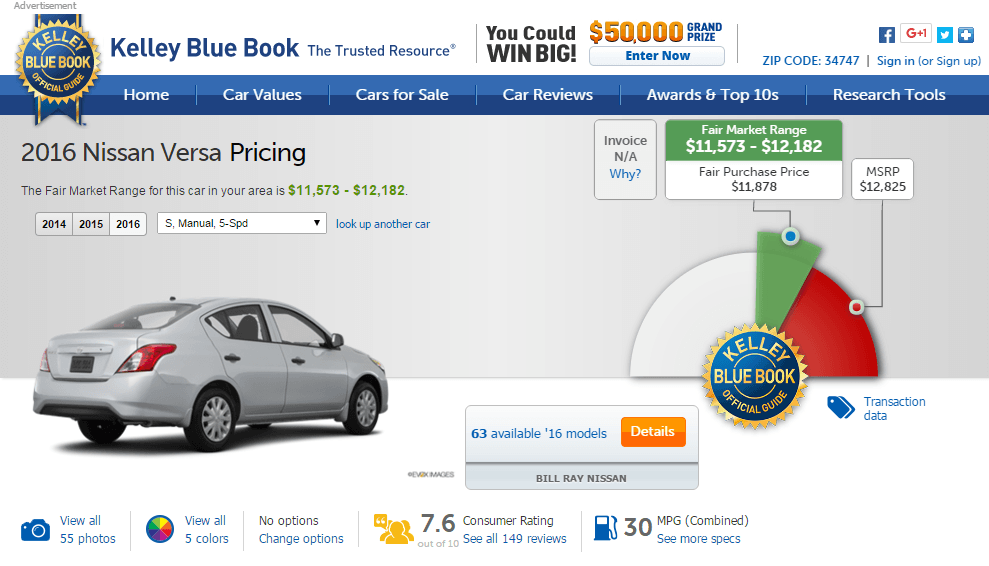
This plan only works if you know what you want. If you think you want a sedan but aren’t sure what make or model, this process won’t work. You need to have a specific car in mind. Go onto sites like Kelley Blue Book to see what other people in your area have paid for the model you’re looking for. Kelley Blue Book will show you what a great deal looks compared to a poor one. This will give you a gauge of what to shoot for during negotiations.
For this example, we’ll use a basic Nissan Versa (see below for screenshot). From this you can see that MSPR is 12,835, but people are not paying close to that. Instead, a fair price is considered to be between $11,573-$12,182, with the average at $11,878. We’ll be looking to beat that.
Plan Your Targets
Next, find dealers in your area that stock the car you want that have a decent reputation. I recommend identifying at least 5-10 dealers. Then pour yourself a cup of coffee and get ready to spend some time on email.
Send each dealer a note with this script:
“Hi there,
I am interested in buying the 2016 Nissan Versa, model S. I will definitely be buying it one way or another on Saturday, but I’m looking for the best deal in the area. Can you tell me what your best out-the-door price is—inclusive of all fees?”
You will get very prompt responses. Some will try to call you; tell them you prefer to keep things over email. Others will try to talk about monthly payments or financing and some will decline to negotiate over email at all, so scratch them off the list. But several will get back to you with a price. Go over each offer to ensure the price is inclusive of all fees.
Once you have a few offers, send a note to each dealer in turn. Tell them what the best offer is and ask them if they can beat it:
“Hi there,
City Nissan said they can give me the Versa for $11,800 with everything included; can you give me a better deal?”
At that point, some dealers will bow out. But others will come back with a lower offer, in which case you repeat the process again with the other dealers until everyone has bottomed out. At that point, you should be at the lowest end—or even lower—than the best price Kelley Blue Book listed.
Time to Pick Up Your Car
From there it’s very easy. Let the dealer know you’re on your way so they can clean up the car, print off the email with the final price you agreed to and stroll into the dealership. Show whoever comes to help you the email and they will connect you with their sales manager.
If they try to change anything you agreed upon—if they claim the car isn’t in stock, they have a similar model with certain upgrades, etc—you are to stand by that email and walk out if necessary. You have an offer in print, so this rarely happens at reputable dealers, but you should be prepared in case of surprises.
Once you know the car you want at the price you agreed on is there and ready, then you can discuss financing options if needed. Again, be careful here that they stick to the out-the-door price you agreed on and ensure they don’t add on extended warranties or service packages. Keep saying no until all of the paperwork is done.
With all of the negotiation and prep work out of the way, you should be in and out of the dealership with your new car in less than an hour. Congratulations! Despite a desire to hide from negotiations, you successfully argued down the price and got a great deal. This is a great way to buy a car without the hassle and stress of a high-pressure salesman.
How about you all? What have you found is the best approach for negotiating when buying a car?
Share your experiences by commenting below!

Money-Saving Tips for the Best College Christmas Gifts

 The following is a guest post by Savanna O’Conner. Enjoy!
Oh, Christmas, our joy and our wallets’ curse! No matter how much you love Christmas, it is almost impossible to ignore the fact that the winter holidays can be quite hurtful to our budgets. From the Christmas tree to the gifts and the dinner, everything can end up costing quite a lot of money. If you haven’t been thorough enough with your budget planning, you may find yourself scraping the bottom of the barrel – even more so if you’re a college student and your budget is limited.
So, how do you survive the Christmas season without turning from Santa Red to Sadness Blue? How do you offer gifts that are meaningful and budget-friendly?
Believe it or not, this is not Mission Impossible: The Winter Edition. It is doable, and achieving gift greatness will keep Christmas spirits higher than the Old Man’s reindeer-drawn sleigh.
Jingle your creativity, because your budget-friendly presents are going to be amazingly awesome!
Start Early
No, really, start early. The sooner you begin searching for gift ideas, the more time you will have to decide what presents your friends and relatives will genuinely love.
Not only that, but you will also have a better chance of saving money on gifts: running for the perfect present on Christmas Eve is not just exhausting, but it can be very pricy too. According to statistics released in 2014 by CreditCards.com, you are much more likely to over-spend when you are in a negative state – angry, for example, that you can’t find anything. It’s equally probable that you will over-spend when you’re in a good mood too, if you are overcome by Christmas spirit.
Add this to the fact that everything in supermarkets and stores is gorgeously arranged to tempt you to buy more during the holiday season, so you will almost definitely spend too much if you procrastinate on your gift buying plans.
Ready, Set, Hunt!
…for special offers, obviously!
The good news about the holiday season is that it starts with Thanksgiving. While this may be yet another holiday that pushes us to over-spend, you can use its aftermath the smart way – by keeping your eyes peeled for offers on Black Friday and Cyber Monday.
If you have a particular gift in mind (which may be a little over your budget), stay put and connect yourself to the aforementioned commercial events. You can get huge discounts on great products – and amaze your friends and family with gifts they will really enjoy.
This is not to say that you should buy everything you see on discount. Stay focused and hunt for those specific products you want to buy for Christmas – try to stay away from special offers you weren’t actually looking for.
Let Them Choose the Gift
Gift cards are an amazing way to save money and time, as well as making sure your Christmas gift will be warmly welcomed.
As long as you know that the recipient would buy from company “X”, giving them a gift card for its products will be more than well-received. Here are some ideas you could consider:
- A Netflix gift card.
- We all have that friend – the one who binge-watches TV shows and movies online. So why not provide him/her with the chance to do it completely free for the upcoming months?
- An airline gift card.
- Offering airline gift cards may sound like an awfully expensive thing to do, but here’s the trick: many airline companies accept credit card reward points/travel points, which you can use to buy gift cards from them. And there are many credit cards with special offers on reward points and travel points (Harvard Card, Venture from Capital One and BankAmericard Travel Rewards Credit Card, to name a few).
- A gift card for their favorite store.
- If your friend or relative likes shopping in a particular store, they would be more than happy to use a gift card there. This way, they can choose to spend the money on whatever products they want.
- An Amazon gift card.
- We all know that Amazon is the wonderland of everything you could ever need. So if you aren’t certain as to what someone would like, offering them this means the world is their oyster in terms of online shopping options.
Do It Yourself
Can you bake, sew, glue or knit?
If so, perfect – Pinterest is there to provide you with an almost infinite number of ideas! From the fanciest cake recipes to the cutest sweaters, the Internet can give you inspiration for just about anything you might be able to do with your own hands.
This type of gift works for people who are closer to you. They will appreciate the effort you’ve put into crafting a present from scratch. Plus, you know what they like and dislike, so you know what types of things they would enjoy more.
The key to making beautiful DIY gifts lies in making sure they are useful, unique and appealing. Avoid boring things people could easily buy from the store (e.g. a pair of handmade white socks). Don’t make presents people will never use (e.g. a crocheted photo frame). Last, but not least, don’t offer DIY gifts that are flawed or haven’t turned out as planned (e.g. a sweater that is smaller than you wanted it).
Be creative – not having the help of Santa’s reindeer and elves is the only limit when it comes to giving gifts that are appreciated and affordable! Have a Merry Christmas and a Happily Wealthy New Year!
How about you all? Do you have a college student on your Christmas gift list? What do you have in mind to get them?
Share your experiences by commenting below!
***Photo courtesy of https://www.flickr.com/photos/mattnazario/13971207088/in/
Most Ridiculous Myths About Structured Settlement Markets

The following post is a guest post. Enjoy!
Just like any other financial and legal instrument, there are numerous rumors and myths that float around about structured settlements. These myths only result in creating complete and utter confusion in the minds of those who are considering selling their structured settlements. If you are one of those people who are absolutely unsure of whether to go ahead with a structured settlement sale or not, here are a few myths about structured settlements markets we have busted for you.
Lawyers and attorneys should avoid recommending structured settlements to their clients as they are bound to cash out
It is a common misconception among lawyers, attorneys and even structured settlement payment recipients that lawyers should avoid recommending structured settlements to their clients as they are most likely to cash it out. On the contrary, it is a proven fact that an estimated 95% of structured settlement recipients avoid selling their structured settlement payments. It is only in a situation where the circumstances of the receiver drastically change from the time of the settlement that he or she may consider cashing out. So lawyers must urge clients to get structured settlements. By becoming a recipient of a structured settlement the client will also acquire guaranteed financial security.
If a recipient cashes out his structured settlement he is liable to pay tax on the lump sum amount
This is yet another misconception that people have in their minds. If your structured settlement payments are tax free, then he is not liable to pay tax on the lump sum amount when you cash out. The recipient is only liable to pay tax on the lump sum cash amount when his structured settlement is also taxable.
The court doesn’t carefully scrutinize the case before giving an approval
Some people believe that the court approves almost all cash outs without scrutinizing the case carefully. This is an absolutely ridiculous myth about structured settlements. Invariably, purchasers of structured settlements only take up deals that are more likely to get court approval. If the structured settlement purchase company has a strong reason to believe that the court will not give an approval to cash out, the company will not take up the case.
Companies that purchase structured settlements and the overall structured settlement industry are unregulated.
This is another major misconception that even lawyers and financial analysts have about structured settlements purchasing industry. Contrary to popular belief, companies that purchase structured settlements are subject to numerous taxation as well as other laws. Both the court as well as the income tax bodies thoroughly scrutinize the case before approval. Even if the structured settlement purchase company has complied with all the laws, if the court has reasons to believe that the transaction is not in the best interest of the annuitant, the court will not approve the application. Further the purchasing company will be liable to pay all the direct and indirect expenses such as filing fees, attorney costs, etc. Additionally if there is ever a situation wherein the purchase company does not comply with the law, they will be liable to pay heavy fines and penalties.
So if you had any doubts and hesitations about the structured settlement industry to countless myths that have floated around, you needn’t stress anymore. The structured settlement industry is a properly regulated industry that always aims at working in the best interest of the annuitant. So before you take any decision on cashing out your structured settlement please ask your attorney to clarify all the misconceptions and doubts you may have.

How to Buy a Car From a Car Rental Company

 The following is a post by MPFJ staff writer, Kevin Mercadante, who is a freelance professional personal finance blogger for hire, and the owner of his own personal finance blog, OutOfYourRut.com. He has backgrounds in both accounting and the mortgage industry.
Most people think that there are two places to buy a used car – a used car dealer or an individual. But there’s actually a third, and that’s a car rental company. They sell thousands of cars each year, offering many of the same advantages that you get in working with a car dealership, except you’ll usually pay thousands of dollars less for the car you want to buy.
We’re going to cover the basics of buying a car from a car rental company. We’re going to use Hertz as an example. Hertz has a dedicated web page for car sales, appropriately titled Hertz Car Sales. From that page, you can browse hundreds of cars in your area that are being offered for sale. Within 100 miles of Boston, Hertz has over 1,400 cars available, but you can pick any large city near you.
Lower Prices than Used Car Dealers
Car rental companies are not car dealers, so they aren’t looking to maximize the profit on the sale of their cars. They also don’t have commissioned sales people who need to be paid out of the proceeds. They mostly want to sell off their large fleets of existing cars to make room for newer models. Car rental companies generally use a car for two or three years, then it’s time to replace it. All of that works to your advantage when it comes to price.
Most of the cars offered for sale on the Hertz Car Sales page are one or two years old, and typically have between 30,000 and 60,000 miles on them.
Some examples of what’s available:
- 2014 Volkswagen Jetta SE with 46,000 miles, $10,375
- 2013 Chevrolet Cruze LT, 56,000 miles, $9,475
- 2015 Chrysler Town and Country Touring Van, 40,000 miles, $21,779
- 2014 Ford Fiesta SE, 41,000 miles, $8,900
- 2014 Honda Accord Sedan LX, 42,000 miles, $14,700
- 2014 Hyundai Elantra SE, 48,000 miles, $10,475
If you click on the link for each vehicle, you’ll be looking at a page that looks very similar to what you will see on a dedicated used car dealership page. They list all of the details of the car, including options, and provide multiple photos of the vehicle. You can also book a three day test rental, ask a question, or apply for financing – all on the same page.
Wider Selection than Used Car Dealers
Used car dealers typically have small numbers of cars of a certain model and make. Selection is limited by what ever type and number of vehicles that come to the lot. Car rental companies however buy fleets of cars. That means that they may have dozens of similar makes and models of the same car, almost the way new car dealers have new cars.
That means you will have more options than you will have with a used car dealer. If you don’t like the color, you can choose another (though admittedly, car rental companies have limited color selection as a general rule). Don’t like the sound system in one car? Move on to the next.
Car rental companies are almost unique in their ability to offer multiple options on used cars within the same make and model. The Hertz Car Sales page conveniently groups similar makes and models in the same place, so you can choose the car you like best.
And if you don’t see the option package in the make and model that you want, you can wait a few days. More inventory is always coming in.
Rent2Buy – A Chance to Test Drive the Car You May Buy
Hertz has a program called Rent2Buy that gives you a three day trial period to test drive the car. You rent the car for three days at the going rate, and if you decide you like the car, you can buy it. The three day rental charge will be waived upon completion of the sale.
This is a big advantage. Test driving a car for 15 or 20 minutes, as is the custom with used car dealers, is not nearly enough time to become familiar with how a car runs and feels. But with three days, you’ll have a much better idea if the car is right for you. You can even use that time to have the car thoroughly checked out by your mechanic to see if there are any hidden flaws. In fact, Hertz recommends that you do just that.
Warranties and Extended Warranties
Just as is the case with used car dealerships, cars sold by car rental companies come with remaining factory warranties. So if a car is two years old and has 40,000 miles on it, and the manufacturer warranty is seven years or 100,000 miles, it will be good for another five years or 60,000 miles, whichever comes first.
With Hertz, all vehicles come with a 12 month/12,000 mile powertrain limited warranty. And you can purchase extended protection plans from the company as well.
Yes, You Can Even Get Financing
Car rental companies don’t extend financing directly, but much like car dealerships, they work to match you with lenders to get the best rate and loan for you. Hertz even has an auto loan calculator tool on the site.
And once again, you can apply for financing directly from the Hertz website. The financing and all the paperwork will be handled online, which will also reduce the tension that often comes from face-to-face negotiations.
Accepting Your Car as a Trade-In
One other point worth mentioning: Hertz will accept your current vehicle as a trade-in toward the purchase of one of their cars. This is one of the primary reasons car buyers go to used car dealers, so that they can trade in their current vehicle hassle-free, or not have to sell it themselves.
The Hertz site doesn’t give details as to the terms of trade-in acceptance. For example, they don’t list any limits as to age, condition or mileage. But if there are any limits, you can always sell the car to CarMax (trust me, they’ll buy a car in any condition, year or mileage!) or a used car dealer in your area that buys cars even if you don’t by one from them.
So there you have the basics on buying a car from a car rental company. We’ve used Hertz as a model, but you can find similar opportunities at other car rental companies. Check them out when it’s time to buy a new car, I think you’ll be pleasantly surprised.
How about you all? Have you or someone you know purchased a car from a car rental company? What other tips do you have for purchasing a car from a car rental company?
Share your experiences by commenting below!
***Photo courtesy https://www.flickr.com/photos/44603071@N00/8135713685/sizes/q/