
All posts by J. Irwin
Save Money on Food with Your Own Garden
 The following is a post by MPFJ staff writer, Jeff. Jeff writes about reducing waste, saving money and building freedom at his website, Sustainable Life Blog.
My wife and I have had our fixed expenses (aka our monthly nut) under control for quite a while now, but occasionally we still spend way too much in the non-fixed categories, which can break the budget and really cut into the savings we want to put away to reach our goals.
The category can change based on things going on (such as house renovations) but typically the one expense that can always blow the budget is food.
One of our favorite ways to combat this is to plant a garden. Planting a garden doesn’t cost a lot, and can be a great hobby that many people will enjoy. Not only do people enjoy it, but aside from a few things the hobby is free and should keep you from spending money in other areas!
You don’t need a lot of skills for gardening, and in some areas you can garden almost all year long. Even in Wyoming where I live, you can garden from early April to late October as long as you’re planting the right things at the right time.
Look at What You Already Buy
The first way that we saved some money with a garden was to look at what we buy at the grocery store. During the summer, my wife & I like to eat salads with a bit of protein (chicken, fish, etc) on them, so we started there. Our first try at a garden included salad fixings, such as tomatoes, cucumbers, carrots and kale. We knew that we would eat these things once they grew, so all we had to do now is not kill them.
We got a packet of seeds for each of the items we wanted at the local flower store and our total cost was about $10. After that, it was simply labor that we did to get the garden going. We watered daily and waited until the fall to reap what we had sown.
After The First Season
Our first season in the garden was not all that successful, but we still were able to recoup all of our costs and save quite a bit of money on our food that fall. While our grocery budget didn’t go down for every single month of the year, we were able to make quite a bit of progress during the 3 months that we harvested stuff from the garden. We were able to lower our grocery bill by 20% or so each month, which was quite nice.
No Yard? No Problem!
For you apartment dwellers: don’t despair! You can give your own veggies a try in some pots on the patio or deck, but I suggest starting with herbs.
Herbs typically cost quite a bit of money at the grocery store and I can never seem to use them all before they go bad. Having them in pots out on the porch will allow you access to fresh herbs all the time, and you can even move them inside when the weather goes bad. A few of my favorites are basil (for pizza, salads and more) and mint (for mojitos!).
So if you’re looking to get started, think about what vegetables that you eat frequently and give some of those a try. All you need is some seeds and the willingness to do a little work outside in the summer time – which shouldn’t be too difficult.
How about you all? Do you have a garden? If so, what do you put in there? Has having a garden saved you money at the grocery store?
Share your experiences by commenting below!
***Photo courtesy mym [CC BY-SA 2.0 (http://creativecommons.org/licenses/by-sa/2.0)], via Wikimedia Commons

5 Ways to Avoid Borrowing Against Your Tax Refund
 Anum Yoon recently joined the blogging bandwagon to write about money management, frugal advice, and financial trends. She started and maintains her personal finance blog, Current on Currency.
Tax season is pretty much over now that April 15th is just around the corner. While many have already received their tax returns, there are others who are still waiting. For those of you that are still sitting tight, you’re probably hankering for that glorious check so that you can indulge in a big purchase, pay off debt, or pay outstanding bills.
Until 2013, the most popular method for getting your refund quickly was the Refund Anticipation Loan. The Refund Anticipation Loan (RAL) is a loan taken against the taxpayer’s anticipated tax refund. This loan usually lasts for 7-14 days before the IRS actually issues the refund check.
Although RALs allow you to get your cash a little bit earlier than waiting for a check from the IRS, they are both costly and inherently risky. Loan fees typically range from $30 to $130 and sometimes additional fees are added on top of that. If you expected a refund of around a few thousand dollars, you can see a significant chunk of change deducted from your refund as fees. Are all these additional costs worth getting your refund a mere week or two faster than waiting for the IRS?
In addition to these fees and costs, there is also risk involved with taking out a RAL. This loan must be repaid even if the IRS denies or delays your refund, or even if your refund is smaller than you anticipated. This can mean costly interest payments if you do not repay the loan and it will end up negatively affecting your credit score or your account being sent to a debt collector.
Be Careful
Many tax time advertisements for “Fast Cash Refunds,” “Money Now,” or “Instant Refunds” are actually Refund Anticipation Loans. These ads are targeted towards people who need money in a pinch and believe they cannot wait the extra week or two for their refund to come in. The fees involved and the risks of not getting enough money for your refund are too high to justify getting your money a little earlier.
There are ways to get your money as quickly as possible without taking out a Refund Anticipation Loan. Avoid the temptation of taking less money now instead of more money later.
Instead of putting yourself in a financial blunder, you can avoid the entire dilemma in the first place by following these five steps:
1. File Early
While this won’t help you now, it is something to keep in mind for next year. Filing your taxes earlier will not only improve your chances of getting a quick refund, but you will also be able to track the status of your tax refund if you do it online. You’ll be thanking your impatient self next year when you won’t have to wait until April.
2. Borrow the Money from a Friend or Family Member
One of the reasons you shouldn’t borrow against your tax refund is because you may not get as much as you anticipate. Since loans against tax refunds usually come with high interest rates, you end up further in debt. Borrowing money from a friend or family member saves you from that because you will probably not have to deal with interest and if you don’t get as much as you planned from the IRS, you’ll have longer to pay the loan back without penalties.
3. File Online and Check the Status
If you haven’t filed yet, consider doing it online. Taxes filed online are often processed faster. You can also check the status of your check. While you may check it multiple times a day as you eagerly await its arrival, it’s better than taking out a loan against it.
4. Choose the Direct Deposit Option
Just as filing online speeds up the process, so does choosing the direct deposit method. This is mostly because you don’t have to wait on the postal service for your check.
5. Decrease the Tax Return Amount
If you have a really hard time not borrowing against the refund, you may want to consider cutting down your refund check next year. You can do this by paying less to the IRS throughout the year. This does make tax season less enjoyable if you get money back, but it helps you battle the urge to borrow against it.
Patience is a virtue. While you’re excited about having some extra money to play with, try to tell yourself that even though waiting a few more weeks might hurt a little now, borrowing against your refund will hurt a lot more later.
How about you all? Do you have any experiences with RALs? Do you have other ideas or tips on how to not borrow against your tax refund?
Share your experiences by commenting below!
***Photo courtesy https://www.flickr.com/photos/carbonnyc/2204277278
How Each Generation Affects the Next One Financially
 The following post is by MPFJ staff writer, Melissa Batai. Melissa is a freelance writer who covers topics ranging from personal finance to business to organics to food. She blogs at Mom’s Plans where she shares her family’s journey to healthier living and paying down debt.
When I went to college, I was the first in my family to do so. I earned a scholarship to our local community college, and did not have to pay any of my tuition or fees. I transferred to a large state university, and the first semester I was there, I received a generous financial aid package funded mostly by grants.
However, the next year I was at the university, there was a change in presidents (and policy). While I still received financial aid, it was for student loans, not grants. I left college with $20,000 in student loan debt.
When I went to graduate school, I received a stipend, but I still had to take out some student loans for my living expenses. I had $10,000 in student loans from grad school, leaving me with a total of $24,000 in student loans. (I had paid off some of my student loan debt after my undergraduate degree when I worked full time for 18 months before graduate school.)
I just paid those loans off a few years ago!
Because of my experience, I am determined that my children will attend college without student loans or with a minimal amount (less than $10,000). I don’t want student loans to impede my children’s future as they did mine. (I just became a home owner last year!)
Many Gen Xers (my generation), were the first in their family to attend college. Our parents had no experience with the college process or the enormous costs of college. But now that many of us have been through the experience, we’re better able to guide our children.
Our children will reap the benefits of our experiences with student loans. In fact, some children (and parents) are deciding that college is not worth the expense. Others are deciding that it doesn’t make sense to go away to an expensive school but rather that it’s more cost-effective to attend the local college or university. Students are now choosing majors more wisely.
This change is in large part due to the backlash from my generation being saddled with student loan debt.
Millenials are approaching college differently than Gen Xers.
Millenials, just like every generation, have been financially affected by the previous generation.
Life is indeed cyclical, and we see that clearly when looking at each generation financially.
The Boomers React to Parents Who Grew Up During the Depression
My grandparents were married in 1934, during The Great Depression. They had nine children and were extremely frugal. I routinely saw my grandmother wash used pieces of tin foil and plastic baggies. She never wasted anything, and she repurposed many items. She had a few, loved possessions. She definitely didn’t have clutter.
Children of those who grew up and were in young adulthood during The Great Depression, the Baby Boomer generation (born between 1945 and 1966), knew the value of saving from their parents. However, perhaps because of the tight financial reins of their parents and because they grew up in a time when the economy was booming, the Boomer generation often suffers financially. David Rodriguez, a Financial Education Advocate with Generations Federal Credit Union argues, “[Baby boomers] knew better. They spent their money and didn’t save, but they knew the concept of saving based on their parents and elders who lived through the Great Depression” (Go Banking Rates).
Of my grandparents’ children, about a third are frugal and very responsible financially. Another third worked hard to earn a good income so they could spend freely. The remaining children have struggled financially with debt, overspending, and bankruptcy.
Even though your parents may teach you how to handle money, either explicitly or through example based on their own experience, you still ultimately decide how to handle your own money, as my grandparents’ children demonstrate.
Gen X Generation Carries Debt
Many Baby Boomers were free spenders, and their children learned from this example. Gen X (born between 1967 and 1982) was the first generation to have easy access to both credit cards and student loans, and many of them fell into debt quickly. According to Financial Advisor Magazine, “Gen Xers are debt-laden. Almost 45% say they have too much debt to even think about saving or investing, and 35% think they will be in debt for the rest of their lives.”
I am one of those debt-laden Gen Xers. However, in the last few years, my husband and I have paid off half of our debt. (We now only have student loan debt for my husband left, not including our home loan). We’re living on a very strict budget, and we refuse to acquire any new debt. Within the next 5 years, our finances should be MUCH better, assuming we stay on our current path.
I am able to do this in part by remembering my grandma’s example of frugality and also learning from my aunts and uncles who are also frugal like my grandmother.
The cyclical nature of life continues. For those who grew up during the Great Depression, the pendulum swung to extreme thrift out of necessity and then habit. Baby Boomers and Gen Xers swung the other way thanks to secure jobs and a good economy for Boomers and easy access to credit for Gen Xers. Now the pendulum is beginning to swing back to thrift.
The Millennial Generation
The Millennials, sometimes called Gen Y (born in 1983 to 1994), grew up seeing their parents spend freely and acquire hefty quantities of debt. However, The Millennials suffered from the recent recession and have likely found it hard to secure a full-time job let alone one that pays well. Many of them choose to freelance, but then they have the large expenses of self-employment taxes and medical insurance.
This generation is more likely to be financially conservative. “Despite these difficult financial circumstances, and perhaps because of them, studies find Millennials are the best at saving money of all generations. Rodriguez explains, ‘I think Millennials will be the best savers, because they have witnessed firsthand not only the recession, but also their own parents struggling to save for and pay for retirement’” (Go Banking Rates).
Influenced by Circumstances
Each generation has learned a financial lesson from a previous generation. A look back over the last 85 years shows a routine pendulum shift—thrift for those who lived through the Great Depression, free spending for Baby Boomers and Gen Xers, and now a shift to thrift again with the Millennials.
True, we learn from each previous generation, but we’re also influenced by world circumstances.
The Baby Boomers benefited from a booming economy and employer pensions.
Gen Xers likely lived through the recession of the 1980s and saw a decline in employer pensions. Gen Xers became the first generation to have the heavy burden of saving for retirement almost entirely themselves.
Millennials have been influenced by our most recent recession and may have trouble finding and keeping a good paying job. Because money is scarce, they’re frugal and finding new ways to enjoy their lives like seeking experiences rather than the American Dream of owning a house.
How about you all? How have you been influenced financially by the generation before you and world circumstances? Do you think you’ve learned valuable financial lessons from your parents, or do you try to handling your money opposite of the way your parents handled money?
Share your experiences by commenting below!
***Photo courtesy https://www.flickr.com/photos/edanley/4289324169

Cleaning Up Your Resume in Preparation For the Job Search
 The following is a post by MPFJ staff writer, Jeff. Jeff writes about sustainable living and finances at his website, Sustainable Life Blog. Jeff really enjoys traveling with his wife as much as he can, to wherever he can.
For all of you students, it’s spring break time, and that means one thing – it’s time to straighten up your resume so you can get a summer job. Even if you’re not a student but are someone looking to take that next step in your career, now is a great time to be searching for jobs. The economy seems to be on the upswing, hiring is increasing and the economy seems to have some tailwinds behind it. Even though it’s been a long bull market, hiring is finally catching up.
Over the years, I personally have found that my salary increases most with job hopping, not with staying with the same firm (this holds true for others as well). Here are a few things that you can do before you start putting your resume out there that will increase your chances of getting an interview.
Scrub your Online Persona
First, Google yourself. You’ll want to look through the first 3 or so pages and make sure there’s nothing untrue or untoward on those top three pages. If employers see anything is wrong there, they’ll toss your resume in the garbage can.
Do the same thing on Facebook, or better yet make sure your profile is private.
Lastly, clean up your LinkedIn profile. Update your skills, add new relevant experience, publications and anything else that will make you look good on paper. They’ll allow you to link to slideshows, so perhaps put a seminar or conference talk you gave on your LinkedIn profile. If you’re a programmer, link to Github. Make sure to put your best online foot forward when looking for new employment.
Buff up your Resume
Even though your online presence matters (a lot), you still need to make yourself look good on paper. Make sure that everything has been spelled correctly, that all of your updated contact information is on there (including a professional email, not something like soccerguy12@aol.com). Make sure you sound as good as possible, and make sure that you’re able to accurately describe what you’ve done thus far in your career – even if you’re a student. Use numbers and other real metrics that show a performance improvement or something else.
For a lot of people, this stuff is difficult to do and they feel uncomfortable doing it. If this is you (it’s me at times as well, but I’ve gotten better) then you should consider using a resume writing service. Honestly, I didn’t have any idea these existed before, but the value seems pretty solid. Of the ones that I looked at initially, Executive Drafts seemed like a great option. After a bit of back and forth emails with them, I almost hired them myself (though I don’t quite need a new resume – yet).
Network
Yes, this advice is tired and cliche, but it’s a cliche for a reason – it works. If you’re looking for a new job, you need to get out there and meet people and let them know! Consider going to chamber of commerce events in your town (they typically have a young professionals specific group) and introduce yourself. Chat with other people there and get to know them. Let them know that you may be in the market for something new, but most importantly, ask them how you can help them reach their goals.
Even if they don’t take you up on, they’ll remember you as someone always willing to help (which will come in handy when they are talking to others about you). Keep making new connections, and your network will grow and your position will improve in the long run, even if it doesn’t directly lead to a job now – it could in the future.
Finally figure out what your skills are, and what you have to offer an employer. Are you great at marketing, or are you better with sales? You want to figure out how your skills well help your future employer grow their business – not what you can do to earn a paycheck from them.
How about you all? When was the last time you switched jobs? How did it come about, and how did it work out?
Share your experiences by commenting below!
***Photo courtesy https://www.flickr.com/photos/124247024@N07/13903383190/

Six Inexpensive Ways To Get Your Yard Ready For Summer
The following post is by MPFJ staff writer Travis, who blogs at Enemy of Debt where he candidly shares his family’s financial struggles, failures and successes. As a father and husband, he provides a unique perspective on balancing debt, finances, and family.
I remember driving through a neighborhood with big houses when I was a teenager and admiring the immaculately manicured lawns, the perfectly shaped trees, and landscaping that looked so perfect I wondered if it was fake. My yard may not look quite as exquisite as the ones I remember from my childhood, but I take pride in the exterior of my home. It’s really not that difficult, and it isn’t even that expensive. To give myself the best chance of having a great looking yard this year, there’s one thing that I absolutely must do.
If I want a great looking yard, I have to start early.
Here’s my list of the top six things I will be doing in the next week or so to get my yard green and growing as quickly as possible, as well as how much it will cost me:
 1. Get A Rake

This is especially essential for me because I live in a cold weather climate where my grass gets matted down by 6 months of snow. Raking the yard will remove the dead grass, making it easier for the blades that remain to get the needed sunlight to start growing again. A good lawn rake can be had for about $15 from Walmart and will last for years.
2. Fertilize The Lawn
The first application of fertilizer is the most essential. The recommended application will not only give the grass the needed nutrients to start growing quickly, but it also contains crabgrass killer. Crabgrass cannot be killed during the growing season after it pops up in the lawn. When it comes to crabgrass, prevention is the only solution, and it must be done early in the spring. I picked up a bag of Crabgrass Halts plus fertilizer on sale at Costco over the weekend for $47.
 Note: To apply the fertilizer, I use my broadcast spreader. One of these costs $35, but it can be used for years. Mine is over 10 years old and still going strong.
3. Spike The Trees
One of my favorite things to do in Summer is to lay in the grass and listen to a warm breeze rustle the tree leaves. They give us shade, and they look majestic in our yard. Trees need food, so I give them some fertilizer spikes in the Spring and then again in the Fall. The spikes are put into the ground along the perimeter of the estimated root line. The bigger the tree, the more spikes you need. I can get by with one $10 package of tree spikes for my Spring application.
4. Trim The Bushes
When my wife and I bought our first house, I decided to trim the bushes in the front of my house in the middle of July. I cut off almost all the leaves, exposing the leafless, uninteresting branches of the infrastructure of the bushes. Guess what, friends? New leaves didn’t grow back and I was left wondering if I had killed my bushes. The next Spring all was good, but I’ll never forget staring at my dead looking bushes for months. Now I trim my bushes in the Spring before they start growing. There are more expensive electric trimmers, but I get by just fine with my $20 hedge shears I picked up at Home Depot.
5. Trim The Trees
As my trees grow, they sometimes extend towards the house, power lines, or just create a shape that isn’t nice to look at. Spring is a great time to take off those unwanted branches. I have a 14 foot Bypass Pruner that allows me to easily remove almost any branch I on my trees. I purchased mine for $40 a few years ago, and it still looks brand new.
 6. Replace Mulch



Some people have rock around their landscaping, and some have mulch. We have a combination of both solutions. The wood mulch discolors and disintegrates over the summer months so I like to refresh my mulch in the Spring. Mulch costs about $2 a bag, and I can get my job done for a total cost of $14.
Overall Costs
One Time Costs:
- Fertilizer Spreader: $35
- Hedge Shears: $20
- Bypass Pruner: $40
Total: $95
Yearly Costs:
- Rake: $15
- Fertilizer: $47
- Tree Spikes $10
- Mulch: $14
Total: $86
I used the phrase, “One Time Costs,” for items that can be used for years. Obviously they may break or eventually wear out, but they’re not an expense that will be incurred every year. The point is, given an afternoon of being outside in the sunshine and a relatively small amount of money I will get my yard in tip top shape for the coming growing season.
Maybe you’ve admired someone’s luscious looking yard wishing that someday yours could look like that. If you like working outside, with a little effort you can inexpensively make your lawn the envy of the neighborhood. The time to make it happen is now, so grab your tools and get to work!
How about you all? Do you like to work on your yard? Is there anything else you would add to this list to help make your yard look the best is possibly can? How much do you spend each Spring getting your yard ready for the warm season?
Share your experiences by commenting below!

Things to do Over Spring Break Without Breaking the Bank

 This following is a post by MPFJ staff writer, Jeff. Jeff writes about sustainable living and finances at his website, Sustainable Life Blog. Jeff really enjoys traveling with his wife as much as he can, to wherever he can.
It’s March, and that means it’s almost spring break for those of you in school or those of you with school age children. Unfortunately, I’m neither and don’t get any time off, but that doesn’t mean that it’s not any fun to day dream and research about vacations I would take if I could.
A Matter of Time
One of the first things that I look for when planning a vacation is how much time I have. Many on spring break have a week (9 days if you count both weekends) but not everyone wants to be away from home for that long. It doesn’t leave a lot of time for you to get settled back into school and work or take care of any small things around the house before you hit the road.
This is a common trap to fall into, and I’ll admit it happens to me all the time. I went on a two week vacation once, and gave myself exactly half a day before I had to go back to work again. I was scrambling the rest of the week to get caught up with housework and other things.
Picking The Right Place
There are plenty of great places that you can go to, and even more so when the weather is warm. My favorite thing to do on vacation is go camping or spend time outdoors. In March, the weather may be a bit cold for tent camping, but there’s probably a scenic area (like the forest service or recreation.gov) near you where you can rent a cabin or something similar to stay in for a few days. Once you get the lodging and travel costs taken care of, you can soak up all the time you need in nature and enjoy the free entertainment it provides.
Of course, if that’s a bit out of your price range, considering doing a few “staycations“. If you’re unfamiliar with the term, a staycation is where you stick around your local area, and do “touristy” things that you have not done yet, or have not had a chance to do up to this point. I can’t tell you how many times that I’ve gone to visit friends in other cities and asked about going to a specific place, only to have them respond with something similar to “we’ve lived here X years and have never been there”. You can check out local museums, an art show or perhaps a local play.
The last time I tried this, I went on a “food tour” and found a bunch of awesome restaurants and had a little bit to eat at each one. I really enjoyed the food tour, and I didn’t have to deal with the major expense of a vacation. There’s also no travel headaches to deal with, like airport parking and long lines.
Relax on the Cheap
I’ve never found a reason for vacations to be difficult on the pocketbook, but sometimes people can make them that way. Getting away and spending time with those that you care about is what matters, not where you go or what you’ll be doing. Focus on the right things when you’re vacationing, and you can easily save a bit of money too.
How about you all? What sort of things do you like to do for spring break that can also help you save a little money?
Share your experiences by commenting below!
***Photo courtesy https://www.flickr.com/photos/tomronworldwide/16048660691/

Should You Cut Up Your Credit Cards?

 The following is a post by MPFJ staff writer, Derek Sall. Derek is the owner of the blog, LifeAndMyFinances.com, where he teaches people how to get out of debt, save money, and become wealthy.
There is a big dispute going on right now between those that are earning money with credit cards and those that cut them up because they want to avoid overspending.
One side loves to use their credit cards all the time because they earn hundreds of dollars a year with their reward points, and they just simply don’t understand why anyone would forgo this money that the credit card companies are giving away, free of charge! Then, there are those that have seen families rack up credit card debts to the point where they were unable to pay even the minimum balance. Due to this fear of overspending, people decide to do without credit cards entirely and live with only checks, debit cards, and cash.
So who is right? Should you cut up your credit cards and live on a cash basis?
The Credit Rewards Perspective
I got my undergraduate degree in Finance, and I thought I was pretty hot stuff when I got graduated. After all my courses, I had an understanding of net present value, future values, interest rates, price-per-earnings ratios. I knew almost everything that there was to know about Finance! I know that there was such a thing as good debt and bad debt. One helped you build even more wealth than you had currently, and the other ended up depreciating your assets, but when used as a tool for wealth, debt could be a great thing.
On a smaller scale, credit card rewards fall into this realm of good debt and bad debt. Obviously, if you hold a balance on your credit card and are making high interest payments each month, this would be considered a bad debt. But, what if you pay the balance off each month, and are still earning those rewards? This temporary debt (which you probably would have incurred anyway) is allowing you to earn points that can soon be redeemed for actual dollars. This must be a form of good debt right? Well, for those that are playing this game, they certainly think so.
The Cash Only Perspective
When we picture those that avoid credit card use, they are often over 60 years old, have gray hair, and are totally ignorant as to how easy money is made. Why would somebody ignore the use of credit cards when they could earn an extra $300 a year in credit card rewards points? It just seems ludicrous!
This group of people though, may not be as ignorant as you might think. Instead, many of them have done their research and discovered that credit card spending can actually hurt your finances by a greater amount than the rewards. How could this be? It’s pretty simple actually. Just follow this logic for a minute.
Let’s say that you withdraw $40 from the bank to spend on whatever you wish during the week. As you walk around the mall or in your downtown square, that $40 is safely in your pocket, just waiting to be spent. Throughout the week, you see some shoes that you might want to buy, but then think about how similar they are to what you already have, so you pass on them. Then, you see some artwork that you think might look nice in the house. But no, there really isn’t anywhere to put it. Finally, you decide to spend some of your money on a nice meal with your friends and on a book that you’ve been dying to get your hands on. Throughout this whole process of spending your own money, you actually have been quite selective.
Now, imagine that instead of pulling $40 out of your own bank account, your grandmother hands you $40 to buy whatever it is that you want. As you walk through the mall, you see a video game that looks pretty awesome and the price tag is $40. Perfect, you buy the game without thinking twice about it. For some reason, the thought that you put into your purchase has severely decreased, but why? It’s simple. You did nothing to earn the money.
The same is true with your credit card. Because we are not literally pulling the physical cash out of our bank account and handing it over to the cashier for a purchase, the emotional aspect has been severely decreased. Even though we are still paying for an item with our own money, it feels more like the $40 that we got from grandma, so we spend it more frivolously.
Studies have been performed that prove this theory. When we purchase items with credit cards, we tend to overspend. And, over the course of the year it is entirely likely that our over-purchasing will exceed the amount that we received back in rewards.
So Where Do I Stand?
I imagine that you’re asking the question, “Well what about you, Derek? Do you use credit cards?” The simple answer to that is, “Yes”, but I believe that I am a special situation. I am what you might call an extreme saver. When I was in high school already, I avoided going out to eat at Wendy’s or Burger King because I knew I could eat for cheaper at home. So, instead of giving into the peer pressure of my friends, I would invite them to my parents’ house so that we could eat their food for free!
Today really isn’t much different. I am extremely content with the possessions I own and feel no need to buy anything extra. For this reason, I don’t feel like I am overly compelled to buy more when I have a credit card in my hand. Or, even if I am, it’s probably the difference of spending $5.00 instead of $4.00. The difference is probably so minimal that the overall effect is unnoticeable.
For many though, I think that it would be the right move to cut up those credit cards. If your credit card bill is constantly over $200 a month, then you are probably consistently overspending and earning nothing on those credit reward points. And, in the grand scheme of things, if you are striving to become wealthy (the right way), then what impact does $300 a year really have? Probably little to none. Don’t get hung up on the credit card game. Instead, use it as little as possible and focus your efforts on reducing your expenses and increasing your income. By focusing on the big picture day in and day out, you will certainly come out ahead!
How about you all? Do you use a credit card? Do you feel like you spend more than usual because of it?
Share your experiences by commenting below!
***Photo courtesy https://www.flickr.com/photos/434pics/3494630853

Have We Forgotten How To Be Frugal?

 The following post is by MPFJ staff writer, Melissa Batai. Melissa is a freelance writer who covers topics ranging from personal finance to business to organics to food. She blogs at Mom’s Plans where she shares her family’s journey to healthier living and paying down debt.
I was born in the early 1970s. In 1978, there was a huge blizzard that closed school for over a week. I had hand-me-down boots that I wore, and yes, I wore bread bags to keep my feet dry in my boots. So did my best friend down the street and many of my classmates. It was normal.
After the storm, when school was closed, my friend and I put a ladder up by the side of the house and climbed up. We slid down off the roof into a huge pile of snow. I can’t tell you how many hours we did that and how much fun we had.
Too much fun, I guess, because the friction from the shingles wore out the seat of my snow pants. My mom was not impressed. Buying a new pair wasn’t an option. Instead, she set to work patching them.
Most of my clothes were hand me downs from my older cousins or thrift store finds. I didn’t feel bad when I got hand me downs. I was excited to see what new-to-me clothes I would get.
My family didn’t have much money; we had to be conservative. But most of my friends were in the same position, so living this way was normal.
Things have radically changed since then.
Now, if you rip out a pair of snow pants, you’ll likely get new ones because really, how can you be expected to go around with patches on the seat of your snow pants? No one walks around with patched clothes now, not even toddlers who don’t have friends they have to worry about impressing.
Frugality Is an (Unpopular) Option Now, Not a Treasured Skill
For many generations of Americans, being frugal was a treasured skill and a richly admired trait. My grandparents, who lived through the Great Depression, continued to be frugal into their old age. My grandma was well into her 80s when she finally stopped washing tin foil and baggies to reuse.
My aunt, who learned her frugality from my grandma, made hats for her bridesmaids’ to wear. The main component of the hats? An empty, washed tuna fish can that she covered in fabric to make the center of the hat. True story. (That hats looked good, too. You’d never guess what they were made of.)
Years ago, this type of frugality was not unusual. Now, it’s scoffed at or openly ridiculed.
Each Generation Is Wealthier Than the Previous One
This topic of how much our society has changed with regards to possessions and money was brought to the forefront recently when U.S. Senator Joni Ernst from Iowa mentioned wearing bread bags inside her boots when she was little. Twitter was soon abuzz with laughter and jokes about the use of bread bags.
Megan McArdle of Bloomberg View argued in support of Ernst, saying of America’s history, “all along, Americans got richer and things got cheaper—especially when global markets opened up. Payless will sell you a pair of child’s shoes for $15, which is about two hours of work even at minimum wage. Perhaps that sounds like a lot to you—two whole hours! But I’ve been researching historical American living standards for a project I’m working on, and if you’re familiar with what Americans used to spend on things, this sounds like a very good deal.”
McArdle goes way back to the late 1800s and says, “There’s a scene in one of the [Little House on the Prairie] books where Laura is excited to get her own tin cup for Christmas, because she previously had to share with her sister. Think about that. Now, go into your kitchen and look at your dishes. Then imagine if you had three kids, four plates and three cups, because buying another cup was simply beyond your household budget—because a single cup for your kid to drink out of represented not a few hours of work, but a substantial fraction of your annual earnings, the kind of money you really had to think hard before spending. Then imagine how your five-year-old would feel if they got an orange and a Corelle place setting for Christmas” (Bloomberg View).
While my extended family may not have struggled as much as Laura Ingalls Wilder’s family, they did struggle. My mom and her brothers and sisters all went to a parochial school while growing up. My mom recounts one time she and her sister took the money from their part-time job to pay for their own schooling because my grandparents simply could not afford the tuition that year.
Yet we live in a time now, fifty years later, where parents are expected to help pay for their child’s college education. If parents decide not to or can’t afford to pay for college, they are often looked down upon, as if they’re shirking their parental duty.
At What Price Does Our New Found Wealth Come?
In many ways, Americans are very lucky. Thanks to globalization, we pay much less for the goods that we need. McArdle highlights this point saying, “Growing up in the 1950s, in a comfortably middle-class home, my mother’s wardrobe consisted of a week’s worth of school clothes, a church dress and a couple of play outfits. Her counterparts today can barely fit all their clothes in their closets, even though today’s houses are much bigger than they used to be; putting a family of five in a 900-square-foot house with a single bathroom was an aspirational goal for the generation that settled Levittown, but in an era when new homes average more than 2,500 square feet, it sounds like poverty” (Bloomberg View).
Even those among us who struggle financially likely have residences with clutter. Goods now are so easily gotten and for so little that stores like The Container Store flourish.
But the low cost of goods is not the only reason why we’re enjoying a higher standard of living. More and more, both parents work and bring in two salaries. In that way, we’re more affluent than the many generations before who typically had one parent stay home to care for the children.
Keeping Up with the Jones’ and Dealing with Peer Pressure If You Don’t
As I said, when I was young, most families had to be frugal because most mothers stayed home with their kids. Only one parent worked. This was the same in most families I knew.
Now, more than 50% of households with children and two parents find both parents working. In these families, they likely have two cars, nice (designer) clothes for both kids and parents, and money for recreational activities. They might save for their children’s college.
If a family still chooses to have one parent stay home, money will be tighter. Perhaps the family only has one car instead of two. Maybe they buy a smaller house than their peers. Maybe their grocery budget is more conservative and they choose not to buy their children expensive snacks for their lunches.
Chances are, both the parents and kids in these families will hear comments from families with more money. Adults may wonder why they only drive one car or say something like, “We could never live with only one car.” Kids might get teased for their hand-me-down clothes and homemade lunch snacks.
What used to be normal in our society is now something to be teased and mocked. Joni Ernst experienced that on a global level on social media.
How about you all? Do you agree that our culture no longer encourages frugality? If you’re frugal, how do you handle the peer pressure to buy more and make more money?
Share your experiences by commenting below!
***Photo courtesy: https://www.flickr.com/photos/teegardin/6097066382/

The Rise of Student Loan Debt and its Toxic Effects

The following is a post by MPFJ staff writer, Derek Sall. Derek is the owner of the blog, LifeAndMyFinances.com, where he teaches people how to get out of debt, save money, and become wealthy.
Have you ever stopped and studied the soaring trends of the cost of college tuition? Back in 1972, the tuition costs per year of a private institution were only $1,832. Today, tuition costs of the same institutions are north of $31,000 each year. If you attend school for five years (as many are doing) and have no financial aid during that time, you will owe more than $150,000 by the time you are handed that ever-so-special piece of paper!
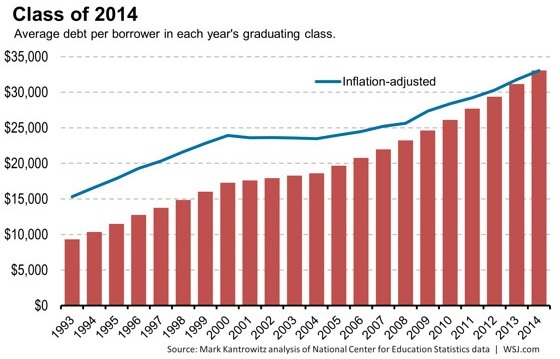 With the rising costs of tuition, student loan debt is becoming a very real issue today. While many students are not graduating with $150k in debt, the average student loan debt is still a staggering $33,000 for each graduating student, and the average just continues to rise with each passing year.
For working professionals, $33,000 may not sound like that much, but consider the these costs when the average graduating student earns only $44,828 in their first year on the job. Paying rent, food, insurance, and transportation is hard enough without tacking on an addition $400 student loan payment each month.
The Impact of the Rising Student Loan Debt
Without even studying the trends or reading the reports, I have seen first-hand the impacts that the rising student loan debts are having on college grads today.
1) Debt Acceptance
This simple shift in perception is changing everything. When I was in college, many of us had debt sure, but we were all still trying to fight it. We worked jobs at night and on the weekends and put every extra penny we had toward our educational expense so we could keep our debts at a minimum.
Today, students go into college assuming that they’ll leave with mountains of debt. With this perception shift into “debt acceptance”, students are no longer scouring the neighborhood for jobs and could really care less if they put money toward their debts while they’re still in school. Many simply assume that they’ll be making bank once they graduate and get their fancy new job and can take care of their debts then. Oh, if they only knew how much this debt will affect them in the future…
2) Getting Chummy with the Parents, Take Two
After graduating with massive debts, new grads are coming to the realization that jobs aren’t all that easy to get. And, even if they can find a job, their loan payments are crippling their independence. With the huge payments that they need to make each month, many new graduates are finding themselves moving back in with mom and dad. It certainly isn’t life as they planned it, but it’s the direct result of taking on too much debt while in college.
Keep in mind that this action not only hurts the young adults and their freedoms, it’s hurting mom and dad as well! The additional stress and expense is likely keeping them from socking the amount of money away that they’ll need for their retirement.
3) A Lonely Retirement Fund
We just mentioned that mom and dad’s retirement fund might be hindered by the new grad’s student loan overage, but it’s killing their own retirement account as well! The most important time to start investing is in those early years and if your student loan costs are through the roof, then you probably won’t be jumping at the opportunity to take money out of your check and put it into your company 401(k). This will likely cost you hundreds of thousands of dollars in the long run.
4) The Downward Spiral of America
As I see it, this increased student loan debt issue is not only affecting us in the current moment, but it is hurting us exponentially in the future. This rising trend means parents aren’t able to fund their retirement fund properly, which means fewer dollars are passed onto their children when they die. Those kids’ retirement funds look even worse because they didn’t start them until they reached their late 30’s. With little-to-no inheritance, they will be looking to the government to fund their retirement, but as many of us know, Social Security likely won’t even exist 20 years from now.
It’s not a cheery picture, but it is very likely that our great country is heading down the hole in a hurry.
How about you all? Is Derek wrong? What is your opinion on the effect of student loans on our nation’s future?
Share your experiences by commenting below!

Five Reasons To Work Early in Your Retirement

 The following is a post by MPFJ staff writer, Kevin Mercadante, who is a freelance professional personal finance blogger for hire, and the owner of his own personal finance blog, OutOfYourRut.com. He has backgrounds in both accounting and the mortgage industry.
Many people can’t wait to retire. At the same time, a lot of people – including many of those who can’t wait to retire – are also more than a little bit concerned by the prospect of outliving their money. It can be a nightmarish thought too – to consider the possibility of being several years into retirement, then running out of money. That creates some compelling reasons to continue to work early in your retirement years.
Here are some advantages to doing just that:
1. Maximize Your Social Security Benefits
Statistically, the majority of people retire at age 62 or shortly thereafter. Financially, this is an unwise move. Your Social Security benefits can rise significantly the longer that you delay collecting your benefits past age 62. In fact, benefits increase somewhere between 5% and 8% each you that you delay collecting them, up to age 70. (There is no advantage to delay taking your benefits past age 70, since increases won’t apply.)
According to this chart put out by the Social Security Administration, Effect of Early or Delayed Retirement on Retirement Benefits, if you begin collecting benefits at age 62, your monthly check the only 70% of what it will be if you wait until you’re full retirement age, which for anyone born in 1960 or later, will be age 67.
Further, if you delay collecting your benefits until age 70, your monthly check will be 24% higher than it would be if you start collecting at the full retirement age of 67.
This is an excellent strategy to increase your Social Security income in retirement. But it’s one of the very best retirement strategies you can take advantage of if you don’t feel that you have saved enough in your retirement plan to retire comfortably. If you can continue to work past age 62, you can increase your monthly benefit for every year that you delay.
2. Maximize Your Investment Earnings and Contributions
If you can work early in your retirement years, you’ll have an opportunity to continue to increase your retirement savings. This is another excellent catch-up strategy, if your retirement savings will be insufficient by the time you reach retirement age.
Let’s work an example to illustrate how effective this strategy can be.
Let’s say that you will have $250,000 saved for retirement by age 62 – the age at which you hope to retire. Using the safe withdrawal rate of 4% per year, your retirement portfolio will provide you with an income of $10,000 per year. Combined with a Social Security benefit of $14,000 per year, you’ll scrape by on an annual income of $24,000 per year, or about $2,000 per month.
But let’s say that you really can’t live on that kind of money – what can you do?
If you delay your retirement until you’re full retirement age of 67, and continue to work, how much can you increase your retirement savings in just five years? More than you think!
If you are earning an average of 8% per year in investment income on your retirement savings, that means that will add an additional $20,000 per year to your portfolio for every year that you delay your retirement.
Now let’s also say that you are contributing $10,000 per year to your company 401(k) plan. If you add that to the $20,000 in annual investment income on your portfolio, that means that you will be adding $30,000 to your retirement plan each year you delay your retirement.
After five years ($30,000 per year X 5 years), your plan grows to $400,000. Again, applying the safe withdrawal rate of 4% per year to your retirement portfolio, you’ll be able to withdraw $16,000 per year from your savings.
At the same time, by continuing to work until you reach your full retirement age, your annual Social Security income rises to $20,000. When you add that to the $16,000 in retirement plan distributions, you are now up to $36,000 per year – or $3,000 per month – in retirement income.
That’s an increase of $1,000 per month – or 50% more than you would have gotten at age 62 – just for continuing to work, and delay your retirement for five years.
3. Minimize Your Retirement Portfolio Drawdown
The earlier that you begin taking withdrawals from your retirement portfolio, the more quickly the account will become depleted. By continuing to work and delaying your retirement, you’ll also avoid drawing down on your retirement portfolio.
This is an arrangement that can work especially well, when you consider that in the early retirement years, you will likely be more able to earn additional income than you will be later in life. It makes a strong case for deferring tapping your retirement assets until later in life when it’s more necessary. The longer you can work, the longer you can do that.
4. Reduce the Number of Years You Need to Rely on Your Portfolio
The other advantage to continuing with work early in the retirement years is that you can reduce the number of years that you need to draw from your retirement portfolio.
For example, let’s say that you expect to retire at 65, and to live to be 85. That means that you need your retirement savings to last for 20 years.
You will have $400,000 in retirement savings by age 65. You decide that you really need $24,000 per year from your retirement savings, but when you divide that by $400,000 (assuming that future investment income is offset by inflation), that will only cover a little over 16 years.
If you continue to work until you are 69, and delay taking withdrawals from your retirement plan for four years, your retirement savings will still get you to age 85 (age 69 + 16 years worth of retirement savings).
5. To Take On New Challenges That Weren’t Possible Before
60-something is a lot younger today than it was 50 years ago. This is in part because people generally are taking better care of themselves, there have been significant medical advances, and the fact that people are doing work today that is much less physically taxing than what it used to be.
It is entirely possible that, unburdened by the necessities of middle age, you will be able to embark on an entirely new career. It may well be that there is a career or business idea somewhere out there that you have been harboring for many years. The early retirement years may be the very best time to turn that dream into a reality.
Retiring to a life of leisure is hardly a universal desire. Even people who have the financial means to completely retire, often continue to work, or to simply move into a different venture. A new venture may be something that’s a lot less stressful, and a lot more enjoyable. The early retirement years can represent an opportunity to pursue that kind of goal.
If you find such a career, it will enable you to put virtually all of the strategies in this article into effect. If you can, your retirement years will be the easiest years of your life, even if you don’t ever actually retire.
How about you all? Do you have any experience or know someone who has had experience with continuing to work during the early retirement years? Do you know of other benefits to working in your early retirement years that are not listed above?
Share your experiences by commenting below!
***Photo courtesy: https://www.flickr.com/photos/92334668@N07/11123538363/sizes/n/