

All posts by J. Irwin

How to Rake in the Dough at the Farmers Market
 The following is a post by MPFJ staff writer, Derek Sall. Derek is the owner of the blog, LifeAndMyFinances.com, where he teaches people how to get out of debt, save money, and become wealthy.
Have you ever walked through a farmers’ market and thought, “I could do this. I could easily grow something and sell it here.” But the next question is, what would you sell? What is it that you could easily grow at home and then sell for a hefty profit at the farmers’ market?
At my local market, there are about four different vendors that sell the normal veggies like strawberries, beans, and tomatoes, and they all seem to leave with more than half of what they came with. If I wanted to sell something, it surely wouldn’t be something ordinary like this, because there are simply too many people selling the exact same thing!
5 Plants to Grow and Sell at the Market
If you want to rake in the dough at the farmers market, then you’ll have to grow something that’s desirable but different. The five options below are a selection that almost anyone can grow, but perhaps could be unique to your farmers’ market.
1) Landscaping Shrubs
Now that housing values have been on the rise for a few years, people are really starting to improve their properties, and this most definitely includes the landscape. Find out what types of shrubs are most popular in your area and try your hand at growing a few dozen. They’ll likely take a couple of years to mature to a point where you can sell them, but the profit margins are enormous. Buy the seedlings for $1 or less and sell the nearly mature plant a couple of years later for $15 or more!
2) Flowers
Everyone loves flowers. People plant them, exchange them, and guys even by flowers after they’ve done something that require forgiveness. People of all ages and gender buy flowers from time to time. If your farmers’ market is currently without flowers on a regular basis, consider growing them (either inside or outside) and setting up a station at the market. Seeds can be purchased for pennies on the dollar, and an assortment of flowers will often sell for $5 at the minimum. The profit margins are good, and if the interest is there, you might just make a killing when you try to sell them!
3) Gourmet Mushrooms
Personally, I’m just starting to develop a taste for them, but there are a lot of people that are absolutely crazy about their mushrooms. They search for good flavors at the store, they ask their friends if they have any fresh ones, and some people even go out and hunt for wild mushrooms in the woods!
If you have some room in the house or outside to create a greenhouse space, with just a 10 foot by 10 foot space one can grow up to 2,500 pounds of mushrooms, which, at $7 per pound, you could potentially develop sales of $17,500. That’s not too shabby considering that the initial expense is minimal, as basically all planting options are.
4) Japanese Maples
Japanese maple trees are absolutely beautiful. They don’t grow so big that they’ll overtake your yard and they can be grown with a variety of different colors. Personally, I would start by growing a few full Japanese maple trees so you can give people a real live look at what they look like. Then, start growing them into 6 foot trees and sell them based on your photos (and of course, other online photos that could be helpful). Become an expert in what you’re selling and people will have confidence in buying from you.
5) Sweet Peppers
Finally, sweet peppers aren’t seen too often at any farmers’ market that I’ve been too (not when compared to strawberries anyway – those are everywhere!). Like mushrooms, many people love them, plus they are pretty easy to grow and preserve once you pluck them from the vine. Become the hit of your farmers market by providing your customers with sweet peppers!
Summary
If you really want to reap the benefits of selling at your local farmers market, you’ll have to find something that quite a few people are looking for, something that’s relatively easy to grow, and something that you can make a tidy profit on, even with competitive pricing from nearby venders or from your local garden center. The item you have in mind might not be in the list above, but if it fits these criteria, then give it a try. After all, what do you have to lose? A few bucks in seeds? This could become a $10,000-$20,000 a year business. I’d say it’s worth giving it a shot!
How about you all? Do you plan on selling something at your local farmers’ market soon? Have you been successfully selling items at a farmers’ market in the past?
Share your experiences by commenting below!
***Photo courtesy https://www.flickr.com/photos/nataliemaynor/2539111053/

Saving Money with DIY

 The following is a post by MPFJ staff writer, Jeff. Jeff writes about reducing waste, saving money and building freedom at his website, Sustainable Life Blog.
I have found that as I’ve gotten older, the skills to fix things (or the ability to YouTube the procedure) has come in quite handy when trying to keep costs down. If you own your own home, this is crucial, as you want to get things back to working order as cheaply and quickly as possible and may not have the spare money it takes to pay someone, or the time to wait for them to come to your place and do it.
Personally, I think there are plenty of reasons to at least try to fix something yourself, and here are a few of them.
Save Money
One of the first times that I realized how much I could save was when the heating element in our then-electric oven burnt out. It was quite the smoldering heap, and I had absolutely no idea how to fix it. We got a bid from someone, but they wanted over 100 bucks to come by and fix it, and I just didn’t want to spend that much money. I talked to a friend who suggested that I do a bit of research on YouTube.
I started looking and found exactly what I needed. Even though I’d never done work on any appliance before (much less an oven) I decided that I could at least give it a try. My oven was already broken, so I didn’t have much to lose.
I went to the appliance store and bought the part needed for $30 or so, and went in and fixed it. It didn’t take that much time and all I had to do was follow the video. Pretty easy way to save money if you ask me.
Nothing to Lose
The last time I ran into a problem with our fancy washing machine it wouldn’t work at all, and I had no idea what was wrong. I was not sure what the cost for repair was, so I did a little research and found the most common issue that our washing machine had was something caught in the pump, so I went downstairs to try and see if there was anything in there. Unfortunately, there was nothing in there so the problem persisted.
As far as I saw it before I started trying to fix it, I didn’t have much to lose. My washing machine was already broken, so if I broke it more it wouldn’t matter. A new one was most likely on deck anyway if our fix didn’t work, so why not at least try.
We ended up having someone come out and fix it for around $300, and it probably wouldn’t have been much more expensive if I had messed something up while I was in there trying to fix it.
Opportunities Everywhere
I used to believe that you needed many different skill sets and tools to get any sort of DIY project done, and that it was almost always better to hire someone. I’ve found that you can easily learn these yourself (mostly on YouTube, or through books) and easily fix things if you desire.
There’s also the question of having the correct tools, but I’ve found that once you get past a basic starter kit of tools, you can do most things. For the more specialized tools, you should ask around with friends or try a tool library.
Enough with the excuses, Give it a shot!
How about you all? What do you typically DIY? How much money do you think you’ve saved recently while doing it?
Share your experiences by commenting below!
***Photo courtesy https://www.flickr.com/photos/simplyarundotcom/8096301670/

The Most Important Financial Comparison: Are You Doing Better Financially Than Last Year?

 The following post is by MPFJ staff writer, Melissa Batai. Melissa is a freelance writer who covers topics ranging from personal finance to business to organics to food. She blogs at Mom’s Plans where she shares her family’s journey to healthier living and paying down debt.
Experts offer a rule of thumb for where we should be at certain ages. For instance, “Fidelity Investments recently put together an age-based savings guideline with a range of savings goals. At age 35, you should have saved an amount equal to your annual salary. At age 45, you should have saved three times your annual salary. At 55, you should have five times your salary. When you retire at age 67, you should have eight times your annual pay” (TIME).
Are you discouraged reading this? Do you feel woefully behind?
Or, are you excited and see that you’re right on track or even ahead of the experts’ schedule?
Your answer is highly variable and depends on many factors that the “experts” cannot know or consider.
What Was Your Parents’ Financial Background Like?
As Americans, we like to think that everyone can get ahead and make a name for themselves based on their own skills, ability, and drive. It’s the old pull-yourself-up-by-your-bootstraps mentality.
While there are certainly success stories like that, the simple truth is that if your parents are able to help you as you leave the nest, you’re much more likely to be a success.
I had several friends in college. Some were like me and came from backgrounds where our parents weren’t able to help financially. We took out student loans and may have gone into credit card debt to pay for a college education. After college, we took many, many years to pay back student loans. (It took me 14 years to pay mine off.)
I had two friends in particular who came from wealthier families. One’s dad was an ophthalmologist and the others was a pharmacist. Their parents paid for their college education and gave them a modest subsidy to live off of. When the one, Jake, went to California right after graduation, his dad urged him to buy a house and gave him the money for the down payment. Eight years later, Jake sold the house for double the price he bought it for and bought a larger house when he got married. Today, eleven years later, that house has also doubled in value and is now worth $1.5 million.
I don’t want to discredit Jake’s success because he’s worked very hard and he chose a career in a field that is growing and pays handsomely. However, Jake’s father’s ability to pay for his college education and give him money for a down payment in the expensive California housing market certainly helped him get ahead financially.
What Are Your Priorities?
Another important factor in each of our personal finances is our priorities.
I taught at a community college for ten years before I quit to stay home with my kids. If I had stayed at the job, I expect that I could have made $100,000 a year after working twenty years or so. I left my job just when I was finally earning a nice wage. I gave up a comfortable life to instead stay home with my children. I don’t regret my decision, but it did certainly impact our family financially.
Other people are dedicated to their careers and work long hours. They may find financial success while juggling family responsibilities, or they may forgo having a family. Because they stay in the work force while raising children (or opt not to have children), their salaries continue to grow throughout the years as do their retirement savings.
What Are Your Goals?
Some people retire and want to travel the world. They want to go on a safari and take a cruise. They want to see the world. Others spend time hopping planes to visit their kids and grandkids who are scattered throughout the U.S. Others are perfectly content staying home and volunteering, tending to their home, yard, and garden, and being with friends and family.
What your goal is in retirement will affect how much you save before you retire.
You Never Truly Know How Others Are Doing
What means do we have to calculate how others are doing financially? We make take stock of their cars, homes, and “toys” like boats, motorcycles, etc. We may guess at how much they make, but very few people broadcast their specific salary. What we have are our guess and estimates, and these are often wildly off.
You don’t know if the neighbor with the perfectly manicured lawn and expensive car is deep in credit card debt or if her home carries two mortgages. You also may not realize that your neighbor in the modest house who drives a 10 year old sedan is a millionaire who spends his money frugally. We never know these things. Instead, we compare against externals without knowing the full financial story. There is no point to this, but we do it over, and over, and over again.
Only Judge Your Finances Against Your Previous Finances
It does no good to compare yourself to others and be discouraged. Jake is a world ahead of me financially. Sure, it’s partly because his dad could help him financially when he was young, but now Jake works long hours as does his wife. They chose to have one child while my husband and I have three.
I chose to give up an income and have more children. That choice is reflected in my finances. If I compare my finances to Jake’s without looking at the choices made, I’ll likely feel frustrated and depressed.
Instead, a much better option is to compare my finances to my finances in the last several years. When I look back from the time I had my third child and my husband and I were at our financial lowest (thanks to the loss of my income), I see that each year since then, our finances have improved. My husband is earning more at his job, and I have a freelance income. Each year, we earn a bit more and pay down more of my husband’s student loan debt. Each year, we have a little more room to breathe.
If you have not yet started tracking your net worth each year, I highly recommend doing so as you can learn a lot about your financial situation, especially whether it’s improving or declining, just based on calculating your net worth. For many of us, finances improve S-L-O-W-L-Y, and you can feel like you’re making very little progress. Tracking your net worth will help you see that you are, indeed, moving forward, even if it’s only baby step by baby step.
Besides comparing ourselves to our own finances, my husband and I also look loosely at what experts recommend. However, we remember that the experts’ rule of thumb for retirement savings is just that—a target to aim for. We’re doing the best to reach that goal, but we also know when the kids are older, I’ll increase my workload and we’ll have more money to funnel to retirement, especially since we’re used to living on one income.
Each of us has unique, complicated financial situations created by our backgrounds and our choices. There is no point comparing to others; simply compare against yourself and your own financial progress year after year.
How about you all? Do you find yourself comparing yourself to others financially? Do you compute your net worth every year to see how you’re progressing financially?
Share your experiences by commenting below!
***Photo courtesy https://www.flickr.com/photos/teegardin/5912231439/

5 Ways To Get The Best Vacation Hotel Deal

 The following post is by MPFJ staff writer Travis, who blogs at Enemy of Debt where he candidly shares his family’s financial struggles, failures and successes. As a father and husband, he provides a unique perspective on balancing debt, finances, and family.
The point of a vacation is to get away from the stresses of everyday life and relax. Unfortunately, planning the vacation is not a stress free activity. Taking time away from work, arranging travel, accommodations, and transportation can all take their toll on a person’s state of mind. One might think that booking a hotel room would be a relatively easy task. Unfortunately, even once you decide on a hotel getting the best value for your money has a difficulty factor ranking right up their with negotiating the price of a car.
This is especially true when the hotel IS the vacation destination. For example, my family and I are planning a vacation to a water park destination a few hours away from home. The hotel we like to stay at includes both an indoor and outdoor water park, as well as an indoor amusement park. We spent hours navigating their website in an attempt to book our room, and learned a few things that could make a significant difference in our vacation budget.
1. Investigate Room Types
Hotels have several types of rooms. The first thing to do is to familiarize yourself with all the types of rooms available, and identify which ones will work for the number of people you have in your group as well as how you plan to use your room. Sometimes we’ve required a kitchen to do our own cooking, and sometimes we don’t. Some rooms have a pull out sofa that we normally assign to our son. It allows him to stay up later and play video games on the biggest television in the room while the rest of us retire to bedrooms with a door and sleep undisturbed. As we read the descriptions of the room types, I wrote down which ones would work for our family.
2. Collect Information on Packages
Hotels and vacation destinations may have packages available that can help you get the most out of your vacation dollars. We found that the hotel we had chosen were offering special family packages, as well as various types of two night package specials. I again wrote down the packages that best fit our vacation plans.
3. Search For Online Specials
Many web sites, not only for hotels but also many retailers, have a tab labeled, “Coupons,” or “Online Specials.” Our vacation destination had a “Specials” tab that stated all guests between May and August received free tickets to a water skiing show. I printed off the page and included it with all our vacation information. We had been to the show previously, and would love to see it again.
4. Explore All Options
We wanted to get an idea as to the cost, including taxes and fees, of different room/package combinations. We filled in our information as if we were actually going to make a reservation, selecting each combination of room and package that we were interested in. Things got a little confusing here, because the website allowed me to pick between “Package Prices” and “Best Rates.” However, the best rates were the standard room only prices, while the package prices were discounted prices. The term “Best Rates” was misleading, as they certainly were not the least expensive option.
The lesson here is to ignore what the words say, and simply get a price for every room and package pair. As before, I wrote down the price of each room/package combination that we were interested in.
5. Call the Hotel Directly
Once I’d compiled a list of room/package combinations that work for us that also fit within our budget, I called the hotel directly. I had to be careful to ensure I was actually talking to the specific location. When dealing with a hotel chain many times I ended up talking to their central reservation office. One can verify they are talking to the actual location, and if not ask for a direct number. Usually the direct number can also be found on a hotel or resort’s web page. Once I was connected with local hotel, I inquired about any specials they have have that aren’t listed on the website. I also asked a series of questions to find out if they give any discounts for corporate rates, AAA or Costco Members.
The more questions you ask, the better chance you have at finding additional discounts, or having the hotel reservation agent tell you about a deal that you may not have found otherwise.
In my experience with this specific vacation destination there were dozens of combinations of rooms, packages, and specials. I don’t think that the hotel is purposely trying to make it difficult or confusing for potential guests to find the best deal. I think that the hotel adds ideas as they come up with them, as well as matching discounts offered by other hotels in the area.
I also don’t think that my experience with this vacation destination is unique. I believe that there are other hotels and resorts that have the exact same problem with their reservation system. The good news is that by following these steps, you can navigate the even the most confusing reservation system and find that gem of a package that helps you stretch your vacation dollars to the max, and finally get that relaxation you deserve!
How about you all? Have you tried and succeeded in lowering your hotel vacation costs by using any of these tricks? What other tips can you give other readers to lower their hotel vacation costs?
Share your experiences by commenting below!
***Photo courtesy https://www.flickr.com/photos/uniquehotelsgroup/5691503052

Want to Retire Well? Be Healthy

 The following is a post by MPFJ staff writer, Derek Sall. Derek is the owner of the blog, LifeAndMyFinances.com, where he teaches people how to get out of debt, save money, and become wealthy.
Do you know what the most common job was in the 1950’s? If you were alive back then, you probably wouldn’t be surprised to hear that most men worked in agriculture or industrial jobs. In other words, men were working hard. They got up early, used their strength the entire day, and then likely worked on their homes or vehicles at night. Their bodies were getting a work out every single day just through their occupation alone.
Guess what the common job title is today? A retail salesperson. Half of these salespeople likely sit behind their desk all day and greet people while perched on a stool. The other half are, at best, walking a total of five miles each day, and using absolutely no strength during their working hours. Put quite simply, we aren’t the physical specimens that we used to be and it’s killing us.

The Rise in Obesity
Over the past few decades, Americans have really noticed their waistlines growing. In fact, even since the quite recent year of 2008, the percentage of Americans that are considered obese has seen an obvious increase. With our more sedentary jobs today, it is becoming increasingly difficult to keep the pounds off, which in turn, is also making it harder to stay out of the doctor’s office.
Medical Issues Due to Overeating and Lack of Exercise
Nearly 10% of all medical spending stems from obesity. Diabetes, coronary disease, strokes, high blood pressure, and even cancer – these are all diseases that could be prevented if we just ate right and exercised more frequently. The remedy is really quite simple, and you’d think that more people would better their habits to save all that money from escaping their bank account. Perhaps you will be one of the smart ones.
The Rising Cost of Health Care
The cost of healthcare is increasing at an alarming rate. On average, an American individual spends just over $8,500 per year on health care. Isn’t that just insane?!
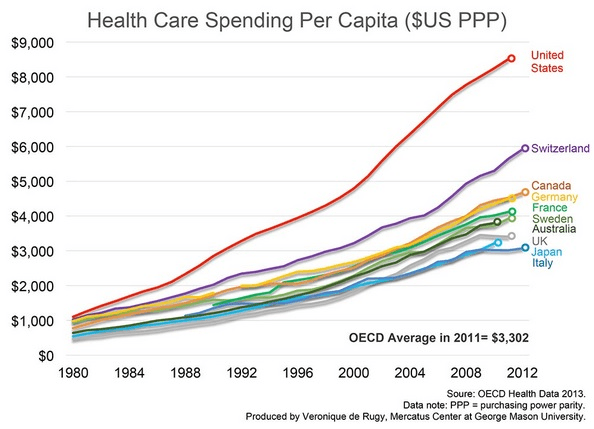
Source: http://mercatus.org/publication/us-health-care-spending-more-twice-average-developed-countries
Many people shrug their shoulders and act like there isn’t anything they can do about it, but that is completely untrue. If you are educated about your options, then there is certainly action that can be taken to reduce your health insurance costs both now and in the future.
1) Save Up a Large Emergency Fund
One of the best ways to save on your medical insurance premiums is to increase the deductible. But, before you raise your deductible to $7,000, you need to make sure that you have that much in the bank account (because accidents DO happen – that’s kind of why we buy insurance in the first place ;)). If you’re able to save up 3-6 months’ worth of expenses as a protection against job loss AND an additional $7,000 to cover your high deductible, then you are ready to raise that deductible and start saving some serious money every month. Sure, it might take a while to save up this much cash, but the savings could be as high as $300 a month, or $3,600 a year. Isn’t your retirement just looking better already?
2) Become Fit and Exercise Regularly
Truthfully, the only reason that you’d want to raise your deductible is if you are healthy. It’s a very important variable in this equation of living a long time with money in your bank account. Quality health takes time and effort (especially since many of us are sitting during work all day).
According to Mayo Clinic, our bodies need 150 minutes of aerobic exercise each week, which equates to a little more than 20 minutes per day. It might seem daunting, but a mere 20 minutes a day (helpful hint: turn off the TV a few times each week) could mean the difference between being healthy without a worry in the world and that triple bypass surgery that’s going to cost you $20,000 out-of-pocket (not to mention the risks this surgery has on your life).
If you want to live a healthy, wealthy life, then you’d better start moving and learning more about the potential health care costs in your future.
How about you all? Are you trying to live a more healthy lifestyle? How have these changes affected your health care costs?
Share your experiences by commenting below!
***Photo courtesy https://www.flickr.com/photos/11553519@N03/6220234414/

Even More Ways to Save Money Each Month

 The following is a post by MPFJ staff writer, Jeff. Jeff writes about reducing waste, saving money and building freedom at his website, Sustainable Life Blog.
When I first started to try to get my finances in order, I did the usual things. I looked for cost savings in my major monthly bills (cell phone, car, rent, etc) and while that saved me a lot of money, it wasn’t going to get me out of debt as quickly as I wanted to be.
After I let the changes I made to my major cost centers sink in for a month, I dug back in to my finances and went looking for more ways to save. What I found was fairly shocking though very helpful in my quest to spend less money and free up more money to pay down debt.
Looking at my results from the end of the month, it was clear that something needed to change – not with my large expenses, but my constant small ones. I was spending a bit of money here and there on small things like snacks, lunches and dinners out, the occasional beer or wine as well as many unplanned trips to the grocery store. In increments typically under $15 and usually under $10, I was burning a ton of cash every month.
I wasn’t even thinking about this spending, it was money that was simply spent because it’s what I’d always done. It was time to readjust my habits and free up more money to pay off debt. Here are a few things that I did.
Establish no-spend days
The first thing I did was to start having what I called no spend days, which are just days where you don’t spend any money. Just about every single purchase I was making most days was something that I didn’t need at all, or if I absolutely needed it I could wait until later to purchase it on a day that I decided to spend money.
I changed my spending day to Sunday only (when I went grocery shopping) and freed up about $50 per week. This added quite a bit of muscle to my debt pay off.
Cook at Home
This gets said a lot, but it’s one thing you can do that will make a huge dent. Stop spending so much money on eating out, and start cooking for yourself instead. One way that I did this was to start batch cooking on Sunday.
My routine went something like this: wake up, pick up a bit around the house, create a menu for the week, then go to the grocery store. Once I got back from the grocery store, it was time to prep my meals for the week. I would cook big batches of things, then individually portion them out into containers so I could just grab one from the fridge every morning and eat it for lunch. I did this with dinners as well. I was eating the same things quite often, but that didn’t matter to me. I was saving a ton.
If you’re interested in getting started, there’s a great part of Reddit dedicated to meal planning, which you can find here.
Add a time buffer
During my (sort of) research on this, I read a book called The Power of Habit and was astounded by how much people do without really thinking about it at all – and I was one of those people. I made a rule where if I found something I thought I wanted (But didnt really need) I’d wait 15 minutes before I made a buy decision and I’d go do something else. For instance if I was shopping on amazon and about ready to check out, I’d get up from the computer and go for a walk.
Usually by the time I was finished walking, I didnt want whatever I had put in my cart anymore.
These are just a few good habits that helped me pay off debt and get me on my way to healthy finances.
How about you all? What are your healthy or unhealthy financial habits? What ways have you used to help save money every month?
Share your experiences by commenting below!
***Photo by Flickr user https://www.flickr.com/photos/68751915@N05/6355251231/

3 Huge Reasons Why Budgeting Became My Friend

 The following is a post by MPFJ staff writer, Derek Sall. Derek is the owner of the blog, LifeAndMyFinances.com, where he teaches people how to get out of debt, save money, and become wealthy.
Budgeting was never taught to me when I was growing up. My parents basically functioned like this: my dad came home with his paycheck, he handed it to my mom, she gave him $20 for the week, and then she was the one stretching that paycheck to pay bills for the entire family. Never once did I see a written budget that they adhered to. They simply lived on as little as possible to get through each month with some money.
While this method seemed to work for them month after month, was it really the most effective way to handle the family finances? At this point in my life, I would say, “certainly not”. Many people try this form of handling their money – you know, the “put your head down, work so you can pay the bills, and survive into the next month – but it often leaves them fighting and with very little invested once they reach retirement age.
Why Budgeting Became My Friend
In my younger years, I married a carefree spender (which drove me nuts), and I used the budget as a way to control her spending. It wasn’t fun, it taught us nothing (other than that I was passionate about saving and she didn’t care one bit about it), and the experience actually left me a little bitter. Is this what it means to be responsible with my money? All these money fights and still not much forward progress financially? Budgets seemed like such a waste.
Today, however, I see budgets in a whole new light.
3 Ways Budgeting Became Fun
Budgeting has allowed me to pay off $21,000 of debt in just six months, and then $54,500 in less than 12 months, all while earning less than $75,000 a year. “How is this possible?” you might ask – “Budgeting,” I’d reply.
1) Budgeting showed me my average income and spending
I keep my budgeting pretty simple and use Mint.com to track both my income and my spending. With this simple tool, I can accurately find how much I typically earn each month, and I can also easily discover the main categories where I’ve been spending my money. This simple tool opened my eyes to how much I had (or didn’t have) at the end of each month. Often times, I only saw a couple hundred bucks after each 30 day segment, which meant I either had an income problem, a spending problem, or both.
2) It helped me reduce my bills drastically
In this Internet age, it is so hard to get a feel for where your money is actually going. Many times, money is automatically withdrawn from your account for various bills and you never really feel the hit. Through budgeting, I was finally able to see exactly where my money was going, and it was so much easier to take action on it.
My phone bill, car insurance, food, gas, my home insurance, my PMI, and my escrow – I was overpaying in all of these areas and could finally see it! By taking action immediately, I was able to reduce my expenses by nearly $200 a month in these areas. This never would have happened without seeing all of those monthly expenses in a budget.
3) Living on practically nothing made me happy
My friends all spend like the typical Americans. They go out to eat, they drive nice cars, and they often one-up each other with their purchases. Envy runs rampant among many of us, and in order to satisfy this intense wanting, we buy stuff – nice stuff, and often go into debt for it.
I started getting caught up in this a little bit just before I wrote my first budget. My friend was looking for a new ride, so naturally I had to find a nice car as well. In a short amount of time, I found my dream car – a black Nissan Altima. Man, that thing was gorgeous, and in the first week or two, I absolutely loved walking up to it and taking it for a cruise.
Then, a strange thing happened – it became a normal car.
The excitement of the purchase was gone and this car became my means of transportation and nothing more. A few months later, I sold it and bought a severely used Honda Civic and a bicycle (to save even more money on gas).
After riding my bike almost everywhere I had to go, I realized that my happiness level was soaring. I was spending practically no money, I was able to get places with my own God-given strength, and I was healthier than I had ever been!
I still feel the same way today. By coming to the realization that stuff doesn’t make me happy long-term, I really have no urge to buy much. As my friends purchase bigger and bigger toys (like expensive RVs for instance), I absolutely love my Honda Civic and my tent. It’s simple, cheap, and empowering, and I wouldn’t have it any other way.
How about you all? What about you? Has budgeting changed your life yet? In what ways has budgeting helped you?
Share your experiences by commenting below.
***Photo courtesy https://www.flickr.com/photos/jakerust/17135106706/

Financial Steps to Take Before You Turn 40

 The following is a post by MPFJ staff writer, Jeff. Jeff writes about reducing waste, saving money and building freedom at his website, Sustainable Life Blog.
Since we’re talking about milestones to reach to ensure that your financial life is on track, we started with financial milestones to reach in your 20s. It’s time to talk about financial milestones that you should reach by the end of your 30s. By the time you’re in your 30s, you should have a solid financial foundation under you, with no consumer debt, a solid emergency fund, and you should be steadily contributing to your retirement account.
Your foundation will be critical, as this is the phase where many people purchase houses, have kids and do a bunch of other things that cost a lot of money. If you’ve got a solid foundation under you you’ll be able to easily weather these choices and make other moves that can put you further ahead. Here are a few things you should accomplish by the end of your 30s.
Save 15% (or more) of Your Income
Feel free to include whatever your employer matches as well as what you contribute to your retirement plans, but to keep yourself on track you’ll want to be saving 15% or more of your income at this stage. This will allow you to save for vacations, kids college and more. You’ll also have your own retirement to consider, and potentially aging parents to take care of. Having a solid buffer of savings (and the ability to keep saving) would be a great way to make it out.
Getting yourself in the pattern of a healthy savings rate will pay dividends down the road.
Make Sure Your Loved Ones Are Taken Care Of
This is one that’s crucial – at this stage, you probably have many people depending on you. A spouse, perhaps a child or two, and maybe even parents. You’ll want to ensure that if something were to happen to you, they would be taken care of. This means having adequate life insurance, making sure that your accounts have updated beneficiaries, set up health care directives and a will if you feel the need. You know what your loved ones will need if you’re gone, and you can help ensure they get it.
If you’re gone, you don’t want them to end up in court (or worse) if you have no plan for what to do when you’re gone. Don’t add added stress for your loved ones – they have enough to deal with already.
Start Thinking About Retirement Needs
How much money are you spending right now, and how much do you anticipate you’ll be spending when you retire? Once you know these numbers, you’ll be able to plan how much you’ll need, and figure out how much you will need to save to get there. While your budget right now might include kids expenses and a house that’s a bit bigger than you’ll be having in retirement you can still start trying to estimate your retirement needs. There are a lot of moving parts to retirement, such as when you should consider taking social security, as well as tax considerations.
Make sure that you’re getting the planning started so you’re not shocked at how much you’ll need in the future. There’s still time if you’re a bit behind.
How about you all? What milestones did you reach by 40, and were they crucial?
Share your experiences by commenting below!
***Photo courtesy https://www.flickr.com/photos/jamiesrabbits/11717173094/

3 Keys to Live a Minimalist Lifestyle

 The following is a post by MPFJ staff writer, Derek Sall. Derek is the owner of the blog, LifeAndMyFinances.com, where he teaches people how to get out of debt, save money, and become wealthy.
We hear the term thrown around all the time, but what is minimalism anyway? According to the gentlemen over at theminimalist.com,
“Minimalism is a tool used to rid yourself of life’s excess in favor of focusing on what’s important so you can find happiness, fulfillment, and freedom.”
There are no defined rules of minimalism. There’s no one that says you can’t own a house or a car and still be a minimalist. Minimalism is different for each person. Some people choose to own less than 100 items, and others own a house in the suburbs and drive a car, and there are (of course) many people mixed everywhere in between.
To be a minimalist, you just need to unbind yourself from the stuff in this world. For those minimalists that own homes, their house does not define who they are and they certainly aren’t struggling from month to month to make the payments. They live far below their means each month so that they can be free from life’s daily struggles. They choose to live on far less than they earn so that they have options to do whatever it is that they please. By getting rid of the excess, they find out what is truly important to them.
The Keys to Live a Minimalist Lifestyle
Minimalism isn’t for everyone. If you like the way your neighbors look at you when you drive past in your new luxury car, then you’re probably not ready to live a minimalist lifestyle. If, however, you question yourself monthly (you know, when all those bills come due) and wonder why you keep torturing yourself with all of those payments, then it’s probably time to start considering a pseudo-minimalist lifestyle.
So if minimalism intrigues you, where should you start? That’s easy – start with the stuff that pains you the most – those big ticket items.
1) Downsize Your House
There are so many people out there that are house poor. They have this huge mansion of a house, which looks awesome, but it comes with such a large monthly payment that it cripples them financially, and they can’t ever have any fun because they are stuck making that stupid payment each month.
This is certainly not the way to live. If you are discontent with the mortgage payment on your home, then why not consider downsizing? Or maybe you could even rent a small apartment above someone’s garage. Think about it. What kind of freedom would you have if you cut your house payment in half? What if you got rid of it entirely? By downsizing your home, you could probably save yourself a thousand dollars a month. Wouldn’t that be such a freeing feeling?
2) Downgrade Your Car
The second largest expense for most people is their car. It often comes with a monthly payment, high insurance costs, maintenance costs, and fuel costs. It’s not uncommon for a person to spend nearly $10,000 per year on their vehicle alone.
What if you went from owning a $20,000 car with payments to a $5,000 that you paid for with cash? Your monthly payments would be gone, your insurance would go down, and your maintenance costs and fuel costs will likely remain the same. By downgrading your ride, you could save yourself around $5,000 per year.
3) Buy Quality Food for Less
People waste so much money on food. Instead of frying up an egg themselves for $0.10, they go to a restaurant and pay $3.00. Or, for the so-called “wise” consumer, they’ll go the grocery store for their eggs instead. But, instead of going to the discount grocery store where eggs are $1.29 a dozen, they’ll go to the nearby grocer where they’re selling for $1.79. Why? Because they feel too sophisticated to shop at a discount grocery store. In my option, that’s just downright stupid.
If you want to save big money on food, avoid restaurants and shop at discount grocery stores like Aldi or Save-A-Lot. The food is good, the prices are cheap, and you’ll save a bunch of time as well (I’m often in and out in less than 10 minutes). Instead of spending $1,000 on food each month, you could just follow this simple advice and cut that bill in half, saving you $6,000 per year. That’s huge!
Final Key Points to Live a Minimalist Lifestyle
To save even more money, do your best to combine all three of these points. If you decide to downsize or move into an apartment, pay careful attention to where it’s located. To save the maximum amount of money, you should find a place that’s within three miles from work and three miles from the nearest discount grocery store. This will allow you to do without your car much of the time, and maybe even allow you to get rid of it entirely! This simple move will save you money in gas, insurance, and also means that your car doesn’t even have to be very expensive since you could bike or walk everywhere anyway!
How about you all? Are you ready to live a minimalist lifestyle? What will you reduce in your life?
Share your experiences by commenting below!
***Photo courtesy https://www.flickr.com/photos/mes_regards/12167414035/

Financial Steps to Take Before You Turn 30

 The following is a post by MPFJ staff writer, Jeff. Jeff writes about reducing waste, saving money and building freedom at his website, Sustainable Life Blog.
I have recently turned 30, and since this happened I’ve been looking over my finances and thinking about where I was when I started my 20s, and where I am now and if I would have done anything different. Given that you’re so used to living a very cheap life in your early 20s and progress in your career (and earnings) typically increases. This affords many options for people, and expenses typically go up as your age increases and you stop living like a student.
Here are the things that I think are most important to master when you’re in your 20s to set yourself up for a good financial future.
Contribute Up to the Match of Your 401k as Soon as You’re Able
This is something that is vastly important for two reasons.
The first reason is that if you don’t contribute up to the max your employer offers to match you’re turning down free money. It’s as if someone was handing out ten dollar bills and you decided to walk by and not take as many as they were willing to give to each person!
Huge mistake. If you start your first job at a modest 40k per year and your employer matches your contributions up to the first 3%, that doubles your investment from 1,200 to 2,400 bucks in your first year.
The second thing you’re missing out on is the compound interest. There are some calculators here to figure out how much money after you have let your interest compound over years and years, but needless to say it’s a lot.
I’m sure you’ve heard the story of the 2 people saving for retirement, and one person puts away 3k per year from 22-30, then nothing until 65, and the other person that started putting away 10k per year at age 30 all the way until 65, and they both about have the same amount of money when they finish at age 65.
Pay Off All Consumer Debt
Debt will do nothing but handicap you as you continue your financial journey. Paying off all debt incurred in college on credit cards will free up a lot of space in your budget, as well as allow you to build up savings for emergencies and further advancing your goals. Instead of paying someone else interest money, you can use your spare cash to earn it. Paying off debt includes all non-mortgage debt: credit cards (pay these first), student loans and car loans.
Yes, student loans are a big deal and many people are leaving college with high balances, but you’ve probably been living on less than 12,000 per year for your entire life. Keep in the same mindset and focus all of your energy and extra money on buying your freedom from debt. I paid off the last of my student loans right after I turned 29, and it allowed my huge amounts of freedom.
Build a 6 Month Emergency Fund
As they said on Forrest Gump; “$hi# Happens”, and you can bet that at some point its going to happen to you. You’ll never know when or how much it’s going to set you back, but you’ll want to make sure that you’ve got the cash to cover it instead of falling back on your credit cards and paying huge amounts of interest to bail you out of whatever issue you’re in.
You wont know what you’ll need, but here are a few things you should cover: your health and car insurance deductible amount, at least 3 months of bare bones living expenses, and if you have any special conditions you should account for those as well.
How about you all? How many of these did you hit before your 20s ended? Can you think of other things you should do before you turn thirty to help with your financial journey?
Share your stories by commenting below!
***Photo courtesy https://www.flickr.com/photos/ky_olsen/5145374771/