
Category Archives for Invest & Retire
Essential Steps to Buy a House
————————————————————————————————————————
Welcome to My Personal Finance Journey! If you are new here, please read the “About” or “First-Time Visitor” pages to find out more about us. If you would like to receive free updates on articles like this by email, then sign up here or you can subscribe to the RSS feed. Also, check us out on Twitter or Facebook. Thanks for visiting! Keep on learning!
————————————————————————————————————————
Click here to enter my free giveaway for 5 copies of H&R Block At Home Premium Edition
The following is a guest post by William from Home Loan Finder.
Essential Steps to Buy a House
When it comes to buying a home, there are many things to consider. Not only do you have to have a lot of money for a down payment, but you should also be fully aware of the level of commitment you are about to enter into. A house is a major investment. Below are 5 things to keep in mind as you are embarking on this step in life.
1. The price is always negotiable
When you are ready to buy, home sellers are ready and waiting to sell to you. And, since you do not know the situation of the seller, you never know if they are anxious to sell or not. If they are, this can be to your advantage. If the house is more than you can afford, but you feel the seller might be willing to budge on the sale price, ask them to come down a bit. It does not hurt to ask and you may be surprised to discover that many sellers expect it.
2. Buy what you can afford
You may want that gorgeous house on the beach with all the windows and space, but you probably can’t afford it. Look at your finances and your prospects for the future and judge accordingly. When you buy homes, it is always easy to have our eyes be bigger than our wallet. If you get into something that will be detrimental to your financial life in the future, you will regret it. Be responsible, be thoughtful and make the best choice according to what you can reasonably pay.
3. Have a down payment
Gone are the days of financing for anyone and their dog. You must have a down payment now when you approach a bank and it should be at least 15% of the value of the loan you would like to borrow. The more you have saved the more a bank is willing to negotiate with you and give you the best interest rate and the best product. You will be in the drivers seat if you have done the hard work and saved the money.
4. Keep your credit clean
If you have bad credit, it will be difficult for you to qualify for a loan. It is important that you pay your bills on time and pay your outstanding balances off. A lot of credit card debt and other liabilities may stand in the way of you getting the loan that you need for your home.
5. Make an offer that is in line with other homes in the area
Many home sellers are expecting that you will want to negotiate the selling price. So, when you are ready to put a bid in on a house, be sure that it is in line with other similar homes that are in the same area. Look at the sales of homes similar to the one you want and find out what they were sold for. This will put you in a good position when you go to the bargaining table.
If you look at all of these points, then you will be ahead of the game when you are ready to search for and buy your new home. It can be an exciting process and hassle-free if you do your homework and make the right decisions.
How about you all? Have you been through the home purchase process recently? What steps did you take to make sure it all went smoothly?
Share your experiences by commenting below!
Jacob’s Thoughts – Listed below are my random thoughts as I was reading this article.
- @ The requirement to have a big down payment in order to buy a home – This is not necessarily true. You can get FHA home loans with very little money down. However, you must be ready to pay for Private Mortgage Insurance (PMI) each month if your down payment is less than 20% of the home value.
- @ The price being negotiable – This is certainly true. Personally, I was able to negotiate the price of my condo down from $109,000 to $105,000. I’ve heard that as a general rule of thumb, you should at least offer 5-10% below asking price.
- This is one of the important reasons to have a good real estate agent to help you. They will be able to advise you on the proper value of property in the area you’re investigating.
- @ Buying what you can afford – This is certainly true as well. Typically, you can qualify for much more home than you can actually afford. Generally, you should target paying no more than 30% of your monthly income to mortgage payments.
***Photo courtesy of http://www.redwoodbridges.com/images-spa-steps/spa-steps2.jpg
My Current Asset Allocation and Net Worth Growth – January-March 2011
————————————————————————————————————————
Welcome to My Personal Finance Journey! If you are new here, please read the “About” or “First-Time Visitor” pages to find out more about us. If you would like to receive free updates on articles like this by email, then sign up here or you can subscribe to the RSS feed. Also, check us out on Twitter or Facebook. Thanks for visiting! Keep on learning!
————————————————————————————————————————
Click here to enter my free giveaway for 5 copies of H&R Block At Home Premium Edition
This post was selected for inclusion in the April 2011 Carnival of Passive Investing at A Rich Life.
Overall, the 1st quarter of 2011 has gone very well.
The financial markets have been recovering fairly well, I have been enjoying my classes in my Chemical Engineering PhD program, Spring is just around the corner, and I just discovered that I’ll be getting a 30% pay raise starting June 1 due to being accepted for fellowship I applied for.
Side Note: Even with this 30% pay raise, I’ll still be making less than half of what I was making while working as a full time engineer. You got to love graduate school!
Let’s take a look at the pertinent details….
Net Worth Growth (not including condo)
From December 28th, 2010 (when the last portfolio update was published – see link below for more information) to April 1st, 2011, the S&P 500 index went up by 5.95%. Pretty nice little run for a quarter! Let’s hope it keeps up!
My Personal Finance Journey – September-December, 2010 Portfolio and Net Worth
During that time period, my net worth (excluding condo ownership) increased by 9.1%.
Condo Equity Growth
Currently, I have 10% home ownership in my condo (up from 9% at the end of December, 2010), with this accounting for 26% of my real net worth (so net worth subtracting the condo loan – this is different from the net worth above).
I have now achieved the following financial goals in 2011. I have done quite well I think – thanks to everyone’s help for keeping me motivated and accountable!
- Am maintaining a my target of 6-9 months of expenses in a cash reserve fund in my Dollar Savings Direct high yield online savings account.
- Have rebalanced my mutual fund portfolio to meet my asset allocation target %’s (75% equity, 25% fixed income overall)
- Have donated $1,150 to Multiple Sclerosis Foundation in 2011 (5% of income).
For a detailed list of my short term, mid term, and long term financial goals, click on the link below:
My Personal Finance Journey – Financial Goals
Review of Current Asset Allocation (excludes condo)
- Overall Fixed Income / Equity Allocation
- Currently, 24% of my net worth is invested in fixed income instruments (cash or bond funds), and 76% is invested in equity.
- This is almost perfectly aligned with my targets for these categories of 25% (fixed income) and 75% (equity).
- Equity Allocation
- In the equity portion of my portfolio, 74% is invested in US Domestic Equities with the remaining 26% being held in international equities.
- This is almost perfectly aligned with my equity breakdown targets of 71% and 29%, respectively, for US Domestic and international holdings.
While the overall percentages for these categories looks pretty good, a detailed look (table below) at the allocation breakdown reveals the real story and provides for better analysis of the current state.
Remember: a red flag goes off if your current % allocation in a category is greater than +/- 5% off of the target allocation. This is my trigger that I need to rebalance that aspect of my portfolio.
% Cash (money market target 5%) 7%
% non-inflat Bond Funds (target 15%) 14%
% TIPS Bonds (target 5%) 3%
% International Equity (Target 11%) 10%
% International Emerging Markets (Target 11%) 9%
% Domestic Large Cap (Target 8%) 9%
% Domestic Small Cap (Target 8%) 9%
% Domestic Small Cap Value (Target 14%) 15%
% Domestic Large Cap Value (Target 13%) 13%
% REIT (target 10%) 9%
Analyzing my current asset allocation percentages, it appears that I am lucky enough to be exactly on target with all of my asset classes (within +/- 5% banding) .Therefore, no rebalancing is required. Always a good thing!
My next moves for the April-May, 2011 time frame will be to do the following:
- Continue contributing to my Roth IRA for the 2011 year. I only need to contribute $2500 more to fully fund it for 2011.
- After fully funding my Roth IRA, any extra money I have will most likely go towards paying off my condo loan and obtaining even more equity in that investment. The only other option I would have is to invest in my individual mutual fund (taxable) account. But, I feel that it would be a more efficient use of my time to build up more equity in my condo. What do you all think?
- Continue investing $41.67 each month in microloans to help the working poor in Peru. This is part of my 2011 goal of having $500 in microloans.
- Try to reach my $5000 fundraising goal for the Multiple Sclerosis bike ride I am doing in June of this year. Currently, we have reached $3,800. If you are interested in making just a $10 donation, click here.
Wish List
- At some point, purchase the Vanguard Total Stock Mkt Idx (MUTF:VTSMX) to replace S&P 500 index fund. This gives better, broader diversification to the US stock market.
- Install a stacked washer/dryer combination unit in to my condominium. This one will be a long shot, but it just may be possible!
How about you all? After fully funding your Roth IRA, would you either 1) gain more equity in your home ownership or 2) purchase additional investments in a taxable index mutual fund account?
Share your experiences by commenting below!
***Photo courtesy of http://www.greekshares.com/uploads/image/calculate_net_worth.gif
Financial Goals April 2011 Update – Short Term, Mid-Term, and Long Term
————————————————————————————————————————
Welcome to My Personal Finance Journey! If you are new here, please read the “About” or “First-Time Visitor” pages to find out more about us. If you would like to receive free updates on articles like this by email, then sign up here or you can subscribe to the RSS feed. Also, check us out on Twitter or Facebook. Thanks for visiting! Keep on learning!
————————————————————————————————————————
Click here to enter my free giveaway for 5 copies of H&R Block At Home Premium Edition
Back in January of this year, I laid out my short term, mid-term, and long term goals for the 2011 year. I do this once every year as part of my goal to create what author David Bach calls a Purpose Focused Financial Plan. The goal of this system is to employ money in your life in a way that matches your life values and dreams.
You can read more about my journey to create this system at the following links – Creating a Purposed Focused Financial Plan & My Personal Finance Journey’s Investment Strategy.
As part of making this system work, I wanted to give an update on how I’m doing so far this year with the goals I established. Overall, I feel that I am doing a satisfactory job.
Updated 13-April-2011
Short Term (< 1 year) Goals:
- Contribute $5000 (or $420 per month) to my Roth IRA with Vanguard this year (maximum allowed) – Have contributed $2,640 so far this year. This puts me a little ahead of my target of $420 per month, but that’s all right.
- Reach net worth target for this year (not displayed here) – Ongoing – getting closer and closer! Requires 20% increase in net worth. May not be possible to obtain, but will attempt.
- Maintain target 6-9 months of expenses in cash reserve fund in Dollar Savings Direct account – Correct for this month, but ongoing.
- Rebalance mutual fund portfolio to meet asset allocation target %’s (75% equity, 25% fixed income overall) – Correct for now, but ongoing.
- Obtain 15% ownership / equity in condominium – Ongoing – currently have 10.11% ownership.
- Put together a will and have it reviewed by a lawyer – Will completed. Not yet reviewed by lawyer.
- Continue to save money for trip to Grand Canyon – Ongoing – need to figure out when to take this.
- Upgrade condominium with investment in stacked washer/dryer combo – $1000 for unit, $1000 for labor/installation – Currently saving $87.50 per month for home maintenance and upgrades – Ongoing, but on track.
- Invest $500 in Microloans for Latin America in 2011 ($41.67 per month) –Ongoing – Have invested a total of $208 this year so far to working poor fund in Peru. This comes with a pretty nice 3% interest rate. Note: I use Microplace.com to invest this money. It seems to work well and be dependable.
- Donate $1,150 to Multiple Sclerosis Foundation in 2011 (5% of income) –Done. So far, I have raised approximately $3,800 to support finding a cure for this disease. If you’re interested in making just a $10 donation to my ride, click here.
- Save 3% of take home pay each month (after taxes) for Dream Account. On target – Have an automatic transfer each month from my Bank of America checking account to my ING Direct high yield savings account.
Mid-Term (3-5 years out) Goals:
- Continue contributing $5000 to Roth IRA each year
- Reach intermediate net worth target (not displayed here, but is 2X my current net worth)
- Own a rental property by 2016.
Long-Term (>5 years out) Goals:
- Obtain a net worth of $1,000,000
- Own a home free of mortgage payments
- Own a vacation home in the mountains somewhere remote
- Accumulate enough funds not have to work, but will probably anyways because I would get bored.
How about you all? What are your financial goals for 2011 and beyond? Are you all staying on target in reaching those goals?
Share your experiences by commenting below!
***Photo courtesy of http://indiejourno.com/wp-content/uploads/2010/11/financial-planning.jpg
What Motivates You To Be Financially Responsible?
————————————————————————————————————————
Welcome to My Personal Finance Journey! If you are new here, please read the “About” or “First-Time Visitor” pages to find out more about us. If you would like to receive free updates on articles like this by email, then sign up here or you can subscribe to the RSS feed. Also, check us out on Twitter or Facebook. Thanks for visiting! Keep on learning!
————————————————————————————————————————
Click here to enter my free giveaway for 5 copies of H&R Block At Home Premium Edition
This is a guest post from Khaleef from KNS Financial (and Fat Guy Skinny Wallet, where he is tracking his struggle to lose 100lbs) as part of the 5th Yakezie blog swap. This week, everyone wrote about what motivates them to be financially responsible. You can view my post at Khaleef’s blog too by clicking here.
When the idea of writing about our financial motivation first came up, I was nervous. I knew that my biggest motivation may be offensive to some. Before you read this please know that is not my intention at all – I just want to share what is on my heart.
This is only the second time that I’ve ever done a guest post, so I want to first thank Jacob for giving me this opportunity!
My motivation to be financially responsible can really be broken down into three main areas: 1) Being a steward of God’s provision. 2) Having a good testimony before others…and 3) Freedom! Let’s take a look at each one in detail.
Financial Motivation: Stewardship of God’s Provision
The main thing that motivates me to be financially responsible is my devotion to God. The bible is clear that Christians are slaves to Christ (and He is our Lord)! That means that everything that I have is subject to God’s will and His word. This includes my marriage, my time, my devotion, my desires, and even my finances!
The bible makes it clear that we are nothing more than stewards over what God has given to us. As a steward, I do not have any rights, but merely responsibilities. It is not my money to begin with, but God has blessed me with what I have, in order that I might carry out His will.
It is just like a man going on a journey and leaving a steward in charge of his possessions. The steward would be expected to live off of the provision of the owner and to take the rest and use it the way the owner wants it used. The steward has an obligation to make sure that the owner’s will is being carried out by using the possessions in the right way (according to the instructions left by the owner)!
Many people (including me when I first became a Christian) see the bible as only dealing with deep, spiritual matters. But what I have found is that the bible is full of commands about how we are to handle our finances. This is because how someone views, and reacts to money, is usually a clear indication of what’s going on in their heart!
Here are some of the broad topics that the bible addresses when it comes to financial matters. These are the things that motivate me to be financially responsible on the major issues.
We are told to honor the Lord with our wealth (Proverbs 3:9-10), and in 1 Timothy 6:17-19, we find instruction on how to practically carry out that command:
For us (because I know that I can speak for my wife in this matter), we try to remain focused on the fact that it is God who provides for us. This helps us to avoid putting our trust in “the uncertainty of riches, but on God, who richly supplies us with all things to enjoy“. We know that we have a future in heaven, and so we do not agonize over earthly riches, nor stress over financial setbacks (as long as they are not the result of poor financial management).
The fact that we are to honor the Lord with our riches, and that those who are rich are given clear instructions on how to handle their money, shows that God does not hate wealth or wealthy people – in fact, Deuteronomy 8:18 teaches, “But you shall remember the LORD your God, for it is He who is giving you power to make wealth…”!
We are told that debt is equivalent to slavery (Proverbs 22:7) – this is something that I am currently feeling firsthand! This is why I hate debt the way that I do…it usually stems from poor money management (yes I know that some people use debt as leverage, but most don’t), and it puts you in a place where you can’t give to help others!
In our finances, we are expected to give our best and first to God! God commanded the nation of Israel saying, “You shall bring the choice first fruits of your soil into the house of the Lord your God” (Exodus 23:19a) and when detailing the offerings that went toward supporting the priests He says, “You shall give him the first fruits of your grain, your new wine, and your oil, and the first shearing of your sheep” (Deuteronomy 18:4).
Proverbs 11:24-29 tells us that we are expected to be generous and ready to share! We are also commanded to be fair and compassionate in our dealings with others (Proverbs 3:27:28). In fact, the bible is very clear on how workers, managers, and business owners are to conduct themselves (Ephesians 6:5-9; Amos 8:4-6).
All these things enter my mind before I make any decision on what to do with my money. However, the instruction doesn’t just stop at these larger principles. This post would turn into a book (hmmm…that’s not a bad idea 😉 ), if I were to list every little detail. However, the bible does give a lot of practical instruction on things like giving, Christians paying taxes, get rich quick schemes, investing, and even becoming a cosigner on a loan.
As I said earlier, as a born again believer, I am a slave to Christ and I find joy in obeying God’s commands. It isn’t always easy to do, but I know it’s right, and I know that God will bless me when I am obedient. So, my primary motivation to be financially responsible is to be a good steward over God’s provision.
Testimony
Well, after I just wrote about my primary motivation, it would be a horrible thing if you found me constantly violating these biblical financial principles! If I claim to have this God-given desire to follow these commands, and then you see me doing other things with my money on a regular basis, a couple of things may happen.
First, this sort of hypocritical behavior can lead someone to conclude that my Christian faith really hasn’t done anything to change my worldview. I would give someone cause to blaspheme the word of God, and consider it to be a lie! When it comes to matters of sin, salvation, hell, and heaven, no one would care what I have to say, since I’m not even being faithful to simple things like money management!
So, I am motivated to live out these things so that I don’t cause someone to have a low view of God or the bible.
Second, another believer could witness how I mismanage my money, and conclude that this is how a Christian should behave (especially since many people are not taught what the bible teaches about finances). They could say, “Well, if Khaleef went out and borrowed a bunch of money in order to buy electronics, cars, a house, or vacations, then I guess it’s okay for us Christians to do that”! I do not want my actions to lead someone to go against God’s word!
Freedom
Because I am currently in debt, this is a huge motivation for me! We manage our finances the way that we do (what many would call conservatively), because we eventually want to be free. Whenever we have to make a decision concerning our finances, we always have to think about our debt! This is why I fully understand what the bible means when it says, “The rich rules over the poor, and the borrower becomes the lender’s slave.” ~ Proverbs 22:7
If we want to move, or make a purchase, or pay for an item to be repaired, we have to consult our financial master (debt) to see if we can do it. Our giving has been hurt, and we are not able to help people the way that we want…all because our master won’t let us!
I would love to be able to work from home and build up my financial consulting and tax preparation business (and also work on my websites)! Being able to spend the majority of my days with my wife would be such a wonderful blessing! Once we are out of debt and have adequate savings, we plan to make this a reality (as long as it’s in God’s will).
So, being free from debt, and free to serve God completely with my finances is a huge motivation to be financially responsible.
Final Thoughts
I know that many of you who read this are not Christians. However, I feel that the beauty of what the bible teaches about finance is that if you apply these principles to your life, you’ll most likely become a better financial manager! Trying to avoid debt, get rich quick schemes, and chasing after money with no real goals in mind, will automatically make you better off!
Just be sure that before you make a financial decision, it lines up with your ultimate goals in life. No matter what your motivation may be, you will need discipline and an ability to think about the long-term in order to make it!
How about you all? What motivates you to be financially responsible?
Share your experiences by commenting below!
Jacob’s Thoughts – Listed below are my random thoughts as I was reading this article.
- I am very honored to be hosting just your second ever guest post Khaleef! It’s an honor to have someone which as well-established of a blog as yours here at MPFJ!
- @ We are told that debt is equivalent to slavery (Proverbs 22:7) – I didn’t know money was so directly addressed in the bible! Interesting!
- @ The idea of Khaleef turning his ideas in to a book – I actually think you might be on to something there. How is the market for books on Christian finances? I have never looked, but it might be an opportunity to take advantage of!
- @ The ideas in the whole article – It’s very interesting to me how motivations for something can be very different, but the end result/goal is the same.
- For example, Khaleef wants to be debt free to have the freedom to better serve God, whereas my motivation for being debt free is more to have the freedom to travel, move where I want if life events occur, etc. The end goal is the same (being debt free), but the motivations are different. It is interesting to me.
***Photo courtesy of Goldemberg Fonseca
Time is Money
————————————————————————————————————————
Welcome to My Personal Finance Journey! If you are new here, please read the “About” or “First-Time Visitor” pages to find out more about us. If you would like to receive free updates on articles like this by email, then sign up here or you can subscribe to the RSS feed. Also, check us out on Twitter or Facebook. Thanks for visiting! Keep on learning!
————————————————————————————————————————
Click here to enter my free giveaway for 5 copies of H&R Block At Home Premium Edition
Today’s guest post comes to us from Les Roberts. Enjoy!
How about you all? Where in your day do you find yourself wasting the most time? What steps do you take to make sure you stay on target?
Share your experiences by commenting below!
Jacob’s Thoughts – Listed below are my random thoughts as I was reading this article.
- @ Social media websites that distract from efficiency – For my generation, perhaps the biggest time-spending black hole is Facebook. Many times, I find myself going to Facebook between tasks. However, my time would most likely be spent elsewhere.
- @ Spending too much time on email – Another enormous “time-suck” for people in today’s age is email. In a book that I read recently, it is estimated that people spend an average of 2 hours on their email each day. This is truly amazing! I admit that I need to do a better job of spending less time on email as well!
- The two best books I know of that offer systems to assist in email overload are 1) The Hamster Revolution
 by Mike Song and 2) Getting Things Done by David Bach.
 - For details about The Hamster Revolutions system, click here.
- @ How to reach the end of the day and accomplish what you wanted to – I read recently somewhere that a good way to ensure a feeling of accomplishment at the end of each day is to make a mental agreement with yourself twice a day – 1) When you get in to the office in the morning, agree with yourself what you will feel good about getting done with that day, and then 2) at lunch time, reassess where you are and if that goal is still reasonable. This way, you hold yourself accountable for what you get done, and will be more likely to stay on target.
- @ Taking a break from your computer screen – This is something that I am a strong believer in. When I am blogging and am having to spend many hours in front of the computer screen, I often find myself feeling zoned out and in a sort of trance. Taking a break and even reading something away from my screen will help get me “back to the real world.”
 by Mike Song and 2) Getting Things Done
 by David Bach.


***Photo courtesy of http://www.timeforresults.com/images/TimeIsMoney.png
Best Ways to Get Started With Investing Online

————————————————————————————————————————
Welcome to My Personal Finance Journey! If you are new here, please read the “About” or “First-Time Visitor” pages to find out more about us. If you would like to receive free updates on articles like this by email, then sign up here or you can subscribe to the RSS feed. Also, check us out on Twitter or Facebook. Thanks for visiting! Keep on learning!
————————————————————————————————————————
Click here to enter my free giveaway for 5 copies of H&R Block At Home Premium Edition
Today’s guest post comes to us from Stella Workman. Stella is a freelance writer who normally provides savings accounts reviews.
Best Ways to Get Started With Investing Online
The best ways to get started investing online often begin with identifying those investments that carry lower risk and understanding those investments thoroughly. Learning the basics of any market is essential to successful investing.
Stocks
The stock market is now more accessible than ever and is also one of the best ways to get started with investing online if you have studied the market and how it works. Stocks are generally considered a higher risk investment than some other markets but also can have nice returns if you are successful with the investment.
You can now invest in most stocks online with less than $100. The key to making a sound investment in the stock market is studying the history of the company that you are interested. Most companies with a steady increase over the past several years are a good stock investment.
Affiliate Marketing
Unlike traditional investments, such as stocks and bonds, affiliate marketing is quickly becoming a popular way to invest online. Large companies often offer customers a chance to advertise their products on a personal or business website in exchange for a small amount of profits that come from sales through those advertisements. If you already have a website then affiliate marketing may be one of the best ways to get started with investing online.
Affiliate marketing isn’t for everyone, however. You do need a space to advertise for other companies and will usually make much smaller profits through this type of investment than with traditional stocks. If you are looking for one of the best ways to get started with investing online and prefer a much less risky type of investment, then you may want to consider a 401k or other type of diversified account.
Diversified Accounts
A 401K account is a diversified investment that is typically a long-term investment. One of the best ways to get started investing online is to find an account that allows you to invest on a regular basis over the span of time. Each time you add money to the account the company will invest small percentages in several different types of investments.
With a diversified account you have a great chance of seeing returns on the investment and successfully lower the risk of losing your entire investment. This is a type of investment that generally lasts for ten years or more, however. There are other types of diversified accounts that you can invest in, as well.
The Bottom Line
When searching for the best ways to get started investing online, your knowledge is the best tool you have for making the decision. Since there are so many options, it is usually best to choose one type of account and stick with it until you have a good working knowledge of how to make sound investments.
How about you all? Where do you invest online? Do you worry about the security of sharing your information online, or are the protection measures taken these days enough to give you peace of mind?
Share your experiences by commenting below!
Jacob’s Thoughts – Listed below are my random thoughts as I was reading this article.
- @ Investing in stocks – Personally, I don’t partake in investing in individual stocks, nor do a recommend it for normal individuals. Why is this? The evidence (70% of investment professionals fail to beat the market indices) simply doesn’t support the idea that us regular “Joe’s” can pick stocks well.
- Instead, I personally follow and recommend a passive investing strategy, which involves buying and consistent reallocation of index ETFs or mutual funds.
- However, if you are interested in investing online in individual stocks, I would recommend using a deep discount brokerage. The cheapest and easiest to use one that I have found is Sogotrade.com.
- @ Affiliate Marketing – For me, I don’t really consider this to be a form of investing. It is more of a type of business opportunity. There are some great affiliate programs available out there (FlexOffers, LinkJunction, etc). However, my favorite simply has to be the Amazon Affiliate Program. Why is this? Simple. You need to buy items on Amazon any way. Why not give some “love” to the site that steered you there in the first place.
- Caution – Affiliate marketing is not to be confused with multi-level marketing / business opportunities, which involve selling product while at the same time trying to add people “under you” in your network. I have participated in several of these home business opportunities and was very sorry that I did in every instance. Live and learn right!?
- @ Investing in diversified accounts – Another great option for investing in this type of account is opening up a Traditional or Roth IRA. My favorite place to do this is Vanguard, since they offer the lowest expense ratio mutual funds.
***Photo courtesy of http://www.cyclingfans.com/2009_giro_d_italia_columbia_highroad_team_time_trial_start_line.jpg
Is Gold Going to Keep Going Up?

————————————————————————————————————————
Welcome to My Personal Finance Journey! If you are new here, please read the “About” or “First-Time Visitor” pages to find out more about us. If you would like to receive free updates on articles like this by email, then sign up here or you can subscribe to the RSS feed. Also, check us out on Twitter or Facebook. Thanks for visiting! Keep on learning!
————————————————————————————————————————
Click here to enter my free giveaway for 5 copies of H&R Block At Home Premium Edition
Today’s guest post comes to us from Alban. Alban is a contributing writer at Home Loan Finder, a home loan comparison website
Investing in gold is a popular investment choice, especially in times of financial crisis when it remains strong when compared to investments such as real estate and stocks, and even increases in value. However, with the worst of the Global Financial Crisis (GFC) over for many countries, is gold still a good investment?
Overseas Influences on Gold Prices
In March 2011 gold is still hitting record highs and on 2-March, was at an all time high value of $1,440.10 per ounce, the highest it has been since 7 December 2010. While some traders believe this value is still not as comparatively high as it should be, being slowed with capped rallies, and not exhibiting the frenzied buying.
Gold continues to rise in value and become more popular as social unrest increases in the Middle East and North Africa raising the prices of oil. However, eyes on the Western world see the financial imbalances in the western economies as a more dangerous long term threat to financial security.
A higher gold price would also be beneficial for the US due to its budget deficit, so even though the initial shocks of the GFC are over, the after-effects can be seen as just as harmful to the stability of economies as there are now increased feelings of fear and uncertainty, should such a crisis happen again.
In the long term, gold is always a good investment option because of its ability to ride out economic uncertainty and global pressures. In India, investors have always looked at the long term results and India is the largest consumer of gold, followed by China, and China’s demand is expected to increase by 40% in 2011.
Rising Gold Prices
In 2010, when gold had already risen to $1,200 an ounce, predications of $3,000 or $5,000 an ounce for gold seemed crazy, but they are not now very far wrong. Analysts and investors are always aiming to predict where gold values will go in the future, and as a result, the calculation used during President Nixon’s time when the convertibility of the dollar for gold was temporarily removed.
The real price of gold is actually much higher in terms of US dollar convertibility, because with $13.789 trillion in circulation, and using a gold price of $1,200 per ounce, if the US had to return to a gold-backed dollar, the government would need to hold 11.5 billion ounces of gold. In 1971 when Nixon temporarily removed the convertibility of the dollar, the US money supply was valued at $35 an ounce, based on the supply to price ratio.
However, currently the US government only holds 261.5 million ounces of gold, so to make the dollar convertible again, the gold price is really $52,381 and with the US money supply growing every day, this figure will continue to go up.
In early 2011, gold continued to rise, and not just sporadically, but in consecutive weeks. Gold is an attractive investment option because of the rising oil prices, but if the increase in the cost of oil continues, the potential is there to stunt economic growth – rather than the price of oil rising because of demand, it is rising because of shocks to the supply.
For example, a $10 movement in the price of oil can cut 25 to 50 basis points from the GDP growth of the US and with this sort of impact, the GDP will struggle to show growth at all in 2011. If GDP growth doesn’t perform in 2011, the Federal Reserve will maintain their soft approach to monetary policy and it could be years before they raise official interest rates again. With high oil prices and a stagnant economy, gold will continue to be in demand as the investment of choice.
Rising Gold Prices in the Future
Gold has seen an incredible rise in value, and if you have invested in the precious metal early then you will be glad of your foresight. However, if you’re not already invested, or wondering how to manage your gold investments for the future, you have to wonder whether this ride has reached its peak.
As you make your decisions on what to do with your investment portfolio, consider all of the factors which are influencing the rising gold price. Gold prices continue to be ruled by the principle of supply and demand – when you leave out the influences of geopolitics, and accept the Global Financial Crisis as a simple low point in the investment time line, then you are operating in a unique market, which could result in a perfect storm situation.
When so many investors seek to diversify their portfolios through capital appreciation, they are mimicking a trend often seen over the long term. However, at the same time, central banks are looking to balance their portfolios too, and this is an unexpected factor, which hasn’t been seen on the market for decades. Plus, not only are the central banks shifting the focus of their portfolios, they are competing for the available gold.
With investors and bankers both focused on gold, which is not reliant on someone’s ability to repay their mortgage for example, the demand is also magnified by a stalled supply in the mines, as gold miners try to produce more gold than they have to replenish their reserves.
Plus, even though China set to surpass India as the largest consumer of gold in the world, the central bank in India was able to beat China to their purchases from IMF. The fact that the two largest countries in the world are competing so vehemently for the limited supply of gold, implies gold shares should be a good investment for anyone to have.
The current gold situation can be likened to the situation of the Dow Jones Industrials Average in the 1980s, where the index broke into four digits, and those who understood the trend were able to make their money simply by buying and holding onto equities as their value continued to increase. The same philosophy is likely to be realised in the current climate, yet many investors are still wary of the precious metal.
However, most investors’ concerns are unfounded. For example, gold is not a commodity which is moving in line with liquidity driven bubbles because if it was, when oil fell 75% from its peak of $140, gold should have dropped lower, but instead gold went higher. This is because gold is not actually a commodity, but a currency, and the one which is performing the best in the world, and not just against the dollar because gold is strong even against the powerful Swiss francs.
It is also important to note that gold isn’t actually in a bubble anyway because for a market to be in a bubble, an asset should be so over-owned that no one wants to buy it when the prices go down. However, since gold represents less than half a percent of the global financial assets, it is actually the most under-owned asset.
Over the last decade gold has been the most profitable, and the safest, financial asset, having ended each year at a higher value than the previous one. With everything that has happened around the world in the last 10 years, that makes gold an asset worth considering, because with strength through such crises it is likley to keep going up.
How about you all? Do you invest in gold? What strategy do you use to work it in to your asset allocation? Have you made much money with it in the long run?
Share your experiences by commenting below!
Jacob’s Thoughts – Listed below are my random thoughts as I was reading this article.
- There are a lot of good considerations above, especially some very good commentary of how world events are affecting the financial markets. However, this might leave the individual asking just how gold should be worked in to your investing strategy. This is particularly true if you are a passive investor, like I am.
- Currently, I do not have any exposure to gold in my overall asset allocation strategy. In fact, writing a post considering if I should add exposure to gold has been on my to-do list for quite some time now.
- In short, if I were to add exposure to gold in my portfolio, I would look for an index fund offered by Vanguard, in order to be in line with my passive investing strategy.
- As it turns out, the closest thing that Vanguard has to a gold mutual fund is the Vanguard Precious Metals and Mining mutual fund, symbol VGPMX. Even though this is an actively managed fund (a big red flag in my book), it does carry only an expense ratio of 0.27%. Because of the low expenses, it would be the most likely candidate that I would employ in my asset allocation. However, further investigation would be needed in order for me to execute upon this idea. Keep an eye out for a future post on this!
- One more question came up in my mind as I was reading this article – does anyone know if gold has increased in value due to recent events in Japan?
***Photo courtesy of http://4.bp.blogspot.com/_ECD1Tci9nwc/TFcn0lZYVgI/AAAAAAAAA2g/Gg2Ix2WO7kQ/s1600/should+invest+gold.jpg
Carnival of Passive Investing # 3 – Random Probability Examples Edition – February 28th, 2011

————————————————————————————————————————
Welcome to My Personal Finance Journey! If you are new here, please read the “About” or “First-Time Visitor” pages to find out more about us. If you would like to receive free updates on articles like this by email, then sign up here or you can subscribe to the RSS feed. Also, check us out on Twitter or Facebook. Thanks for visiting! Keep on learning!
————————————————————————————————————————
Interested in receiving a free $25 Amazon gift card? Click here to sign up for my Cheapskate Jake “Cheapskates Need Love Too” giveaway! Or, click here to enter my free giveaway for 5 copies of H&R Block At Home Premium Edition .
As discussed in my introductory post for this carnival, the purpose of this carnival is two-fold:
- To provide a forum to showcase articles and research in passive investing strategies (i.e. investing in ETFs, index mutual funds, etc. in such a way that one avoids employing active stock picking). By investing with the market, we are able to beat 70-80% of investment “professionals.”
- To create a community of passive investment bloggers to connect and share expertise.
Please enjoy and stop by my blog on my non-carnival days as well.
Congrats to our 3 winners this month! Listed below are the rest of this month’s spectacular passive investing articles!
——————————————————————————————————————————————————————–
Jon the Saver presents Rick Ferri and Passive Investing posted at FreeMoneyWisdom.com
Asset Allocation
Mike Piper presents Investing Life Insurance Proceeds posted at The Oblivious Investor, saying, “How would you invest a portfolio if you were expecting to need to withdraw from it for potentially 50 years or more?”
Rob Bennett presents Valuation-Informed Indexing #28: New Research Shows Valuation-Informed Indexing Beats Buy-and-Hold in 102 of 110 30-Year Periods | ValueWalk.com posted at ValueWalk.com.
Gyutae presents What Is Asset Allocation and Stock Investment Diversification? posted at Money Crashers.
Financial Planning
Mitch Archuleta presents Automate Your Finances to Win Big in Retirement posted at RothIRA.com’s Retirement Planning Blog.
——————————————————————————————————————————————————————–
Index Funds
FMF presents Free Money Finance: Not All Index Funds Are the Same posted at Free Money Finance, saying, “One thing to remember when investing in index funds: not all of them are the same.”
Investing
BankMan presents Are Online Brokerages a Good Deal? posted at High Yield Savings Accounts, saying, “Are online brokerages a good deal for cheap mutual fund trades, or do they skimp on the features you need most to make informed investing decisions?”
Ryan @ CML presents Investing Lessons From Warren Buffett posted at Cash Money Life, saying, “Warren Buffett is one of the world’s greatest investors. Find out some of his best investing tips in this article.”
Note from Jacob – Even though doing what Buffett did (investing in individual stocks) is against the tenets of this carnival, we can learn some valuable lessons about employing a contrarian style of investing when we need to rebalance our portfolios to purchase more shares of equity index mutual funds when markets go down.
——————————————————————————————————————————————————————–
Probability of having your identity stolen – 1 in 200 (So, pretty likely!)
——————————————————————————————————————————————————————–
Jim Yih presents Understanding Index Linked GIC Products posted at Retire Happy Blog, saying, “There is a new breed of GIC (Canadian investment instrument) products that continue to guarantee your capital from losing money but provide some variability in terms of your investment return. These products are commonly known as index-linked GICs.”
Boomer presents How To Invest Your Money: Part Four – Building Your Portfolio posted at Boomer & Echo, saying, “The main focus of this series of articles is to discuss the psychology of investing, how to get started, finding your strategy, and building your portfolio.”
Michael presents Advantages of Buying a House With Cash posted at Consumerism Commentary, saying, “If you can afford it, there are some extreme advantages to buying a house with cash.”
Note from Jacob – Before deciding to buy a house completely with cash, it’s important to consider your overall asset allocation. This article gives some great insight in to this decision.
Michael Pruser presents Ally Bank’s 10-Day Rate Guarantee on CD’s posted at The Dough Roller, saying, “Boring ole CD’s may not give the greatest returns, but show me something else this guaranteed.”
Note from Jacob – CDs can be a valuable tool for housing the cash portion of your asset allocation in your overall passive investing strategy.
——————————————————————————————————————————————————————–
Probability of being on a plane with a drunk pilot – 1 in 117 (Scary! I hope this one isn’t true!)
——————————————————————————————————————————————————————–
Mutual Funds
Hemant Beniwal presents Bond Fund – Complete Guide posted at mutualfundlab.com.
Personal Finance
Carlos Sera presents A Tale of Might posted at Financial Tales.
——————————————————————————————————————————————————————–
Probability of being considered “possessed by Satan” – 1 in 7000 (uh, OK…? haha)
——————————————————————————————————————————————————————–
And, if you are a serious passive investing nerd like me, you might enjoy the following articles on Passive Investing that I came across on Get Rich Slowly and Free Money Finance while reading through this month’s submissions.
Improve Your Investment Returns with Vanguard’s Admiral Shares – Free Money Finance
The Beauty of Index Funds – Free Money Finance
Index Funds: The Investment Answer – Get Rich Slowly
Index Funds Win Again – Get Rich Slowly
Index Funds: Why Choose Anything Else? – Get Rich Slowly
Well – that concludes this month’s edition. Submit your blog article to the next edition (scheduled for March 31st) of Carnival of Passive Investing using our handy carnival submission form
The top editor’s pick of the March 31st, 2011 Carnival of Passive Investing will receive a $25 Wal-Mart gift card.
March’s Carnival will be our first “guest-hosted” edition of the Carnival of Passive Investing. Tom @ Canadian Finance Blog has been kind enough to volunteer to host!
If you are interested in hosting an upcoming edition of the Carnival, take a quick look at the hosting requirements, and then contact me with your preferred open slot in the hosting schedule.
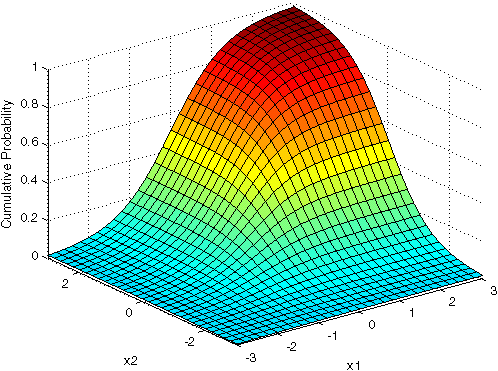
***Photo courtesy of http://www.mathworks.com/help/toolbox/stats/multivariate_studentst2.gif
Sharebuilder Review Guest Post Up Today at Investor Junkie!

————————————————————————————————————————
Welcome to My Personal Finance Journey! If you are new here, please read the “About” or “First-Time Visitor” pages to find out more about us. If you would like to receive free updates on articles like this by email, then sign up here or you can subscribe to the RSS feed. Also, check us out on Twitter or Facebook. Thanks for visiting! Keep on learning!
————————————————————————————————————————
Interested in receiving a free $25 Amazon gift card? Click here to sign up for my Cheapskate Jake “Cheapskates Need Love Too” giveaway!
Good evening everyone! Have you ever wondered if investing with Sharebuilder.com is right for you?
If so, I’d encourage you to check out my guest post/review of Sharebuilder.com’s brokerage service that went up today over at InvestorJunkie.com. You can read the review by clicking the link below!
InvestorJunkie.com – Sharebuilder Review by Jacob
Topics covered in the review include the following:
- Account types
- Investment options
- Fees and commissions to expect
- Review of the online-investor interface.
How about you all? Have you used Sharebuilder before? What was your opinion of their investment options, fees, etc?
Share your experiences by commenting below!
***Photo courtesy of http://www.debtkid.com/wp-content/uploads/2008/02/sharebuilder-account.JPG
How Travelers Can Reduce Bank Fees

————————————————————————————————————————
Welcome to My Personal Finance Journey! If you are new here, please read the “About” or “First-Time Visitor” pages to find out more about us. If you would like to receive free updates on articles like this by email, then sign up here or you can subscribe to the RSS feed. Also, check us out on Twitter or Facebook. Thanks for visiting! Keep on learning!
————————————————————————————————————————
Interested in receiving a free $25 Amazon gift card? Click here to sign up for my Cheapskate Jake “Cheapskates Need Love Too” giveaway!
Today’s guest post comes to us from Matt. Matt contributes to CreditCardCompare.com.au, an Australian website where Aussies can compare frequent flyer cards from a variety of airlines.
Seasoned travelers use proven banking techniques that avoid unnecessary fees but protect funds from theft. Carrying large amounts of U.S. cash is not a wise decision. But, using credit cards, ATMs, and checks while overseas can incur large fees for each transaction.
Every bank has methods for avoiding these fees and will answer the depositor’s questions when information is sought prior to departure. Informed travelers avoid costly bank fees because they complete research as a major portion of trip preparation and then use recommended methods for access to funds. Described below are some of these methods.
- Know your bank’s fee schedule – Ninety days prior to departure research the charges that will be assessed for accessing your account from foreign countries. ATMs are available in most countries, but the fees will add up quickly when the foreign bank and the domestic bank charge fees for each transaction. Research the fees associated with all foreign transactions including ATM, credit cards, and wire transfers.
- Choose a bank with partners – If the primary checking account resides in a locally-owned bank, open another checking account in a major bank with partners in the destination countries. Access to your account is available through partner banks in those countries with reduced fees. Notify the bank that you will be traveling so foreign transactions will not shut down access to the account.
- Open a second account – As insurance against loss of access to your funds, open another checking account at the same bank so that funds can be accessed if the bank system shuts down your account before you can address the situation. Notify the bank of your strategy so they can help you achieve the correct result.
- Establish a money market account – Place enough money for travel in each of the two basic checking accounts and move all other funds into a money market account that has online access. If one of the other accounts is breached, only the travel funds will be lost, but you will have access to money to continue travel and get back home. Look for a money market account that will pay interest on your money and allow you to access it easily.
- Use credit cards for large purchases only – Every credit card transaction will incur fees for currency exchange and use outside the United States. Pay for hotel bills and other major expenses with a credit card, but pay for every other transaction with the local currency.
- Rarely use an ATM – Unless you have access to an ATM that will not charge a fee, only access the ATM for large withdrawals. Avoid ATMs in airports, hotels, and public places because they charge exorbitant fees that will add up quickly and reduce the balance in the checking account that holds the travel funds.
- Exchange money – Avoid exchanging money at the airport upon your arrival. When you reach the hotel, ask where the best place to exchange U.S. currency for the local currency is located. The locals know where you will pay the most favourable exchange rates. Visit the exchange for large transactions and avoid small amounts of money. Make certain you are given small bills at the exchange because most merchants cannot change large denomination currency.
- Monitor exchange rates – Take note every day of the exchange rate between the U.S. dollar and the local currency. If the exchange rate becomes favourable, exchange a larger sum of money to take advantage of the rate. Make local currency last longer if the exchange rate becomes less favourable by postponing unnecessary purchases.
- Take travelers checks – Most large hotels can cash travelers checks, so purchasing travelers checks prior to departure may be the most favourable way to carry sufficient funds for the entire trip. Record the numbers on the travellers check and make two copies. Leave one copy with a person of trust here at home and take the other copy on the trip, but store them separately. Replacement requires the exact check numbers.
- Record account numbers – Write down all checking account numbers, credit card numbers, ATM card numbers, and travellers checks numbers prior to departure and make two copies. Leave one copy with a trusted person and carry the other one, but keep it in the hotel safe with your passport.
Travellers must remember that financial practices overseas are not similar to those used at home. Convenient access to money is very costly because of the bank network access that is required to process every transaction. Awareness is the only way to reduce the fees associated with convenient spending tools. Adopt a local mindset when traveling overseas and use similar tools to the people who live and work in the area.
How about you all? Have you ever been traveling and were hit with unexpected bank/ATM fees? How do you avoid paying too much for access to your money when traveling abroad?
Share your experiences by commenting below!
Jacob’s Thoughts – Listed below are my random thoughts as I was reading this article.
- The methods expressed in this article are very useful. In my experience traveling abroad, each time you access money using an ATM, you are charged ~$5 USD by the local bank and then ~$3-$5 USD from your domestic bank in the USA.
- Credit card foreign currency transaction fees can be even worse. Generally, the fee that your credit card will charge each time you make a purchase abroad is 3%. So, as discussed above, it is important to only use your credit card for emergencies and for larger purchases when you need to conserve your cash.
***Photo courtesy of http://media.rd.com/rd/images/rdc/slideshows/6-Ways-To-Avoid-Exces-Travel-Fees/6-Ways-To-Avoid-Exces-Travel-Fees-01-sl.jpg