

All posts by Jacob A Irwin
The Asset Location Decision – Should That Mutual Fund Be Held in a Tax-Sheltered or Taxable Account?
 A question that is very important and often overlooked (I know I have messed this up before big time) is, “In what type of account should I place the mutual fund that I am thinking of buying?”
A general guiding rule is that as many equity mutual funds as possible should be held in taxable accounts, and taxable bond funds and REITs should be placed in tax-advantaged accounts. Of course, this assumes that you have the choice/flexibility to do this, that you have also first funded your tax-advantaged retirement accounts, and have enough money in taxable accounts to fund short-term needs.
Page 150 of Bill Bernstein’s The Intelligent Asset Allocator provides a very nice, succinct summary of where each type of mutual fund should go. This list is shown below for the Vanguard family of mutual funds:
For Tax-sheltered Accounts (401k, Annuity, or IRA)
In general, value funds and REITs should only be held in tax-sheltered accounts due to the following reasons:
- Value funds have high turnover (selling stocks and buying others). Turnover can kill your profits with taxable accounts.
- REITs obtain most of their long-term returns from dividends. The taxes on dividends can kill your profits in a taxable account.
–Vanguard Value Index Fund
-Vanguard Short-Term or Intermediate Term Inflation Protected (TIPS) Fund
-Vanguard Extended Market Index Fund
-Vanguard Small-Cap and Small-Cap Value Index Funds
-Vanguard REIT Index Fund
-Vanguard Short, Long, or Intermediate-Term Bond Index Fund
-Vanguard Total Bond Market Index Fund
These funds should only be held in tax-sheltered accounts because they have a good amount of buying and selling involved in maintaining the index representation, which can in turn increase your tax risk.
For Taxable Accounts Only
There are several types of funds which make zero sense to hold in a tax-deferred account, since these funds manage taxes in such a way that give you a lower return in exchange for less tax liability.
–Vanguard Tax-Managed Growth and Income Fund
-Vanguard Tax-Managed Small-Cap Fund
-Vanguard Tax-Managed International Fund
-Vanguard Tax-Exempt [Anything – Bonds, etc] Fund
For Tax-Sheltered and/or Taxable Accounts
Although it is acceptable to hold equity mutual funds in tax-sheltered accounts, if possible and with all else being equal, it is best to try to hold them in taxable accounts. This is especially true for international equity funds since they allow investors to use a foreign tax credit to offset some US taxes owed.
Another general rule is that the broader the definition of the asset class mutual fund, the more tax-efficient it will be (for example, emerging markets vs. total international stock fund). Also, large cap funds are more tax-efficient than small-cap funds.
The following feature makes holding equity funds in taxable accounts preferable:
- Tax-deferred accounts like 401ks and traditional IRAs convert long term capital gains and reinvested qualified dividends (taxed at a lower rate if held in a taxable account) to a ordinary income (taxed at a higher rate) upon account liquidation during retirement.
–Vanguard S&P 500 Index Fund
-Vanguard Total Stock Market Index Fund
-Vanguard European Stock Index Fund
-Vanguard Pacific Stock Index Fund
-Vanguard Emerging Markets Stock Index Fund
-Vanguard Total International Stock Index Fund
Order of Preference in the Asset Location Decision
Since starting to employ this concept in my personal finances 3-4 years ago, I have realized that optimizing the asset location decision is not very straight forward (read: not as cut-and-dry as the groupings above would lead on to be) because of many complicating factors, including setting up different accounts at different times, balancing the need to fully fund retirement accounts prior to taxable ones, and mutual fund minimum balances.
As such, I wanted to share a very useful listing I found in Larry Swedroe’s book, The Only Guide You’ll Ever Need for the Right Financial Plan, that ranks mutual fund classes by the preference to hold the fund in a tax-deferred/tax-advantaged account.
In other words, #1 below = the fund asset class having the highest priority/need to be housed in a tax-advantaged account, and #14 = asset class that does better in a taxable account.
- REIT
- TIPs
- Taxable Bond Funds
- US Value Equity
- US Small Cap Equity
- Emerging Market Value Equity
- Emerging Market Small Cap Equity
- Emerging Market Equity (Total/Core)
- International Small Cap Equity
- International Value Equity
- US Equity (Total/Core)
- US Large Cap Equity
- International Equity (Total/Core)
- Tax-Exempt and Tax-Managed Funds
How about you all? When you are first buying a mutual fund, do you consider what type of account it should be placed in for maximal tax efficiency, or is your buying/location decision based on other factors?
Do you follow asset location principles similar to the ones mentioned here or another strategy?
Share your experiences by commenting below!
***Photo courtesy of http://www.flickr.com/photos/rmgimages/4882451618/sizes/m/in/photolist-8rrQLj-gXa2Mf/
How Can Normal Folks Make Their Child A Millionaire? – Part 2 – Which Savings Account/Vehicle Should Be Used?

 In this post series, we are examining questions that came up while recently reading Kevin McKinley’s book entitled, Make Your Kid a Millionaire: 11 Easy Ways Anyone Can Secure a Child’s Financial Future.
As the title suggests, the book’s overall message is that if you take some well-timed steps, it’s easy to accumulate a large amount of wealth for your child by the time the he or she reaches retirement. While there were many specific points covered in the book, the two key questions/themes that I am exploring in this post series are listed below:
- Question # 1 – What, when, why, and how should you start saving for your child’s financial future/retirement?
- Question # 2 – Having established a savings strategy, what is the best type of account/vehicle in which to save money for your child?
In Part 1 of this series, we found that because of the power of compounding interest, saving $1 per day starting when your child is conceived through the time he or she graduates from college can yield almost $2 million for them by the time they are ready to retire.
Having been convinced of the importance of starting to save for your child’s financial future and developed a strategy, the question then becomes, “In what type of account/savings vehicle do you place your child’s retirement savings?”
Let’s explore this concept a little more in-depth today!
Requirement Criteria for Savings Vehicles
Let’s face it – there are a myriad of options available in today’s competitive market place for savings vehicles. So, how does one decide which type of account is best to use?
In order to help with the selection, I’ve listed the criteria I would use to help narrow down the options:
Criteria #1 – Account must have low cost, passively-managed equity index mutual funds. As we’ve established many times before, index funds beat 70% of professional active money managers, so I have no business trying to actively manage my funds as a part-timer. We want to have the account eligible for equity (stock-based) mutual funds because our investment time horizon is 65 years, meaning that we can shoulder a lot of risk during that time period and do not need to add much in the way of fixed income instruments. As such, this rules out products such as whole life insurance and a tax-exempt municipal bond fund.
Criteria # 2 – Account will not be used for short-term child financial needs, but rather for the child’s financial future near/during retirement. As we discussed in Part 1, the goal of saving $1 per day for your child is not to cover the ever-expensive cost of raising a kid (nor would it yield a sufficient amount of money in a short period), including sending them to whatever college they choose. As such, tax advantaged college savings plans, including Coverdells, 529s, UTMAs, etc, are disqualified from the selection.
Criteria #3 – Account has no income requirements and is not required to be transferred out of your personal control at a set point and/or is owned by the child. If all goes according to plan, the $1 per day that you gradually save will be transferred to your honest, hard-working, deserving child when they reach a ripe retirement age. However, if your child turns out to be someone who misuses money and cannot be trusted, you want to make sure that you can retain control over the savings. Taking this criteria in to consideration exludes IRAs / 401ks in the child’s name from the running. Even though you could technically save money in YOUR OWN IRA/401k and simply use it for your child once you are retired, we will work under the assumption that YOU need your retirement savings.
Having laid out these 3 criteria, where does that leave us?
Essentially, 3 options remain – a taxable/regular mutual fund account in your name, a variable annuity in your name, or some form of trust set up by a lawyer. While I do believe that trusts are a suitable option (will be covered in an upcoming post by one of our staff writers, Jeff), this post is aimed at things normal folks can do. Thus, we’ll limit it to accounts that can be set up without paying lawyer fees.
Deciding Between a Taxable Mutual Fund Account and a Variable Annuity
In his book, McKinley’s calculations come to the conclusion that a variable annuity will result in more money during retirement for a child vs. a taxable mutual fund account.
The reasoning provided behind this is that the tax-deferral in an annuity provides more money to be eligible for compounding vs. a mutual fund. However, in his calculations, McKinley assumes that the taxable mutual fund earns 10% each year and distributes all of these gains as normal taxable income. He then proceeds to say that this calculation may not accurately represent how mutual funds today operate. Thus, I wanted to see what was really going on here.
Having covered the ins and outs of annuities pretty in-depth in a recent post, I just wanted to provide a brief summary of annuity characteristics:
- Annuity contributions are after-tax and grow tax-deferred until withdrawal eligible at the age of retirement (59.5 years of age).
- Your savings/contributions and/or earnings are NOT accessible prior to the age of 59.5 without a 10% penalty.
- Since in this instance, we are not interested in withdrawing money prior to the child retiring, the 10% penalty can be ignored.
- Ordinary income tax is owed on all withdrawals (early or after age 59.5) of annuity earnings but never for recovering your contributions/basis.
- Annuities can have higher fees.
For our comparison, we’ll assume:
- 10% gross annual return on mutual funds inside the annuity and taxable investment account.
- Invest $1 per day from 1 year pre-birth to when the child graduates college at age 23.
- Fees/Expense Ratios:
- Taxable account mutual fund charges a fee of 0.17% per year (same as Vanguard Total US Stock Index Fund).
- Variable annuity charges a fee of 0.48% per year (assumes we are investing in a low cost Vanguard annuity, Total Stock Market Index Portfolio option).
- Ignore gift taxes/the cost to transfer the savings to your child at retirement age and transaction fees.
- Constant level total ordinary income tax bracket = 35%.
- All dividends and capital gains distributions are re-invested back to the vehicle. For the regular mutual fund account, we’ll assume that you reinvest the dividend after using it cover the taxes owed for that year.
A Detailed Look at What Taxes Are Owed on Regular Mutual Fund Holdings in a Year
Before we proceed, we need to obtain an in-depth understanding of exactly what tax liability we are responsible for each year by holding the Total Stock Market Index mutual fund in a regular account.
In other words, if we assume a 10% increase in account value each year, how much of that gain will be owed in taxes in the specific year that will affect our compounding interest power? My first guess is that it is not the full 10% account value increase…
To review, there are 3 primary ways that an equity mutual fund can result in taxes that you have to pay:
- #1 – The mutual funds issues you a dividend, or a set percentage of each share’s value that you are holding.
- Ordinary dividends are taxed as ordinary income at your normal income tax rate (%35 in our example).
- Qualified dividends are taxed at a reduced, 15%, level.
- #2 – You did NOT sell any shares of your mutual fund, however, you still may owe capital gains taxes for the underlying stock transactions the fund managers executed throughout the year (reported on 1099-DIV form).
- # 3 – You (or your estate) sells your shares of your mutual fund directly when you are ready to hand the money over to your child in retirement, causing you to owe (mostly long-term) capital gains taxes (reported on 1099-B form / Schedule D).
- In either #2 or #3, there are 2 levels of capital gains taxes that can be paid.
- Short-term (less than 1 year, 1 day) capital gains taxed at ordinary income/ordinary dividend tax rate (35% in our case).
- Long-term capital gains taxed at lower, 15%, rate.
To figure out how much tax the dividends and capital gains distributions would translate to on a per year basis to pay, I looked back on my 1099-DIV for 2010, 2011, and 2012 from Vanguard for a similar fund.
- In all 3 of these years, 100% of the dividends I received were qualified, meaning they would be taxed at the lower, 15% tax rate provided I didn’t sell any of the shares shortly after the ex-dividend date.
- According to this site, the >100 year average dividend yield for the overall stock market is 4.40%, meaning about 1/2 of our assumed return comes from dividends. I very much doubt dividends will be this high going forward, but I cannot predict the future, so we’ll use this.
- In all 3 of these years, I received $0.00 in total capital gains distributions.
- Therefore, we’ll ignore capital gains distributions and assume a 4.40% annual qualified dividend in our example.
- Essentially, this means that this mutual fund is VERY tax efficient, just as the passive investing books say it is.
- Intriguingly, in looking back at my Vanguard transactions for the past few years, the ONLY capital gains distributions I have incurred were with bond funds. Crazy eh?!
So, Which Vehicle Will Give Your Child More Money When They Retire?
As we’ve seen so far, deciding between a deferred variable annuity and a regular taxable mutual fund account for long term savings for your child’s retirement is not exactly simply. Furthermore, it requires quite a bit of knowledge of the tax code as well.
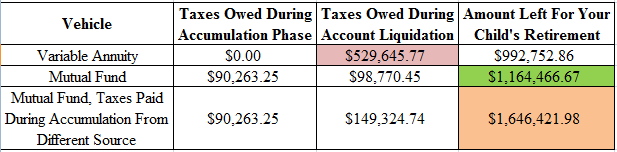
To make some final conclusions about which vehicle is better, we need to run some calculations using what we’ve learned. A copy of the spreadsheet that I put together is shown here, and I highlighted the key findings in the summary table below.
I included 3 scenarios – annuity, regular mutual fund, and a regular mutual fund where each year’s taxes are paid from another source other than distributed dividends.
Annuity
The first calculation I ran was for the stand alone variable deferred annuity. Even though the annuity did have a >2x higher expense ratio than the mutual fund account, the nice thing was that all of the money was able to compound free of taxes until withdrawal.
However, the annuity gets killed by taxes on the withdrawal side (see red highlighted box in table above), and results in the lowest amount of money left to your child.
Even though the contributions/premiums you paid in to the annuity are tax free to withdrawal, every bit of appreciation in account value beyond that gets taxed as ordinary income at 35% when it comes out.
This is somewhat unfair because much of that increase in account value has been due to dividends (which would have been qualified if held outside of the annuity) and long term capital gains on shares you have held for MANY MANY years. However, these all get lumped as “earnings” in annuity language, which are taxable at the ordinary rate. It hurts!
Regular Mutual Fund
Even though the regular, taxable mutual fund account has a lower expense ratio than the annuity, the account gets beat out during the accumulation phase by the annuity since a portion of the distributed 4.40% annual qualified dividend are being used to pay the 15% tax on said ordinary dividend.
However, the benefits on the liquidation side make up for any accumulation shortcoming, allowing for the final after-tax amount of the mutual fund to be >17% higher than that of the annuity (green highlighted cell in above table).
“How does this happen?” – you might be asking.
Essentially it boils down to 2 things:
- The total stock market mutual fund is very tax-efficient during holding, since it only resulted in qualified dividends (which are taxed at a lower, 15% rate) and no capital gains distributions during accumulation, and
- The preferential treatment given during liquidation regarding reinvested dividends and sales from long-term stock holdings that are not allowed in the annuity structure:
- If you remember, with the annuity, all increase in account value beyond what you paid in as contributions/premium got converted to normal income @ the 35% income tax rate.
- For the regular stock mutual fund, you only pay 0.13% of the account’s pre-liquidated accumulation value at a higher 35% short term capital gains rate, whereas in the the annuity, you paid ~35% of the accounts value in taxes at the higher rate.
- This is because in the mutual fund, the only short term holding held less than one year will be the penultimate reinvested dividend. The rest is either recovery of cost basis or taxed at the long term capital gains rate of 15%.
- Regarding dividends, with the annuity, dividends earned by the sub-accounts are viewed as earnings and are therefore taxed at withdrawal as normal income. With the mutual fund, the qualified dividends are distributed to the investor, which then you can use to purchase additional shares, increasing your ending cost basis.
Regular Mutual Fund, But Paying The Qualified Dividend Tax From Another Source
One of the books that I recently read was Ric Edelman’s (one of my favorite authors in finance) book, The Truth About Money. In the book (page 84 to be exact), he mentions that, “In all our 1,000+ collective years of practice as financial planners and investment advisors, having worked with thousands of clients and with $5 billion in client assets, we have never seen a client sell a bond or liquidate a bond fund in order to raise the cash needed to pay the taxes that Schedule B are owed.”
And, reading this got me thinking about how it might apply to this strategy of saving money for a child’s retirement. What this means is that in practice, normal folks might pull the money for the dividend taxes owed on the mutual fund from another source vs using the account value and/or dividend to do so. And, if this were the case, I was curious what financial ramifications it woudl have for the child’s retirement savings.
Taking this in to consideration, I put together the 3rd scenario analysis listed in the table above.
Using this strategy, having a similar liquidation scheme as the regular mutual fund scenario described previously, your child would end up with >61% more money (tan cell in above table) than the annuity strategy, and >41% more money than the mutual fund strategy where account value is used each year to pay taxes. Not too shabby, right?!
Conclusions
In summary, we have laid out several criteria needed for an appropriate account/savings vehicle in which to place the $1 per day that we discussed in Part 1 that could make your child a millionaire by the time he or she retires. By doing this, we narrowed down the options to 2 vehicles – 1) a deferred variable annuity and 2) a regular, taxable mutual fund.
From there, we found that even though annuities defer taxes during the accumulation phase, the fact that all increases beyond contributions are treated as earnings/ordinary income causes annuities to be more expensive to access during retirement than a taxable mutual fund. The end result is that from a mathematical perspective, saving the $1 per day in a regular mutual fund allows you to be better off.
Of course, there are some instances outside of the realm of mathematics where annuities may indeed make sense. For example, since annuities are classified as insurance contracts, they are likely to be more shielded from creditors than a traditional mutual fund account. Further, many offer some sort of death benefit guarantee. Finally, the fact that annuities do have the 10% withdrawal penalty can be beneficial if you are the type of person that might be tempted to access a mutual fund account prematurely.
However, it is my belief that for the majority of “normal” folks, saving the $1 per day in a regular mutual fund account with Vanguard or Fidelity will beat out an annuity.
How about you all? What type of savings vehicle do you use to save money for your child’s financial future?
If you don’t currently save in this fashion, hypothetically, which type of savings account do you think would be best suited for your needs if you were to do so?
Share your experiences by commenting below!
***Photo courtesy of http://www.flickr.com/photos/86530412@N02/7960787444/sizes/m
How Can Normal Folks Make Their Child A Millionaire? – Part 1 – The $1 Per Day Automatic Transfer

 Recently, I read a fairly intriguing book by Kevin McKinley, CFP, entitled, Make Your Kid a Millionaire: 11 Easy Ways Anyone Can Secure a Child’s Financial Future.
As the title suggests, the book’s overall message is that if you take some well-timed (early), pro-active steps, it is possible for people of many economic backgrounds to easily accumulate a large amount of wealth for their child by the time the child reaches retirement.
While there are many specific points covered in the book regarding trusts, taxes, rules of children earning income, etc, there are key two questions/themes that I wanted to explore as a result of reading this book. These are listed below:
- Question # 1 – What, when, why, and how should you start saving for your child’s financial future/retirement?
- Question # 2 – Having established a savings strategy, what is the best type of account/vehicle in which to save for your child?
Part 1 of this series will cover Question #1. Let’s get started!
Chapter 1 of McKinley’s book starts off with a brief ~100 word mentioning of a very potent savings strategy to set up a bright financial future for your child. And, I feel it is worthwhile to spend some more time discussing/elaborating on it. He states that setting aside “$1 every day will result in a millionaire kid later,” however, does not really get in to any additional specifics to execute this strategy.
Why Saving $1/Day For Your Child Can Create A Millionaire
In a nutshell, saving only a small amount of money each day can lead to a large amount later due to the concept of Time Value of Money (TVM), or as it’s often coined, the Miracle of Compounding Interest. Both of these terms have been discussed several times previously on my site.
This is the idea that saving (instead of spending) money today will accumulate to be worth more later in time because interest is earned each period, which then is eligible to earn future compounding interest on top of itself.
What is the Best Way to Save $1/Day For Your Child?
If you’ve been reading this blog for a while, you likely know what my take will be on the best way to save small amounts of money, consistently, over long periods of time.
That’s right – Automatic, pre-scheduled transfers from your checking account to your savings account/vehicle of choice (accounts will be discussed in-depth in part 2 of this series).
The reasoning behind using automatic transfers is 1) so you don’t forget to make the transfer each day/week/month and 2) to play a little psychological “trick” on your financial mind to cause you to miss the money less.
While each financial institution/account will do things slightly different, the ones I have experienced thus far will, unfortunately, not allow you do make 31 daily $1 transfers each month. Instead, many of them will have either $10 or $50 transfer minimums. This is not a show-stopper. You simply adjust the contribution frequently to match what $1 per day would equal and then proceed as planned, accounting for it in your zero-based budget.
When to Start Saving $1/Day For Your Child
Of course, the ideal answer here is “as soon as possible,” stemming from the fact that the earlier you can get compound interest working for you, you will have almost exponentially more money in the end. Unfortunately, I don’t think that is very realistic if you’re in a situation where you don’t plan on having kids for several years in to the future.
However, a good compromise to utilize going forward might be to start saving the $1/Day 9 months to 1 year before the child is born.
So, Just How Much Money Can $1/Day Translate To For Your Child’s Retirement Years?
To my fortunate surprise, saving just $1 per day translates to more money than I would have guessed before beginning this analysis.
For illustrative purposes, I put together the Google Docs worksheet at the following link for you all to download and play around with if desired – How Much Money Can $1 Per Day Lead To?
According to The Washing ton Post, the average age a person has their first child today is between the ages of 25-26 years old. If we assume that a parent starts stashing away $1 per day at the age of 25 (~1 year before the baby is born) and invests the money in a stock market mutual fund earning 10% per year, the following results are obtained:

- Saving $1 per day until your child finishes college (~ age 23) will yield >$1.9 million for your child when he or she reaches retirement age.
- If you wanted to be aggressive and save $1 per day PER PARENT ($2 per day) for your child in the same fashion, this would translate to >$3.9 million.
Intriguingly, and also demonstrating that compound interest over long time periods is the key factor in savings growth here is the observation that if you were to continue saving $1 per day for your child until they are AGE 65 (the parent is age 91), it results in a nest egg of $2.1 million, only 11% more than if you stopped contributing 40 YEARS EARLIER when the child was 23 years old. Crazy, eh?!
Conclusions / Looking Ahead to Savings Vehicles (Part 2)
Clearly, just a little bit of foresight/financial knowledge and only several minutes of your time to execute the strategy of saving just $1 per day for your child can lead to a significant amounts of money for his or her future due to the workings of 65 years of compounding interest.
Of course, these calculations do not take inflation in to consideration, meaning that being a millionaire when your child retires may not mean the same as it does now. In addition, if you want your child to go to a fancy private university that costs $40k per year, saving just $1 per day is not going to be sufficient, as you’d only have around $40k saved up by the time your child goes to college.
We’ll take this in to consideration in Part 2 of this series when we examine which is the most appropriate vehicle/account to save money in when trying to make your child a millionaire. Stay tuned!
How about you all? What sort of money saving strategies, if any, do you employ for your children?
Share your experiences by commenting below!
***Photo courtesy of http://www.flickr.com/photos/85583346@N00/167558529/sizes/
Don’t Let a Salary Raise Get in the Way of Hustling

 The following post is by MPFJ staff writer, Sally. Sally is the blogger behind TinyApartmentDesign.com, a blog about design, living well, and simple, tiny spaces. Enjoy!
A couple years ago, I finally decided to turn my finances around.
I was in debt and always thinking about the next bill I had to pay. It was nerve-wracking. The changes came slowly but surely. A big part of it had to do with finally finding ways to make money consistently that didn’t come from a job. I did a few things to make money. I bought a very small vending machine business. I had an online business that sold a physical product. And I had three paid writing gigs, as well as being an on-call copywriter for a company that created small business websites. I was on track to clear out all of my debt in mid to late 2013.
Then something unexpected happened.
I was offered a new job that came with a very nice pay raise from my previous position. I took the offer and started a job that was challenging, rewarding and exciting. I stayed on track and paid off my debt right around the time I had expected to, but also wanted to streamline some of my side gigs. I sold the vending machine business (with the move, it no longer made sense to drive to the location to collect less than $100 each month). I walked away from my writing gigs, needing a change of pace and feeling the pressure to write rather derivative posts. The only gig I kept was my online business, which has always been consistent and promises to grow in the future. I no longer needed the little gigs to sustain me, I had a salary for that!
But, this line of thinking was temporary. The truth is, as much I am excited about this job, I have to keep my bigger purpose in mind: which has always been to be a business owner, to make my own income and to generate income (through investments) without working, hourly or salaried. So I’ve gotten back on the horse. I am writing again, but this time on my terms and on the topics I care about (they’re not always this first-person oriented, promise!). There are always more ways to make money, and I may even look at another vending business closer to my new home. My online business is steady, but I am ready to branch out and try selling new products too. My new salary has been a great boost for my finances, but it also made me complacent a little too quickly. Learn from my mistake and don’t let a salary boost get in the way of hustling. There are always new opportunities out there and ways to diversify your income. There is nothing permanent except change, and there is no reason to stop looking for new opportunities, especially when that’s half the fun of hustling!
How about you all? Have you ever stopped or taken a break from your side income or side hustle? Was it the right move or did you feel like something was missing?
Share your experiences by commenting below!
***Photo courtesy of http://www.freedigitalphotos.net/images/Business_People_g201-Lady_Looking_Through_Binocular_p89551.html
$98.40 Giveaway – Community and Charity 10% Monthly Blog Income Give Back # 27 – December 2013 Edition

 The 10% give back giveaway fun rolls on for the month of December!
In case you missed the first 26 editions of the 10% Blog Income Give Back, after doing some thinking at the beginning of October 2011 about what direction I want this blog to grow and evolve towards in the future, I decided that any income made from this blog would have more significance to me at a personal life values level if I knew that a portion were being given back to the following places:
- 1) The readers – Obviously, without you here to read my articles and interact with my ideas, there would be no blog in the first place (let alone blog income). As such, it is only fitting that you receive a portion of any blog income.
- 2) Charitable organizations – If you’ve read my blog before, you know that I’m a big believer in donating a portion of my money to charity. Each year, I donate between 5-10% of my income to the National Multiple Sclerosis Society as part of the Bike for MS fundraiser that I do. Beyond the good that is done by donating your money, getting used to contributing to charity is also a good practice to emulate the actions of affluent individuals (T. Harv Eker discusses this in his book, Secrets of the Millionaire Mind, which I would definitely recommend reading if you have a few hours).
Because of these considerations, I’ve decided that each month going forward, I’m going to give away 10% of my net (after-tax) blogging income/profit to My Personal Finance Journey readers (5%) and to charity (5%). Listed below is how the process will work:
- After each calendar month passes, I’ll tally up my net blog income and determine what Dollar value correlates to 10%.
- I’ll post the giveaway (similar to this post you’re reading now), and you’ll have approximately 2-3+ weeks to enter.
- Once the giveaway is over, a grand prize winner will be announced, and that winner will then select what charity they’d like to have 5% of my blog income sent to. Once the giveaway entry window ends, I’ll send out the money to the blog reader winner(s) and personally drop off the charity donation, if possible.
- So far, I’ve been very happy with the success of the October 2011 – November 2013 give backs. Listed below is a summary of what we’ve accomplished so far with the give backs.
- Current total given to charity = $2,298
- Current total given to blog readers = $1,028
Details of December 2013 10% Blog Income Giveaway
- $98.40 total blog income to give away – $50 to a My Personal Finance Journey reader and $48.50 to a charity selected by the reader winner.
- $50 in the form of one prize available to one reader as follows –
- 1) Grand Prize = $50 cash via PayPal.
- $50 in the form of one prize available to one reader as follows –
How to Enter the Giveaway – Deadline to Enter is 11:59 PM, December 31st, 2013
Like previous months, I’ve decided to use the RaffleCopter giveaway management tool to handle sign-up facilitation for this giveaway, so simply go through the steps listed in the widget below to enter the running for the prize and accumulate entry points.
There is no limit to the amount of points you can earn. If you refer 10 subscribers – your name will have accumulated 170 entry points! Or, if you link to the giveaway more than once, you can accumulate those 10 entry points multiple times. You can also share other My Personal Finance Journey articles via social media sites once per day. In the event of a tie, I will be using a random number generator to select the winner.
Important instructions: After you complete an entry method, make sure to click and fill out the “I Did This” or “Enter” button in the widget so that I have a record of your points.
Remember, the deadline for entries will end at 11:59 PM, December 31st, 2013 (a little over 3 weeks from today – the start of the give back). Good luck to you all! Please contact me if you have any questions. After the deadline for entries passes, the winner (one with the most points accumulated) will be contacted via email to receive their prize.
***Photo courtesy of http://www.flickr.com/photos/comedynose/9972164896/sizes/m/in/
Why You May Not Want Insurance to “Total” Your Car

 The following is a post by MPFJ staff writer, Kevin Mercadante, who is a professional personal finance blogger, and the owner of his own personal finance blog, OutOfYourRut.com. He has backgrounds in both accounting and the mortgage industry.
Your car – a 12-year-old vehicle in good working order – is involved in an accident, and needs substantial repair work.
The total cost of the repairs are in the $5,000 range, which is right about what the car’s book value is. The insurance company suggests totaling the car, by offering you a check for $5,000, rather than going through the repair process which also has the potential of costing even more.
Due to the age of the car, and the fact that you’re now looking at a $5,000 cash windfall, the idea of accepting the check and using it as a down payment on a new car suddenly looks appealing. Is that the right course of action?
Sometimes – but not always.
While I will admit that accepting the check and replacing the car is probably the path most people would take, there are several reasons why you might refuse it and go with repairing the car instead.
You may not be ready to buy a new car – and the loan that comes with it
$5,000 is an attractive amount of money, but it won’t come close to buying a brand-new car. The most it will do is act as a reasonable down payment. You’ll have to make up the difference by taking a loan to fully pay for the car. With an average car costing around $25,000, this could mean taking a loan of $20,000. That could result in a monthly car payment of $400-$500.
You may be ready for a new car – heck, nearly everybody is – but are you ready for a hefty new car payment? Since your car is well over 10 years old, you probably don’t have a loan on. You probably haven’t have a loan on it for several years.
As great as a new car will be, taking on a new, large monthly payment can be a budget buster, especially if you have not had a car payment for several years. That payment could eat up all the money in your budget that would otherwise go for savings, the payoff of other debts, or even next summer’s vacation.
Instinctively, allowing the insurance company to total the car may seem like the right thing to do. But there’s a very real possibility that it will turn out to be a much more expensive option in the long run.
The car may be more valuable than what your insurance will total it for
It’s very difficult to value the true worth of an older car. Sure, there are car valuation websites, like Kelly Blue Book that provide generally accepted values on both new and used cars, but some cars just run better and longer than other cars of the same age.
Part of it may have to do with how well you as the owner have taken care of the car over it’s lifetime. If you have been particularly ambitious about this, and the car is extremely well-maintained, it may be worth far more to you than it’s technical book value.
You may decide that fixing the car and keeping it will be the least expensive option. After all, replacing it with a brand-new car will substantially increase your cost of living. And trying to replace it with a similar aged vehicle will be no better than a crap-shoot – there’s no way you can know if the previous owner has maintained the vehicle in anything like the manner that you have.
You may be able to get the car fixed for less money
If you have no mechanical abilities, and are forced to rely upon repair shops for needed repairs, accepting the insurance company’s check to total the car could be the best way to go. But if you can do a lot of repair work yourself, or if you have the ability to get it repaired by others at less than full-service shop fees, it may be less expensive for you to repair the vehicle.
For example, if you can fully repair the car by using used car parts, and either do the work yourself, or have it done by a “friend in the business”, you’ll save thousands of dollars over having it repaired by full-service mechanic.
Full-service repair shops, and especially body shops, often see wrecked cars as a cash cow, and charge premium prices. But if you have the ability and resources to work outside of the system, you may be better to go the repair route.
Replacement components may increase the life of the car
This is yet another outcome that people who have been in car accidents don’t often consider. If your car has just sustained substantial damage, the replacement parts that are put into the car on repair could actually prolong the life of the car.
We’re not talking about the resale value of the car here. As a general rule, the fact that the car has been in a major accident will lower its resale value. But if you’re talking about a car that is over 10 years old, its value is close to scrap anyway. The main reason that you would keep such a car is because you can get several more years out of it, and doing so will keep your auto expense low.
If replacing significant components are reasonably likely to enable you to keep the car for several more years, then repair will become the least expensive option.
Of course, we’re not talking about $10,000 worth of repairs to a car that’s only worth $5,000. Trying to fix car under those circumstances could be counterproductive. But if the balance is close – certainly with a few hundred dollars – you may not want to be so quick to allow the insurance company to total the car.
How about you all? Have you ever faced a situation where the insurance company wanted to total your car? How did you handle it?
Share your experiences by commenting below!
***Photo courtesy of http://www.flickr.com/photos/madaroni/4964347820/sizes/m/in/
Two Lessons I Learned About Retirement Planning

 The following post is by MPFJ staff writer Travis. Travis is a customer blogger for Care One Debt Relief Services, and also appears weekly at Enemy of Debt. Travis candidly shares his personal journey to pay off $109,000 of credit card debt and the tips he’s learned along the way. As a father and husband he provides a unique perspective on balancing debt, finances, and family.
Retirement Planning.
Do these words instantly make your eyes glaze over? For many people, it does. It’s like that statistics class that you wonder all semester when you’ll ever use the information the instructor is droning on and on about each day.
The thing is, you can’t afford to not pay attention.
During orientation for my first job, I was informed that I could contribute to a 401K plan, and that my employer had matching funds for the first 3%. Sounded like a great deal, so I started off contributing 2%. I felt good about myself, I was doing the adult thing and planning for my retirement. But was I contributing enough to accumulate a big enough nest egg for the retirement I wanted? Did I even know what that meant?
I didn’t have a clue, and worse yet, I didn’t talk to anyone.
The first time I talked to anyone about my retirement goals was five years into my marriage when my wife was pregnant with our first child. We visited with our life insurance representative about our changing needs to the imminent addition to our family. He helped us set some reasonable retirement goals, and a plan of action to achieve them. I upped our 401K contributions to be inline with our action plan, and figured we were good to go.
I went along like this for several years. At some point, I thought it would be a good idea to take a closer look at the 401K statements that showed up in my mailbox every three months. I thought I was being smart by diversifying my contributions across several funds that my employer had available within the 401K such as a Large Company Fund, Small Company Fund, and even an International Fund. When I took a look at how each fund was performing, I noticed that the fund I had been sinking the majority of my money into was giving me a return of less than half of some of the other funds.
Another mistake that may have cost me tens of thousands of dollars.
Here’s a simple example to show how much even a small percentage change in your rate of return can affect your investments. Let’s say that at a person contributes $300 a month from the day he starts his first job at age 22, until the day he retires 40 years later. Now, let’s say that his investments give him a rate of return of 4% per year, compounded quarterly.
$300 a month for 480 months, rate of growth of 4% compounded quarterly = $353,415.92
What happens if we up the rate of growth a single percent?
$300 a month for 480 months, rate of growth of 5% compounded quarterly = $455,341.69
In our very simple example, that’s a difference of over $100K, or an net increase of close to 29%!! You can see how paying attention to your investments can dramatically change your financial picture for retirement.
I quickly called my insurance representative who invited me to pay him a visit to re-evaluate my retirement goals as well as the growth performance of my retirement funds. He half-jokingly scolded me for not calling him for so long. But the realization of how I had handled my retirement savings taught me two very important lessons:
Retirement goals are not a one time “set it and forget it” deal: As you progress throughout life, your goals will change and you need to adjust your retirement planning accordingly.
Review your retirement fund growth periodically: When you calculate projected retirement savings, you use an estimated average growth rate. It is essential to check how your funds are doing periodically to see if you need to adjust where your money is invested, or your contributions based upon how your money is growing.
We have had to halt our retirement contributions over the last 4 and a half years while we were enrolled in our debt management program and concentrating on paying off our consumer debt. With only 4 months to go until we complete our program, it’s time to schedule another appointment to go over our retirement goals, and examine how our money is growing.
We have goals for retirement, and through careful and constant planning we aim to achieve them.
How about you readers, how often do you re-evaluate your retirement goals? When was the last time you did so?
Image courtesy of hyena reality / FreeDigitalPhotos.net
How To Learn More About Finance Without Boring Yourself to Tears

 The following post is by MPFJ staff writer, Catherine Alford. Cat is a freelance personal finance writer who blogs at www.BudgetBlonde.com.
Don’t get mad at me for saying this, but for most people, finance is kind of boring.
I mean, I like it (and presumably if you’re reading this blog you like it), but I only came to enjoy finances and learning more about it in my 20’s. It wasn’t something I got really excited about as a kid or a teenager. It wasn’t something that I thought was particularly important until recently.
However, now that I have my own kids on the way, I want them to like finance. I want them to understand it, and I want them to be interested in learning more about it. The only problem is, how do you impart that kind of knowledge without boring them to tears? How do you get them pumped about saving and encourage them not to go into debt?
Furthermore, how do you encourage anyone to get on the right path when it comes to money? How do you teach someone about investing without it being boring?
1. Make it a Game
When I first told my husband that I wanted to learn more about the stock market, he cautioned me that I had to watch the market for three months before investing. He didn’t want me jumping into the game without making an informed decision.
I didn’t know the best way to “watch” the market though. Did I just read the Wall Street Journal every day and keep track of stocks I liked? Did I just keep an excel spreadsheet of how certain companies were doing?
After a little bit of searching, I came across an online game called Wallstreet Survivor, which exists for the sole purpose of increasing financial literacy. On this game, you create a fake stock portfolio. They give you about 100k of fake money to play with, but I only “invested” $1,000 of it since that was a more realistic number for us.
A few months into “playing” (which really meant I bought some shares and watched it), and the stocks were so erratic that I’m not comfortable buying them. Still, it’s been fun to check in on the portfolio and see how it’s doing. It’s a pretty detailed game, and if you want to learn more about the stock market, I’d suggest it.
2. Talk to Someone Your Age
I’ve learned a lot about finance from my father in law. He’s seriously a genius when it comes to the markets. At the same time, he knows so much that I really have to pay attention to follow along. I don’t feel like I have quite the knowledge yet to have a full fledged conversation with him about finance. I mean, he has at least 50 more years of experience of reading the business news, and I feel almost inadequate sometimes trying to get a solid understanding of a lesson from him.
My husband, on the other hand, is maybe 5 years ahead of me in terms of his understanding of the way the finance world works. He doesn’t know as much as his dad, but he knows more than I do. For that reason, I feel like we are more on the same page, and when he gets excited about a topic, I get excited about it too.
Learning more about finance is something we can do together that benefits our family. I would encourage anyone who wants to know more about money to find someone their age to talk to about it first, and once you get comfortable with the terms and get some basic knowledge down, then go ahead and approach your parents or grandparents for some more detailed discussion.
3. Read Fun Books
There are some really great finance books out there. Some are really dry and boring and others are incredibly well written. Of course, not everyone likes the same financial gurus. It really just depends on your personality.
Some people love Dave Ramsey. Some people love Suze Orman. It really just varies from person to person, so my advice is to pick up a few of the top selling finance books at your library and flip through them to see who has the best writing style that speaks to you. I really love reading personal finance books, and I want to make it one of my 2014 goals to read them a lot more!
Ultimately, learning about finance and good money management doesn’t have to be boring. As long as you can talk to someone or play a game or read a book that gets you pumped and excited about learning more, you’re on the right track. If you try one method and it doesn’t get you interested, go for plan B. Watch some videos on You Tube about money management. Talk to you friends about it. Look up your favorite companies.
Just doing one of these tasks per day will increase your financial literacy dramatically, and suddenly, it won’t be boring anymore!
How about you all? How did you increase your knowledge of finance?
Share your experiences by commenting below!
***Photo courtesy of http://www.flickr.com/photos/binusarina/3889528397/sizes/m/in/photolist-6VGRhr-6XMJb5-735pS4-7k
Reader Profile – Robert from Beat the 9 to 5

 Today, in the ongoing Reader Profile Series, we’re getting to know MPFJ.com reader and commenter, Robert, from the site, Beat the 9 to 5. Let’s all give Robert a big round of applause for sharing his life with us and listen to his story. Enjoy!
Also, if you’re interested in sharing your own financial story/journey with us in a reader profile of your own, just shoot me a quick email, and we can get the ball rolling!
1. Please Tell Everyone a Little Bit About Yourself (Background, Education, Family Situation, etc).
My name is Robert Farrington and I’m the owner of The College Investor and Beat the 9 to 5. I’m passionate about helping young people be smart about their finances, specifically when it comes to investing and getting out of student loan debt. This really comes from my own situation.
I hustled through my undergraduate education by working full time and doing odd jobs. This helped me avoid student loan debt. I also went back to get my MBA, but only did it because my employer paid for it.
In my day job, I’m a retail manager. I love my job and the people I work with, but being in retail is tough on my family.
I’m married and my wife and I just celebrated the birth of our first child. This has led me to my next goal in life – beating my nine to five job to become a full time entrepreneur.
2. Describe Your Current Financial Situation (Who Works in Your Family, How Your Income Is, Your Expenses, etc).
I would describe our current financial situation as being in a massive saving phase to achieve two closely related financial goals. Goal one is to make enough money for my wife to stay home with our baby. Goal two is to have enough to retire by 35. Not that we will retire, but we want to have enough to be able to.
A third goal, but not totally financial, is to be able for me to work from home on my entrepreneurial endeavors.
Right now, both my wife and I work full time, and I also side hustle. You can find out more about my side hustle income by reading my Income Reports.
For our expenses, our biggest expense is our house, since we live in Southern California. Beyond that, we enjoy dining out, and then the baby. My biggest surprise in my expenses was that the baby was relatively cheap – so many bloggers talk about kids being expensive, but I haven’t found that to be the case.
3. What Are the Current Financial Challenges You Are Facing (Saving, Paying Off Debt, Student Loans, Merging Finances After Being Married, etc)?
The biggest challenge we’re currently facing financially is to make enough to support my wife not working. The goal is to be able to live off of my income and my side hustle income so my wife can stay home.
A part of this is that we don’t want to cut expenses. Instead, we want to grow our income. So, the biggest thing that is going to define our success is whether I can continue to grow my side income.
4. What Are Your Plans for the Future (Retire Early, Build Your Career, etc)?
The key plan for the future is for my wife to stay home in the next 18 months. Then, within 7 more years, be able to have enough to retire. The way we are going about this is by maxing out our savings.
We max our IRAs and our 401ks each year, but we also invest in a taxable account. The reason for this is that if we do retire early, we can’t really touch our retirement accounts without paying a penalty. So it makes sense for us to stash money away in a traditional brokerage account as well.
5. What’s Your Best Piece(s) of Financial Advice and/or Your General Philosophy on Personal Finances?
My general philosophy on saving money and investing is that you have to pay yourself first, and you have to hustle. Nobody in this world will take care of you better than you will take care of yourself. This means saving a lot, being mindful of your expenses (but at the same time understanding the choices you make with your money and what you value), and being self-sufficient.
I don’t plan on anyone – a company, the government, etc. – to take care of me when I’m older. We’re saving now to be well off later. We have a lifestyle we want to live, and understand that this requires money. We like a bigger house in Southern California. We like to vacation in Hawaii. We don’t want to change that.
Instead, we build our financial lives around achieving these goals and priorities.
What Constitutes a Millionaire in Today’s World?

The following is a guest post. Enjoy!
Things have changed so much on the financial landscape in recent years that even having a million pounds in the UK doesn’t really qualify you to be a true “millionaire,” at least in the historically-typified sense.
A million pound fortune used to be the benchmark of life-changing wealth not so long ago, but now, you might even be classified an impoverished millionaire, if that was remotely possible, unless you had at least £3 Million stuffed away in cash and assets.
In just a single decade, the value of money in real-terms has eroded so that the £1 Million stash you had in 2003 would now have to be £1.3 Million to keep pace with your wealthy counterparts. At least if you are a mere middle-class property owner in London, you might yet get the chance to join the exclusive club when you sell up, as there is an estimated £5.5 Trillion of cash tied up in property assets.
Being a millionaire used to mean you could probably afford to buy a house anywhere in the world if you wanted but in some parts of London that sum of money might not even buy you the parking rights to a home that is definitely off-limits for poorer millionaires.
The 2013 Sunday Times Rich List now has 88 billionaires, compared to 77 the previous year, so spare a thought for the mere millionaires who have to contend with someone looking down on them despite their supposedly wealthy lifestyle.