

- You are here:
- Home »
- Blog »
- Saving Money & Frugal Living »
- 8 Reasons To Always Carry Cash
Groups I Am a Part Of


8 Reasons To Always Carry Cash
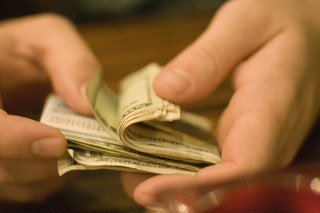 The following is a post by MPFJ staff writer, Kevin Mercadante, who is a professional personal finance blogger, and the owner of his own personal finance blog, OutOfYourRut.com. He has backgrounds in both accounting and the mortgage industry.
There’s an open question on the debate between credit cards and debit cards. But, let’s throw a monkey wrench into the conversation, and add cash to the mix.
There are at least eight reasons to always carry cash, no matter how convenient plastic may be, or what benefits it may offer.
1. In case your credit or debit card is denied
There are a number of reasons why a credit or debit card can be denied. Though the most likely reason is insufficient cash on a debit card, or a maxed-out line on a credit card, those are hardly the only reasons. Here are some others:
- A merchant’s card reader may be malfunctioning.
- There could be a technical problem with the issuing bank.
- There could be a problem with the merchant’s bank.
- Your card may be damaged and unreadable – a deactivated magnetized strip is hardly uncommon.
- There could be a mysterious computer glitch anywhere in the process.
- A general power outage could shut down everything.
Having some cash in your wallet, or at home, could come in handy in any of these situations.
2. Giving to a homeless person or charity collection
How many times have you come across a homeless person or someone collecting money for charity, but found yourself unable to give because you have no cash in your wallet? That’s the kind of thing happens when we become completely reliant upon plastic to pay for everything. Opportunities to give will be blown for a lack of a small amount of cash.
3. Spitting a bill at a restaurant
If you have ever been out to dinner with family or friends, and one of them paid the entire meal on plastic, splitting the bill after the fact can be very difficult unless you have cash. Sure, you can get around this easily if each party puts up a credit or debit card at the time of payment. But sometimes in the confusion of the moment, one person puts out their card in an attempt to keep things simple. If you have no cash to pay your portion, that can lead to an uncomfortable situation of leaving the restaurant owing someone money.
4. The gas station dilemma
Many gas retailers have a minimum balance requirement in order for you to pay at the pump with a debit card. It is very typical for example for a gas station to require a minimum balance of $100 in your account in order for you to use the pump. This is likely because the computer does not know how much the sale will be when you begin the transaction – it has to make the worst-case assumption, and $100 will generally cover the largest sale possible. If you only have $95 in your account, you will be unable to pay at the pump.
You can get around this is simply by using your credit card – but who wants to spend the next 10 years paying for gas in a tank that will be empty in a week? You can also go to the attendant and swipe your card for a flat amount, but that’s no more convenient than paying with cash.
5. Tolls and vending machines
Toll takers and vending machines generally don’t take credit cards. If you live in an area with toll roads, or work in a place where vending machines might be the only source of nourishment between meals, having some cash in your wallet will be an oasis in the desert.
6. There are still few places that only take cash
Even in an increasingly cashless society, there are still a few places out there were you can’t pay with plastic. Some examples include street vendors and fruit and vegetable stands. This is also quite typical at fairs and street festivals. While you may find some merchants and vendors will accept plastic, there are still many who work on a cash only basis. Still another place is garage sales – they don’t take plastic, and if they’re smart, they won’t take checks either.
7. If you have kids
If you have kids, you must have cash – period. Even if your child already has a credit or debit card, there are always situations were they need cash. It might be a minor purchase at school, a school related collection effort, or a school fair. Credit and debit cards won’t work in these situations, and you can’t be writing checks for every little thing that happens.
In addition, if the kids want go out with their friends – to go to the movies, bowling, or even just to the mall – you probably won’t hand them your credit card, and checks won’t do them any good. You’ll have to have some cash on hand to fork over, and usually on very short notice.
8. Minimizing identity theft
I’ve saved this for last because it may be the most important.
Every time you make a purchase using a credit or debit card, a paper trail is created. That is an open opportunity for identity theft, particularly since much of it is perpetrated by employees who have access to the trail. You can minimize the chance of identity theft by at least making small purchases in cash, rather than by plastic. Identity thieves hate cash!
How much cash should you carry?
The answer to this question will be different for everyone. Much depends upon what your situation is – for example, how frequently you encounter tolls, how many kids you have, and how likely you are to frequent vendors who only accept cash.
For most people who fall somewhere in the middle, carrying $50-$100 in cash in your wallet will get the job done. Alternatively – to minimize the damage from the theft or loss of your wallet – usually $20-$30 in your wallet, while keeping $100 or so at home.
And whatever you keep either in your wallet or at home, should be held in small bills. A $100 bill will do you little good at a vending machine, or if one of your kids wants $20 to go to movies.
How about you all? Do you carry cash, or do you prefer to go completely cashless? If you do carry cash, how much do you think is enough?
Share your experiences by commenting below!
***Photo courtesy of http://www.flickr.com/photos/jmrosenfeld/2903513401/sizes/n/in/
About the Author Jacob A Irwin
Hi folks! My name is Jacob. I am the owner and operator of My Personal Finance Journey. I started this blog in January of 2010 and have enjoyed the journey ever since. Since finishing up graduate school in Virginia in 2014, I have been working in biopharmaceutical development in Colorado. You can read more about me and this site here. Please contact me if you have any questions!
Popular posts
Session expired
Please log in again. The login page will open in a new tab. After logging in you can close it and return to this page.
Oh yeah…cash is till king! (well, sorta). I always move with some cash…especially in situations with kids, wants seem to pop up rather quickly 🙂 I also like the “feeling of security” from a padded wallet…cash has gotten me out of some would-be embarrassing situations!
With kids, cash is a must!
Kevin@OutOfYourRut recently posted…8 Strategies to Overcome Middle Age Unemployment
“1. In case your credit or debit card is denied” This happens a lot more than people think, and its normally an anti fraud measure by your bank when you travel. I work as a branch manager of a small bank and deal with this often.
Chuck@Tortoise Banker recently posted…Protect Your Health: Lessons Learned From a Cancer Diagnosis
So having some cash in tow is really a necessity, not an option.
Kevin@OutOfYourRut recently posted…Why Teach Your Kids How to Cook?
I certainly wouldn’t even go outside without a bit of cash – and have you hear about the US govt. considering a change from bills to coins?
Kostas recently posted…Car Insurance Rates – Seven Factors That Determine Them
Yes, that will certainly make cash less convenient. Carrying a pocket full of coins is more cumbersome than paper bills in your wallet. To say nothing of what it will do when you pass through metal detectors!
The reason they want to do that is to save money on minting costs. A paper bill lasts only a few months in ciruculation, where a coin can last for 30 years.
Kevin@OutOfYourRut recently posted…Why Teach Your Kids How to Cook?
There is nothing worse than having your card denied and no cash to pay for the order. For that reason we try to keep some emergency cash on us. The cash can come in handy in so many situations that not having it would simply mean we may just get stuck if we need it and don’t have it.
canadianbudgetbinder recently posted…July 2013 net worth update (+1.00%): UK exchange rate
That’s the worst case scenario that necessitates carrying cash. You never know when that will happen or what the reason will be. Sometimes we over-rely on technology and think it can never fail, but it can. That’s when cash shines.
Kevin@OutOfYourRut recently posted…Why Teach Your Kids How to Cook?
I try to carry around $40 with me for cases just like the ones you described. I’m not very good at it but my husband is. He balances me out. Another reason too is that sometimes restaurants give you a discount if you pay in cash. Score!
Christine @ ThePursuitofGreen recently posted…Cooking at Home: Portobello and Fried Egg Sandwiches
Wow Christine, I hadn’t heard about cash discounts in restaurants, but that’s a good reason to be ready with cash to take advantage.
Kevin@OutOfYourRut recently posted…Why Teach Your Kids How to Cook?
I’ve only found that at small asian restaurants actually. They’ll mark the cash discount on the check sometimes and put the cash total versus the credit total.
Christine @ ThePursuitofGreen recently posted…Living the Costco Way
Lots of small business, usually with handwritten receipts, or that are in an industry that has an element of bargaining will offer a discount if you pay cash. Sometimes when you offer to pay cash, they can reduce the price as they don’t have to pay credit card fees.
One example, this week I bought a painting as a souvenir of a trip. When I went into the gallery, turns out the artist was the one working. I got 25% off by paying cash on the spot. No credit card fee for the business, and I’m guessing that the artist won’t have to split with the gallery (but that’s between them and their employer). For me, it was a good deal, that I wouldn’t have been able to take advantage of without cash in my pocket.
Matthew recently posted…Is Your Home An Asset?
Hi Matthew – There’s also the fact that merchants pay a fee to the credit card companies of 2 – 3%, so they may offer a discount to eliminate that, as well as for immediate income. There’s likely some sort of delay in reimbursement from the credit card companies, so the merchant may give a bigger discount to get the money now.
Kevin@OutOfYourRut recently posted…8 Strategies to Overcome Middle Age Unemployment
Yep good point about immediate income. The 2-3% fee was what I was referring to when I talked about credit card fees.
Matthew recently posted…Should I Use An Investment Advisor?
I occasionally carry cash, but most of the time I don’t have any. It definitely has its disadvantages, but it helps me with self control, so it works out for the best in my case.
Michael | The Student Loan Sherpa recently posted…Things to Know Before You Co-Sign a Student Loan
Great reasons! I used to do this, then I got too lazy to go the the ATM 😛 I need to get back in the habit!
Lisa E. @ Lisa Vs. The Loans recently posted…Who Wants to be a Millionaire?
Hi Lisa – I just find that life is a bit easier when you have a little cash on hand.
Kevin@OutOfYourRut recently posted…Everyone Should Be a Homeowner – Don’t Fall For It!
I guess I can understand why we don’t prioritize carrying cash because these situations almost never arise for us! It did catch us off guard the first time we drove through the Northeast because we kind of forgot tolls existed. I haven’t had any cash in my wallet for weeks now and I think my husband has less than $8.
Emily @ evolvingPF recently posted…Inexpensive House, Expensive Car
Hi Emily – Somehow…that would never work in my life!
Kevin@OutOfYourRut recently posted…Everyone Should Be a Homeowner – Don’t Fall For It!
These are all great reasons. We hardly carry any cash ever.
Michelle recently posted…$11,117 in July Extra Income – Growing but I crave stability
Hi Michelle – I used to do that (not carry cash) but now I know better!
Kevin@OutOfYourRut recently posted…Everyone Should Be a Homeowner – Don’t Fall For It!
We usually have some sort of cash on us. We use the envelope method and supplement with cards we’re using to get rewards points. It never fails though, when we don’t have cash then we need it!
John S @ Frugal Rules recently posted…Rant Warning: When Was the Last Time You Ate?
Hi John – I’m frequently without cash myself – kids make it hard to keep a full wallet! But that’s so true about not having it when you need it.
Kevin@OutOfYourRut recently posted…Everyone Should Be a Homeowner – Don’t Fall For It!