

Category Archives for Invest & Retire
1% Commission "Full Service" Real Estate Agents – Are They Worth the Savings?
As you’re probably already aware, most real estate agents are paid on a percentage-based commission structure of the overall sale value of the associated home or real estate. Typically, this percent commission is around 6%, with 3% going to the selling-agent’s firm and the other 3% going to the buying-agent’s firm.
Begin mild-ranting about the current real estate agent commission structure…
Due to the very nature of this commission structure, an immediate conflict of interest presents itself for the buying-agent. This is due to the fact that the buyer wants to pay as low of a price as possible for the property investment, but the agent will receive less money if he or she secures his or her buyer a lower price. Of course, if you find a professional agent, the expectation is that the buyer’s agent will act in your best interest instead of solely for monetary gain. In fact, when I purchased my condominium last year, my full service buying agent acted very responsibly in trying to find me a reasonable place for the best price possible. End complaining.
So, the bottom line is that with regular real estate agents, the seller can expect to give away about 6% of the money he or she receives from the buyer to pay for real estate agent services (this does not include closing fees of course). While 6% may not seem like a ton of money (after all, we pay waiters and waitresses 15% commission on the food we buy), if you are selling your $500,000 McMansion house, you’re looking at shelling out close to $30,000 to the real estate agents in one transaction. Looking at numbers like this, you can really see how potentially lucrative being an effective real estate agent can be!
Recently, while driving my car around town or riding my bike through the countryside, I’ve begun to see more and more “FOR SALE” signs popping up advertising that the seller of the property is using a 1% commission real estate agent to assist in selling the property. Here in Virginia, one of the popular 1% commission companies I often see is Equity Saver USA.
Clearly, these sellers weren’t all too willing and anxious to fork over the hefty 6% real estate agent fee and were looking for an alternative. In seeing these signs, I began to wonder several things that I wanted to examine in today’s post –
- 1) Do these 1% commission agents offer similar types of services as regular real estate agents, and if not, what services do they take shortcuts on in order to save money?, and
- 2) Are these 1% real estate agents able to negotiate good prices for the property sellers?
What Services Do 1% Commission Full Service Real Estate Agents Offer?
All of you have most likely heard the age-old adage that states, “You get what you pay for.”
Translating this to the current investigation, my initial thought would be that if you decided to use a 1% commission agent to sell your home, you’d get a worse service with fewer actions taken on your behalf. However, according to 1% commission agent websites, they are able to offer the same services as 6% commission agents for a lower cost because they use a model that takes advantage of technological resources that were not available 20 years ago when 6% commissions were the norm.
Because of this potential discrepancy, I feel it’s important for us to take a look at exactly what types of services 1% commission agents offer. The following services were listed on 1% commission agent, Equity Saver USA’s, website. The description of some of the services are adapted slightly for increased readability.
- Upload 10 minutes of full speed online video showcasing your property.
- Broadcast up to 5 minutes of AM audible sales information to potential buyers listing from their car radio.
- Automated and extensive use of all real estate and social networking sites, including MLS & Realtor.com.
- 24/7 dedicated phone support and tour scheduling.
- Mobile office with Internet access, GPS, TV, DVD, satellite radio and leather captain chairs.
- Use of larger 24″x36″ FOR SALE signs for greater visibility.
- Online access to all Virginia Association of Realtor approved contract forms.
- Custom websites dedicated to showcasing your property.
- Utilize “old fashioned” print, radio and TV advertising when needed.
- We are designated Realtors. Realtors subscribe to a strict code of ethics and are expected to maintain a higher level of knowledge related to buying and selling real estate.
How Effective are 1% Commission Agents?
Looking at the list of services that 1% commission agents offer above, it seems to me that at least officially, these 1% commission real estate agents offer all of the services that I would need in an agent if I were to ever sell my condo. They even offer full MLS listing, which is a key feature in today’s “online” real estate shopping market.
However, my worry in blindly using a 1% commission real estate agent to sell my condo lies in the unsaid importance of the “unofficial” services that real estate agents/brokers offer. In other words, I would be concerned about whether or not I’ll be forced to end up selling my home below market value if I don’t obtain these unofficial services.
In the town in which I live, most of the condos for sale that are equivalent to the one I’ll be looking to sell when I finish graduate school are being offered through Better Homes and Garden Realty, a normal full service 6% commission real estate brokerage.
Now, let’s say that I put my condo on the market using a 1% commission broker. It doesn’t take much stretch of the imagination to expect that a powerhouse like Better Home and Garden won’t be too thrilled about my 1% commission broker “stabbing the industry in the back” by charging 5X less than they are for the same services. Let’s now assume that Joe Smo, a new person in town, is looking to buy a condo in the range of the list price of my condo, but doesn’t know the area and just wants a place that will work, be safe, and is in his price range. Joe Smo, at the advice of a colleague, obtains the help of a 6% commission real estate agent to show him around.
Since there are SO many places on the market now with the economy the way it is, it again doesn’t take too much of a stretch of the imagination to envision that the agent helping Joe Smo could merely opt not to show Joe my place, in favor of helping the cause of his or her other 6% commission agent friends who are still being “true” to the real estate community. Sure, the agent would gladly show Joe my condo if he found it listed on MLS (a service included with 1% commission agents) and specifically requested to see it. But, this might not happen since Joe is new to the area.
In my opinion, it is highly likely that this unsaid, unofficial stuff takes place every day in the real estate business. And, being on the wrong side of it can be quite detrimental to obtaining a high resale value for your home.
In order to find a more definitive answer to this hypothesis, I performed an Internet search to try to find any studies that have been conducted on the effectiveness/performance of 1% commission real estate agents compared to “normally” priced ones. However, there were no studies to be found. So, we are unfortunately left with only speculation at this point (sigh).
Are 1% Commission Agents Common in Other Countries as well, or just the United States?
As I was analyzing the situation above, I began to think back on the days that I spent studying abroad in Spain in 2008. During the two months or so I was there, I lived with a family that owned the majority of the small apartment complex in which they lived. And, I began wondering whether or not people (such as mi familia en Espana) engaging in an overseas property investment (outside of the United States) encounter and have to deal with the same types of real estate agent commission issues that we do here.
In general, from what I found in looking around various online resources, 1% commission agents are definitely available for selection in other countries. For example, I found several 1% agents operating out of Canada – one in Toronto and one in Ontario. I also found a 1% commission agent operating out of Falls Church, New Zealand (I’d really like to visit NZ someday by the way!). In these countries, the “normal” rate for real estate agent commissions seemed to be somewhere between 5-8%, which seems to be about in-line with the US.
However, I read that in some instances in Europe (Spain, Bulgaria, and Cyprus), commissions paid to real estate agents can be as high as 25%! Wild stuff! I just hope that my family I lived with in Spain didn’t have to pay this much!
Conclusion
Drawing from the various findings of this post, several key takeaways present themselves to me.
First, while I have no doubt that a 1% commission agent can technically provide the same MLS listing and property promotion services that a 6% commission agent could, I think that the “real estate society” isn’t quite ready to part with 6% commissions, which will make it difficult for now at least to use a 1% commission agent. This is especially true in today’s “buyer’s market” where property prices are going down and down, yet the properties seem to be unable to be sold. I know this is definitely the case right now in my neighborhood.
Second, I do honestly believe that eventually, real estate agent commissions will trend down and that 1% commissions will become “accepted” in the community. This would be similar to the downward shift in stock trading commissions experienced in recent years with the advent of the deep discount brokerage. Related to this trend, I’d also be interested in keeping an eye out for any data analyses/studies that come out comparing the performance of 1% commission agents to “traditional” ones. I think that would really provide a necessary insight in to the current situation.
How about you all? Have you ever used a 1% commission real estate agent? If so, do you feel there were as effective as a traditionally-priced agent? If you’ve stayed away from 1% agents, what specifically were your concerns?
Share your experiences by commenting below!
How Checking Your Credit Report Can Stop Identity Theft

————————————————————————————————————————
Welcome to My Personal Finance Journey! If you are new here, please read the “About” or “First-Time Visitor” pages to find out more about us. If you would like to receive free updates on articles like this by email, then sign up here or you can subscribe to the RSS feed. Also, check us out on Twitter or Facebook. Thanks for visiting! Keep on learning!
————————————————————————————————————————
The following is a guest post. Enjoy!
Identity theft costs American consumers and businesses almost 50 billion Dollars annually. In 2009, more than 11 million people were victims of identity theft and lost an average of almost $5000 per person. This type of crime is growing at a rapid pace due to the sophistication of hacking groups and the ability of thieves to sell private information on the internet. As more personal information moves online with social media and technology like “the cloud”, identity theft may even become an even bigger problem. With regular monitoring of your financial data, it is possible to catch the theft in progress and stop it before serious damage is done. So, how can you spot it?
Checking Your Credit Report
Keeping close tabs on your credit report is important if you’re going to notice any activity that seems abnormal. Your credit report shows your entire credit history, and you should be able to spot anything fraudulent.
The best place to check all 3 of your credit reports (from the three biggest credit reporting agencies – Equifax, Transunion, or Experian) is Annualcreditreport.com. The Fair Credit Reporting Act (which was recently amended in 2010) allows all people to have free access to their credit information (report), one time per year. You can check all three reports free of charge and search for activity that looks suspicious. Your good credit score can be seriously damaged by fraudulent activity, so keeping a close watch on it is important. However, viewing your credit score is not included in the one time per year free credit report viewing.
How to Spot Identity Theft
Your credit report shows all open and closed credit accounts, all the way back to when you opened your first credit card or paid your first utility bill. If you see anything that you don’t recognize, it may be the result of identity theft. The FTC recommends that consumers check their credit at least once per year to make sure it doesn’t contain any fraudulent activity.
Other signs of identity theft may include:
– Phone calls or mail saying you have been approved for credit cards or loans that you did not apply for.
– Missing financial mail like bank or credit card statements.
– Bills and/or credit card charges for items you did not purchase.
What to Do if You Notice Fraud
If you do notice suspicious activity on your credit file, you can have a fraud alert placed on your report. This alert will help stop any unauthorized use of your credit. There are 2 types of fraud alerts, an “initial alert” and an “extended alert”.
An initial alert is put on your credit file for around 90 days. This is a step you might take if you believe your personal information may have been stolen and could be used fraudulently. If you know you are a victim of identity theft already, you may need to file an extended alert which will stay on your credit file for 7 years. This means that creditors must contact you before issuing any new credit in your name.
You will also need to close any accounts that were opened in your name. You can contact the fraud department of the company that issued the account and explain your situation. Keep a record of all correspondence with the company. It may be important to have proof of any agreements that you have made about your case.
You also may want to file a complaint with the FTC and the police. This can help law enforcement find the perpetrators of the theft and prevent any further illegal activity with your credit.
Credit Monitoring Services
Credit monitoring is a service which can be purchased through a credit bureau like Equifax, Transunion, or Experian. This service will alert you any time new accounts are opened or suspicious activity occurs on your credit file. This would include the application for new credit cards, loans or mortgages, or the opening of an account with a mobile phone provider. Some companies that provide credit monitoring will also insure you for losses that result from identity theft. The amount you will be covered for varies with each company and monitoring plan.
Conclusions
Identity theft is a serious problem that can be very expensive and time consuming to deal with. There are measures you can take before a theft happens to lessen the chance that you will be a victim. Regular monitoring of your credit report and financial information will help you notice illegal activity before it turns into something more serious.
How about you all? Have you ever been a victim of identity theft? If so, what steps did you take to correct it? Have you ever noticed any unauthorized charges on your credit cards?
What steps do you take to protect yourself from identity theft? How often do you check your credit report?
Share your experiences by commenting below!
Jacob’s Thoughts – Listed below are my random thoughts as I was reading this article.
- Personally, I’ve been lucky enough to not have been a victim of identity theft so far in life. As far as bad luck goes, I think having your identity stolen would be one of the worst things that could happen since it can affect your purchasing and borrowing ability as well as your credibility as a person for years to come.
- How I protect myself from identity theft
- There are several steps I take to stop identity theft from happening to me, the majority of which are covered in a previous post I wrote which can be assessed at the following link – How To Protect Yourself Against Identity Theft.
- The main steps I take include the following – 1) place a free 3 month fraud alert on my credit report at all three of the main credit agencies (this must be renewed every 3 months), 2) monitor my credit report once a year using the free site mentioned above in this post, and 3) reduce the amount of junk mail I get by “opting out” of these lists at a site called Opt Out Pre-Screen (reducing the amount of junk mail decreases the amount of documents floating around the trash and mail system with my personal details on it).
- Several additional steps that have been added to my “identity theft prevention regimen” lately are to never click links in scam emails and always make sure I see that an Internet website is secured before entering my payment details.
- @ Does insurance cover identity theft?
- As I was reading this post, I began to think that it would be nice (since identity theft is becoming more and more common these days) for some type of insurance policy an individual would already be carrying would protect him or her against damages done by identity theft.
- According to the Insurance Information Institute (III), insurance companies are now offering identity theft coverage either as add-ons to home insurance policies or as separate policies.
- As mentioned above, another increasingly popular service that provides identity theft coverage is credit monitoring services.
- So, since identity theft coverage is not currently included in regular insurance, the question becomes whether or not this type of coverage is worth the extra $25-$50 per year.
- An investigation in to answering this question would be a good topic for a future post. However, my instinct tells me that it probably is not worth the money for the current risk level. Additionally, much of the service offered by credit monitoring agencies can actually be performed by you manually using the steps described above (setting up fraud alerts, etc).
- But, we may see this changing in the coming years as identity theft becomes more prevalent.
- @ How identity theft happens –
- One of my more computer-savvy friends recently told me, much to my surprise, that the majority of identity theft incidents happen simply by random occurrence rather than specifically targeting a certain individual.
- What he said would happen is that a hacker runs a computer script that scans through millions of account numbers, applying number and letter codes in order to discover a person’s password. If a password is “cracked,” it is more the result of random chance than targeting a specific person for personal reasons.
- Furthermore, he told that the majority of identity theft incidents occur through non-technological means. What he meant by this was that more identity theft cases occur simply by someone eaves-dropping on a nearby conversation when a person mentions his or her Social Security number out loud or when someone finds credit card information written on a piece of paper in the trash than when someone uses high-tech computer software to hack an account.
- I found this interesting!
- @ How often you should check your credit report for fraud –
- Because identity theft seems to be turning in to a more significant problem, it begs the question of whether or not checking your credit report once per year (the free route) is sufficient.
- In thinking about this, my thought is that checking your credit score twice per year is probably both a reasonable and safer plan.
- @ I wonder what percentage of identity thieves are actually caught or apprehended?
- When I had finished reading through this article, I felt slightly disheartened because it seems to me that identity theft is almost too easy for fraudsters to get away with.
- After all, if you are a victim of identity theft, it’s not like you can report it to the local police to look in to since the person who took your identity could be in a different country or state. So, just who goes after these people?! And furthermore, how do they prioritize which cases to investigate?
- Because of this, I was curious to find out what percentage of identity thieves are actually caught.
- According to a study I found on Privacy Rights.org, only about 1 in 700 identity thieves are caught. This is truly amazing! That’s a 0.14% chance!
- Just as a point of reference, the probability that you will become a victim of identity theft is 1 in 200. Wild stuff!
***Photo courtesy of http://farm3.static.flickr.com/2285/1594411528_1512b1aad5.jpg
Was The “Lost Decade” Really Lost For Investors?

————————————————————————————————————————
Welcome to My Personal Finance Journey! If you are new here, please read the “About” or “First-Time Visitor” pages to find out more about us. If you would like to receive free updates on articles like this by email, then sign up here or you can subscribe to the RSS feed. Also, check us out on Twitter or Facebook. Thanks for visiting! Keep on learning!
————————————————————————————————————————
This following is a member post by me that was posted on Yakezie.com back in June of this year. I wanted to post it here as well so that you all would have a copy. Enjoy!
A topic that is commonly discussed these days in the personal finance community is something called, “The Lost Decade.” In fact, while I was recently reading several financial magazines, I found out that many would-be experts would have us believe that the past 10 years were completely useless for investors. Quite a bold statement if you ask me!
After reading these statements, I began to wonder, “What facts do the actual numbers dictate to us?” This analysis will be the topic of today’s post.
What Is The Lost Decade?
For those of you unfamiliar with the phrase, “The Lost Decade,” it basically is referring to the fact that during the past ten years, the stock market has fluctuated up and down, but has only gone up 0.48% overall from start to finish. This performance can be seen from the Google Finance screenshot of the S&P 500 index below.
Now, I’m definitely not going to argue that a 0.48% return spread over 10 years is good. Quite the opposite, actually. Earning a 0.48% return is ridiculous! If an investor was to just earn this return, it would be quite accurate to call the 10 year period, The Lost Decade. After all, you could have earned more by merely investing in an online bank savings account!
However, my disagreement with this phrase/name stems from my belief that it does not capture the actual way that the majority of individual investors save (or should save) for retirement.
How Do The Majority of People Save For Retirement?
OK, so if I’m not quite ready to jump to labeling the past decade as “The Lost Decade” because it doesn’t capture the way that most investors save money, just how do I believe people go about tackling the beast we know as “investing?”
In my opinion, when it comes to squirreling away the money that matters for retirement, most people invest using dollar cost averaging (or something similar). This strategy involves investing a specific amount of money (or specific % of your income) each month. By doing this, an investor can accumulate shares of the investment he or she specifies at varying price levels, with more shares being purchased during stock market declines and fewer shares being purchased at higher prices.
Because dollar cost averaging results in ownership of shares purchased at many different price levels, further analysis is required before we place a label on the past decade.
Dollar Cost Averaging Analysis of Two Portfolios
After several iterations of trying to decide on the most effective way to demonstrate this, I decided on two hypothetical portfolios – a basic portfolio and an expanded portfolio.
Both portfolios have the following shared characteristics:
- Examine the total return and investment risk (standard deviation) of a $10,000 initial and $500 monthly follow-on investments from June, 2001 to June, 2011.
- Employ an overall asset allocation of 25% fixed income investments and 75% equity investments.
- Assume monthly rebalancing to maintain these asset allocation targets.
- Naturally, passive investing is used because it has been show to outperform individual stock selection on a long-term basis.
- For simplicity, an analysis of the effect of trading commissions, taxes, expense ratios, and inflation is not included.
However, the two portfolios diverge in regards to the specific mix of investments used to achieve the 75%/25% overall asset allocation split.
The basic portfolio invests only in two assets – 1-year Treasury Bills (T-bills) for the fixed income portion of the portfolio and an S&P500 index fund for the equity piece.
The expanded portfolio uses the exact same index mutual fund asset class selection as I do currently, as shown in the list below. All investments are assumed to be Vanguard index mutual funds, except for the T-bills portion.
Note: All Vanguard mutual fund historical price data was downloaded from Yahoo Finance for the analysis.
This asset class mix/investing strategy was the result of multiple books about Modern Portfolio Theory, including A Random Walk Down Wall Street by Burt Malkiel, Stocks for the Long Run by Jeremy Siegel, and What Wall Street Doesn’t Want You to Know by Larry Swedroe.
1. % Cash (T-bills Target 5%)
2. % Non-Inflation Protected Bond Funds (Target 15%)
3. % TIPS Bonds – (Target 5%)
4. % International Equity (Target 11%)
5. % International Emerging Markets (Target 11%)
6. % Domestic Large Cap (Target 8%)
7. % Domestic Small Cap (Target 8%)
8. % Domestic Small Cap Value (Target 14%)
9. % Domestic Large Cap Value (Target 13%)
10.% REIT (Real Estate Investment Trust – Target 10%)
As you can see in the list above, instead of just having one equity or fixed income asset class (like T-bills or the S&P 500), there are MANY! In addition, we have also added both international and emerging market index funds in to the mix.
I hypothesized that since these different asset have a correlation that does not equal 1, the expanded portfolio would offer a higher return for a given level of risk, consistent with the Efficient Frontier hypothesis/phenomena.
Results
“So, enough talk, Jacob, what did you find out as your results?!”
The complete results of my analysis can be reviewed and downloaded at the shared Google Docs spreadsheet below. Enjoy!
Google Docs Spreadsheet – Was The Lost Decade Really Lost For Investors? – Analysis
However, a summary of my findings can be found in the table below.
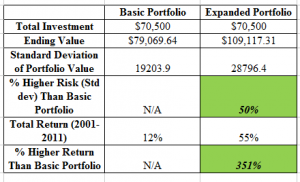
The results of the basic portfolio with the application of dollar cost averaging were somewhat disappointing, with a total return over the past ten years of only 12%. However, this is still definitely better than a 0.48% overall return! During the ten years, we saw that by using this investing strategy, your money would have grown to a current value of ~$79,000.
The results of the expanded portfolio were surprisingly much better. I guess I always have read that this asset allocation stuff works, but have never done this in-depth of an analysis to determine just HOW effective it is!
A total return of 55% was realized over the 10 years. While this is not the 10% yearly average return that the stock market has provided since the 1800’s, it is a 351% increase in return compared to the basic portfolio. Quite amazing! The ending value of the portfolio was almost $30,000 higher than the basic strategy.
It is important to realize that the expanded portfolio value standard deviation did increase by 50%, so it was not completely a free lunch. The increased standard deviation was most likely contributed by the small cap, small cap value, and emerging market funds, as these are generally regarded as higher risk investments.
Conclusions
Now that the dust has settled (or maybe a more accurate saying would be that the spreadsheet electrons have settled) from this analysis, let’s take a step back and see what sort of conclusions we can draw. Several of the key ones I could think of are listed below:
- Even though the past ten years were not the best for investors, I don’t think I would consider them to be “lost” and completely useless to our wealth building goals. However, I suppose this depends on your required rate of return.
- The application of periodic investments using dollar cost averaging can produce higher overall returns than just investing one lump sum because it enables you to purchase lower-priced shares.
- Passive investing works. I would recommend using it! 🙂
- The addition of different asset classes (small-cap, large cap, value, international, etc) to a portfolio is beneficial for returns and risk management. However, it isn’t absolutely necessary, unless you are someone who enjoys managing your own money (as I do). If you like to keep things simple, merely having 2 index mutual funds will most likely provide adequate exposure.
How about you all? How did your investments perform over the past decade? Was it actually a “lost decade” for you?
Zecco.com Investing Brokerage Review

————————————————————————————————————————
Welcome to My Personal Finance Journey! If you are new here, please read the “About” or “First-Time Visitor” pages to find out more about us. If you would like to receive free updates on articles like this by email, then sign up here or you can subscribe to the RSS feed. Also, check us out on Twitter or Facebook. Thanks for visiting! Keep on learning!
————————————————————————————————————————
Zecco.com and I have a pretty long history. I joined Zecco back when it had just started in the 2006-2007 time frame. This was when I was just beginning to learn about investing and trading stocks (I have since changed my investing strategy to a passive investing approach, investing only in index mutual funds. But, that is another story!).
Zecco blasted on to the market with quite a revolutionary concept – commission free stock trading. Naturally, this was the reason that I (like many others) joined! It was hard to believe at that time that a brokerage could be offering commission free stock trading.
Of course, this was back during the “21st Century glory days” of investing, when the market was going higher and higher and brokers were competing desperately for your money. Since that time, Zecco (like everything) has gradually tightened up and increased their commissions to a level that is less enticing than it once was. However, they are still in my mind, one of the better and cheapest discount brokerages around.
Let’s explore some of the details of this “player” in the investing world to determine if it’s right for you.
Account and Investment Options
Through all of the years I have used Zecco, I have just had one account – an individual, taxable, stock trading account.
Having said that, Zecco isn’t without options. Zecco.com has gradually expanded their offerings, and they now feature the following types of investing accounts and investment options:
Account Options:
- Individual and joint taxable investment accounts
- Traditional, Rollover (from 401k), and Roth IRAs
- Just be careful, a $30 per year IRA maintenance fee applies to IRA accounts.
- Stocks / equities
- Exchange Traded Funds (any ETF that is traded on the AMEX stock exchange)
- *New* Mutual funds!
- This is a fairly new feature that was just recently added to the array of investment options at Zecco.com.
- However, before investing in these, be sure to read the fees section below. Trading shares of mutual funds with Zecco involves a $10 commission per transaction (and most of the mutual funds offered have higher expense ratios than equivalent mutual funds at investment houses specializing in mutual funds, such as Vanguard or Fidelity – which are commission free).
- Foreign Currency Exchange (Forex) and Precious Metal trading.
- Options
- Bonds/CDs
Fees, Account Minimums, and Commissions
With the exception of offering Forex trading, Zecco (thus far) seems pretty much like your standard online brokerage investment firm, offering the typical account types and investment vehicles. However, as is normally the case in today’s environment where firms are competing fiercely for your business by offering lower fees and better account terms, an inspection of the fee schedule is a key step in determining whether Zecco is a suitable match for you.
As such, the details of Zecco’s fee, commissions, and account minimums can be seen in the table at the following link – fees, commissions, and account minimums. A summary of the key points can be seen below.
Account Minimums
- This is one of the strong points of Zecco (especially when compared to the $500 account minimum of its closest competitor, which in my mind is Sogotrade), as there are NO account minimums (except for minimums imposed by specific mutual funds that you decide to purchase) and no inactivity fees.
Fees & Commissions
- The commission for buying and selling stocks and ETFs is pretty straightforward, as it costs only $4.95 per trade.
- For options, Zecco’s fee is the $4.95 from above + a fee of $0.65 per options contract.
- For mutual funds traded online, the commission is $10 per trade. However, for broker assisted trades, this fees is almost doubled at $19.99.
- For bonds/CDs, the commission is $4.50 per transaction, with a $22.50 minimum.
Online Account User Experience
Overall, the online investor/user interface offers the essential information you need to invest and manage your money, but does not feature any of the “bells and whistles” that you might find with other brokerages.
For example, if you are looking for automatically generated performance charts, pretty asset allocation pie-charts, etc, then you probably will want to look someplace else!
Shown below is a screenshot of the “Account Overview” screen that pops up when you first log in to your account. As you can see, it is a fairly simple and straightforward interface, with not a lot of distraction. Displayed on this page are the start of day and real time cash balance, market value, total equity, maintained excess (if investing in options), and total remaining account buying power values.
From the main screen, you can then click “Positions” on the left sidebar, and you will be taken to a list of your purchased assets. An example screenshot is shown below.
As you can see from the screenshot above, you are given the typical information about your ETF and individual stock holdings, including last price, intraday change, share quantity, total profit/loss since you first purchased the shares, and the current market value.
Summary / What’s the Bottom Line?
We’ve gone in to a lot of detail in today’s review of Zecco. So, let’s just do a quick recap.
Overall, Zecco offers the various tax-deferred and individual account options that one would expect from a popular brokerage firm (stocks, ETFs, and mutual funds). However, the addition of Forex trading is somewhat unique. If you are looking to do Forex trading, you may want to look in to Zecco.
Zecco’s commissions/fees on buying and selling individual stocks, ETFs, and mutual funds, are pretty competitive compared to the other online discount brokerages on the market today, especially since they do not have a required account minimum. However, they are definitely not the cheapest!
For example, Sogotrade.com offers $3 commission stock/ETF trading. Sogotrade does require a $500 account minimum to open an account. But, if you are looking to invest large amounts of money, you will spend less in commissions in the long run if you choose Sogotrade.
Another “con” of Zecco is their $30 per year IRA maintenance fee. Because of this (and the fact that Zecco charges a $10 commission per mutual fund trade), I would avoid Zecco for retirement investing. Instead, I would open up an account with Vanguard of Fidelity and simply invest in their proprietary, lower-cost mutual funds or ETFs (which one can do with no trading fees incurred and no account maintenance fee).
So, use Zecco if you have less than $500 to invest in a taxable stocks/ETF account, but look elsewhere if you have more than $500 or are looking to open up an IRA.
How about you all? Have you used Zecco.com before? If so, what type of trading did you use it for? Were you satisfied with your experience?
Share your experiences by commenting below!
***Photo courtesy of zecco.com
Guide to Managing Your Savings and Investments in the Internet Age

————————————————————————————————————————
Welcome to My Personal Finance Journey! If you are new here, please read the “About” or “First-Time Visitor” pages to find out more about us. If you would like to receive free updates on articles like this by email, then sign up here or you can subscribe to the RSS feed. Also, check us out on Twitter or Facebook. Thanks for visiting! Keep on learning!
————————————————————————————————————————
The following is a guest post. Enjoy!
The Prospect of Saving & Investing in Today’s Web 2.0 Economy
Confused? Well, don’t think that you are alone. Many people find that the sheer scale of choice when it comes to the savings and investments products now offered by the major banks seems to make the whole issue somewhat intimidating. Thanks to the Internet, a quick search on the topic can bring up more information than you could digest in a working week. However, the web is not all about information overload.
The Joys and Perils of Internet Banking
Investing Options in the Internet Age
Savings Options in the Internet Age
How about you all? Do you find that the new technology and resources on the Internet have made it simpler or harder to manage your investments and savings accounts? What online trading or banking platforms do you find are the easiest to use?
Do you think that it’s almost too easy to monitor bank and investing balances these days?
Share your experiences by commenting below!
Jacob’s Thoughts – Listed below are my random thoughts as I was reading this article.
- @ The benefits and pitfalls of Internet banking and investing technology – Personally, I think that having all of the investing/banking technology and resources on the Internet are both a blessing and a huge problem all at the same time.
- It is a blessing because you have all of the data that investing “professionals” have only a click or keyboard stroke away. Investing online is also easier because you can make all of your transactions personally, without the need to call up and pay a stock or mutual fund broker.
- Additionally, Internet banking has facilitated the competition between banks across the country, helping to drive down fees/costs and increase savings rates. No longer is a person in Fayetteville, Arkansas restricted to only choosing Bank of Fayetteville and Arvest. Now, he or she can open up a high yield savings account online at most any bank in the country, including several banks that reduce costs by only having an online presence.
- On top of this benefit, online banking also makes record keeping of transactions VERY easy. No more balancing your checkbook like my Mom used to do!
- However, having all of this information and technology online is a huge problem, in my opinion, because it facilitates increased access and viewing of personal banking and investing account balances/holdings.
- While this in of itself is not a bad thing, the problem is that in a recession or weak market, having so much access to your account positions only INCREASES the chance that an investor will overreact and sell holdings at the exact time that he or she should be holding or even buying more shares!
- Just think about it! If your retirement balance is going down each day, logging in and seeing that you lost $10,000 overnight is NOT going to be good for your psychology!
- Personally, I feel it is better to only try to check your accounts once a month at least and employ a passive investing strategy.
- @ The idea of savings accounts needing more effort and attention than investments –
- Personally, I don’t agree with this assessment.
- I spend maybe a whole 5 min per month checking and tending to my various dream and life values savings accounts. I have automatic transfers set up to move money from my checking account, and basically, the only time I look at my savings accounts is to check the balances for my monthly net worth and portfolio assessment.
- @ The idea that during a recession, one should simply leave their money with an actively managed mutual fund to await recovery –
- I don’t agree with this assessment either.
- First, I don’t agree with this assessment because 70% of actively managed mutual funds fail to beat market indices. Therefore, I promote index mutual funds as the more sensible choice.
- Second, while I do feel that it is prudent to avoid panicking and withdrawing money from your index mutual fund during a market downturn, blindly holding your money in the fund awaiting recovery is a foolish financial move.
- In my opinion, the safer option is to rebalance your portfolio frequently. What this means is that during a recession, money held in fixed income assets would be moved over to buy more shares of equity in order to maintain the same asset allocation.
- @ The idea of “rate chasing” – moving your money from bank to bank trying to find the highest rate –
- Personally, I don’t agree with this practice either.
- I do admit that I was guilty of this practice back in 2005-2006 when I was just learning about saving and investing. I transferred my cash savings balances multiple times between Emigrant Direct, ING Direct, HSBC, etc as each of them competed in finding the highest rate.
- However, what I found was that all of the effort and mental energy involved in seeking out higher interest rate accounts, transferring the balance, and then closing out the old account was much more hassle than it was worth.
- Because of this, what I do now is choose a savings account at a competitive bank and simply stick with it. Even if I lose 0.05% interest per year by not using “the hot account,” I’m OK with this. The ones that I have settled in to using are HSBC Direct for my life values account, ING Direct for my life dreams account, and Dollar Savings Direct for my emergency fund. I haven’t changed from these in about 2 years now and am pretty satisfied.
***Photo courtesy of http://www.flickr.com/photos/dannyman/4662167556/sizes/l/in/photostream/
The Magic (and Limits) of Using Data to Guide Your Investment Decisions

————————————————————————————————————————
Welcome to My Personal Finance Journey! If you are new here, please read the “About” or “First-Time Visitor” pages to find out more about us. If you would like to receive free updates on articles like this by email, then sign up here or you can subscribe to the RSS feed. Also, check us out on Twitter or Facebook. Thanks for visiting! Keep on learning!
————————————————————————————————————————
The following is a guest post by Rob Bennett. Rob’s favorite book on investing is Irrational Exuberance. His bio can be found by clicking here. Enjoy!
One sentence jumped out at me: ”I really get a lot of enjoyment out of these types of post that require putting together a spreadsheet, imputing some interest rate formulas, and analyzing large amounts of historical data. Maybe it is the scientist in me that enjoys this!”
How about you all? What type of investing strategy do you employ? Have you ever looked in to the Valuation-Informed Indexing approach to investing? If so, what did you think?
Share your experiences by commenting below!
Jacob’s Thoughts – Listed below are my random thoughts as I was reading this article.
- Great article here Rob! Thanks again so much for sharing it with us.
- I did thoroughly enjoy comparing Valuation-Informed Index Investing with the various fixed asset allocation passive investing portfolios in the post on my site a while back. Thanks also for all your great comments and feedback on that post!
- @ Clarification between the “passive investing” (what I currently do) and “Buy-and-Hold” strategy labels –
- There’s really only one thing I want to add to this article, and that is some clarification about the nature of several of the investing styles mentioned above – “passive investing” and “Buy-and-Hold“.
- I’ve noticed over the past year and half of blogging that sometimes, there is confusion about passive investing and Buy-and-Hold being the same thing. While this could just be personal preference in how different individuals define things, I just wanted to write some clarification here to let everyone know how I interpret this subject.
- To me, Buy-and-Hold is an ineffective strategy involving buying shares of a single asset-class index mutual fund and holding them indefinitely (or until retirement), hoping they will go up. For example, Buy-and-Hold would be if you were to purchase one share of an S&P500 mutual fund and hold on to it through thick and thin until you retired.
- Passive investing, on the other hand (again in my interpretation), is something entirely different. In passive investing, I elect a target asset allocation (25% fixed income, 75% equities is my current asset allocation) and then initially buy index mutual funds to obtain this asset allocation.
- As market fluctuations occur, instead of holding indefinitely (as in Buy-and-Hold), I actually rebalance through buying and selling shares as needed to maintain my target asset allocation levels. To do this, I review my portfolio once per month, and rebalance if I am outside of a +/- 5% band.
- And, as I age through different stages of life, I change my target asset allocation to a more conservative level (higher fixed income percentages).
- While this strategy is far from perfect, it’s the most convincing strategy I’ve found to-date.
- So, as you can see, in my opinion, Buy-and-Hold’ing is much different than passive investing.
- There is, however, a time when Buy-and-Hold and passive investing (in my definitions) would overlap. This would be when someone chooses to purchase a single solution asset allocation mutual fund or investing option that holds both fixed income and equity securities and handles rebalancing for you. Examples of this would include Target Retirement Date Funds and services like Betterment.com.
- Since the fund handles rebalancing for you, you can actually buy-and-hold these shares without worrying as much that you bought “too low” or “too high”.
***Photo courtesy of http://www.flickr.com/photos/eschipul/4396806156/sizes/l/in/photostream/
Why Now is the Time to Save and Not Spend

————————————————————————————————————————
Welcome to My Personal Finance Journey! If you are new here, please read the “About” or “First-Time Visitor” pages to find out more about us. If you would like to receive free updates on articles like this by email, then sign up here or you can subscribe to the RSS feed. Also, check us out on Twitter or Facebook. Thanks for visiting! Keep on learning!
————————————————————————————————————————
The following is a guest post. Enjoy!
How to Get Started Saving
The Importance of An Emergency Fund
Getting Started with a Savings Account
How Much Should You Save for Your Emergency Fund?
Remember to Avoid Fees
Conclusion
How about you all? What techniques do you use to maximize your savings each month? Do you have an emergency fund set up? What bank/online bank is it with? How many months worth of expenses do you keep in the account?
Share your experiences by commenting below!
Jacob’s Thoughts – Listed below are my random thoughts as I was reading this article.
Thanks for sharing this article Les! I think that now, more than ever, people are aware that they do need to save. However, what they are lacking is a practical guide to get them started. As such, it’s important to address these issues.
- @ Now not being the time to rack up large sums of debt –
- So yes, I definitely agree that now is not the time to get in to huge amounts of consumer debt (car loans, furniture loans, credit card debt, etc).
- However, I would argue that now, since interest rates are so low, it’s actually a great time to either take out a new mortgage loan or refinance your existing mortgage on a a primary home or other type of real estate. According a recent investigation I performed, interest rates are lower than they have been for 50 years currently. As such, it’s a great, low-cost time to take out good forms of debt on appreciating assets.
- However, this assumes that you have some excess money for down payments, etc, which might be a little hard to come by with the tough economic times. But, it’s a good thing to bear in mind.
- @ Always remember the account hierarchy –
- When you’re beginning to think about opening up a savings account and funding it, it’s ALWAYS important to keep the account hierarchy in mind.
- What the account hierarchy tells us is in what order new funds should be prioritized as they are received. For example, if you don’t currently have adequate health insurance coverage, you have no business opening up a savings account and beginning to fund it until you have appropriate health coverage.
- @ Being prudent with the use of your emergency fund balance –
- It’s very important for us to take a moment to think about what emergency fund money should actually be used for.
- The way I think about what types of expenses qualify for emergency fund use is this: if I don’t pay for this expense, will either my health or income/earning ability be hindered?
- For example, if the car that I use to drive to work breaks down, I would be justified to use my emergency fund for these repairs since the car enables me to arrive at work safely where I earn my income.
- One thing that I have to respectfully disagree with in this article is recommending that emergency fund money be used to fix up things around the house. I would argue that these items are not actually “emergencies” in the sense that your health or earnings ability will be affected.
- Instead, I would recommend setting up an automatic transfer each month in to a home maintenance savings account.
- @ Be careful what type of savings account you choose –
- One thing mentioned briefly in this article is that where you choose to open a savings account has a big impact in the amount of interest you will receive on your balance. And, I just wanted to add a little more detail to that advice.
- For example, if you open up a savings account with Bank of America, you might only receive a 0.05% annual interest rate on your money. Talk about ridiculous!
- However, if you open up an online high-yield savings account with ING or Dollar Savings Direct, you can currently earn 20 times more (1% annual interest rate).
- @ The importance of automatic transfers when saving money in your Emergency Fund account –
- One thing worth adding to the guidance given above about creating an emergency fund is that in my experience, the best and most effective way of consistently building a cash emergency fund is to set up an automatic deduction/transfer from your checking account at the beginning of the month to your emergency fund savings account.
- Having this transfer automatic increases the likelihood that it occurs every month, and scheduling the transfer at the beginning of the month/pay period ensures that you don’t spend this money.
- @ How much money to save in your emergency fund –
- In the article above, Les mentions that $2,500 is a good amount to have in your emergency fund.
- However, I think a better way to go about determining how much each individual should carry in their fund is to shoot for having 6-9 months worth of expenses in this account. This ensures that if you get separated from your current job, you have enough money saved up to live on while you are looking for more work.
- @ Increasing your tax withholding to force you to save money –
- In the article above, it mentions that one way to increase savings is to use money you receive in your tax return. And, if you’re not receiving a large enough tax return, you can increase your W2 withholding.
- While it is definitely true that increasing your tax withholding will automatically take money out of your account and inhibit you from spending it, I would argue that this is not the best way to save money because you are effectively giving an interest-free loan to the government.
- Instead, I would recommend simply setting up an automatic withdrawal from your checking account to your savings account the day that your pay check is deposited each pay period. This will enable you to earn this interest for yourself.
***Photo courtesy of http://farm2.static.flickr.com/1063/5126344583_9031352c31.jpg
What if the Entire World Worked From Home?

————————————————————————————————————————
Welcome to My Personal Finance Journey! If you are new here, please read the “About” or “First-Time Visitor” pages to find out more about us. If you would like to receive free updates on articles like this by email, then sign up here or you can subscribe to the RSS feed. Also, check us out on Twitter or Facebook. Thanks for visiting! Keep on learning!
————————————————————————————————————————
This post was selected as No. 6 in the September 26, 2011 Best of Money Carnival hosted by Boomer and Echo. Be sure to head on over and read all of the top articles!
In recent years, working from home has emerged as a very popular, attractive, and enticing working arrangement. While there are probably many reasons that working at home is so enticing, I believe three are key:
- First, you can set your own schedule.
- Two, you can wear whatever you want and not have to worry about a daily commute, both of which are enticing options!
- Third, you can potentially spend more time with your family and get more done around the house since you are there the whole day instead of away.
It seems like every day, I encounter additional people that are either shooting for or have already attained this goal of having a home-based business. Indeed, since I started blogging in January of 2010, two other Yakezie Network bloggers I have become acquainted with have made their blog their full-time work. Additionally, I am constantly bombarded with advertisements for new “legitimate” home-based business opportunities both online and on TV.
As I attempt to process and make sense of these inputs indicating a shift in favoring working at home, several questions come to my mind. First, with all this work at home “hype,” I’m curious to know just how many people are actually working from home these days. Second, what would happen if the entire (or the majority of the) workforce worked from home? Would this even be possible? And finally, would I want to work from home?
Looking at answers to these questions will be the subject of today’s post. So, let’s get started.
How many people currently work from home?
Advances in telecommunication technology in recent years have definitely made it possible for many people to work at home, if they are offered the opportunity. Indeed, with the advent of phone conferencing and free conference call services, the occurrence of having all meeting members in the same physical room has even become rare in normal office settings. So, needless to say, I am convinced that people can effectively work from home. However, I was curious to find out just how many people actually are working at home these days.
In searching around the Internet, I found the statistics below about the “work at home economy.”
- A new home business is started every 11 seconds! Wow! I’m sure about 90% of these don’t last long (Enterpaige.com).
- 50 million workers in the US (40% of the workforce – excluding self employed individuals) work at home at least part of their work week.
- However, only 3 million work from home full-time, including self-employed individuals (TeleWork Research Network).
- There are approximately 18 million home based businesses in the United States, and they generate $427 Billion per year in revenue (Bureau of Labor Statistics).
- Home business scams and fraudulent opportunities earn $750 million each year (WorkingHomeGuide.com). That’s quite a lot of money! I know I’ve been duped in to trying my fair share of home businesses that didn’t turn out to be anything useful.
From these statistics, I personally gather a couple of takeaway messages.
First, if I am looking for a home-based business, I need to be super careful because there are many businesses that do not last past the first year and also many scams out there offering “lucrative” opportunity, where none actually exists. Second, I think it’s important to take note of the statistic above indicating only 3 million people work from home full-time. This means that only 1% of Americans have this full-time work at home situation. Therefore, I need to realize that it will not be easy to readily obtain. On the other hand of course, it is becoming VERY common for employers to allow their employees to work at home part of the week in “flexible work arrangements.”
Could the entire workforce work from home? What would be the effects?
So, in the investigation in the previous section, we actually found out that despite the “hype,” not all that many people are working from home full time (only about 1% of the US population). Given this relatively low current number of full-time home workers, I figured it would make for an interesting thought exercise to hypothesize what society or the economy would be like if we had the majority (80-100%) of the workforce working from home full-time.
Thoughts on feasibility of the entire workforce working at home
Personally, I don’t feel that it would ever be possible for the majority (80-100%) of workers to work from home because it would be difficult/impossible for service-related workers (restaurants, dentist offices, etc) and factory workers to perform their job function from home since their job either involves servicing clients directly or interfacing with expensive machinery only present at the work-place.
Impact of the elimination of the daily commute if the entire workforce worked at home
However, if a large majority of the population did work at home full-time, it would eliminate the costly daily commute that many workers endure. Commuting in this manner can be costly both from a monetary standpoint (in regards to gasoline expenditures) as well as from a time-cost standpoint (many people I used to work with drove 1 hour each way to work and back. Talk about wasted time!).
If people did not commute each day, it would free up people’s day and hopefully make them more productive at their job. According to a recent article by careers.guardian.co.uk, workers in Great Britain drive an average of 4.5 million total hours per day. Additionally, since people are purchasing less fuel, one would hope that the demand and cost of gasoline prices would decrease. This would be a benefit for everyone! In fact, a recent article by WorkingHomeGuide.com indicated that if 40% of the current workforce were to work from home, oil import demand would be decreased by 37%, a pretty significant amount!
Elimination of at-work social networks and friendships
One of the reasons that I am slightly against the work-from-home full-time idea is that it would effectively eliminate the camaraderie that exists between teams of people that work together frequently face-to-face on projects at the workplace. I’ll address this issue further in the following section.
Elimination of a distinction between work-life and home-life
Another thing that would be effectively eliminated if everyone were to work at home is a separation between home life and work life. I’ll address this more in the following section as well.
Would I want to work at home?
As you might imagine, since this blog is called My Personal Finance Journey, I often like to share my opinions on how the topics I discuss either do or don’t apply to my situation. In the case of working from home, I would have to say that I would be in the “camp” of not wanting to work at home full-time.
On one hand, it would be nice to be around my possessions and house all day and have access to home-cooked food all of the time. However, I think that after a while, I would get a case of cabin fever and feel the need to move about and explore somewhere new for a portion of the day. I suspect that this would be the case with me since this often happens if I have to stay home for several days on the weekend working on projects for graduate school. In general, I feel that a mix of scenery is good for me.
Second, I would not want to work from home because I enjoy having at least some form of separation between work and home. In my previous job, they actually gave me a laptop that I could use for work purposes. And, since I wasn’t able to even access external email accounts (Gmail, Outlook, etc), it was very easy to stay focused while at work because my computer used for family, friends, and blogging related issues would be waiting for me at home. Furthermore, being able to actually go to a different physical location makes this separation even easier to create. For example, if I were to ever run my own business that technically could be operated out of the home, I would most likely look for a small office space somewhere away from the house that would enable me to create this work-home life separation.
Third (and maybe most importantly), I would not want to work at home full time because some of my closest connections and friendships have emerged from relationships I’ve formed at the workplace. In my opinion, the connection you feel with a team of people working on a project at the workplace is very valuable and something that I wouldn’t want to lose.
Conclusions
Today, we’ve explored that although working from home is a popular concept or dream for a lot of people, only a small group have actually made this a reality. However, if working from home is something you’re shooting for, I believe it is very possible to make it happen with a little perseverance. After all, as we’ve seen, there are numerous time and cost-saving benefits that come with this type of working situation.
Thanks for reading!
How about you all? Have you ever thought about working from home? Are you currently working towards the goal of this work situation? What do you think the world would be like if EVERYONE worked from home?
Share your experiences by commenting below!
***Photo courtesy of http://farm2.static.flickr.com/1026/3169836251_b62772064d.jpg
A Journey of Investing in Company Stocks – From Childhood to Adulthood

————————————————————————————————————————
Welcome to My Personal Finance Journey! If you are new here, please read the “About” or “First-Time Visitor” pages to find out more about us. If you would like to receive free updates on articles like this by email, then sign up here or you can subscribe to the RSS feed. Also, check us out on Twitter or Facebook. Thanks for visiting! Keep on learning!
————————————————————————————————————————
The following is a guest post from Jon Taylor. Jon and I have been friends since elementary school, and it’s truly an honor to have him do a post for my site! Enjoy.
Well recently, my childhood friend, Jacob, reached out to me and asked if I could write a guest article on his financial blog. He asked me to discuss my experiences as a company stock owner and specifically my role with owning Apple stock. Especially with the recent departure of Steve Jobs, I felt such an article would be appropriate.
How I Got Started Investing in Stocks
Getting into stocks really came to me by accident. While I was young, I was privileged to have my grandparents purchase some Wal-Mart company stock for me. Since I was too young to be interested in stocks, it was a non issue, and I never paid any attention to it.
My Experiences Investing in Apple
It wasn’t until 2005, my first year of college, that I started getting back into stocks. Due to my job being an Apple Specialist, I was always familiar with Apple’s products and how well they were doing as a company. For nothing other than an emotional attachment to the company, I had decided I wanted to purchase some Apple stock.
After looking at my Wal-Mart history it was evident that the stock had only devalued since it was given to me when I was young. I decided to cut my losses, sell all my Wal-Mart stock and put it towards Apple.
At this time, I started getting more into stocks and testing the waters about what other gems might be out there. Unfortunately, there was no industry that I understood better than Apple’s so any new stock purchases were a gamble for me. I invested in companies like Starbucks, Heely’s, Divx, which all proved to be losers in my portfolio. There’s a quote in the stock world, “invest in what you know” and I had decided it was time to do that.
Apple was riding the success of the iPod and a booming Mac business when I decided to stop buying any other stocks and stick to Apple. Investing in a company that I had full faith in allowed my conscience to be at ease and not feel like I’m gambling with companies.
Apple’s Stock Takes Off
Two years later it was 2007 and Apple had risen 280% and I finally made my second buy in. While Wall St. was clamoring that Apple is over valued and it can’t possibly go any higher, I was fully confident with my buy in. Knowing that Apple had a new product in the pipeline, the iPhone, it was a no brainer that Apple would continue its success. I knew that when Apple enters a new market, they do it because they can do it better than existing competition. With the successful launch of the iPhone later that year, I ended up buying back two more times over the passing year.
It wasn’t until 2009 that I decided to take my first profits off the table. My current investment was up 435% and I sold off about 19%. My stock broker always cringed at my lack of diversification but the results couldn’t be ignored. I had stuck to what I knew and it treated me well. With all my buy ins and sales thus far, my Apple stock currently stands at a 280% overall return.
The iPad has proven to be one of their best creations. With being in the sales industry, I have never seen a product that has produced as many smiles amongst all walks of life then the iPad. It has truly become a game changer in the electronics world and people who disagree with that just aren’t paying attention. While Apple does have good competition from Android in the phone industry, I don’t think anyone will come close to Apple in the tablet market. I predict the iPad will be much like the iPod market in which Apple dominated. Even with the stock floating around $400 I still feel it’s a good buy. While people might think it is too high, it will continue to go higher and iPhone, iPad and Mac sales are all on the rise and out performing their peers.
How Will Apple Do Without Steve Jobs?
As for Apple currently, I think they will be just fine. Tim Cook (the new CEO) has had a very significant role in Apple’s recent success, especially since Job has been ill. Tim has helped Apple secure high profit margins and has streamlined logistics. Steve Jobs is wise enough to have surrounded himself with excellent people whom his vision has been instilled. As Jon Gruber said, Jobs best creation was not Apple’s products, but Apple itself. Companies road maps are usually five years out and Apple will continue its success with Cook at the helm.
Unfortunately it is impossible to replace someone like Steve Jobs. It’s sad to think of Apple without him but it’s hard to ignore. While Steve is chairman of the board, things won’t change too much. Either way we will all have to sit back and see how Apple performs with the new CEO.
Jacob, it’s been great to talk with you and thanks for having me for this discussion. If you have any questions let me know, and I can answer them in the comments section.
How about you all? How do you feel Apple will fair without Steve Jobs at the helm? What age did you start investing in stocks? Do you feel that your parents (or grandparents) gave you a good financial head start to life?
Share your experiences by commenting below!
Jacob’s Thoughts – Listed below are my random thoughts as I was reading this article.
First off, I just want to say “thanks” to Jon for sharing his experiences with us! Very interesting stuff!
- @ Giving your children (or grandchildren) a financial head start in life by purchasing shares of stock for them –
- As I’ve mentioned before in several posts, there are many things parents can do to give their children a financial head start in life.
- One of my favorite ways that I’ve discussed in these past posts is for parents to buy a single share of stock for their children in a company in which they would likely be interested. For example, a parent could buy a share of stock in a company such as Disney, Mattel, or even Kellogg (for their favorite cereal; who doesn’t love Fruit Loops, after all!?). Parents can then use this share of stock as a way to capture their childrens’ interest and teach them about financial skills and concepts.
- In Jon’s case, his grandparents bought him a share of Wal-Mart stock. While this might not have been the best choice to “attract” Jon’s interest as a young child, it probably was chosen because Wal-Mart is a very strong company, and they were hoping it would make him some money by the time he was an adult.
- While this is a great thing to do, I would propose that as a child, it is probably more important to begin to learn financial skills than to simply have money accumulated for them once they are older. For this reason, I suggest that parents buy company stocks that children would have an interest in learning about finances with, in addition (or prior) to simply saving money for them to use later in life.
- One quick question for Jon before I get on to my other comments – What age did your grandparents purchase the first share of Wal-Mart stock? I’d be interested in hearing your thoughts about if you think they should have waited or bought the share of stock sooner?
- @ Investing in individual companies you know vs. investing in a passive investing portfolio of index mutual funds –
- As I was reading this article, I began to think about a possible issue/question that could arise.
- On one hand, there’s no denying that some individuals, such as Jon here, have had great success in investing in individual stocks of companies with which they are very familiar.
- So, this might beg the question – should everyone simply invest in individual stocks of companies they are intimately familiar with?
- While there probably would be much debate as to how this question should be answered, given what I have experienced thus far in investing, I would say that the answer is, “no.”
- There are several reasons that I answer in this way.
- First, I believe that stellar performances such as the one Jon experienced here are exceptions, not the rule/norm. What I mean by this is that for every single experience such as the one Jon detailed here, there are likely hundreds (maybe even thousands) of losses in equal magnitude experienced by other individual investors in other stocks.
- Second, I feel that the majority of people should not invest only in individual company stocks because they lack the self-discipline to resist selling in times when the financial media claims the stock is highly overvalued.
- Third, I would argue that even if person knows a company inside and out and is aware of the superiority of the products in the pipeline, the company’s long term stock performance can still suffer from factors that are somewhat outside your realm of knowledge. For example, the industry I am most familiar with is the biotech/pharmaceutical industry, having worked in it for several years now. However, I would not invest only in individual companies in this industry because even if I knew that a company had a great pipeline of drugs, a lawsuit on a product’s safety profile or unfavorable FDA inspection could result in instant devaluation of the company’s stock and could last for many years.
- Fourth, in the finance books I have read over the past 5 years or so, multiple studies have indicated that the occurrence of active management (so employing an investing strategy of buying/selling individual stocks) outperforming the market indices decreases drastically over the long term (20 years or more). What this means is that while it might be possible for someone to outperform the market by selecting individual stocks over a 5-6 year period, the odds become increasingly less favorable for creating a long-term investing strategy for retirement using this method.
- Because of these factors, I simply don’t believe normal individuals should invest significant amounts of money in individual stocks. Instead, I prefer to employ a passive investing strategy using low-cost index mutual funds to maintain a target asset allocation.
- However, I think that it is perfectly acceptable to invest what I call “play money” in individual stocks (or an amount that you are OK with losing and are not dependent on for retirement).
- @ How Apple Will Do Without Steve Jobs –
- It’s truly amazing to look at Apple’s (Nasdaq symbol – AAPL) stock performance over the past 6 years or so. According to Google Finance, since 2005, the stock has risen 971%! Pretty amazing if you ask me!
- Personally, I am not sure how Apple will do without Steve Jobs.
- Part of my uncertainty lies in that I don’t know if Steve was the “vision” that was responsible for all of the new products that came out.
- I feel that if he was merely the one that created the Apple organization and culture of innovation, the company will do just fine. However, if Steve was directed tied to the invention of the iPod, iPad, iTouch, iPhone, etc., Apple’s future success will be greatly hindered since it has depended on new products coming out in order to fuel its rapid growth.
***Photo courtesy of http://www.flickr.com/photos/davidgsteadman/3197461036/sizes/l/in/photostream/
If I Could Have One Financial Do-Over…

————————————————————————————————————————
Welcome to My Personal Finance Journey! If you are new here, please read the “About” or “First-Time Visitor” pages to find out more about us. If you would like to receive free updates on articles like this by email, then sign up here or you can subscribe to the RSS feed. Also, check us out on Twitter or Facebook. Thanks for visiting! Keep on learning!
————————————————————————————————————————
The following guest post was written by me back in June of this year and posted on Broke Professionals as a part of the Yakezie blog swap. In this monthly event, Yakezie participants pair up and exchange articles on a common topic.
For June, we traded posts on the common topic of “if we could have one financial do-over, what would it be and why?” I wanted everyone to have a copy here as well for future reference. You can also view Broke Professional’s guest post on this site by clicking the following link – If We Could Have One Financial Do-Over – Broke Professionals
Failures. Mistakes. I’m sure all of us have made numerous errors in our financial life that we wish we could take back. However, I don’t necessary think we should view failures as horrible things. They are only bad if we fail to learn from them. This, I believe, is key to success.
How Should We View Mistakes?
There are several quotes by basketball star, Michael Jordan, that I believe capture the essence of how we should all view failure in our lives. These are listed below:
“I’ve failed over and over and over again in my life, and that is why I succeed.” – Michael Jordan
“I’ve missed more than 9000 shots in my career. I’ve lost almost 300 games. 26 times, I’ve been trusted to take the game winning shot and missed. I’ve failed over and over and over again in my life. And that is why I succeed.” – Michael Jordan
The One Mistake I Wish I Could Do-Over The Most
So, even though I’ve made some significant financial mistakes in my life and have learned from them, there are two in particular that I wish more than anything that I could take back/do-over. These are described below:
- The first financial mistake I’ve made in my life is that on and off from 2005-2008 (when I was just starting to learn how to invest), I invested in penny stocks and individual stocks from the advice of two investing newsletters.
- For penny stocks, the newsletter I used was Pennystock.com (which, I can’t believe is still active and recommending stocks!).
- For regular mid and large-cap stocks, I used Winning Investing.com (with Harry Domash).
- While both of these newsletters weren’t particularly expensive (Pennystock was $80 for two years and Winning Investing was $15 per month), I still foolishly paid for stock advice that made me little to no money in the long run, especially after trading fees and newsletter costs are taken in to account.
- Something you might be asking yourself is, “Why, Jacob, was following the advice of stock picking newsletters a financial mistake? After all, many people do this same thing.”
- First of all, it is true that far too many individual investors follow the advice of stock newsletter analysts who claim to be experts (or may even be experts). Second, it is bad that many people act this way because numerous financial studies that I have read since my mistakes in the 2005-2008 time frame have proven that 70-80% of “professional” financial advisors fail to choose stocks that outperform the market.
- Instead of investing foolishly in these individual stocks, what I should have been doing is investing in a broad range of asset classes through the use of index mutual funds, and using rebalancing to maintain a set asset allocation. This strategy is commonly known as passive investing.
- The only money that I should have been investing in individual stocks is what I call “play money,” or small amounts of money (less than $500) that would be OK to lose.
- The second financial mistake I’ve made in my life that I wish I could do-over is being scammed out of around $1,500 by a “fly-by-night” CCD video camera supplier during my eBay selling/business days.
Even though investing in individual stocks was foolish and I wish I could take it back, I only lost 10-20% of the money I initially invested maximum. So, especially since I am young and realized the mistake early, I was able to bounce back from the mistake quickly.
Since for this blog swap, we have to pick just one financial mistake that we could do-over, I would have to choose the CCD video camera eBay supplier scam as my top mulligan pick. Read on below to find out why!
The Scam
Background
From 2004-2007 (during my undergrad days with no income), eBay selling was a pretty big hobby and side-business of mine. I started out just selling random things around the house – DVDs, CDs, clothes, suitcoats, bike parts, etc. However, the venture grew in to me sourcing items for resale from second hand shops, thrift stores, Goodwill, Salvation Army stores, and garage sales.
Eventually, I obtained my state sales tax ID and was able to buy goods at wholesale prices for resell on eBay. Using this method, I sold anything for a profit that I could find, including iPods, bike equipment, and even Breathalyzer testers! I was even able to claim the self employment income on my taxes one year in order to start up and fund a Roth IRA.
The Trickery
After making several thousand Dollars from eBay selling, it is possible that I became a little too aggressive in looking for additional products to resell…
One day back in 2005-2006, I received an unsolicited email from a seemingly nice man representing a supplier that sells Canon CCD cameras to people with wholesale licenses (state sales tax IDs). His back-story, company description, and website all seemed to check out as being legit, so I began working through the details of a potential deal for him to sell me several CCD cameras that I would resell on eBay.
My contact was very responsive to any and all questions I had during the negotiations of price, delivery, etc, and we finally decided on the price of $1500 per camera. The only suspicion that I had during the negotiation was that he insisted on payment being made through Western Union, instead of using PayPal or a credit card like I would have preferred. He mentioned some technicality about how their company receives payment that I believed at the time (but looking back on it, I obviously shouldn’t have gone for it).
Anyhow, I agreed to send money to him for one camera via Western Union in advance of receiving the product. I went to the grocery store that afternoon to make the transfer, and it went through with no problems. I then rushed home to tell my contact to confirm receipt of the money.
Well, he received it all right! So much so that he felt that he never had to talk to me again! He disconnected the phone number I was using to reach him, didn’t answer any emails, and I never heard from him again. Now, granted that I was a little less Internet savvy back then than I am now, but I really didn’t do much to try to track him down. I remember thinking that I didn’t believe there was anything I could do. I looked around at Western Union’s website, and couldn’t see any refund policies like the ones that credit cards or PayPal has.
So, in fewer words, I was essentially screwed, scammed, and hoodwinked out of $1,500.
I’m not very proud of it, but that’s exactly what happened. There’s a lot of “shoulda-woulda-coulda’s” I scold myself for looking back on this experience. But, needless to say, I wish I could do-over this financial mistake.
Lessoned Learned
As I mentioned previously, it’s all right to make mistakes, as everybody does throughout their life. However, the key to success (in my opinion) is that we learn from our mistakes.
So, what things did I learn from my Canon CCD scam artist fiasco here (and that you can learn too)? I’ve listed the key ones below:
- Try harder to track down scam artists.
- While the tools and resources that are present on the Internet today weren’t necessarily available when this experience happened to me back in 2005-2006, I definitely should have tried harder to track down the guy who ran off with my money.
- First, I should have tried to contact Western Union to see if there was any way to trace his whereabouts or get a refund. I didn’t bother to do any of that.
- Second, I should have tried to track down his company’s information using domain registration information.
- Unsolicited email deals are OK, as long as you pay with a guaranteed method.
- I learned from this experience that any time you pay in advance for a product online with a client you don’t know, you should always pay using a medium that enables you to make appeals and refund your money.
- Good options for doing this are PayPal and credit cards. In fact, back when I was reselling items on eBay, I had to request a refund from a supplier through PayPal that didn’t come through with an order. Everything worked out smoothly getting my money back though.
- Request verification credentials from a reputable rating agency about companies/clients you deal with.
- Thinking back on my experience, I definitely should have done more research on the person/company I was working with before exposing myself to such a monetary risk.
- A good way to check a company’s reputability is through use of the Better Business Bureau’s website, BBB.org.
How about you all? What financial mistakes have you made in your life? What’s the one mistake you wish you could do-over? Have you ever been scammed out of money by anyone or any company?
Share your experiences by commenting below!
***Photo courtesy of http://farm5.static.flickr.com/4024/4258179346_c3f12d9eb3.jpg