

All posts by Jacob A Irwin
Tour de Personal Finance 2012 – Final Championship Sprint on the "Parisian Champs-Élysées" of Personal Finance
The 2012 Tour de Personal Finance has been an absolute 100% success (far beyond anything I could have imagined!). A big thanks goes out to everyone that has participated in the Stages and to the hundreds of voters who have stopped by to support their favorite authors/articles.
Later this week, I’ll write up a Tour de Personal Finance recap, post-race show, and awards ceremony to talk about what happened this year and how I envision the event growing in the coming years. But, that’s enough of that commentary for now!
Without further ado, let’s continue on with the final, 18th Stage (the final championship sprint) of the 2012 My Personal Finance Journey Tour de Personal Finance (to follow all of the action, click on the Tour de Personal Finance category link and scroll down to read all the posts involved in this subject).
AN IMPORTANT UPDATE ON PRIZES FOR THE COMPETITION
As I mentioned in the introduction post for the 2012 Tour de PF, I have reserved the reader portion of my 10% monthly blog income give back event for both June and July as prize money to the Yellow Jersey winner and runner-up/second place podium finisher. The Yellow Jersey winner will also select a charity of their choice to receive the charity portion of the 10% monthly blog income give back.
At the time that I mentioned these prizes, I did not yet know the exact quantities that they would be. However, I now have everything calculated, and the prizes will be as follows:
- Prize to Yellow Jersey Winner – $75.00
- Amount that will be given to a charity chosen by the Yellow Jersey Winner – $123.05
- Prize to 2nd place podium finisher – $50.00
There are only 2 blogs/posts remaining in the 2012 Tour, so the competition should be quite interesting in this Stage! To view the most up-to-date brackets of the competition, click the following link – 2012 Tour de PF Bracket
Going along with Tour de France cycling tradition, I’ve listed each competition within each stage as an “intermediate sprint” (one post versus another) along with the description provided by the blog author when the post was submitted.
Also, if applicable, I will give a brief description of the stage of the Tour de France that took place the same day as the competition.
How to Vote
Intermediate Sprint # 1
- Should You Charge Your Boomerang Kids Rent? (Boomerang): It’s no longer a given that kids will move out on their own when college ends. In fact, there’s a term for this group – Boomerang Kids. Should you charge rent to these boomerang kids?
- Money For All Seasons I: Income, Spending, and Age (Seasons): Using the four seasons – spring, summer, autumn and winter – as a metaphor for the four different stages in our lives, I have set out some age related expectations regarding income, expenditure, investments and cash-flow. It is a common sense way to illustrate how our financial situation today carries into our future and that it is never late to change one’s financial trajectory.
Tour de France Daily Recap
Wiggins took the race lead by doing a consistent ride throughout the high mountain stages and then throwing down the gauntlet with two STELLAR individual time trials to take the yellow jersey over his main rivals! The second place rider in the race is over 3 minutes behind him overall and is his own teamate! Cadel Evans, the pre-race favorite, finishes almost 15 minutes down! Quite a collapse!
George Hincapie looks set to finish his 18th ever Tour de France, which I believe is a world record for most Tour finishes. Peter Sagan has pretty much clinched the green jersey competition, and Thomas Voeckler is ten points ahead of his nearest rival in the King of the Mountains competitions. So, those jerseys are pretty much wrapped up, and there shouldn’t be too many surprises on today’s Stage.
***Photo courtesy of http://www.flickr.com/photos/59920447@N04/7616350830/sizes/l/in/photostream/
Easy Like Sunday Morning Recap and Roundup – # 8 – July 22nd, 2012

————————————————————————————————————————
Welcome to My Personal Finance Journey! If you are new here, please read the “About” or “First-Time Visitor” pages to find out more about us. If you would like to receive free updates on articles like this by email, then sign up here or you can subscribe to the RSS feed. Also, check us out on Twitter or Facebook. Thanks for visiting! Keep on learning!
————————————————————————————————————————
Each time, the purpose of the Easy Like Sunday Morning Recap and Roundup series is the same – for me to be able to connect with you, the readers, on a more personal (non personal finance informational transmission only) level, encourage community, and also to give back to the other bloggers around the blogosphere who have mentioned My Personal Finance Journey throughout the past few weeks or so. It’s been about a month since the last roundup, so we definitely have some catching up to do!
As far as the theme goes, the title of the roundup gives it away. The roundup theme is named after the Lionel Richie song, Easy Like Sunday Morning (which I play once each time I put this together), to remind us of the importance of slowing down at least every once in a while to take appreciation for that which transpired over the past few days.
So, without further ado, let’s get started with this edition’s roundup!
Updates from Jacob’s Personal Finance Journey and Life
- As far as my life in general, the month of July has been fairly easy-going and has not brought too many drastic changes.
- Mainly, I have been running Alzheimer’s disease experiments in the lab and staying in town for the most part on the weekends. I’ve also been getting out and riding my road bicycle for exercise, since it’s far too hot these days to run! haha
- This past weekend, I had my parents come in to town from Arkansas and my sister come in from North Carolina, so it was nice to enjoy some of the local cuisine, breweries, and hiking areas along with them.
- Also, at the beginning of July, my girlfriend and I saw some really nice fireworks at a local park here in Virginia. Below is my favorite picture I took during the event! Enjoy!
- As far as my personal finances and blog go, the months of June and July have treated me pretty well.
- Blogging income was very strong for the month of June, so that has helped me to make significant progress towards maxing out my Roth IRA for the 2012 year. As of today, I only have $300 left to go! I’m pretty excited to get this knocked out for the year.
- It is also helping to have my girlfriend contributing $300 towards the monthly housing expenses, which helps with the HOA fee and miscellaneous utilities.
- One thing that was a little difficult financially and emotionally was that in late June/early July, we almost lost one of our greyhounds, Charlie, to a strange stomach problem. What was happening was that he was continuously throwing up weird white foam after eating or drinking anything. However, it now appears that he recovered from it.
- Because of this problem and some other knee problems Charlie has had along with miscellaneous other expenses, my girlfriend and I have now paid about $600 since the beginning of June on dog-related expenses.
- Hopefully, we won’t have any major medical problems for a couple months at least now.
- However, to account for dog-related expenses, my girlfriend and I are both saving up a “doggie emergency fund” so that we never have to take out credit to pay for pet care.
- As far as the blog goes, as you’ve probably noticed, I have mainly been busy running the Tour de Personal Finance. We’re currently down to only 4 posts competing, and I’ve really enjoyed hosting this event once again this year!
Guest Posts from Personal Finance Bloggers on My Personal Finance Journey
Since the last roundup, there were three guest post here at My Personal Finance Journey.
-Daniel from Smarter Finance Today discusses how to refinance your home mortgage properly.
-Karl from Wise Stock Buyer discusses the benefits and pitfalls of index funds vs. individual stocks.
If you would like to guest post on my site, please click here to read more details about how to kick off the guest posting process. I’d love to hear from you!
Blasts From the Past
For the first 6 months after I started this blog, I pretty much “blogged in a cave.” What I mean by this is that I cranked out over 200 very good blog articles in this time period, but since I didn’t know any better, I didn’t reach out to other bloggers, get involved with the online community through commenting on other sites, or do any kind of site promotion at all. As you can imagine, some of the articles written during this time period didn’t get the attention that I think they deserved corresponding to the content contained.
The Blast from the Past section will feature one old My Personal Finance Journey article each roundup that I feel is high quality, but was published prior to my blog having any sort of real readership. This week’s article is listed below:
What Would I Do if I Inherited $1 Million? – In this post, I detail how I would allocate money to various places if I inherited $1,000,000. I discuss how a certain portion of it would go to taxes, play money, charity donations, and then that the remainder would be used to help me achieve my Purpose Focused Financial Plan.
Personal Finance “Mad Props” of the Week Award
Every once in a while, when I’m reading an article or site in the personal finance blogosphere, I’ll be so impressed in hearing about what a person did or wrote about, that all I can say to myself is WOW! This section of the roundup will serve as a running “home” for recognizing outstanding achievement.
If you know of someone in the PF blogging world that is really doing amazing things, feel free to send me an email for consideration in future roundups.
Giveaways
- The College Investor is giving away an iPad until July 31st.
If you’re hosting a giveaway and it’s not listed above, please send me an email to let me know, and I’ll get it included in next week’s roundup!
Blog Carnivals Featuring My Personal Finance Journey Articles
SEVERAL POSTS I’VE ENJOYED READING SINCE THE LAST ROUNDUP
Top 10 Referring Sites to My Personal Finance Journey Since the Last Roundup
- Surviving and Thriving
- Yakezie
- The Money Principle
- Free Money Finance
- Mortgage Free in Three
- Wise Bread
- So Over Debt
- Carnival of Passive Investing
- Tight Fisted Miser
- See Debt Run
Top 5 My Personal Finance Journey Commenters Since the Last Roundup
- Krantcents
- Jon @ Free Money Wisdom
- Evolving PF
- Making Sense of Cents
- Frugal Beautiful
Best Reader Submitted Question Since the Last Roundup
My Other Sites
However, I have several other domain names purchased, and I am currently learning WordPress Self-Hosted to get these sites live as soon as time allows! I’ll be sure to keep you all updated on progress.
Well, that wraps up this edition of the round-up. If you have any suggestions or recommendations for things you’d like to see in this roundup, just let me know by sending me an email!
As always, thanks to all the readers for creating such a great community here at My Personal Finance Journey. Your interaction is what keeps me going on this blog!
Until next time – Jacob
How about you all?
Saving Money on Life Insurance: Questions to Ask Before You Buy

Choosing life insurance is just like making any other financial decision. Typically, you will find that taking time to make the right decision will generally yield better results than if you make an uninformed quick decision. As they say, “If you are going to do it, you should really do it right.”
Here are some questions you might want to ask yourself before committing to buying life insurance.
They can help to ensure you not only choose the right life insurance product, but they may also save you some money too!
How much coverage do I need?
Finding out how much cover you need is the key to getting the right level of life insurance. There is a remarkable number of people out there who are either under-insured or over-insured. Being under-insured means you won’t have enough coverage should you need to make a claim, and being over-insured means you are probably paying too much.
Use an online calculator to give you a rough idea of how much coverage you need, or speak to a financial adviser or insurance expert for advice.
What kind of policy is right for me?
With life insurance, there is not just one single option. Instead, there are many different products out there. From accidental death insurance, to income protection insurance, to funeral insurance, and much more. Do some research to find out what different products are on offer, and work out which one is best for you.
Bear in mind that some insurance providers will let you tailor your policy, allowing you to get the most suitable policy at the most suitable price.
How do I choose an insurance provider that is right for me?
There are many different providers out there, and it can be difficult choosing the right one. Again, do some research and find out what you can about the insurer. Read independent online reviews, and find out what other people think. Try to choose an insurer that has an “A” rating or higher.
Where can I find the best deals?
Many people start their search for life insurance online on comparison websites. This can be a useful place to start, as you can compare multiple options in one place at the same time. Be aware of the comparison criteria used on the website, and also remember that the price given will usually be an estimate, and not what you will actually pay.
What do I do once I have a shortlist?
Once you have checked out all the options online and made a shortlist of policies you like, it’s time to get down to the nitty gritty. This is the time to make more thorough comparisons, and to find out more information about each policy. Read the small print to find out if there are any exclusions that may affect you, or anything in the policy that shows it is not as good as it seems.
How can I save money?
When you’re looking at life insurance options, be sure to check for any special offers. Some providers offer a certain amount of cash back if no claims are made within a certain time. Others may offer a discount for buying online. Some may offer one or two months free each year. Just be sure to choose a policy that is right for you – don’t choose one just because it has a great offer but not-so-great insurance.
How can I reduce my premiums?
One of the best ways to reduce your premiums is to get healthy! You can quit smoking, cut down on alcohol, do more exercise, or reduce your cholesterol or blood pressure if they are high. Becoming more healthy can have a huge effect on your premiums, and can save you a huge amount of money over the life of the policy.
What is the best payment option?
Insurers often offer different payment options. You may find that making annual payments will be cheaper than monthly payments, but it will really depend on whether you can afford to pay a large sum up front, or you want to spread the cost throughout the year.
Do I need to review my life insurance once I have it?
Reviewing your life insurance regularly is one of the most effective ways to save money, and also to make sure your policy still suits your lifestyle. Try to review your life insurance annually, and also when your lifestyle changes significantly – such as, having a child.
How about you all? What strategies/methods do you use to 1) find the best life insurance policy and 2) ensure you are saving the most money?
Share your experiences by commenting below!
***Photo courtesy of http://www.flickr.com/photos/diggersf/709831439/
Tour de Personal Finance, Stage 17, Round 5 – Posts 1-32

————————————————————————————————————————
Welcome to My Personal Finance Journey! If you are new here, please read the “About” or “First-Time Visitor” pages to find out more about us. If you would like to receive free updates on articles like this by email, then sign up here or you can subscribe to the RSS feed. Also, check us out on Twitter or Facebook. Thanks for visiting! Keep on learning!
————————————————————————————————————————
Without further ado, let’s continue on with the 17th Stage (the first of 5th Round of competition! There are only 4 blogs/articles left in the Tour!) of the 2012 My Personal Finance Journey Tour de Personal Finance (to follow all of the action, click on the Tour de Personal Finance category link and scroll down to read all the posts involved in this subject).
AN IMPORTANT UPDATE ON PRIZES FOR THE COMPETITION
- Prize to Yellow Jersey Winner – $75.00
- Amount that will be given to a charity chosen by the Yellow Jersey Winner – $123.05
- Prize to 2nd place podium finisher – $50.00
To view the most up-to-date brackets of the competition, click the following link – 2012 Tour de PF Bracket.
Also, if applicable, I will give a brief description of the stage of the Tour de France that took place the same day as (or that has happened since the previous Stage of) the competition.
HOW TO VOTE
You can vote for the one article (one from the one intermediate sprint in the case of today’s Stage) you’d like to see proceed in the Tour by commenting in the comments section below and telling which are your favorites.
I’ve listed a keyword after each post title to make it easy to vote (as a made-up example, you can just comment: Sprint 1: Mutual, etc.) Be sure to comment which one you like the best out of each set of two! Criteria for the best article is completely up to you, but you can use these factors as a guide: 1) post of your favorite blogger, 2) most interesting post, 3) most thought-provoking post, 4) most unique post, or 5) most actionable post.
Here are today’s competitions:
Voting will continue until July 21th for this Stage!
INTERMEDIATE SPRINT # 1
-
Pay Off Mortgage Early or Invest– The Complete Guide (Mortgage): Should I pay off my mortgage early or invest? Forget the dangerous half-truths and over-simplified conventional wisdom about getting out of debt. Instead, learn the many dimensions to paying off your mortgage early in this complete guide so you can make a smart financial decision that perfectly fits your personal situation.
- Should You Charge Your Boomerang Kids Rent? (Boomerang): It’s no longer a given that kids will move out on their own when college ends. In fact, there’s a term for this group – Boomerang Kids. Should you charge rent to these boomerang kids?
TOUR DE FRANCE DAILY RECAP
***Photo courtesy of http://www.flickr.com/photos/7448869@N03/4117029583/sizes/o/in/photostream/
Banking Sector Blight

The Libor Scandal
The London Whale
More Fraud and Scams
Have you felt any effects from these scandals to your personal finances?
***Photo courtesy of http://www.flickr.com/photos/jepoirrier/2046188221/
Tour de Personal Finance, Stage 16, Round 4 – Posts 33-52

————————————————————————————————————————
Welcome to My Personal Finance Journey! If you are new here, please read the “About” or “First-Time Visitor” pages to find out more about us. If you would like to receive free updates on articles like this by email, then sign up here or you can subscribe to the RSS feed. Also, check us out on Twitter or Facebook. Thanks for visiting! Keep on learning!
————————————————————————————————————————
Without further ado, let’s continue on with the 16th Stage (the last of the 4th Round of competition!) of the 2012 My Personal Finance Journey Tour de Personal Finance (to follow all of the action, click on the Tour de Personal Finance category link and scroll down to read all the posts involved in this subject).
AN IMPORTANT UPDATE ON PRIZES FOR THE COMPETITION
- Prize to Yellow Jersey Winner – $75.00
- Amount that will be given to a charity chosen by the Yellow Jersey Winner – $123.05
- Prize to 2nd place podium finisher – $50.00
To view the most up-to-date brackets of the competition, click the following link – 2012 Tour de PF Bracket.
Also, if applicable, I will give a brief description of the stage of the Tour de France that took place the same day as (or that has happened since the previous Stage of) the competition.
HOW TO VOTE
You can vote for the one article (one from the one intermediate sprint in the case of today’s Stage) you’d like to see proceed in the Tour by commenting in the comments section below and telling which are your favorites.
I’ve listed a keyword after each post title to make it easy to vote (as a made-up example, you can just comment: Sprint 1: Mutual, etc.) Be sure to comment which one you like the best out of each set of two! Criteria for the best article is completely up to you, but you can use these factors as a guide: 1) post of your favorite blogger, 2) most interesting post, 3) most thought-provoking post, 4) most unique post, or 5) most actionable post.
Here are today’s competitions:
Voting will continue until July 20th for this Stage!
INTERMEDIATE SPRINT # 1
-
Money For All Seasons I: Income, Spending, and Age (Seasons): Using the four seasons – spring, summer, autumn and winter – as a metaphor for the four different stages in our lives, I have set out some age related expectations regarding income, expenditure, investments and cash-flow. It is a common sense way to illustrate how our financial situation today carries into our future and that it is never late to change one’s financial trajectory.
- Realising the Sacrifices Our Parents Made (Parents): Recently, when I saw a hitch hiker, I remembered my dad hitch hiking to work practically every day. I thought it was normal, but now realise that no, my parents sacrificed a lot for us kids. There is so much we can learn from how frugally they lived, although I couldn’t hitch hike!
TOUR DE FRANCE DAILY RECAP
Pau – Bagnères-de-Luchon. The stage is going on right now, so I’ll be sure to bring an update on the result when the other intermediate sprints go live later today.
***Photo courtesy of http://www.flickr.com/photos/yannickcarer/4805698261/sizes/m/in/photostream/
Should You Exchange Vanguard Mutual Fund Investor Shares for Admiral Shares (Even if the Fund is in a Taxable Account)?

Back in 2008-2009, one of the first few mutual funds that I purchased after starting to significantly fund my individual, taxable Vanguard mutual fund account was the Vanguard Small Cap Value Index Fund. This was done in an effort to continue developing my portfolio to my target investment strategy and asset allocation that has been discussed previously on this site.
Since I could only afford an initial investment of $3,000 (minimum required to purchase the fund), I just purchased the normal Investor Shares class of the fund. However, after several years of adding contributions to this individual account and through subsequent rebalancing, my account value held in this specific fund finally ticked over the $10,000 mark in the January 2011 time period. I was pretty pumped!
Vanguard’s Admiral Share Mutual Funds – Features and Qualifications
At this time that I achieved the $10,000 account value mark, since I had always tried to remain abreast of various features offered by Vanguard, I did know that there was indeed another class of mutual fund shares Vanguard had for offer, called Admiral Shares. However, the only things that I really knew about these shares were:
- 1) They offered a lower expense ratio than their Investor Class Share counterparts, and
- 2) Required a $10,000 fund value minimum in order to purchase.
Once I had done a little more research on Admiral Shares, I found out the following additional requirements needed to buy this type of mutual fund:
- You must have invested $10,000 or more in a Vanguard index fund that offers Admiral Shares (the minimum for certain sector index funds and tax-managed funds is $100,000), or
- Invest $50,000 or more in a Vanguard actively managed fund that offers Admiral Shares.
Advantages and Disadvantages of Converting to Vanguard Admiral Shares (If You Qualify)
When I found out that Admiral Shares featured a lower expense ratio than the Investor Shares I was currently holding, I was VERY interested in making the change once I had accumulated the $10,000 minimum.
However, at the same time, I was hesitant to make the switch because I worried that changing from the normal Investor Shares to the lower-cost Admiral Shares would represent a traditional mutual fund exchange, initiating a taxable event in the taxable account my Small Cap Value Index Fund is held within.
Because of this, I delayed for 1.5 years while I waited to have enough time to do the full-length, gory analysis to determine if the capital gains taxes I would pay from this taxable event/exchange would be less than the money I would save on the lower expense ratio with the Admiral Shares.
And, would you guess what?! When I sat down two days ago with my Excel spreadsheets ready to do some numerical analysis, I read the webpage below from Vanguard, which said that making the switch from Investor Shares to Admiral Shares in the same mutual fund is tax free, because it is viewed by tax law as the same fund. So, this whole time, I had been worried about something that simply wasn’t the case, due to my ignorance!
Vanguard.com – Changing from Investor Shares to Admiral Shares
To summarize, the advantages and disadvantages of converting to Vanguard Admiral Shares are listed below:
Advantages
- Lower expense ratios, which means you keep more of your returns.
Disadvantages
- No disadvantages. Switching does not represent a taxable event.
The moral of the story is that if you qualify for Admiral Shares, you should switch NOW!
How Much Did My Ignorance Cost Me? – Implications of Delaying the Conversion
Luckily for me, it appears that delaying the conversion from Investor Shares to Admiral Shares did not cost me a whole lot of money.
From January 2011 until now, my taxable Small Cap Value Index Fund has maintained an average value of $10,500. According to Google Finance, the expense ratio for the Investor Shares version of this fund is 0.35%, while the Admiral Shares version is 0.21%. In other words, the Investor Shares version takes 0.14% more of your money on a per annual basis than the Admiral Shares.
This translates to a loss of only $22 over the 1.5 year time period. So, we’re obviously not “breaking the bank” here, but just think about how much money you could save if you translated this over the 50 years or so I will invest with Vanguard (or whatever it turns in to and my account is handed off to) before and during retirement and that also I would hope that my balances in the accounts would only increase (hopefully).
As an example, let’s consider that the average value of the fund over a 50 year holding period was $200,000. This equates to paying roughly $14,000 more in fees to Vanguard simply by holding the Investor Shares version of the fund (not even taking compound interest in to account, which would further tilt the values in favor of the Admiral Shares).
What Funds Does Vanguard Offer Admiral Class Shares For?
As I mentioned above, all Vanguard funds, unfortunately, do not offer an Admiral Shares class option.
However I figured it would be useful to list out the OPEN (not closed) funds that have Admiral Shares and then compare their expense ratios to their Investor Shares counterparts in a tabular form for easy viewing.
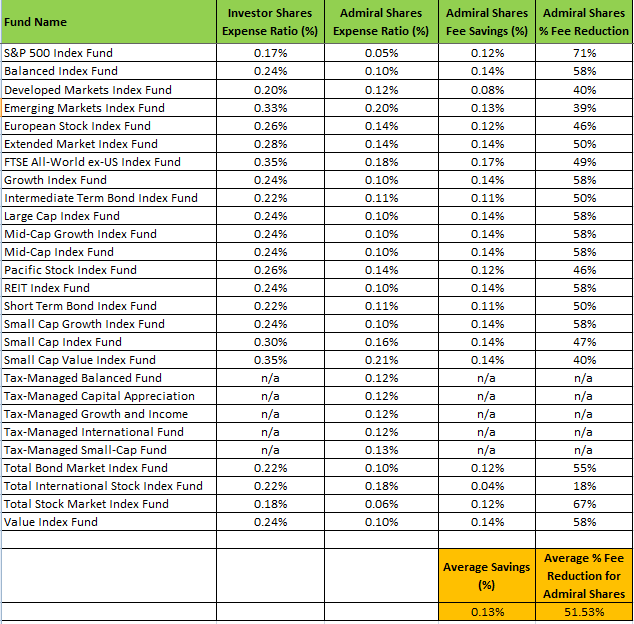
Note: To see the source information for this data, click here. Also, if you’re having trouble viewing the picture above OR would like to download a copy of this table for later viewing, click the link below:
As can be seen in the table, Vanguard offers Admiral shares for the majority of their index mutual funds.
- In fact, there are a total of 27 Vanguard mutual funds which have Admiral Shares available.
- Among these funds, you save an average of 0.13% by switching to Admiral Shares.
- This equates to an ~52% reduction in fees compared to regular Investor Shares. This is quite an amazing savings!
However, most of Vanguard’s actively managed mutual funds do not have this option. For example, the only actively managed Admiral Shares options are the Tax-Managed mutual funds in the bottom third of the table, which did not actually have a regular Investor Shares option available.
Conclusion
To wrap things up with this post, the moral of the story is that if you qualify for Admiral Shares by meeting the $10,000 account balance minimum, you should switch!…………………..NOW!
There really are no drawbacks to watch out for by making the switch, as switching from Investor Shares to Admiral Shares is tax-free. Vanguard has a total of 27 mutual funds that feature Admiral Shares, so take a look today at your account and see if you qualify to make the change and save 51% on management fees.
How about you all? If you use Vanguard for your investing, have you made the switch from Investor to Admiral Shares?
If not, what is holding you back from doing so?
Share your experiences by commenting below!
How To Refinance Your Home Mortgage Properly

————————————————————————————————————————
Welcome to My Personal Finance Journey! If you are new here, please read the “About” or “First-Time Visitor” pages to find out more about us. If you would like to receive free updates on articles like this by email, then sign up here or you can subscribe to the RSS feed. Also, check us out on Twitter or Facebook. Thanks for visiting! Keep on learning!
————————————————————————————————————————
With the current state of the economy, many people are now looking to refinance their home mortgage to reduce the interest charges and fees that they are currently paying. Advertisements by home loan companies have led many consumers to believe that refinancing their mortgage is a great idea and will always save them money. While this is often true, there are still many things people need to be aware of to ensure they come out financially better off after refinancing their mortgage.
Here are some tips you should follow to refinance your mortgage properly:
Determine If Refinancing Is Right For You
The first thing you should do before refinancing your mortgage is to decide if refinancing is actually the best option for you. There are many great reasons to refinance your mortgage, such as taking equity out of your home to fund the purchase of a new car or to simply try and reduce your repayments by refinancing into a lower interest rate loan. Whatever your reason for refinancing, you should make sure you have looked at some options other than refinancing, such as car loans or separate home equity loans if you are looking to make a large purchase, to ensure you are making the best financial decision.
Understand The Interest Rate Cycle
Interest rates are constantly changing over the course of many years. To ensure your mortgage refinance is successful you need to refinance at a time when the market interest rates are below what you are currently paying on your home loan minus switching fees. If interest rates are currently higher than what you are paying now, then now is not the time to refinance. Instead, try to postpone refinancing until you can get a better rate. If interest rates are lower than what you are paying now, then you should definitely consider refinancing your loan. But remember, just because the current interest rates may be lower than what you are paying now does not mean it is automatically a good idea to refinance, as you need to also consider the often large fees associated with refinancing.
Be Aware Of All The Costs
A mortgage refinance typically comes with many fees. Some of the main ones you will likely see are: closing costs, loan application fees, and broker fees. When reviewing loan refinance offers from various lenders, it’s important that you understand all the fees that will be charged so you can properly compare different lenders. Also, you need to weigh up the interest rate savings against these costs; you may find that the costs of refinancing your mortgage outweigh the benefits, even if you can get a much cheaper interest rate on your loan! To work all this out, simply find one of the many mortgage refinance calculators that are available online, and work out how much you can save.
No Closing Costs? – Be Weary!
A lot of companies that offer refinance loans also offer the option of no closing costs to try and bring in more customers. These deals may seem like a great choice, but you need to be careful. Often, when a company is offering no closing costs on their loans, they are adding extra hidden fees and higher interest rates to make up the difference. So, if you are offered a refinance loan without closing costs, be sure to check all the fine print to make sure you are actually saving money.
Do Your Own Research – Avoid Brokers
Using the services of a mortgage broker is a very common way of getting a home loan or refinancing your current loan. They can provide you with a lot of information about home loan offers that are available from different lenders. But remember, mortgage brokers are paid on commission, so it is actually in their best interests to sign you up for a higher interest rate loan, because they will get a higher commission. You can still use mortgage brokers as a source of information, but once you have the information from them about several good home loan lenders make sure you contact the companies yourself to inquire about their refinancing options. Also, make sure you do your own independent research into mortgage refinance options that are available, and don’t rely entirely on what your mortgage broker says.
Conclusion
Refinancing your mortgage can be one of the biggest financial decisions you will make. Make sure you know why you are refinancing, do your homework, and don’t let other people tell you what a great deal is; come to your own conclusions by researching your options effectively!
How about you all? Have you ever refinanced your home? If so, why did you do it?
Looking back on the process, do you feel it was the right decision? Do you know how much money you saved by doing it?
Share your experiences by commenting below!
***Photo courtesy of http://www.flickr.com/photos/jwthompson2/139445633/sizes/l/in/photostream/
Tour de Personal Finance, Stage 15, Round 4 – Posts 1-32

————————————————————————————————————————
Welcome to My Personal Finance Journey! If you are new here, please read the “About” or “First-Time Visitor” pages to find out more about us. If you would like to receive free updates on articles like this by email, then sign up here or you can subscribe to the RSS feed. Also, check us out on Twitter or Facebook. Thanks for visiting! Keep on learning!
————————————————————————————————————————
Without further ado, let’s continue on with the 15th Stage (the first Stage of the 4th Round of competition!) of the 2012 My Personal Finance Journey Tour de Personal Finance (to follow all of the action, click on the Tour de Personal Finance category link and scroll down to read all the posts involved in this subject).
AN IMPORTANT UPDATE ON PRIZES FOR THE COMPETITION
- Prize to Yellow Jersey Winner – $75.00
- Amount that will be given to a charity chosen by the Yellow Jersey Winner – $123.05
- Prize to 2nd place podium finisher – $50.00
To view the most up-to-date brackets of the competition, click the following link – 2012 Tour de PF Bracket.
Also, if applicable, I will give a brief description of the stage of the Tour de France that took place the same day as (or that has happened since the previous Stage of) the competition.
HOW TO VOTE
You can vote for the two articles (one from each intermediate sprint) you’d like to see proceed in the Tour by commenting in the comments section below and telling which are your favorites.
I’ve listed a keyword after each post title to make it easy to vote (as a made-up example, you can just comment: Sprint 1: Mutual; Sprint 2: 401k, etc.) Be sure to comment which one you like the best out of each set of two! Criteria for the best article is completely up to you, but you can use these factors as a guide: 1) post of your favorite blogger, 2) most interesting post, 3) most thought-provoking post, 4) most unique post, or 5) most actionable post.
Here are today’s competitions:
Voting will continue until July 18th for this Stage!
INTERMEDIATE SPRINT # 1
-
Pay Off Mortgage Early or Invest– The Complete Guide (Mortgage): Should I pay off my mortgage early or invest? Forget the dangerous half-truths and over-simplified conventional wisdom about getting out of debt. Instead, learn the many dimensions to paying off your mortgage early in this complete guide so you can make a smart financial decision that perfectly fits your personal situation.
- 7 Financial Advisors I Would Like to Punch in the Face (Punch): There are plenty of financial advisors in my industry that give financial planning a bad name (Madoff anyone?), and unfortunately they’re everywhere. I’ve been in the business for almost 10 years, and I’ve had countless run-ins with these types of advisors and despite my laid back personality, I would like nothing more than to punch them in the face, seriously. Here are some financial advisor horror stories that other clients have shared with me, the lessons learned, and let’s just see if you would want to pull a Rocky Balboa on their face, too.
INTERMEDIATE SPRINT # 2
-
Should You Charge Your Boomerang Kids Rent? (Boomerang): It’s no longer a given that kids will move out on their own when college ends. In fact, there’s a term for this group – Boomerang Kids. Should you charge rent to these boomerang kids?
- Online Poker: Is It as Legit as Stock Picking? (Poker): There are those that believe stock picking is a lot like gambling — and those that believe online poker is a safer bet than stock picking. Could online poker be as legit as picking stocks?
TOUR DE FRANCE DAILY RECAP
Samatan – Pau. At the finish, breakaway rider, Pierrick Fedrigo of France took out the win. Bradley Wiggins finished safely in the pack, and so holds on to his yellow jersey going in to this coming week’s mountain stages and final time trial. Should be interesting to see if he can hold on. I think he will!
***Photo courtesy of http://www.flickr.com/photos/teamtraveller/3378064901/sizes/l/in/photostream/
Carnival of Retirement # 28 – July 16th, 2012 Edition

————————————————————————————————————————
Welcome to My Personal Finance Journey! If you are new here, please read the “About” or “First-Time Visitor” pages to find out more about us. If you would like to receive free updates on articles like this by email, then sign up here or you can subscribe to the RSS feed. Also, check us out on Twitter or Facebook. Thanks for visiting! Keep on learning!
————————————————————————————————————————
Top 4 Editor’s Picks
1. Miss T. @ Prairie Eco Thrifter writes Go Slowly Toward Financial Security – Slow and steady wins the race, the old proverb goes. This is also a great strategy when working towards your financial security and a comfortable retirement. Patience and consistency are the secrets to going slowly towards financial security.
2. L Bee @ L Bee and the Money Tree writes How I cut my spending 38 Percent by simply by writing it down. – You may have heard me gushing on my blog/twitter about this FREE debt worksheet I’ve been working off starting last month. A fellow pf blogger, John at Married with Debt is kind enough to send over the excel spreadsheet he and his wife use to track their finances FOR FREE to anyone who wants it.
3. Kevin @ Thousandaire writes Your Investments Are in Big Trouble – If the government bubble bursts your money is in big trouble if you aren’t prepared.
4. BARBARA FRIEDBERG @ Barbara Friedberg Personal Finance writes RETIRE ABROAD WITHOUT PAYING A FORTUNE – With the baby boomers approaching retirement in record numbers, fears about high costs and inadequate savings prompt exploration of creative retirement options.
Listed below are the rest of this week’s posts!
Joel @ Retiremoose Blog writes Who is really an unbiased financial advisor? – Sources of retirement advice
Jessica @ Budget for Health writes Budget Review: April-June 2012 – Check out our budget review to see how we did over the past 3 months. We had a few surprises come up (getting a new car starter and battery) but managed to finish our 911 fund and invest in two Roth IRAs!
Ted Jenkin @ Your Smart Money Moves writes Why Is Gen XY Worth Less Than Their Parents? – Common sense says it’s no surprise that older Americans are wealthier than young Americans.
Maria @ The Money Principle writes Investing as science, an art form and a game – Investing is challenging, not because of the amount of knowledge we need but because we need different kinds of knowledge.
krantcents @ KrantCents writes The 3 W’s of Success – The 3 W’s of Success is the twenty-third in a series of articles to help you reach your goal.
Suba @ Broke Professionals writes My Financial Bucket List – I’m trying to get the highest return on investment… the investment of life. Here are the top five financial goals on my bucket list. What are yours?
MMD @ My Money Design writes How Much Money Would I Make If I Rented Out A House? – What kind of rate of return would I make if I bought a house and rented it out for rental income? This example will walk through buying a house in my neighborhood and then crunching the numbers to see how much I could make in a year.
Passive Income Earner @ The Passive Income Earner writes Easy Investing With Computershare – Are you familiar with Computershare? I learned about the marvels of Computershare in my mid-thirties and I must admit that I wish I had learned about it in my early twenties.
Evan @ My Journey to Millions writes Building a Retiree’s Income Stream at a Younger Age – In my very limited experience successful Retirees often have multiple streams of income regardless of whether they were intentionally created. These streams of income include:
PPlan @ Provident Plan writes Will There Always Be Poor People? – The issue of poverty is a complicated social issue. Jesus is often quoted as saying You will always have the poor with you. Find out what he really meant.
Teacher Man @ My University Money writes Dollar Cost Averaging Strategy – There is this cool thing that happens when you ignore all the stock picking stuff that people talk about, stop paying attention to the “experts” on TV and simply invest your money in a dispassionate and consistent manner. The aforementioned “cool thing” is that you end up with a lot more money.
Tyler @ Poor Student writes June Dividends – It is that time of the month. That came out wrong perhaps. I mean that I have now collected all my dividends for the month of June. And it was my best month yet.
Tushar @ Start Investing Money writes Are Your Parents Jeopardizing Your Savings Plans? – Are Your Parents Jeopardizing Your Savings Plans without even knowing it? After all, we are a product of our childhood and the way that we were raised…
Robert @ The College Investor writes Cash Cow Stocks: Great for Long-Term Investing – A cash cow is generally defined as a company that turns 5-10% of its sales into cash. Good businesses that can turn sales into true free cash flow usually have a competitive advantage that strengthens their future, which makes them a great investment for long-term investing.
A Blinkin @ Funancials writes I Was Housed By A Homeless Guy – Sounds ironic, doesn’t it? How could “he who don’t own home” be capable of housing “he who own home?” Confucius can’t even provide understanding on this matter so I suppose I’ll have to explain further.
JP @ My Family Finances writes How Does the Average Family Budget Compare to Yours? – We are obsessed with being more than average. So, if you want to avoid the average family budget, it helps to know what it is.
PITR @ Passive Income To Retire writes Passive Income with a Bed and Breakfast? – It was just last week that I was at a friend’s wedding. It was a great time to celebrate with them, and as it turns out, it was my first time at a bed and breakfast. For the first time, I got a close-up view of what it takes to run a bed and breakfast.
harry campbell @ Your Personal Finance Pro writes Keep Your CD’s Liquid and Still Earn a High Rate of Return – Most investors probably don’t have too many high yielding ‘safe’ investments lying around from the high interest rate days. The 5% CD’s that we all took for granted in 2007-2008 are a thing of the past and I know most people wish they would have locked in a couple more 5 year CD’s at these rates. So in today’s market, what are the best options for investors looking to earn a high return and minimize risk?
Amanda L Grossman @ Frugal Confessions writes Alleviating Financial Stress for the Sake of Your Health – Stress can do horrible things to your body. While everyone’s body reacts to it differently, some of the common ways stress manifests itself is through headaches, migraines, stomachaches, sleep deprivation, ulcers, and panic attacks. Learn how I manage such issues.
Jeff Rose @ Good Financial Cents writes Your Family Vacation vs. Your Retirement, Who Wins? – Families spends countless hours trying to plan the ultimate “Griswold family vacation”. And our family is no different this year. But here’s my question: How much time do you spend planning your vacation vs. planning your retirement?
Daniel @ Sweating the Big Stuff writes Do You Pay Student Loans Bills With a Credit Card? – I love using my credit card for gas (3 percent cash back) when I can, but there are certain situations where you simply can’t use a credit card to pay your bills. I would love to get 1 percent cash back on my rent…
Sicorra @ Tackling Our Debt writes Make More Money, Get Out of Debt, and Live Your Life – Work on following these simple steps so that you can still enjoy life, while you work towards becoming debt free.
Hank @ Money Q&A writes What Is A Cafeteria Plan For Health Insurance? – What is a cafeteria plan for health insurance? It is a type of employee health insurance plan that allows employees to choose from different types of health benefits
Paul Vachon @ The Frugal Toad writes Manage Personal Cash Flow as if You are a Business – Cash Management is vital to the success of a business because it allows the business to pay it’s bills while using cash efficiently to fund day to day operations. Consumers can benefit from managing their own cash in much the same ways a business does.
Investor Junkie @ Investor Junkie writes How Can I Increase Income Safely in Retirement? – Many retirees are asking how they can make more money now that long term CDs with attractive rates are maturing. There are many alternative investments that generate income. In no particular order, here is what I recommend:
Invest It Wisely @ Invest It Wisely writes Zen Personal Finance: My Philosophy, and What It Means to Invest It Wisely – What is zen personal finance? Is it a new-age thing? Is it a type of meditation? Is it a new way of looking at our finances? Read more to learn what it really is!
SB @ One Cent at a Time writes How can you benefit from 401k fee disclosure rule – Starting this month, 401(k) providers must clearly disclose the fees they charge to employers for the retirement savings plans, The fees include investment management, record keeping, administration and other services. How it can benefit you.
Corey @ 20s Finances writes Does the Cash Method Really Work? – One of the many ways that people try to curb their spending habits is to go to an all-cash budget. The reason for making the adjustment is that it helps you weigh the actual cost of each expense because it is actual bills leaving your pocket. It’s not a method that my wife and I use, but it has been helpful for some of our closest friends. Find out why it could help you.
***Photo courtesy of http://www.flickr.com/photos/68751915@N05/6869770873/sizes/l/in/photostream/