

All posts by Jacob A Irwin
How is the US Economy Doing Compared to Other Parts of the World?
————————————————————————————————————————
Welcome to My Personal Finance Journey! If you are new here, please read the “About” or “First-Time Visitor” pages to find out more about us. If you would like to receive free updates on articles like this by email, then sign up here or you can subscribe to the RSS feed. Also, check us out on Twitter or Facebook. Thanks for visiting! Keep on learning!
————————————————————————————————————————
The final quarter of 2012 painted a bleak picture for the US economy. But that was then, and the first quarter of 2013 is offering US citizens a different, more promising one, according to a recent report from the Fed.
But, the question remains – how does this compare to how other parts of the world are doing?
Full house – Housing Market Status
Faith restored in the Stock Markets
On the job
Conclusions
How about you all? What’s your feeling on the strength of the US and global economy at the present time and where it’s heading in the near future?
Share your experiences by commenting below!
Jacob’s Thoughts – Listed below are my random thoughts as I was reading this article.
- Very interesting guest post here! Thanks for sharing!
- Since I mostly watch Netflix movies, I don’t often watch news reports on the US/global economy, so it was interesting for me to hear some of the recent statistics about the housing market and unemployment rates.
- Regarding the comparison between the US and the UAE specifically and how both economies seem to be going upwards right now, it really highlights how globalized the US economy has become. In fact, it’s hard to find a company that does not have some sort of monetary foothold that it depends on another part of the world for, whether it’s manufacturing or customer base.
***Photo courtesy of http://upload.wikimedia.org/wikipedia/commons/d/d7/Philippine-stock-market-board.jpg
Five Reasons Why DIY Could Backfire on You

————————————————————————————————————————
Welcome to My Personal Finance Journey! If you are new here, please read the “About” or “First-Time Visitor” pages to find out more about us. If you would like to receive free updates on articles like this by email, then sign up here or you can subscribe to the RSS feed. Also, check us out on Twitter or Facebook. Thanks for visiting! Keep on learning!
————————————————————————————————————————
The following is a post by MPFJ staff writer, Kevin Mercadante, who is professional personal finance blogger, and the owner of his own personal finance blog, OutOfYourRut.com. He has backgrounds in both accounting and the mortgage industry.
In an era of constrained finances, the mantra is now do-it-yourself – or DIY.
I’m going to take a contrary view here and argue in the opposite direction. Here are five reasons why the DIY could backfire on you, and end up costing you even more money:
1. You lack the expertise
Some people are just good at repairs. They can fix just about anything, including things they never fixed before. That is just a gift that some people have, but most don’t. If you are not among the group of people who are blessed to have repair skills, DIY can become a disaster for you.
One of the biggest challenges in fixing anything that’s broken is figuring out exactly what the problem is. If you don’t know what the problem is, you can fix something that isn’t broken without ever repairing what it was that needed to be fixed. Worse, you can get caught in the weeds on a repair problem that will force you to bring in a true expert. Not only will it cost money that you were trying to save, but you’ll also be out the time you put into the attempted repair.
I suppose it is possible to learn a variety of repair skills, but that in itself will take time and could cost money. In addition, learning repair work often comes about by trial and error, which can also cost, both in time and in money.
2. You don’t have the time to fix everything
Anything you try to repair will take time. Whether it’s an auto repair, fixing your furnace, the electricity in your house, or even your toaster, it will take time out of your schedule that might be better used in some other direction.
Also, the amount of time that you will spend on any single repair will be in inverse proportion to your skill level. The less skill you have at any certain repair job, the more time you will spend working on it. This will be bad enough if you already have a tight schedule. But, if you do all of your own repairs, that effort could be the very reason you don’t have more time.
Yet another complication is that if you are accustomed to repairing whatever breaks, you could live in house full of items that are just days away from further breakdowns. Often when something breaks, it’s just the beginning of a series of problems. You could be investing your time doing little more than extending the life of an item by a few weeks or months. That can put you in a cycle of perpetual repair jobs that will leave you with even less time for everything else in life.
3. It could take away from making money
Often times when it comes to DIY, you can save money if you don’t count the time that you put into the project.
Let’s say that it would take an expert repair person one hour to fix a broken contraption, at a cost of $100 to you. Instead you decide to fix it yourself. If you normally earn $25 per hour at your job, and you spend 10 hours trying to do the repair yourself, you will have effectively spent $250 ($25 per hour times 10 hours) “saving money” by doing the repair yourself.
In in absolute sense, it would be cheaper for you to pay repair person $100 instead of doing the job yourself. And yet, this is not always the case. It is not as important a consideration if you don’t have the capability to earn additional income in the time that you might spend on repairs. But if you could earn additional income – from overtime, higher commissions, or more income from self-employment – you have to consider the opportunity cost of a DIY repair.
This could even be a test as to whether or not you do a repair yourself or hire someone else. Ask yourself the question: how much money could I earn in the time that will take to do this repair job?
If the answer to that question is “none”, then the decision is a little bit easier. But if you could be earning money instead of doing the repair job, you’re going to have to figure out which is more profitable to you.
4. It can be disruptive
Because it takes time to do repairs, and more so if you don’t quite have the skills necessary, it can become disruptive. For example, if you try to repair your own car, you’ll be without the use of the vehicle for the length of time it takes you to fix it. Would you be better off bringing the car to the shop where it will be fixed in 2 to 3 hours and back on the road, or doing the work yourself and losing use the car for two or three days?
5. If something goes wrong, it could cost you even more
Finally, we get to the question of what to do if your intended repair doesn’t go quite as well as you hoped? Most of us are pretty good at a few things, but none of us are good at everything. If you take on a repair project and the job takes a turn in the wrong direction, not only will you have lost time and all the efforts you invested, but you will certainly have to bring in a certified expert to fix the problem. That will bring you full circle to the exact situation you were trying to avoid by doing the work yourself.
Any time you attempt a DIY repair, consider your skill level, the time you will invest in the job, the opportunity cost and the potential of what could go wrong if you are not successful in your effort. DIY isn’t the automatic savings route it’s often made out to be, at least not for most people.
How about you all? Do you try to do most repairs yourself? Or do you turn them over to the experts and concentrate on doing what you do best?
Share your experiences by commenting below!
***Photo courtesy of http://www.flickr.com/photos/christinehawks/776742529/sizes/m/in/photostream/
Festival of Frugality # 378 – March 5th, 2013 Daylight Savings Celebration Edition

————————————————————————————————————————
Welcome to My Personal Finance Journey! If you are new here, please read the “About” or “First-Time Visitor” pages to find out more about us. If you would like to receive free updates on articles like this by email, then sign up here or you can subscribe to the RSS feed. Also, check us out on Twitter or Facebook. Thanks for visiting! Keep on learning!
————————————————————————————————————————
Let’s take a second and look at this number – 378 editions. If we assume roughly 50 weeks per year of the carnival running, this means that the Festival of Frugality is between 7-8 years old! I’m not sure about you all, but I didn’t even know what blogging was 8 years ago, so you can see that Jim (Festival creator) sure was a pioneer in getting the personal finance blogging world going and had some foresight in starting up this carnival!
In order to celebrate all of us surviving the winter months and getting an hour more of light this Sunday at 2 am, this round of the Festival is also the Daylight Savings edition! What’s your favorite part of having an hour more of light?
I know that for me, it means that I don’t have to bike ride home from my work at 6 pm in the dark, something which makes it safer, quicker, and more enjoyable for sure!
1. John presents You Bought That at WalMart?! posted at Frugal Rules.
2. Peter presents Rising Food Costs Have You Down? Here’s How to Fight Back posted at Bible Money Matters.
3. Miss T. presents Save Money Exercising posted at Prairie Eco Thrifter.
4. Suba presents It’s Going To Be A Big Year For My Family posted at Broke Professionals.
5. John presents If You Are Struggling with Debt, Do Not Get Pets… posted at Married with Debt.
And now, on to the best of the rest!
Jen presents Saving Money Isn’t Always Easy posted at Master the Art of Saving.
PFC presents The Starter Emergency Fund posted at PF Carny.
Shaun Rosenberg presents 10 Reasons To Give Minimalist Living A Try posted at Shaun Rosenberg.
Mike presents Stop Trading Time for Money posted at The Financial Blogger.
Jeff Rose presents Money Basics: Manage Your Cash Flow posted at Good Financial Cents.
Carrie presents 6 Ways to Give Memorable Gifts Without Going Into Debt posted at PT Money.
Melissa presents Real Life Bartering with Mavis of One Hundred Dollars a Month posted at Free From Broke .
Mike Collins presents Five Reasons You Should Open a Capital One 360 Savings Account Today posted at Wealthy Turtle
Emily presents The Rise of the 15 Year Mortgage posted at One Smart Dollar.
Girl Meets Debt presents Observations of a Former Bank Teller posted at Girl Meets Debt.
Corey presents Clipping Coupons: Is it Worth It? posted at 20s Finances.
Maria presents Stumbles on the way to paying our debt posted at The Money Principle.
Jon the Saver presents Why The Envelope System is Perfect for a Marriage posted at Free Money Wisdom.
A Blinkin presents A Continuation of the Minimum Wage Debate posted at Funancials.
Invest It Wisely presents Romance 101: How to Turn Up the Heat This Valentine’s Day posted at Invest It Wisely.
SFB presents How to Prepare for Life After College posted at Simple Finance Blog.
Amanda L Grossman presents Insights from Our Free Investment Portfolio Check-Up, and How to Get Yours posted at Frugal Confessions.
Tushar presents The Importance of Planning and Saving for the Future posted at Start Investing Money.
Ashley presents Cash Discount for Car Repairs posted at Money Talks Coaching.
Jason presents APY vs APR – Understanding the Difference posted at Work Save Live.
Daniel presents Buy Cheap Wine For Your Friends But Tell Them It Was Expensive posted at Sweating the Big Stuff.
Don presents How Much Does an MBA Really Cost? posted at MoneySmartGuides.
KT presents How to define simple living money saving tips posted at Personal Finance Journey.
Hank presents What To Do Right Now Before You Lose Your Wallet posted at Money Q&A.
Crystal presents Why Freelancing Might Not Be For You posted at Budgeting in the Fun Stuff.
Little House presents The Advantages of Buying Secondhand posted at Little House in the Valley.
Pauline presents About money, time, and doing the right thing posted at Reach Financial Independence.
Lazy Man presents Gas Dryer Savings Are Worth a Big Risk posted at Lazy Man and Money.
Also, let Jim (the Festival organizer) know if you are interested in hosting as well. It’s a bit of work, but a great way to get your blog out there and meet new folks in the process! I just took a quick look at the schedule, and it appears that almost all of the hosting dates are open for the rest of this year. So, there is plenty of opportunity!
***Photo courtesy of http://upload.wikimedia.org/wikipedia/commons/9/9f/Sunset_pier.jpg
The Ticket to Career Advancement: Work on Your Strengths, Not Your Weaknesses

————————————————————————————————————————
Welcome to My Personal Finance Journey! If you are new here, please read the “About” or “First-Time Visitor” pages to find out more about us. If you would like to receive free updates on articles like this by email, then sign up here or you can subscribe to the RSS feed. Also, check us out on Twitter or Facebook. Thanks for visiting! Keep on learning!
————————————————————————————————————————
The following is a post by MPFJ staff writer, Kevin Mercadante, who is professional personal finance blogger, and the owner of his own personal finance blog, OutOfYourRut.com. He has backgrounds in both accounting and the mortgage industry.
Do you want to make more money? Work on your strengths!
That’s often the exact opposite of what most of us do. We instead try to improve on our weaknesses, hoping to find career salvation in that. That’s also a natural response – the fewer flaws we have, the more approval we get from others. In truth, it’s unlikely that an absence of weaknesses will move you forward in your career, if it’s even possible to achieve that goal.
Every one of us has a certain market value in our careers. That market value is mostly defined by our strengths, and not by an absence of weaknesses. Our strengths represent what it is were good at – what others are most likely to see in evaluating us. If you’re not moving as quickly as you hope in your career, it may be the you’re spending too much time working on your weaknesses rather than on your strengths.
Step One: identify your strengths
Usually, we’re our own worst critics. We can become so focused on our weaknesses that we’re hardly aware that we have any strengths. It’s easy to see how this comes about. While we don’t always get credit for what we do well, were often quickly criticized for what we do wrong. That tends to raise the importance of our weaknesses in our minds.
A critical step is identifying your strengths, and we all have them. Think about what it is that you do well – what it is that you’re primarily responsible to do in your job – and you’ll find one or more strengths. Get input from others, from your superiors, from your coworkers, and even for people outside of work. Other people will be able to quickly identify what your strengths are, because it is what they have come to rely on you for.
Once you identify those strengths, make a commitment to improve them and to do so constantly. If your strength is sales, work on increasing your production. If your strength is management, concentrate on being a better manager and improving department performance. By improving on your strengths, you’re making them more visible, and that will help you stand out in a crowd.
Think about it – if you needed to hire a master carpenter or a top salesman, how concerned would you be if you found out that they were weak in organizational skills? Probably not much. You’d be hiring them because of their primary strength.
“Do what you do best and let others do the rest”
A good friend of mine – a successful salesman who later opened his own business – always said, “Do what you do best, and let others do the rest.” He was really good at sales, but pretty weak in a lot of other areas. He chose to concentrate his efforts on improving his sales, then relegating other tasks to the support staff.
The people who worked with him were not always happy about his weak administrative skills, but it was his sales ability that not only determined his income, but also kept a few of his coworkers in a job. Whatever other weaknesses he had, management was willing to overlook. He was there to sell, not to fill out forms or make phone calls. He delegated that work to others.
.
I think most people today do the opposite. We’re so concerned with multitasking, with getting all the work within 50 feet of our desks done, that we rarely work in the functions we are primarily hired to handle. Eventually, we wonder why we aren’t making more money or being promoted.
Determine what it is you’re best at, then do your best to delegate the areas where you are weak to others. My sales friend’s weaknesses may have displeased some of his coworkers, but at the same time none of them would (or could) take on his sales work either. He was doing what he was strong at, and relying on them to do what they were best at.
Concede on your weaknesses – nobody’s perfect
None of us are – or ever will be – perfect. Accept it and move on. You can waste a lot of time and effort trying to be perfect, and despite your best efforts, you won’t achieve it. It will be better to work on improving what it is you are good at, since that is usually where your greatest income earning capabilities are.
Unfortunately, it will not be easy to ignore your weaknesses. It often seems as if businesses these days insist that we’re nothing less than perfect. That can be tough to stand against. But stand you must, because your career and your future rely on what it is you are good at.
This isn’t to say that you should ignore your weaknesses completely, but rather that you must concentrate most of your improvement efforts on your strengths instead.
Playing your own game
In order to be good at anything, you have to have high levels of comfort and confidence in what you are doing. That often flows naturally where your strengths are concerned. Your weak spots, however, can cause conflict and take you off your game.
If you look at anyone who is good at anything, they have the uncanny ability to focus on what is most important and to block out everything else. If you spend too much time trying to improve on your weaknesses, you’ll be giving in to distractions that will keep you from doing what is you do best. It’s also likely that you’ll never become particularly good in your areas of weakness. And, your best efforts will probably not improve either your performance or your income. Only becoming better at your strengths can do that.
Admittedly, this is going to be difficult to do in today’s job market. Nearly everything seems to be pointing in the opposite direction, that we need to be generalists or at least competent in everything. It’s a trend we have to resist. Being a generalist makes you just like everyone else. But by being a specialist in something you’re good at is where you stand out from the crowd.
That’s where money and promotions come from.
How about you all? Have you identified your strengths and do you work to improve them? Do you get resistance to that effort on the job?
Share your experiences by commenting below!
***Photo courtesy of http://www.flickr.com/photos/pasukaru76/5268559005/sizes/n/in/photostream/
A Detailed Look Inside H&R Block’s Online Tax Preparation Platform – What is Free and What Must You Pay For?

————————————————————————————————————————
Welcome to My Personal Finance Journey! If you are new here, please read the “About” or “First-Time Visitor” pages to find out more about us. If you would like to receive free updates on articles like this by email, then sign up here or you can subscribe to the RSS feed. Also, check us out on Twitter or Facebook. Thanks for visiting! Keep on learning!
————————————————————————————————————————
As I mentioned in the first post of this series where I dissected TurboTax, a great option for individuals without a business over filling out the tax forms directly is to employ one of the many low-cost online tax preparation platforms available on the market.
Aside from TurboTax, the other two most widely-used online tax prep platforms throughout the personal finance world are H&R Block, and Tax Act.
Because of the wide spread use of these three platforms, I think it’s important for people to have a good working knowledge about what they offer. However, in my experience helping people with their taxes, the primary thing that my friends get confused about is what these programs offer for free, and what is it you have to pay for. More specifically, I find that they often end up paying for one of the service upgrades being offered, when in fact, their taxes were actually simple enough that they could have just used the free versions.
So, the purpose of this post series is to dissect each of these 3 most popular programs one-by-one to determine what they offer, what is free, and what you need to pay for. Since we combed through TurboTax’s online program in the first post of the series, we will now focus on another key player, H&R Block.
H&R Block Online – Overview
H&R Block’s online tax preparation platform (sometimes referred to as H&R Block at Home) is a spin-off from H&R Block’s long-standing retail tax preparation business (11,000 offices throughout the US – wild!). Without a doubt, if you live in the United States, it’s hard to NOT see an H&R Block office in your town.
H&R Block Online Options and Pricing
Shown below is the overall pricing for the various options on offer by H&R Block that pops up when you first visit their website. In my opinion, as was the case with TurboTax, this table shows a nice overview of the options and is pretty self explanatory/clear for normal folks like us. There are four things that I want to make sure to point out though:
- You don’t actually pay for anything until you officially click “file taxes.” This means you can go through the system and fill in your tax information without worrying about accidentally paying for anything until the very end of the process.
- The prices in bold shown in the below screenshot are only the pricing for filing your federal tax return. What this means is that you will have to pay an extra fee on top of the ones shown in the chart below because you are required by law to file state taxes. Don’t be surprised by this!
- According to H&R Block’s State Tax filing pricing, it costs $28-$35 (price depends on current promos going on) per state to file your state taxes.
- What this means is that the state tax filing is perhaps where H&R Block makes most of its money…..?
- One of the nice little perks about the paid versions of H&R Block is that they will automatically save and import your previous year’s tax information to the current year. They will also auto-populate your employer details based on solely their EIN. Nice things to have, but maybe not necessarily worth paying for if you are pressed for money..
- Finally, it’s a little confusing in reading the chart below, but if you have a self-employment business/income (including farm business) to report, the only option available through H&R Block is the $50 Premium version (please note, this is not necessarily the same thing as merely having a 1099-MISC from some random side income you did – more on this will be discussed below in the Income section).
So, as I mentioned above, this chart is pretty straight-forward and easy to understand. However, the place where it gets confusing and people with simple taxes end up paying for un-needed service add-ons is DURING the process of filing out your tax information as you are going through the various steps in the system.
Because of this, I feel we need to spend some time discussing places where potential mistakes could occur, causing someone that started their tax filing using the Free Edition (far left above) to end up unnecessarily using the Deluxe (middle, “most popular”) version. This happens quite often, in my opinion, because at almost every step of the way, the questions prompt you to upgrade to one of the paid options.
First, right off the bat, if you are searching around the H&R Block website to determine more about which pricing package to choose, you see this screen:
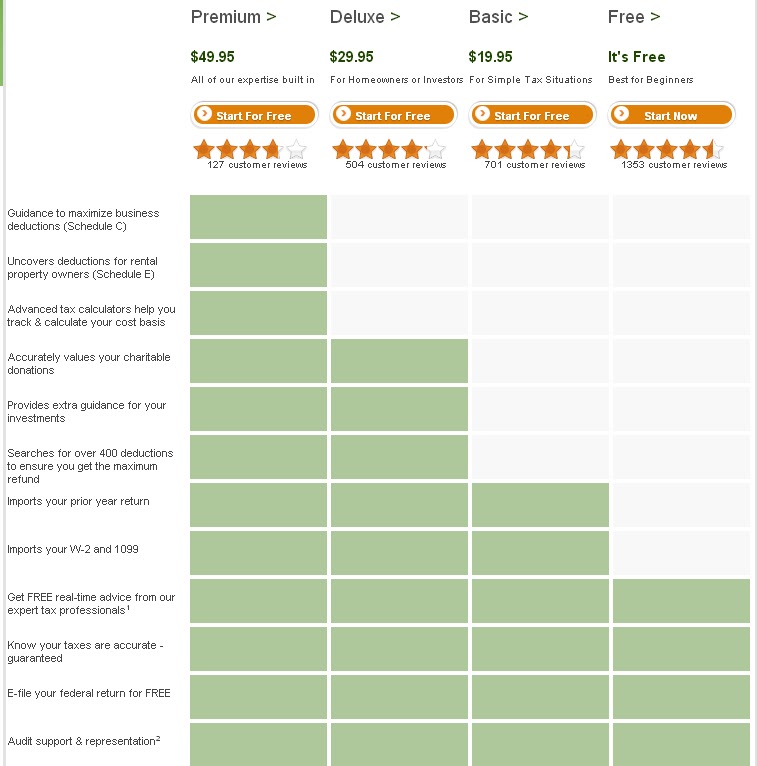
Now, I’m not sure what your reaction to this screen above is, but at first glance to a person that doesn’t spend a lot of time critically evaluating personal finance programs, it seems like if you choose the Free Edition, you potentially won’t get ANY DEDUCTIONS ON YOUR TAXES.
However, this simply is not the case. You can still get many deductions owed to you by using the free edition. So, my suggestion would be that people simply ignore this table and click the “get started using the Free edition button” if that was what you think is right for you at this point.
What is Free and What Must You Pay for Regarding Income?
Having dodged that landmine, you then proceed to set up your H&R Block account, enter your identifying personal information, and the next section you will come to is where you enter any income you had for the relevant tax year.
I was very pleasantly surprised with H&R Block’s version of the income section of their tax preparation platform. On the main page of the income section (shown below), they very clearly spell out in catchy red text what types of income entries require you to upgrade to a paid version of their platform and was does not.
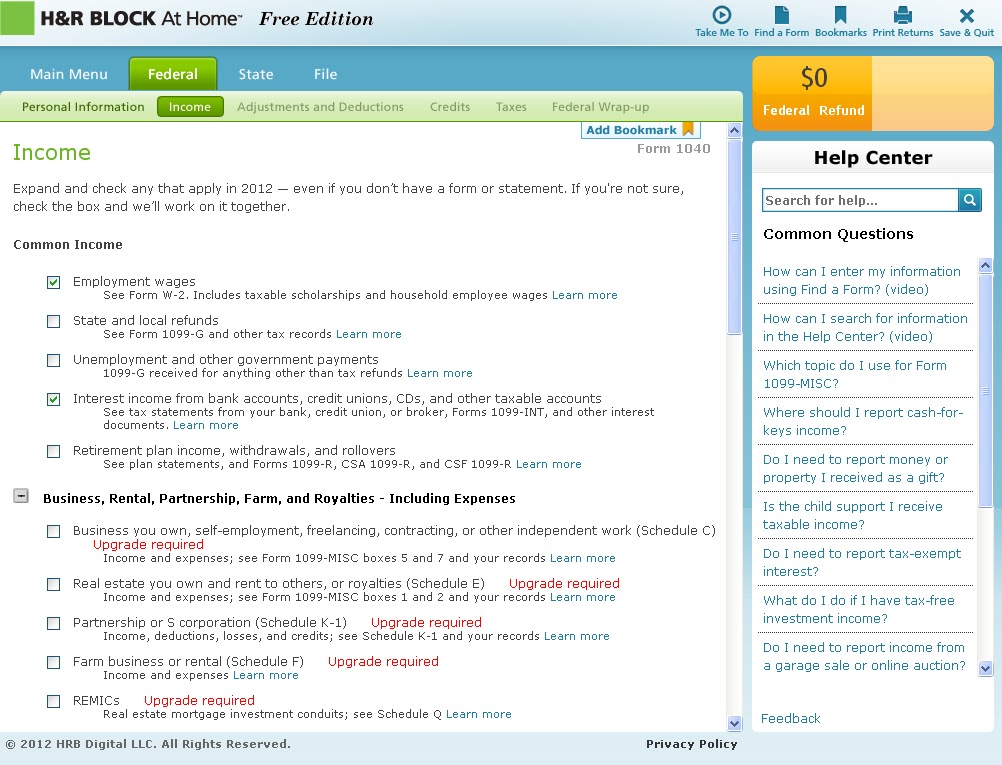
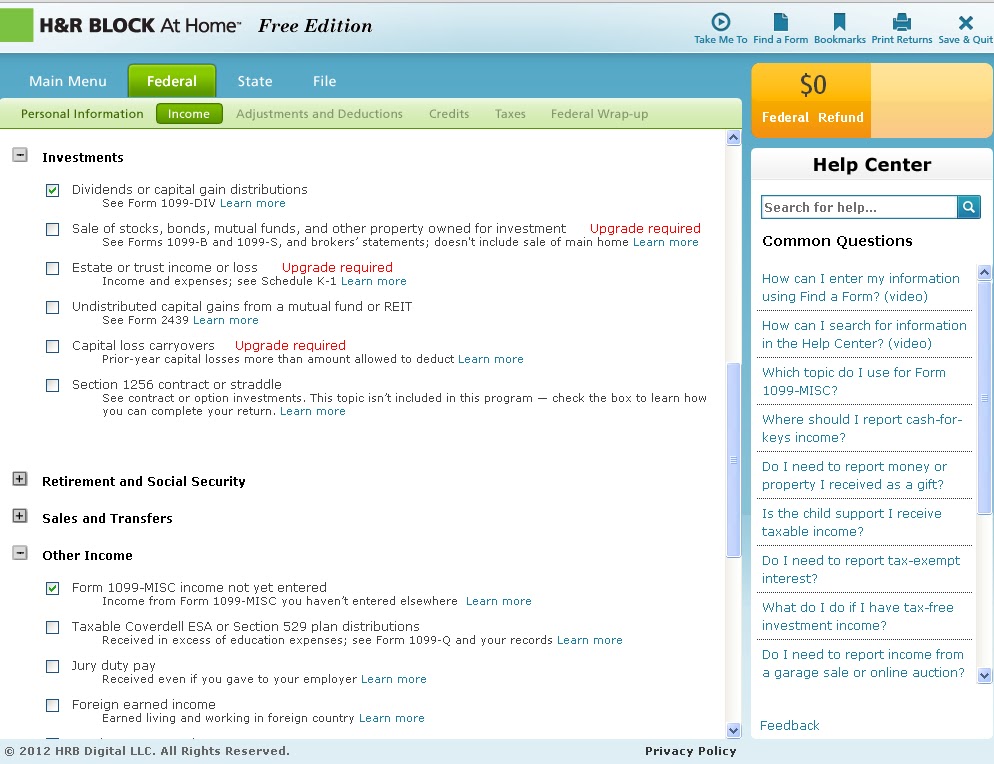
As can be seen in the screenshot above, below is a summary of what you must pay for and what is included in the Free Edition of H&R Block:
- Included in Free Edition
- Wages from regular employment (includes scholarship/fellowship income).
- 1099-INT and 1099-DIV.
- 1099-MISC income, provided that it is not regular/self employment income.
- If you have a 1099-B (sale of taxable securities), it does actually require you to upgrade to a paid version to continue with that section.
- If you have income from rental properties or self-employment, it does actually require you to upgrade to the $50 Premium version to continue with that section.
What is Free and What Must You Pay for Regarding Deductions?
In the deductions section of H&R Block, they also make it very clear to discern what is included in the Federal Free Edition and what you must pay for. In fact, it’s so simple because there ARE NO PAID UPGRADE REQUIREMENTS when it comes to deductions. Pretty sweet, right?!
That’s right, all of the deductions I inspected (shown on screenshots below) are actually included in the Federal Free Edition.
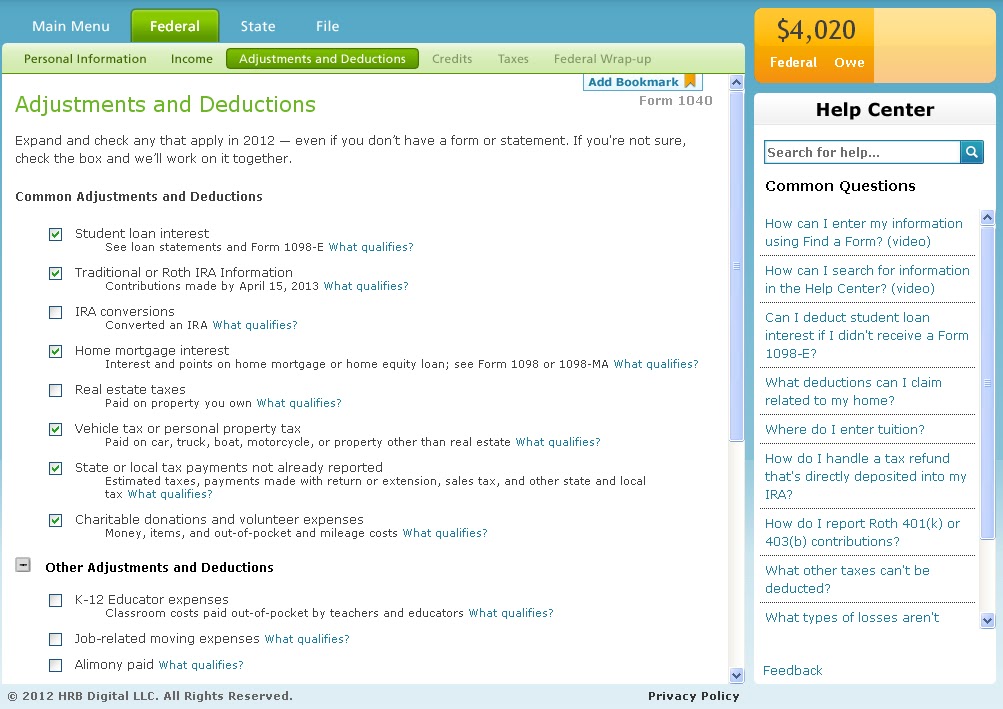

Just to drive this point home, all of the deductions listed below are in fact included in H&R Block’s Federal Free edition.
- Home loan interest paid.
- Kids.
- Car / property tax.
- Student loan interest paid.
- Medical/HSA contributions.
- Job-related moving expenses.
- Estimates taxes paid (as long as they are not for self employment income).
- Charity donations.
Conclusions
In my opinion, H&R Block offers a super-reliable, AMAZINGLY easy-to-use online tax preparation platform that is hard to go wrong with. Even if your tax situation dictates that you have to use one of their paid options, I would consider it money well spent, and likely, a significant tax savings over the use of live tax professional. I also like the fact that their platform does not try to “trick” you in to spending money that isn’t necessary with upgrades; they seem to legitimately want to help you get through your taxes effectively. They are also pretty inexpensive according to market prices for tax prep help.
I sincerely hope this post helps you to understand not only a little more about what features H&R Block offers, but to also help you determine what level of services/pricing you actually need to use in their platform to accommodate your personal tax situation.
In Part 3 of this series, we’ll take a look at Tax Act’s online tax preparation platform – on the way soon!
How about you all? How about you all? Have you ever used H&R Block’s online platform to do your taxes? If so, how did you like it? Did you ever find yourself paying for a upgrade to the online service when you really didn’t need it?
Share your experiences by commenting below!
How I Got Out of Debt Without a Job

————————————————————————————————————————
Welcome to My Personal Finance Journey! If you are new here, please read the “About” or “First-Time Visitor” pages to find out more about us. If you would like to receive free updates on articles like this by email, then sign up here or you can subscribe to the RSS feed. Also, check us out on Twitter or Facebook. Thanks for visiting! Keep on learning!
————————————————————————————————————————
Consolidating My Debts
The Next Step
Making it all Work
Conclusions and Lessons Learned
How about you all? Have you ever had to struggle with paying down large amounts of debt while also dealing with a job loss/switch? What strategies either worked or didn’t work for you?
Share your experiences by commenting below!
Jacob’s Thoughts – Listed below are my random thoughts as I was reading this article.
- Thanks so much for sharing your story with us today, Tony!
- I’m curious – what sort of interest rate did you get charged on your consolidation loan?
- The decision to go with a consolidation loan can be a tough one because often times, there are underlying debt behavior problems that must also be fixed and there can be large fees charged for the consolidation agencies.
- I’m glad to hear it worked out for you and that you are on a better path now in your freelance career!
***Photo courtesy of http://office.microsoft.com/en-us/images/results.aspx?qu=paying+bills&ex=1#ai:MP900341906|
Reader Profile – MyFIJourney

————————————————————————————————————————
Welcome to My Personal Finance Journey! If you are new here, please read the “About” or “First-Time Visitor” pages to find out more about us. If you would like to receive free updates on articles like this by email, then sign up here or you can subscribe to the RSS feed. Also, check us out on Twitter or Facebook. Thanks for visiting! Keep on learning!
————————————————————————————————————————
Today, in the ongoing Reader Profile Series, we’re getting to know reader and insightful commenter, MFIJ, from the site, My Financial Independence Journey. Let’s all give MFIJ a big round of applause for sharing his life with us and listen to his story. Enjoy!
Also, if you’re interested in sharing your own financial story/journey with us in a reader profile of your own, just shoot me a quick email, and we can get the ball rolling!
1. Please tell everyone a little bit about yourself (background, education, family situation, etc).
2. Describe your current financial situation (who works in your family, how your income is, your expenses, etc.).
3. What are the current financial challenges you are facing (saving, paying off debt, student loans, merging finances after recently being married, etc.)?
4. What are your plans for the future (retire early; build your career, etc.)?
5. What’s your best piece(s) of financial advice and/or your general philosophy on personal finances?
***Photo courtesy of gravatar.com
Urgency in Sports and Debt Repayment

————————————————————————————————————————
Welcome to My Personal Finance Journey! If you are new here, please read the “About” or “First-Time Visitor” pages to find out more about us. If you would like to receive free updates on articles like this by email, then sign up here or you can subscribe to the RSS feed. Also, check us out on Twitter or Facebook. Thanks for visiting! Keep on learning!
————————————————————————————————————————
The following is a post by MPFJ staff writer, Jeff. Jeff writes about Sustainable living and finances at his website, Sustainable Life Blog. Jeff really enjoys traveling with his wife as much as he can, to wherever he can.
Share your experiences by commenting below!
Jacob’s Thoughts – Great post! I think that having the sense of urgency if much needed, especially at first when a person has large amounts of high interest credit card debt because even if they are sticking to the payment schedule, the reality is that it still is costing them a large amount of money each year in interest. After getting the high interest debt paid off, it might actually be wise to step back to think about investing some money at least.
I’m curious – what is the interest rate on your student loans that you haven’t yet paid off? Do you think it might be better to invest at the same time as you are paying those off?
***Photo courtesy of http://www.flickr.com/photos/birddogger/4930697767/
Balancing Your Work With Your Life

————————————————————————————————————————
Welcome to My Personal Finance Journey! If you are new here, please read the “About” or “First-Time Visitor” pages to find out more about us. If you would like to receive free updates on articles like this by email, then sign up here or you can subscribe to the RSS feed. Also, check us out on Twitter or Facebook. Thanks for visiting! Keep on learning!
————————————————————————————————————————
The following post is by MPFJ staff writer, Greg Johnson. Greg is a proud husband, father, and debt crusader who is in the process of becoming debt free. Along with his wife, Greg co-founded the personal finance blog, Club Thrifty, where they encourage readers to “Stop Spending. Start Living.”
Lately, I’ve been thinking a lot about the delicate balancing act that goes on between the demands of one’s work schedule and his life.
I suppose my thoughts originated in part because I’ve recently been pulling a lot of “all-nighters” recently. I’ve been questioning my own work schedule, wondering how I can find the optimum balance in my life. Where does the pursuit of money infringe on the pursuit of happiness, and vice versa?
Fortunately or unfortunately, we live in a world in which we need money to live. We need money to meet our needs for shelter and food. We need it for our comfort. We even need it for many of the things we find entertaining – like travel or sports. We need money…and we need to work – in some form or another – in order to get it. Whether or not one believes in the consumer driven system that our labor sustains is moot. The fact is that we live in this system, and we have no way around it.
So, what is the right balance? Obviously, we need to have a high enough income to take care of our needs first. Furthermore, many of us want to save for the future so that we are not stuck working 8-hour days in our older age. Still, many people trade working 60-80 hours a week today so that they don’t have to work as hard later. They forget to live their life now while they toil and dream of a life that may never come later. Unfortunately, many people become too old or sick by the time that they get there. That time that they spent working is time that they will never get back.
Don’t get me wrong. I don’t think that there is anything wrong with planning ahead. In fact, I encourage it. Yet, often times, I feel that we trade so much of our time away to in order make money – gambling that we will have time to spend it in the future. We forget that the only certainty that we have is now. We forget the reasons that we want to make money in the first place. What is really worth more to us? Is it the time or the money?
In my own life, I am struggling with the balance between my work and my life. My day job is very demanding, and I’m not sure how much longer it is going to be worth it. I make a good amount of money, but is the trade-off worth it? Is being on-call worth and working straight through the night worth it? Am I making enough to justify working weekends and holidays, especially since I don’t control my own salary? I’m not sure. I’m beginning to get the sense that my work/life balance is out of whack.
I want to be able to travel. I want to be able to spend more time with my children and my wife. I don’t want to be in the middle of dinner, only to be interrupted by my work – causing me to be an absent father and husband for the rest of the night. I still enjoy the financial benefits that the job provides, but I’m questioning whether I’ve reached the point where the financial benefits are outweighed by the sacrifices that our family has to make in order to achieve them.
A friend and fellow blogger of mine shared a quote in the comments of one of my articles a few weeks ago. He said, “When given a choice between time and money, always choose time.” Why, you ask? “You can use your time to make more money, but you can’t use money to make more time.” How true that is.
One way to use your time to earn more money is by pursuing a new degree to further your career. A Graduate Tax degree, for example, puts you in a great situation moving forward because you can work in a variety of different industries as a tax professional. This degree, which you can earn online while continuing to work at your current job, allows you to take positions as a tax associate, financial analyst, staff attorney, or international tax manager, which opens up your earning potential to an entirely new set of possibilities.
I have yet to find a distinct rule on what somebody’s work/life balance should be. It varies depending on each individual and their own goals. I have found it is best to try to remember to put money in its proper perspective. For me, earning money alone can not be the primary goal. It is only a tool to help me achieve the things that I really want out of life. Once I decide that the pursuit of money is conflicting too much with my life goals, it will probably be time for a change.
So, what are your thoughts? How do you know when to draw the line between working hard and over-working?
Have you ever struggled with balancing the demands of your work with your life? How did you come to make your decision?
Please share your stories in the comments below!
***Photo courtesy of http://www.flickr.com/photos/kansasphoto/5302790893/sizes/l/in/photostream/
Should You Use a Real Estate Agent to Sell Your Home?

————————————————————————————————————————
Welcome to My Personal Finance Journey! If you are new here, please read the “About” or “First-Time Visitor” pages to find out more about us. If you would like to receive free updates on articles like this by email, then sign up here or you can subscribe to the RSS feed. Also, check us out on Twitter or Facebook. Thanks for visiting! Keep on learning!
————————————————————————————————————————
The following is a post by MPFJ staff writer, Kevin Mercadante, who is professional personal finance blogger, and the owner of his own personal finance blog, OutOfYourRut.com. He has backgrounds in both accounting and the mortgage industry.
With real estate prices down in so many markets, if you’re looking to sell your home, you want to get as much from it as possible.
One of the ways to do this that quickly comes to mind is selling your home without using a real estate agent. After all, real estate agents charge a hefty fee for their services, that could run as high as 6% of the sale price. If you could sell your home without having to pay that fee, that’s more money in your pocket – a lot more!
As much as we might like to see the real estate agent’s fee – and their services – as superficial and unnecessary, the reality is that they perform certain vital services that spare us of the need to do ourselves. Before trying to sell your home yourself, think carefully about how that will impact the sale, and your efforts to make it happen.
What will you give up – and what will you take on – if you choose to go it alone?
You will have to market the home yourself
If you have ever tried to sell a home yourself, then you know how complicated the process can be. Top of the list is marketing the property – nothing will happen unless you are able to master this process.
If you decide to sell the home yourself, you’ll need to place ads in all of the major publications in your area. You may also have to consider advertising on “for sale by owner” websites. You will have to pay for all of these advertisements.
You’ll also have to purchase a “house for sale” yard sign, and print up hundreds of flyers providing photos, specifications, and a sales type description of your home. All of that will take time – and money.
A real estate agent will do all of that for you and you generally will not have to pay for any of it. In addition, the agent will list your property on the local multiple listing service (MLS). By having your property listed on the MLS, it will make it available to every other real estate agent in town so that they can then show it to their buyer prospects. This is a service that you cannot duplicate for yourself. Is also the system by which most homes are sold. You are at a severe disadvantage if your house isn’t listed on the MLS.
You will have to show the home yourself
This will mean you’ll have to make yourself available to show your home anytime anyone wants to see it. In order to do this efficiently, you’ll have to make a point to be home most of the time until the home is sold. You will find out quickly that most of the people who come to see your home will be “lookers”, either having no real interest in buying your home nor the ability to do so if they did. And, some people who call to look at the property just plain don’t show up. That can get old real fast.
There’s a skill involved in showing a property for sale, and unfortunately, most homeowners don’t have it. In fact, a homeowner is probably the worst person to show the property to potential buyers. You’re emotionally involving in the property, tend to see only it’s good points, and of course, anxious to sell it. This can make for a very uncomfortable experience for the people looking at home.
Real estate agents can handle all of this for you as part of the fee that you pay. Not only will they show the home even when you are not around, but they will also pre-qualify buyers to make sure that they have the ability to buy the house. And, since showing and selling homes is their business, they have the skills necessary to show your property in a professional manner.
You will have to handle the negotiations yourself
Whenever you are selling anything, it will help to have a “middleman” to handle the negotiations for you. Real estate agents can negotiate a sales transaction between buyer and seller, and do so in a way that will not only maximize the sales price, but will also avoid uncomfortable exchanges.
Because the purchase of a house involves so much money, emotions can get in the way of the process. Words can be exchanged that could doom the transaction entirely. With a real estate agent in the middle, such comments can be modified and that can keep the process moving forward.
A real estate agent, because he or she is not the owner of the property, will also find it easier to discuss sticky situations – such as repairs and closing costs – with both buyer and seller. Their position in the middle of the transaction could be the difference between a successful sale and one that never goes to contract.
Is that worth saving a 6% Realtor fee
Imagine doing all of that yourself; do you still think that a 6% Realtor fee is too much?
While many of us that don’t work in the business tend to think of real estate sales as somehow easy, the reality is that it is very difficult and can break down at any point in the process. Since the real estate agent is paid a commission only upon the sale of your property, they have a built-in incentive to keep the deal alive and move it forward. Think of the agent as your partner in the sale of your home.
In today’s competitive real estate market, many real estate agencies are willing to work for less than the standard 6% fee. There are some agencies out there that will charge as little as 1% or 2%, just to put your property on the multiple listing service. You’ll have to handle all of the other aspects of the sales transaction yourself, but being on the MLS is a huge advantage – especially in a tight market.
I’m not a real estate agent, nor is this post an advertisement for Realtors in any way. After being in the mortgage business for many years, I saw a lot of home sellers waste a lot of time and a lot of money trying to handle this themselves. If you really want to sell your home in the least amount of time for most amount of money, a real estate agent is a necessary evil.
How about you all? Have you ever tried to sell your home without using a real estate agent? What would you recommend to anyone who is contemplating it?
Share your experiences by commenting below!
***Photo courtesy of http://www.flickr.com/photos/marciatoddrealtor/5986303280/sizes/o/in/photostream/