

All posts by Jacob A Irwin
Financial Problems in Retirement: Is Bankruptcy the Right Choice?
The following is a guest post. Enjoy!
Retirement is supposed to be a time for reflection on your life, relaxation, and maybe even a chance to finally see your dreams become a reality. But for a startling number of retirees, retirement only brings financial problems, making seniors the fastest-growing segment of bankruptcy filers. This doesn’t mean seniors are financially irresponsible, though; quite the contrary. More than half (62%) of bankruptcy filings are the result of exorbitant medical bills.
If you’re facing the prospect of bankruptcy during your retirement, you may feel overwhelmed and frightened. Bankruptcy may help you, but knowing all of your options is key to getting out of financial trouble.
Keys to Avoiding Bankruptcy
Bankruptcy can happen to anyone, but if you’re in the early stages of financial trouble, you may still be able to avoid it. To stay out of bankruptcy:
- Avoid taking on debt that’s not absolutely necessary; no credit cards to pay for vacations or clothing!
- Maintain up-to-date health insurance so that you’re not saddled with medical debt, and be sure to sign up for Medicare.
- Don’t loan money to children or other loved ones if you can’t afford to lose the money.
- Don’t retire early if you don’t have enough saved up.
- Consider taking a part-time job in retirement.
Remember, seniors have options for protecting their financial health and assets that younger people don’t have. In addition to Medicare and Social Security, seniors can also tap into reverse mortgages. If you own your own home, a reverse mortgage can provide a steady stream of income, but you get to keep your home.
What Bankruptcy Offers
If you’re considering filing for bankruptcy, know that bankruptcy does not have to be the end of the financial road for you. Every bankruptcy is different, so you should talk to a lawyer before making any major decisions. Generally, though, bankruptcy will eliminate most of your debts, except for student loans, which can’t be discharged in bankruptcy. The downside is that your credit will be wiped clean, eliminating your ability to get a loan, credit card, or new home for a few years. In general, you can usually get a credit card about two years after bankruptcy. A Chapter 7 bankruptcy will fall off of your credit report in 10 years, while a Chapter 13 takes seven years.
When You’re In Over Your Head
If you’re considering filing for bankruptcy, slow down before making any decisions you can’t take back. Then take the following steps:
- Talk to a financial advisor or credit counselor to explore possible alternatives out of debt.
- If you have loved ones who may be able to help you, consider seeking help paying down your debt in return for something else. Perhaps, for example, your kids can pay off your credit cards in return for weekly baby-sitting for a year.
- Seek an experienced bankruptcy attorney who works with seniors. Steer clear of lawyers who run volume-based practices, since their job is little more than signing paperwork. It may cost a bit more to hire a lawyer who takes his or her time, but this strategy ensures your assets are protected.
Bankruptcy can be scary, but it doesn’t have to ruin your financial life for good. And when you’re in over your head, bankruptcy may even be the lifeline you need to regain control.

Get Your Dorm Room Ready For Freshman Year at College

 The following is a post by MPFJ staff writer, Kevin Mercadante, who is a professional personal finance blogger, and the owner of his own personal finance blog, OutOfYourRut.com. He has backgrounds in both accounting and the mortgage industry.
College is just a few weeks away, but you still have some time to get what you need to set your dorm room up with all the comforts of home, and to do so for not a lot of money.
Here is a list of 10 must-have items for the upcoming college school year. Have them in your dorm room, and the whole year will go better for you.
1. Earplugs – Or a Good Set of Headphones
“Ear protection” is at the top of the list, since silence is often at a premium in college dorm rooms – not to mention college dorms in general. This is especially true if one or more of your roommates is a party animal, or likes to listen to loud music. Earplugs will be the budget ear protection, and you can get these for just a few dollars at any pharmacy chain.
But a good set of headphones will be the better route, since it sometimes takes preferred noise to drown out the annoying variety. Shop for the best headphones you can find at Best Buy, then order the same set on Amazon.com for a lot less.
2. Mini-Fridge
Burning the midnight oil is hardly an uncommon occurrence in the college universe, especially during exams. But it’s unlikely that the cafeteria will be open that late at night. And sometimes even during the day, you will want a cold drink, or have the need to preserve food for daytime snacks and meals when you just don’t feel like leaving your room.
Target and Walmart are generally where you’ll find the best prices on a decent mini fridge. But if you want to save even more money, check out a local thrift store, or even a garage sale. Since the fridge will be in a room with multiple occupants, you want to spend as little for this as possible, against the chance that it might be damaged.
3. A Supply of Common Over-the-Counter Medications
Headaches, upset stomachs and chest colds don’t disappear when you leave home. In fact, they may be even more common in a college dorm. For that you will need to lay in a supply of common over-the-counter medications. This can include Tylenol (or some other preferred pain reliever), nasal decongestant, cough syrup, antacids, vitamins, and even Band-Aids and disinfectants.
It’s best to buy the smallest packages of each, and to buy storebrand varieties that are available at local grocery stores. There are two reasons for doing this:
- You want your medicine supply to be as inconspicuous as possible, so that you can avoid becoming your dorm floor’s medicine man/woman, and
- In case one of your roommates hits you up for some of your medications, you’ll be providing them with the least expensive brand available.
4. A Clothes Hamper
This is especially important if your practice at home is to simply allow your laundry to accumulate in a corner of your bedroom. Not only will a clothes hamper help to organize your laundry routine (a full hamper will be the signal that it’s time to do your wash), but it will also help you to avoid commingling your clothing with your roommates dirty laundry.
Once again, Target and Walmart are likely to be the least expensive sources for this item. And while you’re at it, stock up on some inexpensive store brand laundry detergent.
5. A Desk Lamp and a Reading Light
Your dorm room will almost certainly come equipped with a desk, but you shouldn’t assume that that will include a desk lamp. Since it’s entirely possible that you will spend at least as much time at your desk as you do in your bed, you need proper lighting. You can find a good quality desk lamp for not a lot of money at Staples, during their back to school sales, typically held in August and early September.
Also look into a reading lamp so that you can read and study in bed after the lights are out.
6. A Coffee Maker and Related Items
Naturally this applies only if you are a coffee drinker, but it can also serve as a hot water source for tea, if that is your preference. There are usually entire shelves filled with coffee makers in thrift stores, typically selling for no more than $3 to $5.
While you’re at it, don’t skimp on coffee filters and a decent quantity of your favorite coffee or tea brands. You can save a bit more by buying these at a dollar store, particularly if you are not hung up on the brand.
7. A Comfy Mattress Pad
College dorm room beds are not known for being the most comfortable sleeping accommodations. But you can change that situation by adding a mattress pad on top of the bed, right underneath the fitted sheet. A couple of extra inches of foam could guarantee a better night’s sleep throughout the school year.
You can try Bed, Bath & Beyond, but you’ll almost certainly find a less expensive version at Walmart.
8. Microwave Oven
It’s almost a certainty that you will want something quick and hot, and on more occasions than you might anticipate. Simply having a microwave oven to heat up soup or a packaged hot meal, could save you a trip to the cafeteria, and give you more time for studying, relaxing, or sleeping.
Thrift stores or garage sales will be your best sources, since they usually have plenty of them. And since the oven will likely be used by your roommate(s) (and their guests), it’s better that it’s not brand-new.
9. Bed Linens
These will be especially important if the dorm room bed is a non-standard size. A bed that is just a few inches longer than a standard twin size bed will not fit the sheets that you probably have.
Cost can be a factor here. Bed linens are not cheap to begin with, but non-standard sizes are even more expensive. WalMart and Target will likely be your best sources on the price side, but keep your eyes peeled for sales. Especially since you’ll probably need two sets of bed linens, that way you can have one on the bed while the other one is in a hamper waiting to be washed.
10. A Fan (or Space Heater)
Room temperature can be an issue when you are sharing a room with a stranger for the first time. If your roommate likes to keep the room on the warm side, a fan will be a welcome tool. At the opposite end of the spectrum, if your roommate likes it cool, even in the dead of winter, you may need a space heater kept close to your bed in order to keep peace in the room.
Fans are inexpensive in late summer, since they are close to being mothballed for the winter. But space heaters may be at a premium, since it isn’t quite cold enough for them yet, and there probably aren’t many available. Search the web to see where you can get the best deals, and don’t rule out a visit to a thrift store or two to see what you can find.
Anticipate your needs for your dorm room, and give yourself time to find the best deals that way you won’t spend more money than you need to.
How about you all? What are some dorm-room essentials you can think of?
Share your experiences by commenting below!
***Photo courtesy of https://www.flickr.com/photos/mattnazario/13971207088/in/
The Benefits of Tracking and Maintaining a High Credit Score

Having a good credit score is critical for so many things in life: from applying for a loan for a new car or house, to applying for a new credit card, how much interest you’ll have to pay on a loan or on insurance, or applying for a student loan to help get you through college.
According to a study from the Corporation for Enterprise Development (CFED), 56% of Americans have a subprime (a.k.a. bad!) credit score, making understanding how credit scores work and how to maintain a healthier, high credit score is critical for economic development not only for the individual, but for the health of this country’s economy as a whole.
What Is A Credit Score?
Your credit score is basically a mathematical calculation of the predictability of risk. In other words, when you have a credit card or have any kind of bill that requires payment, you’re making a promise that you will pay it back by a specific date. If you don’t pay, then you are penalized. To the creditors, you are now at a higher risk of non-payment again in the future. There is no room for a one-time error in these mathematical equations: you mess up and don’t pay your bills one month and your credit score suffers.
Credit scores range anywhere between 300 and 850, with 850 being the highest score one could have, also making that person at the lowest risk for defaulting on their loans or other bill payments. Having a significantly lower score sends a red flag to potential creditors that you may not be trusted to actually pay back the money you promised, giving those creditors doubts on whether or not to even approve your loan to begin with. Or, perhaps they’ll approve it, but at a significantly higher interest rate.
What Resources Are Available For Student Loan Problems?

 The following is a guest post by Paul Smith. Paul is an attorney with an interest in personal finance. He blogs at insideconsumerfinance.
Like most of our generation, I have student loans. In my case, it is a federal consolidation loan I took out after having graduated from law school five years in an effort to simplify the ten plus loans I had from the three years I had been in school. Several years ago, I started making regular monthly overpayments on my loans to wipe them out sooner than the 30 year term.
I had heard horror stories from some of my friends about mistakes that had been made by their servicer when they attempted to make more than the required minimum payments on their federal student loans. At the time, my loans were serviced by the U.S. Department of Education itself (they would later be transferred to a state student loan authority for servicing as part of a large scale transfer process which began several years ago when the Department was inundated with way more loans than it could possibly service) and the DOE’s procedure was that when you made an extra payment outside of your normal required monthly payment, they would just apply it to the next month’s payment rather than automatically applying it directly to the principal. Once you had made the payment, then you would have to send an email to the DOE requesting that the payments be applied directly to principal rather than credited towards your next required monthly payment. I began doing this but after several months started to have problems when I periodically checked my loan account on the DOE’s website. Instead of being applied to principal, my “due date” kept showing up as further and further in the future and my principal was not being reduced at all even though I had been sending multiple emails requesting that the extra payments be applied directly to principal every time that I made a payment. I tried calling the DOE’s main customer service center numerous times and was told more than five times that the accounting department was working on it and that my account information would reflect the correct figures in 7-10 business days. I kept calling and calling but to no avail; the message I kept receiving was that the accounting department was working on it and the figures would be corrected in 7-10 business days.
Finally, completely exasperated, I happened to be poking around on the DOE’s website and came across a page for the Federal Student Loan Ombudsman. Turns out that I had stumbled across exactly what I needed-a resource that exists for the sole purpose of assisting federal student loan borrowers who are having problems related to the servicing of their loans. The website had a form for you to fill out giving your contact information and describing the specific problem you were having. Not expecting any response, I filled out the form and pressed submit.
To my surprise, two weeks later I received a call from someone at the Ombudsman’s office to discuss my problem in greater detail. The representative was very friendly and assured me that she would do everything in her power to assist me in resolving my issues. After about a month, she was able to resolve all of my problems with the misapplication of my extra payments and my account balance was finally corrected.
Fast forward a year and I began having similar issues with the state student loan authority that was now servicing my loans; they completely failed to apply my overpayments to the principal of my loans, instead simply pushing the due date for my monthly required payments further and further into the future. This servicer had a payment process that was similar to that employed by the DOE; you made a payment and then afterwards had to send an email requesting that the extra payment be applied directly to principal. I did this for months without incident but then started noticing the same problem, despite the fact that I was making the extra payments the balance on my loan when I logged onto the servicer’s website kept reflecting the same amount every time I checked it. I tried the same route, contacting the general customer service number multiple times over a month or so and received the same answer as before-our accounting department is working to straighten out the issues and the corrected numbers will be appearing on the website in 7-10 business days. Well, this never ended up happening so, in frustration, I asked one of the general customer service representatives whether there was anyone else I could speak to. She directed me to the Loan Resolution department at my servicer, and they were eventually able to sort out the issue. Like the Ombudman, the Loan Resolution group serves as an advocate for borrowers who are having problems related to the servicing of their loans
However, the state student loan authority that is now servicing my loan also committed a second mistake in processing up my application to be placed on an Income Based Repayment plan. For those of you who are unfamiliar with IBR, it was specifically provided for several years ago in legislation passed by Congress. The way IBR works is that, if you meet certain income and outstanding loan balance criteria, then your monthly loan payment will be capped at a given percentage of your income.
In my case, I filled out my application to be placed on IBR and received a letter back indicating that they would not process my application until after my previous IBR plan had expired. They also said that I needed to make several payments at the standard repayment plan rates, which were much higher than my currently monthly IBR rate at the time, before I could have my new IBR amount determined. Knowing this was incorrect, I again called the Loan Resolution group at the servicer and was able to get my application processed before my current plan had expired.
These stories are intended to highlight the fact that there are resources out there for borrowers that many of us don’t even realize exist. Now, typically the Ombudsman will require you to attempt to work your problems out through the DOE first, so give the regular customer service line one chance to fix it and then ask for a supervisor, which my mother taught me and I have always found to work well in the customer service setting. If the general customer service supervisor cannot satisfactorily resolve your issues, then ask if there is a loan resolution group at your servicer. If not, then contact the Federal Student Loan Ombudsman.
Make sure to have all documentation of your dispute handy when contacting the Ombudsman, as the more detailed information you can give them the easier it will be for them to assist you in resolving your issues. I also highly recommend taking notes every time you speak with your servicer-including taking down the time you called, the name of the representative you spoke with and the substance of what they told you. I have found this to be a very valuable practice when it comes to working out issues related to both student loans and other issues as well. The Ombudsman makes the same recommendation and also provides other tips for using in resolving issues with your student loans.
***Photo courtesy of https://www.flickr.com/photos/barkbud/4257136773/in/
How To Fight For Disability Claims

The following is a guest post. Enjoy!
Many people work hard for their entire lives. Then, an accident happens which causes them to be seriously injured, making it impossible for them to work any longer. In these cases, a person depends on their insurance to cover the cost of their recovery, as well as compensate them for their lost wages. Unfortunately, insurance companies are often not willing to pay the money they owe without a fight.
You must remember that insurance companies are publicly traded. They have a fiduciary responsibility to their shareholders to raise the value of the company’s stock. This can’t happen if they are constantly paying out claims. Therefore, they often reject perfectly legit claims in an effort to save money. If you believe your claim has been denied unjustly, you need to stand up for your legal rights. Are you in need of a disability lawyer? Here is how you can find one.
1. Talk to people who have hired disability lawyers
If you are looking for a lawyer who specializes in long term disability insurance, the first thing you should do is to talk to people who have been in the same situation you find yourself in now. Ask all of your friends and family if they have ever had a disability claim rejected. This is a very common occurrence, so there is a good chance that a friend or relative of someone you know has gone to court to contest an unfairly rejected disability claim. If you are able to track down some people who fall into this category, ask them about the lawyer who helped them with their case. Did he or she have many years of experience handling disability cases? Ideally, you want to hire a lawyer who focuses on personal injury law. Ask the person if their lawyer handled the case professionally. Did the lawyer win the case? If you are satisfied with what you hear, give the lawyer a call to set up a meeting.
2. Explore the Internet
Every lawyer has a website these days. If you are unable to secure the number of personal injury lawyer references you had hoped for, there are other ways you can track down a lawyer to represent you. Dealing with horrible doctors after an injury? The Internet is a vast resource, so you should put it to work for you. Do a search for disability lawyers in your area. Read their websites to find out how long they have been practicing. You should avoid a lawyer who is fresh out of law school. Your case is too important to be handled by a raw rookie. There are some lawyers who handle a wide range of legal issues. Although these lawyers might be competent enough to handle your case adequately, you should strive to find a law firm that only deals with personal injury cases.
3. Get recommendations from people online
As mentioned earlier, the Internet is a great resource. However, there are other ways for you to find a good personal injury lawyer besides pursuing their websites. You can also visit a wide variety of review websites. These are sites where people can post their personal experiences regarding doctors, lawyers, contractors, mechanics and other professionals they have done business with in the past. You should be able to get a good number of references from these sites.
Review: Cinch Financial Free Financial Product/Account Locator and Savings Tool

Recently, I had the opportunity to be exposed to a new (well, new for me anyhow!) free financial website/tool called Cinch Financial. As such, today, I wanted to share a little about some of the features it offers, as well as my opinion on its real-world utility.
What is Cinch Financial?
From what I can tell, Cinch has three primary functions/features with which users can engage on the site:
- First, it allows individuals to upload copies of their personal bills and/or account statements.
- The documents are then reviewed by someone at Cinch, and they issue personal recommendations back to the user on if/how they can save money based on their current state.
- Second, the team at Cinch has taken the time to review the myriad thousands of banking, credit cards, auto insurance, home insurance, and mortgage account providers out there, and whittled the confusion down to providing less than 5-10 top picks (called Cinch Picks) for users.
- This is quite powerful, as in my opinion, there is a high degree of information overload that often prevents individuals making decisions to reach their financial goals.
- Third, users can get personalized recommendations for the financial products mentioned in #2 above by answering 5-10 very simple and quick questions about their specific financial situation.
- With both #2 and #3, the interface allows you to input a current product you are using, and it will provide an estimate of how much you can save or how much more you can earn with another product.
- Although I have not yet tried the 1st feature (uploading a statement/bills), I was able to try out the 2nd and 3rd. Below is screenshot of what this section of the website looks like.
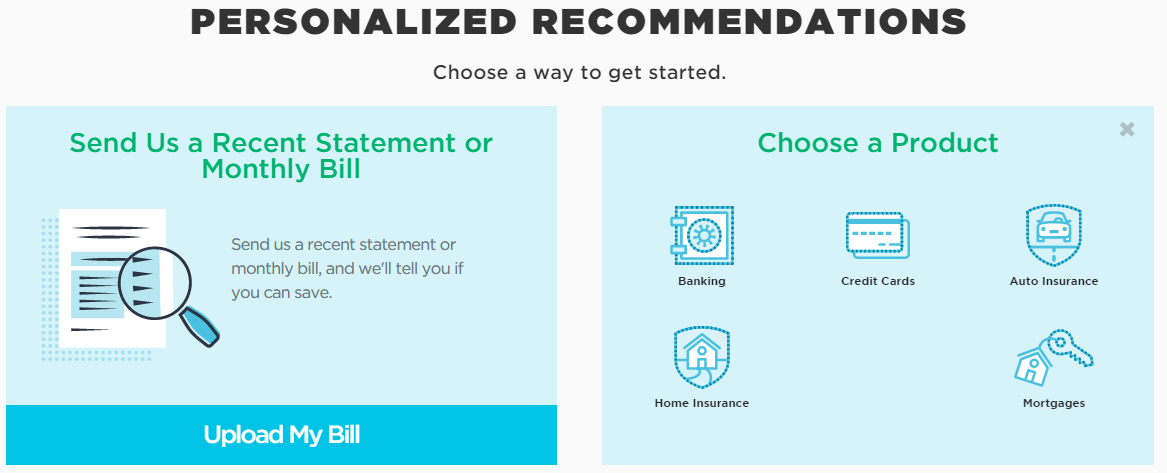
Personalized Recommendations for Financial Products
In my opinion, my favorite feature of the site was the interface that provides personalized recommendations for financial products that can most benefit me.
Banking
After clicking on the button indicating that you want to get a personal recommendation for banking financial accounts, you will then be taken to easy-to-interface with screens (only 1 question per screen!) where you answer the following questions:
- What is your zip code?
- The biggest drawback for the personalized recommendations is that Cinch currently only covers the following states for local financial products and providers: MA, NY, TX, IL, and CA.
- How much do you direct deposit monthly?
- How much do you spend on your debit card monthly?
- Will you use the bank account as a primary checking account or an extra account?
- Do you want access to a local bank branch?
- What ATM features do you want?
- Do you want overdraft protection?
- Rank several account features in order of importance
After answering these questions, you will be taken to your personalized bank account recommendations. Below is an example of what one of the recommendation screens looks like:
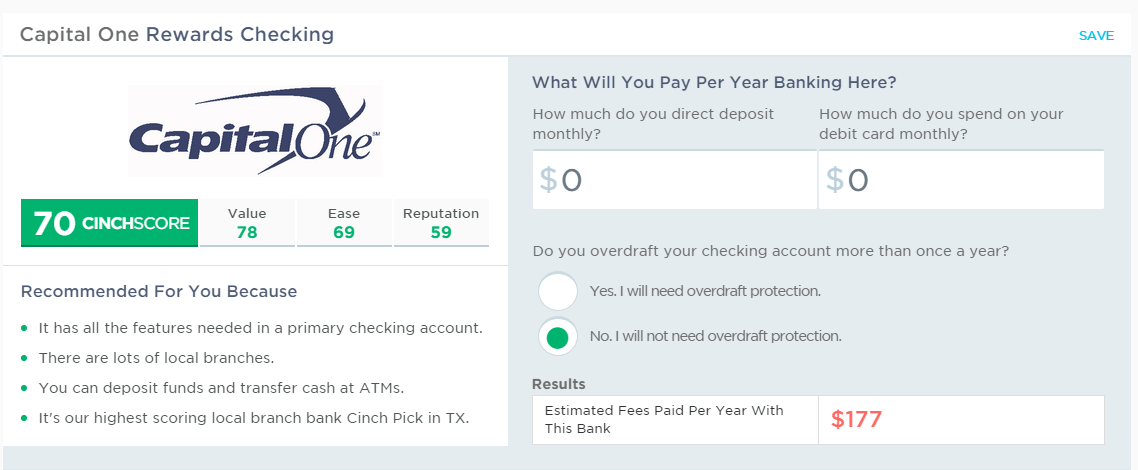
I really liked how it shows on the screen the results recommended for me, and it clearly spells out how much in fees I would pay with no direct deposit.
One thing I would like to have seen were more local recommendations and/or ways individuals can get a checking account for free, without direct deposit or a minimum balance.
Credit Cards
Overall, I thought the credit cards section of Cinch was probably the strongest feature available right now. To get personalized recommendations, you answer the questions below:
- Why are you looking for a new credit card?
- How much do you spend per month on your card?
- What kind of rewards would you prefer receiving?
- Do you spend more than $500 each month in specific listed categories?
- Estimated credit score?
After answering these questions, I was taken to a screen with my top 3 credit card picks. Shown below is a screenshot of one of the cards selected for me.

I really liked how it spells out how much I can increase my cash back rewards compared to my current favorite card (Chase Freedom). It was also refreshing to see that the three cards selected for me were ones that I hadn’t heard of. This was cool because I definitely have a habit of going to CreditCards.com every once and a while to see if there are any good looking new cards.
Auto Insurance
The auto insurance section of the site was about on par with utility as the banking section. You input some really quick information about yourself and your car, and then it lists top picks for auto insurance for you.
As with the credit card feature, it estimates the amount you could save by switching from your current auto insurance provider. An example screenshot of the auto insurance section interface/result is shown below:

Lastly, it is nice that the system saves your information that you input for 1) future use and 2) for other recommendations (ie you input your credit score range for home mortgage recommendations, and the system carries that information over if you were looking for recommendations for auto insurance).
Home Insurance and Mortgages
Overall, I thought that these two sections were the weakest / least robust of Cinch’s offerings. For home insurance, there were pretty limited choices that surfaced while searching. For mortgages, I thought that the recommendations weren’t as useful because the system did not list specific details of the potential mortgage I could qualify for from each specific provider that popped up.
How Much Does Cinch Financial Cost To Use?
Cinch is currently totally, 100% free.
I was also intrigued to find out that they do not currently try to monetize their site in order to maintain objective advice. It will be interesting to see how they decide to start making money (i.e. through affiliate linking like CreditCards.com, banner ads, or by charging for personalized recommendations in the future).
Bottom Line
So, what’s the bottom line here with Cinch Financial?
Overall, I would give it the thumbs up for folks to try out and see if they can either find new useful financial products or save some money vs. their current ones! It is free, after all, so what do you have to lose?
Creating a Lifestyle of Financial Independence, Whatever That Means to You

The following is a guest post. Enjoy!
This is a personal goal, but it’s something that a lot of people share. Financial independence means different things to different people. For some, it means never working again. To me, it means doing the work that I choose, that gives me pleasure, and never putting enormous energy into something I don’t believe in. Because let’s face it, many of us are raised in a system where we’ve got to pour all of our energy into pursuits we care nothing about. That first dawned on me in high school at my private school and at my first job at a fast food chicken restaurant.
Lots of us just get used to doing things we hate. “That’s life,” we say. And that isn’t wrong. That’s a principle of many philosophies and religion. Buddhists hold as a central tenet that life, itself, is suffering. Now, while I don’t mind sitting down with that thought and mulling it over for awhile, I’m not going to let that sort of thinking lock me in to life and work that is boring, painful, or soulsucking. That doesn’t mean I’m not going to work, or even work really really hard. But it means I’m going to work for something that I feel matters.
But in order to do that, you’ve got to be able to pay the rent. If you already have a job that you love, that affords you a lifestyle you enjoy, then congratufreakinlations. Not everybody is there, though. For those of you who are not, and who don’t have a specific direction in mind to get out of this cycle, here are some practical steps.
- Replace Horrible Tasks With Less Horrible Tasks. If you hate your job, get a job you hate less. If you can’t find one, simple try to get one that pays better. If you can’t do that and your job is draining you of all energy, quit. Quitting puts you in survival mode. You’ll have to take stock of yourself, your skills, and ways you can work to survive. I did it once, and started my writing career which, within a year, had doubled my income from my previous job. Quitting is extreme, but it’s better to accept lower pay for something that doesn’t sap your life force. You’ll have energy to make better decisions, to help yourself along, than you will if you stay at a terrible job just for the money. Slowly find ways to replace income, and replace those with better fit or better paying tasks, till you are busy with stuff that at least pays well and hopefully gives you enjoyment.
- Activate Your Own Creativity. Find something you can create, and create it, no matter what. You can try different things: starting a blog, doing woodworking, writing and recording songs, starting a small business. But stick to it for a year and see where it leads you. Don’t put any financial expectations on this work, just let it develop. In time, chances are you’ll be making money on this thing, perhaps enough to replace your normal income with.
The end goal is fulfillment. If you enjoy your work, you’ll be a lot closer to enjoying your life. You won’t have to sustain an expensive lifestyle to give yourself happiness shots in the arm every few hours. You’ll just be happy. From there, financial independence comes a lot easier. You can save and invest much easier.
Savings and Investment will further buoy your new lifestyle. You won’t be so worried about bills, and you’ll have extra income and financial security from your investments. Eventually, investments like the ones I’ve mentioned may bring in a lot of extra income, enough to replace some of the leftover work that you may have to do but don’t enjoy. In a way, this is a financial dream, but it’s a dream that thousands of people are living. You’ve got to work and make it a priority, but in the end you are the priority. This is your life. Make it work the way you want.
Why You Can’t Take a Binary Options Platform for Granted

The following is a guest post. Enjoy!
Making it as a binary options trader takes a lot of hard work. While this form of investing is certainly preferable to a lot of other versions, that doesn’t mean it’s a walk in the park either. You’ll need to put in the time it takes to learn the ropes and, of course, practice in real world situations. However, without the help of a quality binary options platform, none of this will add up to much. Even a good broker can’t replace the importance of the right platform.
Platforms Are How You See the Market
Trading options well demands that you see the market clearly. This is one of the main things a binary options platform does. You have to be able to follow various underlying assets and the market as a whole in order to know which option to purchase. Otherwise, you’re just taking stabs in the dark and might as well be spending your money at the roulette wheel.
It Decides How Much You Earn
A binary options platform will control how much you earn on your investments in two very important ways. First, as we touched on above, the better the platform, the better you’ll be able to do. A low-quality platform will always mean you make less money with binary options.
However, platforms are often linked to your payouts too, like when they come with your broker. In that case, they affect the percentage you’ll get for every win. No platform or broker will pay out 100%. The amount you get can go up to around 85% or a whole lot lower. It’s definitely worth taking the time to find out how much you’ll be able to expect from your platform.
It Limits What You Can Trade
Another way your binary options platform will affect your earnings is by controlling what you’re able to trade. You don’t have to be in investing for long to know that you always want to diversify your portfolio. With options, you can choose to trade just about anything, including commodities, stocks and currency.
Ideally, you want a platform that can handle as many as possible and supports a number of different currencies too. This will give you a lot of room to move depending on how the market is acting. While most people love that options allow you to make money no matter how the world’s economies are doing, it’s still a good idea to give yourself plenty of possibilities to work with.
High Security
Finally, don’t use any binary options platform that doesn’t come with a high level of security. You want 128-bit SSL encryption at the very least and it should come from a top provider in the industry. Otherwise, your funds will always be at risk.
Once you have a quality platform to trade from and a decent broker, you’ll have a much easier time pulling in profits from binary option trading.

$779.13 – Community and Charity 10% Monthly Blog Income Give Back #’s 32-45 – May 2014-May 2015 Edition

 The 10% give back giveaway fun rolls on for the month of May 2015.
The past year has been one of major life changes for me. I finished my graduate school degree in August 2014, got married in September, moved to Colorado in November, started a new job in December, and bought a single family home in January 2015. With all of these changes, I have gotten a little behind with running give backs on MPFJ. In fact, my records showed that I haven’t done one since April 2014.
As such, we need to do some catch up!
In case you missed the first 31 editions of the 10% Blog Income Give Back, after doing some thinking at the beginning of October 2011 about what direction I want this blog to grow and evolve towards in the future, I decided that any income made from this blog would have more significance to me at a personal life values level if I knew that a portion were being given back to the following places:
- 1) The readers – Obviously, without you here to read my articles and interact with my ideas, there would be no blog in the first place (let alone blog income). As such, it is only fitting that you receive a portion of any blog income.
- 2) Charitable organizations – If you’ve read my blog before, you know that I’m a big believer in donating a portion of my money to charity. Each year, I donate between 5-10% of my income to the National Multiple Sclerosis Society as part of the Bike for MS fundraiser that I do. Beyond the good that is done by donating your money, getting used to contributing to charity is also a good practice to emulate the actions of affluent individuals (T. Harv Eker discusses this in his book, Secrets of the Millionaire Mind, which I would definitely recommend reading if you have a few hours).
Because of these considerations, I’ve decided that each month going forward, I’m going to give away 10% of my net (after-tax) blogging income/profit to My Personal Finance Journey readers (5%) and to charity (5%). Listed below is a summary of the results we’ve achieved together thus far through this give back effort:
- After each calendar month passes, I’ll tally up my net blog income and determine what Dollar value correlates to 10%.
- So far, I’ve been very happy with the success of the October 2011 – April 2014 give backs. Listed below is a summary of what we’ve accomplished so far with the give back effort.
- Current total given to charity = $2,570
- Current total given to blog readers = $1,266
So, that’s the overall flow of things and a brief recap of what’s happened so far with the give back initiative. Now, let’s get in to the specific details for this month’s (May 2014-May 2015 catch up!) giveaway.
Details of May 2014-May 2015 10% Blog Income Giveaway
- $779.13 total blog income to give away – $389.57 to 2 My Personal Finance Journey readers and $389.57 to the National Multiple Sclerosis Society of Colorado.
- $389.57 in the form of 2 prizes available to 2 readers as follows –
- 1) Grand Prize = $250 USD Cash Via PayPal.
- 2) Runner-Up Prize = $139.57 USD Cash Via PayPal.
- $389.57 in the form of 2 prizes available to 2 readers as follows –
How to Enter the Giveaway – Deadline to Enter is 11:59 PM, June 15th, 2015
Like previous months, I’ve decided to use the RaffleCopter giveaway management tool to handle sign-up facilitation for this giveaway, so simply go through the steps listed in the widget below to enter the running for the prize and accumulate entry points.
There is no limit to the amount of points you can earn. If you refer 10 subscribers – your name will have accumulated 50 entry points! Or, if you link to the giveaway more than once, you can accumulate those 5 entry points multiple times. In the event of a tie, I will be using a random number generator to select the grand prize and runner-up (2nd place) prize winners.
Important instructions: After you complete an entry method, make sure to click and fill out the “I Did This” or “Enter” button in the widget so that I have a record of your points.
Remember, the deadline for entries will end at 11:59 PM, June 15th, 2015 (~4 weeks from today – the start of the give back). Good luck to you all! Please contact me if you have any questions. After the deadline for entries passes, the grand prize and runner-up prize winners (one with the most points and second most points accumulated, respectively) will be contacted via email to receive their prizes.

Protecting Yourself Against Identity Theft and Financial Fraud

 Identify theft and other financial fraud is a relatively common crime, but if you take certain preventative measures, you can help minimize your risk and be comforted in the fact that your ID and your money are a little safer than they might be otherwise.
Here are just a couple of things you can do:
Monitor Your Credit Report
Using free services like annualcreditreport.com, check your credit report just once per year to make sure there isn’t anything hurting your score than you were not responsible for. Look for suspicious activity or new accounts that were opened without your knowledge. Monitoring your credit report once a year will allow you to not only maintain your credit if it’s good already, but also catch possible identity theft early if it happens.
Initiate Fraud Alerts From Each of the 3 Credit Bureaus
Another great way to protect yourself against financial identity fraud is to set up fraud alerts from the 3 major credit bureaus: Transunion, Experian, and Equifax. These sites not only help you monitor your credit report on a yearly basis, but you can also set up free fraud alerts so that the company may catch a potential source of fraud sooner than you may have during your yearly check. This way, you don’t have to worry about a fraud occurring in February and you not knowing about it until you check your report again the following January.
Use a Credit Card For All Your Online Purchases
Sure, often times when someone steals your financial identity, it’s your credit card information. Still, using a credit card for all your online purchases is much smarter than say sending money via a bank transfer because with a credit card you can more easily refute the charges.
Additionally, some credit cards have special programs in place to help prevent financial identity theft.
Unfortunately, identity theft and financial fraud continue to be an issue in today’s society. Thankfully, now there are a lot of programs out there to help you stay ahead of the game and to help ensure your financial safety. While none of these programs will stop the thieves completely, they are all designed in such a way to stop them quickly and to ensure your financial identity is not permanently compromised and so you can rest easy knowing your money is in good hands.
***Photo courtesy of https://www.flickr.com/photos/intelfreepress/7853146846/in/