

All posts by Jacob A Irwin
Contents and Building Insurance – Are These Coverage Types Necessary and What Do They Include?
————————————————————————————————————————
Welcome to My Personal Finance Journey! If you are new here, please read the “About” or “First-Time Visitor” pages to find out more about us. If you would like to receive free updates on articles like this by email, then sign up here or you can subscribe to the RSS feed. Also, check us out on Twitter or Facebook. Thanks for visiting! Keep on learning!
————————————————————————————————————————
The following is a guest post. Enjoy!
Just how important is home insurance? Are contents and building insurance really necessary? Home insurance is vitally important and must include contents and buildings insurance if you want your home to be fully protected.
Home insurance should be a central part of your planning for the future. Should your house be severely damaged by storms or fire, or robbed and vandalized by an intruder who steals valuable items, how would you financially cover repairs and replacement costs without the assistance of your home insurance coverage?
Home insurance protects your property, but also your financial stability. Facing the costs of repairing extensive damage or replacing stolen valuables without any help from a home insurance payout would be a daunting prospect and one that must be avoided. The simple answer is to secure strong home insurance which incorporates both contents and building insurance.
What do contents and building home insurance cover you for?
Contents insurance provides important cover for all of the valuable items in your home, from your top of the line TV to your expensive jewelry. Sadly, burglaries are a common crime, particularly when the early dark nights of winter draw in.
You’ve worked hard for your home and property, why wouldn’t you cover everything contained within its walls with contents insurance? Contents insurance provides cover for your valuables against storms, fire, theft, attempted theft, and vandalism.
Should you be an unfortunate victim of a natural disaster, accident or crime, your contents insurance will pay money towards repairs or replacements. Be certain not to underestimate the worth of your valuables. It makes sense to pay for more expensive contents insurance that provides the strongest possible cover for your property.
Buildings insurance is equally important. It covers your house and all outbuildings like sheds, garages, and greenhouses against damage caused by severe weather conditions like heavy snowfall or storms.
It also covers accidents like fires and crime and vandalism. Likewise, the bursting of water pipes, leaking of gas pipes, broken roof tiles and chimneys, and the accidental breaking of windows are also usually covered by buildings insurance. Check each considered policy carefully for what is covered.
Conclusions
Needless to say, house repairs can be quite expensive. Buildings insurance is the best way to ensure you are covered for all those accidents and emergencies that are impossible to foretell and which would otherwise be a huge financial drain. Home insurance incorporating contents and building insurance provides peace of mind and protection for your home, family and finances.
Note from Jacob: It’s important to realize that even with home insurance coverage, you should still maintain an adequate emergency fund and home maintenance account in order to cover your home insurance deductible, other expenses that would endanger your earnings ability, and routine house maintenance that does not require tapping in to your home insurance.
How about you all? Do you have home insurance currently on your house? Do you feel it’s worth the cost? Have you ever had to tap in to your home insurance? Were fewer repair and replacements covered than you anticipated?
***Photo courtesy of http://farm1.static.flickr.com/189/471545870_f1a5f1346d.jpg
Safe Travels to All Finance Bloggers Heading to the Conference This Weekend!

————————————————————————————————————————
Welcome to My Personal Finance Journey! If you are new here, please read the “About” or “First-Time Visitor” pages to find out more about us. If you would like to receive free updates on articles like this by email, then sign up here or you can subscribe to the RSS feed. Also, check us out on Twitter or Facebook. Thanks for visiting! Keep on learning!
————————————————————————————————————————
As we all get geared up for the weekend, I just wanted to take moment to wish happy and safe travels to all of my financial blogging friends that are going to the Financial Blogger Conference in Chicago this weekend.
Unfortunately, my schedule didn’t allow me to be able to attend, but I look forward to hearing all about everyone’s learnings and fun stories about meeting face to face after blogging in different parts of the country and world over the past year or two!
So, have fun and be safe friends!
***Photo courtesy of http://viewology.net/wp-content/uploads/2010/05/Thai-Airasia-HS-AAJ-Boeing-737-Plane-Landing-Photo-6-500×334.jpg
Chaikin Power Gauge Stock Rating Widget Review

————————————————————————————————————————
Welcome to My Personal Finance Journey! If you are new here, please read the “About” or “First-Time Visitor” pages to find out more about us. If you would like to receive free updates on articles like this by email, then sign up here or you can subscribe to the RSS feed. Also, check us out on Twitter or Facebook. Thanks for visiting! Keep on learning!
————————————————————————————————————————
If you’ve read this blog before or are familiar with the blog carnival I created, The Carnival of Passive Investing, you’re probably aware that I’m not a big fan of being heavily invested in individual stocks.
The reason for this is that in my mind, investing in individual stocks is more of a speculative activity, rather than investing. After all, 70% of actively managed money fails to outperform the market indices. Due to these considerations, most of my retirement funds are invested in passively managed index mutual funds.
However, having said this, I am also very fascinated with the idea of being able to select winning individual stocks (I’m just not convinced enough to place my entire future on it). One of my hobbies is to investigate new stock trading methodologies to see if they are effective over long-term periods. In fact, I often enjoy using small denominations of funds (what I call play money) to invest in individual stocks to see how these methodologies work. An example of one of these investigations I did was a look at Phil Town’s Rule Number 1 stock trading system.
Needless to say, I’m always on the lookout for new and exciting tools that can give stock traders an advantage that will enable them to profit. One of these tools that I’ve been exposed to recently is the Chaikin Power Gauge Stock Rating Widget.
Current State of Stock Ratings by Analysts
Since this widget provides ratings of the common stocks of individual companies, I couldn’t resist briefly ranting about the current state of stock ratings that we all see in the newspapers and financial press…
As you’re probably already aware, this current system of having “analysts” (I love how vague this term is – why don’t they specify who the analyst is or what company they work for?!) rate stocks is laughable at best due to the intense conflicts of interest present in the system. What exactly creates this conflict of interest? Well, as far as I know, the analysts that rate company stocks work for the same big investment banking houses that get paid millions (if not billions) of Dollars by the publicly traded companies receiving the rating for their investment banking work. In other words, the analysts doing the ratings are paid by the same companies they are paid to rank…Crazy, uh? In my opinion, this is the ultimate in conflicting interests!
In fact, I’d venture a guess that the current analyst ratings of individual stocks are about as trustworthy as a politician promising to set up a colony on Mars if he or she is elected President of the United States. End rant..
Using the Chaikin Power Gauge Stock Rating Widget – Features and Widget Outputs
The Chaikin Stock Rating Widget is embedded below (you can use it directly on this webpage, or any webpage where you see it, which is a cool feature!). To try it, enter any stock symbol in the entry box and hit enter.
Once you enter a stock ticker symbol and hit the “enter” button, the following qualitative and quantitative details will be generated automatically for you on the widget.
- The current trading price per share of the common stock (the widget doesn’t do ETFs or mutual funds yet).
- The Chaikin Power Gauge rating – This rating is based on market expert Marc Chaikin’s back-tested 20 factor model, which has been proven successful at identifying a stock’s potential over the next 3-6 months. I personally didn’t yet look in to the details about what 20 factors this widget takes in to consideration.
- Pretty much all you need to know in interpreting the rating is that green is bullish and red is bearish. Makes sense, right?
- Along with the overall Power Gauge rating, the widget displays the bullish or bearish levels of the following company details.
- Financial metrics.
- Earnings performance.
- Price/volume activity.
- Expert opinions.
If after reading the information displayed on widget, you decide that you want more information, you can click “For details on this stock, click here” to request a free 4-page stock report sent instantly via email. When I requested a 4-page detailed report on Southwestern Energy as a test, I was pleasantly surprised at how many details are delivered in the report. Pretty cool stuff for being free!
Effectiveness of Power Gauge Stock Rating Widget
So, if you’re like me, right now, you’re probably thinking, “This widget sounds great and easy to use, Jacob, but whether or not it actually works is what I really need to know!”
In my opinion, this widget could potentially be used in one of two ways.
- First, it could be used in conjunction with your existing stock evaluation methodology as a “check,” a way to get another perspective on a stock before buying or selling it. If you’re going to use the widget in this manner, I think you have all of the tools and knowledge you need; simply research a stock using your current method and then see if this widget concurs.
- Second, it could be potentially used as a sole source of information on a stock in order to decide whether or not to buy/sell. If you’re going to use it this way, the effectiveness of the widget’s ratings become more serious, important, and crucial. Let’s explore this second case a little bit more, shall we?
Unfortunately, since the widget does not provide historical ratings, it’s impossible to perform a back-test using published stock data to determine how accurate the widget is at predicting stock performance. In addition, it’s impossible to predict the future (as you probably already know). Alas, we’ve run in to a dead end.
However, I have a plan to see if we can find out…This should be most interesting!
Listed below is a “mixed bag” of 10 of the 30 Dow Jones Industrial Average companies from different industries. Along with the name of each company, I’ve also listed the current stock price per share, ticker symbol, and the Chaikin Power Gauge Rating from the last week of September, 2011. It’s interesting to note that the widget doesn’t predict that a single one of these stocks will go up in the next 3-6 months.
I’ve placed two reminders on my Outlook calendar – one in 3 months from now and one from 6 months – to check the performance of these stocks since this posting. I’ll plan to update this post with how the performance does or doesn’t match what was predicted below by the widget at that time. Should be very interesting!
3M (MMM) – $74 – Very Bearish
American Express (AXP) – $46.45 – Neutral – Trend Down
Boeing (BA) – $59.51 – Neutral
Coca-Cola (KO) – $67.39 – Bearish
ExxonMobil (XOM) – $69.30 – Neutral – Trend Down
The Home Depot (HD) – $33.72 – Neutral
Merck (MRK) – $31.04 – Neutral – Trend Down
Wal-Mart (WMT) – $50.79 – Neutral – Trend Down
Disney (DIS) – $29.81 – Neutral – Trend Down
Microsoft (MSFT) – $25.06 – Neutral – Trend Down
How about you all? Have you ever used the Chaikin Stock Rating widget or any other similar tool for analyzing stocks? If so, which ones? How well have you found they work?
Share your experiences by commenting below!
Note: This review was sponsored monetarily by Chaikin Power Tools. However, the views and opinions expressed represent my honest evaluation of the product.
***Photo courtesy of http://www.chaikinpowertools.com/
1% Commission "Full Service" Real Estate Agents – Are They Worth the Savings?

As you’re probably already aware, most real estate agents are paid on a percentage-based commission structure of the overall sale value of the associated home or real estate. Typically, this percent commission is around 6%, with 3% going to the selling-agent’s firm and the other 3% going to the buying-agent’s firm.
Begin mild-ranting about the current real estate agent commission structure…
Due to the very nature of this commission structure, an immediate conflict of interest presents itself for the buying-agent. This is due to the fact that the buyer wants to pay as low of a price as possible for the property investment, but the agent will receive less money if he or she secures his or her buyer a lower price. Of course, if you find a professional agent, the expectation is that the buyer’s agent will act in your best interest instead of solely for monetary gain. In fact, when I purchased my condominium last year, my full service buying agent acted very responsibly in trying to find me a reasonable place for the best price possible. End complaining.
So, the bottom line is that with regular real estate agents, the seller can expect to give away about 6% of the money he or she receives from the buyer to pay for real estate agent services (this does not include closing fees of course). While 6% may not seem like a ton of money (after all, we pay waiters and waitresses 15% commission on the food we buy), if you are selling your $500,000 McMansion house, you’re looking at shelling out close to $30,000 to the real estate agents in one transaction. Looking at numbers like this, you can really see how potentially lucrative being an effective real estate agent can be!
Recently, while driving my car around town or riding my bike through the countryside, I’ve begun to see more and more “FOR SALE” signs popping up advertising that the seller of the property is using a 1% commission real estate agent to assist in selling the property. Here in Virginia, one of the popular 1% commission companies I often see is Equity Saver USA.
Clearly, these sellers weren’t all too willing and anxious to fork over the hefty 6% real estate agent fee and were looking for an alternative. In seeing these signs, I began to wonder several things that I wanted to examine in today’s post –
- 1) Do these 1% commission agents offer similar types of services as regular real estate agents, and if not, what services do they take shortcuts on in order to save money?, and
- 2) Are these 1% real estate agents able to negotiate good prices for the property sellers?
What Services Do 1% Commission Full Service Real Estate Agents Offer?
All of you have most likely heard the age-old adage that states, “You get what you pay for.”
Translating this to the current investigation, my initial thought would be that if you decided to use a 1% commission agent to sell your home, you’d get a worse service with fewer actions taken on your behalf. However, according to 1% commission agent websites, they are able to offer the same services as 6% commission agents for a lower cost because they use a model that takes advantage of technological resources that were not available 20 years ago when 6% commissions were the norm.
Because of this potential discrepancy, I feel it’s important for us to take a look at exactly what types of services 1% commission agents offer. The following services were listed on 1% commission agent, Equity Saver USA’s, website. The description of some of the services are adapted slightly for increased readability.
- Upload 10 minutes of full speed online video showcasing your property.
- Broadcast up to 5 minutes of AM audible sales information to potential buyers listing from their car radio.
- Automated and extensive use of all real estate and social networking sites, including MLS & Realtor.com.
- 24/7 dedicated phone support and tour scheduling.
- Mobile office with Internet access, GPS, TV, DVD, satellite radio and leather captain chairs.
- Use of larger 24″x36″ FOR SALE signs for greater visibility.
- Online access to all Virginia Association of Realtor approved contract forms.
- Custom websites dedicated to showcasing your property.
- Utilize “old fashioned” print, radio and TV advertising when needed.
- We are designated Realtors. Realtors subscribe to a strict code of ethics and are expected to maintain a higher level of knowledge related to buying and selling real estate.
How Effective are 1% Commission Agents?
Looking at the list of services that 1% commission agents offer above, it seems to me that at least officially, these 1% commission real estate agents offer all of the services that I would need in an agent if I were to ever sell my condo. They even offer full MLS listing, which is a key feature in today’s “online” real estate shopping market.
However, my worry in blindly using a 1% commission real estate agent to sell my condo lies in the unsaid importance of the “unofficial” services that real estate agents/brokers offer. In other words, I would be concerned about whether or not I’ll be forced to end up selling my home below market value if I don’t obtain these unofficial services.
In the town in which I live, most of the condos for sale that are equivalent to the one I’ll be looking to sell when I finish graduate school are being offered through Better Homes and Garden Realty, a normal full service 6% commission real estate brokerage.
Now, let’s say that I put my condo on the market using a 1% commission broker. It doesn’t take much stretch of the imagination to expect that a powerhouse like Better Home and Garden won’t be too thrilled about my 1% commission broker “stabbing the industry in the back” by charging 5X less than they are for the same services. Let’s now assume that Joe Smo, a new person in town, is looking to buy a condo in the range of the list price of my condo, but doesn’t know the area and just wants a place that will work, be safe, and is in his price range. Joe Smo, at the advice of a colleague, obtains the help of a 6% commission real estate agent to show him around.
Since there are SO many places on the market now with the economy the way it is, it again doesn’t take too much of a stretch of the imagination to envision that the agent helping Joe Smo could merely opt not to show Joe my place, in favor of helping the cause of his or her other 6% commission agent friends who are still being “true” to the real estate community. Sure, the agent would gladly show Joe my condo if he found it listed on MLS (a service included with 1% commission agents) and specifically requested to see it. But, this might not happen since Joe is new to the area.
In my opinion, it is highly likely that this unsaid, unofficial stuff takes place every day in the real estate business. And, being on the wrong side of it can be quite detrimental to obtaining a high resale value for your home.
In order to find a more definitive answer to this hypothesis, I performed an Internet search to try to find any studies that have been conducted on the effectiveness/performance of 1% commission real estate agents compared to “normally” priced ones. However, there were no studies to be found. So, we are unfortunately left with only speculation at this point (sigh).
Are 1% Commission Agents Common in Other Countries as well, or just the United States?
As I was analyzing the situation above, I began to think back on the days that I spent studying abroad in Spain in 2008. During the two months or so I was there, I lived with a family that owned the majority of the small apartment complex in which they lived. And, I began wondering whether or not people (such as mi familia en Espana) engaging in an overseas property investment (outside of the United States) encounter and have to deal with the same types of real estate agent commission issues that we do here.
In general, from what I found in looking around various online resources, 1% commission agents are definitely available for selection in other countries. For example, I found several 1% agents operating out of Canada – one in Toronto and one in Ontario. I also found a 1% commission agent operating out of Falls Church, New Zealand (I’d really like to visit NZ someday by the way!). In these countries, the “normal” rate for real estate agent commissions seemed to be somewhere between 5-8%, which seems to be about in-line with the US.
However, I read that in some instances in Europe (Spain, Bulgaria, and Cyprus), commissions paid to real estate agents can be as high as 25%! Wild stuff! I just hope that my family I lived with in Spain didn’t have to pay this much!
Conclusion
Drawing from the various findings of this post, several key takeaways present themselves to me.
First, while I have no doubt that a 1% commission agent can technically provide the same MLS listing and property promotion services that a 6% commission agent could, I think that the “real estate society” isn’t quite ready to part with 6% commissions, which will make it difficult for now at least to use a 1% commission agent. This is especially true in today’s “buyer’s market” where property prices are going down and down, yet the properties seem to be unable to be sold. I know this is definitely the case right now in my neighborhood.
Second, I do honestly believe that eventually, real estate agent commissions will trend down and that 1% commissions will become “accepted” in the community. This would be similar to the downward shift in stock trading commissions experienced in recent years with the advent of the deep discount brokerage. Related to this trend, I’d also be interested in keeping an eye out for any data analyses/studies that come out comparing the performance of 1% commission agents to “traditional” ones. I think that would really provide a necessary insight in to the current situation.
How about you all? Have you ever used a 1% commission real estate agent? If so, do you feel there were as effective as a traditionally-priced agent? If you’ve stayed away from 1% agents, what specifically were your concerns?
Share your experiences by commenting below!
How Checking Your Credit Report Can Stop Identity Theft

————————————————————————————————————————
Welcome to My Personal Finance Journey! If you are new here, please read the “About” or “First-Time Visitor” pages to find out more about us. If you would like to receive free updates on articles like this by email, then sign up here or you can subscribe to the RSS feed. Also, check us out on Twitter or Facebook. Thanks for visiting! Keep on learning!
————————————————————————————————————————
The following is a guest post. Enjoy!
Identity theft costs American consumers and businesses almost 50 billion Dollars annually. In 2009, more than 11 million people were victims of identity theft and lost an average of almost $5000 per person. This type of crime is growing at a rapid pace due to the sophistication of hacking groups and the ability of thieves to sell private information on the internet. As more personal information moves online with social media and technology like “the cloud”, identity theft may even become an even bigger problem. With regular monitoring of your financial data, it is possible to catch the theft in progress and stop it before serious damage is done. So, how can you spot it?
Checking Your Credit Report
Keeping close tabs on your credit report is important if you’re going to notice any activity that seems abnormal. Your credit report shows your entire credit history, and you should be able to spot anything fraudulent.
The best place to check all 3 of your credit reports (from the three biggest credit reporting agencies – Equifax, Transunion, or Experian) is Annualcreditreport.com. The Fair Credit Reporting Act (which was recently amended in 2010) allows all people to have free access to their credit information (report), one time per year. You can check all three reports free of charge and search for activity that looks suspicious. Your good credit score can be seriously damaged by fraudulent activity, so keeping a close watch on it is important. However, viewing your credit score is not included in the one time per year free credit report viewing.
How to Spot Identity Theft
Your credit report shows all open and closed credit accounts, all the way back to when you opened your first credit card or paid your first utility bill. If you see anything that you don’t recognize, it may be the result of identity theft. The FTC recommends that consumers check their credit at least once per year to make sure it doesn’t contain any fraudulent activity.
Other signs of identity theft may include:
– Phone calls or mail saying you have been approved for credit cards or loans that you did not apply for.
– Missing financial mail like bank or credit card statements.
– Bills and/or credit card charges for items you did not purchase.
What to Do if You Notice Fraud
If you do notice suspicious activity on your credit file, you can have a fraud alert placed on your report. This alert will help stop any unauthorized use of your credit. There are 2 types of fraud alerts, an “initial alert” and an “extended alert”.
An initial alert is put on your credit file for around 90 days. This is a step you might take if you believe your personal information may have been stolen and could be used fraudulently. If you know you are a victim of identity theft already, you may need to file an extended alert which will stay on your credit file for 7 years. This means that creditors must contact you before issuing any new credit in your name.
You will also need to close any accounts that were opened in your name. You can contact the fraud department of the company that issued the account and explain your situation. Keep a record of all correspondence with the company. It may be important to have proof of any agreements that you have made about your case.
You also may want to file a complaint with the FTC and the police. This can help law enforcement find the perpetrators of the theft and prevent any further illegal activity with your credit.
Credit Monitoring Services
Credit monitoring is a service which can be purchased through a credit bureau like Equifax, Transunion, or Experian. This service will alert you any time new accounts are opened or suspicious activity occurs on your credit file. This would include the application for new credit cards, loans or mortgages, or the opening of an account with a mobile phone provider. Some companies that provide credit monitoring will also insure you for losses that result from identity theft. The amount you will be covered for varies with each company and monitoring plan.
Conclusions
Identity theft is a serious problem that can be very expensive and time consuming to deal with. There are measures you can take before a theft happens to lessen the chance that you will be a victim. Regular monitoring of your credit report and financial information will help you notice illegal activity before it turns into something more serious.
How about you all? Have you ever been a victim of identity theft? If so, what steps did you take to correct it? Have you ever noticed any unauthorized charges on your credit cards?
What steps do you take to protect yourself from identity theft? How often do you check your credit report?
Share your experiences by commenting below!
Jacob’s Thoughts – Listed below are my random thoughts as I was reading this article.
- Personally, I’ve been lucky enough to not have been a victim of identity theft so far in life. As far as bad luck goes, I think having your identity stolen would be one of the worst things that could happen since it can affect your purchasing and borrowing ability as well as your credibility as a person for years to come.
- How I protect myself from identity theft
- There are several steps I take to stop identity theft from happening to me, the majority of which are covered in a previous post I wrote which can be assessed at the following link – How To Protect Yourself Against Identity Theft.
- The main steps I take include the following – 1) place a free 3 month fraud alert on my credit report at all three of the main credit agencies (this must be renewed every 3 months), 2) monitor my credit report once a year using the free site mentioned above in this post, and 3) reduce the amount of junk mail I get by “opting out” of these lists at a site called Opt Out Pre-Screen (reducing the amount of junk mail decreases the amount of documents floating around the trash and mail system with my personal details on it).
- Several additional steps that have been added to my “identity theft prevention regimen” lately are to never click links in scam emails and always make sure I see that an Internet website is secured before entering my payment details.
- @ Does insurance cover identity theft?
- As I was reading this post, I began to think that it would be nice (since identity theft is becoming more and more common these days) for some type of insurance policy an individual would already be carrying would protect him or her against damages done by identity theft.
- According to the Insurance Information Institute (III), insurance companies are now offering identity theft coverage either as add-ons to home insurance policies or as separate policies.
- As mentioned above, another increasingly popular service that provides identity theft coverage is credit monitoring services.
- So, since identity theft coverage is not currently included in regular insurance, the question becomes whether or not this type of coverage is worth the extra $25-$50 per year.
- An investigation in to answering this question would be a good topic for a future post. However, my instinct tells me that it probably is not worth the money for the current risk level. Additionally, much of the service offered by credit monitoring agencies can actually be performed by you manually using the steps described above (setting up fraud alerts, etc).
- But, we may see this changing in the coming years as identity theft becomes more prevalent.
- @ How identity theft happens –
- One of my more computer-savvy friends recently told me, much to my surprise, that the majority of identity theft incidents happen simply by random occurrence rather than specifically targeting a certain individual.
- What he said would happen is that a hacker runs a computer script that scans through millions of account numbers, applying number and letter codes in order to discover a person’s password. If a password is “cracked,” it is more the result of random chance than targeting a specific person for personal reasons.
- Furthermore, he told that the majority of identity theft incidents occur through non-technological means. What he meant by this was that more identity theft cases occur simply by someone eaves-dropping on a nearby conversation when a person mentions his or her Social Security number out loud or when someone finds credit card information written on a piece of paper in the trash than when someone uses high-tech computer software to hack an account.
- I found this interesting!
- @ How often you should check your credit report for fraud –
- Because identity theft seems to be turning in to a more significant problem, it begs the question of whether or not checking your credit report once per year (the free route) is sufficient.
- In thinking about this, my thought is that checking your credit score twice per year is probably both a reasonable and safer plan.
- @ I wonder what percentage of identity thieves are actually caught or apprehended?
- When I had finished reading through this article, I felt slightly disheartened because it seems to me that identity theft is almost too easy for fraudsters to get away with.
- After all, if you are a victim of identity theft, it’s not like you can report it to the local police to look in to since the person who took your identity could be in a different country or state. So, just who goes after these people?! And furthermore, how do they prioritize which cases to investigate?
- Because of this, I was curious to find out what percentage of identity thieves are actually caught.
- According to a study I found on Privacy Rights.org, only about 1 in 700 identity thieves are caught. This is truly amazing! That’s a 0.14% chance!
- Just as a point of reference, the probability that you will become a victim of identity theft is 1 in 200. Wild stuff!
***Photo courtesy of http://farm3.static.flickr.com/2285/1594411528_1512b1aad5.jpg
Was The “Lost Decade” Really Lost For Investors?

————————————————————————————————————————
Welcome to My Personal Finance Journey! If you are new here, please read the “About” or “First-Time Visitor” pages to find out more about us. If you would like to receive free updates on articles like this by email, then sign up here or you can subscribe to the RSS feed. Also, check us out on Twitter or Facebook. Thanks for visiting! Keep on learning!
————————————————————————————————————————
This following is a member post by me that was posted on Yakezie.com back in June of this year. I wanted to post it here as well so that you all would have a copy. Enjoy!
A topic that is commonly discussed these days in the personal finance community is something called, “The Lost Decade.” In fact, while I was recently reading several financial magazines, I found out that many would-be experts would have us believe that the past 10 years were completely useless for investors. Quite a bold statement if you ask me!
After reading these statements, I began to wonder, “What facts do the actual numbers dictate to us?” This analysis will be the topic of today’s post.
What Is The Lost Decade?
For those of you unfamiliar with the phrase, “The Lost Decade,” it basically is referring to the fact that during the past ten years, the stock market has fluctuated up and down, but has only gone up 0.48% overall from start to finish. This performance can be seen from the Google Finance screenshot of the S&P 500 index below.
Now, I’m definitely not going to argue that a 0.48% return spread over 10 years is good. Quite the opposite, actually. Earning a 0.48% return is ridiculous! If an investor was to just earn this return, it would be quite accurate to call the 10 year period, The Lost Decade. After all, you could have earned more by merely investing in an online bank savings account!
However, my disagreement with this phrase/name stems from my belief that it does not capture the actual way that the majority of individual investors save (or should save) for retirement.
How Do The Majority of People Save For Retirement?
OK, so if I’m not quite ready to jump to labeling the past decade as “The Lost Decade” because it doesn’t capture the way that most investors save money, just how do I believe people go about tackling the beast we know as “investing?”
In my opinion, when it comes to squirreling away the money that matters for retirement, most people invest using dollar cost averaging (or something similar). This strategy involves investing a specific amount of money (or specific % of your income) each month. By doing this, an investor can accumulate shares of the investment he or she specifies at varying price levels, with more shares being purchased during stock market declines and fewer shares being purchased at higher prices.
Because dollar cost averaging results in ownership of shares purchased at many different price levels, further analysis is required before we place a label on the past decade.
Dollar Cost Averaging Analysis of Two Portfolios
After several iterations of trying to decide on the most effective way to demonstrate this, I decided on two hypothetical portfolios – a basic portfolio and an expanded portfolio.
Both portfolios have the following shared characteristics:
- Examine the total return and investment risk (standard deviation) of a $10,000 initial and $500 monthly follow-on investments from June, 2001 to June, 2011.
- Employ an overall asset allocation of 25% fixed income investments and 75% equity investments.
- Assume monthly rebalancing to maintain these asset allocation targets.
- Naturally, passive investing is used because it has been show to outperform individual stock selection on a long-term basis.
- For simplicity, an analysis of the effect of trading commissions, taxes, expense ratios, and inflation is not included.
However, the two portfolios diverge in regards to the specific mix of investments used to achieve the 75%/25% overall asset allocation split.
The basic portfolio invests only in two assets – 1-year Treasury Bills (T-bills) for the fixed income portion of the portfolio and an S&P500 index fund for the equity piece.
The expanded portfolio uses the exact same index mutual fund asset class selection as I do currently, as shown in the list below. All investments are assumed to be Vanguard index mutual funds, except for the T-bills portion.
Note: All Vanguard mutual fund historical price data was downloaded from Yahoo Finance for the analysis.
This asset class mix/investing strategy was the result of multiple books about Modern Portfolio Theory, including A Random Walk Down Wall Street by Burt Malkiel, Stocks for the Long Run by Jeremy Siegel, and What Wall Street Doesn’t Want You to Know by Larry Swedroe.
1. % Cash (T-bills Target 5%)
2. % Non-Inflation Protected Bond Funds (Target 15%)
3. % TIPS Bonds – (Target 5%)
4. % International Equity (Target 11%)
5. % International Emerging Markets (Target 11%)
6. % Domestic Large Cap (Target 8%)
7. % Domestic Small Cap (Target 8%)
8. % Domestic Small Cap Value (Target 14%)
9. % Domestic Large Cap Value (Target 13%)
10.% REIT (Real Estate Investment Trust – Target 10%)
As you can see in the list above, instead of just having one equity or fixed income asset class (like T-bills or the S&P 500), there are MANY! In addition, we have also added both international and emerging market index funds in to the mix.
I hypothesized that since these different asset have a correlation that does not equal 1, the expanded portfolio would offer a higher return for a given level of risk, consistent with the Efficient Frontier hypothesis/phenomena.
Results
“So, enough talk, Jacob, what did you find out as your results?!”
The complete results of my analysis can be reviewed and downloaded at the shared Google Docs spreadsheet below. Enjoy!
Google Docs Spreadsheet – Was The Lost Decade Really Lost For Investors? – Analysis
However, a summary of my findings can be found in the table below.
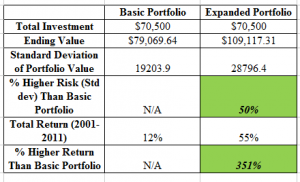
The results of the basic portfolio with the application of dollar cost averaging were somewhat disappointing, with a total return over the past ten years of only 12%. However, this is still definitely better than a 0.48% overall return! During the ten years, we saw that by using this investing strategy, your money would have grown to a current value of ~$79,000.
The results of the expanded portfolio were surprisingly much better. I guess I always have read that this asset allocation stuff works, but have never done this in-depth of an analysis to determine just HOW effective it is!
A total return of 55% was realized over the 10 years. While this is not the 10% yearly average return that the stock market has provided since the 1800’s, it is a 351% increase in return compared to the basic portfolio. Quite amazing! The ending value of the portfolio was almost $30,000 higher than the basic strategy.
It is important to realize that the expanded portfolio value standard deviation did increase by 50%, so it was not completely a free lunch. The increased standard deviation was most likely contributed by the small cap, small cap value, and emerging market funds, as these are generally regarded as higher risk investments.
Conclusions
Now that the dust has settled (or maybe a more accurate saying would be that the spreadsheet electrons have settled) from this analysis, let’s take a step back and see what sort of conclusions we can draw. Several of the key ones I could think of are listed below:
- Even though the past ten years were not the best for investors, I don’t think I would consider them to be “lost” and completely useless to our wealth building goals. However, I suppose this depends on your required rate of return.
- The application of periodic investments using dollar cost averaging can produce higher overall returns than just investing one lump sum because it enables you to purchase lower-priced shares.
- Passive investing works. I would recommend using it! 🙂
- The addition of different asset classes (small-cap, large cap, value, international, etc) to a portfolio is beneficial for returns and risk management. However, it isn’t absolutely necessary, unless you are someone who enjoys managing your own money (as I do). If you like to keep things simple, merely having 2 index mutual funds will most likely provide adequate exposure.
How about you all? How did your investments perform over the past decade? Was it actually a “lost decade” for you?
Budgeting for Your Holiday? Don’t Forget Travel Insurance

————————————————————————————————————————
Welcome to My Personal Finance Journey! If you are new here, please read the “About” or “First-Time Visitor” pages to find out more about us. If you would like to receive free updates on articles like this by email, then sign up here or you can subscribe to the RSS feed. Also, check us out on Twitter or Facebook. Thanks for visiting! Keep on learning!
————————————————————————————————————————
The following is a guest post. Enjoy!
Selecting Among Travel Insurance Options
Many focus on the obvious costs of transport and accommodation, forgetting about more mundane necessities like travel insurance. While the bulk of your vacation planning, and therefore required holiday budget may vary considerably, there are several important rules of thumb when it comes to selecting travel insurance that can save you money in certain circumstances – and sometimes this can mean significant cash.
Travel Insurance Features – “The Devil is in the Details”
Using Travel Insurance for Medical Care Expenses
Conclusions
How about you all? Do you generally purchase travel insurance when you go on trips, purchase rental cars, book hotel rooms, or book plane tickets? Do you feel travel insurance is worth the cost?
Share your experiences by commenting below!
Jacob’s Thoughts – Listed below are my random thoughts as I was reading this article.
- @ How I plan/save for vacations –
- At the beginning of the article above, it is mentioned that accumulating the funds needed for the “perfect” vacation can be quite difficult. Indeed, I agree that this is definitely an accurate statement.
- However, I feel that there is a solution for saving for vacations that makes the grim prospect a little easier. What’s the solution, you’re probably asking? It’s called automatic transfers.
- For many years before setting up my Purpose Focused Financial Plan, I wanted to save for vacations. However, when the end of each month came, it seemed like all of my money had been exhausted. In this way, I never made any progress saving for a vacation.
- The best way I’ve found to remedy this procrastination and ineffective-saving habit was to set up an automatic transfer once per month (at the beginning of the month though) from my checking account to my life values and dreams savings account with a pre-determined amount. This pre-determined amount is specifically earmarked for enabling me to fulfill a vacation determined from my yearly financial review of my life values and dreams.
- @ Whether or not travel insurance is needed? Is it a good idea at all?
- First off, I just want mention that I think the advice given in this article is pretty accurate for how to proceed ONCE you know for sure that travel insurance is right for you.
- However, I feel that determining WHETHER OR NOT travel insurance is right for you is an entirely different discussion.
- In short, in my opinion, I don’t feel that travel insurance is worth the money one bit for most normal individuals and families. Here’s why….
- Similar to the way rental car insurance companies try to push rental car insurance policies because they are wildly profitable since claims rarely need to be made, most purchased travel insurance policies will never be touched.
- And, when claims are filed, I’m willing to bet that it was completely unnecessary because the traveler was already covered in some form or fashion by either their own health insurance or credit card insurance policies (if credit cards were used for the purchase).
- So, yeah, it would be “ideal” to have travel insurance. But, in tough economic times especially, you have to think about what you REALLY NEED.
- So, now that I’ve gotten that out of the way, I do feel that travel insurance has its certain place or niche in the “travel economy.”
- I feel that travel insurance is a good thing to have whenever an employee is traveling on company business.
- At many companies, the employer is actually liable for an employee’s well-being and health when they are “on the company clock.” And, having a relatively inexpensive travel insurance policy is, in my opinion, a wise idea in order for all parties to know how damages will be paid if any accidents or damage is done by the employee to rental cars, etc during a trip.
- This ensures that there is not the tension between the employer and employee about deciding who is “liable.” Instead, the situation is already paid for, and the employer-employee relationship can continue on a little smoother.
***Photo courtesy of http://images.cdn.fotopedia.com/flickr-2597316650-hd.jpg
Zecco.com Investing Brokerage Review

————————————————————————————————————————
Welcome to My Personal Finance Journey! If you are new here, please read the “About” or “First-Time Visitor” pages to find out more about us. If you would like to receive free updates on articles like this by email, then sign up here or you can subscribe to the RSS feed. Also, check us out on Twitter or Facebook. Thanks for visiting! Keep on learning!
————————————————————————————————————————
Zecco.com and I have a pretty long history. I joined Zecco back when it had just started in the 2006-2007 time frame. This was when I was just beginning to learn about investing and trading stocks (I have since changed my investing strategy to a passive investing approach, investing only in index mutual funds. But, that is another story!).
Zecco blasted on to the market with quite a revolutionary concept – commission free stock trading. Naturally, this was the reason that I (like many others) joined! It was hard to believe at that time that a brokerage could be offering commission free stock trading.
Of course, this was back during the “21st Century glory days” of investing, when the market was going higher and higher and brokers were competing desperately for your money. Since that time, Zecco (like everything) has gradually tightened up and increased their commissions to a level that is less enticing than it once was. However, they are still in my mind, one of the better and cheapest discount brokerages around.
Let’s explore some of the details of this “player” in the investing world to determine if it’s right for you.
Account and Investment Options
Through all of the years I have used Zecco, I have just had one account – an individual, taxable, stock trading account.
Having said that, Zecco isn’t without options. Zecco.com has gradually expanded their offerings, and they now feature the following types of investing accounts and investment options:
Account Options:
- Individual and joint taxable investment accounts
- Traditional, Rollover (from 401k), and Roth IRAs
- Just be careful, a $30 per year IRA maintenance fee applies to IRA accounts.
- Stocks / equities
- Exchange Traded Funds (any ETF that is traded on the AMEX stock exchange)
- *New* Mutual funds!
- This is a fairly new feature that was just recently added to the array of investment options at Zecco.com.
- However, before investing in these, be sure to read the fees section below. Trading shares of mutual funds with Zecco involves a $10 commission per transaction (and most of the mutual funds offered have higher expense ratios than equivalent mutual funds at investment houses specializing in mutual funds, such as Vanguard or Fidelity – which are commission free).
- Foreign Currency Exchange (Forex) and Precious Metal trading.
- Options
- Bonds/CDs
Fees, Account Minimums, and Commissions
With the exception of offering Forex trading, Zecco (thus far) seems pretty much like your standard online brokerage investment firm, offering the typical account types and investment vehicles. However, as is normally the case in today’s environment where firms are competing fiercely for your business by offering lower fees and better account terms, an inspection of the fee schedule is a key step in determining whether Zecco is a suitable match for you.
As such, the details of Zecco’s fee, commissions, and account minimums can be seen in the table at the following link – fees, commissions, and account minimums. A summary of the key points can be seen below.
Account Minimums
- This is one of the strong points of Zecco (especially when compared to the $500 account minimum of its closest competitor, which in my mind is Sogotrade), as there are NO account minimums (except for minimums imposed by specific mutual funds that you decide to purchase) and no inactivity fees.
Fees & Commissions
- The commission for buying and selling stocks and ETFs is pretty straightforward, as it costs only $4.95 per trade.
- For options, Zecco’s fee is the $4.95 from above + a fee of $0.65 per options contract.
- For mutual funds traded online, the commission is $10 per trade. However, for broker assisted trades, this fees is almost doubled at $19.99.
- For bonds/CDs, the commission is $4.50 per transaction, with a $22.50 minimum.
Online Account User Experience
Overall, the online investor/user interface offers the essential information you need to invest and manage your money, but does not feature any of the “bells and whistles” that you might find with other brokerages.
For example, if you are looking for automatically generated performance charts, pretty asset allocation pie-charts, etc, then you probably will want to look someplace else!
Shown below is a screenshot of the “Account Overview” screen that pops up when you first log in to your account. As you can see, it is a fairly simple and straightforward interface, with not a lot of distraction. Displayed on this page are the start of day and real time cash balance, market value, total equity, maintained excess (if investing in options), and total remaining account buying power values.
From the main screen, you can then click “Positions” on the left sidebar, and you will be taken to a list of your purchased assets. An example screenshot is shown below.
As you can see from the screenshot above, you are given the typical information about your ETF and individual stock holdings, including last price, intraday change, share quantity, total profit/loss since you first purchased the shares, and the current market value.
Summary / What’s the Bottom Line?
We’ve gone in to a lot of detail in today’s review of Zecco. So, let’s just do a quick recap.
Overall, Zecco offers the various tax-deferred and individual account options that one would expect from a popular brokerage firm (stocks, ETFs, and mutual funds). However, the addition of Forex trading is somewhat unique. If you are looking to do Forex trading, you may want to look in to Zecco.
Zecco’s commissions/fees on buying and selling individual stocks, ETFs, and mutual funds, are pretty competitive compared to the other online discount brokerages on the market today, especially since they do not have a required account minimum. However, they are definitely not the cheapest!
For example, Sogotrade.com offers $3 commission stock/ETF trading. Sogotrade does require a $500 account minimum to open an account. But, if you are looking to invest large amounts of money, you will spend less in commissions in the long run if you choose Sogotrade.
Another “con” of Zecco is their $30 per year IRA maintenance fee. Because of this (and the fact that Zecco charges a $10 commission per mutual fund trade), I would avoid Zecco for retirement investing. Instead, I would open up an account with Vanguard of Fidelity and simply invest in their proprietary, lower-cost mutual funds or ETFs (which one can do with no trading fees incurred and no account maintenance fee).
So, use Zecco if you have less than $500 to invest in a taxable stocks/ETF account, but look elsewhere if you have more than $500 or are looking to open up an IRA.
How about you all? Have you used Zecco.com before? If so, what type of trading did you use it for? Were you satisfied with your experience?
Share your experiences by commenting below!
***Photo courtesy of zecco.com
Yakezie Carnival – Examples of Selflessly Helping Others Throughout History – September 25th, 2011 Edition

————————————————————————————————————————
Welcome to My Personal Finance Journey! If you are new here, please read the “About” or “First-Time Visitor” pages to find out more about us. If you would like to receive free updates on articles like this by email, then sign up here or you can subscribe to the RSS feed. Also, check us out on Twitter or Facebook. Thanks for visiting! Keep on learning!
————————————————————————————————————————
Welcome everyone to the September 25th, 2011 edition of the Yakezie Carnival!
About This Carnival
For those of you unfamiliar with the Yakezie Personal Finance Blog Network, it is the web’s largest, most involved, and most organized group of personal finance and lifestyle bloggers. Participants in the network collaborate multiple times throughout each day on the Yakezie forums and through other mediums. You can view all of the details at the “About Yakezie” page by clicking here.
Each week, the members and challengers of the Yakezie Network submit their best articles to be featured in the Yakezie Carnival. And, today, it is My Personal Finance Journey’s honor to be the host! We last hosted the carnival at the beginning of the summer on June 26th prior to the launch of the Tour de Personal Finance and had a great time!
Jacob’s Deep Yakezie Reflections of the Day – Yakezie Changed My Blogging Life?
In January of 2010, I started My Personal Finance Journey. I “blogged in a cave” for about 6 months without reaching out to any other bloggers, which I found out later was a big mistake. However, I guess this time wasn’t totally lost since I generated almost 200 posts during this time, some of which still get read quite a bit (long chain approach of blogging if you read that post on ProBlogger).
On July 10th, 2010, I joined the Yakezie Challenge without totally understanding or appreciating what it was (shhh..don’t tell Sam haha). At this point, I didn’t really know what I was doing blogging at all. I didn’t understand the etiquette (I would leave comments such as, “Nice article – check out my related post at this URL.” Blogs probably thought I was spam!), the business, or the communication of blogging. In fact, about 5 months dwindled by before I actually did anything with Yakezie.
However, in December of 2010, this all changed; I started being very active on the Yakezie Forums and trying to help others in the Network wherever possible. And, I can say with certainty now that I would not be the same today were it not for Yakezie.
Today’s Carnival Theme
OK, enough with the sentiment, Jacob. What about that carnival? You got it.
Since the slogan of Yakezie is “to selflessly help others,” I figured it would be interesting to dig up some examples throughout history where people have selflessly helped others, not only in business but, in all walks of life. It’s so interesting to see time and time again that by simply helping others, you actually end up helping yourself in the process. So, enjoy!
To get us started, listed below are this week’s Top 3 Editor’s Picks. Typically, when I host a carnival, it is quite clear what the three winning articles are. However, I find that when I’ve hosted Yakezie Carnivals, the quality of the articles is so high that I often find myself torn between about 8 articles competing for the top spots.
1. Wealth Informatics: How much emergency fund do I really need? – The amount of emergency fund recommended varies from $1000 to 1 year salary. How much do we really need?
A amazingly good post here from Suba, the resource-post master. I typically recommend simply keeping 6-9 months of expenses in an emergency fund. When I ran the 9 months of expenses figure for Suba’s situation described in this post, I came out with around $12,000 for her target emergency fund balance, which is in the ballpark of what she figured as well with the exception one personal expense item.
So, I think the 6-9 months recommendation is a good way to “keep things simple” and get people started towards an emergency fund goal. However, once they accumulate that savings, it’d be good to go through this list that Suba provides to obtain further visibility and optimization.
2. Smart Family Finance: Are You Ready to be Your 20-Something’s Financial Advisor? – 7 percent of 20-somethings consult a professional financial advisor, but one in three consult their parents. Are you ready to be your 20-Something’s unofficial financial advisor?
In today’s society, not only are young adults coming back home to live with Mom and Dad, but it is also becoming a trend to use them as their sole source of financial advice. In this post, Smart Family Finance gives a list of the gamut of financial areas on which young adults are seeking advice from their parents. I have definitely consulted my parents on almost all of the things on this list. However, I always investigate the advice given further to make sure I am taking the right path. So, my overall advice here is that young people blindly taking their parents’ suggestions could get them in to trouble.
3. KNS Financial: A Lawyer Is Forced To Become A Stripper To Make Ends Meet: How Far Would You Go? – A lawyer turned stripper, gives us a picture of what financial desperation really looks like. How far would you go to make ends meet? What would be your first move?
Very good post KNS! In some ways, this reminds me of the “what would you do if you were homeless” Yakezie blog swap we did a while back. In that, people shared just what they would do if hard times were forced upon them. If I was laid off from a “professional” job and couldn’t find another due to the economy, I would try to target jobs that are fairly high paying but don’t require advanced degrees. Some of these include being an airport valet (make lots of money in tips) or Porta-Potty cleaner.
And, listed below are the best of the rest! The selected entries are formatted as follows – 1) Blog title in bold, 2) Post title and link, and 3) a description written by the site owner about the post.
Frugal Confessions: Smart Stores: Consumer Monitoring in Exchange for Your Information – Retailers and manufacturers have developed some pretty crafty ways to monitor and target consumers over the years, like the example above. And people who hunt down deals (frugal people like us) appear to be the ones who are most monitored given the nature of how this technology works.
My Journey to Millions: How Much Will Your Expenses Be in Retirement? – In retirement planning, you don’t need 50%, 60%, 70%, 80%, 90% or 100% of your pre-retirement income. During retirement, you need the amount that your budget dictates.
Prairie Eco Thrifter: Is Going Green Killing Our Economy? – While the environmental movement is not the sole cause of a shift in the patterns of our everyday lives, it does contribute. The demand to protect the environment certainly has placed a strain on the economy. In a time like this, it makes one wonder whether it is really worth it.
Live Real, Now: Time vs. Money – My time is valuable. No matter what I do, or how hard I work, I can never get more than my allotment. Why would I waste it to save a fraction of what I can earn by using it in other ways?
Mainstream Mom: Is Extreme Couponing Right for You? – I get that you can save an incredible amount on groceries, and that is fantastic. I save an incredible amount too, I just don’t stockpile it in my garage.
————————————————————————————————————————
Selflessly Helping Others – Example 1 – Help Others and You Will Be Helped in Return
Source – http://www.helpothers.org/story.php?sid=21057
————————————————————————————————————————
Living in Financial Excellence: 7 Good Character Traits of a Cheapskate – “Cheapskate” is such a negative term in today’s society, but when you look at the definition and characteristics of being a cheapskate, it’s actually a good thing (at least in my eyes). Today, I discuss what qualities define cheapskates and how those qualities set cheapskates up for long-term success.
Invest It Wisely: The Biggest Unknown Risk of Stock Investing – “We say that stocks are risky because we know that prices can suddenly drop hard — stock prices are volatile. But, we also believe that stocks are not really all that risky for those committed to holding them for the long term. In the long term, stocks always provide good returns. By following a Buy-and-Hold strategy, we can overcome the riskiness of stocks.” Personally, I don’t think it is so. I view this as dangerous thinking.
Control Your Cash: Follow these steps for guaranteed wealth, seriously – As a discipline, personal finance is similar to sociology and women’s studies in that there’s almost no hands-on knowledge involved.
Maximizing Money: Why I Finally Closed My Chase Bank Checking Account – After years as a happy customer, I closed my Chase Bank checking account, even though I would have rather kept it open. This is the story of my experience as a Chase customer.
My University Money: The Government Can’t Actually Create Jobs – The government has tons of problems, but their solutions usually add to them.
Investor Junkie: What Do Netflix and Taxes Have in Common? – Now you might be wondering what does taxes have to do with Netflix? Everything! This is a classic example of elastic demand
Free Money Wisdom: Tips for Borrowing from a Family Member–Family Personal Loans – Utilize the information in this article to decide if taking out a family loan makes sense for your situation and what you can do to ensure that you manage yourself in a manner that will equate to a situation that is comfortable for all participating parties.
Mom’s Plans: How We Plan to Tackle Our Debt – We would like to have a significant chunk to put down on a house in a few years, and I don’t want to purchase a house if we have other debt. Here is our plan for paying down our current debt quickly.
————————————————————————————————————————
Selflessly Helping Others – Example 2 – Urban Legend About Winston Churchill in a Virtuous Cycle of Giving and Receiving
“Fleming was a poor Scottish farmer. One day at work in a field he heard a cry for help. Following the sound, Fleming came to a deep bog, in which a boy was stuck up to his chest, screaming and sinking. Farmer Fleming tied a rope around his own waist and the other end to a tree, and waded into the bog. After a mighty struggle in which it seemed they would both perish, the exhausted farmer pulled himself and the boy to safety. He took the lad back to the farmhouse, where Mrs Fleming fed him, dried his clothes, and when satisfied he had recovered, sent him on his way home.
Source – http://www.businessballs.com/stories.htm
————————————————————————————————————————
The Frugal Toad: College Students and Identity Theft – College students made up roughly 25% of all victims of identity theft last year. Find out how to lower your risk of Identity Theft by using these six strategies.
Narrow Bridge Finance: Home Buyer’s Guide Part II: From Offer to Contract – A continued look at the process of buying a home. This article focuses on the steps for making an offer and going under contract.
The Happy Homeowner: Why I’m Taking a Vacation Instead of Paying Down My Debt – If my financial journey were compared to a hand of Texas Hold’em, I have seen Dave Ramsey’s gazelle-like intensity–and raised it by a few hundred Suze Orman “DENIED!’s.” This article highlights why it’s important to infuse balance in your financial journey.
The Penny Hoarder: 5 Weird Ways to Make Money Recycling – Collecting cans for the recycling center is not the only way to make a buck with your recyclables. Check out these 5 new, very weird ways to make extra money recycling…
Everything Finance: Money and Relationships: What’s the Root of Your Problem? – You’ve probably heard plenty about how money problems and relationship problems often go hand in hand. You’ve seen the statistics, and read about the reality of financial and budget problems and their impact on relationships.
Money Reasons: How I Saved $1190 By Purchasing A Cable Modem– In this article, I describe how sometimes, savings creep up on you. My cable modem purchase over 11 years ago is one such example! If you still rent a cable modem, check out my article and see why I decided to buy my cable modem instead.
Stock Market Basics: Best Gold ETF – Invest in gold via the gold ETF, as it is the easy way to invest in gold without the troubles of buying and selling gold in physical form. Plus, gold investment is a must in your portfolio given the state of economy.
20’s Finances: Is it Hard to Time the Market in a Recession? – Offering advice on the best time to invest in the stock market.
Investorz’ Blog: What to Consider When Investing in Commodities –Most investors don’t invest in commodities for one reason or another. But, using the right techniques, trading commodities can be far more profitable than stocks. Here are a few things you should know before investing in commodities, which is a much different world than stocks.
Buck Inspire: Las Vegas Ground Transportation, Mortgage Options – Knowing your ground transportation options will make your travel plans run smoother. But, knowing all your mortgage options will help you make the most informed, biggest financial decision of your life!
Squirrelers: Save Time and Money by Hiring the Right Home Improvement Contractor – When getting work done on your home, it’s important to hire the right people for the job. This post provides tips on how to go about doing just that.
Krantcents: Am I Training for a Race? – I am in training physically, mentally, and progressing to my goals.
Saving Money Today: Investing in Gold – With gold prices soaring and more investors looking to add some to their asset mix, it’s important to learn the different ways to invest in gold.
Compounding Returns: Trading Options? Keep an Eye on Expenses. – Options for low cost trading. Expenses can cut into your profits. It’s in your best interest to find the lowest fee brokerage.
————————————————————————————————————————
Selflessly Helping Others – Example 3 – Want Someone to Save Your Life? Save Theirs First!
In 1996, Kevin Stephan of Lancaster, N.Y. was serving as a bat boy for his brother’s baseball team when someone accidentally hit him in the chest with a bat. This collision caused his heart to stop beating. However, Penny Brown, an off-duty nurse, was in the stands and performed CPR on Kevin to revive him. Kevin recovered from this incident.
Ten years later, Penny Brown was eating in a restaurant and choked on her food. Coincidentally, Kevin worked as a cook at this very same restaurant and had learned CPR during training as a volunteer fire fighter. Thankfully, Kevin performed the Heimlich maneuver and saved Penny’s life.
Fate sure works in mysterious ways eh?!
MSNBC has the complete story here – http://www.msnbc.msn.com/id/11190559/ns/us_news-weird_news/t/teen-saves-life-woman-who-saved-him/
————————————————————————————————————————
Fat Guy, Skinny Wallet: Why I Chose Not To Use Debt Consolidation – Debt consolidation was not the right choice for me many years ago. Find out the details that made me turn away from this seemingly helpful service.
TotallyMoney: How to deal with bringing debt into a relationship – Can debt and relationships work?
Smart On Money: How To Deal With Regular Bills When You Have An Irregular Income – When your income doesn’t come in 24 equal payments spaced evenly throughout the year, it can be hard to make a budget.
Money Q&A: Should You Pay Off The Lowest Balance Or Highest Interest Rate Debts First? – There are several opinions as to which method of paying off credit card and other debt is best. Should you pay off the debts with the highest interest rate first? Or, should you tackle debts with the lowest balances first?
How To Save Money: US Bank Account Comparison For Canadians – A thorough side-by-side comparison of all US dollar checking and savings accounts that are currently offered by the major Canadian banks.
Free From Broke: Budgeting for Christmas Shopping Before it’s too Late – Start budgeting for Christmas shopping now before it’s too late! Otherwise, you can be stuck in debt. Read this article for tips on how to budget your Christmas shopping.
BeatingTheIndex:The Bet On Rising World Energy Consumption – World energy consumption is rising sharply in the next 2 decades which makes a compelling case for investing in the energy sector.
Broke Professionals: Moving up the career ladder – Have you ever wondered why Johnny Jerk down the hall was promoted to that director slot while you were passed over? Here are profiles of three managers with whom I once worked.
The College Investor: Best 401k Moves – A look at the best moves you can make to maximize your 401k!
My Multiple Incomes: The Ultimate Guide to Social Media Backlinks – A look at the social media options out there and how to use them to create backlinks to your website.
Not Made of Money: Don’t Let Money Errors Derail Your Finances – Everyone makes mistakes: bank tellers, store clerks, and us. I’m never put out when someone makes an honest error. I simply point out the problem and ask them to correct it. If I’m not looking for them, though, those errors can cost a lot of money.
Family Money Values: Why We Have Official Family Meetings – In the years following 9/11, I realized that life is so fragile – it really sank in that we could die suddenly, at any time. The boys had grown up by then and had moved out, but I started thinking about what would happen to them if we did die suddenly and together. That is when I started sharing information about our finances and estate plans with them. We do so in family meetings and so can you.
One Cent At A Time: What Makes You Feel Rich And Wealthy? – Why do you want to be rich? To have more fun, respect, social status, and a worry free life? I have an answer for you – you don’t need huge amounts of money to achieve all these great things in life.
Our Journey To Zero: Save Your Budget, Spice up Your Life – Reuse That Halloween Costume! – Tired of spending your hard earned money on a new Halloween costume every year? Here’s some ways to get some extra mileage out of your ghoulish get ups!
Financial Success for Young Adults:Would QE3 Make Stock Prices Go Up? – The speculation surrounding a third round of quantitative easing has investors concerned and maybe a little excited that their retirement accounts will get a boost. Let’s see what would happen if QE3 began.
Well, that wraps up this week’s Yakezie Carnival! Thanks so much for everyone for participating. Next week’s carnival will be hosted by Family Money Values Blog. Get your posts in soon!
Thanks for reading,
Jacob
***Photo courtesy of http://farm1.static.flickr.com/192/471143582_e8b3a758d9.jpg
Are You REALLY Doing Everything You Can to Save for the Future?

————————————————————————————————————————
Welcome to My Personal Finance Journey! If you are new here, please read the “About” or “First-Time Visitor” pages to find out more about us. If you would like to receive free updates on articles like this by email, then sign up here or you can subscribe to the RSS feed. Also, check us out on Twitter or Facebook. Thanks for visiting! Keep on learning!
————————————————————————————————————————
The following is a guest post.
Times are tough. But, are they really? Think about everything you know about the Great Depression of the 1930s. Try and recall the photographs of the era that were plastered in virtually every history book you’ve ever seen. Skin-and-bones unfortunates lined the block to get a bowl of soup. Barefoot families hopped the rails in hopes of finding a better life elsewhere. Back then, if your neighbor had a radio you could listen to through the walls on a quiet winter’s night, you were the luckiest guy on the block besides your neighbor.
Putting Today’s Recession Economy in to Perspective
Relative to the rest of history, and especially within the history of this country, that wasn’t very long ago. Yet today’s “tough times” are very different from those of the 1930’s. You might be facing foreclosure, but let me ask you something: how much do you have today that a struggling family didn’t have during the Great Depression? How much of that can you let go of, if times are really that tough?
For a majority of Americans, audacious adjustments in their standard of living are not being undertaken to better preserve a solid financial future. For example, how many families with sub-par income have expensive monthly mobile phone contracts? Loads! Even reducing down to prepaid phones is leaps and bounds compared to the sacrifices previous generations had to make when it came to limited communications. But, it could save families countless sums if they severely restricted or even eliminated their mobile phone usage.
What about food? Americans are notorious eaters, and little has changed in terms of what’s on our plate since the start of the Great Recession. It’s not so much what’s on the plate but how much is on it, that determines whether a family is effectively limiting themselves in order to squirrel away enough for the future. Nobody is suggesting families reduce themselves to the rations of the third world, but honestly, no one needs that second helping in this country, and smaller portions can easily equal to larger savings over time.
Conclusion
Families need to seriously stop and think about what they take for granted. We all want to be up-to-date on the latest technology, enjoy the best entertainment, and indulge in the comfort foods of choice. But, what’s the point if it impedes on the security of the future? There was once a time when tough times meant tough life. Maybe the reason we’ve yet to recover from this economic mess is that we’ve failed to live as tough as we ought to.
How about you all? Has your standard of living changed at all since the start of the recession in 2008-2009 (I know that mine hasn’t)? Do you feel you’re saving as much as you should be?
Share your experiences by commenting below!
***Photo courtesy of http://www.flickr.com/photos/danielvoyager/3893900302/sizes/l/in/photostream/