
Category Archives for Invest & Retire
5 Reasons Why You Should Insure Your Home Loan
My Personal Finance Journey Homepage
5 Reasons Why You Should Insure Your Home Loan
Festival of Frugality #247 – Passive Index Investing Edition
“A very low-cost index is going to beat a majority of the amateur-managed money or professionally-managed money” – Warren Buffett
“Every time that I do it [write a new version of his book, A Random Walk Down Wall Street], I find it’s always two thirds of active [money] managers who are beaten by a simple index that does nothing but buys and holds all the stocks.” – Burton Malkiel
“Individual stock brokers pay almost no attention to the returns their clients earn. It is rare to come across one who routinely calculates his clients’ annual returns” – William Bernstein, Author of the Intelligent Asset Allocator
“Past performance [of mutual funds] is not a predictor of future performance. In 1998, fewer than 20% of all equity funds outperformed the S&P500 Index. That figured drops to 11% over the previous 10 years and to just 4% over the previous 15 years.” – Larry Swedroe, Author of What Wall Street Doesn’t Want You to Know
Can Graduate Students With An Assistantship Participate in the University 401K Plan?
My Personal Finance Journey Homepage
- Have their tuition fully paid for
- Receive a small salary through what’s called an “assistantship”
- And also have health insurance paid for.
How about you all? Do you know if the rule for graduate students participating in 401k and pension programs is different at other schools?
Share your experiences by commenting below!
Did you like this article? You can get the complete text of all the latest articles at My Personal Finance Journey in your email inbox each evening by clicking the link below and entering your email address. Your address will only be used for mailing you the articles, and each one will include a link so you can unsubscribe at any time.
Subscribe to My Personal Finance Journey via Email
Related articles about graduate students’ 401k contributions at several of my favorite personal finance blogs:
CashMoneyLife – Considerations for When It May Not Be Appropriate to Contribute to a 401K
Two New Tax Advantaged Investment Accounts You Need to Know About
Recently, while reading Burton Malkiel’s book, A Random Walk Guide to Investing , I came across a description of two new types of investment accounts that George Bush was helping to develop when the book was published. These two types of accounts could potentially be added to your overall investment mix of stocks, bonds, or buying gold as an investment.
The two types of accounts are listed below, along with descriptions of their features:
- Retirement Savings Account
- Designed to replace Roth IRAs
- Allow each individual to contribute up to $7,500 per year. Has to be earned income.
- No tax deduction when funds placed in to account. No tax held upon withdrawal in retirement.
- Lifetime Savings Account
- Each individual in a family could contribute up to $7,500 per year, irregardless of the source (i.e. does not have to be earned income).
- No tax deduction when funds placed in to account. No tax held upon withdrawal in retirement.
These two types of accounts could give a serious tax advantage to the individual investor that knows about them and uses them effectively.
While reading this, I began to wonder what the status was for these types of accounts. Did a law ever pass allowing these accounts? Are they still being debated?
In searching around the internet a little, I could find no evidence that these types of accounts were ever enacted or if they are actively being debated.
Does any one out there reading this know about the status of these account types? They should like they would be quite attractive options!
Did you like this article? You can get the complete text of all the latest articles at My Personal Finance Journey in your email inbox each evening by clicking the link below and entering your email address. Your address will only be used for mailing you the articles, and each one will include a link so you can unsubscribe at any time.
My Current Asset Allocation and Net Worth Growth – August 2010
My Personal Finance Journey Homepage
Let’s take a look….
Net Worth Growth (not including condo)
From July 14 (when the last portfolio update was published – see link below for more information) to August 11, the S&P 500 index went down 1%.
My Personal Finance Journey – July 2010 Portfolio and Net Worth
During that time period, my net worth (excluding condo ownership) decreased 4.31%. This decrease is due to the fact that I am not counting my home equity in my overall net worth / asset allocation calculations. The reasoning for this was discussed in a previous post at the following link – How Does Home Ownership Fit in to Your Overall Asset Allocation?.
Condo Equity Growth
Since I am not counting the home equity in my condo as part of my asset allocation, I need to add a new section to these monthly portfolio reviews to account for this important aspect.
Currently, I have 7.62% home ownership in my condo (up from 0% last month), with this accounting for 56% of my real net worth (so net worth subtracting the condo loan – this is different from the net worth above).
I have now achieved the following financial goals in 2010:
- Achieved my short term target net worth for this year.
- Contributed the maximum contribution level of $5000 allowed for my Roth IRA for the year 2010 (and 2009 as well).
- Eliminated all significant holdings in individual stocks from my portfolios.
- Eliminated the actively managed Vanguard Short-Term Investment-Grade Fund (MUTF: VFSTX) and replaced it with the following short-term bond index fund – Vanguard Short-Term Bond Index Fund (MUTF: VBISX).
- Successfully purchased a condominium to live in for graduate school. Yah!!!
- Initiated Rollover IRA to Vanguard from my Fidelity 401k from my previous employer.
- Purchasing a TIPS inflation protected mutual fund.
For a detailed list of my short term, mid term, and long term financial goals, click on the link below:
My Personal Finance Journey – Financial Goals
Review of Current Asset Allocation (excludes condo)
- Overall Fixed Income / Equity Allocation
- Currently, 24% of my net worth is invested in fixed income instruments (cash or bond funds), and 76% is invested in equity.
- This is almost perfectly aligned with my targets for these categories of 25% (fixed income) and 75% (equity).
- Equity Allocation
- In the equity portion of my portfolio, 64% is invested in US Domestic Equities with the remaining 36% being held in international equities.
- This is significantly off from my equity breakdown targets of 71% and 29%, respectively, for US Domestic and international holdings, and will have to be corrected through rebalancing actions when I roll over my 401k holdings to a Vanguard IRA (more detail below).
While the overall percentages for these categories may not be ideal, a detailed look (table below) at the allocation breakdown reveals the real story and provides for better analysis of the current state.
Remember: a red flag goes off if your current % allocation in a category is greater than +/- 5% off of the target allocation. This is my trigger that I need to rebalance that aspect of my portfolio.
% Cash (money market target 5%) 8%
% non-inflat Bond Funds (target 15%) 16%
% TIPS Bonds (target 5%) 0%
% International Equity (Target 11%) 19%
% International Emerging Markets (Target 11%) 9%
% Domestic Large Cap (Target 8%) 12%
% Domestic Small Cap (Target 8%) 16%
% Domestic Small Cap Value (Target 14%) 8%
% Domestic Large Cap Value (Target 13%) 6%
% REIT (target 10%) 6%
The components of my portfolio highlighted in red above are outside of the 5% safety band, and therefore, need to be analyzed for reallocation. Fortunately, due to my current situation of rolling over my Fidelity 401k to a Vanguard IRA, I will be able to remedy most, if not all, of these discrepancies. Yah!!! Finally, the time has come!
- TIPS Bonds –
- During the roll-over to a Vanguard IRA, I selected to place the equivalent of 4% of my net worth in to the TIPS mutual fund. This will satisfy this category of my asset allocation.
- International Equity and Small Cap Equity –
- As you can see from the %’s above, I have 8% of my net worth too much invested in international and small cap equity funds.
- To remedy this, I will exchange 8% of my net worth out of these types of funds to the small cap value, large cap value, or REIT category. Problem solved!
- Small Cap Value and Large Cap Value Equity –
- I currently need 7% and 6% more worth of my net worth in large cap value and small cap value equity funds, respectively, to be aligned with my asset allocation targets.
- In order to gain this alignment, I simply instruct Vanguard to purchase this much of these respective mutual funds during the roll over. Easy as could be!
My next moves for the August/September 2010 time frame will be to do the following:
- Sign up for a biweekly home loan payment plan.
- Set up accounts for making home ownership automatic – automatic deductions for loan repayments, real estate taxes, maintenance reserve funds, insurance, etc.
- Begin to set up a will (since I don’t have one right now and it’s something that everyone needs if you have any kind of assets).
Wish List
- At some point, purchase the Vanguard Total Stock Mkt Idx (MUTF:VTSMX) to replace S&P 500 index fund. This gives better, broader diversification to the US stock market.
- Purchase more microloans in developing countries as part of my “making a difference” life value in my Purpose Focused Financial Plan.
How about you all? Did you make any big moves that affected your net worth this past month?
Do you consider your home equity as part of your net worth or do you leave it as separate?
Did you like this article? You can get the complete text of all the latest articles at My Personal Finance Journey in your email inbox each evening by clicking the link below and entering your email address. Your address will only be used for mailing you the articles, and each one will include a link so you can unsubscribe at any time.

Vanguard vs. Fidelity – Which Funds Are Better?
Yesterday morning, I had the distinguished honor of being on a call with Fidelity, the administrator/provider of my previous company’s 401k accounts, to roll over my 401k to a Vanguard IRA.
During this call, the sales agent was fiercely trying to persuade me to rollover the 401k account to a Fidelity IRA. His two major selling points were that he claimed that Fidelity had..
- 1) Lower expense ratios than Vanguard, and
- 2) Better money managers/actively managed mutual funds.
I then proceeded to get in to an argument with the sales rep about how active management is a foolish game in which to play. He fought back valiantly, stating that if you find a good money manager that takes advantage of the Modern Portfolio Theory, you can achieve higher returns through proper asset allocation.
Needless to say, he was digging his own grave with this piece of wisdom, since that has nothing to do with why active management is superior (asset allocation can be done on your own with index funds).
Regardless of how I felt about the validity of reason #2 above (better actively managed funds), reason #1 did in fact get me thinking because I have never done a personal, head-to-head comparison of Fidelity and Vanguard. I merely was trusting that Vanguard was superior because it is the most recommended in the investment books I read by Malkiel, Siegel, et. al.
Because of this, I wanted to dedicate today’s post to comparing Vanguard against the largest mutual fund company in the world (as far as quantity of capital invested goes), Fidelity.
Point of Comparison #1 – Comparison of Expense Ratios (and subsequently, performance)
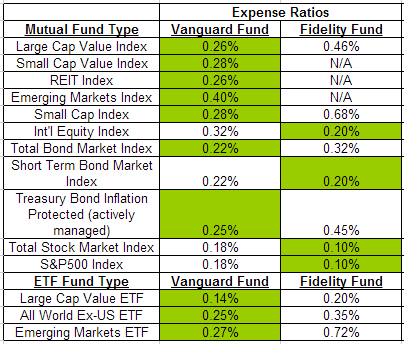
As you can see on the table above, Vanguard features lower expense ratios (and therefore higher returns) on 10 of the 14 funds that I am holding. This corresponds to Vanguard beating Fidelity on expense ratios 70% of the time.
Moreover, Fidelity does not even offer index funds for the small-cap value, REIT, and Emerging Market arenas. This is rather inadequate for the asset allocation-obsessed investor.
Simply put – no one can beat Vanguard on index investing.
Point of Comparison #2 – Trading Fees / Commissions
When it comes to trading fees and commissions for trading ETFs and mutual funds, Fidelity and Vanguard are tied.
They both offer $0 trading on their proprietary mutual funds and ETFs.
Point of Comparison #3 – Minimum Balances, Initial Quantities, and ETF Availability
This point is an area where Vanguard shows though as having a clear advantage, at least in my perspective.
Fidelity requires that an investor have (for each mutual fund) a minimum initial investment quantity and continuing investment balance of $10,000. For the majority of investors, especially for younger investors, I feel that this is simply not realistic.
On the other hand, Vanguard requires a minimum initial investment of $3,000. However, once the account is established, the balance can dip below that level without penalty.
As far as ETFs go, Vanguard reins superior over Fidelity because 1) their ETFs feature lower expense ratios and 2) Fidelity does not even offer their own ETFs. Instead, the ETFs listed on the table above are actually iShares ETFs that Fidelity offers with $0 commission trading.
Point of Comparison #4 – Ease and Simplicity of Navigating Website
In trying to find the expense ratio data in the above table, I have to admit that I obtained a serious headache in the process.
Even though I am very used to and partial to Vanguard, Fidelity’s website is a pain to navigate. It is much harder to sort mutual funds based on asset class and whether they are index funds or actively managed.
Additionally, I feel that Fidelity tries to complicate index investing too much by offering “enhanced” index mutual funds. This makes it even harder to drill down to the investment vehicle that you want.
Key Takeaway
By the evidence shown above, I believe we have disproved what the sales agent was saying about Fidelity offering lower expense ratio index mutual funds.
As I am wrapping up this post, I am trying to brainstorm in my head just why Fidelity manages the most capital in the world, when Vanguard is clearly superior as far as index investing goes. Thus far, I have thought of the two reasons listed below:
- Fidelity markets itself better to institutions, encouraging them to establish their 401k accounts with their company.
- Fidelity specializes more in active management vs. index investing.
- Since sadly, the majority of investors fall in to the active management trap, I suppose it would make a lot of sense for Fidelity to have an increased amount of capital.
How about you all? Do you all use Vanguard of Fidelity for your index and/or actively managed mutual fund needs? What made you go with the provider you chose?
Share your experiences by commenting below!
Related articles comparing Vanguard and Fidelity at several of my favorite personal finance blogs:
- Comparison of Vanguard, Schwab, and Fidelity @ the Investing Guy
- Target Retirement Funds Face Off – Vanguard and Fidelity and T Rowe Price@ The Amateur Asset Allocator
Cost of Living in California Compared to…Anywhere Else
Today’s guest post comes to us from Jordan, a dedicated blog reader and voiceful commentator.
In a previous post on this blog, I had analyzed how my costs of living had changed after hiring movers and moving from the southern US to the Northeast. Jordan’s post, on the other hand, will take a look at how the cost of living in California stacks up to the rest of the world. Let’s get started!
Cost of Living in California Compared to…Anywhere Else
California…Hollywood, Beverly Hills, serfdom. It’s not often that I take time out of my day to moan on paper…er, electrons. Sure, I take plenty of time to gripe in person, or over-the-phone for that matter. But when one of your best friend calls you and gives you a legitimate stage for your molestations, you just have to go with it.
This post will attempt to reconcile the differences between living in California and, well, living in any other part of the world. Of course, being that money is the backdrop here, I will try to steer clear of political diatribe and objectively comment on the sound financial facts.
TO FRAME A PICTURE:
Of course, we have to put all this in context now, don’t we? I have lived on multiple continents and experienced many cultures. And when I wasn’t an inhabitant, I was traveling there. Business…pleasure…it matters not. The point is that I have sampled many corners of the globe and can candidly say, without any qualms, that California is the most expensive place to live – ever.
THE FIRST STROKES:
I moved to San Francisco, California nearly two months ago for work. I was given an Extended Stay hotel to call home while I looked for a place to rent. I was making six figures, had a car paid for, no college debts, and a very healthy credit score. Even though the housing markets in the US are still WAY overpriced, I figured they would have fallen enough in California that maybe I could find a decent deal. Wrong. I linked up with a Realtor and she explained that, unless you are willing to commute 60 minutes to work, one way, there would be no way I would be able to afford a house in a respectable area. I asked her for the definition of respectable…let’s say that many homes come with barred windows to keep out the neighbors.
Realizing that I didn’t want to be the first straight white guy to die in San Francisco, I decided that safety was a priority. So I ended up finding a 700 square foot apartment for myself. 1 bed, 1 bath. $2000 a month. Not bad considering I could buy the same unit for a meager $825,000. Definitely wasn’t in Kansas anymore.
BUILDING THE THEME:
When I got tired of crying myself to sleep at night over the money I was literally throwing away on rent, I decided to go to the DMV to register my car. It is, after all, illegal to drive an unregistered vehicle for more than 30 days. So a short 6 hour wait later, I got to pay $500 dollars to register a 2006 car in California. My eyes bulged. My wallet hid. The guy next to me laughed as he told me he just paid $1800 to register a new truck. I will quit now before the political wheel starts turning.
THE FOCAL POINT:
Okay, I have been sodomized by the state of California so far. I’ll just cut back on other expenses to make up for it. Yea right. Gas: $3.25 a gallon. Milk – more expensive than gasoline: $5.20 a gallon. Tickets for entering an intersection during a yellow light (they have sniper cameras): minimum $300 dollars. A pound of low-grade, shit bird turkey meat: $11.00. Parking ticket for not paying a meter when there are NO change machines around: $50 (even after explaining that I got the ticket WHILE I was getting change for a dollar inside to pay the meter). Parking anywhere? Bring change! State income tax: 10%.
THE MASTERPIECE COMPLETED:
I think it’s fair to say that California is going to cost me nearly 400% more than it would in the midwest. Use an online calculator and that is your base rate. Are you white, male, and able to pay taxes? Square it. All in all I would never choose to live in California. This is the only place I know of where a six figure salary buys you minimal protection and only the bare essentials. Sure there are plenty of things to do, but it takes money to do them all.
How about you all? Have you all lived in California and experienced these kinds of living expenses?
Do the costs anywhere else in the world compare to California? Let everyone know by commenting below!
What Would You Do If You Had Credit Card Debt?
I have also given real life examples of how I respond to the Account Hierarchy as I track my portfolio and net worth each month.
What’s the big deal? What makes credit card debt so bad?
A recent guest post (A Credit Card Debt Saga – And How I Survived) described in bloody detail what contributes to making credit card debt the worst debt we can have.
However, the long and the short of it is that this type of debt is bad because 1) credit cards carry high interest rates and 2) the interest is compounded daily.
How I would handle credit card debt
Now that we’ve gotten through the introduction of the topic, I wanted to walk through an example of how I would handle tackling credit card debt, if I was unfortunate enough to have accumulated it.
Assumptions
According to CreditCards.com, the average household credit card debt is ~$16,000. Wow!!!! This is incredible.
We’ll assume that this is the amount of credit card debt that I racked up with some emergency medical treatment I received while being airlifted off of the back country slope of a skiing mountain in Colorado (not covered under insurance). We’ll assume that I was completely free of credit card debt before this happened.
Additionally, we’ll also assume that I make an income of $50,000 per year ($4,200 per month) and do not pay taxes, for simplicity.
Action Steps
As you might have guessed, to tackle paying off this balance, I would start with the highest priority in the Account Hierarchy and work my way down from there.
- Priority #1 – Make sure that I have health insurance.
- Check – I currently have health insurance through my employer-sponsored PPO plan. Move to next priority.
- Priority #2 – Ensure that I have an emergency fund of sufficient amount to cover my expenses.
- Check. Move to next priority.
- Priority #3 – Pay off credit card debt.
- Ok – I know I need to pay this off. So, let’s skip this one and come back to it for now.
- Priority #4 – Pay off monthly mortgage payment.
- Check. Move to next priority.
- Priorities # 5-9 – Involve investing in your employer’s 401K, an Individual Retirement Account, and an individual taxable mutual fund account (in that priority order).
- Before getting hurt in the skiing accident, I was contributing 25% of my monthly salary ($1,041) to max out my 401K.
- On top of that, I was contributing another 27% of my monthly salary ($1,134) to a Roth IRA and taxable mutual fund account.
So, that’s how I would handle credit card debt in that situation.
How about you all? Would you have acted differently in the scenario above?
Do you prioritize your savings/spending in a similar order as this? Let me know!
Did you like this article? You can get the complete text of all the latest articles at My Personal Finance Journey in your email inbox each evening by clicking the link below and entering your email address. Your address will only be used for mailing you the articles, and each one will include a link so you can unsubscribe at any time.
Subscribe to My Personal Finance Journey via Email
Related articles about credit card debt at several of my favorite personal finance blogs:
The Digerati Life – A Success Story About Paying Off Credit Card Debt
Blogging Away Debt – How I Reduced My Credit Card Interest Rates
Personal Finance and Investing Magazines
My Personal Finance Journey Homepage
, I came across a brief look at several new financial products the government was developing when the book was published back in 2007.-
SmartMoney Magazine
 – $10 for 1 year
 -
Kiplinger’s Personal Finance magazine – $12 for 1 year
-
Money (1-year) – $19
 – $10 for 1 year
 – $12 for 1 year
 – $19
– $19


How about you all? Which money/investing/personal finance magazines do you have a subscription for?
How did you decide which one to pick?
Did you like this article? You can get the complete text of all the latest articles at My Personal Finance Journey in your email inbox each evening by clicking the link below and entering your email address. Your address will only be used for mailing you the articles, and each one will include a link so you can unsubscribe at any time.
Microloans Part 2 – How Should Microloans Be Treated in My Overall Financial Plan?

Yesterday, in Part 1 of this series, we explored a general overview of what microloans/microcredit is and how you, as a normal human being, can get involved in them. If you missed Part 1, click on the link below to read up!
Microloans Part 1 – What Are Microloans and How I Invest in Them?
So, you now know what microloans are, where you can access them, and what the risk are. You are ready to invest.
However, the question then becomes, how do these loans fit in to my overall financial plan?
More specifically, are they donations? Are they play money? Are they fixed income investments? Are they equity? How do they fit in to my overall asset allocation?
Whew…those are a lot of questions! Let’s take things one question at a time before my head starts to spin!
Are microloans fixed-income investments?
Investopedia defines a fixed income investment as follows:
An investment that provides a return in the form of fixed periodic payments and the eventual return of principal at maturity. Unlike a variable-income security, where payments change based on some underlying measure such as short-term interest rates, the payments of a fixed-income security are known in advance. Investopedia.com – Fixed Income Securities
So, according to the definition above, microloans are fixed-income investments.
However, the real question is if they are the type of fixed income investments that we would want to include in our overall asset allocation.
According to Part 3 (see link below) of our previous Investment Strategy Series, the only 3 types of fixed income investments that belong in our long term portfolio are 1) cash, 2) inflated protected bonds, and 3) short term index bond funds.
Investment Strategy – Defining Your Specific Mix of Fixed Income Securities
Since microloans fall in to none of these categories, they cannot be grouped in to our fixed income asset allocation.
Are microloans equity investments?
No – they are fixed-income investment, as evidenced by the definition above. They are just not the type we need to build our long term portfolio.
Are microloans donations?
Absolutely not (at least not technically). Microloans are not donations because the money you loan out is promised to be repaid, with interest added.
Additionally, as we saw in Part 1, micrloans are fairly reliable, displaying a 97% repayment rate.
Because of this, it is not definitely not a donation, by definition.
Are microloans play money?
As we have seen in previous posts, play money is a category for funds which we commit to use to either help us learn, enjoy life, and feel rich, and don’t expect to ever get back.
While it could be argued loaning small amounts of money to the poor can make you feel rich, I do not feel comfortable grouping microloans in to this category. For my purposes, I generally reserve this category for any funds I use to invest in individual stocks.
So, how do microloans fit in to my financial plan?
After doing some thinking, I believe that I will integrate microloans in to my “Making a Difference” life value that I discovered in Part 2 (can be accessed at link below) of creating a Purpose Focused Financial Plan.
Determine and Take Action on Your Life Values
Currently, this year’s goal for my “Making a Difference” life value is to donate 5% of my income to charity.
However, I think it would fit incredibly well to add a goal in here to partcipate in a microloan of $500 to help people in poverty in Latin America.
Yes, I think that works! I just updated Part 2 to include that. This was a cool exercise!
How about you all?
How do you treat microloans (if you invest in them) in your overall financial plan? Do they count as donations? Do they count towards your retirement?
Did you like this article? You can get the complete text of all the latest articles at My Personal Finance Journey in your email inbox each evening by clicking the link below and entering your email address. Your address will only be used for mailing you the articles, and each one will include a link so you can unsubscribe at any time.