

Category Archives for Get Out of Debt
What Resources Are Available For Student Loan Problems?
 The following is a guest post by Paul Smith. Paul is an attorney with an interest in personal finance. He blogs at insideconsumerfinance.
Like most of our generation, I have student loans. In my case, it is a federal consolidation loan I took out after having graduated from law school five years in an effort to simplify the ten plus loans I had from the three years I had been in school. Several years ago, I started making regular monthly overpayments on my loans to wipe them out sooner than the 30 year term.
I had heard horror stories from some of my friends about mistakes that had been made by their servicer when they attempted to make more than the required minimum payments on their federal student loans. At the time, my loans were serviced by the U.S. Department of Education itself (they would later be transferred to a state student loan authority for servicing as part of a large scale transfer process which began several years ago when the Department was inundated with way more loans than it could possibly service) and the DOE’s procedure was that when you made an extra payment outside of your normal required monthly payment, they would just apply it to the next month’s payment rather than automatically applying it directly to the principal. Once you had made the payment, then you would have to send an email to the DOE requesting that the payments be applied directly to principal rather than credited towards your next required monthly payment. I began doing this but after several months started to have problems when I periodically checked my loan account on the DOE’s website. Instead of being applied to principal, my “due date” kept showing up as further and further in the future and my principal was not being reduced at all even though I had been sending multiple emails requesting that the extra payments be applied directly to principal every time that I made a payment. I tried calling the DOE’s main customer service center numerous times and was told more than five times that the accounting department was working on it and that my account information would reflect the correct figures in 7-10 business days. I kept calling and calling but to no avail; the message I kept receiving was that the accounting department was working on it and the figures would be corrected in 7-10 business days.
Finally, completely exasperated, I happened to be poking around on the DOE’s website and came across a page for the Federal Student Loan Ombudsman. Turns out that I had stumbled across exactly what I needed-a resource that exists for the sole purpose of assisting federal student loan borrowers who are having problems related to the servicing of their loans. The website had a form for you to fill out giving your contact information and describing the specific problem you were having. Not expecting any response, I filled out the form and pressed submit.
To my surprise, two weeks later I received a call from someone at the Ombudsman’s office to discuss my problem in greater detail. The representative was very friendly and assured me that she would do everything in her power to assist me in resolving my issues. After about a month, she was able to resolve all of my problems with the misapplication of my extra payments and my account balance was finally corrected.
Fast forward a year and I began having similar issues with the state student loan authority that was now servicing my loans; they completely failed to apply my overpayments to the principal of my loans, instead simply pushing the due date for my monthly required payments further and further into the future. This servicer had a payment process that was similar to that employed by the DOE; you made a payment and then afterwards had to send an email requesting that the extra payment be applied directly to principal. I did this for months without incident but then started noticing the same problem, despite the fact that I was making the extra payments the balance on my loan when I logged onto the servicer’s website kept reflecting the same amount every time I checked it. I tried the same route, contacting the general customer service number multiple times over a month or so and received the same answer as before-our accounting department is working to straighten out the issues and the corrected numbers will be appearing on the website in 7-10 business days. Well, this never ended up happening so, in frustration, I asked one of the general customer service representatives whether there was anyone else I could speak to. She directed me to the Loan Resolution department at my servicer, and they were eventually able to sort out the issue. Like the Ombudman, the Loan Resolution group serves as an advocate for borrowers who are having problems related to the servicing of their loans
However, the state student loan authority that is now servicing my loan also committed a second mistake in processing up my application to be placed on an Income Based Repayment plan. For those of you who are unfamiliar with IBR, it was specifically provided for several years ago in legislation passed by Congress. The way IBR works is that, if you meet certain income and outstanding loan balance criteria, then your monthly loan payment will be capped at a given percentage of your income.
In my case, I filled out my application to be placed on IBR and received a letter back indicating that they would not process my application until after my previous IBR plan had expired. They also said that I needed to make several payments at the standard repayment plan rates, which were much higher than my currently monthly IBR rate at the time, before I could have my new IBR amount determined. Knowing this was incorrect, I again called the Loan Resolution group at the servicer and was able to get my application processed before my current plan had expired.
These stories are intended to highlight the fact that there are resources out there for borrowers that many of us don’t even realize exist. Now, typically the Ombudsman will require you to attempt to work your problems out through the DOE first, so give the regular customer service line one chance to fix it and then ask for a supervisor, which my mother taught me and I have always found to work well in the customer service setting. If the general customer service supervisor cannot satisfactorily resolve your issues, then ask if there is a loan resolution group at your servicer. If not, then contact the Federal Student Loan Ombudsman.
Make sure to have all documentation of your dispute handy when contacting the Ombudsman, as the more detailed information you can give them the easier it will be for them to assist you in resolving your issues. I also highly recommend taking notes every time you speak with your servicer-including taking down the time you called, the name of the representative you spoke with and the substance of what they told you. I have found this to be a very valuable practice when it comes to working out issues related to both student loans and other issues as well. The Ombudsman makes the same recommendation and also provides other tips for using in resolving issues with your student loans.
***Photo courtesy of https://www.flickr.com/photos/barkbud/4257136773/in/

What’s the Big Deal About Getting Out of Debt?

 The following is a post by MPFJ staff writer, Derek Sall. Derek is the owner of the blog, LifeAndMyFinances.com, where he teaches people how to get out of debt, save money, and become wealthy.
I have officially been debt free (including my home) for 7 months now. I typically don’t tell too many people about this milestone because they either look at me like I’m a superhero that has done the impossible, or they think I’m an idiot because I’m forgoing all those tax benefits by not having any debt. Either way, the conversation gets awkward, so I naturally just avoid it.
So what was the driving force for me to do such a crazy thing? And is it all that I imagined it’d be?
Why the Fight to Get Out of Debt?
I have had a few queezy-ache-in-the-pit-of-my-stomach feelings in my life, and at least one of them had to do with debt that I could not pay. I was 24 and newly married. Bills seemed to be coming in left and right and we simply couldn’t handle another one. And then (of course) that new bill came in the mail – it was our student loan bill of $75. I knew we didn’t have the money to pay it and I felt completely worthless, broken down by all the debt. From that point on, I knew that I never wanted to be in debt again.
…And then life happened.
My wife (the spender) decided that she just couldn’t live with me any longer. She left the house and demanded half of our net worth (which was mostly tied up in the house). Since I didn’t want to sell the house, I was officially in debt again – to the tune of $21,000. Ugh.
I was required to come up with the full amount in 6 months. It wasn’t easy, but I did it. Not only was I debt free again (besides the house), but I quickly understood what amazing things could be accomplished with a plan and a deadline. This payoff got my brain thinking a little more than usual, and I started asking myself some strange questions:
- What if I paid off the home mortgage?
- Would that be possible?
- And how would this benefit me?
Ultimately, I decided to set a goal to become completely debt free in one year. The plan was to completely rid myself of debt for the following reasons:
- Peace of mind – no bank can take this house from me
- Increased cash flow – no payments means that my money stays with me each month
- Save on interest – paying off the debt means saving thousands of dollars in interest payments
- Invest heavily to create options for myself later in life
My Perspective Today
Now, over a half a year into my debt-freedom walk, has my perspective changed at all? Absolutely not. Since that last payment, I have been able to cash flow a $10,000 wedding (that’s right, I found a wonderful lady that also likes to save), buy $2,500 worth of windows for my home, and just enjoy life in general. Plus, I still have a healthy amount of cash in the bank. If I had car payments and house payments, how do you think I would have had to pay for all of these things? With credit of course, which then would have put me into more debt, which would have made me even more strapped for cash! It’s a vicious cycle that only keeps dragging us down.
What I Am Most Excited About
The absolute best thing about being completely debt free is the options that come with it. By having absolutely no payments, my future wife and I are banking thousands of dollars every single month. With this extra cash, we soon plan on investing in a rental property, which will then provide us an even larger cash flow. By doing this just three times, we will effectively replace my wife’s working income and she will be able to stay at home with our future kids!
With debt, the only way to make this possible would be to cut our everyday expenses dramatically. We would have to constantly watch our pennies and spend money only after checking the bank account first. This is certainly not how I’d like to live my life. By getting out of debt, investing heavily, and creating a passive income, my wife and I can continue to live comfortably and provide a stable, stress free environment for our family.
How about you all? Are you ready to get out of debt? What motivates you to get out of debt?
Share your experiences by commenting below!
***Photo courtesy https://www.flickr.com/photos/59937401@N07/7214450550/

Getting Calls from Debt Collectors at Work or Home at All Hours of the Day or Night? You Do Have Options to Make Them Stop

 The following is a guest post by Paul Smith. He is an attorney with an interest in personal finance. He blogs at insideconsumerfinance.blogspot.com.
The Fair Debt Collection Practices Act (FDCPA) is a federal statute that protects consumers from abusive debt collection practices. It was passed by Congress to “eliminate abusive debt collection practices by debt collectors, to insure that those debt collectors who refrain from using abusive debt collection practices are not competitively disadvantaged, and to promote consistent State action to protect consumers against debt collection abuses.”
What can debt collectors not do under the FDCPA?
The FDCPA sets forth strict guidelines concerning the methods that debt collectors can use against consumers in an effort to collect on debts.
For instance, the debt collectors cannot contact a consumer by telephone before 8:00 a.m. or after 9:00 local time. The debt collector also cannot contact the consumer at their place of employment if the debt collector knows that the employer knows (or has reason to know) the employer prohibits the consumer from receiving those communications. (In plain English this means that the debt collector cannot contact you at work if they know your employer says you can’t receive those types of communications at work).
Debt collectors also cannot harass or abuse consumers. Forms of harassment or abuse that are specifically prohibited under the Fair Debt Collection Practices Act include threatening to arrest someone, beat them up, curse the consumer, or repeatedly calling someone without identifying that the person calling is a debt collector in an effort to get the person to pay the debt.
What can you do if a debt collector is violating these rules?
Let’s say you keep getting calls at 10:00 p.m., well after your children are asleep. Well, you have options.
One of the best and least known options a consumer has under the Fair Debt Collection Practices Act permits a consumer to request that a debt collector cease ALL communication with the consumer, a request the debt collector MUST honor or else they are in violation of the law.
Under this provision, a debt collector cannot contact a consumer by any means: phone, letter, electronic communications, etc. once the consumer has given the debt collector written notice that either (i) the consumer refuses to pay the debt or (ii) the consumer wants the debt collector to cease all communication with him or her.
The key here MUST give written notice he or she wishes to receive no further communication from the debt collector. If you don’t then, the debt collector can keep calling you (between the hours of 8:00 a.m. and 9:00 p.m.) or emailing you, sending you letters, etc.
Once the written notice has been given, the debt collector can only communicate with the consumer to confirm that the debt collector will stop communicating with him or her or to notify the consumer that the debt collector is going to sue for non-payment of the debt.
And, once a lawsuit is filed, the debt collector cannot contact a consumer directly except through his or her attorney once the lawsuit has been filed (by either side).
Does this actually work?
Unfortunately many times debt collectors simply ignore this provision of the law and will continue to harass people even if they receive these notices. However, they do so at their peril-any communications after the written notice has been sent are continuing violations of the Fair Debt Collections Practices Act, each of which would entitle the consumer to sue the debt collector for money damages and attorney’s fees.
Having seen these kinds of cases while working in the court system, many debt collectors act in really outrageous ways that violate just about every provision in the FDCPA. However, this is almost better for a consumer who decides to challenge the debt collector in court, because they debt collection will have a very hard time winning the case if they’re engaging in that type of behavior.
What’s the bottom line?
If you’re being harassed by a debt collector, and no matter whether they are doing so within the bounds of the FDCPA, you do have options. I recognize that filing a lawsuit is a big investment of time, energy and money, but sending written notice is easy, painless and will only cost you the price of a stamp.
If you decide to take that route, then the written notice doesn’t need to be lengthy or very formal; just say your name, your account number (if applicable) and that you no longer wish to receive any communications from the debt collector. (I personally don’t recommend sending a letter saying you refuse to pay the debt because that will just encourage to get really aggressive and file a lawsuit).
If you feel like it, you could also say that if they continue to communicate with you after having received the notice, then you will consider that a violation of the Fair Debt Collection Practices Act and you will file a lawsuit against the debt collector if they continue to contact you in an attempt to collect the debt.
How about you all? Do you have any experience getting debt collectors to stop calling or know someone that has? Have you tried a strategy not discussed here that worked for you?
Share your experiences by commenting below!
***Photo courtesy https://www.flickr.com/photos/meddygarnet/3186273338
How Each Generation Affects the Next One Financially

 The following post is by MPFJ staff writer, Melissa Batai. Melissa is a freelance writer who covers topics ranging from personal finance to business to organics to food. She blogs at Mom’s Plans where she shares her family’s journey to healthier living and paying down debt.
When I went to college, I was the first in my family to do so. I earned a scholarship to our local community college, and did not have to pay any of my tuition or fees. I transferred to a large state university, and the first semester I was there, I received a generous financial aid package funded mostly by grants.
However, the next year I was at the university, there was a change in presidents (and policy). While I still received financial aid, it was for student loans, not grants. I left college with $20,000 in student loan debt.
When I went to graduate school, I received a stipend, but I still had to take out some student loans for my living expenses. I had $10,000 in student loans from grad school, leaving me with a total of $24,000 in student loans. (I had paid off some of my student loan debt after my undergraduate degree when I worked full time for 18 months before graduate school.)
I just paid those loans off a few years ago!
Because of my experience, I am determined that my children will attend college without student loans or with a minimal amount (less than $10,000). I don’t want student loans to impede my children’s future as they did mine. (I just became a home owner last year!)
Many Gen Xers (my generation), were the first in their family to attend college. Our parents had no experience with the college process or the enormous costs of college. But now that many of us have been through the experience, we’re better able to guide our children.
Our children will reap the benefits of our experiences with student loans. In fact, some children (and parents) are deciding that college is not worth the expense. Others are deciding that it doesn’t make sense to go away to an expensive school but rather that it’s more cost-effective to attend the local college or university. Students are now choosing majors more wisely.
This change is in large part due to the backlash from my generation being saddled with student loan debt.
Millenials are approaching college differently than Gen Xers.
Millenials, just like every generation, have been financially affected by the previous generation.
Life is indeed cyclical, and we see that clearly when looking at each generation financially.
The Boomers React to Parents Who Grew Up During the Depression
My grandparents were married in 1934, during The Great Depression. They had nine children and were extremely frugal. I routinely saw my grandmother wash used pieces of tin foil and plastic baggies. She never wasted anything, and she repurposed many items. She had a few, loved possessions. She definitely didn’t have clutter.
Children of those who grew up and were in young adulthood during The Great Depression, the Baby Boomer generation (born between 1945 and 1966), knew the value of saving from their parents. However, perhaps because of the tight financial reins of their parents and because they grew up in a time when the economy was booming, the Boomer generation often suffers financially. David Rodriguez, a Financial Education Advocate with Generations Federal Credit Union argues, “[Baby boomers] knew better. They spent their money and didn’t save, but they knew the concept of saving based on their parents and elders who lived through the Great Depression” (Go Banking Rates).
Of my grandparents’ children, about a third are frugal and very responsible financially. Another third worked hard to earn a good income so they could spend freely. The remaining children have struggled financially with debt, overspending, and bankruptcy.
Even though your parents may teach you how to handle money, either explicitly or through example based on their own experience, you still ultimately decide how to handle your own money, as my grandparents’ children demonstrate.
Gen X Generation Carries Debt
Many Baby Boomers were free spenders, and their children learned from this example. Gen X (born between 1967 and 1982) was the first generation to have easy access to both credit cards and student loans, and many of them fell into debt quickly. According to Financial Advisor Magazine, “Gen Xers are debt-laden. Almost 45% say they have too much debt to even think about saving or investing, and 35% think they will be in debt for the rest of their lives.”
I am one of those debt-laden Gen Xers. However, in the last few years, my husband and I have paid off half of our debt. (We now only have student loan debt for my husband left, not including our home loan). We’re living on a very strict budget, and we refuse to acquire any new debt. Within the next 5 years, our finances should be MUCH better, assuming we stay on our current path.
I am able to do this in part by remembering my grandma’s example of frugality and also learning from my aunts and uncles who are also frugal like my grandmother.
The cyclical nature of life continues. For those who grew up during the Great Depression, the pendulum swung to extreme thrift out of necessity and then habit. Baby Boomers and Gen Xers swung the other way thanks to secure jobs and a good economy for Boomers and easy access to credit for Gen Xers. Now the pendulum is beginning to swing back to thrift.
The Millennial Generation
The Millennials, sometimes called Gen Y (born in 1983 to 1994), grew up seeing their parents spend freely and acquire hefty quantities of debt. However, The Millennials suffered from the recent recession and have likely found it hard to secure a full-time job let alone one that pays well. Many of them choose to freelance, but then they have the large expenses of self-employment taxes and medical insurance.
This generation is more likely to be financially conservative. “Despite these difficult financial circumstances, and perhaps because of them, studies find Millennials are the best at saving money of all generations. Rodriguez explains, ‘I think Millennials will be the best savers, because they have witnessed firsthand not only the recession, but also their own parents struggling to save for and pay for retirement’” (Go Banking Rates).
Influenced by Circumstances
Each generation has learned a financial lesson from a previous generation. A look back over the last 85 years shows a routine pendulum shift—thrift for those who lived through the Great Depression, free spending for Baby Boomers and Gen Xers, and now a shift to thrift again with the Millennials.
True, we learn from each previous generation, but we’re also influenced by world circumstances.
The Baby Boomers benefited from a booming economy and employer pensions.
Gen Xers likely lived through the recession of the 1980s and saw a decline in employer pensions. Gen Xers became the first generation to have the heavy burden of saving for retirement almost entirely themselves.
Millennials have been influenced by our most recent recession and may have trouble finding and keeping a good paying job. Because money is scarce, they’re frugal and finding new ways to enjoy their lives like seeking experiences rather than the American Dream of owning a house.
How about you all? How have you been influenced financially by the generation before you and world circumstances? Do you think you’ve learned valuable financial lessons from your parents, or do you try to handling your money opposite of the way your parents handled money?
Share your experiences by commenting below!
***Photo courtesy https://www.flickr.com/photos/edanley/4289324169

The Rise of Student Loan Debt and its Toxic Effects

The following is a post by MPFJ staff writer, Derek Sall. Derek is the owner of the blog, LifeAndMyFinances.com, where he teaches people how to get out of debt, save money, and become wealthy.
Have you ever stopped and studied the soaring trends of the cost of college tuition? Back in 1972, the tuition costs per year of a private institution were only $1,832. Today, tuition costs of the same institutions are north of $31,000 each year. If you attend school for five years (as many are doing) and have no financial aid during that time, you will owe more than $150,000 by the time you are handed that ever-so-special piece of paper!
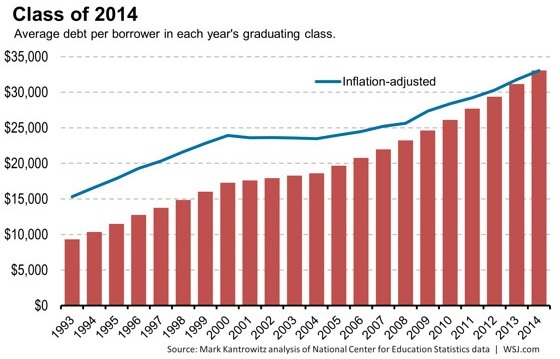 With the rising costs of tuition, student loan debt is becoming a very real issue today. While many students are not graduating with $150k in debt, the average student loan debt is still a staggering $33,000 for each graduating student, and the average just continues to rise with each passing year.
For working professionals, $33,000 may not sound like that much, but consider the these costs when the average graduating student earns only $44,828 in their first year on the job. Paying rent, food, insurance, and transportation is hard enough without tacking on an addition $400 student loan payment each month.
The Impact of the Rising Student Loan Debt
Without even studying the trends or reading the reports, I have seen first-hand the impacts that the rising student loan debts are having on college grads today.
1) Debt Acceptance
This simple shift in perception is changing everything. When I was in college, many of us had debt sure, but we were all still trying to fight it. We worked jobs at night and on the weekends and put every extra penny we had toward our educational expense so we could keep our debts at a minimum.
Today, students go into college assuming that they’ll leave with mountains of debt. With this perception shift into “debt acceptance”, students are no longer scouring the neighborhood for jobs and could really care less if they put money toward their debts while they’re still in school. Many simply assume that they’ll be making bank once they graduate and get their fancy new job and can take care of their debts then. Oh, if they only knew how much this debt will affect them in the future…
2) Getting Chummy with the Parents, Take Two
After graduating with massive debts, new grads are coming to the realization that jobs aren’t all that easy to get. And, even if they can find a job, their loan payments are crippling their independence. With the huge payments that they need to make each month, many new graduates are finding themselves moving back in with mom and dad. It certainly isn’t life as they planned it, but it’s the direct result of taking on too much debt while in college.
Keep in mind that this action not only hurts the young adults and their freedoms, it’s hurting mom and dad as well! The additional stress and expense is likely keeping them from socking the amount of money away that they’ll need for their retirement.
3) A Lonely Retirement Fund
We just mentioned that mom and dad’s retirement fund might be hindered by the new grad’s student loan overage, but it’s killing their own retirement account as well! The most important time to start investing is in those early years and if your student loan costs are through the roof, then you probably won’t be jumping at the opportunity to take money out of your check and put it into your company 401(k). This will likely cost you hundreds of thousands of dollars in the long run.
4) The Downward Spiral of America
As I see it, this increased student loan debt issue is not only affecting us in the current moment, but it is hurting us exponentially in the future. This rising trend means parents aren’t able to fund their retirement fund properly, which means fewer dollars are passed onto their children when they die. Those kids’ retirement funds look even worse because they didn’t start them until they reached their late 30’s. With little-to-no inheritance, they will be looking to the government to fund their retirement, but as many of us know, Social Security likely won’t even exist 20 years from now.
It’s not a cheery picture, but it is very likely that our great country is heading down the hole in a hurry.
How about you all? Is Derek wrong? What is your opinion on the effect of student loans on our nation’s future?
Share your experiences by commenting below!

5 Ways To Save On College Expenses

 The following is a post by MPFJ staff writer, Derek Sall. Derek is the owner of the blog, LifeAndMyFinances.com, where he teaches people how to get out of debt, save money, and become wealthy.
As college prices continue to rise, students really need to focus on keeping costs down so that they don’t owe back monster loan amounts when they graduate. The fewer loans the student can get away with, the better they typically fair in life.
So what are some quality ways that students can save on their college expenses?
1) Live at Home
Many college students balk at the thought of living at home. According to them, “College is about independence and learning how to live on your own.” Well, somewhat, yes. But, if you talk to many grads that are struggling to pay back their student loans, their typical advice is to “live with your parents as long as you can.”
Living at home is not all bad. Most of the days you will be on the college campus anyway, and if you want the “college experience” you can always visit your friends that are living on campus. By avoiding the dorm life, you can save upwards of $10,000 per year! Over the course of four years, that’s $40,000! That’s a pretty huge savings if you ask me. Well worth the sacrifice.
2) Do Without the Car
The next largest expense when you’re at school is that car you’re driving around. You have to insure it, put gas in it, and pay for all the repairs that are inevitable. Often times, even if you own the car outright, you can spend $400 or more per month.
If you can get by with a bicycle, do it. Bum rides from your friends (you can throw them a couple bucks here and there) and stop taking senseless trips off campus. The savings will be quite noticeable.
3) Don’t Buy the Textbooks
Many colleges are still requiring you to buy the textbooks for your classes, but often times the professors cover everything that’s necessary anyway, which means that you could easily do without it. If you are required to answer questions at the end of each chapter, find the book in the campus library and make a free copy of those pages. Either that, or just borrow the book from your friend. By avoiding these purchases, you can save $500 or more per semester.
4) Keep Applying for those Scholarships
Quite a few students apply for scholarships before their freshman year, but then don’t bother to search out scholarships after that. There are so many funds that are designated for sophomores, juniors, and seniors that you should make a point to continue applying! A thousand dollars here and there can really help out a ton in the grand scheme of things. You’ll be glad that you got some of these scholarships when it comes time to pay for your student loans.
5) Learn to Buy Cheap Food
Believe it or not, pizza is really not all that cheap. If you are spending $10 on a pizza and devouring it in one or two sittings, then you are still spending $5-10 per meal! Instead of ordering pizza from the local restaurant, buy some cheap foods from the grocery stores – items like bread, tuna, eggs, pasta, rice, canned beans and corn, etc. Also, keep your eyes peeled for functions around campus that offer free food. After all, you can’t beat free.
How about you all? What other ways can you think of to save on college expenses?
Share your experiences by commenting below!
***Photo courtesy of https://www.flickr.com/photos/smemon/5188351708/in/

Why Your Debt Is Costing You More Than Money

 The following is a guest post by Richard, who blogs about his personal experiences of getting out of debt, saving money and gaining financial freedom over at Frugality Magazine. Enjoy!
As someone who has recently succeeded at paying off all my consumer debt I recently spent some time considering how debt has affected my life – and what changes I expect now that I’m free from the shackles of unpaid debt and all the negatives that come with it.
As it turns out, debt robs you of far more than the money we all think about. We know that once you take on debt, you then have obligations to repay it. You’re borrowing from your future self and reducing your freedom because you’ll not only need to pay back the principle that you borrowed but also the interest on top of that.
But what else does debt cost you?
5 Things I Personally Missed Out On Because of My Debt
Here are just a few of the things I realized my debt cost me – over and above the obvious financial constraints…
Sleep
When you’re drowning in debt, wondering if you’ll ever dig your way out and in some extreme circumstances even wondering how you’ll meet your minimum payments, it’s not surprising that a few sleepless nights can be had worrying about the situation.
But there’s more.
In my own situation, I opted for a “short term pain for long term gain” mindset in order to repay my debt as quickly as possible. In order to do this I landed the best paid job I could find – irrespective of any other factor (working hours, job satisfaction etc.).
I ended up working 50+ hours a week, which included shifts, which essentially meant I could either choose sleep or spending time with my friends and family with the few remaining hours I had each week.
And while I tried to find the best balance I could, a “normal” nights sleep weighed in at between 5 and 6 hours. Not healthy and certainly nowhere near as much as I need to feel refreshed and rejuvenated each day.
Sadly, I’m now so used to getting up at 4 am for work, even on my days off or while on vacation I still find myself waking up at a similar time.
Birthday Parties
I have a number of nieces and nephews of school age or younger. Which means there are birthday parties going on all the time. And while I get invites, they’re often last minute. Which means I haven’t got time to request the specific day off work.
So I miss out. I’m resigned to seeing all the photos on Facebook and hearing about the party second-hand from the family members who attended. While I don’t enjoy my job at the best of times, it’s hardest when I know I’m missing out on a big family get-together.
Vacations
Vacations cost money. Money that could arguably be better put into debt repayments. So while my girlfriend and I had a number of lovely days out, over the last few years we’ve avoided the temptation of taking off for foreign climates and instead put our hard-earned cash into paying down our debt.
Surprisingly, while I love to travel, this hasn’t been too painful. And now that the debt is repaid, there’s nothing to stop us jetting off the the sun this year if we so choose. And to do so without any feeling of guilt 😉
My Dream Job
When I had made the decision to land a new job and get serious about my debt I was actually offered two different positions. There was the highly paid yet life-sucking position I took and then there was the alternative; in many ways my dream job.
Relaxed, enjoyable, reasonable hours, based around my passions and with loads of opportunity for personal growth and fulfillment. Except it paid barely more than half of the alternative.
If I’d been debt free I’d have jumped at the chance – I could easily have lived on the salary and would be doing something I love for a living. But, my debt repayments took priority, I (politely) turned down the dream job and instead went after the money.
A mistake? Who knows. Hopefully other opportunities will arise. Now my debt is paid off and my monthly expenses have dropped like a stone, I have far more options available and far more flexibility in my career.
I’m sorry to have missed the job, but I’m more glad I paid off my debt and bought back my freedom.
A House In The Countryside
Real estate is expensive – even more so in the UK (where I live) than the States. The prices we pay – particularly as a percentage of the average salary – would make your eyes water.
So in another attempt to keep costs down and snowball all available funds into debt repayments we opted for a low-cost home in the middle of the town I work in. It’s acceptable, but it’s not what we want long term.
We’ve found properties we like online and in newspapers but the additional cost of a “nice” home has kept us from making the transition. We’ve had to say no to the home in the countryside with the beautiful garden that we want.
Has It All Been Worth It?
You might be thinking by now that I’m a bit depressed looking at all the extra things that my debt has cost me. And in a way it’s a bit sad. But it was also temporary. And now I’m in a better financial situation than most of my friends with their nicer houses, fancy cars and piles of debt.
I’ve spent 4 years making compromises so that I don’t have to make any after that. Has it been easy? No. Would I recommend it to others? That depends. Am I glad I did it? Yes, actually I am.
I’m not proud of the things I’ve given up/missed out on, but it feels like I’m entering a new era of my life – free of the burden of debt. Where I’m free to dream about the future without needing to factor in any kind of debt.
In all, I’m pleased I made those compromises because the end result will be far better.
What have you missed out on because of your debt? What costs have you found to debt besides the obvious financial ones?
Please leave your experiences in the comments below!
***Photo courtesy of https://c1.staticflickr.com/9/8094/8456188296_375a94bc19.jpg

5 Steps To Get Out Of Debt Fast

 The following is a post by MPFJ staff writer, Derek Sall. Derek is the owner of the blog, LifeAndMyFinances.com, where he teaches people how to get out of debt, save money, and become wealthy.
Are you current in debt?
Do you consistently make payments on your student loans? Your car? Your furniture? Does it ever just feel like all of your money that comes in just immediately goes out again? If you are sick and tired of this phenomenon, then it’s probably about time that you get out of debt. Fortunately for you, I have the five steps that will get you out of debt fast.
1) Commit
I once heard a simple riddle about two frogs that resonated with me;
“Two frogs are sitting on a lily pad. One decided to jump off. How many frogs are left on the lily pad?”
Well, the answer is one of course…or is it? Just because the frog decided that he was going to jump off does not mean that he actually jumped off from that lily pad. So, quite likely there are still two frogs left on that pad.
The same is true for many of us as well. We decide to do something, and we really mean it, but quite often that task just never gets accomplished. In order to get yourself out of debt, you are going to need to commit yourself to getting out 100%. This alone will not get you out of debt fast though. There are still four other steps!
2) Find a Friend
While there are some truly stubborn individuals that have escaped debt without partnering up with anyone else, it is definitely easier to trudge through this journey with a like-minded individual. This could be your friend, your parents, your brother or sister; anyone that has been talking about getting out of the debt mess they are in. It can be difficult to find someone that will truly commit, but at the very least it will help you get started on your debt free journey.
3) Lower Your Expenses
Alright, now that you are committed and most likely have an accountability partner, it’s time to reduce your expenses so that you actually have a few bucks at the end of the month to put toward all of those debts!
The best place to start is by looking at your last few months of expenses (this should be easy to find through your banking transactions) and then creating a list with two columns, “Wants” and “Needs”. A need is something like heat, food, clothing, and your house payment. A want (that you are already paying for) is something like cable TV, cell phone service, lawn mowing service, eating at restaurants, vacations, and $100 haircuts.
Now, just because an item is listed in the “want” category doesn’t mean that you have to get rid of it. That is up to you to decide.
In addition to the list, you should also circle the items that you believe are costing you more money than they should. For instance, a car might be a necessity for you, but you don’t really need that brand new leased car that is sitting in your driveway. You might be able to get away with an older model Honda that still gets the job done.
Do your best to remove the unnecessary expenses and reduce the necessary ones.
4) Increase Your Income
This is a biggie. Yes, reducing your expenses does help tremendously, but there is always a limit that you are going to reach where you just can’t possibly save any more money. With income though, the sky is the limit.
To increase your income, you could find a part-time job, ask for a raise, or you could start a business of your own on the side. I decided to start a side gig three years ago and have earned over $40,000 with it. I was able to pay off all of my consumer debt and am now working to pay off my home loan!
5) Reward Yourself Along the Way
Paying off debt can be quite exciting at first, but after a while, putting an extra $300 toward a $35,000 debt just loses its luster. Sometimes it seems like your debt will never go away! In order to keep your hopes up and to remind yourself that you are making progress, it is important to set up little goals (with rewards) along the way.
When I was first starting to pay off my debts, I really wanted a Detroit Tigers baseball cap (the nice fitted ones, not the dufey looking ones with the strap) so I built it into my goals. I had $20,000 worth of debt and I told myself that if I would get this debt down to $18,000 by a certain date, then I would buy myself that hat! Well, long story short, I hit the goal and still have the hat today. It rejuvenated my spirits and made me want to keep paying down that debt to the next goal!
How about you all? Are you ready to pay off your debt fast?
Share your experiences by commenting below!
***Photo courtesy of http://upload.wikimedia.org/wikipedia/commons/c/c2/Running_Dachshund_at_the_beach.jpg
What You Need To Know About Nonprofit Debt Relief Providers

 The following post is by MPFJ staff writer Travis. Travis is a customer blogger for CareOne Debt Relief Services, and also appears weekly at Enemy of Debt. Travis candidly shares his personal journey to pay off $109,000 of credit card debt and the tips he’s learned along the way. As a father and husband he provides a unique perspective on balancing debt, finances, and family.
Struggling with debt is a very stressful. I can attest to that, as I’ve lived through it.
Deciding to take a step forward and get help is extremely difficult, and knowing where to get help from can be confusing. Commercials for debt relief providers can be heard on the radio, seen on TV, and pop up at any time when surfing the internet.
There are seemingly countless debt relief providers willing to help people get out of debt.
People looking for a way out of their financial problems can be vulnerable because they are desperate to do anything to improve their situation and get their life back on track. Not only could they easily fall victim to a scam, but they could also enroll into a debt consolidation program based upon misinformation.
One of the most prevalent pieces of misinformation is that nonprofit debt relief companies will serve you better than companies that are for profit. Here are some of the more common myths associated with nonprofit debt relief providers:
- Nonprofit Debt Relief Providers Charge Less: The fee structure determining what debt relief companies can charge are generally dictated by individual states. They are mostly based upon the amount of debt owed, or the number of accounts enrolled in a debt relief program. When compared against each other, nonprofit and for profit debt consolidation providers charge almost identical fees to customers.
- Nonprofit Debt Relief Providers Are Charities : Many people equate nonprofit with being a charity, which is not true. Nonprofit only refers to a company’s tax reporting status. If they are able to meet the qualifications to be 501(c)(3) certified, they are nonprofit.
- Nonprofit Debt Relief Providers Don’t Make Any Money: Being nonprofit certified does not mean they don’t make money. What it means is that they use the proceeds of doing businesses for other means such as increasing salaries of their employees, or providing additional services for their customers.
- Nonprofit Debt Relief Providers Cannot Be Scams : Being able to meet the IRS’s guidelines to be labeled as nonprofit says nothing about the integrity of the people running the company or their ability to scam vulnerable people out of their money.
These statements expose commonly held myths regarding nonprofit debt relief providers, yet we continue to have large numbers of providers get certified as nonprofit, and make sure potential customers know it.
Why? There are several advantages to being certified as nonprofit.
- Attract Customers : The above myths continue be perpetuated and believed by consumers. Debt relief providers know the positive connotation associated with the term nonprofit, and use it to their advantage to appear more attractive to potential customers.
- Some States Require It : Some states require a debt relief company to have nonprofit status to operate in their state. Lawmakers seem to believe the very misguided assumptions listed above assuming that having a nonprofit status somehow protects consumers from having their money taken away by a crooked company. For profit debt relief providers have been trying for years to change these laws.
- Tax Exceptions : Nonprofit companies receive tax except status, which gives them tax breaks from the IRS as well as from many states.
- Fair Share Payments from Creditors : When a person falls upon hard financial times, there’s a good chance that they may just stop paying creditors and eventually declare bankruptcy leaving creditors holding balances that will never be paid. Getting some of their money is better than none, so creditors give a kick back to debt consolidation companies for each payment made to them through a debt consolidation program. The amount used to be in the neighborhood of 15%, however in recent years this amount has been reduced to the 3 to 4% range. This kick back is called a fair share payment, and is made in the form of a contribution to a “charitable organization,” ie a nonprofit debt relief company.
Fair share payments are a huge point of contention within the debt relief industry. Many industry experts believe that a debt relief provider getting a kick back from the creditors represents a conflict of interest. They fear that fair share payments could result in debt relief providers steering customers towards debt consolidation instead of another solution (such as debt settlement or bankruptcy) that may be better for a customer’s unique circumstances. This point continues to be debated between the parties involved, as with the government agencies that regulate them.
Nonprofit debt relief providers aren’t inherently any worse, or better than their for profit equivalents. The point is that their nonprofit/for profit status shouldn’t heavily way into your decision as to what provider to use.
Here are a few things that do matter when deciding which debt relief provider to use:
Fees: Find out what fees they charge, and how much they are. This will vary a little from state to state, so ensure you tell them what state you reside in. Many debt relief providers will charge a one time administration setup fee, and then a monthly program fee.
24 Access to Data: You should be able access information about your program at any time. This information should include (but not be limited to):
- Your accounts enrolled in the program
- How much you are paying
- Payment history
- Estimated time until completion
Better Business Bureau Rating : If a company has a bad rating with the BBB, it’s a definite red flag.
Better Business Bureau Complaints: You should not only investigate how many complaints they have had in the last year, but just as important is how many they have successfully resolved. There will always be some amount of people that have a bad experience, even more so with debt relief. But it’s a good sign if the provider is successfully resolving their complaints.
Testimonials: If you know someone that has used a debt relief provider, ask them about their experience. Nothing is more valuable than first hand testimonials. Search the internet, and even check the provider’s site to see if they have an online forum or community. Spend time reading what their customers are saying about them. There will always be spectacular reviews, as well as the horrible experiences. Read enough reviews to get a feel for what the overall “voice” is saying about the provider.
The best thing someone can do before starting down any debt relief path is to become as educated as possible. Know what programs are available to you, know what the differences are about the different types of providers, and thoroughly research each provider that you are contemplating using. The important thing to remember is that while they may be in the business of helping people, their primary object is to make money.
How about you readers, have you used a debt relief program? Have you ever heard any of the myths of nonprofit companies?
Image courtesy of Stuart Miles / FreeDigitalPhotos.net
What Do Workout Supplements and Credit Cards Have in Common?

 The following post is by MPFJ staff writer Travis. Travis is a customer blogger for CareOne Debt Relief Services, and also appears weekly at Enemy of Debt. Travis candidly shares his personal journey to pay off $109,000 of credit card debt and the tips he’s learned along the way. As a father and husband he provides a unique perspective on balancing debt, finances, and family.
For over two years, I operated on 4 hours of sleep a night.
I’d collapse into bed at midnight, and roll back out at 4:15am. In sleepy darkness, I’d stumble to the kitchen where I would mix a glass of water with pre-workout supplement powder. Thirty minutes later I’d pull out of the driveway, and feel the very large dose of stimulants kick in as I drove to the gym. By the time I got to my first weight lifting exercise I probably could have scaled the wall if I wanted to. This worked for a long time, but then I started to experience some very undesirable side effects.
A change was needed, so I made the decision to completely quit taking any kind of pre-workout supplement. I expected the workouts to be harder, but I wasn’t ready for how much the lack having my body pumped full of stimulants early in the morning would affect my entire day. All of a sudden it was very hard to get out of bed early in the morning, and I found myself being tired all day. The stimulants had artificially been giving me the energy to push through the day with little sleep. It really shouldn’t have been any surprise that my body eventually began to break down.
I can’t help but notice the parallels between my experience with pre-workout supplements and my financial journey.
For the first thirteen years of marriage, our finances were artificially kept afloat by supplementing our income with credit cards. Eventually, our credit card payments grew so large that we could no longer meet our monthly financial commitments.
A change was needed, so we enrolled in a Debt management Program and quit credit cards. We knew that living within our means for the first time ever was going to be tough, but we had no idea how hard it would really be. Suddenly, we had to cut out of our lifestyle things that we had become accustomed to doing at will such as lavish vacations, leaving for the weekend and staying in hotels, purchasing material items at will, and dining out several times a week.
In both cases, an artificial stimulant was used to keep things moving forward. A huge dose of pre-workout supplements not only gave me the energy to workout, but it also masked the fact that I wasn’t getting enough sleep. A huge dose of funds from credit cards allowed us to spend without limits for years. It allowed us to do whatever we wanted, whenever we wanted. It also masked the long-term damage we were doing to our family’s finances.
With the stimulants removed, we had to start doing things the right way.
I am making a concerted effort to get more sleep. Going to bed a little earlier, and sleeping in a little later. I’m still not getting as much sleep as I probably should, but on most nights I now average about 6 hours of sleep. Research has shown that getting too much sleep can actually be detrimental to your health and that sleeping for between 6.5 and 7.4 hours per night is the perfect amount. I have also learned that sleep debt is a very real condition, much like financial debt. In order to pay off sleep debt, you must sleep more than 7.4 hours per night until you have caught up. Once you have caught up, however, it is best to schedule your sleep for about 7, or in my case, 6 hours per night to reduce your chances of heart disease, diabetes, and stroke. Between the increased sleep and an improved diet, I now naturally have the energy to work out and get through my day. Sometimes, I miss the head spinning buzz that I got from the supplements, but long-term I know this is what’s best for my body.
My wife and I have cut expenses deeper than we had imagined we ever would need to, and have worked very hard to find additional sources of income. Add to that the teamwork we’ve developed in creating and sticking to a budget and our finances have never been in better shape. Sure, we sometimes think of the days where we spent without a care in the world, but we know that we are on the right track for a bright financial future.
We are accomplishing our goals with nothing but our own hard work and determination. It feels right. It feels good.
How about you, readers? Are you surviving financially through artificial means? What are you going to do about it?
***Image courtesy of stockimages / FreeDigitalPhotos.net